Jackson
Rhoads
Randy Rhoads drew it on a scrap of paper. He got about a year with it. A generation of metal kids got the rest.
San Dimas, California, Christmas week 1980. Randy Rhoads, Ozzy Osbourne’s new guitar player, walks into Grover Jackson’s shop with a scrap of paper and a drawing of a V with a shark fin in it. The shape is too sharp for the name on the shop’s guitars. So Grover puts his own name on it.
- Introduced
- 1981
- Type
- Solidbody electric
- Class
- Production
Have a photograph of this guitar? Send a picture
The short version
1979
The polka-dot V
Karl Sandoval finishes Randy a V around the last Quiet Riot shows. It’s the door, not this guitar.
1980
The scrap of paper
Christmas week in San Dimas. Randy brings Grover a drawing.
1981
Concorde
The white pinstriped prototype is finished in February or early March and goes out on the Blizzard of Ozz tour.
1981
Cut down to size
In October the body is trimmed. The black second guitar is completed on 27 December.
1982
19 March
Randy dies, age 25. The unfinished guitars on the bench become the first Jacksons sold to the public.
2026
Full circle
Kirk Hammett plays the signature Rhoads of a guitarist who fell for the shape watching him.
Side A
A1
A scrap of paper, Christmas week
Randy Rhoads already had a V. Karl Sandoval had built him a polka-dot one, finished around the last Quiet Riot shows in 1979. That guitar opened the door. It isn’t this one.
By the end of 1980 Randy was playing for Ozzy Osbourne, and Sandoval had moved on. So in the week before Christmas, Randy walked into Grover Jackson’s shop in San Dimas with a scrap of paper and a drawing of a V with a shark fin swept into it, and Grover took the job.
Keep the timing in mind. He’d get about a year and a bit with what came out of that shop.
A2
Too sharp for Charvel
Grover’s shop built guitars under the Charvel name, mostly bolt-on, Strat-style guitars. This thing was too wild for that badge. So Grover put his own name on the headstock, and drew the pointed headstock to go with it, like an Explorer’s hockey stick made meaner. That’s where the Jackson brand comes from. The very first Jackson guitar was Randy’s.
Tim Wilson built most of it. It was all maple, with the neck running in one piece right through the body. That’s why you can play the top frets without the heel of the neck getting in your hand’s way. The fingerboard went from rounder by the nut to flatter up high, so chords feel natural down low and big bends don’t die out. Randy called the white pinstriped prototype the Concorde, after the airliner he’d flown home from Britain on, and because it looked like one. It may have been slated to be called the Original SIN first, depending who you ask.
It was finished in February or early March 1981, and Randy took it out on the rest of the Blizzard of Ozz tour.
A3
Cut down to size
The Concorde had a problem. It was heavy, and Randy was not a big guy. And fans kept asking him if he’d sawn up a Gibson V.
So in October 1981 they cut the body down and stretched the upper horn out. Mike Shannon built the black second guitar, with sharkfin inlays and the strings anchored through the body, and finished it on 27 December 1981. That lopsided silhouette, one wing longer than the other, is the shape we call a Rhoads.
Worth being straight about this. The guitar most associated with Randy in his lifetime is his yellowed white ’74 Les Paul Custom. Don’t hang the Blizzard of Ozz and Diary of a Madman records on this V. The Concorde was a live guitar on that tour, and the black one shows up in just a handful of photos.
Flip the record · By the numbers
25
Randy’s age when he died, before he could sign off on a production model.
12"–16"
Compound fingerboard radius, there from the first guitar.
60
Concorde replicas made in 2010.
$12,619.56
List price of those replicas. Read the digits as a date. It’s Randy’s birthday, 12/6/1956.
Side B
B1
He never saw the catalog
Randy Rhoads died on 19 March 1982. He was 25.
Jackson had more of the second shape on the bench. Randy never signed off on a production model, so the guitar in the catalog is a tribute more than a true signature. Those unfinished pieces became the first Jacksons ever sold to the public.
Vinnie Vincent was the first professional offered one, and he played it on Kiss tours from 1982 to 1984. After that the shape found its people, mostly ones who played very loud.
B2
Handed down
In 1986 Metallica made Master of Puppets, and by one account Kirk Hammett’s Rhoads provided the bulk of the tones on it. That record put the shape in front of an awful lot of people.
Alexi Laiho of Children of Bodom got a custom one in 2001. Talking about his guitar years later, he kept it simple: “Yeah, it’s a Randy Rhoads shape.”
Christian Andreu of Gojira was fifteen when he saw Hammett with a Rhoads. He called it “the most metal thing I’d ever seen.” Now Andreu has his own signature Rhoads. And on a stadium stage in London in 2026, Kirk Hammett played one.
A kid saw Kirk with a Rhoads, grew up, got a signature Rhoads of his own, and then Kirk put one in his touring rig.
Randy had his guitar for barely more than a year. Every Rhoads since, down to the one Jackson builds in Corona today, has been passed along from the drawing he carried into a shop in San Dimas to kids he never got to meet.
Put this on
You’ve read about it. Now hear it. Here’s what this guitar sounds like, and what to listen for.
Master of Puppets
Kirk Hammett’s Rhoads is behind the bulk of the tones on this album, by one account. Listen for Kirk’s leads.
Find it on YouTube (opens in a new tab)Seek & Destroy (live at London Stadium)
Kirk playing Christian Andreu’s signature Rhoads. Andreu fell for the shape after seeing Kirk with one.
Watch it on YouTube (opens in a new tab)
The cast
The people, and the specific guitars, that made the legend.
1981
Randy Rhoads
Concorde, then the black second guitar
Designed the shape and played the Concorde on the rest of the Blizzard of Ozz tour. His best-known guitar in his lifetime was still a Les Paul Custom.
1981
Tim Wilson
Builder, the Concorde
Built most of the first guitar, all maple with the neck running right through the body.
1981
Mike Shannon
Builder, the black second guitar
Built the trimmed-down version that became the Rhoads shape.
1982
Vinnie Vincent
An early Rhoads
The first pro offered one after Randy died. Played it on Kiss tours from 1982 to 1984.
1986
Kirk Hammett
Rhoads
His Rhoads carried most of the tones on Master of Puppets.
2026
Christian Andreu
Signature Rhoads
Gojira’s guitarist saw Kirk on a Rhoads at fifteen. Now he has his own.
Liner notes
Specs, construction, rarity, value, and every source we used.
Jackson’s first guitar is Randy’s offset V — neck-through, a pointed six-in-line, not a Soloist superstrat.
- Body
- Solid alder wings on a neck-through maple core; offset Rhoads V
- Neck
- Neck-through 3-piece maple with graphite reinforcement; Jackson Speed Neck; satin color-matched
- Fingerboard
- Rolled ebony, inverted mother-of-pearl sharkfins, 24 jumbo stainless, 12"–16" compound, Luminlay side dots
- Scale
- 25.5" (64.77 cm). Mix flagged.
- Pickups
- Seymour Duncan JB TB-4 (bridge) and ’59 SH-1N (neck), HH
- Hardware
- Floyd Rose 1500 double-locking trem; Gotoh MG-T locking tuners; black; reverse pointed 6-in-line
- Electronics
- Volume, tone, 3-way blade
- Finish
- Satin Black, Matte Army Drab; Snow White (gloss on the factory Snow White page)
- Nut
- Floyd Rose 1500 locking, 1.6875" (42.86 mm)
Open the full research fileConstruction details, the complete player record, production numbers, dated value estimates, and sources
Current typical = American Series Rhoads RR24 (USA, Corona; jackson.com, 1 September 2026). Catalog $2,849.99. Foam-core case included. Living USA flagship Rhoads — not JS, not Pro Plus, not MJ, not a leftover USA Select RR1. RR24 HT is the Hipshot hardtail sibling on this plate, $2,729.99, not a second slug. Factory scale copy: 25.5" (64.77 cm). Radius also prints millimetres. Mix flagged; no millimetres invented for the scale.
Construction
San Dimas, Christmas week 1980. Randy Rhoads walked into Grover Jackson’s Charvel shop with a scrap of paper and a shark-fin V. He already had a polka-dot V from Karl Sandoval, finished around the last Quiet Riot shows in 1979 (Guitar.com; Louder). That guitar is the door. It is not this one. Sandoval had left. Grover took the job.
The shape was too sharp for Charvel. Grover put his own name on the headstock so the bolt-on shop would not have to wear it. That is the Jackson brand. Guitar.com: Grover also drew the pointed peghead, an Explorer hockey-stick made meaner. Randy nicknamed the white pinstripe prototype Concorde — after the airliner he had flown home from the U.K. on, and because it looked like one (Jackson history; Guitar World). Wikipedia: it was slated The Original SIN first. Keep both names.
Tim Wilson built most of the first guitar. All Pacific Coast maple, neck-through, compound 12"–16" board, a Strat-style trem with a Bill Gerein brass block (Guitar.com). Pickups split: Guitar.com has Seymour Duncan Super Distortion bridge and Jazz neck, brass bezels; Louder has Distortion and Jazz. Keep both. Wilson: finished February or early March 1981. Randy took it on the rest of the Blizzard of Ozz tour.
It was heavy. Randy was small. Fans asked if he had sawn up a Gibson V. In October 1981 they cut the body down and stretched the upper horn. Mike Shannon built the black second guitar. Completed 27 December 1981. Sharkfins. Fixed tail, strings through. That silhouette is the Rhoads.
Randy died 19 March 1982, age 25. Jackson had more of the second shape on the bench. He never signed off on a production model. Louder: the catalog guitar is a tribute, not a true signature. Those unfinished pieces became the first Jacksons sold to the public.
San Dimas RR serials start RR0000 in 1982, RR0001 in 1983 (guitarinside). Custom (bound ebony, sharkfins) versus Student (rosewood, dots) are the same Gibson-style grades as Soloist, not a quality drop. Bridges: Floyd Rose, Kahler, or Tune-o-matic string-through. Rhoads use RR. Soloists use J. Do not date a Rhoads from a J stamp.
Not a Soloist. The Soloist is the 1984 neck-through superstrat — double-cut, Strat layout, jackson-soloist. Kelly, Warrior, King V, and Dinky are other Jackson silhouettes. Do not hang a superstrat or a symmetrical Gibson V on this plate.
Ontario 1986. USA Select RR1 was the long production flagship: alder, maple neck-through, 22 jumbo, Original Floyd or TOM (Wikipedia). Fender newsroom 17 September 2025: American Series RR24 / RR24 HT, Corona, 24 stainless, Floyd 1500 or Hipshot, reverse 6-in-line, JB / ’59. Living USA flagship is that RR24. JS is bolt-on import. Pro Plus is okoume or nyatoh neck-through, Floyd 1000; factory headstock is pointed 6-in-line, not reverse. MJ Japan is a different factory on this name.
Classic vs current: 1981 Concorde — all maple, 22 frets, vintage trem, Distortion / Jazz — against the living Corona RR24: alder wings, 24 stainless, Floyd 1500, JB / ’59, reverse pointed six-in-line.
Players
Do not recruit Soloist users or ESP KH-series as if they were this V. Phil Collen and Scott Ian live on jackson-soloist. Marty Friedman’s KE-1 / MF-1 are Explorer-ish signatures, not a Rhoads.
Randy Rhoads (Ozzy Osbourne). The Concorde is the guitar on the remaining Blizzard of Ozz dates in 1981 (Guitar.com; Jackson history). The black second guitar is in a handful of photos before March 1982. Louder: the guitar most associated with him in his lifetime is the yellowed Alpine White ’74 Les Paul Custom. Do not flatten Blizzard of Ozz or Diary of a Madman to this V.
Vinnie Vincent (Kiss). Wikipedia’s Rhoads page: first professional offered an early Rhoads after Randy’s death; Creatures of the Night and Lick It Up tours 1982–84. Louder names him in the early fondlers. Do not credit the Creatures album tracks to this guitar; session credits on that record are mixed.
Kirk Hammett (Metallica). Guitar.com: the Rhoads “provided the bulk of the tones on the seminal Master of Puppets.” Living signature platform is ESP KH — do not steal KH-series onto this slug. The 2026 London Stadium Seek & Destroy clip is Christian Andreu’s signature Rhoads in Kirk’s hands (Guitar World), not the Puppets guitar.
Alexi Laiho (Children of Bodom). Premier Guitar, 15 May 2013: “Yeah, it’s a Randy Rhoads shape.” Wikipedia: 2001 custom Rhoads L/L with Roope Latvala — alder, neck-through, 24 frets, ebony, Original Floyd, Jackson J-50BC and JE-1000. Later ESP signatures are not this guitar.
Christian Andreu (Gojira). MusicRadar, 25 March 2026: he was fifteen, saw Hammett on a Rhoads, “the most metal thing I’d ever seen.” Living signature is Pro Plus RR24 EVTN6, EverTune F6, one Fishman.
Also known to play (Louder laundry list, last, short): Corey Beaulieu; Phil Campbell; Matthew Tuck. Fender newsroom launch partners Brandon Ellis and Jeff Loomis are current American Series, not named-studio documents here. Phil Demmel’s Demmelition V is a different Jackson.
Rarity
Current American Series, Pro Plus, X, MJ, and JS Rhoads are regular production, not rare. Jackson does not publish yearly Rhoads unit counts. None invented.
guitarinside’s RR ranges date a guitar; they do not count a run. RR0000 is 1982 San Dimas. 1983 is RR0001–RR0294. After spring 1990, only custom Rhoads keep RR; production USA models take U0. Custom versus Student is trim, not a census split.
The 2010 Concorde replica is a labeled limited: 60 examples, $12,619.56 — Randy’s birth date, 12/6/1956 (Guitar World, Nick Bowcott). Not a 1981 census, and not 2026 street.
A Soloist J-serial is a different object. Randy’s Concorde and the black second guitar are unique. They are not a vintage Rhoads.
Value
Informal estimate, 1 September 2026. Not an appraisal.
Ask vs sold labeled. Celebrity lots are not-comps. No invented medians or factory counts. Reverb Price Guide widget did not print a clean band in the static fetch this pass.
New street. Living USA SKU American Series RR24: $2,849.99 (jackson.com, 1 September 2026). Hardtail RR24 HT $2,729.99. Fender newsroom (17 September 2025) listed RR24 $2,849.99–$2,899.99 and HT $2,729.99–$2,779.99 — launch range, same floor on the live carts. Pro Plus RR24 $1,399.99. jackson.com Rhoads collection this pass: X RRX24 $899.99; JS32 $499.99 / product-page Regular $549.99 (mix flagged); JS32T $449.99; MJ RR24MG $3,199.99. JS is bolt-on import street, not this table.
Used modern. American Series used: no clean 2025–26 sold sample isolated. X / Pro / JS used sits under those new streets; don’t invent a midpoint.
Vintage / collectible. Named Reverb asks this pass, not hammers: 1984 San Dimas black RR0742 $14,999; 1984 San Dimas black Custom $19,241.91. Treat as asks. A listing’s “sold for over $100,000” claim is sales copy, not a captured hammer. The 2010 Concorde replica $12,619.56 is a 2010 limited list, not 2026 street. Randy’s own guitars and Kirk’s Puppets Rhoads are unique objects. They are not a vintage Rhoads.
See also
- jackson-soloist — 1984 neck-through superstrat; not this V
- charvel-san-dimas — bolt-on San Dimas superstrat from the same shop; not a Rhoads
- dean-ml — 1977 V-plus-Explorer hybrid; another pointed silhouette, not a Jackson
Sources
- Jackson, American Series Rhoads RR24 — current Corona USA flagship table; $2,849.99; Floyd 1500; JB/’59; reverse 6-in-line
- Jackson, American Series Rhoads RR24 HT — Hipshot hardtail sibling; $2,729.99; TUSQ nut
- Jackson, Pro Plus Series Rhoads RR24 — $1,399.99; okoume/nyatoh; Floyd 1000; Distortion pair
- Jackson, JS Series Rhoads JS32 — bolt-on import; Regular $549.99
- Jackson, Rhoads collection — JS32 $499.99; JS32T $449.99; X RRX24 $899.99; MJ RR24MG $3,199.99; MJ RRT $2,679.99; Pro RR3 $1,369.99
- Jackson History — late 1980 contact; Concorde; Jackson name on the headstock; second guitar as the Rhoads
- Fender newsroom, American Series Rhoads — 17 September 2025; 1980 collaboration; RR24 $2,849.99–$2,899.99; HT $2,729.99–$2,779.99; Ellis / Loomis
- Wikipedia, Jackson Rhoads — period 1981–present; Original SIN / Concorde; 23 December 1980; second prototype; Vinnie Vincent 1982–84; Laiho/Latvala 2001 L/L; USA Select RR1
- guitarinside, Jackson serial numbers — RR vs J vs U0; 1982 RR0000; 1983 RR0001–RR0294
- Guitar World, Nick Bowcott, Concorde — 23 December 1980 napkin; maple neck-through; 2010 replica 60 at $12,619.56
- Guitar.com, A Brief History of Jackson Guitars — 23 December 1980; Wilson February/early March 1981; Super Distortion + Jazz; 27 December 1981 second guitar; Sandoval 1979 polka-dot V
- Louder / Classic Rock, Ed Mitchell — Premier Guitar Grover quote; Les Paul Custom as the lifetime guitar; Concorde MKII 27 December; tribute not a signed-off signature; Vinnie / Beaulieu / Campbell / Tuck
- Guitar.com, Kirk Hammett — Rhoads on Master of Puppets
- Premier Guitar, Alexi Laiho — 15 May 2013; “Randy Rhoads shape”
- MusicRadar, Christian Andreu — 25 March 2026; Hammett as the door; EverTune signature
- Guitar World, Hammett on Andreu’s Rhoads — M72 London Stadium Seek & Destroy
- Reverb, 1984 San Dimas RR0742 — ask $14,999
- Reverb, 1984 San Dimas Custom — ask $19,241.91
Keep digging
Guitars this one gets compared to, confused with, or descended from.
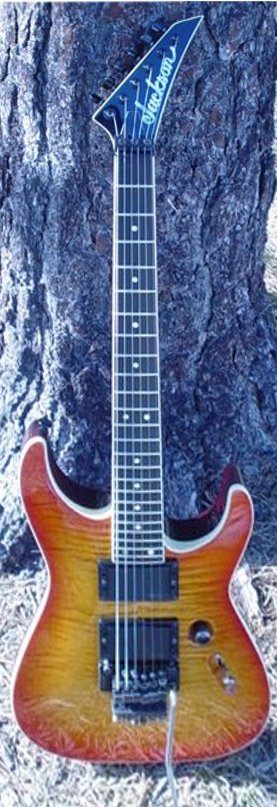
A 1987 Soloist archtop. Photo by Jimshine; perspective correction by GreyCat. Licensed under CC BY-SA 4.0. Via Wikimedia Commons. Jackson
Soloist
1984
Grover Jackson took the Strat shape and ran the maple neck straight through it. Jeff Beck’s was pink.
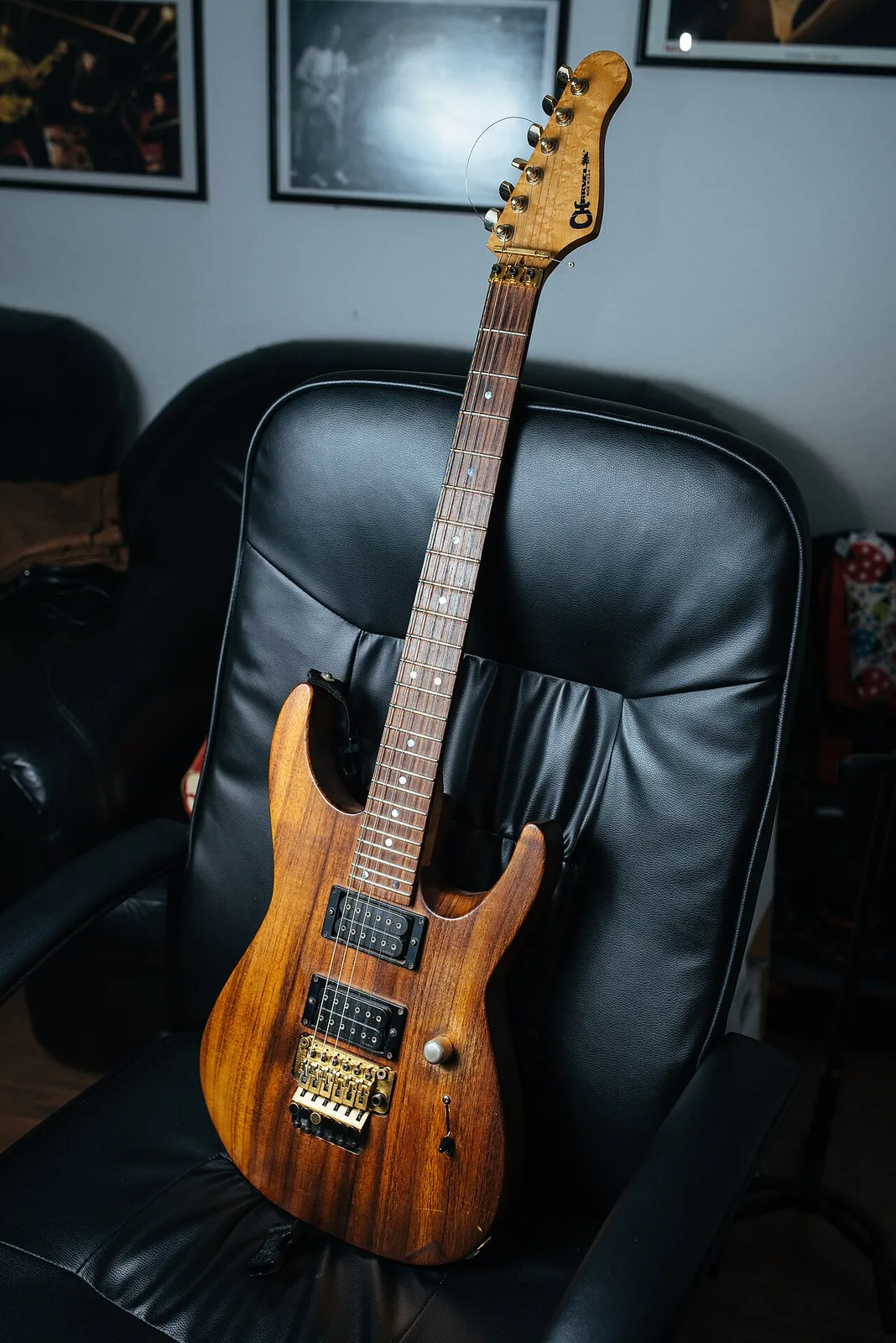
Photo: Nenad Stojkovic / Wikimedia Commons / CC BY 2.0 Charvel
San Dimas
1979
Named for a town, not a star: the place where a repair shop learned to build what players asked for.
- Send a picture
Dean
ML
1977
Half a Flying V, half an Explorer. Then Dimebag Darrell played one with a lightning bolt, and it was his.