Jackson
Kelly
It’s named after a guitarist from an Australian band called Heaven. Marty Friedman is why you know it.
San Dimas, 1983. Jackson already has a pointy V with Randy Rhoads’s name on it. Now a guitarist named Bradford Kelly, from an Australian band called Heaven, orders something else: black with white pinstripes, long in the lower horn, chopped off at the top. The shape gets his name.
- Introduced
- 1983
- Type
- Solidbody electric
- Class
- Production
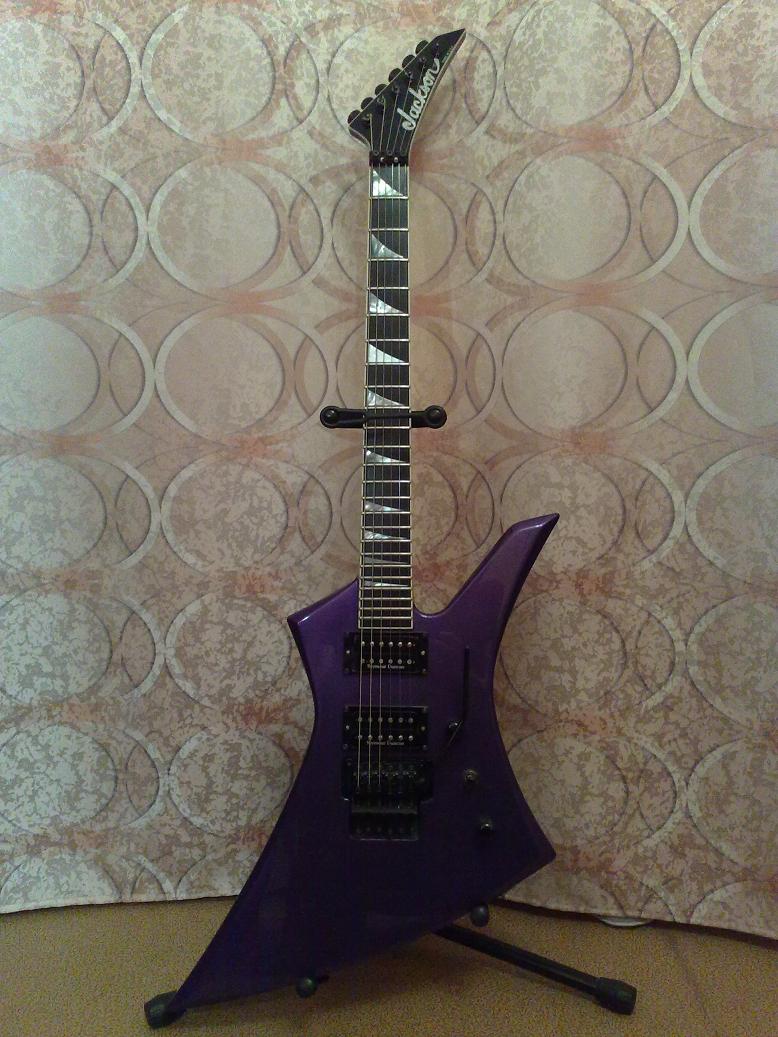
The short version
1983
The first Kelly
Bradford Kelly of Heaven orders it. Some accounts put the shape’s birth in 1982.
1985
Bought in Hawaii
Marty Friedman picks up the Kelly he’ll call
1990
Rust in Peace
Friedman’s first Megadeth album is played on a Jackson Kelly.
2000
Retired
Friedman leaves Megadeth, and
2005
King Kelly
A 25th-anniversary run of 25, based on Bradford’s first guitar.
Side A
A1
A guitarist from a band called Heaven
Most guitars with a person’s name on them belong to that person forever. This one didn’t.
Jackson already had a pointed V, the one Randy Rhoads had drawn. The shop needed another sharp shape that wasn’t that guitar. Bradford Kelly, the guitarist in an Australian band called Heaven, came up with one, either on his own or with Grover Jackson, the way Randy had. He ordered the first example: black with white pinstripes, the neck running right through the body, two Seymour Duncan pickups, and a fixed bridge. It has 22 frets, though some accounts say the early Kellys had 24. It even had cutouts in the body that he’d asked for and most later Kellys don’t.
The date is 1983 or 1982, depending who you ask. Either way, it got his name.
He also ordered a matching guitar for his bandmate Mark Evans, who’d played bass in AC/DC. The two of them turn up with those guitars in Heaven’s video for “Where Angels Fear to Tread.”
A2
Not a V, not an Explorer, not quite
Picture it: a long, pointed lower horn, the top of the body chopped off at an angle, and Jackson’s sharp six-in-a-row headstock. People like to call it a heavily modified Gibson Explorer, and you can see why. The Explorer is an ancestor in the pointy-offset business. But this is a San Dimas guitar with maple running through the middle, and the points are Jackson’s own.
It isn’t a Rhoads either. Same shop, same headstock, same neck-through habit, different outline. The Rhoads is a lopsided V. The Kelly isn’t a V at all.
A3
Bought in Hawaii
Around 1985, a young guitarist named Marty Friedman was living in Hawaii, playing in a band called Hawaii, and he bought a Kelly. It was a black-and-white tiger stripe with two humbuckers and two tone knobs. It came to be known as #2.
When he joined Megadeth, he had it stripped down. It ended up black, with one humbucker, one volume knob, and nothing else. That’s a guitar set up by a player who knows exactly where his hands are going and doesn’t want anything in the way.
He has said himself that Rust in Peace, in 1990, was a Jackson Kelly. The history that came with #2 puts it on Countdown to Extinction in 1992 as well, on two records with his earlier band Cacophony, and on more than a thousand Megadeth shows. He retired it when he left the band in 2000. By then the Kelly had a signature model with his name on it, the KE-1, including a limited run of 100 in 1996.
Flip the record · By the numbers
22
Frets on the very first Kelly. Some accounts give the early ones 24.
1,000+
Megadeth shows Friedman played on his
1985
The year Friedman bought
25
King Kellys made in 2005, modeled on Bradford Kelly’s original.
Side B
B1
The road less crowded
Jeff Loomis, of Nevermore and later Arch Enemy, has his own signature Kelly. His reason for choosing it is the best short review the guitar has ever had:
I knew I wanted to do the Kelly guitar because I know Marty Friedman used it for many years, but I hadn’t seen a lot of guitar players playing it.
A Jackson builder, Mike Shannon, cut the neck right in front of him. Brandon Ellis of the Black Dahlia Murder followed with a signature of his own, based on his Custom Shop Kelly in a finish called Green Crackle. His newer one has 27 frets.
The Kelly you can buy today is simpler than Bradford’s: no cutouts, 24 frets, and a locking trem instead of his fixed bridge.
B2
Whose guitar is it
Bradford’s first Kelly is still around. Jackson refinished it in 2005, the same year it made 25 King Kellys for an anniversary, modeled on that first guitar. So the original shape got its due, and the name on every Kelly since has been his.
But ask why anybody knows the shape, and you get a different name. Jeff Loomis didn’t pick it because of Heaven. He picked it because of Marty Friedman, who carried one through a decade of Megadeth and stripped his down to a single knob.
The model says Kelly. The sound people hear when they picture one, those fast, singing lines on Rust in Peace, belongs to the guy who bought his in Hawaii.
Put this on
You’ve read about it. Now hear it. Here’s what this guitar sounds like, and what to listen for.
Rust in Peace
Friedman has said himself that his guitar on this album was a Jackson Kelly. His lead lines are the reason the shape got famous.
Find it on YouTube (opens in a new tab)
The cast
The people, and the specific guitars, that made the legend.
1983
Bradford Kelly
The first Kelly
The guitarist in Heaven. Drew the shape, alone or with Grover Jackson, and ordered the first one.
1985
Marty Friedman
“#2,” a 1985 Kelly
Bought it in Hawaii, stripped it to one pickup and one knob, and played it through his Megadeth years.
Jeff Loomis
Signature Kelly
Wanted a Kelly because Friedman had played one and hardly anybody else did.
2021
Brandon Ellis
Signature Kelly
The Black Dahlia Murder guitarist’s first signature, based on his Custom Shop Kelly in Green Crackle.
2011
Dan Gargiulo
KE2
Revocation’s guitarist took a USA Kelly on the road.
Liner notes
Specs, construction, rarity, value, and every source we used.
Jackson’s pointed offset after the Rhoads V — Kelly, not a Soloist superstrat, and not a Rhoads.
- Body
- Poplar; offset Kelly
- Neck
- Neck-through maple with graphite reinforcement and scarf joint; gloss color-matched
- Fingerboard
- Laurel, pearloid sharkfins, 24 jumbo, 12"–16" compound (304.8 mm to 406.4 mm)
- Scale
- 25.5" (64.77 cm). Mix flagged.
- Pickups
- Jackson high-output humbuckers, HH
- Hardware
- Floyd Rose Special double-locking trem (recessed); Jackson sealed die-cast; pointed 6-in-line. Gold hardware on Gloss Black; black on the metallics
- Electronics
- Volume, tone, 3-way toggle
- Finish
- Gloss Black, Lime Green Metallic, Deep Purple Metallic, Racing Red
- Nut
- Floyd Rose Special locking, 1.6875" (42.86 mm)
Open the full research fileConstruction details, the complete player record, production numbers, dated value estimates, and sources
Current typical = X Series Kelly KEX (jackson.com, 8 September 2026). Catalog $799.99. Living neck-through production Kelly — not JS bolt-on, not leftover USA Select KE2, not a signature. Factory scale copy: 25.5" (64.77 cm) on Gloss Black; Racing Red prints 25.5" (648 mm). Mix flagged; no millimetres invented for the scale. JS32 / JS32T are the bolt-on volume siblings on this plate, $469.99, not a second slug. No American Series Kelly this pass.
Construction
San Dimas already had a V. Randy’s offset Concorde had put Jackson on the headstock. The shop still needed another pointed silhouette that was not that guitar.
Bradford Kelly of the Australian band Heaven drew one. Wikipedia: designed by and named after him. guitarguitar: by himself or with Grover, the way Randy had. Music Zoo: he ordered the first example. Their guitar is serial J0029, black with white pinstripes, neck-through, ebony, 22 frets, two Seymour Duncans, master volume, 3-way, a fixed bridge with fine tuners. They date it 1983 and call it the first Kelly. 22 frets on that object. guitarguitar: original Kellys sported 24. Keep both. The matching Tele he ordered for bandmate Mark Evans (ex-AC/DC) is J0025. Keep 1983. Wikipedia’s infobox prints 1982–present; guitarguitar says the shape has not changed since its 1982 inception. Guitar World (Jonathan Horsley, 22 December 2020): “In 1983, Jackson launched the Kelly.” This plate starts in 1983. Keep 1982.
Not a Rhoads. Rhoads is the offset V — jackson-rhoads. Kelly is a pointed offset with a long lower horn and a chopped upper bout. Same factory, same pointed six-in-line, same neck-through habit. Different outline. Do not hang a flying-V on this plate.
Not a Soloist. Soloist is the 1984 neck-through superstrat — double-cut, Strat layout, jackson-soloist. Kelly is not a Dinky either. Warrior, King V, and the Kelly Bird bass are other Jackson silhouettes. The bass is a bass.
Not a Gibson Explorer. No Gibson SKU. Wikipedia calls Kelly “a heavily modified version of the Gibson Explorer.” That is the mash. Kalamazoo’s Explorer is 1958, korina, then mahogany reissue. This is San Dimas, 1983, maple through the middle, Jackson’s own points. Ancestor in the pointed-offset job. Not that guitar. Ibanez Destroyer is a 1970s Explorer-shaped copy. Not this one either.
The first Kelly is larger and cut out. Music Zoo: Bradford requested those cutouts; production Kellys usually do not have them. That first guitar is what the 2005 25th-anniversary King Kelly was based on. Production Kelly is the simplified living shape. Do not flatten King Kelly onto every KE.
Early customs share the J serials with Soloist, King V, and Concert Bass (guitarinside: Kelly is in that J list). Rhoads use RR. Do not date a Kelly from an RR stamp. guitarinside’s table: San Dimas through 1986, Ontario from 1987. J0029 sits in the 1983 J0001–J0034 band. USA Select KE2 was the long production flagship: alder wings, quartersawn maple neck-through, bound ebony, 24 jumbo, Original Floyd, Duncan JB TB-4 / Jazz SH-2N. jackson.com still lists it at $4,199.99, sold out this pass — leftover USA Select, not a living American Series. There is no American Series Kelly. Fender bought Jackson in 2002 (Guitar World).
Marty Friedman’s KE-1 is the 1990s signature on this shape: typically one humbucker, one volume. Wikipedia: that SKU, and the Professional series, left the catalog. Living line is import and signature: JS bolt-on poplar; X neck-through poplar, Floyd Special; Pro Jeff Loomis (basswood / sandblasted ash, Blackouts, Floyd 1500); Pro / Pro Plus Brandon Ellis. Classic vs current: 1983 J0029 — 22 frets, cutouts, fixed tail, two Duncans — against the living X KEX: poplar, 24 jumbo, Floyd Special, Jackson humbuckers, no cutouts.
Players
Do not recruit Rhoads V users, Soloist users, or Adrian Smith’s San Dimas Dinky as if they were this offset. Dave Mustaine is King V. Phil Collen and Scott Ian live on jackson-soloist. James Hetfield’s Explorers are Gibson mahogany and ESP copies, not a Kelly.
Bradford Kelly (Heaven). The namesake. Music Zoo: J0029 is his, and it is in the video for “Where Angels Fear to Tread” with Evans’s matching Tele. Album-to-guitar credits for the LP are unpublished here. The video is the fact. The guitar was refinished at Jackson in 2005. Unique object.
Marty Friedman (Megadeth / Cacophony). The guitar this plate is known for. He told his own site (2002 FAQ): Rust in Peace (1990) was a Jackson Kelly, later the blueprint for the KE-1. Guitar Player (15 August 2024) on the Reverb listing for his 1985 USA Kelly nicknamed #2: bought in Hawaii around 1985 while in the band Hawaii; originally a black-and-white tiger stripe with two humbuckers and two tones; converted to a single humbucker and one volume when he joined Megadeth; also on Countdown to Extinction (1992), two Cacophony records, and more than 1,000 Megadeth shows. Listing copy calls it one of the first 500 Jacksons. That is the listing, not a factory census. He retired it when he left Megadeth in 2000. The KE-1 is the signature that followed, including a 1996 limited KE1-MF run of 100 (Reverb listings). His FAQ is the studio credit for Rust in Peace.
Jeff Loomis (Nevermore / Arch Enemy). Jackson blog, 4 September 2019: “I knew I wanted to do the Kelly guitar because I know Marty Friedman used it for many years, but I hadn’t seen a lot of guitar players playing it.” USA signature first, then the living Pro Series Ash. Mike Shannon cut the neck in front of him.
Brandon Ellis (The Black Dahlia Murder). Jackson blog, 2 April 2021: first signature, based on his Custom Shop Kelly, Green Crackle, one Seymour Duncan Parallel Axis, Floyd 1000. Guitar.com, 1 July 2026: Pro Plus KE27 — 27 stainless, 25.1" scale, Gotoh GE1996T, Dyad Parallel Axis. Ellis: “this one features meaningful customisations to virtually every aspect.” That SKU is a signature, not this table.
Also known to play stays short. Dan Gargiulo (Revocation): MetalSucks, 21 June 2011 — “I recently began using a Jackson KE2 live.” Wikipedia’s Kelly page also lists Adrian Smith. His living Jackson is a San Dimas Dinky. Do not steal it.
Rarity
Current JS, X, Pro, and Pro Plus Kellys are regular production, not rare. Jackson does not publish yearly Kelly unit counts. None invented.
J serials date a guitar; they do not count a run. J0029 is the first named object. Early San Dimas customs with the original cutouts are finite because that was a custom shop, not a numbered King Kelly cap. The 2005 25th-anniversary King Kelly is a labeled limited: 25 examples (Next Big Thing Guitars). Not a 1983 census, and not 2026 street.
USA Select KE2: out of regular production as a living flagship; leftover carts still exist. A Rhoads RR-serial V is a different object. Bradford’s J0029 and Friedman’s #2 are unique. They are not a vintage Kelly.
Value
Informal estimate, 8 September 2026. Not an appraisal.
Ask vs sold labeled. Celebrity lots are not-comps. No invented medians or factory counts. Reverb Price Guide on early San Dimas Kelly did not print a clean band in the static fetch this pass.
New street. Living neck-through SKU X Series KEX: $799.99 (jackson.com, 8 September 2026). JS32 and hardtail JS32T: $469.99. Pro Series Signature Jeff Loomis Kelly Ash: $1,699.99. Pro Series Signature Brandon Ellis Kelly: $1,779.99 (sold out this pass). Pro Plus KE27: $2,199.99. Leftover USA Select KE2: $4,199.99 (jackson.com; Musician’s Friend still listing) — not a current factory flagship, and not this table. JS is bolt-on import street.
Used modern. Reverb Price Guide on Pro Series KE3 (2003–2011): estimated used $454–$1,083 (98 orders, Good to Mint). X / JS / Pro used sits under those new streets; don’t invent a midpoint for KEX.
Vintage / collectible. Named Reverb figures this pass: 1984 San Dimas Kelly J0331 ask $8,476.60 (listing ended); 1984 San Dimas King Kelly J0097 sold listing $5,447.75. Treat the first as an ask. The 2005 King Kelly limited is a 2005 object; Next Big Thing ask $3,899. Friedman’s #2 listed at $125,000 (Guitar Player, 2024). That is one artist-owned guitar. Not a comp. No Burst tier.
See also
- jackson-rhoads — the offset V that started the Jackson brand; not a Kelly
- jackson-soloist — 1984 neck-through superstrat; not this offset
- ibanez-destroyer — 1970s Explorer-shaped copy; not Jackson’s Kelly
Sources
- Jackson, X Series Kelly KEX — current neck-through production table; $799.99; Floyd Special; poplar; 25.5" (64.77 cm) / (648 mm) mix
- Jackson, JS Series Kelly JS32 — bolt-on volume; $469.99; poplar; Floyd licensed
- Jackson, JS Series Kelly JS32T — hardtail sibling; $469.99
- Jackson, USA Select Kelly KE2 — leftover USA Select; $4,199.99 sold out; alder; Original Floyd; JB / Jazz
- Jackson, Pro Series Signature Jeff Loomis Kelly Ash — $1,699.99; basswood / sandblasted ash; Blackouts; Floyd 1500
- Jackson, Pro Series Signature Brandon Ellis Kelly — $1,779.99; Green Crackle; sold out this pass
- Jackson, Pro Plus Series Signature Brandon Ellis Kelly KE27 — $2,199.99; 27 fret; 25.1" scale
- Jackson History — Kelly among early/mid-1980s models with King V, Soloist, Dinky
- guitarinside, Jackson serial numbers — RR vs J; Kelly listed with Soloist/King V on J serials; 1983 J0001–J0034; San Dimas through 1986, Ontario from 1987
- Wikipedia, Jackson Kelly — period 1982–present; Bradford Kelly / Heaven; Friedman popularized; KE1 and Professional series dropped; Explorer mash in the lead
- The Music Zoo, 1983 “Heaven” Kelly J0029 — first Kelly; Bradford Kelly of Heaven; 22 frets; fixed tail; King Kelly 25th based on it; Where Angels Fear to Tread video; 2005 refinish
- The Music Zoo, 1983 “Heaven” Tele J0025 — matching Tele for Mark Evans
- Guitar World, Jonathan Horsley, The history of Jackson Guitars — 22 December 2020; Kelly launched 1983; Friedman most-famous player; Fender acquired 2002
- guitarguitar, The Jackson Kelly — 14 February 2025; Bradford Kelly / Heaven; 1982 inception; original 24-fret neck-through; JS32 vs X KEX
- Marty Friedman official FAQ — 8 August 2002; Rust in Peace on a Jackson Kelly, later the KE-1 blueprint
- Guitar Player, Phil Weller — 15 August 2024; 1985 #2; Hawaii 1985; tiger stripe then black single-humbucker; Countdown; $125,000 ask; listing “first 500”
- Guitar.com, Friedman 1985 Kelly — same COA; Cacophony / Dragon’s Kiss
- Jackson blog, Jeff Loomis — 4 September 2019; chose Kelly because Friedman used it; Shannon neck
- Jackson blog, Brandon Ellis — 2 April 2021; first signature; Green Crackle; Custom Shop basis
- Guitar.com, KE27 — 1 July 2026; 27 fret; 25.1"; Ellis quote
- MetalSucks, Dan Gargiulo — 21 June 2011; KE2 live
- Reverb Price Guide, Pro Series KE3 — used $454–$1,083
- Reverb, 1984 San Dimas Kelly J0331 — ask $8,476.60; listing ended
- Reverb, 1984 King Kelly J0097 — sold $5,447.75
- Next Big Thing, 25th Anniversary King Kelly — 2005; 25 examples; ask $3,899
- Musician’s Friend, USA Select KE2 — leftover $4,199.99
Keep digging
Guitars this one gets compared to, confused with, or descended from.
- Send a picture
Jackson
Rhoads
1981
Randy Rhoads drew it on a scrap of paper. He got about a year with it. A generation of metal kids got the rest.
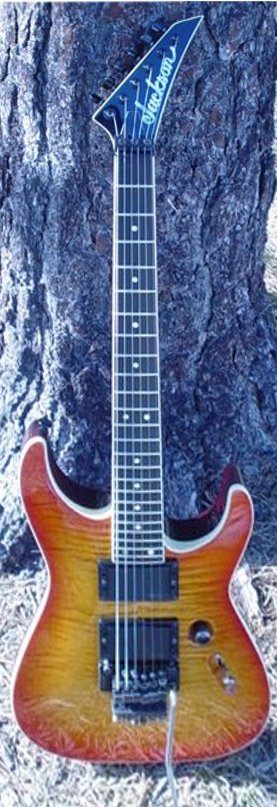
A 1987 Soloist archtop. Photo by Jimshine; perspective correction by GreyCat. Licensed under CC BY-SA 4.0. Via Wikimedia Commons. Jackson
Soloist
1984
Grover Jackson took the Strat shape and ran the maple neck straight through it. Jeff Beck’s was pink.
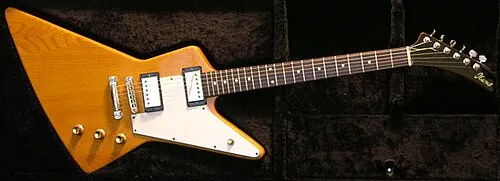
Photo: TheDestroyerGuy / Wikimedia Commons / Public domain Ibanez
Destroyer
1975
Ibanez copied the Explorer, right up until Gibson sued. Eddie Van Halen got a sound out of it nobody could copy.