Boss
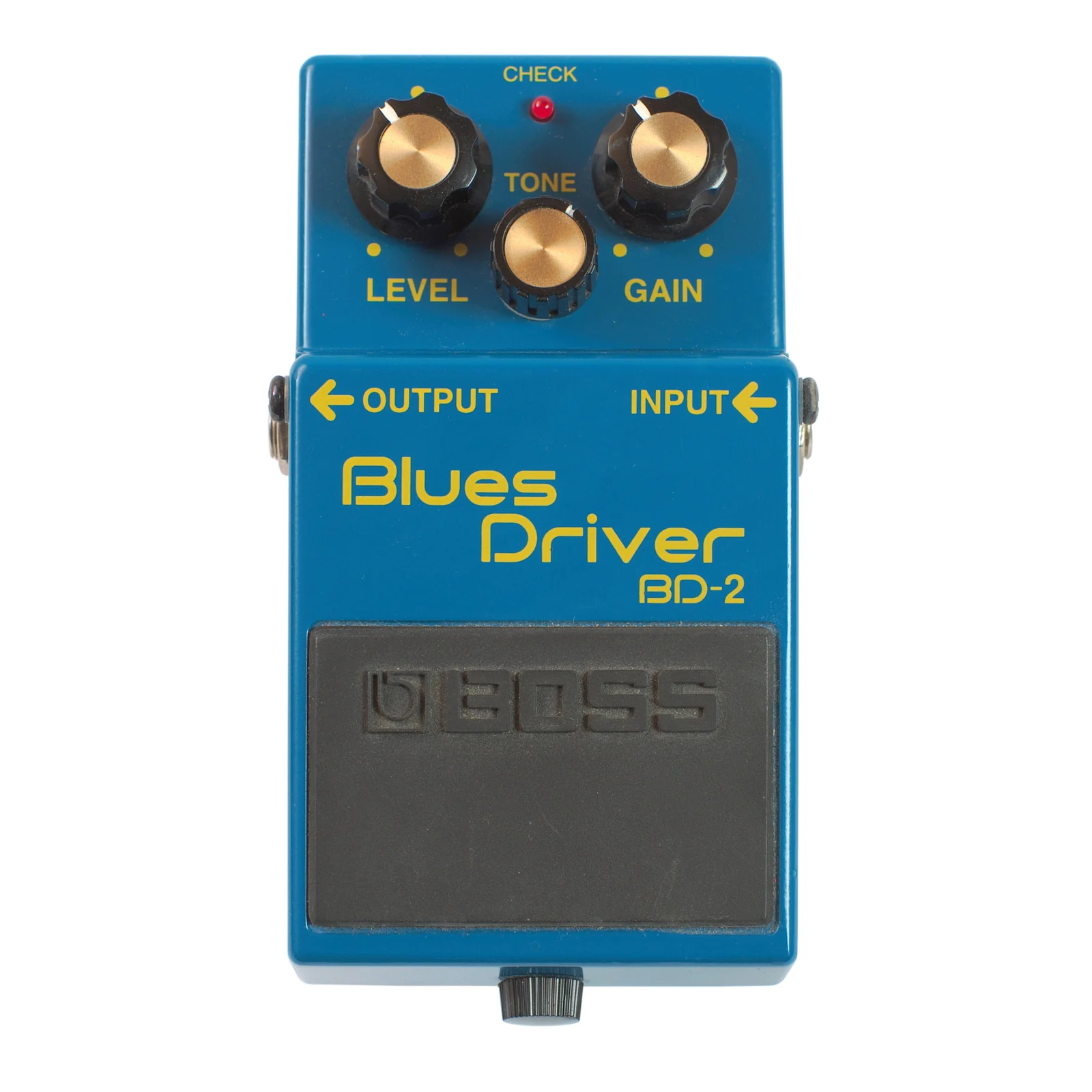
BD-2 Blues Driver
Three knobs on the box, and the other two are your guitar’s volume and your right hand.
1995. Grunge is still running things, the blues is creeping back, and Boss sets out to fit an old amp trick into a little blue box: roll the guitar’s volume down, and the dirt comes clean.
- Introduced
- 1995
- Effect
- Overdrive
The short version
1995
The Blues Driver
Boss brings out the BD-2, built to answer your guitar’s volume knob the way a cranked amp does.
2008
Open it up
Brian Wampler publishes a guide to modding the BD-2, including a version made for Brent Mason.
2013
Big Effect
On Green Day’s tour, Billie Joe Armstrong’s solo preset kicks in a BD-2.
2014
Waza Craft
Boss adds the BD-2W, all-discrete, with a Standard mode and a Custom mode.
2016
Revolution Radio
For some of the big tones, Armstrong plugs a guitar through a Boss Blues Driver and messes around with echoes and delays.
2017
A new board
The BD-2’s circuit moves to surface-mount parts, and Boss pairs it with the JHS Angry Charlie in the JB-2 Angry Driver.
2023
Fifty years of Boss
A metallic-finish anniversary edition, with the same post-2017 circuit inside.
Side A
A1
Turn it down and it cleans up
Every guitarist with a loud tube amp finds the trick sooner or later. Turn the amp up until it breaks into crunch and play a chord. Then, instead of reaching for a switch, roll the volume knob on the guitar back. The dirt thins out and the sound comes clean again. No pedal, no tap dance, just your hand on a knob.
When Boss told the story of designing the Blues Driver, it started right there:
If you distort using the amp and turn the guitar volume down, you can get a clean sound.
That was the job. Boss wanted a pedal that would give you “a crunch-like sound from amp distortion even when you turn the guitar volume down,” without going to mud on the way. And it said that “retaining the connection between musician and instrument was essential.”
Boss calls the BD-2 the first effect that let you control the distortion from the guitar’s volume knob. That’s Boss talking about Boss, so take it as the company’s claim. Still, it’s a good thing to want to be first at. The pedal would follow, and the player would lead.
A2
Blues in the grunge decade
The BD-2 came out in 1995, smack in the middle of a decade that grunge still ran. Blues had crept back into the conversation anyway, and a new wave of blues players, Joe Bonamassa and Eric Gales among them, were getting noticed. The name on the box wasn’t subtle about who it was pointed at.
It was one of the early pedals that tried to put the behavior of a hot tube amp inside a small box: not just the sound of it breaking up, but the way it squeezes and opens up as you play. Boss’s phrase for what it was chasing was a tube amp’s “interactive gain and compression.”
It worked well enough that the blue box ended up nearly everywhere. The pedal builder Brian Wampler put it plainly:
One of those pedals that everybody has owned or at least played through once.
A3
Not a Tube Screamer
The Tube Screamer is built around an op-amp clipping stage. The Blues Driver doesn’t work like that, and the difference is the whole point.
Its first gain stage is a pair of transistors doing an op-amp’s job, built from separate parts instead of a chip. Wampler describes two of those discrete op-amps in a row, followed by an ordinary op-amp that makes the volume back up, boosts the bass, and buffers the signal on its way out.
There are clipping diodes, four of them to ground, two on each side. But most of the dirt comes from the gain stages themselves being overdriven. That’s much closer to how an amp gets dirty.
The tone section is borrowed from amps too: an amp-style tone stack, derived from a Fender combo circuit, with fixed values. Wampler hears an old Fender tweed Princeton in it. That’s the tone section, mind, not the whole pedal. Boss never claimed more than “inspired by actual amps.”
Three knobs: Level, Tone, Gain. That’s all Boss gives you.
Flip the record · By the numbers
3
Knobs. Level, Tone, Gain.
2
Discrete op-amps built from transistors in the gain stages, before a standard op-amp finishes the job.
4
Clipping diodes, two on each side. Most of the dirt still comes from the gain stages themselves.
1995
In continuous production ever since.
Side B
B1
Solos, and a guitar plugged straight in
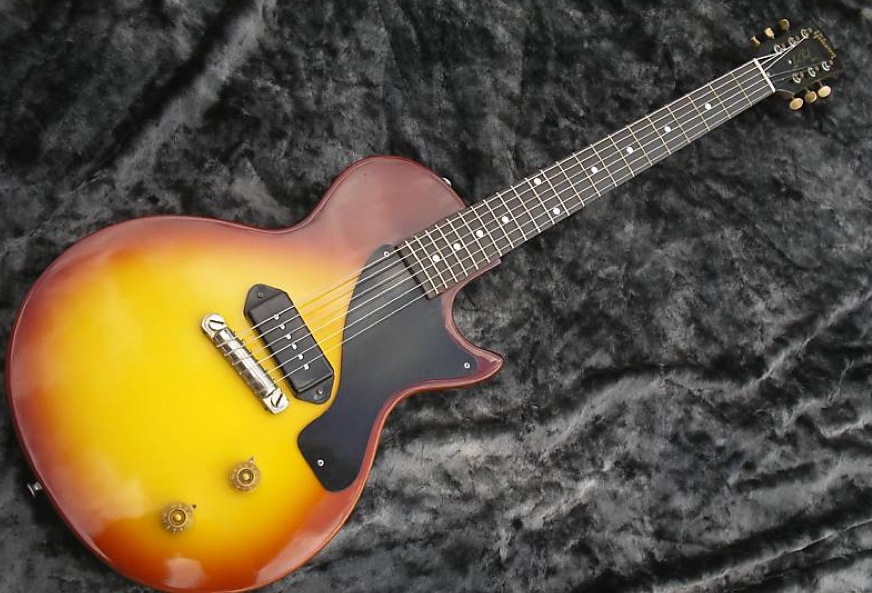
Its best-documented work is rock, not blues. In 2013, on Green Day’s tour behind ¡Uno!, ¡Dos!, and ¡Tré!, Billie Joe Armstrong had a preset called “Big Effect.” It kicked in a BD-2 for his solos. His guitars on that run included a handful of Gibson Les Paul Juniors.
Three years later, making Revolution Radio, he was tracking guitars three and sometimes four deep. Some of it, he said, was about as simple as recording gets: “to get a really big tone, we’d just plug a guitar through a Boss Blues Driver and mess around with different echoes and delays.” He said a Blues Driver, and he didn’t say which one. By then there was more than one to choose from.
Boss’s own list of players runs from Prince to Steve Vai to Robert Smith to Courtney Barnett, whose 2015 gear list had a BD-2 on it. A list of names isn’t a song you can put on, though. For that, start with Revolution Radio.
B2
Opened up
Ask Josh Scott, of JHS Pedals, how he got into building them, and the answer is a Blues Driver. Two, actually:
I got into pedals because, as a player, I used two Blues Drivers together for years and years. One day, one of them broke. I opened it up and realized it was just a simple soldering fix.
He took charge of the thing himself, which is what the pedal had been asking players to do all along. He wasn’t the only one in there with a soldering iron, either. Wampler, Robert Keeley, and Scott all made their first start on the Blues Driver circuit. In 2008 Wampler published a guide to modding it, including a version he made at Brent Mason’s request, for better tone. Keeley had his “Phat Mod.” None of those were Boss models. They were players deciding the box could do more.
Boss made its own version. The Waza Craft BD-2W arrived in 2014, all-discrete, with a Standard mode and a Custom mode that Boss says “delivers new body and sustain.” In 2017 the regular BD-2 moved to surface-mount parts, which is why modders go looking for older ones. The same year Boss paired the Blues Driver with a JHS design, the Angry Charlie, in the JB-2 Angry Driver. Scott’s company and the pedal that got him started ended up in one box.
The plain blue BD-2 has been in production since 1995, and it still asks the same thing of you. Set the Gain somewhere sensible. Then play it with the two controls Boss never put on the box: the volume knob on your guitar, and your right hand.
Put this on
You’ve read about it. Now hear it. Here’s what this pedal sounds like, and what to listen for.
Revolution Radio
For “a really big tone,” Billie Joe Armstrong says, they’d “just plug a guitar through a Boss Blues Driver and mess around with different echoes and delays.” He doesn’t name the songs, so listen to the record as a whole.
Find it on YouTube (opens in a new tab)
The cast
The people who built it, and the players who made it famous.
2013
Billie Joe Armstrong
Green Day
Used a BD-2 for solos on tour, and plugged a guitar through a Blues Driver for some of the big tones on Revolution Radio.
Josh Scott
JHS Pedals
Ran two Blues Drivers for years. When one broke, he opened it up, and that’s how he got into pedals.
2008
Brian Wampler
Pedal builder
Wrote a guide to modding the BD-2, and is one of the builders who got their start on its circuit.
Often paired with
The pedals and guitars it usually shares a board or a record with.