Gibson
Les Paul
Junior
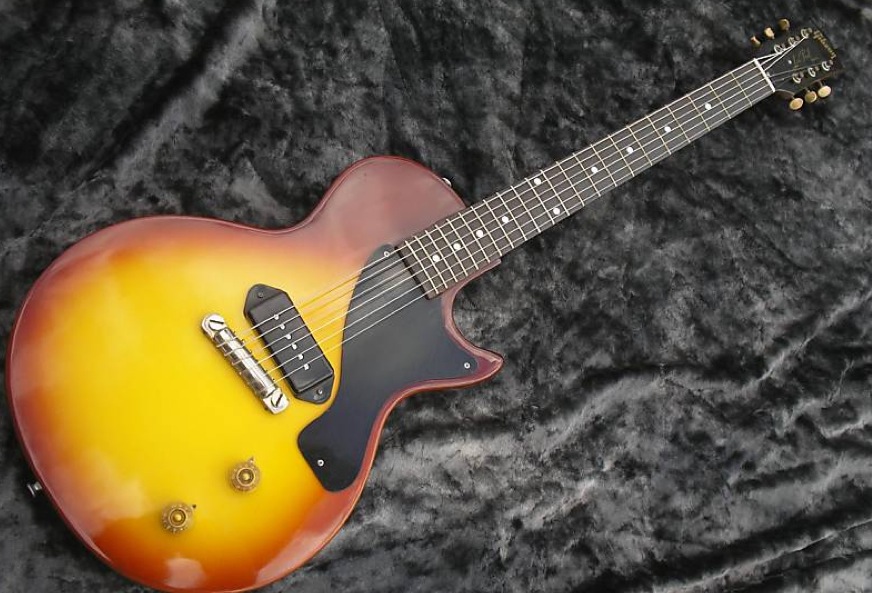
One pickup, two knobs, no switch. Built for beginners. Mountain and the New York Dolls never needed more.
Kalamazoo, 1954. Gibson’s Les Paul has a carved top, two pickups, and a gold finish, and it isn’t cheap. So the factory makes one for students: a flat slab of mahogany with one pickup, a volume knob, a tone knob, and nothing else to touch.
- Introduced
- 1954
- Type
- Solidbody electric
- Class
- Production
The short version
1954
The student model
One P-90 at the bridge, a flat mahogany body, no binding. Gibson ships 823 the first year.
1955
TV Model
The Junior in a pale yellow finish. Nobody agrees on why it’s called “TV.”
1956
A few millimeters
The pickup moves a little toward the neck, away from the bridge.
1958
Two horns
A rounded double-cutaway body, in cherry. Still one pickup.
1961
Pointed
The thin, pointed SG shape arrives. It still says Les Paul Junior on it.
1963
SG Junior
The Les Paul name comes off. Or 1964, depending who’s counting.
1970
Mississippi Queen
Leslie West and Mountain, on a single-cut Junior.
Side A
A1
Nothing to switch
Every guitar shop has a wall of guitars with too many knobs. Coil taps, push-pulls, five-way switches, a little mini-toggle nobody remembers the job of. Then there’s the Junior, which has a volume knob and a tone knob, and that’s your lot.
Gibson made it in 1954 as a student guitar. The Les Paul had been out for two years, with a carved maple top, gold paint, and two pickups. The Junior skipped all that. A flat slab of mahogany with no carving and no binding. Dot inlays. A simple wraparound bridge. One P-90 pickup, in a black cover with little ears on the sides that everybody calls a “dog-ear,” and it sits right by the bridge.
No neck pickup, so no pickup switch. You don’t choose a sound. You turn it up and play.
That’s also how you tell the family apart. One dog-ear pickup is a Junior. Two flat “soapbar” pickups on the same slab is a Special. A carved top and a pair of humbuckers is a Standard.
A2
Why “TV”?
In 1954 and 1955 a paler version shows up, in the yellowish finish Gibson now sells as TV Yellow. Gibson called it the TV Model. It’s the same guitar as a Junior in a different finish.
Why “TV”? You’ll hear three stories. One says the pale finish looked better than a dark one on black-and-white television. One says it had to do with The Les Paul & Mary Ford Show. One says nobody really knows. I’d love to tell you which is right. Nobody can.
A Junior doesn’t ask you what sound you want. It gives you the one it’s got, as loud as you like.
Gibson moved the pickup a few millimeters toward the neck in early 1956. Beyond that, the recipe barely changed. There was even a three-quarter-size Junior, with a 22¾-inch scale, for smaller hands. Collectors mostly don’t want those, which tells you exactly who they were for. The kids kept buying. Gibson shipped 823 Juniors in 1954 and 2,839 the next year, and from 1954 through 1960 it adds up to 19,035.
A3
Three bodies, one name
The shape did change. In 1958 the Junior grew a second cutaway, a rounded, thick double-cut, usually in cherry red. Still one pickup, still two knobs. (Some single-cuts were still made in 1959, in cherry, so the shape alone won’t date one.)
In 1961 it went thin and pointed, the body we now call an SG, and it still said Les Paul Junior on it. The name came off in 1963 or 1964, depending on who’s counting, and it became the SG Junior. After the rename, it’s a different guitar’s story.
Flip the record · By the numbers
1
Pickup. A dog-ear P-90 at the bridge, and that’s it.
823
Juniors Gibson shipped in 1954, the first year.
2,689
TV Models shipped from 1954 to 1960.
19,035
Juniors shipped from 1954 to 1960. A student model, and it sold like one.
Side B
B1
A Les Paul Junior into a PA
Leslie West of Mountain made more noise with one pickup than most people make with three. On Mountain’s early records, “Mississippi Queen” and the album Climbing!, his studio guitar was a single-cut Junior with that one P-90. One interview dates it to 1956.
He had opinions about the shape:
The single-cutaway had a better sound.
What it was plugged into depends on which interview you read. Most say a Sunn Coliseum PA system. One says a 50-watt Marshall through a Sunn cabinet. Even the color’s in dispute: some say sunburst, some say TV yellow. Either way, it’s one pickup, turned all the way up, and it’s enormous.
B2
Automatic guitars
Johnny Thunders of the New York Dolls played a double-cut TV Junior, the late-’50s kind with the round horns. It’s the guitar people picture him with, in the Dolls and later in the Heartbreakers. His bandmate Sylvain Sylvain played them too, and they had a name for them. They called them “automatic guitars.”
It fits. There’s no setting to find. You plug it in, you hit it, and it goes. Sylvain says he and Thunders “put the Les Paul Junior on the map.”
A Junior gives you one pickup, a volume, and a tone, and then gets out of the way. Everything else is up to your hands. Plenty of people learned on one. A few of them never saw a reason to trade up.
Put this on
You’ve read about it. Now hear it. Here’s what this guitar sounds like, and what to listen for.
Mississippi Queen
Leslie West’s early Mountain studio guitar was a single-cut Junior with one P-90. That’s the whole guitar, pushed as hard as it goes. Listen to how big one pickup can sound.
Find it on YouTube (opens in a new tab)
The cast
The people, and the specific guitars, that made the legend.
1970
Leslie West
Single-cut Les Paul Junior
Mountain’s Climbing! and “Mississippi Queen.” He didn’t like the double-cuts. Sources split on whether his was sunburst or TV yellow.
1970s
Johnny Thunders
Double-cut TV Junior
A late-’50s rounded double-cut, often called a ’59. The New York Dolls, then the Heartbreakers.
1970s
Sylvain Sylvain
Les Paul Junior
Thunders’s bandmate in the Dolls. He says the two of them “put the Les Paul Junior on the map.”
Liner notes
Specs, construction, rarity, value, and every source we used.
One dog-ear P-90 student slab — not a Special, not a Custom, not a Standard, and not a Burst.
- Body
- Single-cut slab mahogany. Flat top, no carve, no maple cap. Unbound.
- Neck
- Set mahogany. 50s Vintage profile. Unbound headstock.
- Fingerboard
- Unbound rosewood; 22 medium jumbo; acrylic dots; 12.0 in / 304.8 mm radius.
- Scale
- 24.75 in / 628.65 mm
- Pickups
- One dogear P-90, bridge. No neck pickup.
- Hardware
- Wraparound. Nickel. Vintage Deluxe tuners, white buttons. Black pickguard.
- Electronics
- 1 volume, 1 tone. Hand-wired Orange Drop capacitors. No toggle.
- Finish
- Gloss nitrocellulose. Vintage Tobacco Burst (this SKU).
- Nut
- Graph Tech, 43.05 mm / 1.69 in
Open the full research fileConstruction details, the complete player record, production numbers, dated value estimates, and sources
USA Original Collection single-cut, Vintage Tobacco Burst, LPJR00VTNH1. USA DC is a different SKU (SlimTaper, list $1,699); Custom Shop Historic 1957 SC / 1958 DC are reissues (list $3,999), not the table. Vintage Kalamazoo differs — Construction.
Construction
Kalamazoo, 1954. One dog-ear P-90, slab mahogany, no maple cap, no binding, dots, wraparound, two knobs. Two soapbars = Special. Carved maple + two humbuckers = Standard. Black Beauty = Custom.
Three bodies, one name. 1954–mid-1958: single-cut slab (12 3/4" bout, VG; 1¾", Joe’s). guitarhq mid-1958 ( serial 8 49xx) / Gazette late 1958 / Wikipedia 1958: rounded double-cut slab, cherry, still one P-90. Some 1959 single-cuts exist, in cherry (guitarhq). Don’t date every DC “1959.” Trade “Les Paul SG” is a trap. 1961–63: pointed thin body (~1⅜", Joe’s), still silkscreened Les Paul Junior. guitarhq/Gazette rename SG Junior in 1963; VGAB’s model-name row switches 1964. Still one P-90. Not SG Special. Melody Maker (1959) is adjacent student, not this guitar.
TV Model = this guitar (finish + peghead legend). Three “why TV” stories: B&W glare rumor (Gazette/guitarhq); Wikipedia Les Paul & Mary Ford Show / not glare; Joe’s unverifiable. Don’t pick. guitarhq: 1954 TV maple 3/4-scale, then 1955 full-scale maple, mahogany by mid/late 1955. Joe’s/Gazette/VG treat TV as Junior construction from 1955. Early maple contested: VG “a few very early-’54 maple”; Joe’s maybe two dozen; guitarhq assigns maple primarily to 1954–55 TV and 3/4s. 3/4-scale: VG 22 3/4" Junior beginning 1956; guitarhq 1954 TV. Scarce and less wanted (guitarhq).
Contested bits. Pickup close to the bridge in 1954; nudged neckward early 1956 (guitarhq; Gazette; Joe’s 3–4 mm). Wraptail inserts lengthened 1956 — the ’54–’56 lean/crack is a condition deduction, not a different model. Wraptail metal: VG pot metal vs Joe’s aluminium. P-90 cover: dog-ear except guitarhq 1954 intro “1 soapbar” and 4-digit 1958 “soapbar-style P90s underneath the dog ear covers.” Dots: VG 1954 pearl then plastic vs Joe’s celluloid never MOP. Knobs: VG mid-1955 bonnet vs Joe’s 1956. Caps: VG mid-’55 bumblebee vs Joe’s 1956. Listed scale 24.75" vs Joe’s wraptail 24-9/16". Gazette 1957 Alnico 5; Joe’s 1956–57 magnet change “not consistent.”
Current 2026. USA Original Collection, Nashville — the table. Hide glue is Historic only. USA DC SlimTaper (LPJD007WNH3) is not a 1958 Historic. Nut 43.05 mm prints 1.69 in (SC) / 1.7 in (DC); millimetres agree. Fetched 1957 Historic SKU is left-handed; Gazette identity isn’t LH-only. Historic sheet prints “Les Paul Model” silkscreen vs vintage “Les Paul Junior” — flag. 1960 DC VOS Green Sparkle $5,399; Murphy Lab Ultra Heavy Aged TV Yellow $7,999; Custom Select 1957 VOS Purple Sparkle $5,399. Reissues ≠ vintage. Epiphone Juniors and the Armstrong H-90 aren’t this guitar.
Players
Leslie West (Mountain) — single-cut Junior; Climbing! / “Mississippi Queen” (1970). Guitar World 2012: “a Les Paul Junior” into a Sunn Coliseum PA. Guitar Player picking: early Mountain studio guitar was a single-cutaway Junior, one P-90. He disliked double-cuts (VG Family Feud; GP: “The single-cutaway had a better sound”). Do not illustrate West with a Thunders-style double-cut TV. Keep conflicts: sunburst (MusicRadar) vs TV Jr (GP Hendrix piece); Sunn Coliseum PA (GW 2012, GW 1987, MusicRadar, ToneQuest) vs 50-watt Marshall into a Sunn cabinet (GP). Year: ToneQuest ’56. Do not write “West’s Woodstock Junior.” Do not file his Flying V here.
Johnny Thunders (New York Dolls; The Heartbreakers) — double-cut TV Junior, late 1958–60 rounded slab. Often called a ’59. Famous guitar = DC TV Junior. The Too Much Too Soon cover is a Les Paul Special, not a Junior.
Also known to play. Sylvain Sylvain — 2009 gibson.com: he and Thunders “put the Les Paul Junior on the map”; they called them “automatic guitars.”
Rarity
Volume student model; scarcity is configuration/finish, not the name. Factory shipping, not production counts.
GuitarHQ LpJr 1954–60: 823 / 2,839 / 3,129 / 2,959 / 2,408 / 4,364 / 2,513 = 19,035. GuitarHQ TV: 5 / 230 / 511 / 552 / 429 / 543 / 419 = 2,689. VG magazine Junior (not split): same 1954–57; 1958 2,480. Do not treat VG 2,480 / GH 2,408 as single-cut-only. Wikipedia “nearly doubling Junior sales” at the double-cut is unowned against both 1958 cells, down from 1957’s 2,959. VG “most popular instrument” is rank in the line, not a 1958 spike. First-year 823 is small, not Flying-V small. Peak sunburst 1956; 1959–60 DC cherry is volume.
Joe’s 1955 TV 219 vs GH 230. Joe’s 1954 TV blank/starts 1955 vs GH 5. Joe’s 1958 sunburst 365. Joe’s DC cherry cells appear year-shifted (1959 2,043 / 1960 4,364 / 1961 2,513 matching GH 1958/59/60). Publish both grids; don’t pick. 1961–63 GH/VGAB SgJr still named LP Jr on VGAB: 2,151 / 2,395 / 2,318 = 6,864. Joe’s 1961 DC cherry 2,513 vs GH SgJr 1961 2,151. guitarhq SgTv 1961 256 is lumped Juniors+Specials. Joe’s Junior-only 1961 TV 29. Do not treat 256 as Junior TV. 3/4-scale is scarce and less wanted (guitarhq).
Value
Informal estimate, 25 August 2026. Not an appraisal.
Asks ≠ solds. Reverb sold medians were not returned. Don’t invent them. Artist lots (West / Thunders / Armstrong) are a separate provenance market, labeled not-a-comp. Humbucker conversion destroys one-P-90 identity (Edgewater).
New USA: SC $1,599; DC $1,699. Used USA / recent should discount; thin labeled 2024–26 solds. Historic VOS list $3,999; used neighborhood high-$3ks to ~$5k. Carter asks $4,499 ULA / $5,000 Heavy Aged — asks, reissue. 1961–63 SG-body player: GVG excellent $5,600–$8,000 — guide, not sold median. Thin named solds. Below slab-DC money. Don’t use SG Special comps.
Joe’s July 2026 (excellent original case): 1954–58 sunburst $6,000–$13,000; 1955–58 TV $10,000–$20,000. Guide, not solds. No separate DC cherry band. Edgewater July 2026 dealer-comp: Junior SC “1952–1957” $8,000–$18,000 (don’t import the 1952; intro is 1954); later SC $8,000–$15,000; DC 1958–60 $10,000–$20,000. GVG excellent: 1954 $12k–$22k; 1955 $8k–$18k; 1956–57 $7k–$10k; 1958 $18k–$35k; 1959 $20k–$38k; 1960 $15k–$28k. 1958–59 tops are upper-ask outliers vs Joe’s/Edgewater — not sold medians.
Carter 1957 SC sunburst ask $14,500 (replacement wraptail) — ask, partly non-original, already above Joe’s excellent top. Working ask-direction clean original 1954–58 SC sunburst: high $6ks to mid-teens. SC TV above sunburst. DC cherry Edgewater $10k–$20k. DC TV top of the production finish ladder. 1961 TV 29 (Joe’s) is a named object, not a price series. $20k–$40k asks may exist and sit; no 2024–26 public sold histogram isolated. Edgewater May 2026: SC TV +50–80% vs sunburst; DC TV +30–50% vs cherry — buyer/dealer narrative, not a sold strip.
See also
- gibson-les-paul-standard — carved maple, two pickups; Burst sidebar lives there
- gibson-sg — SG Special / Iommi-Townshend-Santana Woodstock live there; 1961–63 SG-body Junior stays here until the rename
- gibson-melody-maker — adjacent student; not this one-P-90 Junior
Sources
- Vintage Guitar: In Detail — Gibson’s 1954–58 Les Paul Junior
- Joe’s Vintage Guitars: Gibson Les Paul Junior guide
- guitarhq: Les Paul Junior and TV Model
- guitarhq: solidbody shipping 1952–69
- Gibson Gazette: Les Paul Junior Buyer’s Guide
- Gibson Gazette exclusive: Double Cut TV Yellow / Vintage Cherry
- Gibson Les Paul Junior Vintage Tobacco Burst (USA)
- Gibson Les Paul Junior Double Cut Exclusive Dark Walnut
- Gibson Custom 1957 Les Paul Junior Reissue VOS Vintage Sunburst
- Gibson Custom 1957 Les Paul Junior Reissue VOS TV Yellow
- Gibson Custom 1957 Les Paul Junior Reissue VOS Vintage Sunburst left-handed
- Gibson Custom 1958 Les Paul Junior Reissue VOS Cherry Red
- Joe’s Vintage Guitars: Gibson shipping totals 1948–1979
- Joe’s Vintage Guitars: Les Paul TV Model guide
- Joe’s Vintage Guitars: Vintage Gibson Les Paul market value guide
- True Vintage Guitar: Les Paul TV 1954–58 shipping
- Vintage Guitar and Bass: SG Junior
- Vintage Guitar: Family Feud (Leslie West)
- Vintage Guitar: Leslie West
- Guitar World: Leslie West on tone (4 Jan 2012)
- Guitar World: Leslie West 1987 interview
- Guitar Player: Leslie West picking techniques
- Guitar Player: Here’s Why Leslie West is a Guitar Legend Like No Other
- Guitar Player: Leslie West on “Mississippi Queen” for Hendrix
- MusicRadar: Leslie West on Mountain’s Mississippi Queen
- ToneQuest Report: The Leslie West Interview
- Louder / Classic Rock: The Guitars That Built Rock — Les Paul Junior
- Wikipedia: Gibson Les Paul Junior (lead only)
- Edgewater: 2026 vintage Gibson value guide
- Edgewater: complete Les Paul Junior guide (May 2026)
- Guitar Value Guide: Les Paul Junior
- Carter Vintage: 1957 Les Paul Junior sunburst ask $14,500
- Carter Vintage: 2026 Custom 1957 Junior ULA TV Yellow ask $4,499
- Carter Vintage: 2025 Custom 1957 Junior Heavy Aged TV Yellow ask $5,000
Keep digging
Guitars this one gets compared to, confused with, or descended from.
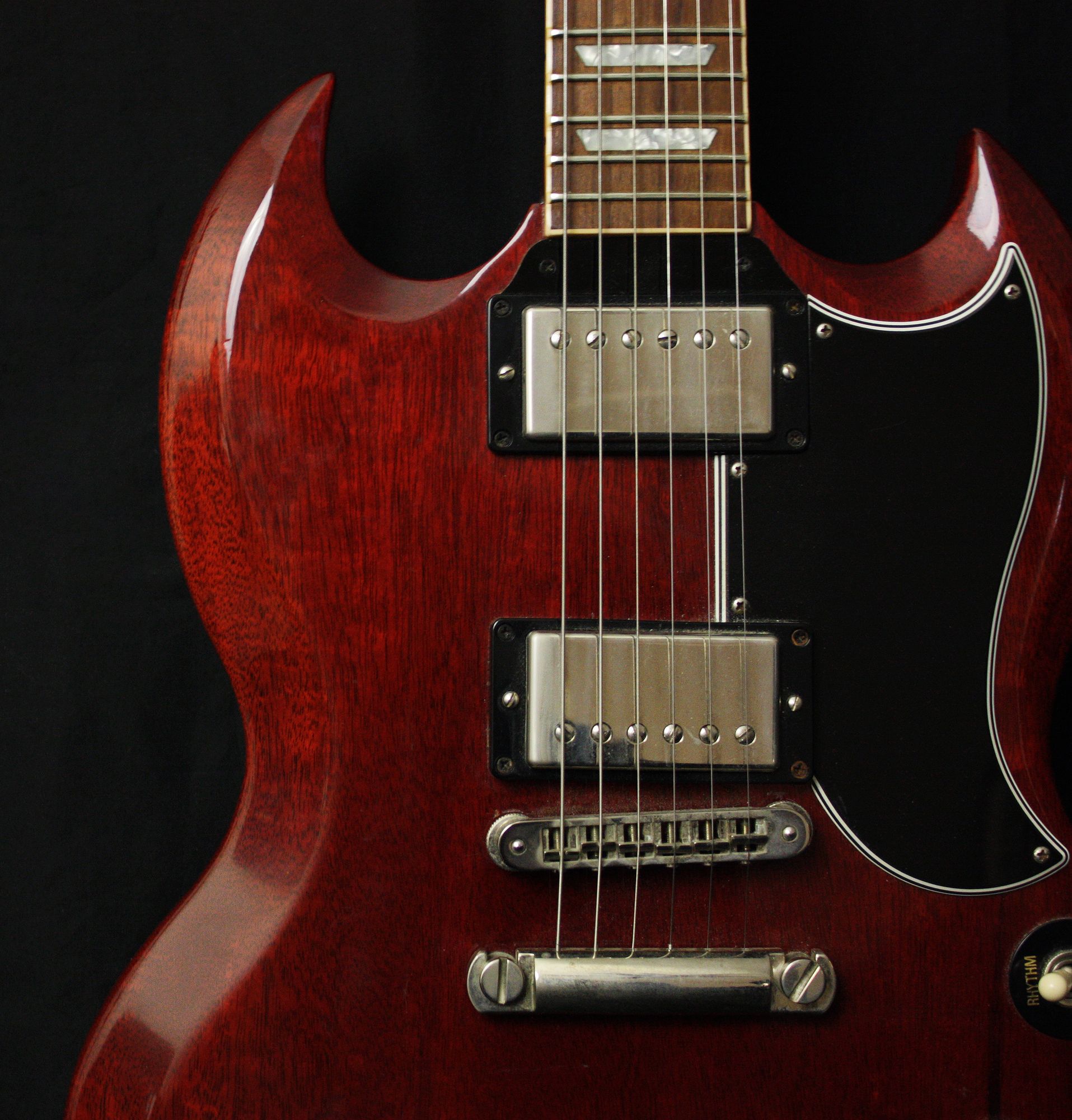
Gibson SG Standard ’61 Reissue, photographed 18 March 2010. Photo by John Tuggle. Licensed under CC BY 2.0. Via Wikimedia Commons. Gibson
SG
1961
Gibson has never stopped making SGs. Angus Young has lost count of his. He still only means one.
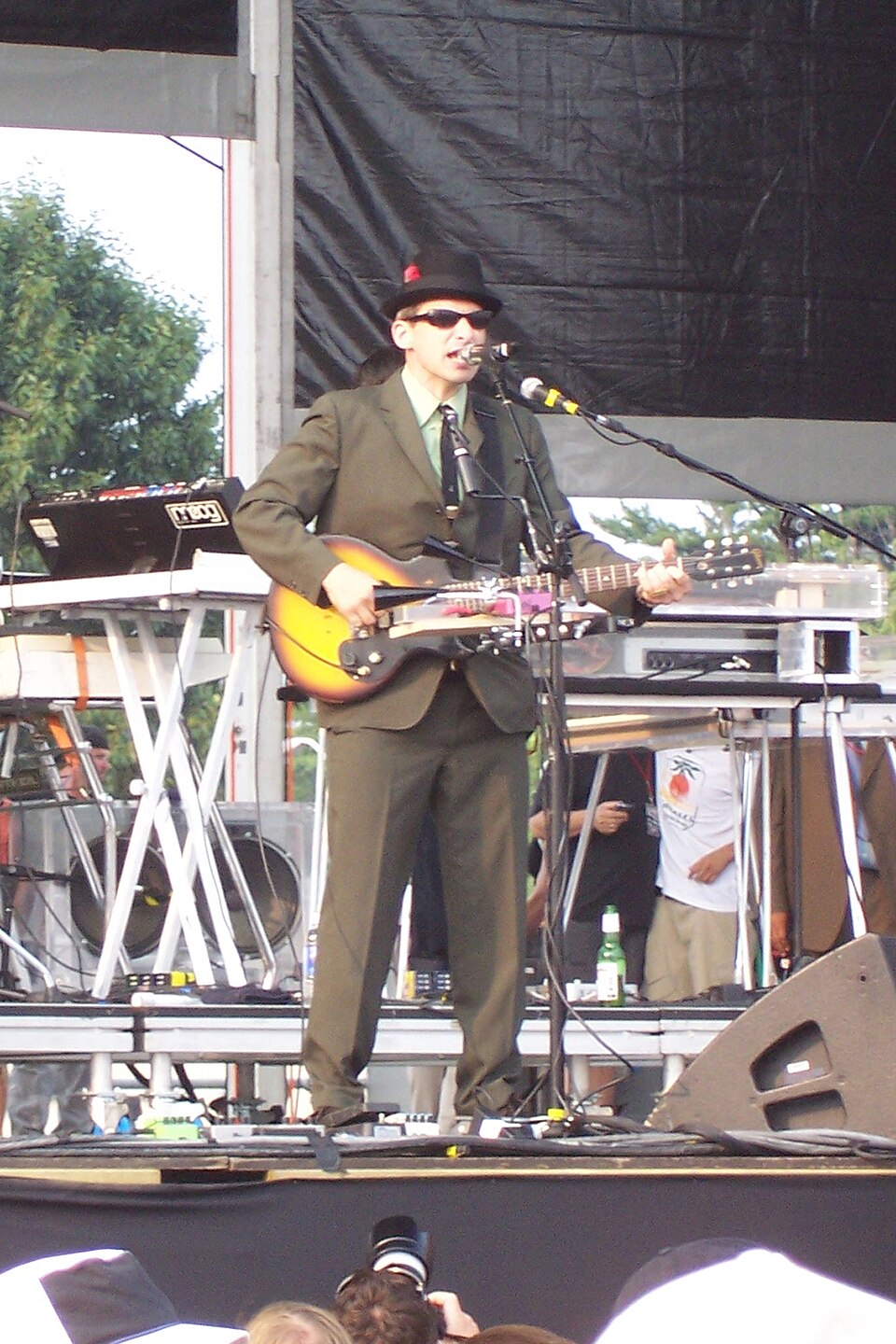
Photo: Jason / Wikimedia Commons / CC BY-SA 2.0 Gibson
Melody Maker
1959
Gibson built it to be outgrown. Billy Gibbons pinstriped his on day one. Joan Jett never traded up.