Dunlop
Cry Baby
An amp engineer’s shortcut, built into an organ pedal for horn players. Guitarists plugged in anyway.
Sepulveda, California, November 1966. A junior engineer named Brad Plunkett is simplifying an amplifier, and the part he puts in sweeps from low to high and says “wah.”
- Introduced
- 1967
- Effect
- Wah
No photograph of this pedal yet. Have one? Send a picture
The short version
1966
A switch becomes a knob
In November, Brad Plunkett swaps a switch in the Vox Super Beatle amp for a potentiometer. Swept, it says wah.
1967
Into production
Cry Baby and Clyde McCoy pedals go into production early in the year, first in Sepulveda, then in Italy.
1972
Parked
Mick Ronson sets his Cry Baby in one spot and leaves it there for Bowie’s Ziggy Stardust.
1982
Dunlop takes over
Thomas Organ has closed (1981 or 1982; the dates don’t agree). Dunlop buys the name and the original tooling. Its first pedal is the GCB-95.
1987
A stock one
Slash makes Appetite for Destruction with a Cry Baby straight off the shelf.
2019
Same board
Tom Morello’s GCB-95 is still on a board he hasn’t changed since the early ’90s.
Side A
A1
A part that said wah
November 1966, at Warwick Electronics, the company behind Thomas Organ, in Sepulveda, California. Brad Plunkett is a junior engineer, and his job is the Vox Super Beatle, a solid-state amp that needs redesigning. There’s an expensive switch in it that sets a midrange boost. Plunkett takes the switch out and puts in something cheaper: a potentiometer, a knob you can turn smoothly from one end to the other.
Sweep that knob and the boost slides from low to high, and the sound says “wah.”
They put the prototype inside the housing of a Vox Continental organ’s volume pedal, so you could sweep it with your foot. Bill Page tried it on saxophone. Then a guitarist, Del Casher, plugged in and told the company president, Joe Benaron, what he’d just heard: a guitar effect.
Benaron didn’t see it that way. He wanted it for horn players. He licensed the name of the bandleader Clyde McCoy for the Vox version and pointed the thing at the horn section.
It didn’t stay pointed there.
A2
Somebody said it sounded like a baby
The other name came from the sound. The way the story goes, somebody at Thomas heard the pedal scream and said it sounded like a baby crying.
Cry Baby and Clyde McCoy pedals both went into production early in 1967, first in Sepulveda, then in Italy, at Eko and then at JEN, a factory Benaron founded with a foreman named Ennio Uncini. The patent application went in on 24 February 1967. It was granted on 22 September 1970.
Those early pedals were not consistent. They varied a lot from one unit to the next. Dunlop’s own telling has Jimi Hendrix going through six or seven before he found one that sounded right.
The first famous wah records came quickly after that. Which pedal was on which of them is murkier than people like, and Hendrix’s name usually comes attached to a Vox. Where somebody did write down “Cry Baby,” one of the best examples is a record where the wah hardly moves.
A3
Parked
Mick Ronson played guitar on David Bowie’s The Rise and Fall of Ziggy Stardust and the Spiders from Mars, from 1972. He played a stripped 1968 Les Paul Custom through a Marshall, with a Cry Baby in between. The producer, Ken Scott, said that when it came to Ronson’s sound, “it was always the Gibson Les Paul through a Marshall and the Cry Baby wah.” And he remembered exactly how Ronson used it:
Mick would start at one end of the wah and slowly work down or come up, he’d hit the sound we wanted, leave it there.
A wah pedal is a filter that sweeps a peak up and down the midrange. Stop it halfway and you get a fixed tone: nasal, thick, cutting, like a guitar talking through its nose. That’s Ronson on Ziggy. He wasn’t rocking the pedal. He was using it as a tone knob he worked with his foot.
Put the record on and listen to how the guitar sits forward, honking, while nothing about it wobbles.
Flip the record · By the numbers
2
Names on the same circuit in early 1967. Cry Baby, and Clyde McCoy for Vox.
3
Places it was built in its first life. Sepulveda, then Eko and JEN in Italy.
6–7
Wahs Jimi Hendrix went through before one sounded right, as Dunlop tells it.
1970
Year the patent was granted. The application went in on 24 February 1967.
Side B
B1
Dunlop picks up the tooling
Thomas Organ went out of business in 1981 or 1982; the dates don’t agree. In 1982 Dunlop acquired the Cry Baby name, along with the original Thomas Organ and JEN tooling and machinery.
Its first pedal was the GCB-95. Dunlop raised the frequency range for a more aggressive, up-front sound than the 1967 voicing had. The GCB-95 is still the standard Cry Baby.
After that came the variants: the 535Q, the Mini, signature models for Slash, Kirk Hammett, Eddie Van Halen, and Mick Ronson. There’s a fair case that the Cry Baby is the best-selling pedal of all time.
The name traveled too. When the Tube Screamer’s makers brought their overdrive to Sam Ash in Manhattan, Sammy Ash pointed to the Cry Baby, a pedal named for the sound it made. The Tube Screamer got its name partly by the same logic.
B2
A stock Cry Baby
Fame never needed a fancy one. Slash, looking back on Guns N’ Roses’ first album:
When I did Appetite for Destruction I had a stock Cry Baby.
No mods, no rebuild. The one off the shelf.
Tom Morello has a GCB-95 on a board he hasn’t changed since the early ’90s, right next to a Phase 90.
Nobody at Thomas Organ ever drew up a setting called “halfway, and leave it.” Ronson found it on his own, somewhere in the middle of the pedal’s travel, by ear and by foot. On Ziggy Stardust you can still hear it, sitting right where he left it.
Put this on
You’ve read about it. Now hear it. Here’s what this pedal sounds like, and what to listen for.
The Rise and Fall of Ziggy Stardust and the Spiders from Mars
Mick Ronson’s Cry Baby, mostly parked in one spot as a tone filter between his Les Paul and a Marshall. Listen for the guitar honking forward without wobbling.
Find it on YouTube (opens in a new tab)
The cast
The people who built it, and the players who made it famous.
1966
Brad Plunkett
Inventor, Thomas Organ
A junior engineer redesigning the Vox Super Beatle amp. He swapped a switch for a potentiometer and heard it say wah.
Del Casher
First guitarist to plug in
Tried the prototype on guitar and told the company president it was a guitar effect.
Joe Benaron
President, Thomas Organ
Wanted it for horn players and licensed Clyde McCoy’s name for the Vox version. Co-founded the JEN factory in Italy.
1972
Mick Ronson
Cry Baby, parked
A stripped 1968 Les Paul Custom into a Cry Baby and a Marshall on Ziggy Stardust. He used the wah as a tone filter, not a sweep.
1987
Slash
A stock Cry Baby
“When I did Appetite for Destruction I had a stock Cry Baby.” Dunlop later made him a signature model.
early 1990s
Tom Morello
GCB-95
On a board he hasn’t changed since the early ’90s, next to an MXR Phase 90.
Often paired with
The pedals and guitars it usually shares a board or a record with.
- Send a picture
MXR
Phase 90
1972 or 1974 · Modulation
One knob, and the quiet swirl Eddie Van Halen stepped on when he wanted to be heard.
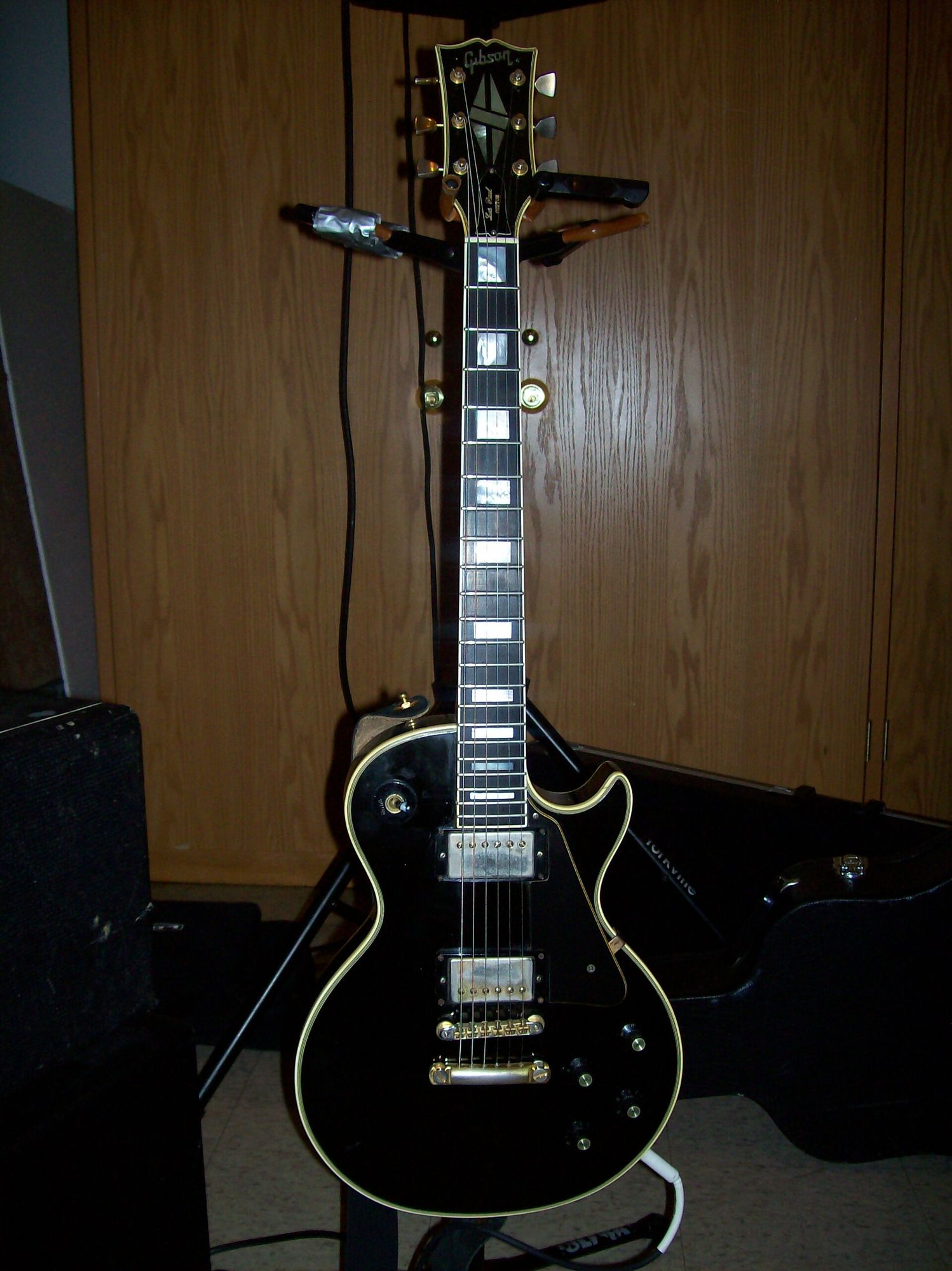
A 1974 Gibson Les Paul Custom guitar. Photo by Ibanez Guy. Licensed under CC BY-SA 3.0. Via Wikimedia Commons. Gibson
Les Paul Custom
1954
Jimmy Page paid his off in installments at 18. It was stolen in 1970. He got it back over 40 years later.