Gibson
Les Paul
Custom
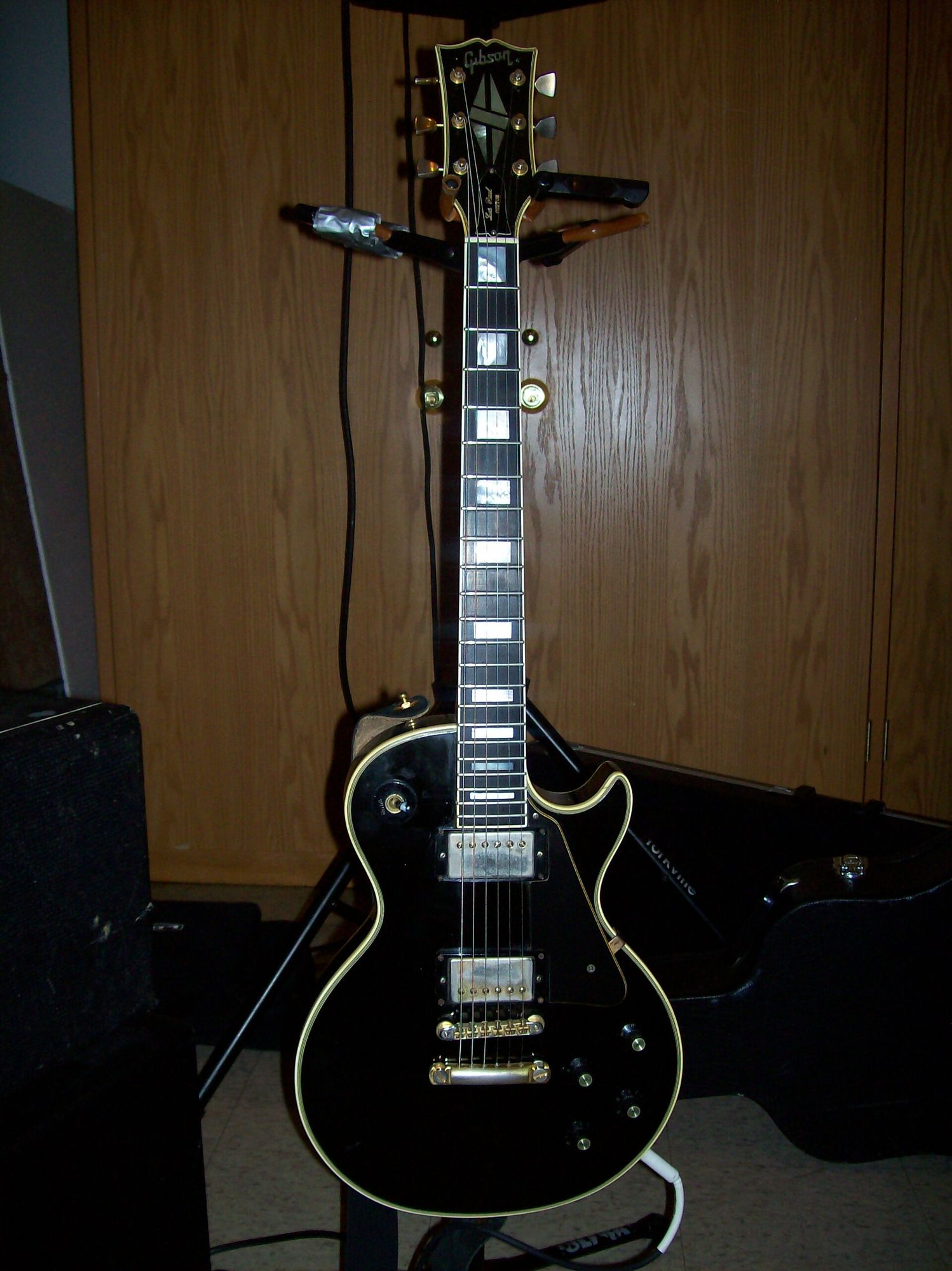
Jimmy Page paid his off in installments at 18. It was stolen in 1970. He got it back over 40 years later.
England, 1962. Jimmy Page is eighteen, and he wants the black Gibson with the gold hardware. It costs £185, which he doesn’t have. So he buys it the way you buy anything you can’t afford: on layaway, a little at a time.
- Introduced
- 1954
- Type
- Solidbody electric
- Class
- Production
The short version
1954
The Black Beauty
Black finish, ebony board, gold hardware, $325. Some were already shipping in late 1953.
1957
Three humbuckers
Three pickups replace the original two. A few two-humbucker Customs exist, but not many.
1961
The name moves out
The Les Paul Custom name moves to the new SG body, usually in white.
1962
Page buys one
A 1960 three-pickup Custom, on layaway, at eighteen.
1968
Back in black
The single-cut Custom returns, now with two humbuckers and a maple top.
1970
Two stories begin
Frampton is handed a 1954 Custom at the Fillmore West. Page’s is stolen at Minneapolis–St. Paul.
1980
The crash
Frampton’s Custom goes down with a cargo plane after a date in Venezuela.
2015
Home
Page gets his back on 12 November. Or 2014, depending who you ask.
Side A
A1
Paid off a little at a time
Some guitars you buy on a whim. The Les Paul Custom was never that guitar. It was the one on the top shelf, the one you walked past for months, the one you saved for.
Jimmy Page saved for his. In 1962 he was eighteen, and he put a black 1960 Custom on layaway for £185. It had three pickups, gold hardware, and a finish like a piano. He used it on sessions and he took it into the early days of Led Zeppelin.
Then, in 1970, it disappeared. We’ll come back to that.
A2
Les wanted black
Gibson introduced the Custom in 1954, though some were already shipping at the end of 1953. The goldtop had been out for two years. Les Paul asked for a second color, and the color he wanted was black.
People call it the tuxedo Les Paul, and that’s exactly what it is. Black finish. An ebony fingerboard with pearl blocks. A split-diamond inlay on the headstock, borrowed from Gibson’s top archtop, the Super 400. Gold hardware. Seven layers of binding around the top. It was the first Gibson electric with the new Tune-o-matic bridge. It cost $325, a hundred dollars more than the goldtop.
The frets were low and flat, so low that it got the nickname “Fretless Wonder.” And the body wasn’t what you’d guess. There was no maple top. The 1950s Custom was mahogany all the way through, with a P-90 at the bridge and an Alnico V at the neck. It was a different-sounding guitar from the goldtop, not just a dressier one.
It was the Les Paul you saved up for, and it looked it.
A3
Three pickups, then a long break
In 1957 Gibson gave it three of the new humbuckers. A few Customs from that era have only two, but three became the look. The next year, gold Grover tuners.
It never sold in big numbers. From 1954 through 1960 Gibson shipped 1,912 of them, against around 7,000 goldtops in the same years. In 1961 the Custom name moved over to the new, thin SG body, usually white, and the black single-cut went away.
It came back in 1968, black again, but with two humbuckers and, this time, a maple top. Through the 1970s Gibson made them by the thousands. In 1978 alone it shipped 10,171.
Flip the record · By the numbers
$325
The 1954 list price, $100 more than the goldtop Les Paul.
7
Layers of binding around the top. The back and headstock got five.
94
Customs shipped in 1954, the first year.
1,912
Shipped from 1954 to 1960. Gibson sold around 7,000 goldtops in the same years.
Side B
B1
The Phenix
In 1970, after a Humble Pie show at the Fillmore West, a man named Mark Mariana handed Peter Frampton a 1954 Les Paul Custom. Somebody had already converted it to three humbuckers. Frampton played it on Rock On, on Rockin’ the Fillmore, on studio records, and it’s in the photos on the Frampton Comes Alive! gatefold.
In 1980, after a show in Venezuela, the cargo plane carrying his gear crashed. Everyone assumed the guitar burned. It hadn’t. It turned up on the island of Curaçao, and in 2011 Frampton got it back. People call it “Phenix” now, and you can see why.
B2
Stripped, white, and silver
Not every Custom stayed black. Mick Ronson’s 1968 had its finish stripped down to the maple top by a man named Pete Hunsley. It became the Spiders from Mars guitar, on Hunky Dory, Ziggy Stardust, and Aladdin Sane. The Ronson biography The Spider With the Platinum Hair isn’t sure it was his idea:
Whether Mick actually wanted him to or not is open to debate.
Randy Rhoads had an Alpine White Custom from Quiet Riot into Ozzy Osbourne. He thought it was a 1963, then a 1972, and Gibson says 1974. I’m not going to pick. Adam Jones of Tool has played a 1979 Silverburst on every Tool album. Keith Richards painted a 1957 himself.
B3
Didn’t turn up at the other end
Back to Page. In 1970 the Custom was stolen by a baggage handler at Minneapolis–St. Paul airport. Here’s how he put it:
We went over the border, but my ‘Black Beauty’ didn’t turn up at the other end.
Decades went by. Then a man named Perry Margouleff arranged a trade to bring it back, and the details were checked against old film of Page at the Royal Albert Hall in 1970, down to the inlay at the 12th fret. On 12 November 2015, Page had it back. Or in 2014: the accounts don’t agree.
Forty-four years or forty-five, depending on the account. He’d bought it an installment at a time when he was eighteen, and he was past seventy when it came home.
Put this on
You’ve read about it. Now hear it. Here’s what this guitar sounds like, and what to listen for.
Performance Rockin’ the Fillmore
Peter Frampton on “Phenix,” the 1954 Custom he’d been handed at the Fillmore West the year before. Three humbuckers, a lot of volume.
Find it on YouTube (opens in a new tab)Starman (Top of the Pops)
6 July 1972. Mick Ronson’s 1968 Custom, stripped down to the bare maple top, in his hands on Top of the Pops.
Watch it on YouTube (opens in a new tab)Blizzard of Ozz
Randy Rhoads’s Alpine White Custom was his main guitar for most of his Ozzy recordings. Nobody has pinned it song by song.
Find it on YouTube (opens in a new tab)Schism
Adam Jones’s 1979 Silverburst Custom has been his number one on every Tool album, so this one included. Listen for how thick the riff sits.
Find it on YouTube (opens in a new tab)
The cast
The people, and the specific guitars, that made the legend.
1962
Jimmy Page
1960 three-pickup Custom
Bought on layaway at eighteen. Sessions and early Zeppelin, until it was stolen in 1970. Back in his hands in 2015, or 2014, depending who you ask.
1970
Peter Frampton
“Phenix,” a 1954 Custom
Already converted to three humbuckers when Mark Mariana handed it to him. Lost in a 1980 plane crash, returned in 2011.
1972
Mick Ronson
1968 Custom, stripped
The Spiders from Mars guitar, on Hunky Dory, Ziggy Stardust, and Aladdin Sane.
late 1970s
Randy Rhoads
Alpine White Custom
Quiet Riot into Ozzy. He thought it was a 1963, then a 1972. Gibson says 1974. Nobody has settled it.
1979
Adam Jones
1979 Silverburst Custom
His number one on every Tool album and every Tool show.
c. 1966
Keith Richards
1957 Custom, painted by Keith
Three PAFs and his own artwork. It went on display at the Met’s Play It Loud show.
Liner notes
Specs, construction, rarity, value, and every source we used.
Black, gold, split diamond, ebony blocks — the tuxedo Les Paul, not a Standard, not a Burst, and not an SG Special.
- Body
- Single-cut. 1-piece mahogany back; 2-piece maple top; 9-hole weight relief. Multi-ply binding.
- Neck
- Set mahogany; Modern Medium C; long tenon. Bound headstock; pearl Gibson logo and split diamond.
- Fingerboard
- Bound ebony; 22 medium jumbo; mother-of-pearl blocks; 12.0 in / 304.8 mm radius. End-of-board 56.89 mm / 2.24 in.
- Scale
- 24.75 in / 628.65 mm
- Pickups
- 490R (neck) / 498T (bridge); gold covers
- Hardware
- Gold. ABR-1 Tune-O-Matic; stop bar; Grover kidney. Black multi-ply guard. Black speed knobs. 2-ply truss cover engraved Les Paul Custom.
- Electronics
- 2 volume, 2 tone; 500k CTS; hand-wired harness; Switchcraft 3-way; 1/4 in jack.
- Finish
- Gloss nitrocellulose lacquer. Ebony (this SKU). Alpine White is a separate Custom Shop listing.
- Nut
- Corian, 42.85 mm / 1.69 in
Open the full research fileConstruction details, the complete player record, production numbers, dated value estimates, and sources
Current Gibson Custom Shop LPC-EBGH1E, Nashville. Not a 1954–60 all-mahogany Black Beauty, not a 1957 three-PAF Historic, not the USA Original Collection Custom 70s, and not a Burst.
Construction
Kalamazoo, 1954 as a catalog year (Gibson Gazette). guitarhq: late 1953 intro; early 1954 examples have no serial, later 1954 inked yellow. Gibson USA Custom 70s copy also says 1953. Date the guitar. Do not collapse this into the 1952 goldtop Les Paul Model.
Tuxedo, not a goldtop with extra binding. Les asked for black as the second color after gold (Hunter, Guitar Player, 27 Jan 2024, quoting Paul’s Gourmet Guitars 2009 tape). Ebony board, celluloid/pearl blocks (including the 1st fret), split-diamond peghead (Gibson: the inlay comes from the Super 400), gold hardware, Les Paul Custom truss cover. Hunter: seven-ply top binding, five-ply back and headstock; 1954 list $325, $100 over the gold Les Paul Model. First Gibson electric with McCarty’s ABR-1 Tune-o-matic (Hunter; guitarhq); stop bar, Bigsby optional. Fretless Wonder: low, flat, dressed frets (Hunter; guitarhq). Do not shop a current medium-jumbo Custom as if it still had that wire.
1954–56 recipe is not a Standard. Carved mahogany top, mahogany back and neck — no maple cap (Hunter; MusicRadar; Gibson’s 1957 Historic copy: “a single large piece of solid mahogany”). guitarhq hedges “generally did not have a maple top in the 1950s.” Bridge P-90 + neck Alnico V staple (rectangular poles; Seth Lover, late 1952/53), both black-covered on guitarhq’s late-1953 spec. Staple is not a P-90 and not a PAF. Scale 24 3/4 in. Tuners: guitarhq gold Kluson ribbed-back with pearloid buttons; Hunter names Sealfast.
Mid-1957: three humbuckers replace the two singles (guitarhq). A few two-humbucker Customs exist; guitarhq calls them rare; no factory 2-vs-3 split is published. True Vintage’s “two pickups 1953–1957, three from 1957” is the catalog story, not a census. 1958: gold Grover Rotomatics replace the Klusons (guitarhq). This is still a single-cut Black Beauty. It is not a 1958–60 sunburst Standard. Burst lives on gibson-les-paul-standard.
1961–63. The name moves onto the pointed SG body, usually white, still three gold humbuckers. guitarhq: single-cut and SG-body Customs both exist in 1961; rename to SG Custom 1963. Joe’s LP Cust ’61 = 18 is the leftover single-cut; GuitarHQ SgCus 1961 = 513 is the SG-body guitar. That white three-pickup lives on gibson-sg-custom. Do not price a 1961–63 white Custom as a Black Beauty.
1968 return. Single-cut black, two humbuckers, maple top (guitarhq: the 1950s Custom generally had none). guitarhq: 14° peghead pitch (was 17°), “amp” knobs, wide peghead, long tenon; 1968 control cavity routed through the mahogany before the maple went on; February 1969 the cavity is routed with the top already glued. Early 1969 pancake (thin maple in the mahogany); mid-1969 the pancake moves to the middle; Made in USA + volute; 3-piece maple neck. Reverb News (already used on the Standard plate): June 1968 NAMM / July 1968 to dealers — a Goldtop Standard and a two-humbucker Custom, not a Burst reissue.
Current 2026 — do not collapse two standing SKUs. The table is Gibson Custom Shop Les Paul Custom, Ebony, $5,499: maple cap, 9-hole weight relief, 490R/498T, mahogany neck, long tenon, Grover kidneys. Alpine White lists $5,799. USA Original Collection Les Paul Custom 70s (LPCU700EBGH1) is a different guitar: three-piece maple top, maple neck with volute, Nashville TOM, T-Type pair, witch hats, list $3,999. Gibson: after ~20 years the Custom was Custom Shop only; the 70s SKU puts a Norlin-era recipe back on the USA line. Historic 1957 3-pickup VOS Ebony is a mahogany recreation (Custombuckers, list $6,899 on Gibson/Sweetwater) — not a 1957, not the table. 1954 staple/P-90 Historics exist; they are not this SKU. Epiphone Black Beauties are not this guitar.
Players
Iommi’s Monkey, Townshend’s Woodstock / Live at Leeds / Tommy, and Santana’s Woodstock guitar are SG Specials. They live on gibson-sg. Lucille is an ES-355. Clapton’s Beano guitar is a Les Paul Standard (Burst sidebar), not a Custom. Page’s Number One / Number Two are Bursts. Do not file a tuxedo as a Standard.
Jimmy Page — 1960 three-humbucker Les Paul Custom, serial commonly given as 0 6130 / 06130 (Met Play It Loud object caption on Commons). Guitar.com (15 Apr 2025): bought 1962, age 18; session guitar; early Zeppelin until stolen by a baggage attendant at Minneapolis–St. Paul, 1970. Guitar World (Tolinski, 18 Mar 2021): Anthology — “We went over the border, but my ‘Black Beauty’ didn’t turn up at the other end.” Star Tribune: layaway £185; returned 12 November 2015 after Perry Margouleff arranged a trade (a 1959 Custom, about $45,000 in that write-up — provenance swap, not a production comp). Guitar.com dates the return 2014. Keep both; the 2015 date is the more specific public one. Modifications (extra toggles, later removal) are part of the custody story, not a different model. This is not Number One. Royal Albert Hall 1970 film is cited in the recovery write-up as a 12th-fret inlay check. Do not treat the Gibson Page Black Beauty reissue as the stolen guitar.
Peter Frampton — “Phenix,” a 1954 Les Paul Custom already converted to three humbuckers when Marc Mariana (Vintage Guitar: Mark Mariana) handed it over after Humble Pie at Fillmore West, 1970. Vintage Guitar (July 2019): Rock On, Rockin’ the Fillmore, studio records, and the Frampton Comes Alive! (1976) gatefold. Serial sanded before the gift (Frampton / Guitar Player). Cargo-plane crash after a 1980 Venezuela date; presumed burned; recovered on Curaçao and returned 2011 (VG; NYT 3 Jan 2012). Not a stock two-pickup 1954. Celebrity lot, not a comp.
Mick Ronson — 1968 Les Paul Custom, ebony stripped to the maple cap. Gibson Gazette 24 Feb 2026: the Spiders from Mars / Bowie guitar (Hunky Dory, Ziggy Stardust, Aladdin Sane). Guitar World (Marten, 23 Mar 2026): Top of the Pops, 6 July 1972; The Spider With the Platinum Hair places the strip with Pete Hunsley — Chapman: “Whether Mick actually wanted him to or not is open to debate.” Headstock break later. The 2026 Murphy Lab run is a replica, not the original.
Randy Rhoads — Alpine White Les Paul Custom, Quiet Riot into Ozzy. Premier Guitar: bandmates bought it late 1970s; Rhoads thought 1963, later 1972 (John “JT” Thomas / Budgie). Gibson’s own recreation is captioned 1974. Guitar Lobby follows Gibson 1974. Year is contested. Do not pick. Pancake four-piece body, yellowed nitro, T-buckers / Super ’74 depending on the write-up, name on the guard. Main guitar for most Osbourne recordings/shows per PG. The Sandoval / Jackson Vs are different guitars.
Adam Jones — 1979 Silverburst Les Paul Custom. Guitar World: number one on every Tool album and every Tool show. Reverse-mounted neck pickup / later Seymour Duncan DDJ in the bridge are later work, not 1979 stock. Gazette uses Jones as the Custom association. Not a Standard. Not a Burst.
Keith Richards — 1957 Les Paul Custom, serial 7 7277, painted, Met Play It Loud (obtained ca. 1966). Three PAFs. Not Micawber. Not the 1960 ES-355. Not the 1963 SG Custom.
Also known to play. Steve Jones — white ’74 Custom (Guitar Player / Hunter); he also owned a ’54. Hunter: Robby Krieger owned a modified ’54 (’70s mini-humbucker in the neck) — not the Light My Fire SG Special. Gazette name-drops Clapton on a three-pickup Custom; the Beano guitar is still a Standard. No Ace Frehley Alive! Custom credit this pass — early KISS is widely a Deluxe; treat three-pickup Customs as later image, not that sleeve.
Rarity
Factory shipping, not production. guitarhq LpCus 1954–60: 94 / 355 / 489 / 283 / 256 / 246 / 189 = 1,912. Hunter uses the same 1,912 through end-1960 vs “around 7,000” goldtops in that window (excluding 1952–53 goldtop sales). Joe’s grid starts 1955 (355) and adds LP Cust ’61 = 18 leftover single-cuts — it does not reprint 1954’s 94. Do not add Joe’s 18 into the 1,912. 1961–63 SG-body counts sit on gibson-sg-custom (513+298+264 for 1961–63).
1968 return is small next to later Norlin: Joe’s ’68 LP Cust. 433; then 2,353 / 2,612 / 3,152 / 3,934 / 7,091 / 7,465 / 6,229 / 4,013 / 1,431 / 10,171 / 1,219 (1969–79). 1978 (10,171) is volume, not a Black Beauty census. Current Custom Shop and USA 70s are regular production. Three-pickup 1957–60 and first-year 94 are the thin original cells; they are still not korina-V scarce. A painted Richards or a recovered Page/Frampton guitar is a named object, not a production count.
Value
Informal estimate, 25 August 2026. Not an appraisal.
Asks ≠ solds. Reverb Price Guide sold medians were not returned this pass. Page / Frampton / Rhoads / Jones lots are provenance, not comps.
New. Custom Shop Ebony $5,499; Alpine White $5,799. USA Custom 70s $3,999. Historic 1957 3-pickup VOS Ebony $6,899 (Gibson; Sweetwater). 3-pickup + Bigsby Historic $7,199 (Sweetwater). Different SKUs. Used Historic is reissue money, not 1957 money.
Used modern Custom Shop (maple-cap 490/498). Dealer asks in the high $3ks to mid $4ks for clean 2020s Ebony (Guitars4You 2023 £3,890; Danville 2023 $4,499). Long-scale used band on Sweetwater Gear Exchange $3,015–$4,465 is that SKU, not the 24.75 in table. Thin labeled 2024–26 solds. Informal ask-direction for an ordinary used Custom Shop Ebony: about $3,500–$4,500; not a sold median.
Norlin / 1970s player. High shipping. The Standard plate’s mixed Deluxe/Custom $2,500–$8,000 is player-vintage, not a Custom-only sold strip. Don’t use a Rhoads white or a Jones Silverburst as the 1974 median.
Vintage single-cut. True Vintage Guitar dealer estimates (not public solds): 1954–56 Custom $25,000–$45,000; 1957 $40,000–$75,000; 1958 $45,000–$75,000; 1959 $50,000–$80,000; 1960 $45,000–$75,000. TVG 1961–63 $15,000–$25,000 is the SG-body name, not this page’s leftover-18 single-cut. 1968–69 true revival Les Pauls (Standard + Custom lumped in TVG’s sentence) $10,000–$30,000. Edgewater buyer-reference (what they paid, not a median): 1955 $34,000; 1957 $50,000; 1960 $62,100. Guitar Value Guide’s 1957 excellent $80,000–$160,000 sits above TVG — guide, not a hammer. No 2024–26 Heritage ordinary Custom hammer isolated this pass. Working ask-direction for a clean original-finish 1957–60 three-PAF Black Beauty: mid-five figures; 1954–56 staple/P-90 below that. Refinish and headstock repair cut hard (TVG: refinish often ~50%). A 1954 with three later humbuckers is a Frampton-class conversion, not a stock 1954.
See also
- gibson-les-paul-standard — maple-cap two-pickup working guitar; Burst is a sidebar there, not here
- gibson-sg-custom — the 1961–63 white three-pickup that borrowed this name
- gibson-es-355 — Lucille lives there; split-diamond is not a Custom ID by itself
Sources
- Gibson Custom Les Paul Custom, Gloss Ebony
- Gibson Custom Les Paul Custom, Alpine White
- Gibson Les Paul Custom 70s, Ebony
- Gibson Custom 1957 Les Paul Custom Reissue 3-Pickup VOS Ebony
- Sweetwater: 1957 Les Paul Custom Reissue VOS 3-Pickup
- Gibson Gazette: Les Paul models
- guitarhq: Les Paul Custom 1954–1960
- guitarhq: solidbody shipping 1952–69
- Joe’s Vintage Guitars: Gibson shipping totals 1948–1979
- Guitar Player: Dave Hunter on the 1954 Black Beauty (27 Jan 2024)
- MusicRadar: The history of the Gibson Black Beauty
- True Vintage Guitar: Les Paul value guide
- Edgewater: Les Paul Custom Black Beauty era 1954–1960
- Reverb News: Les Paul’s first comeback (1968)
- Guitar World: Page reunited with the 1960 Custom (18 Mar 2021)
- Guitar.com: Page’s Led Zeppelin Les Pauls (15 Apr 2025)
- Star Tribune: Page’s Black Beauty, Minneapolis
- Vintage Guitar: Frampton’s ’54 Custom / Phenix (July 2019)
- Guitar Player: Frampton on recovering the Custom
- NYT ArtsBeat: Frampton reunited after 31 years (3 Jan 2012)
- Gibson Gazette: Mick Ronson 1968 Les Paul Custom (24 Feb 2026)
- Guitar World: Ronson ’68 replica (23 Mar 2026)
- Premier Guitar: The guitars of Randy Rhoads
- Guitar World: Adam Jones 1979 Silverburst Custom
- Commons: Page Black Beauty, Met Play It Loud (serial 06130)
- Commons: Richards 1957 Custom, serial 7 7277, Met
- Danville Music: 2023 Custom Shop Ebony ask $4,499
- Guitars4You: 2023 Custom Shop Ebony ask £3,890
- Sweetwater Gear Exchange: Custom Long Scale used band
- Guitar Value Guide: Les Paul Custom
_-_Play_It_Loud._MET_(2019-05-13_18.41.11_by_Eden,_Janine_and_Jim).jpg)
_-_obtained_ca.1966,_decorated_by_Keith_Richards_-_Play_It_Loud._MET_(2019-05-13_19.26.09_by_Eden,_Janine_and_Jim).jpg)
Keep digging
Guitars this one gets compared to, confused with, or descended from.
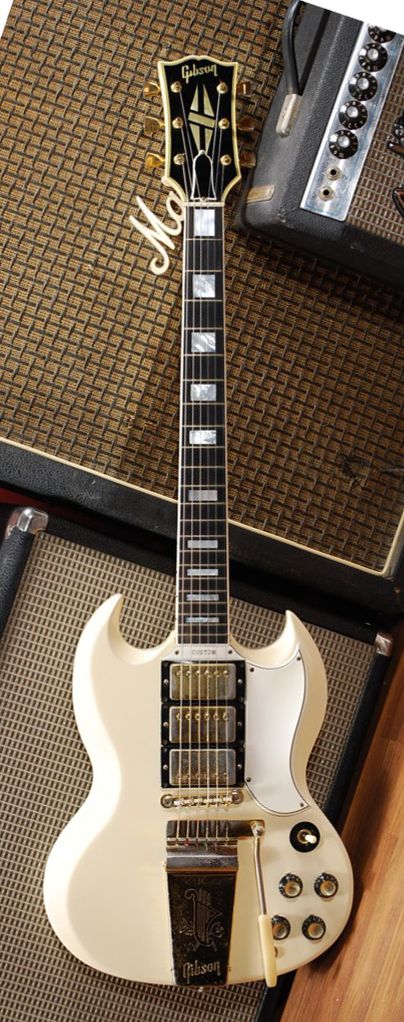
1963 Gibson SG Custom with Lyre Vibrola. Photo by Sellenman; derivative by Clusternote. Licensed under CC BY-SA 3.0. Via Wikimedia Commons. Gibson
SG Custom
1961
White paint, gold hardware, three pickups. Nobody carries this guitar onstage hoping to blend in.
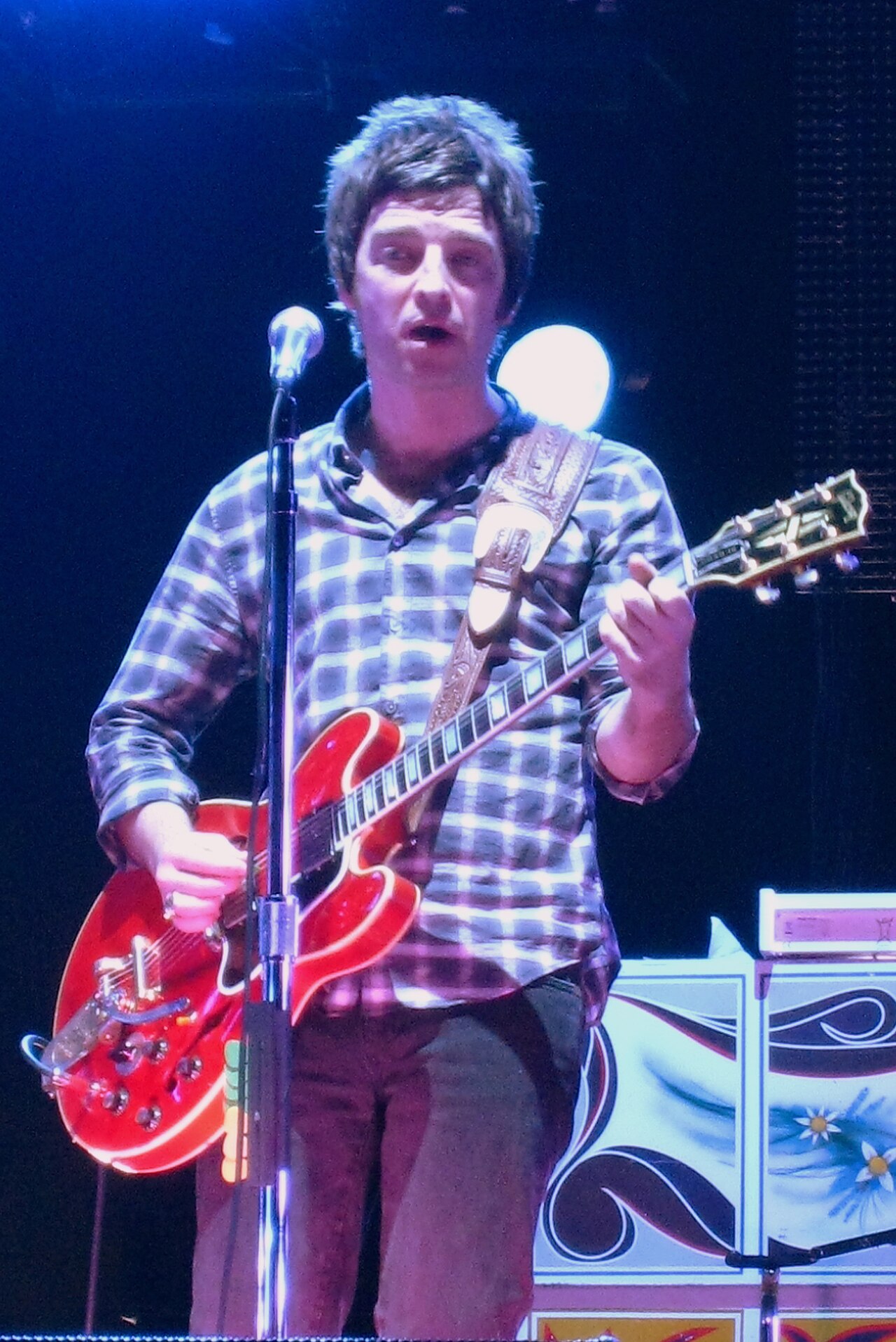
Photo: Anirudh Koul / Wikimedia Commons / CC BY 2.0 Gibson
ES-355
1958
B.B. King ran into a burning dance hall to save a guitar. Every Gibson after it was Lucille too.