Electro-Harmonix
Deluxe Memory Man
A warm, wobbly analog echo, and the kind of box that taught the Edge the repeats could be the beat.
A young Dublin band is cutting its early demos when the guitarist gets his first Memory Man. Within minutes, he says, he’s hearing more than echo. He’s hearing rhythm.
- Introduced
- c. 1978
- Effect
- Delay
The short version
1976
The Memory Man
An Electro-Harmonix ad from December calls it new.
1978
The Deluxe
A four-knob Deluxe with a “squelch” switch comes first, then five knobs and a chorus-vibrato. The dates don’t agree; some put the five-knob version nearer 1980.
1980
Boy
U2’s first album. The Edge’s rig is a Gibson Explorer and a Memory Man, and not much else.
2011
The Whole Love
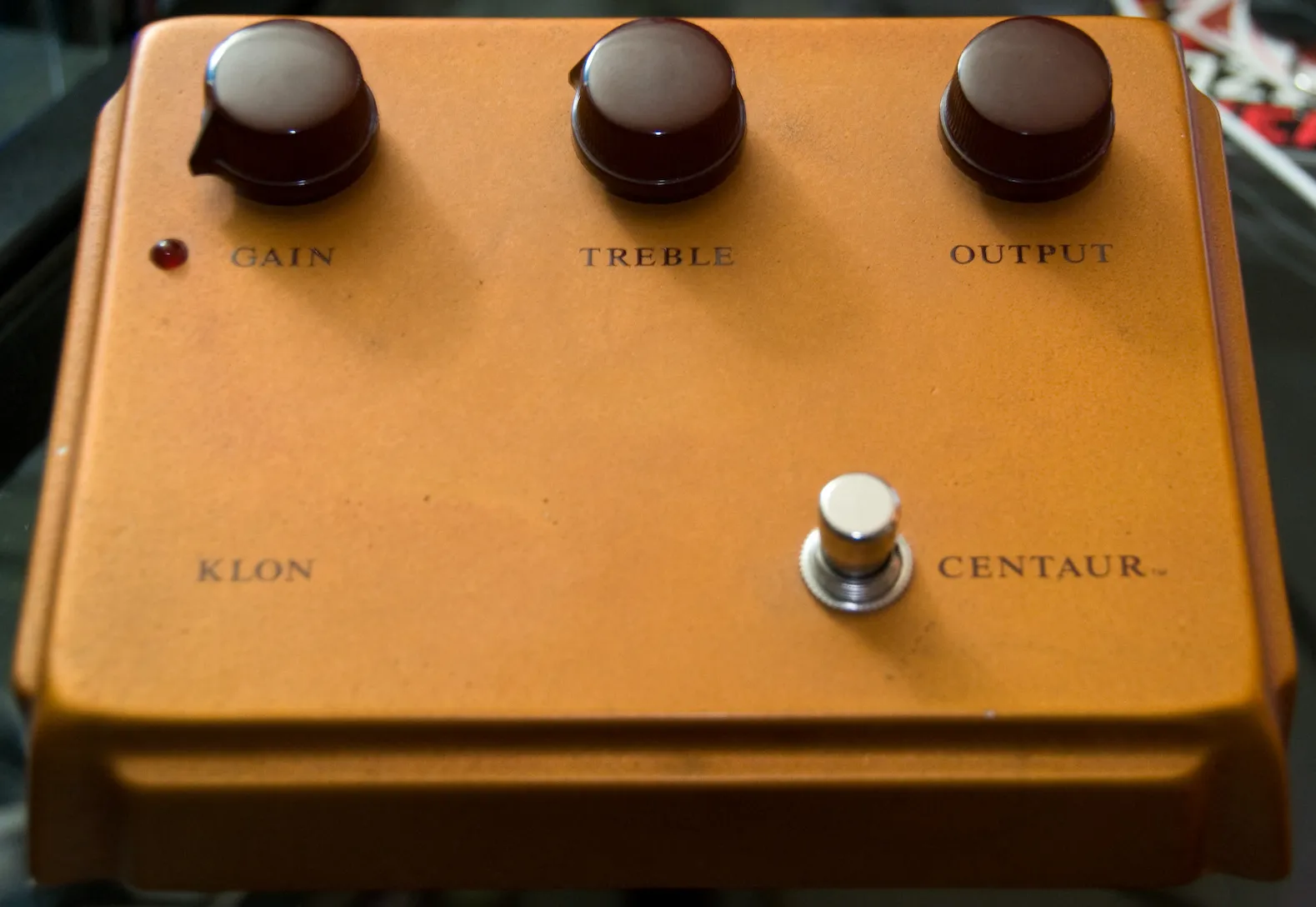
Nels Cline has a Deluxe Memory Man on his Wilco board, next to a Klon Centaur.
Side A
A1
Within minutes
U2 were still cutting early demos when the Edge got his hands on an Electro-Harmonix Memory Man. It didn’t take him long. Here’s how he tells it:
We were cutting some of our early demos when we got our first Memory Man unit... Within minutes, I was drawn not only to the textural qualities of the echo but also the rhythmic possibilities that it suggested.
Look at the second half of that. Most people hear an echo pedal and think of space, a halo around the notes. He heard rhythm. He heard the repeats as something he could play against, like a second guitarist who only ever answered back.
By Boy, in 1980, his rig was small: a Gibson Explorer and a Memory Man echo, and not a lot else. Whether the box on those first records was the Deluxe is where you have to be careful. The Edge just says “Memory Man.” He’s one of the first names people give when they talk about early Deluxe users, and the story goes that it’s on “I Will Follow” and “Sunday Bloody Sunday.” That’s the story. It isn’t a receipt.
A2
A bucket brigade
The Memory Man is an analog delay, and the way it remembers is wonderfully literal. Inside are bucket-brigade chips, a long chain of tiny stages, anywhere from 68 to 4,096 of them, that pass the signal along one to the next like a line of people handing down buckets of water. A clock sets how fast the buckets move, and that sets the delay time.
Early pedals used Reticon chips, later ones Panasonic. Either way, the sound comes out warm and a little grainy, close to tape echo without the tape. That mattered. Before this, echo mostly meant a heavy tape unit with motors and loops to look after. The Memory Man was among the first solid-state pedal echoes, and you could put it on the floor and stand on it.
A3
Five knobs and a wobble
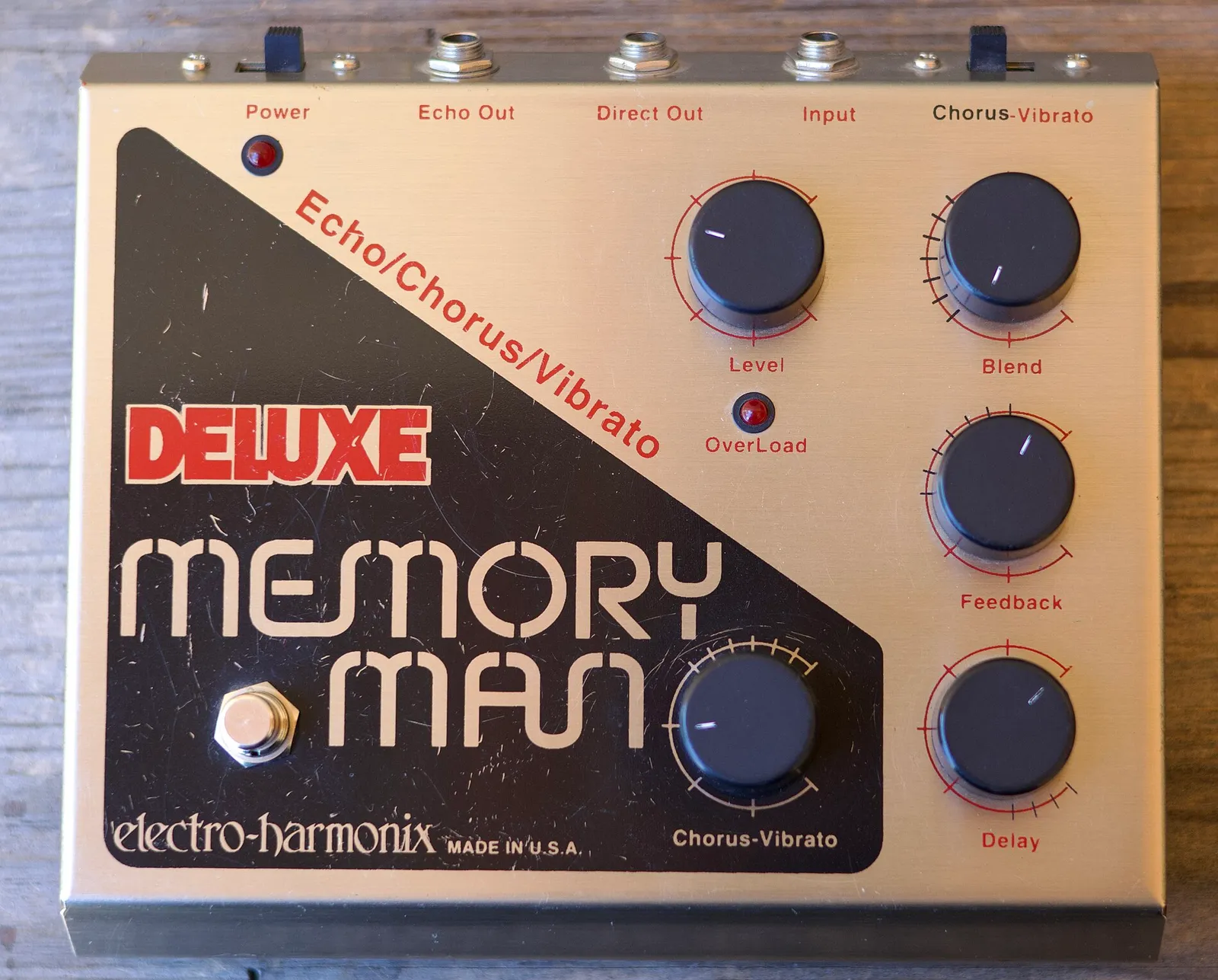
The Deluxe most people picture has five knobs: Level, Blend, Feedback, Delay, and Chorus-Vibrato, with a switch that puts either a chorus or a vibrato on the repeats. That’s the wobble, the slight seasick shimmer on every echo. It has two outputs, Echo and Direct, so you can feed two amps, one wet and one dry. The AC cord is wired straight into the box. There’s an LED to show it’s on and another that lights when you’re overloading it.
The repeats come back a little softer and a little woozier each time, like they’ve been somewhere.
Before that came a four-knob Deluxe, with a “squelch” switch that worked as a noise gate.
Flip the record · By the numbers
5
Knobs on the Deluxe most people picture. Level, Blend, Feedback, Delay, and Chorus-Vibrato.
4,096
The most bucket-brigade stages the signal gets handed through. The fewest is 68.
2
Outputs, Echo and Direct, so one amp can be wet and the other dry.
1976
The year Electro-Harmonix advertised the first Memory Man as new.
Side B
B1
Nobody agrees on the year
When any of this happened is honestly hard to say. The Memory Man line started around 1976; an Electro-Harmonix ad from December of that year calls it new. The four-knob Deluxe came first. People who know the company’s history date one of those to 1978 or 1979, and remember the five-knob version in a 1978 catalog. Others put the five-knob version around the turn of the decade.
Good dates for this stretch are hard to come by. Somewhere around 1978 is as close as anybody honestly gets.
B2
After the Edge moved on
The Edge didn’t stay with it. He moved on to a Korg SDD-3000 and a TC 2290, digital rack units with cleaner repeats, and the later U2 records aren’t Memory Man records.
The pedal kept finding people anyway. Ed O’Brien of Radiohead used one, and so did Alex Turner of Arctic Monkeys. Chris Cornell, Robert Smith, Omar Rodríguez-López, and Jamie Cook are on Electro-Harmonix’s list of users. Nels Cline had a Deluxe Memory Man among his usual pedals on Wilco’s 2011 album The Whole Love, on the same board as a Klon Centaur.
Electro-Harmonix built a family around it: the Stereo Memory Man, the Memory Boy, the Memory Toy, and a digital Stereo Memory Man with Hazarai.
None of that changes what the box does when you switch it on. Play a note and it comes back a step behind you, warm and a little seasick. Then again, softer. Then again. Leave a gap and the repeats walk right into it, in time. A guitarist in Dublin noticed that within minutes, and built his early sound on it.
Put this on
You’ve read about it. Now hear it. Here’s what this pedal sounds like, and what to listen for.
I Will Follow
On Boy the Edge was playing a Gibson Explorer through a Memory Man. The story goes that it was the Deluxe; he himself just says “Memory Man.” Listen with his demo-day line in mind, echo as rhythm and not just space.
Find it on YouTube (opens in a new tab)
The cast
The people who built it, and the players who made it famous.
1980
The Edge
Memory Man, U2’s early records
Heard rhythm in it within minutes, by his own account. Often named as an early Deluxe user, though he only ever says “Memory Man.”
Ed O’Brien
Deluxe Memory Man, Radiohead
One of the later players who picked one up.
Alex Turner
Deluxe Memory Man, Arctic Monkeys
Another of the later players who picked one up.
2011
Nels Cline
Deluxe Memory Man, Wilco
One of his usual pedals on The Whole Love, on the same board as a Klon Centaur.
Often paired with
The pedals and guitars it usually shares a board or a record with.