Klon
Centaur
Bill Finnegan wanted an overdrive you couldn’t hear, and built about 8,000 by hand before he had to stop.
The late 1980s. Bill Finnegan is playing small rooms with a Telecaster and a Twin Reverb, and he can’t turn up. The overdrives he tries change his underlying tone. He wants one that sounds like his amp, played loud, and nothing else.
- Introduced
- 1994
- Effect
- Overdrive
The short version
Late 1980s
Too loud for the room
Finnegan, a Telecaster, a Twin Reverb, and small rooms with volume limits. The overdrives he tries all change his tone.
1994
The Centaur goes on sale
After more than four and a half years of spare-time prototypes with engineer friends, Finnegan starts selling it late in the year.
Mid-1990s
Fred Fenning dies
The MIT-trained engineer who helped build the prototypes is killed in a plane crash. Finnegan later gives him much of the credit.
2008
The original run ends
About 8,000 pedals in fifteen years, every one built, tested, and shipped by Finnegan from home. He starts on the KTR.
2011
On Wilco’s board
Nels Cline names the Centaur among his usual pedals on The Whole Love.
2014
The KTR
A version built for contract manufacturing and easy repair, with a note from Finnegan printed on the box.
2023
Hard to tell apart
A DigiTech Bad Monkey turns out to be hard to tell from a Centaur by ear.
Side A
A1
Too loud for the room
Every working guitarist knows this problem. The amp sounds right when it’s loud. The room wants it quiet.
In the late 1980s Bill Finnegan was playing small rooms with volume limits, a Fender Telecaster into a Twin Reverb, and he wasn’t happy with it. The obvious fix was an overdrive pedal. He tried them, the Ibanez Tube Screamer among them, and he didn’t like what they did to his underlying tone. They added dirt, sure. They also changed the guitar underneath it.
What he wanted was stranger than a better overdrive. He wanted the sound of his own amp being played loud, as if there were no pedal in the chain at all. A box whose whole job was to go unnoticed.
A2
Four and a half years in the spare time
Finnegan had engineer friends, including an MIT graduate named Fred Fenning. Together they built prototypes in their spare time, and kept at it for more than four and a half years. That is a long time to spend on three knobs.
Fenning didn’t get to see what it became. He died in a plane crash in the mid-1990s, and Finnegan later gave him much of the credit for the design.
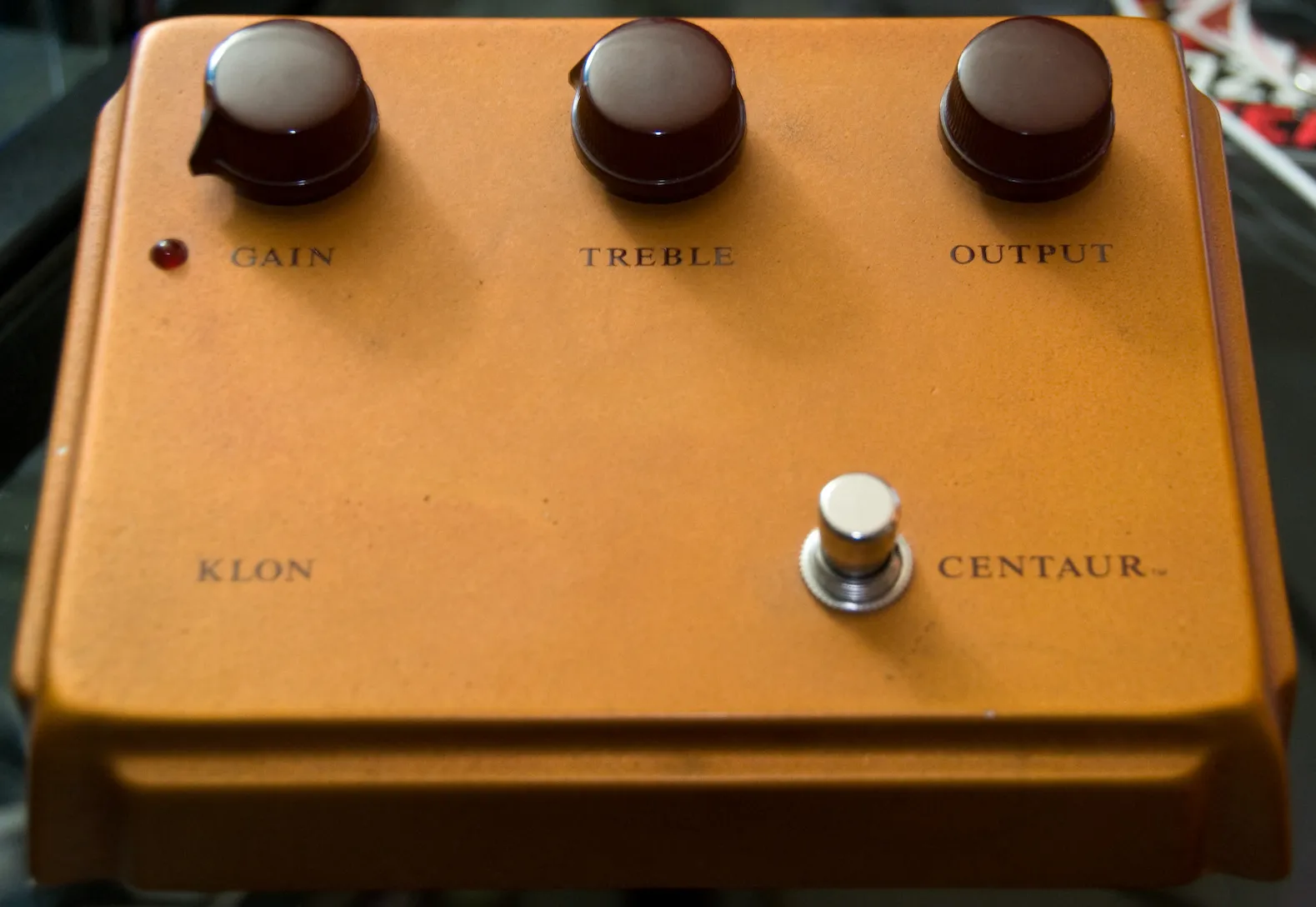
Late in 1994 Finnegan started selling the result. He called it the Centaur. It came in a cast enclosure in bronze, with oxblood lettering and a sword-waving centaur on the front that everybody calls “the horsie.”
A3
How to hide a pedal
Three knobs: Gain, Treble, Output. The interesting part is inside.
First, the Centaur doubles its 9-volt supply to 18 volts, which gives the signal more headroom. Then it splits your guitar three ways. One path goes to the distortion: a TL072 op-amp and a pair of new-old-stock 1N34A germanium diodes. A second path takes the clean low end straight to the output. A third path is clean too, and it fades away as you turn up the Gain.
That’s the trick. At low settings, most of what you hear is still you. As you turn it up, the dirt takes over gradually, and the bass never gets carved out. Most of the grit comes from the op-amp; the germanium only shows itself at the very top of the Gain.
The result is what people came to call a “transparent” overdrive: more gain, not much change in tone. Some ears hear a midrange push and a bit of added thickness in it too. Finnegan meant it to push an amp that was already breaking up, not to be the only dirt on the board. Used his way, you notice the amp, not the pedal.
He also poured epoxy over the circuit board. A circuit like this can’t be patented under U.S. law, so he made it hard to copy instead.
Flip the record · By the numbers
~8,000
Centaurs Finnegan built himself before he stopped in 2008.
12–14
Weeks it took to fill an order.
18
Volts inside. The Centaur doubles its 9-volt supply for more headroom.
3
Paths your signal takes through the circuit, two of them clean.
Side B
B1
One man, at home
For the whole original run, Finnegan built, tested, and shipped every Centaur himself, from home. Every part was custom: the enclosure, the knobs, the pots. Orders took twelve to fourteen weeks to fill.
It never grew into a factory. The margins were thin and commercial space in Boston was hard to justify, so it stayed one man, at home. In 2008 he stopped, after about 8,000 pedals in fifteen years. Finnegan put it bluntly:
“I was going to have to kill it before it could kill me.”
Along the way it found a strange, wide crowd. Jeff Beck, Joe Perry, Matt Schofield, Ed O’Brien. Nels Cline named it among his usual pedals on Wilco’s 2011 album The Whole Love, with his ’59 Jazzmaster as his go-to guitar and a Deluxe Memory Man on the same board. Finnegan said it drew baby boomers, younger indie-rock players, and experimental musicians alike, which is about as broad as a guitar audience gets.
B2
Kindly remember
Finnegan didn’t walk away from the circuit. From 2008 he designed the Klon KTR, a version built for contract manufacturing and easy repair, and it came out in 2014. The one new feature is a switch for buffered or true bypass, designed by Paul Cochrane, who makes the Timmy. Printed on the enclosure is a note from Finnegan:
“Kindly remember: The ridiculous hype that offends so many is not of my making.”
The copies came anyway. The Wampler Tumnus, the Way Huge Conspiracy Theory, the Electro-Harmonix Soul Food, and plenty more. Put them through their paces and they get close, even with silicon diodes in place of germanium, which suggests the sound lives in the circuit’s design more than in any one part. By 2023 a DigiTech Bad Monkey was being shown to be hard to tell from a Centaur by ear. Finnegan, for his part, has argued that klones discourage people from engineering anything new.
He spent four and a half years making a box that would vanish under a player’s hands, and fifteen more building it one at a time. The one thing he never managed to make disappear was the noise around it.
The cast
The people who built it, and the players who made it famous.
1994
Bill Finnegan
Designer and builder
Built, tested, and shipped every original Centaur himself, from home.
Fred Fenning
Engineer, the prototypes
An MIT graduate who worked on the prototypes with Finnegan. He died in a plane crash in the mid-1990s.
2014
Paul Cochrane
Engineer, KTR bypass switch
Maker of the Timmy. Designed the buffered/true-bypass switch, the KTR’s one new feature.
2011
Nels Cline
Wilco, The Whole Love
Named the Centaur among his usual pedals on the record, with his ’59 Jazzmaster and a Deluxe Memory Man on the same board.
Jeff Beck
Centaur player
On a player list that also runs through Joe Perry, Matt Schofield, and Ed O’Brien.
Often paired with
The pedals and guitars it usually shares a board or a record with.
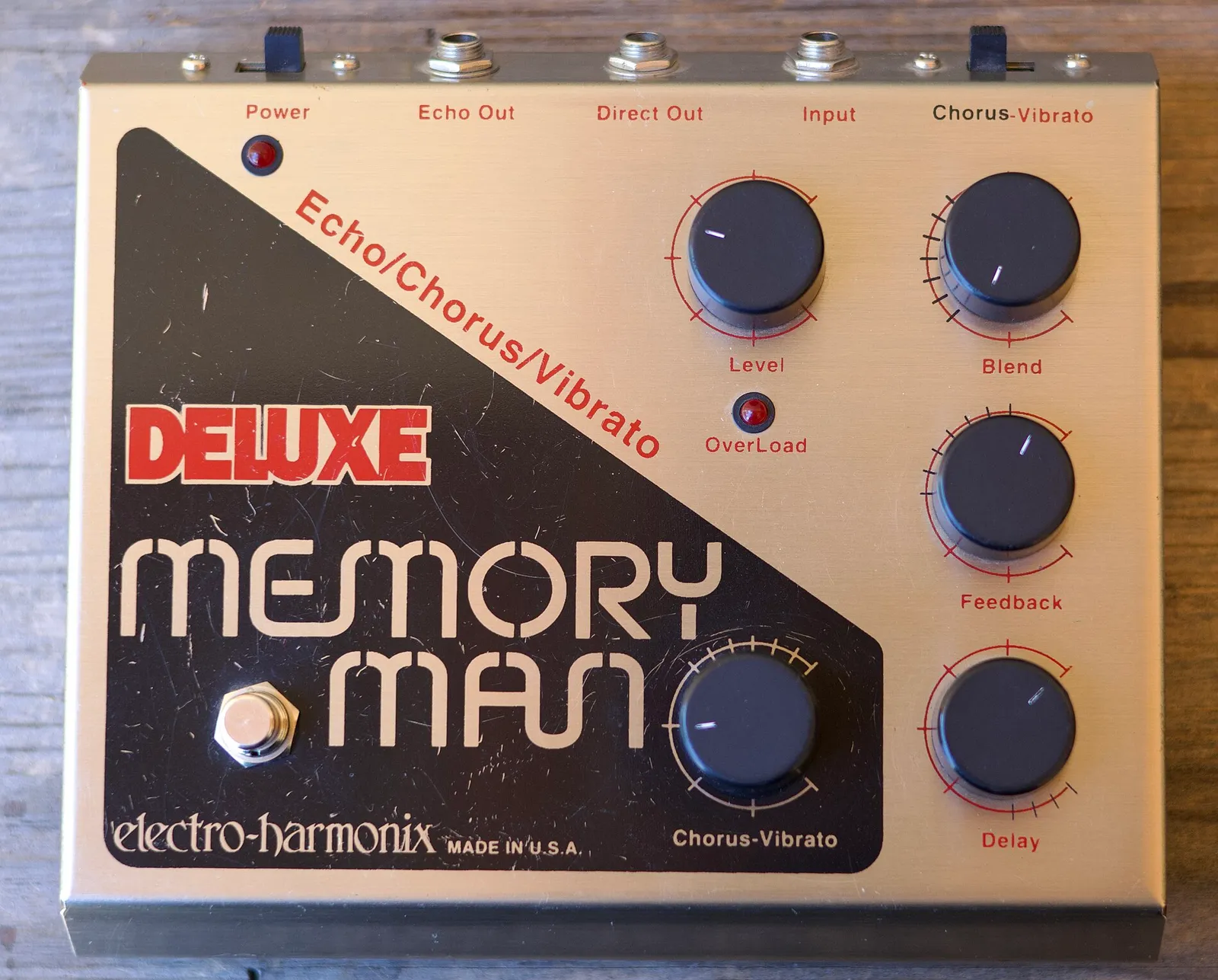
Photo: Bontempi1953 / Wikimedia Commons / CC BY-SA 4.0 Electro-Harmonix
Deluxe Memory Man
c. 1978 · Delay
A warm, wobbly analog echo, and the kind of box that taught the Edge the repeats could be the beat.
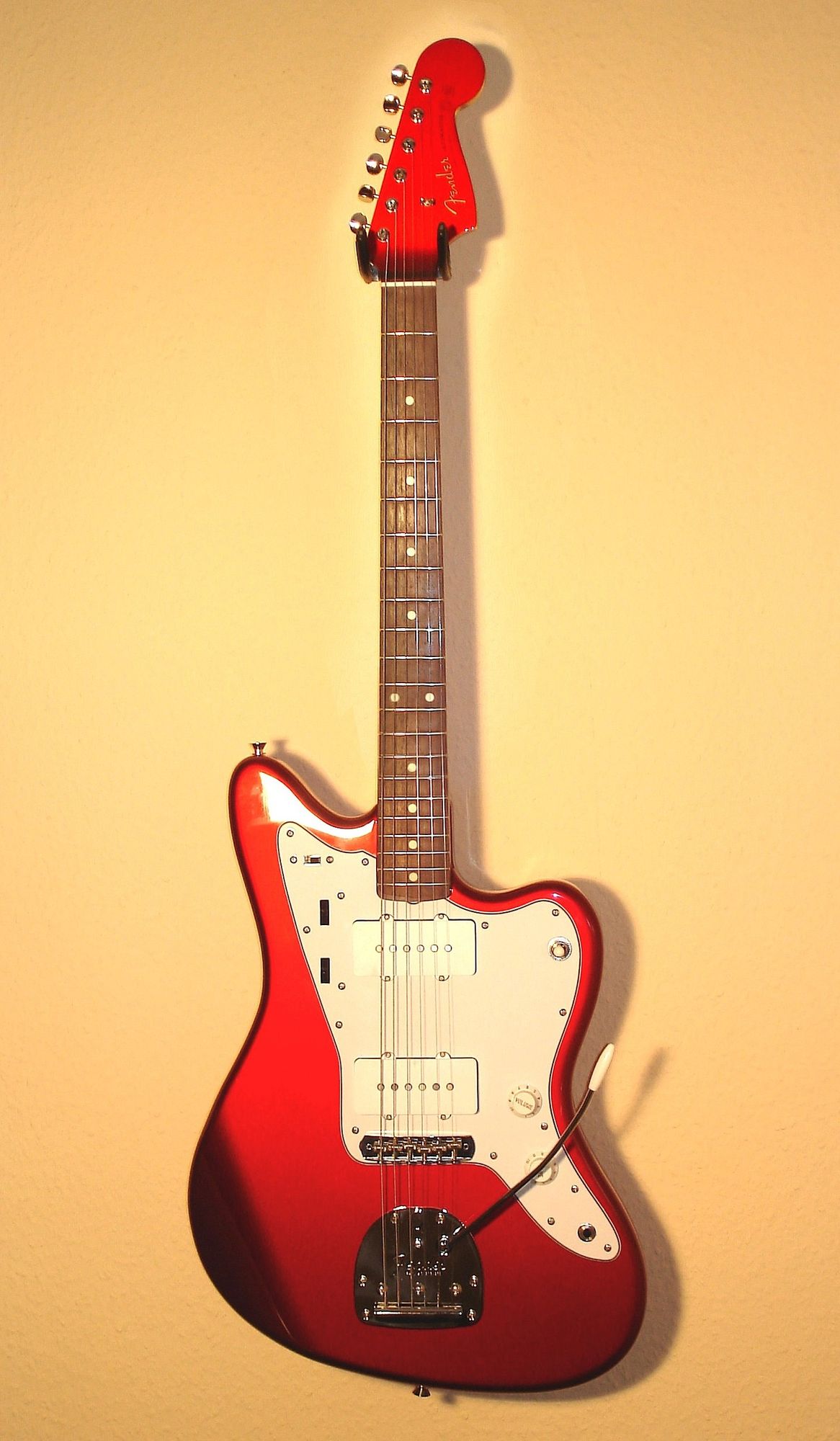
Photo: Dirk-X / Wikimedia Commons / CC BY-SA 4.0 Fender
Jazzmaster
1958
Fender built it for jazz players. Jazz players said no thanks. Surfers, punks, and noise bands said yes.