Electro-Harmonix
Holy Grail
It’s called the Holy Grail, and on “Hey” John Frusciante probably never switched it off.
Electro-Harmonix, Queens. Staff tell Josh Scott there are no prototypes. Then Owen Matthews sends him down to “the basement basement,” and there it is: a box with a stainless steel front plate and “Holy Grail 1, handle with care” written on it in Sharpie.
- Introduced
- 2002
- Effect
- Reverb
No photograph of this pedal yet. Have one? Send a picture
The short version
1968
Electro-Harmonix starts
Mike Matthews launches the company in New York with $1,000.
1984
The company closes
After two bankruptcies, EHX shuts down, and Matthews turns to Russia and Sovtek.
2000
Back to New York, and a chip
Pedal production returns to New York, and at a trade show Matthews sees the chip set the Holy Grail will be built on.
2002
Spring, Hall, Flerb
The finished pedal is reviewed that June and again that August.
2006
Stadium Arcadium
John Frusciante names it on “Strip My Mind” and “Animal Bar,” and probably had it on for all of “Hey.”
2015
The Neo
EHX announces a compact Holy Grail Neo for crowded pedalboards.
2026
Holy Grail 1
Word gets out that Josh Scott has found the prototype in the EHX archives while researching a book on the company.
Side A
A1
Handle with care
The people at Electro-Harmonix told Josh Scott the prototypes didn’t exist. Scott, who runs JHS Pedals and doubles as a pedal historian, was in the company’s archives in Queens, working on a book about EHX called Made on Earth for Rising Stars.
Then Owen Matthews, the founder’s son, sent him down to “the basement basement,” a space EHX used for R&D and for storing tubes.
Down there was a box with a stainless steel front plate. Somebody had written on it in Sharpie: “Holy Grail 1, handle with care.” Inside, by Scott’s account, the wiring was “insane.” He makes a big claim for it, and he’s careful about how he makes it:
This unit, to my knowledge, is the world’s first digital spring reverb unit.
Look at the words on that box. A name borrowed from a medieval quest, and a warning to be gentle. Everything about it says relic, the kind of thing you keep on a shelf and lift down with both hands.
That isn’t where it ended up.
A2
A chip at a trade show
Mike Matthews started Electro-Harmonix in New York in 1968, with $1,000. It didn’t go smoothly forever. The company filed for bankruptcy in 1982, recovered for a while, filed again, and closed in 1984. Matthews went to Russia, founded New Sensor and the Sovtek brand, and from 1992 EHX pedals were made there.
In 2000 he brought production home to New York. That same year, Scott says, Matthews went to a trade show and saw a chip set from Crystal. The appeal was simple: “you can essentially load in their pre-programmed algorithms, and you can mess around with it and tweak it.” Matthews had a pedal made around it.
Don’t let the year fool you. 2000 is the chip and the move back to New York, not the pedal. The finished Holy Grail turns up in reviews in the summer of 2002, in June and again in August. It was one of the new designs that came out of the return, alongside all the reissues.
A3
Spring, Hall, and something called Flerb
There’s almost nothing to it. One knob, a three-way slide switch, a footswitch. The knob sets how much reverb you hear against your dry signal. The switch picks the space.
Spring is modelled on the spring reverb in a combo amp. There’s no actual spring in the box; it’s a digital imitation of one, and a warm, convincing one. Hall is bigger and more orderly, with clear, tight, controlled reflections. Flerb is the strange one: flange and reverb at once, a reverb with a flanger’s whoosh running through its tail. It has the worst name on the switch, a word that sounds like a sneeze.
The original came in a brushed steel case with the jacks and controls mounted on the case and a vintage-style footswitch, and it shipped in a plywood storage box. It ran in mono off the 9V adapter that came with it.
One reviewer at the time conceded the name might be ambitious, but reckoned “Damned Fine Coffee Mug wouldn’t be stretching things too far.” The same review carried one fair caveat: a reverb pedal isn’t at its best in the chain unless you’re playing clean guitar.
Flip the record · By the numbers
3
Reverbs on the slide switch. Spring, Hall, and Flerb, a flanged reverb.
1
Knob. It sets how much reverb you hear.
2
Days Frusciante spent in a studio making Holy Grail demos as a favor, by Matthews’s account.
~70
Pedals in the EHX line by 2011, with the Holy Grail among the popular ones.
Side B
B1
Two days in the studio
Matthews tells a story about John Frusciante. Back when Frusciante was a student, at a NAMM show, Matthews let him try every pedal. Frusciante remembered. Later, as a favor, he spent two days in a studio making Holy Grail demos for him.
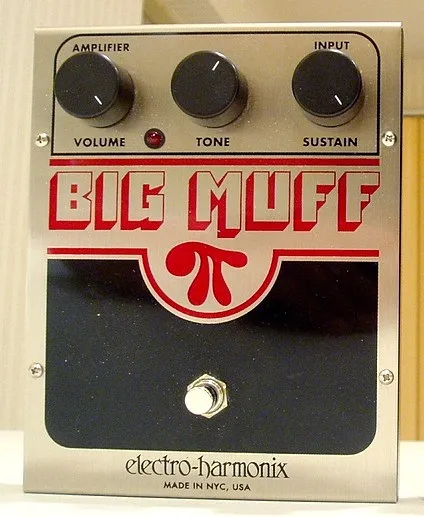
When Stadium Arcadium came out in 2006, Frusciante went through the record track by track, and the Holy Grail keeps turning up. On “Strip My Mind” he puts it plainly: “On the solo I used Electro-Harmonix Big Muff Pi fuzz and Holy Grail reverb pedals.” Fuzz and reverb on the same solo.
“Animal Bar” is stranger. The main part is volume-knob swells, a wah worked “exactly the opposite of how it’s normally used,” and a chorus maxed out in places, with the Holy Grail on its Spring setting.
You’ll hear that he had one as far back as By the Way in 2002. Maybe. No interview we’ve found details the effects on that record. He didn’t say which version he used in 2006, either.
B2
Smaller boxes, same name
The family grew. The Holy Grail Plus added a Room setting. The Max went another way, with Spring, Hall, Reverse, and Plate. In 2015 came the Neo, a compact box for players whose pedalboards had run out of room. The Nano is the small one that runs on a regular nine-volt supply.
Jimmy LaValle of The Album Leaf moved to that one after his first unit gave him “weird ground buzz.” He didn’t lose faith in the idea: “Hands down one of the best reverb pedals available... I have one of these patched into my patch bay for use on anything.” Jim Root had one on his Slipknot board in 2015, which is a long way from The Album Leaf.
By 2011, Matthews counted “about 70 pedals” in the line, “including some very popular ones like the Holy Grail, Cathedral, and the POG II.”
B3
On throughout the song
Put on “Hey.” Ask Frusciante whether the Holy Grail was on, and the answer has a shrug built into it:
No overdubs. I probably had the Holy Grail reverb pedal on throughout the song.
Probably. He spent two days making demos for the thing, and he still can’t say for sure it was ever off. Listen for the space the notes hang in. If he’s right, it never leaves.
The first one came with a warning on it in Sharpie: handle with care. By “Hey,” nobody was handling it at all. It was just on.
Put this on
You’ve read about it. Now hear it. Here’s what this pedal sounds like, and what to listen for.
Hey
No overdubs. In Frusciante’s words, “I probably had the Holy Grail reverb pedal on throughout the song.”
Find it on YouTube (opens in a new tab)Strip My Mind
The solo uses a Big Muff Pi and the Holy Grail, by Frusciante’s own account.
Find it on YouTube (opens in a new tab)Animal Bar
The Holy Grail is set to Spring, with volume-knob swells, a wah used the opposite of the normal way, and a chorus maxed out in places.
Find it on YouTube (opens in a new tab)
The cast
The people who built it, and the players who made it famous.
2000
Mike Matthews
Founder, Electro-Harmonix
Saw the chip set at a trade show and had the pedal made.
2006
John Frusciante
Holy Grail, Stadium Arcadium
Named it on three songs on the record. Matthews says he also spent two days in a studio making Holy Grail demos as a favor.
2015
Jim Root
Holy Grail on the board
Had one on his Slipknot pedalboard, next to MXR Carbon Copy delays, a Micro POG, and a Boss NS-2.
2013
Jimmy LaValle
The Album Leaf
Keeps one patched into his patch bay “for use on anything.”
Josh Scott
Historian, JHS Pedals
Found the “Holy Grail 1” prototype and called it, to his knowledge, the world’s first digital spring reverb.
Often paired with
The pedals and guitars it usually shares a board or a record with.