Electro-Harmonix
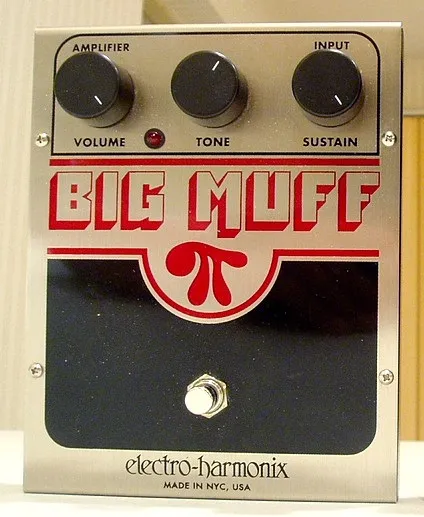
Big Muff Pi
Built to chase Hendrix, it missed, and made the smallest amp in the house sound like a wall.
Manny’s Music, New York, late 1969. The first Big Muffs arrive from a year-old company called Electro-Harmonix, sold as a “distortion/sustainer.” Mike Matthews has always said Jimi Hendrix bought one.
- Introduced
- 1969
- Effect
- Fuzz
The short version
1969
First ones to Manny’s
Hand-built on perf board and sold in New York by the end of the year. For a long time everyone said 1971.
1973
The Ram’s Head
A bigger case, a ram’s head in the corner, and a growlier middle. David Gilmour’s favorite.
1979
“Comfortably Numb”
Gilmour’s Black Strat runs through a Ram’s Head for the solo on The Wall.
1984
Bankrupt
Electro-Harmonix goes under, and the Big Muff stops.
1992
Back from Russia
Matthews revives it through Sovtek. The Russian Muffs come with more bass and nicknames.
1993
Siamese Dream
Billy Corgan stacks an Op-Amp Big Muff into a wall of guitars.
2000
Home to New York
The NYC Reissue, a revised take on a late-’70s model, brings production back.
Side A
A1
The first ones went to Manny’s
The first Big Muff Pis went to Manny’s Music in New York, near the end of 1969. Mike Matthews had founded Electro-Harmonix the year before, and he has always said that Jimi Hendrix walked into Manny’s and bought one soon after they came in. That’s Matthews’s story, and he has stuck to it.
Either way, Hendrix belongs here, because his was the sound they were chasing. Matthews already knew the fuzz business. He’d produced the Foxey Lady for Guild, which was a Mosrite Fuzzrite with a new name on it. Early in 1969 Electro-Harmonix put out a two-transistor pedal called the Muff Fuzz, named for how muffled it sounded. Then Matthews and Bob Myer designed a bigger one with four transistors, and the Big Muff Pi was born.
They were after the fuzz tones of Hendrix and his peers. They missed. What came out was heavier and smoother than the sound they were aiming at, with a sustain that just kept going. And it did one thing nobody had quite asked for: it made a small amp sound huge, at any volume.
When it was born is its own small argument. The very first ones were hand-built on perf board and sold in 1969, with a proper etched-board version early in 1970. For years, though, everyone said 1971.
A2
Clip it, then clip it again
Electro-Harmonix didn’t call it a fuzz. The box said “distortion/sustainer,” and the second word is the important one. Hold a note on a Big Muff and it doesn’t want to die.
Here’s why. There are four transistor stages. The first one takes in your guitar, and that’s where the Sustain knob lives. Then come two identical clipping stages, each with its own pair of diodes, one right after the other. Clip a signal once and it gets rough. Clip it again and it turns thick and saturated, which is how a fairly gentle circuit ends up sounding like a wall.
Between those and the output stage sits the tone control, which blends a low-pass filter with a high-pass one. At noon it scoops out the middle, so you get big lows and a fizzy top with a hollow in between. Three knobs: Volume, Tone, Sustain. On a chord, in a small room, it sounds enormous.
A3
The Ram’s Head and the Black Strat
The Big Muff changed clothes a lot, and every version has its fans. The first was the Triangle, a grey case with black letters and the knobs set in a triangle, smoother and less fuzzy than what came later. From 1973 there was the Ram’s Head, a bigger case with a ram’s head in the corner and a growlier midrange. In 1976 came the red-and-black graphics most people picture.
The Ram’s Head is David Gilmour’s favorite, and you can hear why on “Comfortably Numb.” For the solo his Black Strat went through an MXR Dyna Comp and a Ram’s Head Big Muff, then into Hiwatt amps with a Yamaha rotary cabinet blended in. Listen to how long those bent notes hang there. That’s the sustainer doing its job.
It was supposed to sound like Hendrix. It sounded like a bigger amp than you owned.
Carlos Santana was on one early. Alex Lifeson and Cliff Burton had them too.
Flip the record · By the numbers
4
Transistor stages. The Muff Fuzz that came first had two.
2
Clipping stages, back to back, each with its own pair of diodes.
3
Knobs. Volume, Tone, Sustain.
1992
The year it came back, made in Russia, after eight years out of production.
Side B
B1
Bankrupt in New York, back from Russia
In 1984 Electro-Harmonix went bankrupt, and the Big Muff stopped. That could have been the end of it.
Instead it came back from Russia. In 1992 Matthews revived it through his Russian company, Sovtek, and the Russian Muffs got nicknames: the “Civil War,” the “Green Russian,” the “Black Russian.” They had more bass than the New York ones. Lee Ranaldo and Thurston Moore of Sonic Youth preferred them.
By then the name had gotten into the culture on its own. Mudhoney called their 1988 debut EP Superfuzz Bigmuff. Depeche Mode had an instrumental called “Big Muff” back in 1981. When Nirvana made Nevermind, Butch Vig remembers, “Kurt had a Big Muff... And he had a RAT.” Vig had a Russian Big Muff of his own, though, so who played what on which track is muddy.
In 2000 production came home to New York with the NYC Reissue, a revised take on a late-’70s model.
B2
Everybody’s wall
The late-’70s Op-Amp Big Muff swapped the transistors for op-amps and came out mid-heavy and even more saturated. In 1993 Billy Corgan used one on Siamese Dream. Put the record on and listen to the guitars lock together into one solid sheet of sound.
The list of people who leaned on a Big Muff reads like a tour of loud guitar: the Jesus and Mary Chain, J Mascis, Kevin Shields, Jack White, the Edge. Electro-Harmonix kept spinning it off, too. There’s a Little Big Muff and a Nano, a Metal Muff, a Deluxe, a bass version, a J Mascis signature, and reissues of the Triangle, the Ram’s Head, the Op-Amp, and the Green Russian. In 2025 a Big Muff 2, made with JHS, put an unreleased Bob Myer circuit into a box.
Gilmour’s notes that won’t die and Corgan’s solid sheet have almost nothing in common, except the box on the floor. Matthews and Myer set out to catch somebody else’s sound. What they caught was size, and every player since has filled it with their own.
Put this on
You’ve read about it. Now hear it. Here’s what this pedal sounds like, and what to listen for.
Comfortably Numb
For the solo, David Gilmour’s Black Strat ran through an MXR Dyna Comp and a Ram’s Head Big Muff into Hiwatt amps. Listen to how long the bent notes hang in the air.
Find it on YouTube (opens in a new tab)Siamese Dream
Billy Corgan’s Op-Amp Big Muff is under the record’s wall of guitars. Listen for the layers locking into one solid sheet.
Find it on YouTube (opens in a new tab)
The cast
The people who built it, and the players who made it famous.
1969
Mike Matthews
Founder, co-designer
Started Electro-Harmonix in 1968 and designed the Big Muff with Bob Myer. Says Hendrix bought one at Manny’s.
1969
Bob Myer
Co-designer
Designed the four-transistor Big Muff with Matthews. An unreleased circuit of his became the Big Muff 2 in 2025.
1979
David Gilmour
Ram’s Head Big Muff
His favorite version. It’s on the “Comfortably Numb” solo, after his Black Strat and a Dyna Comp.
1990s
Lee Ranaldo & Thurston Moore
Sovtek Big Muffs
Sonic Youth preferred the Russian ones, with the extra low end.
1993
Billy Corgan
Op-Amp Big Muff
The late-’70s op-amp version, all over Siamese Dream.
1991
Kurt Cobain
A Big Muff, next to a RAT
Butch Vig remembers both at the Nevermind sessions. Vig had a Russian Big Muff of his own, so which one is on which track is anyone’s guess.
Often paired with
The pedals and guitars it usually shares a board or a record with.

Photo: Lightburst / Wikimedia Commons / CC BY-SA 4.0 Fender
Stratocaster
1954
The guitar most people mean when they say “electric guitar.” Designed by a man who didn’t play one.
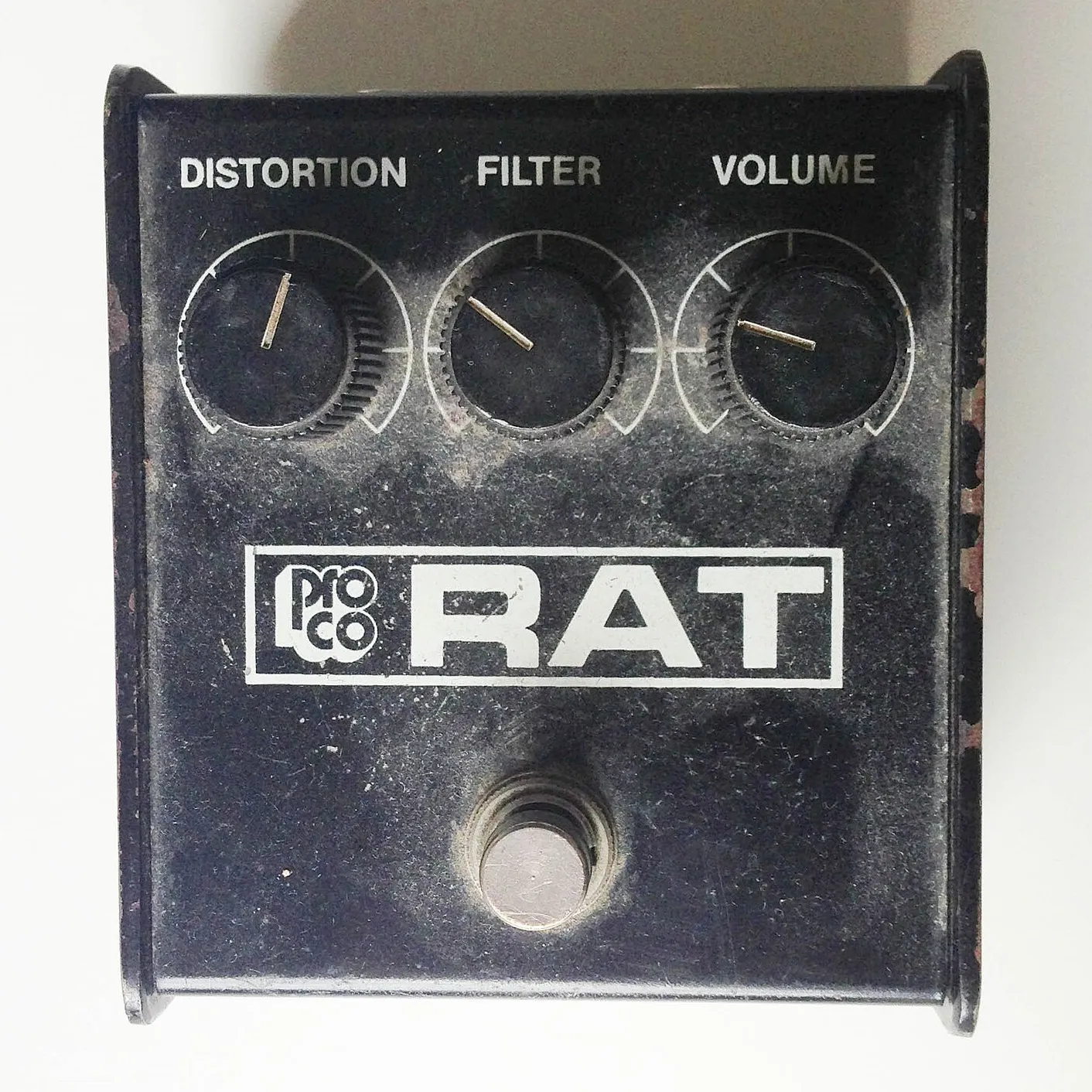
Photo: David Hilowitz / Wikimedia Commons / CC BY 2.0 ProCo
RAT
1979 · Distortion
Named for a basement full of rats, born of a wrong resistor, and at its best plugged in the wrong way.
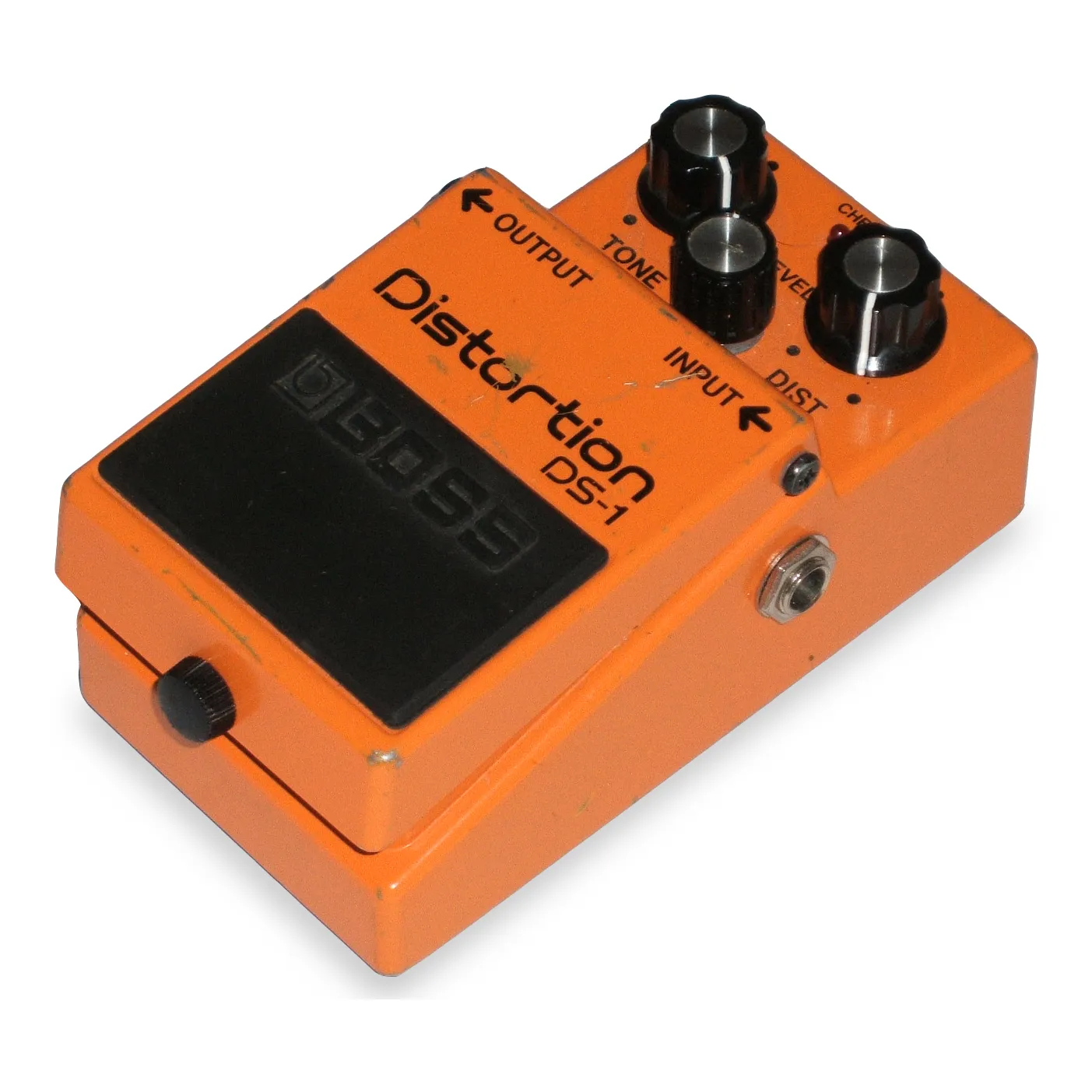
Photo: Matt Eason / Wikimedia Commons / CC BY 2.5 Boss
DS-1 Distortion
1978 · Distortion
The orange box Joe Satriani took on stage as the simplest, smallest, most reliable thing he could find.