Ibanez
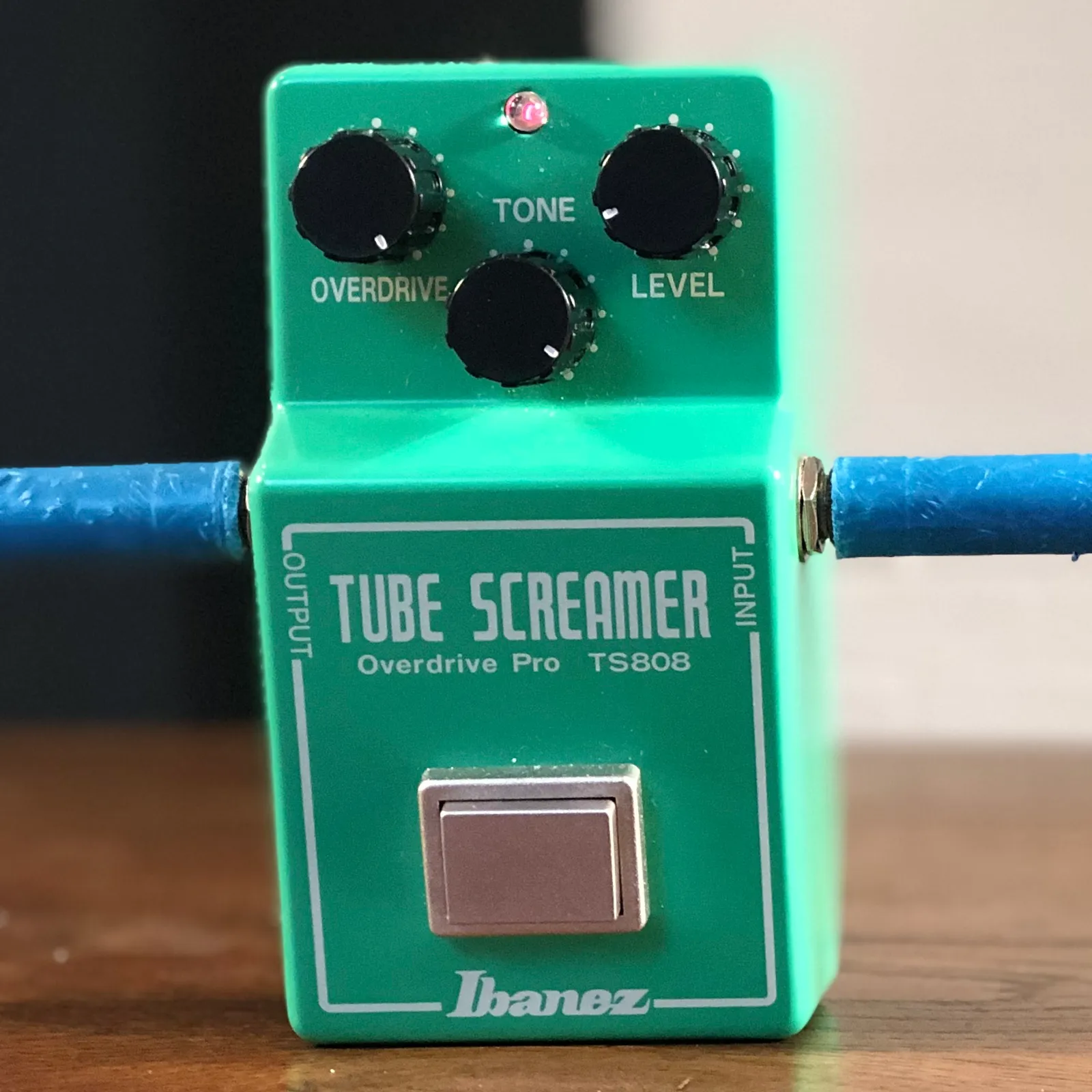
Tube Screamer TS808
Named for a screaming tube amp, and at its best when it hardly screams at all.
Sam Ash Music, Manhattan. Susumu Tamura and the people from Hoshino plug in a little overdrive, and Sammy Ash says it sounds like a “screaming tube amp.” The name sticks. The pedal’s best work turned out to be a lot quieter than that.
- Introduced
- 1979
- Effect
- Overdrive
The short version
Mid-1970s
Ibanez wants an answer
Known for copies of Gibsons, Fenders, and Rickenbackers, Ibanez is adding pedals and wants a rival to the Boss OD-1.
1979
Tamura draws the circuit
Symmetrical clipping and a JRC 4558D chip. Sold as the Maxon OD808 in Japan and, after a visit to Sam Ash in Manhattan, as the Tube Screamer everywhere else.
1981
The TS9 takes over
The TS808 run is usually dated 1979 to 1981. Its successor is nearly the same circuit, a bit brighter.
1982
Texas Flood
Three days in Jackson Browne’s studio, and a Tube Screamer is the only effect. Which model is still argued.
1983
“Turn it on slightly”
Stevie Ray Vaughan says he uses the Tube Screamer for its tone knob.
2008
The hand-wired TS808HW
The first Tube Screamer with true bypass. Maxon, meanwhile, still makes its own OD808.
Side A
A1
A screaming tube amp
Picture the counter at Sam Ash Music in Manhattan. An engineer named Susumu Tamura has come over with the people from Hoshino, the company behind Ibanez, carrying a small overdrive they sell at home as the Maxon OD808. Sammy Ash hears it. It sounds, he says, like a “screaming tube amp.”
Then he makes a pitch. There’s a wah out there called the Cry Baby, he points out, and it’s called that because it sounds like a crying baby. Name the thing for what it sounds like. So the export pedal went out as the TS808 Tube Screamer Overdrive Pro, and a circuit that would be cloned more times than anyone can count had its name.
It’s a great name. It’s also a little misleading. The Tube Screamer was never at its best screaming. The player who did the most to make the name famous, whichever green box he was standing on, used it the way a good cook uses salt.
A2
Built to beat a Boss
In the early 1970s Ibanez was known mostly for copies of Gibsons, Fenders, and Rickenbackers. By the middle of the decade it was getting into pedals, and it wanted an answer to the Boss OD-1.
Ibanez’s pedals were built by Nisshin, the Japanese firm behind the Maxon brand. Nisshin had already made Ibanez an orange “Overdrive” and then the OD-855 Overdrive II, which had the green paint and the square footswitch before the Tube Screamer did.
In 1979 Tamura drew up the circuit. He wanted a pedal that behaved more like an overdriven tube amp, and he was frank about the competition: the Boss OD-1 and the MXR Distortion+. He tested it through a 1968 Fender Twin Reverb and a Vibrolux Reverb, and now and then a Marshall Super Lead.
Two things shaped the sound before anyone heard it. Boss held the patent on solid-state asymmetrical clipping, so Tamura went symmetrical. And he turned down several op-amps as too expensive before settling on a plain little chip, the JRC 4558D. Maxon couldn’t export, so Nisshin sold the pedal at home as the OD808 and Ibanez sold it everywhere else.
A3
The hump in the middle
Three knobs: Overdrive, Tone, Level. That’s the whole control panel.
Inside, two silicon diodes sit in the op-amp’s feedback loop and round off the peaks of your signal, softly and evenly. The circuit blends some of your clean signal back in with the clipped one, which is why it doesn’t flatten you out. Play softly and it backs off. Dig in and it growls.
The real trick is what it does to the frequencies. It trims the bass and pushes the midrange, the famous “mid hump.” That’s the sound of a guitar that doesn’t get lost when the band comes in. Put it in front of an amp that’s already breaking up, and the amp tightens and leans forward. It’s why metal players keep one in front of a high-gain amp to firm up the low end.
It doesn’t add much dirt. It decides where the dirt goes.
Then there’s the chip. The 4558 has a whole mythology, with players hunting for the right one like a lucky coin. People who have taken the circuit apart tend to say the diodes do most of the work and the op-amp matters less than the legend says. Depends who you ask. I’d spend the time on the Tone knob.
Flip the record · By the numbers
3
Knobs. Overdrive, Tone, Level. That’s the whole control panel.
2
Silicon diodes doing the clipping, softly and evenly.
4558
The JRC chip number players hunt for like a lucky coin.
1
Effects on Texas Flood, by its engineer’s count. A Tube Screamer.
Side B
B1
Green boxes everywhere
The TS808 itself didn’t last long. The run is usually dated 1979 to 1981. Then came the TS9, also Tamura’s, nearly the same circuit with a different output stage, a bit brighter and less smooth. The TS10 followed in 1986, part of the Power Series, built with cheaper parts.
After that the family never stopped growing. A TS9 reissue in 1992, the TS9DX in 1998, the TS7 in 1999, a reissued TS808, and in 2008 the hand-wired TS808HW, the first Tube Screamer with true bypass. Maxon still makes its own OD808. Modifiers like Keeley and Analog Man went to work on them, and the clones are past counting.
A lot of the famous Tube Screamer players are really TS9 players: Trey Anastasio with two of them, Gary Moore, Adrian Smith, Joan Jett on a TS9DX. Lee Ritenour helped make the name. But the player everybody pictures standing on one is a Texan with a beat-up Strat.
B2
The only effect on the record
November 1982. Stevie Ray Vaughan and Double Trouble spend three days, the 22nd to the 24th, at Jackson Browne’s studio in Los Angeles and come out with Texas Flood. Vaughan plays mostly his “Number One” Stratocaster, through two Fender Vibroverbs and Browne’s Dumbleland Special.
The engineer, Richard Mullen, kept the effects list short: “The only effect he used was an Ibanez Tube Screamer.” And even that one barely gets a look in. It’s there for the gritty solos on the title track and on “Testify,” and that’s about it.
Now, which Tube Screamer? This is where people get loud. One camp hears a TS808 in the snarl on “Texas Flood,” and on “Testify” too. The other says Vaughan had a TS808 only briefly, from late 1981 into early 1982, that it never made an official release, and that from the middle of 1982 to the middle of 1988 his pedal was the TS9. Nobody has settled it.
What he wanted from it is clearer. Here’s Vaughan in 1983:
“I use the Tube Screamer because of the tone knob. You can turn it on slightly to get a Guitar Slim tone, which is how I use it.”
Slightly. Sammy Ash heard a scream in the thing, and it will scream if you ask. The man who made it famous asked it for a little tone, a couple of solos’ worth, and let the Strat do the talking.
Put this on
You’ve read about it. Now hear it. Here’s what this pedal sounds like, and what to listen for.
Texas Flood
A Tube Screamer was the only effect on the record, and you hear it on the gritty solo. Whether it was a TS808 or the TS9 that followed is still argued.
Find it on YouTube (opens in a new tab)
The cast
The people who built it, and the players who made it famous.
1979
Susumu Tamura
Designer, Nisshin
Drew the circuit to compete with the Boss OD-1 and the MXR Distortion+. He designed the TS9 too.
Sammy Ash
Gave it its name
Heard a “screaming tube amp” at Sam Ash Music in Manhattan and pointed to the Cry Baby as a name that said what it did.
1982
Stevie Ray Vaughan
A Tube Screamer, model argued
The only effect on Texas Flood. Whether that was a TS808 or a TS9 depends who you ask.
1982
Richard Mullen
Engineer, Texas Flood
“The only effect he used was an Ibanez Tube Screamer.”
Lee Ritenour
Tube Screamer
Helped make the name, alongside Vaughan.
Trey Anastasio
Two TS9s
Like a lot of famous Tube Screamer players, a TS9 man rather than a TS808 one.
Often paired with
The pedals and guitars it usually shares a board or a record with.
