Fender
Stratocaster
The guitar most people mean when they say “electric guitar.” Designed by a man who didn’t play one.
Fullerton, California, 1954. Fender already had a hit in the Telecaster, a plank with a neck bolted on. Leo Fender wanted something fancier to put at the top of the catalog. What he came up with is still the shape a kid draws when you ask them to draw a guitar.
- Introduced
- 1954
- Type
- Solidbody electric
- Class
- Production

The short version
1954
Out of Fullerton
A small spring run, a first ad in April, and full production from October.
1957
Buddy Holly on Sullivan
A sunburst Strat on network television. A lot of future guitar players were watching.
1965
CBS buys Fender
The deal closes on 5 January. Collectors still draw a line at that date.
1967
Monterey
Hendrix wrecks one onstage, and the Strat becomes a rock guitar for good.
1969
Woodstock
A 1968 Olympic White Strat and “The Star-Spangled Banner.” It’s at MoPOP now.
1973
Blackie goes on
Clapton debuts his Nashville parts guitar on 13 January.
1977
The five-way switch
After 23 years of players wedging the switch by hand, Fender makes it official.
1983
Texas Flood
Stevie Ray Vaughan and Number One, a Strat assembled from three different years.
Side A
A1
A guitar for people who stand up
The Strat is the most personal guitar there is. Hendrix’s sounds like nobody else’s. So does Clapton’s, and Gilmour’s, and Stevie Ray’s. The strange part is that it was designed to be nobody’s in particular, by a man who couldn’t play it.
Here’s the part people forget: Leo Fender didn’t play guitar. He fixed radios. He built amplifiers. He listened to the people who came into his shop and complained, and then he built the thing they were complaining about not having.
By 1954 they had the Telecaster, and the Telecaster was great. It was also a slab. Corners everywhere, and it dug into your ribs if you played it for four hours in a bar. So the new one got shaved. A cut where your forearm rests. A scoop in the back for your belly. Two horns so you could reach all the way up the neck. Leo called it the Original Contour Body, which is exactly what an engineer would call it.
It went into the catalog as the top of the line, $249.50 with the tremolo. Hold one next to a Tele sometime. The Tele looks like a tool. The Strat looks like it was drawn by somebody who’d seen a car show.
A2
The switch nobody was supposed to use
Three pickups, which was a lot in 1954, and a tremolo that moved the whole bridge instead of just yanking on the tailpiece. Six saddles you could set one by one, so the thing actually played in tune. That tremolo is half the reason the guitar stuck around.
Then players found something Fender hadn’t planned. The pickup switch had three positions. But if you balanced it carefully between two of them, you got two pickups at once and a thin, glassy, quacky sound that’s all over half the records you love. Players learned to find that sweet spot by feel and hope it stayed put.
Fender caught up in 1977 and made the five-way switch standard. That’s 23 years of the customers being right and the factory catching up. Leo would’ve liked that part.
A3
Lubbock, Cork, and a Fiesta Red case
The Strat didn’t need long to find its people. Fender has Buddy Holly buying one at Adair Music in Lubbock in 1955, though the exact year and shop are still argued about. What nobody argues about is 1957, Holly on The Ed Sullivan Show with a sunburst Strat and those thick glasses. A whole generation of kids decided what a guitar looked like that night.
It crossed the Atlantic in a Fiesta Red finish. Cliff Richard ordered a 1959 Strat for his guitarist, Hank Marvin, and that red Strat up onstage with the Shadows is how a lot of British kids first laid eyes on one. In Ireland, a kid named Rory Gallagher bought a 1961 at Crowley’s music shop in Cork in 1963 and played it until the finish was mostly gone. People like to say it was the first Strat in Ireland. His estate hasn’t found proof. I still like the story.
Leo didn’t play guitar. He listened to the people who did, then built the thing they were complaining about not having.
Out in California, Dick Dale was cranking one through the biggest amp he could find on “Misirlou.” He liked to say Leo handed it to him in the mid-’50s. The rosewood board says late 1959. That’s how it goes with guitar stories. The legend and the fingerboard don’t always agree.
Flip the record · By the numbers
$249.50
List price in 1954, with the tremolo. Hardtail was $229.50.
268
Estimated Strats built in the fall 1954 production run. Nobody has an official count.
23
Years players jammed the three-way switch between positions before Fender made a five-way.
3
Different years in Stevie Ray Vaughan’s Number One (a ’63 body, a ’62 neck, ’59 pickups).
Side B
B1
Woodstock, Monday morning
Then Hendrix got hold of one, and nothing about the guitar was ever polite again.
He owned a lot of Strats and he was hard on them. At Monterey in 1967 he destroyed one onstage, and the photos still look like the end of something. Two years later, at Woodstock, he played a different one: a 1968 Olympic White Strat, some call it “Izabella.” By the time he went on, it was Monday morning, 18 August 1969. Most of the crowd had gone home. The people who stayed heard him turn “The Star-Spangled Banner” into sirens and falling bombs on a guitar Leo had designed for country pickers. That Strat is in the MoPOP museum in Seattle now.
B2
The famous ones are all mutts
Here’s my favorite thing about this guitar. The most famous Strats in the world are held together with other guitars’ parts.
Clapton’s “Blackie” came out of a Nashville shop in the early ’70s, where he bought a stack of old used Strats and put the best parts together. It’s usually described as a 1956 black body with a 1957 maple neck. He took it onstage on 13 January 1973 and played it on “Cocaine,” “I Shot the Sheriff,” and “Lay Down Sally” until he retired it after the 1985 tour.
Stevie Ray Vaughan called his “Number One” a ’59, because that’s what the pickups said. When the Fender Custom Shop took it apart in 2003, they found a 1963 body and a 1962 neck. That’s the guitar on Texas Flood. David Gilmour’s Black Strat, the one on the “Comfortably Numb” solo, has had its neck swapped so many times you need a notebook to keep up.
None of that ever mattered. The Strat was built to be taken apart with a screwdriver, and the people who loved it most did exactly that.
B3
Still the default
CBS bought Fender on 5 January 1965, and collectors still split everything into “pre-CBS” and after. The headstocks got bigger, the finishes got thicker, and by the ’70s the guitars were heavier. In 1985 CBS sold the company to a group of investors, and a couple of years later, Fender was building guitars in America again.
You can walk into a store tomorrow and buy a new Strat made in Mexico, in California, or in the Custom Shop. Same horns, same three pickups, same tremolo.
Leo didn’t build a personality into this guitar. He built a blank page: a body you could unscrew, a switch you could cheat, a tremolo you could lean on, and parts you could swap on a kitchen table. Everybody who picked one up wrote their own sound onto it. That’s why the most common electric guitar in the world keeps turning into somebody’s one-of-a-kind.
Put this on
You’ve read about it. Now hear it. Here’s what this guitar sounds like, and what to listen for.
Misirlou
Dale’s Strat, “the Beast,” played as fast and loud as he could make it. This is the surf guitar sound most people hear in their heads.
Find it on YouTube (opens in a new tab)The Star-Spangled Banner (Woodstock)
The 1968 Olympic White Strat, Monday morning, 18 August 1969. Listen to him use the tremolo to make sirens and falling bombs.
Watch it on YouTube (opens in a new tab)Good Times
Nile Rodgers on “the Hitmaker,” a 1960 hardtail Strat. That clean, choppy rhythm is the Strat at its funkiest.
Find it on YouTube (opens in a new tab)Comfortably Numb
David Gilmour’s Black Strat on the solo. Same guitar family as Buddy Holly’s, sounding like a different planet.
Find it on YouTube (opens in a new tab)
The cast
The people, and the specific guitars, that made the legend.
1957
Buddy Holly
Sunburst Stratocaster
Fender has him buying his first one at Adair Music in Lubbock. The Ed Sullivan clip is the one everybody means.
1969
Jimi Hendrix
1968 Olympic White Strat
Woodstock, Monday morning, most of the crowd gone home. The guitar is at MoPOP in Seattle.
1973
Eric Clapton
“Blackie”
A 1956 black body, a 1957 maple neck, built from a pile of used Strats he bought in Nashville.
1979
David Gilmour
The Black Strat
A 1969 he bought at Manny’s in New York in 1970. The solo on “Comfortably Numb.”
1983
Stevie Ray Vaughan
“Number One”
He called it a ’59. The Custom Shop later found a ’63 body and a ’62 neck.
1963
Rory Gallagher
1961 Sunburst Strat
Bought at Crowley’s in Cork and played for the rest of his life, until the paint was mostly gone.
Liner notes
Specs, construction, rarity, value, and every source we used.
Three pickups, a contoured body, and a synchronized tremolo — the layout most players still mean by “electric guitar.”
- Body
- Alder or roasted pine; double-cutaway, contoured
- Neck
- Bolt-on maple, Deep “C”
- Fingerboard
- Maple or rosewood, 9.5" (241 mm) radius, 22 narrow-tall frets
- Scale
- 25.5" (648 mm)
- Pickups
- Three V-Mod II single-coils
- Hardware
- 2-point synchronized tremolo, cold-rolled steel block
- Electronics
- Master volume, two tones, 5-way, treble-bleed
- Finish
- Gloss urethane body, satin neck
- Nut
- Bone
Open the full research fileConstruction details, the complete player record, production numbers, dated value estimates, and sources
Current American Professional II. A 1954–mid-1960s guitar used different wood, 21 frets, a 3-way switch, nitro, and a six-screw tremolo. Player II (Mexico): 22 medium-jumbo frets, 1.650" nut, gloss polyester, Alnico V Player pickups.
Construction
By 1954 the Telecaster was already Fender’s working bolt-on. Leo put a second guitar on the line that spring as the new top of the catalog, tremolo and hardtail. First known ad: April 1954 International Musician. A small pre-production run began that month. Full-scale production began in October. Vibrato listed at $249.50, hardtail $229.50. Guitar Center, citing Forrest White, treats production-model status as beginning 13 October 1954; earlier 1954 examples as pre-production or artist instruments.
The point was comfort and range the Tele did not have. Leo called the body Original Contour Body: forearm cut, belly cut, double cutaway. Four-screw maple neck (Fender notes “bolt-on” is technically screws). 21 small frets. Kluson tuners. Eight-screw single-ply white guard. Bodies typically two to four pieces. Guitar Center and guitarhq.com put early production on solid ash, with alder standard from mid-1956 except blonde. Edgewater’s February 2026 guide says 1954 sunburst was alder.
Three single-coils gave it a vocabulary the Tele did not. Guitar Center’s original recipe says Alnico III; Edgewater says “Alnico III or V.” Master volume, two tones on neck and middle, bridge typically untamed on vintage wiring, 3-way blade. Players jammed the switch between positions. Factory 5-way arrived in 1977. 250 kΩ pots typical. Black-bottom pickups to March 1964, grey-bottom after.
The synchronized tremolo is the other half of why the guitar stuck: six-screw fulcrum, inertia block, springs in a rear cavity, individual height and intonation saddles. Hardtails were catalog from the start.
Then the instrument changed in the player’s hands. One-piece maple neck with integral maple board and walnut skunk stripe through 1958. Slab rosewood from mid-1959. Thin round-laminate rosewood veneer from about August 1962. Nut 1-5/8" (“B”); A/C/D special-order from 1962. Profiles: chunky “D” 1950–55, “V” 1956–57, smaller “D” from 1958. Truss rod at the heel. Eleven-screw multi-ply guard from 1959. Butterfly string tree from mid-1956. Two-tone sunburst 1954–57, three-tone from 1958. Custom Duco at a 5% upcharge. Nitrocellulose through 1967 (guitarhq.com). Thicker poly around 1968–69. guitarhq.com has polyester 1968–1980; True Vintage Guitar calls it a 1968–69 nitro-to-polyurethane transition. Individual instruments straddle it.
CBS bought Fender on 5 January 1965. Large Strat headstock late 1965. Three-bolt neck, micro-tilt, and bullet truss on many 1971–80 Strats. CBS sold Fender to William Schultz’s investors in March 1985. U.S. production resumed in Corona in 1987, Custom Shop the same year.
The table above is American Professional II. Player II (Mexico) is the high-volume spec, alder / chambered ash / mahogany. American Vintage II is the year-dated nitro reissue. Three current ways to buy the same silhouette.
Players
The Strat became a rock guitar almost as soon as it left Fullerton. Buddy Holly bought one in 1955. Fender has him at Adair Music in Lubbock. Sullivan, 1957, is the clip people mean, and Fender ties the locked-wrist downstroke to “Peggy Sue.” Year and shop of that first guitar are not fully settled. Hank Marvin took a 1959 Fiesta Red, serial 34346, ordered by Cliff Richard, to Britain. Dick Dale’s Beast is the one on “Misirlou” (1962). Dale told a mid-1950s Leo-handed-it-over story. Rosewood board and tech inspection put it late-1959.
Then Hendrix. He owned many. At Monterey in 1967 he destroyed one. Woodstock, 18 August 1969, is a different guitar: a 1968 Olympic White, sometimes called “Izabella,” including “The Star-Spangled Banner,” now at MoPOP.
Clapton made two of them famous, years apart. Brownie is a 1956, bought 7 May 1967 at Sound City in London, on the cover of the 1970 Eric Clapton album and associated with Derek and the Dominos’ “Layla.” Blackie is the later one, an early-1970s Nashville parts guitar, typically a 1956 black body with a 1957 maple neck, assembled after a Sho-Bud haul. Live debut 13 January 1973. Fender associates it with “Cocaine,” “I Shot the Sheriff,” “Lay Down Sally.” He retired it after the 1985 Behind the Sun tour.
The later famous ones are still this guitar, lived in. David Gilmour bought a 1969 at Manny’s in 1970. Christie's has the Comfortably Numb solo on The Wall from Super Bear, 1979, on that repeatedly re-necked object. Stevie Ray Vaughan’s Number One, also First Wife, carried Texas Flood (1983). A 2003 Custom Shop exam (Guitar World, 2019) found a 1963 body, 1962 neck, and pickups from a 1959, which is why he sometimes called it a ’59. When he got it, 1973 or 1974, is not pinned here.
Rory Gallagher bought a 1961 from Crowley’s in Cork in 1963 and played it for the rest of his life. “First Strat in Ireland” is repeated. The estate has not found conclusive proof. Nile Rodgers’s Hitmaker is a 1960 hardtail with a 1959 neck, later painted Olympic White, documented on Chic (“Le Freak,” “Good Times”). Buddy Guy is known to play the model without a single canonical guitar.
Rarity
You can buy a new Strat tomorrow. Player, American Professional, Vintage II, signatures, and Custom Shop all coexist. Custom Shop is the limited current line. It is not vintage rare.
The 1954 guitar is scarce because almost none were made. Official 1950s–60s factory model totals were never published. Neck-plate serials were shared across models and overlap years, so they date a guitar, they don’t count a year. What we have are serial guesses. Spring first run: fewer than 200 (True Vintage Guitar; Guitar Center Riffs notes reports of ~200 leaving the factory that spring). Fall regular production: 268 (guitarhq.com / precbsstratocasters.com), excluding earlier pre-production. The same sources note unconfirmed speculation of as many as ~1,300 Strats in all of 1954. guitarhq: “No one really knows the exact number of 1954 Strats manufactured.” Keep both the <200 spring figure and the 268 fall figure. Neither is a factory total. By 1966, True Vintage Guitar cites more than 5,000 examples per year.
First-year and custom-color examples are the scarce end of pre-CBS (1954–early 1965). Blackie, Brownie, the Black Strat, Hitmaker, Number One, Gallagher’s 1961 are unique objects. They are not a vintage Strat.
Value
Informal estimate, 25 August 2026. Not an appraisal.
A new one is ordinary money. New street: Mexico Player II about $840–$1,000. US American Professional II about $1,840. American Vintage II about $2,500–$2,600. Custom Shop team-built commonly $4,200–$5,500 new. Used modern: Reverb Price Guide snippet on used Player-series about $400–$600 (2018+).
A 1970s CBS Strat is already a different market. AxeDB mixed-condition sold medians: about $2,700 (1971–75) and $1,800 (1976–80). Dealer excellent-original for those years is higher (Edgewater: $4,000–$8,000 / $2,500–$5,000).
Pre-CBS is where the guitar’s scarcity shows. Asking prices are not sold prices. Dealer excellent-original retail can sit about 2× mixed-condition marketplace medians. Original finish vs refinish, and provenance, can double or halve a result (refinish often ~half). Reissues and Custom Shop copies do not substitute for 1950s–60s originals.
Vintage / collectible. AxeDB mixed-condition sold medians (toward 2025): 1954–58 maple-board ~$19,000; 1959–62 slab ~$15,000; 1963–64 veneer ~$14,000; 1965–67 ~$12,000. On Reverb, 61% of 1954–58 sales closed below ask. Joe’s Vintage Guitars, July 2026, excellent-original sunburst (dealer ask): 1954 $85,000–$275,000; 1955 $50,000–$80,000, stepping down to 1960–65 $15,000–$45,000. True Vintage’s working sunburst retail is lower at the top (spring 1954 $60,000–$125,000; late 1954 $50,000–$75,000). VG 2026 guide lists 1954 at $250,000–$350,000 at the extreme clean/early-production end, not a typical sale. Original custom-color 1955–59: dealer $45,000–$200,000+. Mary Kaye (blonde + gold): VG 2026 research cites 37 factory examples 1956–64. The 1956 promo guitar auctioned at $227,500. That is one object. 1954–58 sold samples are small. Do not average AxeDB launch-era medians with $200k+ dealer queens.
Artist-owned examples are a separate market: Gallagher 1961, Bonhams London 17 October 2024, £889,400 / ~$1.16M including premium; Gilmour Black Strat $3.9M (2019) and $14.5M (2026).
See also
Sources
- The history of the Fender Stratocaster: the 1950s — 1954 introduction, April ad, October full-scale production, original prices, tremolo design.
- 15 Stratocaster players for the ages — Holly, Hendrix (Monterey/Woodstock), Clapton/Blackie, Gilmour/Black Strat.
- Stratocaster or Telecaster — 1954 Strat vs 1951 Tele; Holly on Sullivan 1957; 5-way later institutionalized.
- Not Fade Away: Buddy Holly — 1955 Adair Music purchase; “Peggy Sue.”
- Iconic Mods: Blackie — Sho-Bud haul, parts guitar, 13 January 1973 debut.
- American Professional II Stratocaster — current U.S. spec; August 2026 list ~$1,840.
- Player II Stratocaster — Player II woods, 22 frets, Alnico V, 2-point tremolo.
- Fender Stratocaster changes 1954–1965 — year-by-year; Forrest White on October 1954; original recipe; alder 1956; rosewood 1959; CBS 5 Jan 1965.
- guitarhq.com Fender — woods, necks, finishes, tuners, 5-way 1977, nitro vs poly.
- guitarhq.com 1954 Stratocaster — 268 fall regular-production estimate; serial-guess caveats.
- Pre-CBS Stratocasters, 1954 — fall 1954 regular-production 268; unpublished factory total.
- True Vintage Guitar: Stratocaster dating and value — year value table; <200 first-run claim; refinish haircut; custom-color premiums.
- Joe’s Vintage Guitars: Vintage Stratocaster value guide — July 2026 dealer excellent-original bands.
- AxeDB: The Vintage Stratocaster Market — 4,121 solds; mixed-condition medians (April 2026).
- Edgewater Guitars 2026 value guide — February 2026 vintage ranges.
- Vintage Guitar: 40 Most Valuable Guitars of 2026 — 1954 Strat $250k–$350k extreme; Mary Kaye configuration count 37.
- MoPOP: Clapton 1956 Stratocaster (Brownie) — 7 May 1967 Sound City purchase.
- Christie's: Gilmour Black Strat — Comfortably Numb / Super Bear.
- Guitar World: SRV Number One — 1963 body / 1962 neck / 1959 pickups (4 January 2019).
- Rory Gallagher 1961 Stratocaster — Crowley’s 1963 purchase; Ireland-first claim unproven.
- Premier Guitar: Nile Rodgers Hitmaker — 1960 hardtail / Chic productions (2022).
- Premier Guitar: The Dick Dale Wiring — The Beast; late-1959 dating vs Dale’s mid-1950s story.
- Guitar World: Buddy Guy on the Stratocaster — known-to-play (18 July 2024).
- Bonhams: The Rory Gallagher Collection — 17 October 2024; 1961 Strat £889,400 / ~$1.16M.
- Fender American serial dating — shared/overlapping numbers, not model totals.
- Guitar World: 25 Stratocaster players — Hendrix, Clapton/Blackie, Gilmour Black Strat auction figure.
- Sweetwater American Professional II Stratocaster — Am Pro II street snapshot.
- Sweetwater Player II Stratocaster — Player II spec; 1.650" nut.
- Reverb American Professional II Stratocaster — typical-new / used listing snapshots.
- Reverb: the vintage Strat market by the numbers — older sold-data essay (CBS drop-off); do not treat its dollar figures as 2026.
- Fender Nile Rodgers Hitmaker materials (Fender video / Stories Collection) — Hitmaker as 1960 hardtail / 1959 neck.
- Vintage Guitar: Eric Clapton's Blackie
- Vintage Guitar: Fender's First-Gen Stratocaster (Gruhn)
- Guitar Player: Gallagher Strat to National Museum of Ireland
- Guitar Center: Nile Rodgers salutes 70 years of the Strat
- Yahoo: original Mary Kaye Strat $227,500 — 1956 promo guitar auction; configuration is not a model average.
Keep digging
Guitars this one gets compared to, confused with, or descended from.
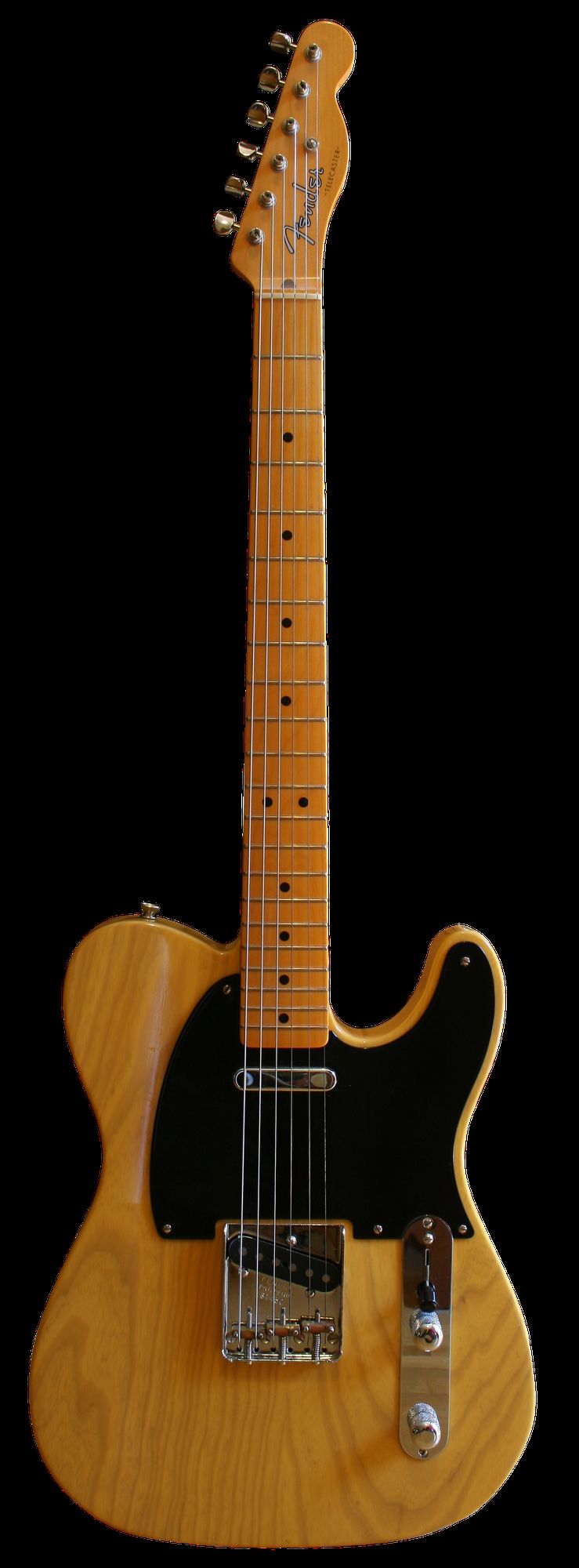
Fender Telecaster American Vintage 1952 with transparent background. Photo by Massimo Barbieri. Licensed under CC BY-SA 3.0. Via Wikimedia Commons. Fender
Telecaster
1950
Leo built it like a tool. The famous ones look like they just clocked off a double shift.
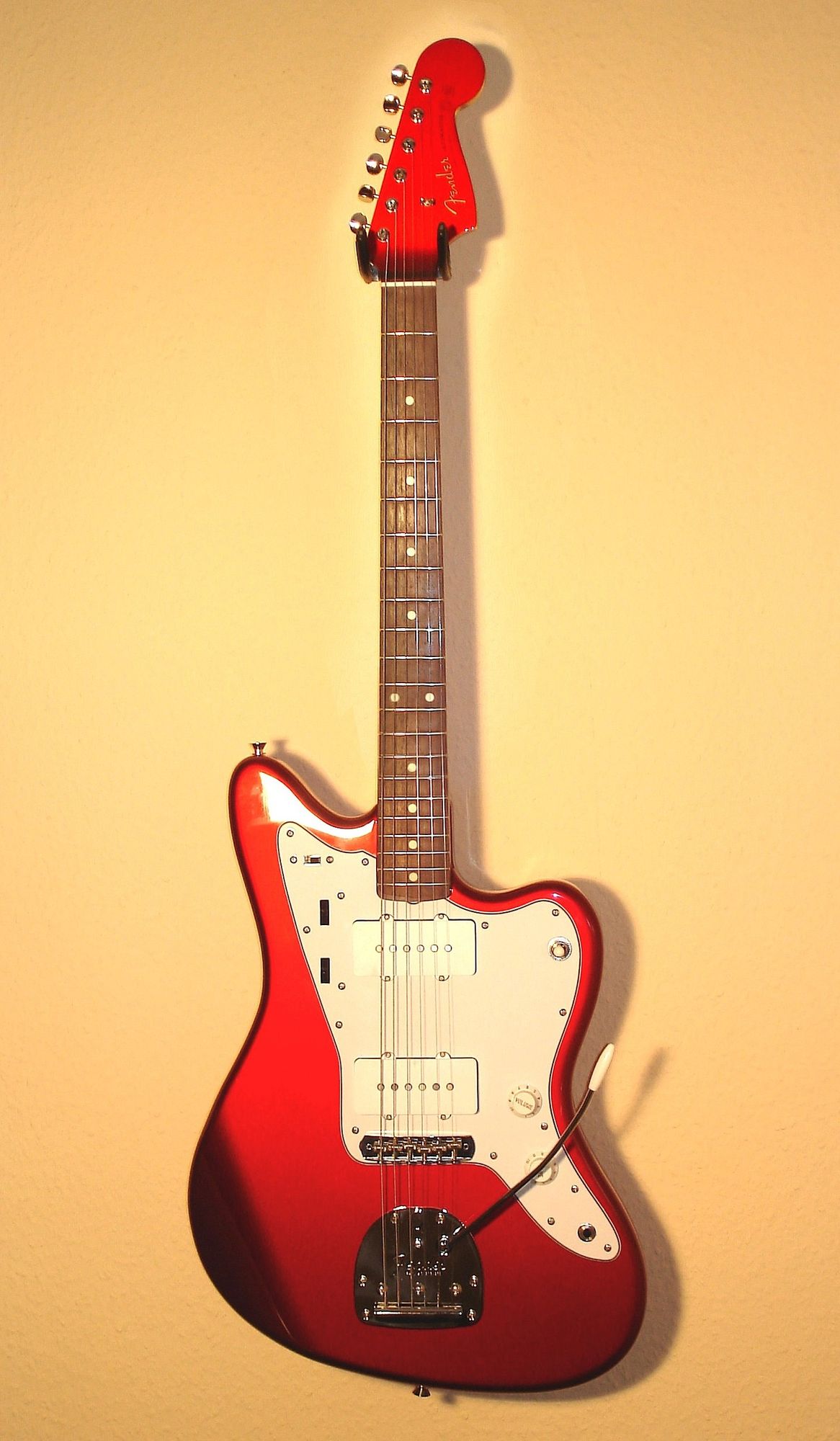
Photo: Dirk-X / Wikimedia Commons / CC BY-SA 4.0 Fender
Jazzmaster
1958
Fender built it for jazz players. Jazz players said no thanks. Surfers, punks, and noise bands said yes.

Photo: Infrahertzz / Wikimedia Commons / CC BY-SA 3.0 Fender
Precision Bass
1951
Leo’s bass let the player at the back be heard. You know their lines by heart. You mostly don’t know their names.