Ibanez
Destroyer
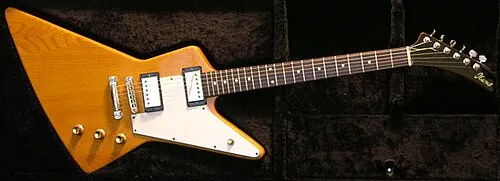
Ibanez copied the Explorer, right up until Gibson sued. Eddie Van Halen got a sound out of it nobody could copy.
1977. Van Halen are about to make their first album, and about half of it will go down on a Japanese copy of a Gibson Explorer that Eddie has painted white. The same year, Gibson takes Ibanez’s American distributor to court over its copies.
- Introduced
- 1975
- Type
- Solidbody electric
- Class
- Production
The short version
1975
“Explore the Destroyer”
Ibanez’s Explorer-shaped copy arrives, built at the FujiGen factory in Japan.
1976
Paul hands it to Ace
A Destroyer goes from Paul Stanley’s hands to Ace Frehley’s.
1977
Gibson sues
Gibson goes to court over Ibanez’s copy designs.
1978
Half a debut
Van Halen’s first album comes out. By now the straight copies are gone from the catalog.
1980
Destroyer II
A new outline and the goosebeak headstock. Some sources say it arrived for 1981.
1984
Phil Collen’s set-neck
The high-end DT-555 becomes the Def Leppard guitarist’s model.
2016
Last call
The last year of a standard Destroyer guitar in the Ibanez catalog.
Side A
A1
A copy you could actually buy
In the late 1950s Gibson drew three guitars that looked like they belonged at a car show: the Flying V, the Explorer, and the Moderne. The Explorer barely shipped. The Moderne never really got past a patent drawing.
By the mid-1970s Hoshino, the Japanese company behind Ibanez, was already selling American shapes built at the FujiGen factory and shipped to the States through Elger. Then it went after the whole modernistic set. The Rocket Roll was the V. The Futura came off the Moderne’s patent drawing. And in 1975 the Destroyer was the Explorer, with a tagline that didn’t exactly hide it: “Explore the Destroyer.”
It was a copy, and it was supposed to be a copy. The shape was borrowed. Hold on to that.
A2
Ash, sen, or korina? Depends who you ask
Nobody can quite agree what the 1975 guitar is made of. The catalog said selected solid ash with a finish called African Korina, which is a cheeky name for a finish, since korina was the wood on Gibson’s original. The period ads just said African korina. One longtime writer looked at the bodies and called them sen, a wood that gets described as a kind of mahogany. All three stories are still in circulation. I’m not picking one.
What isn’t in dispute is the recipe. A glued-in maple neck, 22 frets on rosewood, a 24¾-inch scale, and a pair of Super 70 humbuckers into a stop tailpiece. That’s a Gibson way of building a guitar: thick, loud, and sustaining. Two volume knobs, one master tone, a three-way switch. No whammy bar at all.
A3
Half of a debut album
Here’s where the copy stops mattering.
Eddie Van Halen had one. Whether it was his main guitar from 1975 or he got it in 1977, just before the band made its first record, depends who you ask. By the time the tape rolled it was painted white, with the Super 70s still in it, and it’s on about half of that 1978 debut: “Runnin’ with the Devil,” “You Really Got Me,” “Jamie’s Cryin’,” “Feel Your Love Tonight,” “On Fire.”
Put on “Runnin’ with the Devil” and listen to the very start. That metallic scrape is Eddie raking the strings between the bridge and the tailpiece, the little stretch of string nobody is supposed to play. Then there’s the stutter in the “You Really Got Me” solo. He turned the neck pickup’s volume all the way down and flicked the selector, so the sound cut in and out. Two volume knobs and a toggle, turned into an instrument.
Nobody at Gibson or Ibanez designed that scrape. It lives in the little stretch of string behind the bridge.
Not long after the album, Eddie got out a saw and cut a V-shaped chunk out of the body below the bridge. That’s the Shark, the guitar on the cover of Women and Children First in 1980. It looks fantastic. By most accounts, the surgery hurt the tone.
Flip the record · By the numbers
3
Late-’50s Gibson “modernistic” shapes Ibanez went after in the mid-’70s. The Destroyer was the Explorer.
$450
What a Destroyer listed for in 1977.
24¾"
Scale length. The Gibson number, a touch slinkier under the fingers than a Fender.
~½
Roughly how much of Van Halen’s 1978 debut was played on one.
Side B
B1
Paul gave it to Ace
Kiss had one too. Photos put a Destroyer in Paul Stanley’s hands by late February 1976, and then in Ace Frehley’s. Stanley remembered it as “essentially a korina wood Gibson Explorer copy that I gave to Ace.”
Kiss also put out an album called Destroyer in 1976. That’s a title, not a guitar credit, and a confusing one if you’re searching old photos.
B2
Sued into something new
In 1977 Gibson sued Ibanez’s American distributor over its copy designs. The straight Destroyer was gone in 1977 or early 1978, depending on which book you trust. Ibanez was already drawing its own guitars by then, the Artist, the Musician, the Iceman.
The name came back around 1980 or 1981 as the Destroyer II, with the outline changed enough to keep the lawyers home: a little bill on the treble horn, a stepped bottom edge, and the goosebeak headstock that would become Ibanez’s own. Around 1983 or 1984, depending who you ask, Phil Collen of Def Leppard got the high-end set-neck DT-555, shaped a little more like a Dean ML, with a V-notch cut in the tail. It was his main guitar into the Pyromania tour.
After that the Destroyer drifted in and out of the catalog for decades. The last standard Destroyer guitar was in 2016. You can’t order a new one from Ibanez today.
B3
The part nobody could copy
Gibson could come after the shape, and by 1978 the straight copy was gone. That was fair enough. The shape was Gibson’s.
But nobody could take the scrape at the start of “Runnin’ with the Devil” to court, or the stutter in “You Really Got Me.” Those came from a kid in a bar band poking at the parts of a guitar nobody else bothered with. Plenty of guitars look like an Explorer. That noise, on that record, came out of the Japanese copy.
Put this on
You’ve read about it. Now hear it. Here’s what this guitar sounds like, and what to listen for.
Runnin’ with the Devil
That metallic scrape at the very start is Eddie raking the strings between the bridge and the stop tail, on the white Destroyer.
Find it on YouTube (opens in a new tab)You Really Got Me
Listen for the stutter in the solo. Neck volume turned all the way down, then Eddie flicks the pickup selector back and forth.
Find it on YouTube (opens in a new tab)Jamie’s Cryin’
Another debut track cut on the Destroyer. No whammy on this guitar, so what you hear is fingers and a loud amp.
Find it on YouTube (opens in a new tab)
The cast
The people, and the specific guitars, that made the legend.
1977
Eddie Van Halen
A Destroyer, painted white, later the Shark
Played it on about half the first Van Halen album. Then he cut a chunk out of the body.
1976
Paul Stanley
A korina-look Destroyer
Had one in his hands by early 1976, then gave it to his bandmate.
1976
Ace Frehley
The one Paul gave him
Kiss’s lead guitarist, on the receiving end.
1984
Phil Collen
DT-555 Destroyer II
His main guitar into Def Leppard’s Pyromania tour. A Destroyer, not a Dean, whatever the notch in the tail suggests.
Liner notes
Specs, construction, rarity, value, and every source we used.
Ibanez’s 1975 Explorer-shape with Super 70s and a stop tail — Destroyer, not a JEM, not an RG550.
- Body
- Selected solid ash (1976 Golden Oldies catalog); sen in Vintage Guitar. Angular Explorer-shape. Mix flagged.
- Neck
- Set 3-piece maple
- Fingerboard
- Rosewood, pearloid dots, 22 frets
- Scale
- 24¾" / 628 mm. Mix flagged.
- Pickups
- Super 70 humbuckers, chrome covers, black rings
- Hardware
- Harmonic-o-matic, stop tail, Smooth Tuner Star machines, chrome
- Electronics
- Two volumes, master tone, 3-way
- Finish
- African Korina (catalog name for the translucent natural)
- Nut
- Factory unpublished this pass. Dealer listing 1.65" (Flash Flood, modified 1975). Mix flagged.
Open the full research fileConstruction details, the complete player record, production numbers, dated value estimates, and sources
Classic living example = FujiGen 2459 (1975–early 1978). No current typical guitar SKU this pass: Ibanez wiki last standard Destroyer guitar 2016; ibanez.com USA Destroyer page not found 1 September 2026. Destroyer bass is not this guitar. JEM and RG550 stay on their plates. Not a Gibson Explorer SKU.
Construction
The job was a copy you could actually buy. Gibson’s 1958 Explorer had barely shipped. By the mid-1970s Ibanez, through Hoshino and Elger, was already selling American shapes from FujiGen. Vintage Guitar (Willie G. Moseley): in the mid-’70s the company went after the late-’50s “modernistic” trio. Rocket Roll took the V. Futura took the Moderne patent drawing. Destroyer took the Explorer. Tagline, Ibanez wiki: “Explore the Destroyer.”
This plate starts in 1975. Michael Wright, Vintage Guitar: debuted circa 1975. Ibanez wiki and Guitar World (Chris Gill, 14 July 2022): 1975. Model 2459. An earlier mahogany 2459 that same year is a short first body, not a second encyclopedia object; the living original is the “African Korina” 2459.
Catalog wood is selected solid ash with an African Korina finish (Golden Oldies pamphlet, via Axeology; Ibanez wiki). Period ads said African korina. Vintage Guitar: the bodies looked like ash and were sen, “a type of mahogany.” Ibanez wiki keeps all three. Do not pick a winner. Set 3-piece maple, rosewood dots, 22 frets, 24¾" / 628 mm, Super 70 pair, Harmonic-o-matic and stop, white/black/white guard, star tuners. Side jack. That is the 1975 guitar.
It is not a JEM. It is not an RG550. Those are 1987 superstrats — monkey grip and claw on one, Wizard/Edge/HSH mass sibling on the other. Destroyer is an Explorer-shape from twelve years earlier. Rocket Roll and Futura stay off this slug. Iceman is a different original. Do not file this as a Gibson Explorer SKU: different company, different factory, different headstock, different name.
1977: Gibson sued Elger over copy designs. Direct copies were gone by 1978 (Gill; Ibanez wiki: discontinued early 1978). Blue Book puts the halt in 1977. Keep both. Ibanez was already moving to Artist, Musician, Iceman.
Wright: 1980, Destroyer II. Wiki: introduced for 1981. Keep both. The silhouette was altered so the lawyers would stay home — a bill on the treble horn, a stepped bottom, and the goosebeak headstock Wright says would become the company’s trademark head. Bolt-on DT50 and set-neck flame-maple-on-mahogany DT400 in that first wave (Blue Book). Set-necks from those years are the ones Wright calls exceptionally fine.
1984: Wright dates the high-end set-neck DT-555 Phil Collen model, “modeled a little more after the Dean ML” — Explorer with a V notch in the butt. Ibanez wiki lists DT555 1983–85. Keep Wright’s 1984 naming and the wiki span. That year the line rolled into the X Series. Star-shaped DT-250 / DT-350 cousins are the same catalog family, not the 1975 object. Wright on a 1985 DT-250: basswood, Powerocker, V5 pair; Transparent Red with a red maple board. Superstrat was already eating the pointy years. DT-250 lasted 1984–85.
Later catalog returns are revivals on this name, not a second slug: 1995–96, 2000–2005, 2009–11, 2013–16. Last standard guitar year on the wiki is 2016. Mike D’Antonio MDB models are basses. No living guitar SKU found this pass.
Classic vs current: 1975–78 FujiGen 2459 — ash or sen, Super 70s, stop, korina-look finish — against no new Destroyer guitar you can order from Ibanez in 2026.
Players
Do not recruit JEM or RG550 users. Vai is JEM. Gilbert is RG/PGM. Satriani is JS.
Eddie Van Halen (Van Halen). The player this guitar still means. Gill, Guitar World July 2011 (Van Halen News Desk reprint): about half of the 1978 debut — “Runnin’ with the Devil,” “You Really Got Me,” “Jamie’s Cryin’,” “Feel Your Love Tonight,” “On Fire.” The metallic scrape on the “Runnin’ with the Devil” intro is strings between bridge and stop; the “You Really Got Me” solo stutter is neck volume at 0 and the selector. Gill 2022: a main guitar 1975 through 1977, including about half the debut. Guitar.com (7 May 2024): he got it in 1977, just before the August–October sessions. Keep both arrival years. At record time the body had been painted white; Super 70s still in. Shortly after the album he cut a V-chunk below the bridge — the Shark. Gill: the experiment hurt the tone. Women and Children First (1980) cover is the Shark; the parts on that record were borrowed from Chris Holmes. The EVH Striped Series Shark (NAMM 2019) is an EVH-brand replica, not an Ibanez SKU.
Phil Collen (Def Leppard). Wright: DT-555 from 1984, his high-end Destroyer II. Wiki: main guitar into the Pyromania tour. Stay on this plate. Not a Dean ML, even if the butt notch rhymes.
Ace Frehley (Kiss). Axeology quotes Paul Stanley: an Ibanez Destroyer, “essentially a korina wood Gibson Explorer copy that I gave to Ace.” Photos put it in Paul’s hands by late February 1976, then Ace’s. The 1976 Kiss album Destroyer is a title, not this guitar. Wikipedia’s Unmasked-tour DT300 for Stanley is not pinned here.
Rarity
No current Destroyer guitar SKU. Factory does not publish 2459 or series totals. None invented.
The original 1975–78 2459 is finite because the copy run ended with the lawsuit, not because Ibanez numbered it like a JEM777 LNG. Wright’s 1,432 is a DT-250 worldwide figure, not a Destroyer census and not a 2459 count. Destroyer II was regular early-’80s production; later DT420 / DT520 were import catalog, now discontinued. Eddie’s Shark and Collen’s DT-555 are unique objects. They are not a vintage Destroyer.
Value
Informal estimate, 1 September 2026. Not an appraisal.
Ask vs sold labeled. Celebrity lots are not-comps. No invented medians or factory counts.
New street. No living Ibanez Destroyer guitar cart this pass. Sweetwater DT420 and DT520FM: no longer available. Musician’s Friend DT520: unavailable. Do not quote those stale list prices as 2026 street.
Used modern. Later DT420 / DT520 / DT200 sit below original 2459 money. Reverb Price Guide widget for those SKUs did not print a clean band this pass. Don’t invent a midpoint.
Vintage / collectible. Reverb Price Guide snippet on a 2459 listing: $3,485–$5,601. Named ask this pass, modified example: Flash Flood 1975 2459 $4,734.45 (from $5,260.50) — wraptail and DiMarzio Super Distortions, not stock. Equipboard used available $5,260.50 (updated 30 July 2026). Named sold: $4,999 (1975 2459, Reverb sold listing). Destroyer II DT400 (1981–82) Reverb guide $1,235–$2,672 on 20 orders Good to Mint; named solds include $1,700 and $1,750 (November 2025, Very Good) and $1,500 (15 June 2025). That DT400 tape is not a 2459 tape.
Bernie Marsden’s 1976 2459, Gardiner Houlgate 11 June 2024, £6,500 against a £3,000–£5,000 estimate — artist-associated lot, not a street comp. Eddie’s Shark is a unique object. It is not a vintage Destroyer.
See also
- ibanez-jem — 1987 monkey-grip superstrat; not this Explorer-shape
- ibanez-rg550 — 1987 mass sibling of the JEM; not this guitar
- ibanez-iceman — 1975 angular original; not this Explorer-shape
- gibson-explorer-1958-korina — the 1958 original this copied; not a Gibson SKU on this plate
Sources
- Vintage Guitar, Willie G. Moseley, Ibanez Destroyer — mid-’70s modernistic trio; sen vs ash; 2459B 1977 list $450
- Vintage Guitar, Michael Wright, Ibanez Destroyer II — circa 1975 debut; 1980 Destroyer II; goosebeak; 1984 DT-555 Collen / ML notch; DT-250 1984–85; 1,432 DT-250
- Guitar World, Chris Gill, 50 years of Ibanez in the USA — 1975 Rocket Roll Sr. and Destroyer; EVH 1975–77 and about half the debut; copies gone by 1978; Destroyer series in the early-’80s catalog
- Guitar World / Van Halen News Desk, Chris Gill, Search and Destroy, July 2011 — debut-album tracks; scrape and stutter; white paint; Shark cut; Holmes WACF
- Guitar.com, The gear used by Eddie Van Halen on Van Halen I — 1977 arrival; Super 70s; named non-tremolo tracks
- Ibanez wiki, 2459 — 1975–78 FujiGen; ash / sen / korina split; Super 70; 24¾" / 628 mm; discontinued early 1978
- Ibanez wiki, Portal: Destroyer series — 1975–78, 1981–87, later revivals; last standard guitar 2016
- Ibanez wiki, Destroyer series — “Explore the Destroyer”; Destroyer II 1981; X Series 1983
- Axeology, Ace Frehley 2459 — Golden Oldies selected solid ash / African Korina finish; Stanley quote; February 1976 photos
- Blue Book, Ibanez Destroyer Series — 2459 Explorer copy; halt 1977; Destroyer II 1980; DT50 / DT400
- Reverb, Ibanez 2459 X-Style Guitar — 1975–78; 24.75"; Flash Flood ask $4,734.45 / $5,260.50; nut 1.65" on that modified example
- Reverb, Ibanez DT400 Destroyer 1981–1982 — guide $1,235–$2,672 / 20 orders; named 2024–25 solds
- Equipboard, Ibanez 2459 — used $5,260.50 (30 July 2026)
- Gardiner Houlgate, Bernie Marsden 1976 2459 — 11 June 2024; sold £6,500; estimate £3,000–£5,000; artist lot
- Sweetwater, DT420 — no longer available
- Sweetwater, DT520FM — no longer available
- Musician’s Friend, DT520 — unavailable
- Wikipedia, Ibanez Destroyer — 1975 introduction; EVH 2459 / Shark on WACF cover
Keep digging
Guitars this one gets compared to, confused with, or descended from.
Ibanez Jem 7VWH vertical. Photo by Rachmaninoff; upright derivative by GreyCat. Licensed under CC BY-SA 4.0. Via Wikimedia Commons. Ibanez
JEM
1987
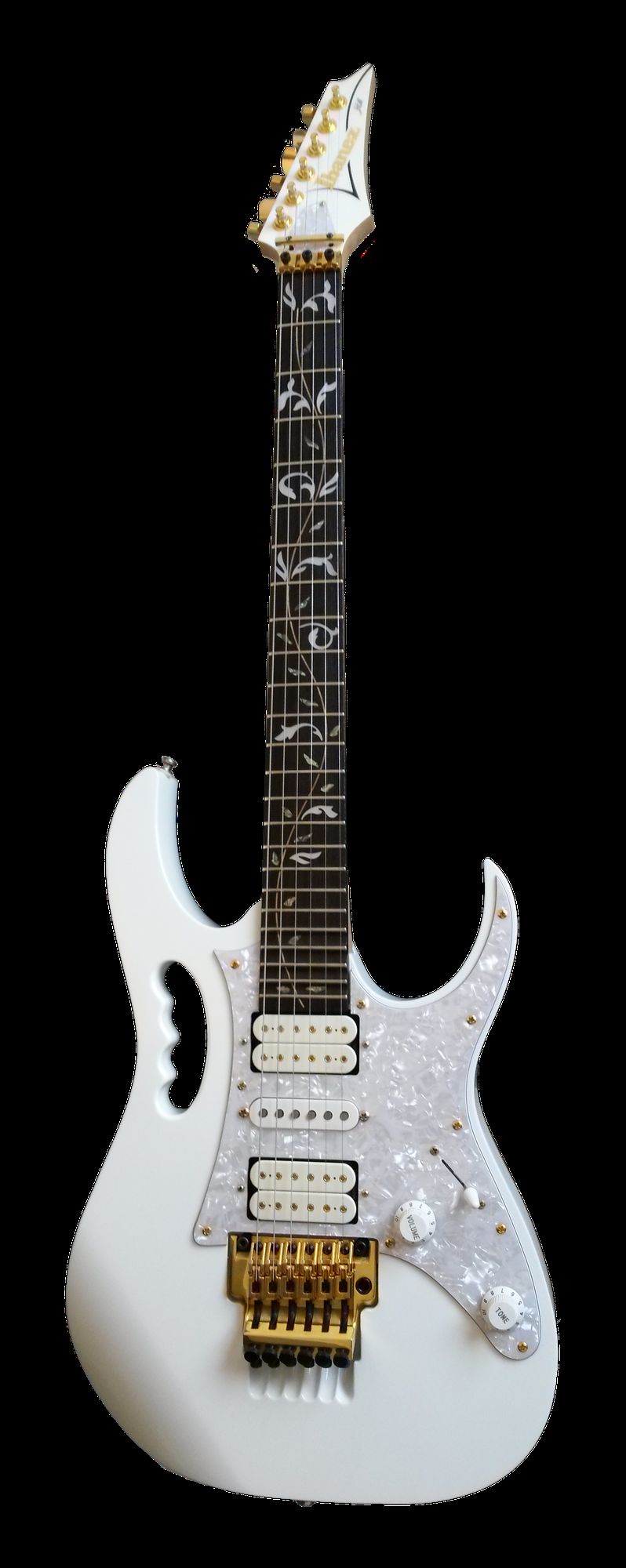
Steve Vai wanted a handle through the body and a finish that matched his curtains. Ibanez put it in the catalog.
- Send a picture
Ibanez
RG550
1987
Nobody’s name on it. Just a thin neck, 24 frets, and a locking trem, and it keeps coming back.
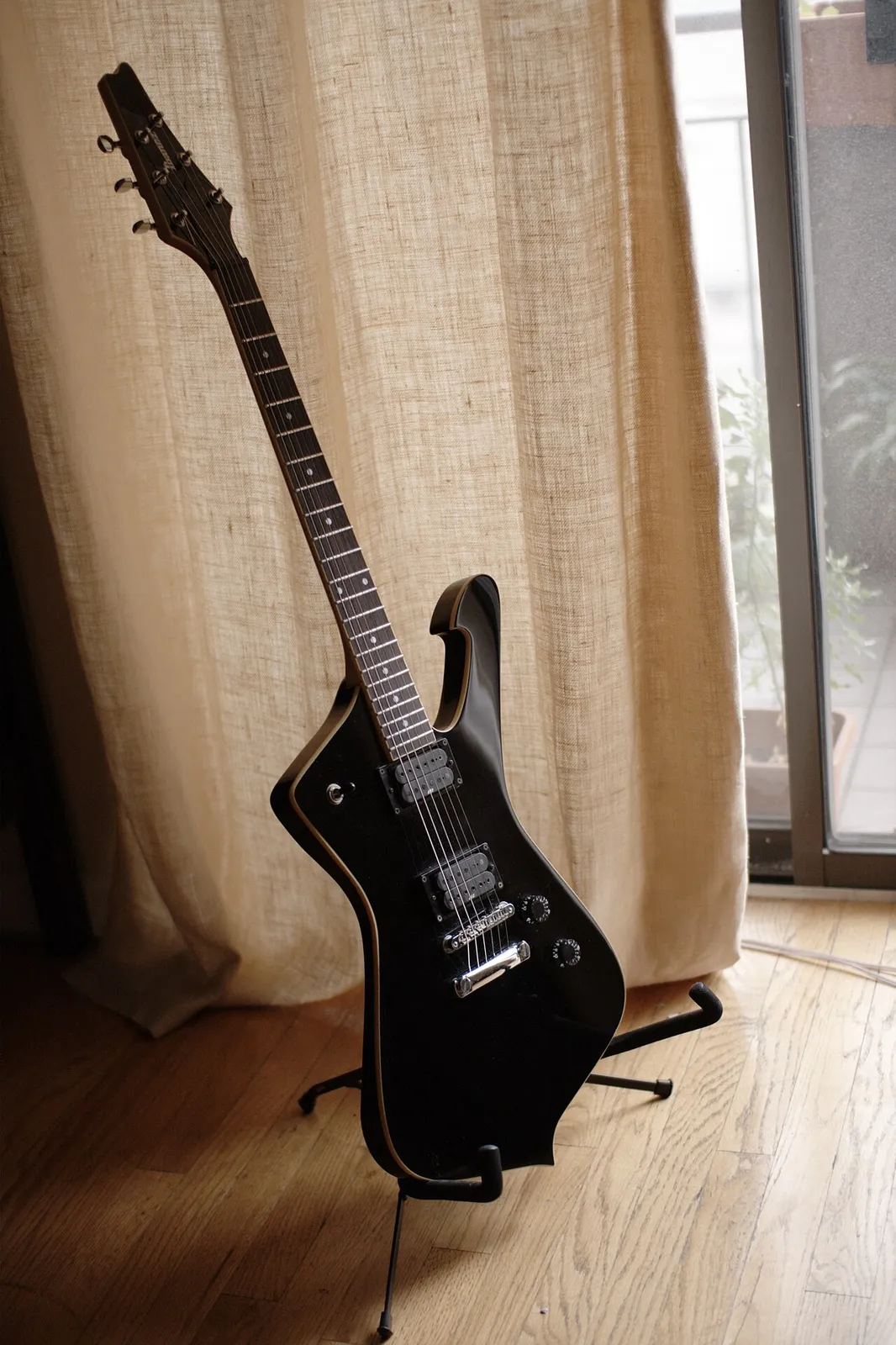
Photo: anders pearson / Wikimedia Commons / CC BY-SA 2.0 Ibanez
Iceman
1975
Ibanez drew this one itself in 1975. When the lawyers made the copies go away, it got to stay.