Boss
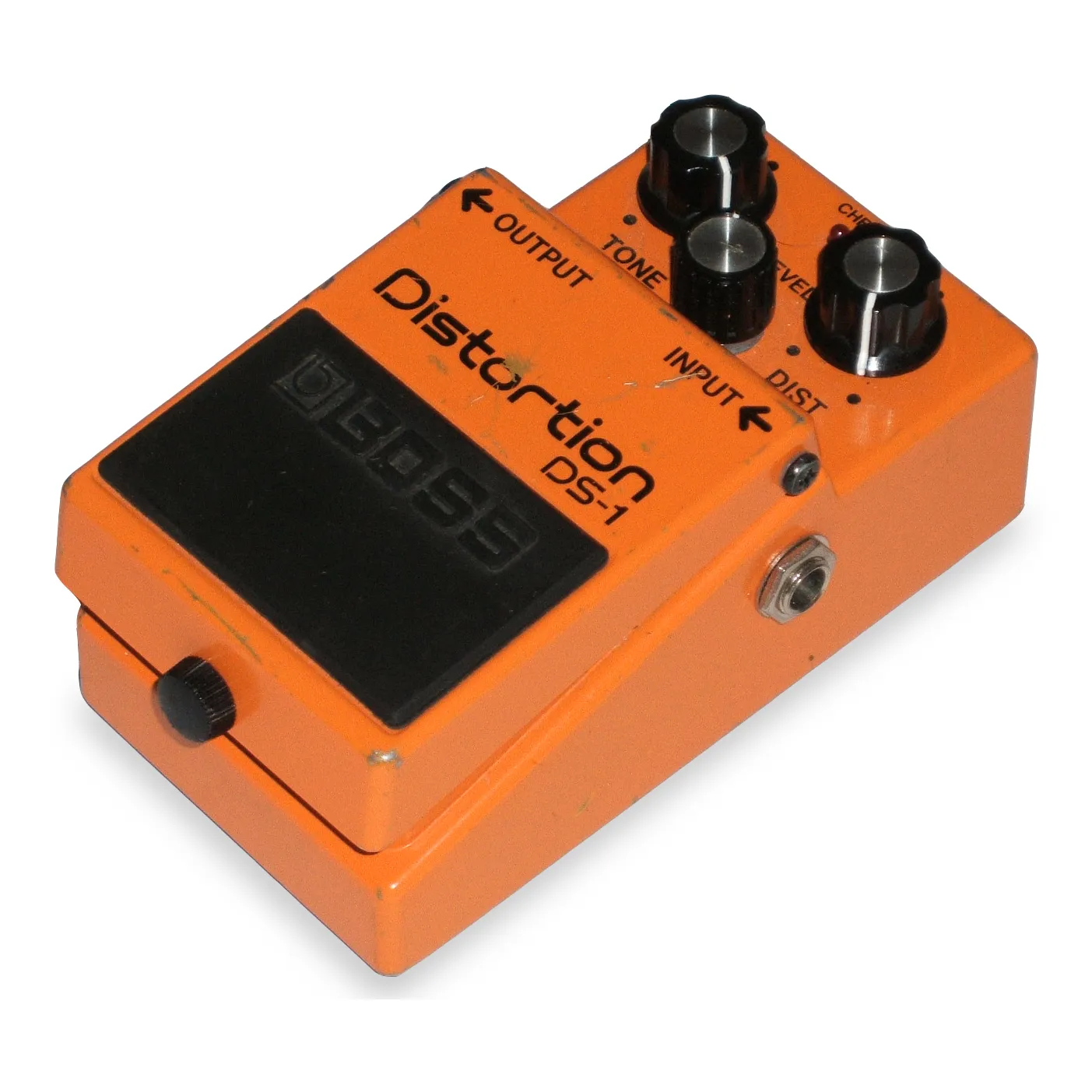
DS-1 Distortion
The orange box Joe Satriani took on stage as the simplest, smallest, most reliable thing he could find.
Hyde Street Studios, San Francisco. Joe Satriani is making Surfing with the Alien fast and cheap, with a pair of Kramers, a Marshall, and a little orange Boss pedal.
- Introduced
- 1978
- Effect
- Distortion
The short version
1978
The orange box
Boss brings out the DS-1, built around a Toshiba preamp chip. It has been in production ever since.
1987
Surfing with the Alien
Joe Satriani plays a Kramer into a DS-1 into a Marshall. The same year, Boss adds the DS-2 Turbo Distortion.
1991
Nevermind
A DS-1 sits in Kurt Cobain’s setup, next to a ProCo RAT and a Big Muff.
1994
The chips run out
Boss switches to a Rohm op-amp. Players hear a “fizzy” edge, and the modders move in.
2000
The chip that stayed
A Mitsubishi op-amp goes in. It’s still the one inside today.
2023
Fifty years of Boss
A Waza Craft DS-1W, and an orange metallic edition for the anniversary.
Side A
A1
A guitar from parts, a box off the wall
Surfing with the Alien was made fast and cheap. Joe Satriani and the producer John Cuniberti cut it at Hyde Street Studios in San Francisco, and it came out in 1987.
The guitars were two Kramer Pacers. One of them, a white one, had been “put together from parts,” and Satriani is honest about it: it “was really great if you wanted to play out of tune all the time.” On “Satch Boogie” the amp was a 100-watt Marshall. And between the guitar and the amp sat the most ordinary distortion pedal in the music shop.
Ask him how he got the sound on “Satch Boogie,” and the answer is one line long:
That’s the Kramer into a DS-1 into the Marshall 100-watt.
It’s a record built to show what an electric guitar can do. There’s nothing exotic anywhere in that sentence. A guitar somebody bolted together, an amp, and a pedal you could buy anywhere.
It wasn’t a one-song trick, either. On “Echo” he was playing through a different amp altogether, a Roland JC-120, “and using the DS-1.” Different amp, same little orange box.
A2
The shape of a distortion pedal
Boss, Roland’s pedal brand, brought out the DS-1 in 1978. It’s been in production ever since.
Along with the ProCo RAT, it made hard clipping popular: chopping the tops off the signal sharply instead of rounding them off, which gives a tighter, more aggressive sound than an overdrive. That whole kind of pedal came to be called a distortion pedal after the DS-1, the way Boss’s OD-1 set the shape for overdrives. When you picture “a distortion pedal,” you’re probably picturing something like this.
Inside, it works in stages. A transistor boosts your signal by about 35 dB, with a filter that keeps the bass from turning to mud. An op-amp pushes it harder into two silicon diodes, which do the clipping. Then comes the tone control, which works like a Big Muff’s and scoops out the midrange around 500 Hz with the knob at noon.
There are buffers at both ends, and Boss’s switching keeps your signal running through them even when the pedal is off. That isn’t true bypass, and some players care about that a great deal. Three knobs: Tone, Level, Distortion. That’s all there is to it.
A3
When the chip ran out
The first DS-1s were built around a Toshiba preamp chip. In 1994 those chips ran out, and Boss redesigned the pedal around a Rohm op-amp. Players noticed. The new ones were quieter, they said, with a “fizzy” or “waspy” edge the old ones didn’t have.
The complaints fed a whole modding scene. Some of the big boutique pedal makers got their start opening up DS-1s and fixing what they didn’t like. Boss moved to a Mitsubishi op-amp in 2000, and that’s the chip still in there.
The family grew, too. The DS-2 Turbo Distortion arrived in 1987, with a second “turbo” mode that pushes the lower mids. John Frusciante used one. So did Kurt Cobain.
Flip the record · By the numbers
3
Knobs. Tone, Level, Distortion.
35 dB
About how much the transistor stage boosts your signal before the clipping starts.
2
Silicon diodes doing the hard clipping.
500 Hz
Where the tone control scoops out the midrange with the knob at noon.
Side B
B1
On the floor at *Nevermind*
Cobain had 1980s DS-1s as well. When Nirvana made Nevermind in 1991, one was in his setup, along with a ProCo RAT, a Big Muff, and a Small Clone chorus. The RAT got the famous trick, plugged straight into the mixing desk, and all the attention that came with it. The DS-1 was right there next to it on the floor.
B2
Same box, same orange
Satriani took it out on the road, too. On stage, he said, he went looking for “the simplest, smallest, most reliable thing I could find and I found those original Boss DS-1s.”
By 2021 the DS-1 was still Boss’s best-selling drive pedal. There have been special editions: a 40th-anniversary DS-1-4A in 2017, a Waza Craft DS-1W in 2023, an orange metallic one for Boss’s 50th the same year, and a run of store-exclusive colors. The basic orange box never went away.
Put on “Ice 9” and listen to the rhythm guitars. Satriani says they’re the DS-1, “so they’re a bit crunchier,” with an OD-1 in there somewhere too, he thinks. Nobody went hunting for anything rare to get that sound. It came off the same wall you’d walk past in any music shop, and it was plenty.
Put this on
You’ve read about it. Now hear it. Here’s what this pedal sounds like, and what to listen for.
Satch Boogie
In Satriani’s words, “the Kramer into a DS-1 into the Marshall 100-watt.”
Find it on YouTube (opens in a new tab)Ice 9
The rhythm guitars are the DS-1, “so they’re a bit crunchier.” There’s an OD-1 in the mix somewhere too, he thinks.
Find it on YouTube (opens in a new tab)Echo
A different amp this time, a Roland JC-120, “and using the DS-1.”
Find it on YouTube (opens in a new tab)
The cast
The people who built it, and the players who made it famous.
1987
Joe Satriani
DS-1, Surfing with the Alien
Built his early solo sound on it, and later went looking for the most reliable thing he could find on stage. It was this.
1987
John Cuniberti
Producer, Surfing with the Alien
Cut the record with Satriani at Hyde Street Studios, fast and cheap.
1991
Kurt Cobain
1980s DS-1s
Had one in his Nevermind setup, alongside a RAT and a Big Muff. He used DS-2s too.
John Frusciante
DS-2 Turbo Distortion
Played the DS-1’s 1987 sibling, the one with the second “turbo” mode.
Often paired with
The pedals and guitars it usually shares a board or a record with.
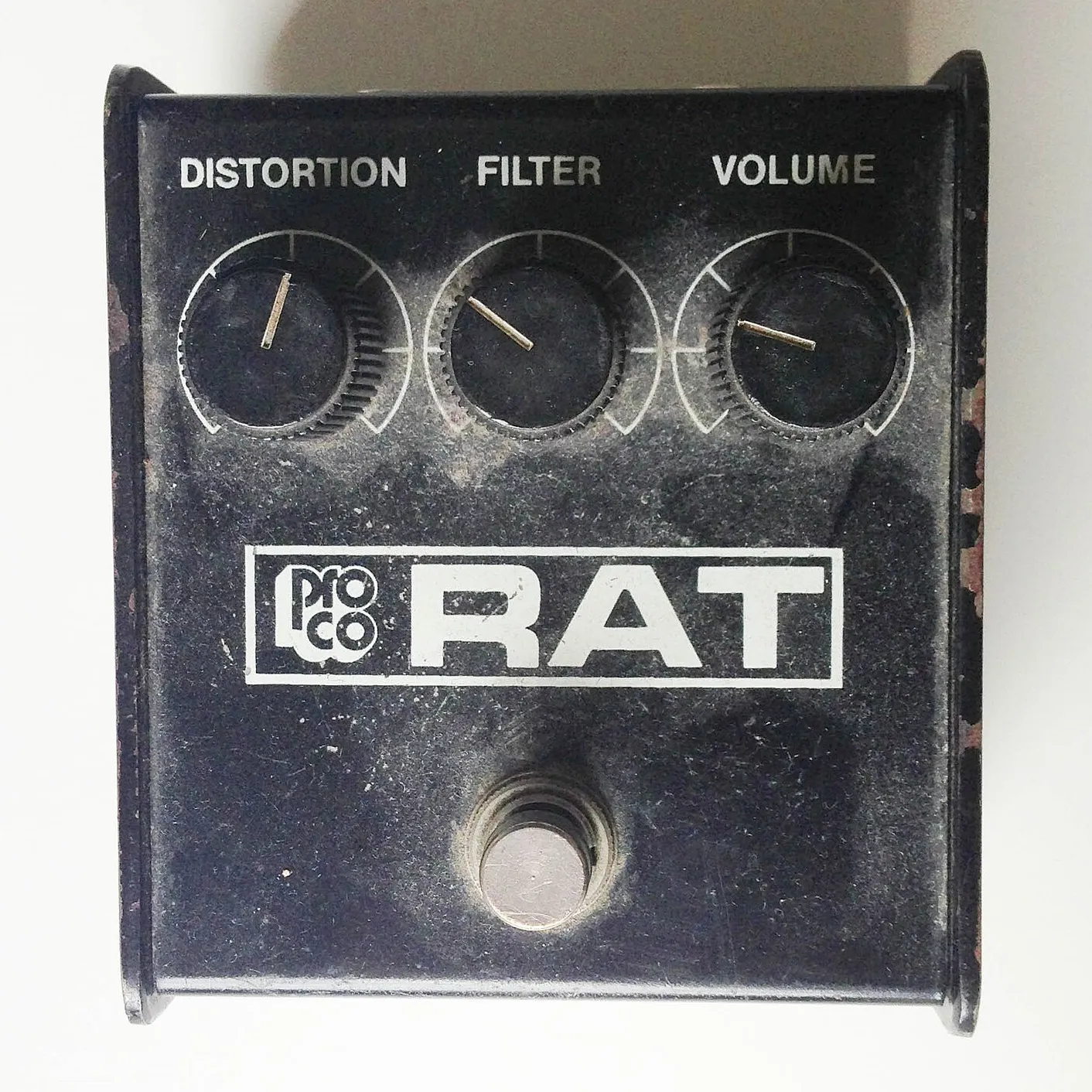
Photo: David Hilowitz / Wikimedia Commons / CC BY 2.0 ProCo
RAT
1979 · Distortion
Named for a basement full of rats, born of a wrong resistor, and at its best plugged in the wrong way.
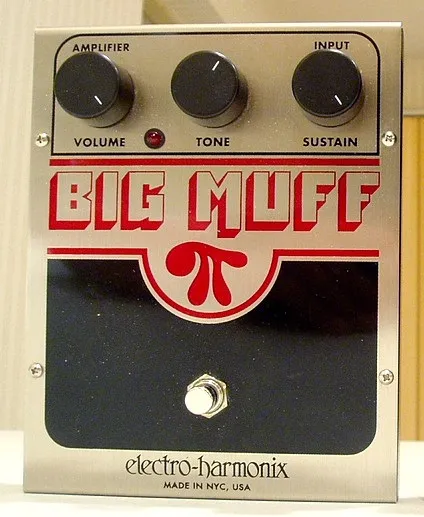
Photo: NIRVANA2764 / Wikimedia Commons / CC BY-SA 3.0 Electro-Harmonix
Big Muff Pi
1969 · Fuzz
Built to chase Hendrix, it missed, and made the smallest amp in the house sound like a wall.