ProCo
RAT
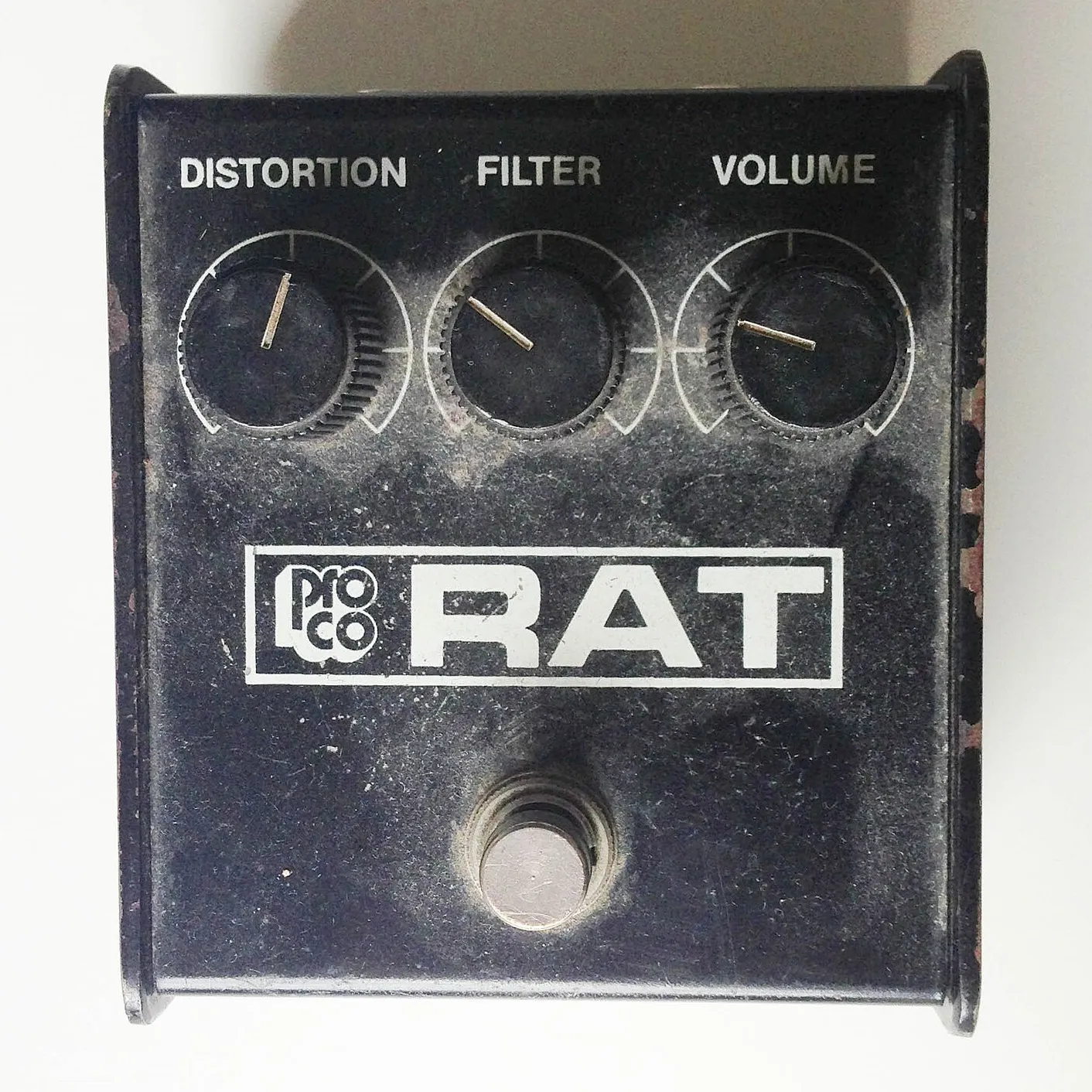
Named for a basement full of rats, born of a wrong resistor, and at its best plugged in the wrong way.
Kalamazoo, Michigan, the mid-1970s. At ProCo Sound, an engineer named Scott Burnham reaches for a resistor and picks up the wrong one. The circuit starts to shriek.
- Introduced
- 1979
- Effect
- Distortion
The short version
mid-1970s
The wrong resistor
Scott Burnham and Steve Kiraly start on the circuit, maybe as early as 1974. A resistor of the wrong size makes the gain jump.
1977–78
Bud Box RATs
A dozen or so built to order in plain off-the-shelf metal boxes.
1979
The Big Box
In ProCo’s catalog, in a big black wraparound case. Some say 1978; the dates don’t agree.
1981
Tone becomes Filter
The knob is reversed and renamed. Clockwise now means darker.
1984
Shrinking to fit
A compact “White Face” RAT to keep up with Boss, MXR, and DOD. The “Black Face” follows in 1986.
1988
RAT2
An on/off LED and glow-in-the-dark labels. Still the one in production.
1991
Straight into the desk
Butch Vig runs Kurt Cobain’s RAT into the mixing console on Nevermind.
Side A
A1
Rats in the basement
The basement at ProCo Sound in Kalamazoo had rats. That isn’t a figure of speech. It’s where the pedal got its name.
Sometime in the mid-1970s, maybe as early as 1974, a ProCo engineer named Scott Burnham started working on a circuit with a colleague, Steve Kiraly. One day, soldering parts onto the board, Burnham picked up a resistor of the wrong size by mistake and put it in. The circuit started shrieking and moaning.
The gain jumped. Somebody tidier might have gone hunting for the bad part and put things back the way the drawing said. The RAT is what happened instead.
A2
A dozen in plain metal boxes
The first RATs weren’t really products. A dozen or so were built to order in 1977 or 1978, in Bud Boxes, the plain metal enclosures any electronics supplier kept on the shelf. ProCo’s owner, Charlie Wicks, liked the thing enough to make it real, and by 1979 it was in the catalog. You’ll hear 1978 for the RAT, too. The dates don’t agree, and nobody’s settling it now.
The production version was the “Big Box” RAT: a big black wraparound enclosure with white lettering, about as subtle as the name. A bass version, the Juggernaut, came out the same year.
Vernon Reid played a Big Box, and he remembers what it did to people:
People were freaking out. Hard-rock dudes, metal dudes, funk dudes—everybody. It was insane.
A3
The knob that turns the wrong way
In 1981 ProCo reversed the Tone knob and renamed it Filter. Turn it clockwise and the sound gets darker, the opposite of most pedals. It still catches people out.
Here’s what’s going on in there. An op-amp, originally a chip called the LM308, turns the signal up so hard it starts distorting on its own. Then two silicon diodes to ground chop the tops off. The Filter comes after all that, a low-pass that decides how much top end gets through. The LM308 was a slow chip, and that slowness is part of why a RAT’s top end doesn’t fizz the way harsher distortions do. It trims a little bass and leaves the midrange up front.
Three knobs, Distortion, Filter, Volume, and a lot of road between them. Keep the Distortion low and it’s an overdrive; John Scofield used it that way. Past about two-thirds it gets thick and grungy. All the way up it’s nearly a fuzz.
Flip the record · By the numbers
~12
Made-to-order RATs in Bud Boxes before it was a catalog product.
3
Knobs. Distortion, Filter, Volume, and a lot of range between them.
2
Silicon diodes to ground, chopping the tops off the signal.
1988
The year the RAT2 arrived. It’s still the one ProCo makes.
Side B
B1
Shrinking to fit
By 1984 Boss, MXR, and DOD were all selling compact pedals, so the RAT shrank to keep up: first the “White Face,” then the “Black Face” in 1986. The RAT2 came in 1988, with an on/off LED and labels that glow in the dark, and it’s the one still in production. The LM308 went obsolete along the way, and by 1996 something else was in its socket.
The family grew. A ProCo employee, Gerry “Grape” Carpenter, built the Turbo RAT in 1989, with red LEDs as its clipping diodes. Later came the Deucetone, the You Dirty RAT with germanium diodes, and the FATRAT, plus reissues from 1991 on.
All that range shows up in who plugged one in. Jeff Beck and Nuno Bettencourt, sure. But also the jazz guys: Scofield, Bill Frisell, Ben Monder, Kurt Rosenwinkel. Nels Cline. David Gilmour had one in his 1994 rig. A distortion box that a jazz guitarist and a metal guitarist both want on the floor is a rare thing.
B2
Straight into the desk
- Nirvana are making Nevermind with Butch Vig, and Kurt Cobain has a RAT.
Plugging a distortion pedal straight into a mixing console, with no amp and no speaker, is usually how you get a thin, buzzing mess. It’s one of the first things you learn not to do. Vig did it anyway, on purpose, and he remembers it plainly:
Kurt had a Rat distortion pedal that he used on a couple of songs, and on a track like ‘Breed’ we just DI’d the Rat, we didn’t go to an amp. We split the signal and we ran it to an amp, and we also took the DI and ran it right into the board so that it had much more of a fuzzy white-noise kind of sound to it.
The two songs were “Breed” and “Territorial Pissings,” the most frantic things on the record.
Put on “Breed” and listen past the amp, to the grain riding on top like static on a loud radio. That’s the half of the signal that never went near a speaker cabinet. Somebody heard a mistake, liked it, and left it on the record.
Put this on
You’ve read about it. Now hear it. Here’s what this pedal sounds like, and what to listen for.
Breed
Kurt Cobain’s RAT, split two ways, into an amp and straight into the mixing desk. Listen for the fuzzy white-noise grain riding on top.
Find it on YouTube (opens in a new tab)Territorial Pissings
The other song Butch Vig ran the RAT straight into the desk on, for a trashier punk sound.
Find it on YouTube (opens in a new tab)
The cast
The people who built it, and the players who made it famous.
mid-1970s
Scott Burnham
Designer
The ProCo engineer who started the circuit with Steve Kiraly and soldered in the wrong resistor.
1979
Charlie Wicks
ProCo’s owner
Liked the made-to-order boxes enough to put the RAT in the catalog.
Vernon Reid
Big Box RAT
Remembers hard-rock, metal, and funk players all “freaking out” over it.
John Scofield
RAT, turned down low
Used it with the Distortion knob low, as an overdrive.
1991
Kurt Cobain
RAT on Nevermind
Used it on a couple of songs, split between an amp and the desk on “Breed.”
1991
Butch Vig
Producer, Nevermind
Plugged the RAT straight into the console on purpose, for that white-noise edge.
Often paired with
The pedals and guitars it usually shares a board or a record with.
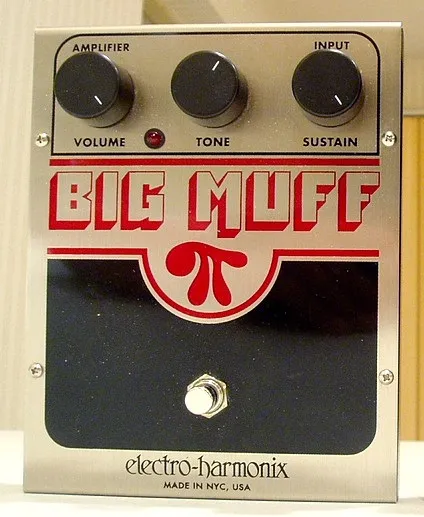
Photo: NIRVANA2764 / Wikimedia Commons / CC BY-SA 3.0 Electro-Harmonix
Big Muff Pi
1969 · Fuzz
Built to chase Hendrix, it missed, and made the smallest amp in the house sound like a wall.
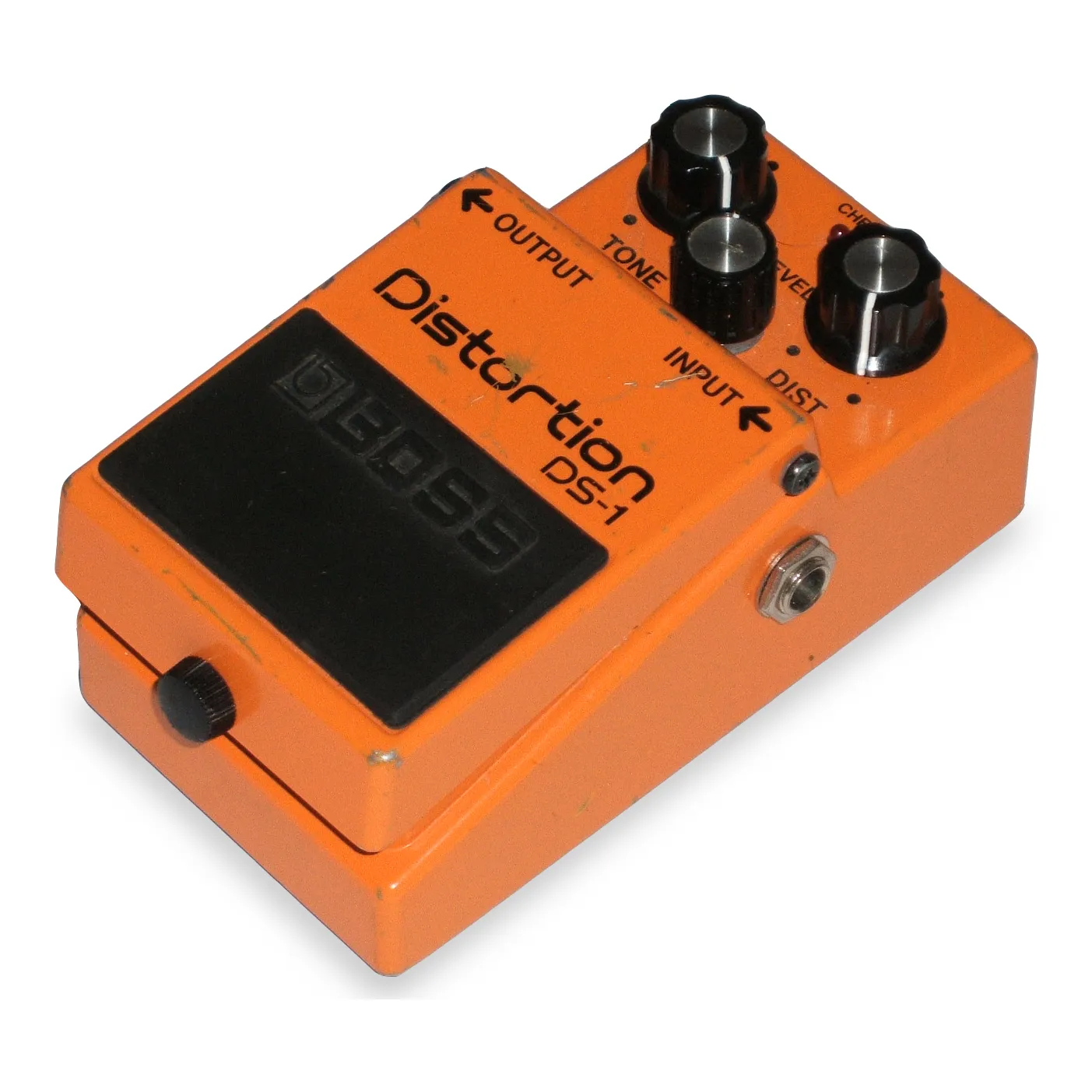
Photo: Matt Eason / Wikimedia Commons / CC BY 2.5 Boss
DS-1 Distortion
1978 · Distortion
The orange box Joe Satriani took on stage as the simplest, smallest, most reliable thing he could find.