Fender
Jazzmaster
Fender built it for jazz players. Jazz players said no thanks. Surfers, punks, and noise bands said yes.
1958. Fender has conquered country and rock and roll, and now Leo wants the one crowd that still laughs at his guitars: the jazz players in their suits, sitting down, with big hollow archtops on their knees. So he builds them the most expensive guitar Fender has ever made. They don’t buy it.
- Introduced
- 1958
- Type
- Solidbody electric
- Class
- Production
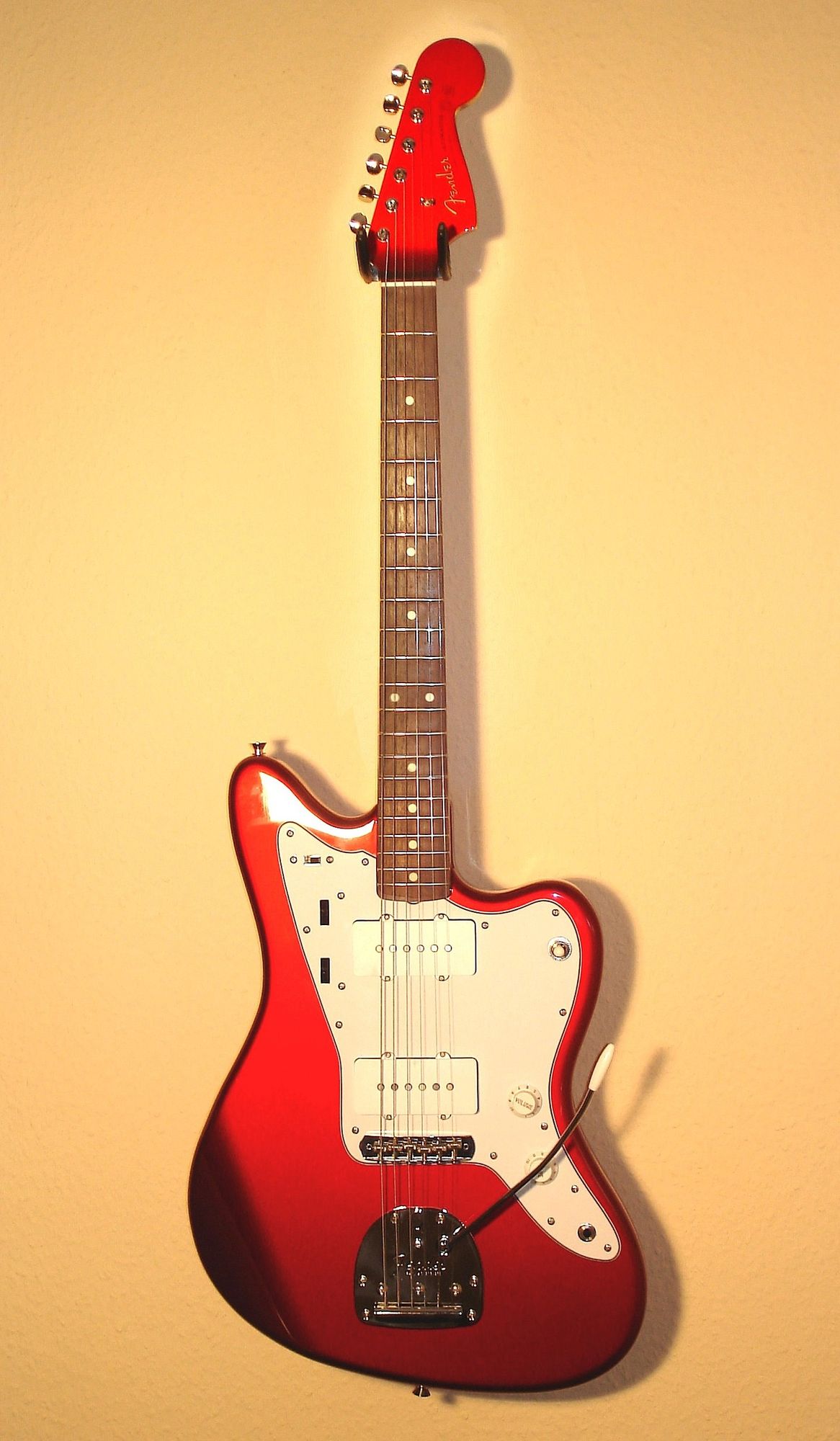
The short version
1958
Top of the line
$329, more than a Strat. Offset waist, rosewood board, and a gold aluminum pickguard.
1960
“Walk, Don’t Run”
The Ventures make it a surf guitar with an instrumental version of a jazz tune.
1977
Punk finds it
Elvis Costello on the cover of My Aim Is True. Tom Verlaine all over Marquee Moon.
1980
Discontinued
Fender stops building standard Jazzmasters in the U.S. Used ones get cheap.
1986
Japan picks it up
Japanese reissues become the Jazzmasters most players actually see.
1999
Stolen
Sonic Youth’s modified guitars disappear from a tour truck on 4 July. Fans find some of them later.
Side A
A1
Built for a crowd that never showed up
Every guitar shop has a Jazzmaster person. They’re usually a little odd, they usually know more about records than you do, and they would never, ever buy a Strat. There’s a reason for that, and it goes back to a guitar that was rejected by the exact people it was built for.
By 1958 Fender had the country players with the Telecaster and the rock and roll kids with the Stratocaster. The only guys still turning up their noses were the jazz players. They played big hollow archtops, mostly Gibsons, sitting down, in suits.
So Leo went after them. The new guitar had a waist that was offset, one side lower than the other, so it would sit comfortably on your lap. It was the first Fender with a rosewood fingerboard. The early ones had a pickguard made of gold-anodized aluminum, which looks fantastic and lasted about six to nine months. Fender called it the Jazzmaster and priced it at $329, more than a Strat. Top of the line.
The jazz guys looked it over, said “very nice,” and went back to their archtops.
A2
Two guitars in one
I’ll say this for the Jazzmaster: nobody ever accused it of being simple.
The pickups are wide and flat, and people love to call them “humbucker-like.” They aren’t humbuckers. They’re single-coils, just big ones, and they sound warm and a little soft compared to a Strat.
Then there are two circuits. The regular one has a volume, a tone, and a three-way switch, like you’d expect. Flip a little slide switch up on the top horn, and now you’re on the “rhythm” circuit, just the neck pickup, with two tiny roller wheels for volume and tone. The idea was to set up a darker comping sound and a brighter solo sound and flick between them. It’s clever. Half the people who buy one never touch it.
Fender designed the most elaborate guitar in the catalog for jazz players. Surf kids bought it and turned the reverb all the way up.
And the bridge. The bridge floats, the vibrato floats, and if you dig in hard, the strings like to hop out of the saddles. Players have been swapping in Mustang bridges and aftermarket parts for decades. I’ve fixed more Jazzmaster bridges than I can count, and I’d buy another one tomorrow.
A3
Walk, Don’t Run
The first big Jazzmaster record isn’t jazz at all. In 1960 the Ventures cut “Walk, Don’t Run,” an instrumental cover of a jazz guitar tune by Johnny Smith. Don Wilson played a Jazzmaster. So the jazz guitar’s first hit was a pop record made from a jazz song. You couldn’t make it up.
Surf music took the Jazzmaster and ran with it. Bands like the Surfaris and the Astronauts cranked the reverb, worked the vibrato arm, and turned that soft, warm tone into something wet and shimmering. It was a long way from a jazz club.
Flip the record · By the numbers
$329
List price in 1958, when a Stratocaster was $275.50. Fender’s most expensive electric.
2
Separate circuits, lead and rhythm, each with its own volume and tone.
6–9
Months Fender used the gold-anodized pickguard before switching to tortoiseshell.
1st
Fender production guitar with a rosewood fingerboard. The Strat and Tele came later.
Side B
B1
The cheapest Fender in the shop
Surf faded, and so did the Jazzmaster. Fender stopped making standard ones in the U.S. around 1980 (Fender says September 1980, some sources say 1982). For almost twenty years there wasn’t a standard American Jazzmaster at all.
That turned out to be the best thing that ever happened to it. Used Jazzmasters got cheap, nobody wanted them, and the people who went looking for cheap guitars were punks and weirdos. In 1977 Elvis Costello stood knock-kneed on the cover of My Aim Is True holding one. The same year, Tom Verlaine’s Jazzmaster was all over Television’s Marquee Moon, all those jagged, tangled lines.
B2
Trailer parks and tour vans
J Mascis of Dinosaur Jr. bought a 1958 Jazzmaster in a Vermont trailer park. It was his first guitar, the one he learned on, and he made it roar. Sonic Youth watched what Mascis was doing and dug in harder. Thurston Moore and Lee Ranaldo tore the Jazzmasters apart, pulling out tone controls and extra switches, and tuned them in odd ways. Ranaldo put humbuckers in one and people called it the “Jazzblaster.” On 4 July 1999, a lot of their gear was stolen from a tour truck in Orange County. Some of it came back, thanks to fans who recognized it.
Kevin Shields and Bilinda Butcher of My Bloody Valentine. Robert Smith of the Cure. Nels Cline of Wilco. Thom Yorke of Radiohead, with a white 1964 on stage. (It’s Yorke, not Jonny Greenwood. Greenwood is a Telecaster guy. I’ll be correcting people on that until I die.)
B3
The comeback
Fender Japan started reissuing the Jazzmaster in 1986, and eventually the U.S. caught on. Today there’s a cheap one, an American one, a Custom Shop one, and a lot of signature models for people who were, a generation ago, buying used Jazzmasters because nobody else wanted them.
It’s still a strange guitar. The bridge still gives people trouble. The rhythm circuit still confuses everybody. It never won over the jazz crowd it was made for.
The Jazzmaster never fit where it was supposed to go, so it went and found the people who were never going to fit either. Surf kids, punks, noise bands, the Jazzmaster person at your local shop. It was always their guitar. It just took Fender a long time to notice.
Put this on
You’ve read about it. Now hear it. Here’s what this guitar sounds like, and what to listen for.
Walk, Don’t Run
Don Wilson’s Jazzmaster on the first big Jazzmaster record, a pop instrumental version of a jazz guitar tune. Fender’s own origin story for the surf connection.
Find it on YouTube (opens in a new tab)Marquee Moon
Tom Verlaine’s Jazzmaster is all over this album. Listen to the title track’s two guitars weaving around each other, jagged and clean at the same time.
Find it on YouTube (opens in a new tab)Feel the Pain
The song most people connect with J Mascis’s Jazzmaster sound. His first guitar was a ’58 from a Vermont trailer park.
Find it on YouTube (opens in a new tab)
The cast
The people, and the specific guitars, that made the legend.
1960
Don Wilson
The Ventures’ Jazzmaster
“Walk, Don’t Run.” Fender’s own origin story for the surf connection.
1977
Elvis Costello
The cover guitar
Knock-kneed on the front of My Aim Is True, holding a Jazzmaster. Fender later made a signature model of it.
1977
Tom Verlaine
A ’58 or ’59 Jazzmaster
All over Television’s Marquee Moon. Sources disagree on the year, so we won’t pick.
1980s
J Mascis
1958 Jazzmaster
His first guitar, bought in a Vermont trailer park. The one he learned to play on.
late 1980s
Thurston Moore & Lee Ranaldo
Stripped and rewired
Sonic Youth pulled out tone controls and switches. Ranaldo’s humbucker version got called the “Jazzblaster.”
2018
Thom Yorke
1964 Olympic White
The Radiohead Jazzmaster player is Yorke, not Jonny Greenwood. People mix them up constantly.
Liner notes
Specs, construction, rarity, value, and every source we used.
Fender’s 1958 offset: a dual circuit and a floating trem that jazz players mostly skipped — surf, punk, and indie did not.
- Body
- Alder; offset waist
- Neck
- Bolt-on maple, Deep “C”
- Fingerboard
- Maple or rosewood, 9.5" radius, 22 narrow-tall frets
- Scale
- 25.5" (648 mm)
- Pickups
- Two V-Mod II Jazzmaster single-coils
- Hardware
- Panorama tremolo with brass Mustang saddles
- Electronics
- Lead circuit plus rhythm circuit in series mode (not a wire-for-wire 1958 clone)
- Finish
- Gloss urethane
- Nut
- Bone, 1.685"
Open the full research fileConstruction details, the complete player record, production numbers, dated value estimates, and sources
Current American Professional II. Classic 1958–65: 21 frets, slab then veneer rosewood, gold then tort guard, floating bridge and separate vibrato, dual lead/rhythm circuit. Player II often simplifies electronics to one volume, one tone, and a 3-way — no vintage-style dual circuit on the examples checked.
Construction
Fender unveiled the Jazzmaster in 1958 (late 1958 in Joe’s Vintage Guitars). Dave Hunter (Fender: 75 Years, excerpted in Guitar World): 1958 list $329 versus Stratocaster $275.50 — then Fender’s most expensive Spanish electric. Offset waist, designed for seated playing. Larger and heavier than a Strat; single forearm contour.
Original U.S. production ended in the CBS era. guitarhq.com states Jazzmaster discontinued 1982 (Jaguar 1975). Other summaries loosely say “late 1970s/early 1980s.” 1982 is the dated figure found. Later Japanese and U.S. reissues; currently in production.
Vintage bodies are alder throughout the run. Gold-anodized aluminum pickguard late 1958–mid-1959 (“gold guard”); then 4-ply celluloid tortoiseshell on sunburst, white on custom colors. Gold-guard window: about six to nine months. Joe’s says mid-1959; True Vintage Guitar says 1959 tort replacement. Same window, not a precise day.
Neck: bolt-on maple. First Fender production guitar with a rosewood fingerboard. Slab Brazilian rosewood 1958–spring 1962; veneer from spring 1962 — Jazzmaster switched before Strat/Tele. Clay dots 1958–late 1964; pearl dots late 1964–mid-1966; bound neck late 1965; block inlays mid-1966. Twenty-one frets vintage. Standard nut 1-5/8" (“B”). Heel-adjust truss rod for the whole 1958–71 run.
Pickups: two wide, flat, low-inductance single-coils with large aperture; plastic covers flush to the guard; RWRP pair for partial hum-cancel in middle. They are not humbuckers. “Humbucker-like” is a descriptive comparison, not a pickup type. Foam under the pickups; original foam commonly rots.
Hardware: floating bridge with six threaded barrel saddles — not a Strat synchronized tremolo. Separate floating vibrato tailpiece with trem-lock button and long arm. Kluson tuners to mid/late 1965, then Fender “F” (Schaller) tuners. Vintage saddles are infamous for string-slip; aftermarket Mustang and Mastery bridges are common player mods.
Electronics are the dual circuit unique to the model. Lead: lower-bout volume and tone, 3-way toggle (bridge / both / neck). Rhythm: upper-horn slide switch selects neck pickup only, bypasses lead controls; two chrome-edged roller wheels for rhythm volume and tone. Lead pots typically 1 MΩ — high versus Fender’s usual 250 kΩ. Rhythm tone pot value is contested. Fender’s control explainer says the two tone pots have different electrical values (rhythm darker) but does not state ohms. Reverb News wiring notes: lead volume 1 M linear, lead tone 1 M audio, rhythm volume 1 M linear, rhythm tone 50 k linear. Joe’s: rhythm “50 kΩ or 1 MΩ depending on year.” Wikipedia lead: 500 kΩ vs 1 MΩ. No single ohm value is settled for all years. Angled oval jack plate shared with Jaguar.
Finish: nitro through pre-CBS; Joe’s has polyester from approximately 1967–68 on CBS examples. Standard 3-color sunburst; custom colors +5%. Matching headstocks on non-blonde customs from about spring 1962. Mid-1965 “witch hat” knobs are a CBS marker.
American Professional II modernizes it: V-Mod II pickups, Deep “C,” 22 frets, Panorama tremolo with brass Mustang saddles, rhythm circuit in series mode. Not a wire-for-wire 1958 clone. Player II often drops the dual circuit entirely.
Players
The 1958 jazz pitch missed. Fender built a seated offset for East Coast jazz names; jazz guitarists stayed with archtops and the new Les Pauls. Surf took it first. After Fender discontinued the original U.S. line (Fender: September 1980; guitarhq.com: 1982), punk, new wave, noise, and indie players — who could find them cheap — made the revival. Do not skip surf; do not skip the discontinuation.
Don Wilson (the Ventures). Fender's own origin story for the surf association: Wilson's Jazzmaster on the 1960 hit "Walk Don't Run" (a cover of Johnny Smith's 1954 jazz guitar tune). The New York Times (2008) cites the same record. First famous Jazzmaster recording is, ironically, a pop instrumental of a jazz tune, not a jazz guitarist.
Elvis Costello. Posed with a Jazzmaster on both covers of My Aim Is True (1977). Fender uses the Attractions' "Radio, Radio" (1978) as a chapter break and issued an Elvis Costello Signature Jazzmaster (2008–2010) as a tribute to the cover guitar. He used more than one (a DIY-refinished first guitar around the debut, later a grey-burst principal guitar). The canonical image is the 1977 cover.
Tom Verlaine (Television). Hunter / Guitar World (Fender: 75 Years): his '58 Jazzmaster is "laced … all over" 1977's Marquee Moon. A later Guitar World Verlaine tribute names a '59 Jazzmaster with a bronze pickguard as the debut guitar. Keep both years; do not pick. Sonic Youth, that tribute says, would follow Verlaine's lead a few years later to seek out Fender offsets as the affordable option.
J Mascis (Dinosaur Jr.). Fender: first guitar was a 1958 Jazzmaster bought in a Vermont trailer park — "the one he learned to play on," and the basis of his signature (gold hardware, vintage white). Fender's Jazzblaster essay adds that Sonic Youth's commitment to the model hardened after seeing what Mascis was doing. "Feel the Pain" is the public association, not a studio-diary claim that every track is that 1958 guitar.
Thurston Moore and Lee Ranaldo (Sonic Youth). Fender: late-1980s adoption. They stripped tone controls and extra switching; Ranaldo's humbucker-loaded Jazzmaster was nicknamed Jazzblaster. Almost never stock. Original Jazzblasters were among the instruments stolen 4 July 1999 from a tour truck in Orange County; some later returned via fans. 2009 Fender Sonic Youth signatures (Moore spec and Ranaldo spec) are manufacturer confirmation.
Thom Yorke (Radiohead). The Radiohead offset is Yorke, not Jonny Greenwood. Fender's Jazzmaster history lists Yorke; Fender's Telecaster essay lists Greenwood (Teles, and later a Starcaster). King of Gear documents Yorke's Jazzmasters with Mustang bridges and photographs a 1964 Olympic White Jazzmaster onstage (e.g. "Bloom," Montreal, 7 July 2018). A live staple, not "the Radiohead guitar" in the way Number One is SRV's. Casual "Radiohead Jazzmaster" talk that means Greenwood is a mix-up.
Also known to play the model, without a single canonical guitar: Robert Smith (the Cure); Kevin Shields and Bilinda Butcher (My Bloody Valentine); Ira Kaplan (Yo La Tengo); Nels Cline (Wilco); Win Butler (Arcade Fire); Jonny Buckland (Coldplay). Surf: the Astronauts, Surfaris, Tornadoes (Hunter). Fender notes Hendrix, Dylan, Townshend, and Clapton (Yardbirds) were "seen with" Jazzmasters — sightings, not identity instruments. Hendrix's public guitar is the Strat; Clapton's Yardbirds identity guitar is a Telecaster (and Beck's is an Esquire). Dick Dale isn't a Jazzmaster name in the sources checked; his association is Stratocaster.
Rarity
Current production is not rare — Player II through Custom Shop.
Official Jazzmaster shipping totals are unpublished. No public year-by-year factory counts. Less common as a vintage Fender than Strat/Tele; not Broadcaster-rare.
Gold-anodized pickguard: last quarter 1958 through mid-1959 (about six to nine months) — the rarest original production look. No factory total. Custom colors and matching headstocks are scarcer than sunburst.
Original U.S. standard production ended September 1980; no U.S. standard production 1980–1999. Japan reissues from 1986 are the volume offsets many players actually see. Demand rose with indie and shoegaze use after the U.S. line went dark.
Value
Informal estimate, 25 August 2026. Not an appraisal.
Asking prices are not sold prices. Original finish vs refinish, and provenance, can double or halve a result. Artist-owned examples are a separate market. Reissues do not substitute for originals. 2024–26 public sold comps are thin — no AxeDB-scale Jazzmaster study. Prefer labeled dealer asks over invented medians. Do not use the 2016 VG $8,000–$13,000 table as current.
New street. Mexico Player II $880 (Fender $879.99). American Vintage II 1966 about $2,600. US American Professional II tracks the current US Pro II guitar tier, about $1,840.
Used modern. Used Mexican Players often about $500–$750. MIJ/CIJ JM66 / ’62 reissue used about $1,200–$1,900. Early 1986–90s Japan overlaps that band; asking ≠ sold.
Vintage / collectible. Edgewater Guitars, February 2026, excellent all-original: 1958–59 sunburst $18,000–$35,000; 1960–64 sunburst $12,000–$25,000; custom colors $25,000–$50,000 depending on rarity. Gold-guard and rare custom colors sit at or above the top of the first-year band. Public sold gold-guard comps were not located in quantity for 2024–26 — dealer-ask vs sold gap unknown. Player-grade and refinished vintage JMs sell substantially lower. Edgewater’s reduction table: refinish 45–60%, replaced trem 20–30%, rhythm circuit stripped 15–25%.
See also
Sources
- Jazz bomb, surf staple: a Jazzmaster history — 1958 intent, offset, dual circuit, floating tremolo; 1980 discontinuation; 1986 Japan; Yorke (not Greenwood).
- Demystifying the Jazzmaster controls — lead vs rhythm operation.
- How Sonic Youth invented the Jazzblaster — Moore/Ranaldo, Jazzblaster, 4 July 1999 theft, 2009 signatures.
- J Mascis — Mascis 1958 Jazzmaster.
- American Professional II Jazzmaster — Panorama trem, V-Mod II, series rhythm.
- Joe’s Vintage Guitars: Jazzmaster evolution 1958–1971 — construction chronology; gold-guard window.
- Guitar World: Fender 75 Years — Jazzmaster — Hunter excerpt: 1958 pricing; Verlaine Marquee Moon as a ’58.
- Guitar World: Tom Verlaine tribute — ’59 Jazzmaster, bronze pickguard, Marquee Moon.
- Guitar Moderne: Jazzmaster resurrection — 1958 jazz pitch missed; 1980 discontinuation; Verlaine / Costello / Smith / Sonic Youth revival (October 2016).
- *New York Times*, 7 September 2008 — Ventures “Walk Don’t Run”; Verlaine bought cheap in the ’70s.
- Reverb News: Jazzmaster pickups, upgrades, mods — pot values (one wiring recipe), offset rationale.
- Edgewater Guitars 2026 value guide — February 2026 Jazzmaster ranges; thin solds.
- Vintage Guitar: Revisiting The Jazzmaster — July 2016 VG Price Guide table; do not use $8k–$13k as 2026 working prices.
- Sweetwater Player II Jazzmaster — Player II spec; simplified controls.
- guitarhq.com Fender — 1958 introduction; 1982 discontinuation (conflicts with Fender/Wynn September 1980 U.S. end); rosewood first on Jazzmaster 1958.
- Fender Player II series — Player II Jazzmaster $879.99 (August 2026).
- Willcutt: American Vintage II — AVII 1966 Jazzmaster ~$2,600.
- Premier Guitar: Sonic Youth signature Jazzmaster
- King of Gear: Yorke's Jazzmasters — Mustang bridges; 1964 Olympic White photographs. Radiohead offset = Yorke, not Greenwood.
Keep digging
Guitars this one gets compared to, confused with, or descended from.

Photo: Lightburst / Wikimedia Commons / CC BY-SA 4.0 Fender
Stratocaster
1954
The guitar most people mean when they say “electric guitar.” Designed by a man who didn’t play one.
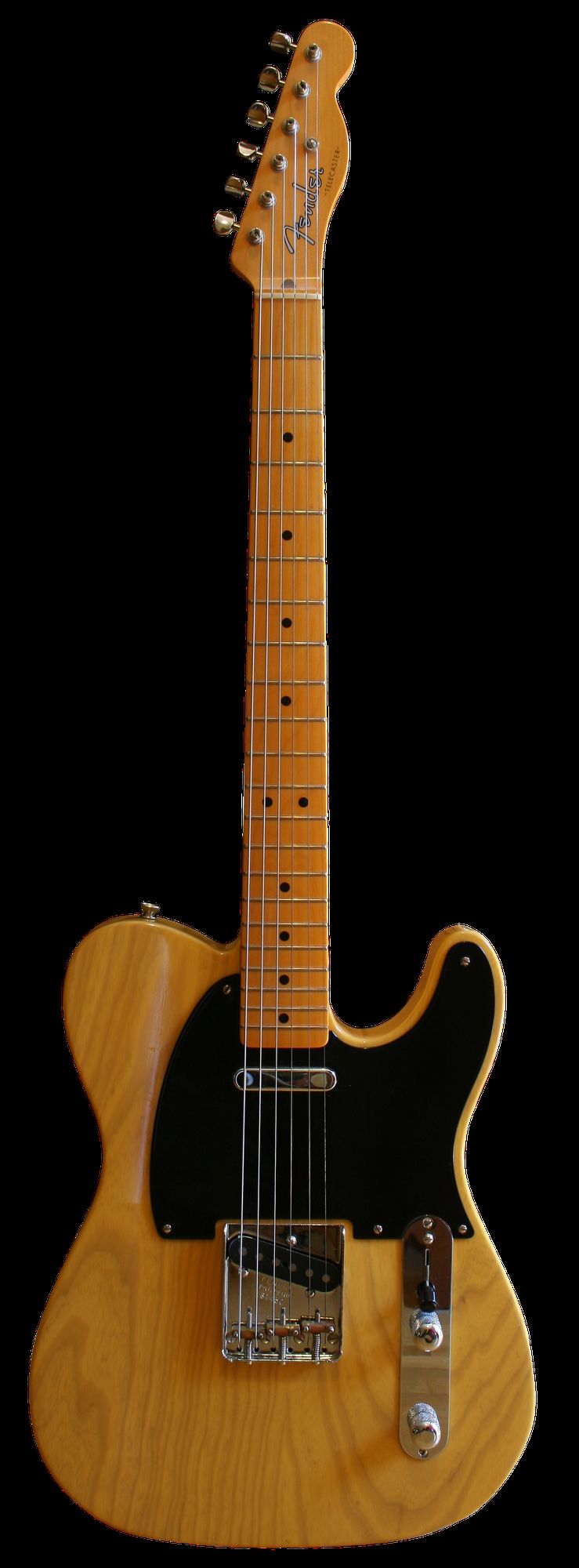
Fender Telecaster American Vintage 1952 with transparent background. Photo by Massimo Barbieri. Licensed under CC BY-SA 3.0. Via Wikimedia Commons. Fender
Telecaster
1950
Leo built it like a tool. The famous ones look like they just clocked off a double shift.

Photo: Infrahertzz / Wikimedia Commons / CC BY-SA 3.0 Fender
Precision Bass
1951
Leo’s bass let the player at the back be heard. You know their lines by heart. You mostly don’t know their names.