MXR
Dyna Comp
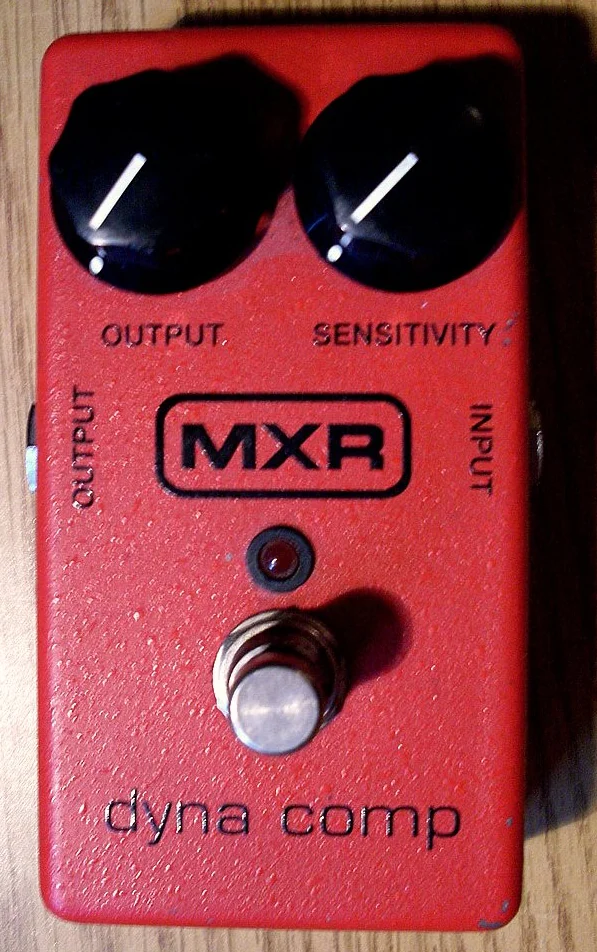
Built to make loud notes quieter, and Pete Townshend stepped on it to push his solos.
A run of gigs in Europe at the turn of the 1980s. Pete Townshend kicks on a little MXR compression box to push his solos, and it makes “such a hell of a noise.”
- Introduced
- 1972 or 1974
- Effect
- Compressor
The short version
1972
MXR in Rochester
Keith Barr and Terry Sherwood found MXR Innovations in Rochester, New York.
1972 or 1974
Output and Sensitivity
MXR brings out the two-knob Dyna Comp. The dates don’t agree, and nobody’s settled it.
c. 1976
Script to block
The cursive MXR logo gives way to the block-letter one, around 1976 or 1977.
Late 1970s
The Ross
The Ross Compressor arrives, its circuit built on the script Dyna Comp and tweaked a little.
1980
A hell of a noise
Pete Townshend says the MXR compressor he’s been using on stage in Europe “makes such a hell of a noise.”
1981
A light and a jack
Around 1981 or 1982, MXR adds a status LED and a power-supply input.
1987
Dunlop
Three years after MXR closes its doors, Jim Dunlop buys the brand.
2008
The old chip
MXR’s Custom Shop rebuilds a 1976 Dyna Comp around a found batch of out-of-production CA3080 chips.
Side A
A1
A hell of a noise
Europe, around the turn of the 1980s. The Who are on stage, and when it’s time for a solo or one of the long rave-ups at the end of a song, Pete Townshend steps on a small MXR box. A while earlier that job belonged to a Univox Super-Fuzz. Now it belongs to a compressor.
He talked about it in a 1980 interview, and he didn’t sound like a man describing a subtle studio tool:
For some gigs we did recently in Europe I used an MXR compression sustain unit. It makes such a hell of a noise when you put it on.
He never says “Dyna Comp” in that sentence. The box is identified as one by the people who keep track of his gear, and it stayed in his live rig for years.
What makes it funny is the job description. A compressor is meant to be the polite one on the floor. It makes the quiet notes louder and the loud notes quieter, so nothing jumps out and nothing gets lost. Townshend used one to make a racket.
A2
Two knobs and a metal can
MXR started in Rochester, New York, in 1972, founded by Keith Barr and Terry Sherwood. When the Dyna Comp arrived is another matter. Depends who you ask: 1972, or 1974, listed alongside the Phase 90 and the Distortion+. If the Phase 90 really was MXR’s first pedal, a 1972 Dyna Comp gets awkward. Call it 1972 or 1974 and leave it there.
The controls are about as simple as a pedal gets. Output sets how loud it comes out. Sensitivity sets how hard it squeezes. Turn Sensitivity up and your picking evens out, the attack of each note softens, and the tail of the note keeps going after it would normally have died.
Inside the originals is a chip called the CA3080, in a little metal can, a kind of amplifier whose gain the circuit can turn up and down as you play. That chip is a big part of the character. And it does have character: the Dyna Comp isn’t transparent. It puts its own color on the sound, a squash that countless Nashville pickers insist on.
A3
The Nashville squash
Plug a Telecaster into one and you hear why it became, in one writer’s phrase, “a Nashville standard.” Single-coils can sound thin. The Dyna Comp thickens them up and smooths out the jumps in volume from note to note, which matters a great deal when you’re chicken-picking a fast run and every note needs to come through at the same height.
Then there’s the attack. With the front of each note softened, a picked Telecaster line starts to swell in a little, and the effect, as one account of the Nashville players has it, is like “a pedal steel player working his volume pedal.” A hint of pedal steel, from one stomp.
It also works as a plain booster, more level and more sustain for a lead. Which, of course, is how Townshend used it.
Flip the record · By the numbers
2
Knobs. Output sets the level, Sensitivity sets how hard it squeezes.
1976
The year of the Dyna Comp MXR’s Custom Shop copied, down to the wire harness.
1984
The year MXR closed. Dunlop bought the name three years later.
1972
The year MXR was founded in Rochester. Maybe the Dyna Comp’s year too.
Side B
B1
Slide, bloom, and pop
Slide players loved it. Lowell George of Little Feat and Bonnie Raitt both favored it for “the sweet sustain it lent to their slide work.” George’s biographer went further and wrote that his “use of compression defined his sound.”
One caution there. The Little Feat studio records are widely said to owe their squeeze to a pair of chained studio compressors, with the Dyna Comps out on stage. The talk runs both ways and nobody has settled it, so don’t go pinning a particular Little Feat album track on the pedal.
David Gilmour liked how it could make his single-note lines “bloom and soar.” On the “Comfortably Numb” solos, his Black Strat went into a Big Muff with “a little goose from an MXR Dyna Comp” and on into a Hiwatt, enough sustain to hold a note as long as he liked. At least one fan account of that solo leaves the compressor out, so call it a little goose and not the whole sound.
Andy Summers is the clean-tone case: his “popping, ringing clean chords” are held up as a perfect illustration of what the pedal does. Adrian Belew, David Byrne, Sonny Landreth, Jim Messina, and Masayoshi Takanaka all turn up on the list of users too.
B2
Script, block, and a box of old chips
The first Dyna Comps wore MXR’s cursive script logo. Around 1976 or 1977 that changed to the block lettering most people picture. By 1981 or 1982 the pedal had picked up a status LED and a jack for a power supply. MXR closed in 1984, and Jim Dunlop bought the brand in 1987.
Other people wanted that script-era sound too. The Ross Compressor, from the end of the 1970s, was built on the script Dyna Comp’s circuit and tweaked a little.
Then, in the 1980s, the CA3080 went out of production. In 2008 MXR’s Custom Shop got hold of a batch of the original metal-can chips and built a ’76 Vintage Dyna Comp with “the exact same circuitry as the 1976 version—right down to the component layout, silkscreening and handmade wire harness.”
The family kept growing after that: a script-logo reissue with an LED and a power jack, a Mini with a button for slow or fast attack, a Deluxe, and the Super Comp, a separate pedal with an Attack knob of its own. The plain two-knob Dyna Comp is still in the line.
B3
Just exactly what I needed
John Frusciante’s name is on the Dyna Comp list because of footage of him recording the solo on “Mellowship Slinky in B Major,” on Blood Sugar Sex Magik in 1991. That’s one source for one track, and not one we could check, so hold it loosely.
He is plain about the pedal itself, though. Back in the Red Hot Chili Peppers in 2022, he explained what it gave him:
Sometimes the Dyna Comp was just exactly what I needed in terms of getting the right amount of sustain on clean things.
That’s the same job it did for the slide players and the Nashville pickers: clean notes that last longer and sit up evenly. Studio guitarists have used it to stand out in the mix since the day it came out.
It was built to make the loud notes quieter. Then a lot of players heard what it was doing to the quiet ones and kept stepping on it, the way Townshend did, to be heard.
Put this on
You’ve read about it. Now hear it. Here’s what this pedal sounds like, and what to listen for.
Comfortably Numb
The solos. Gilmour’s Black Strat into a Ram’s Head Big Muff, with “a little goose from an MXR Dyna Comp,” into a Hiwatt. Listen for notes that hang as long as he wants them to.
Find it on YouTube (opens in a new tab)
The cast
The people who built it, and the players who made it famous.
Lowell George
Slide, Little Feat
One of the slide players who favored it for “the sweet sustain it lent to their slide work.” His compression, a biographer wrote, “defined his sound.”
Bonnie Raitt
Slide
The other slide player at the front of the Dyna Comp story, for that same sweet sustain.
1979
David Gilmour
Pink Floyd
Liked how it could make his single-note lines “bloom and soar.” A little of it sits in the Comfortably Numb solo chain.
Andy Summers
The Police
His “popping, ringing clean chords” are held up as a perfect illustration of what the pedal does.
1979
Pete Townshend
The Who, live rig
Used it on stage as a boost for leads and outro rave-ups, in place of his old Univox fuzz.
2022
John Frusciante
Red Hot Chili Peppers
“Sometimes the Dyna Comp was just exactly what I needed,” he said, for sustain on clean parts.
Often paired with
The pedals and guitars it usually shares a board or a record with.
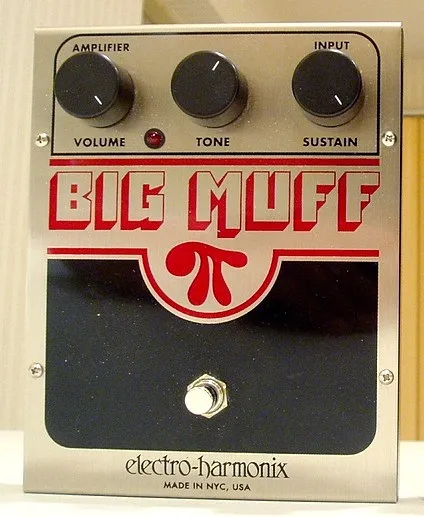
Photo: NIRVANA2764 / Wikimedia Commons / CC BY-SA 3.0 Electro-Harmonix
Big Muff Pi
1969 · Fuzz
Built to chase Hendrix, it missed, and made the smallest amp in the house sound like a wall.
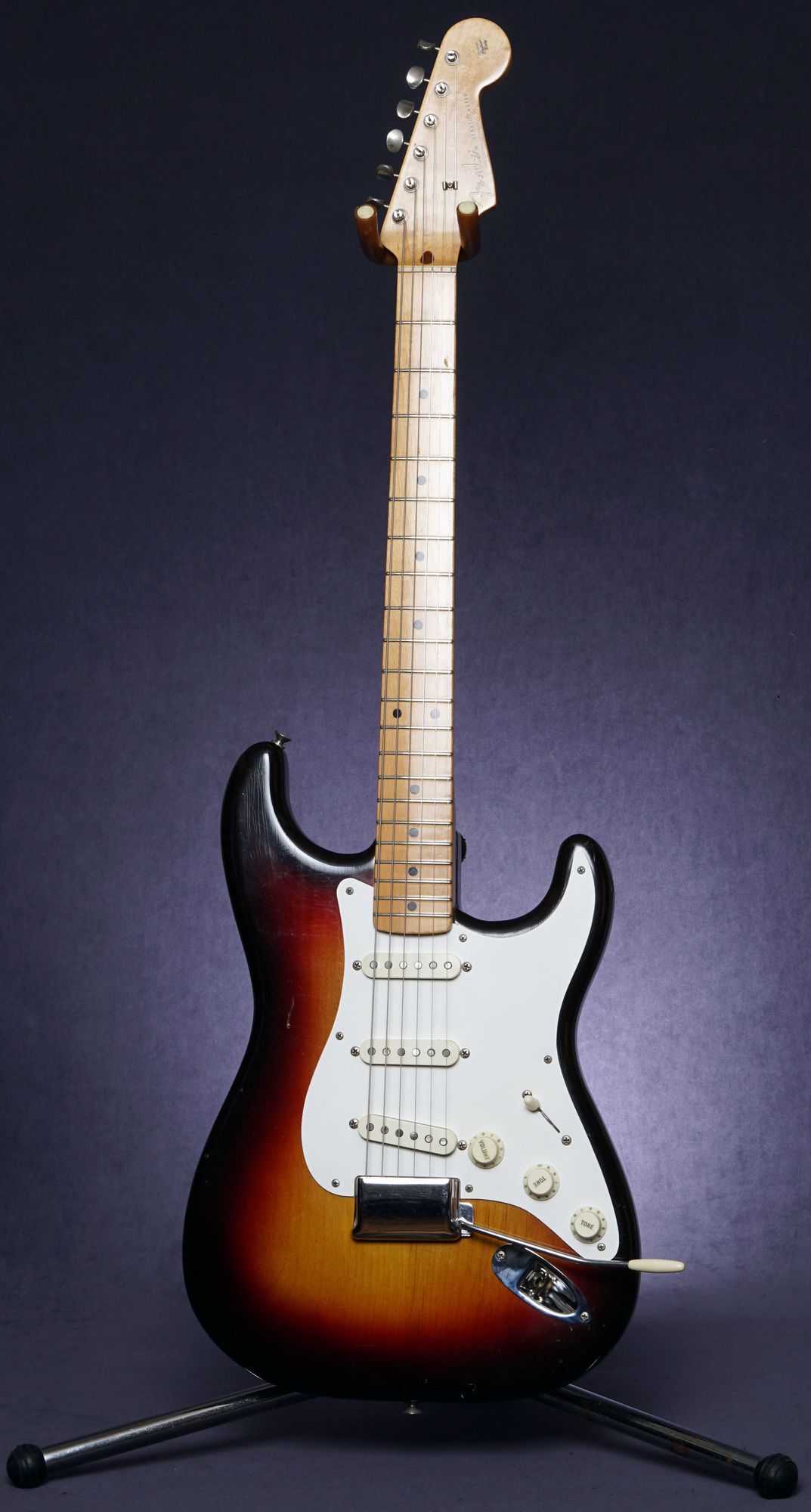
Photo: Lightburst / Wikimedia Commons / CC BY-SA 4.0 Fender
Stratocaster
1954
The guitar most people mean when they say “electric guitar.” Designed by a man who didn’t play one.