Knaggs
Severn
Twenty-four years building other people’s guitars. Then Joe Knaggs built the one he wanted to play.
Maryland, 2009. Joe Knaggs has spent twenty-four years at PRS, starting in the finishing room and ending up in R&D. He walks out with Peter Wolf, and the first guitar he builds under his own name, in a garage, gets traded for a set of golf clubs.
- Introduced
- 2010
- Type
- Solidbody electric
- Class
- Production
Have a photograph of this guitar? Send a picture
The short version
1985
PRS
Joe Knaggs starts in the finishing department at Paul Reed Smith.
2009
His own name
Knaggs leaves PRS and starts a company with Peter Wolf.
2010
Frankfurt
Nine guitars go to the Musikmesse in March. The first Knaggs ships a week before the show.
2013
Two humbuckers
The Trembuck puts a pair of humbuckers on the same Severn body and hinge trem.
2016
The X
A flatter-board sister for modern players. The original stays as it was.
2020
Still out front
Of about sixteen Knaggs models, the Severn still sells the most, “but not by much.”
Side A
A1
Twenty-four years of somebody else’s guitars
Joe Knaggs grew up on the same street as Paul Reed Smith. In October 1985 he went to work at PRS, in finishing. He moved up through the factory, into the Private Stock custom shop, and finally into R&D, where he had a hand in guitars like the Mira, the Starla, and the Singlecut.
All of them had Paul’s name on the headstock.
In 2009 he left with Peter Wolf to start his own company in Greensboro, Maryland. The first guitar under his own name was hollow, made in a garage, and in his words it “was like our Severn model but a little different, like a thick Stratocaster but hollowed out.” He traded it for golf clubs.
A2
The one he wanted to play
Knaggs had a 1961 Strat, and that’s where the Severn starts. That’s the whole brief: a Strat-layout guitar with three single-coils, from a guy who’d spent his career building PRS carved-tops.
He made choices that tell you he was building for his own hands. The fingerboard has an 8½-inch radius, nearly as round as an old Fender board but flat enough that bent notes don’t fret out. The neck is glued in, not bolted on, which most Strat-style guitars don’t do. The lower bouts are a little broader than a Strat’s, the heel is carved like the bow of a boat, and the headstock tilts back enough that there’s no string tree. The pickguard is wood, and he picks the wood for it the way you’d pick a top for an acoustic.
He named it after a Maryland river that runs into the Chesapeake Bay. The others got Chesapeake rivers too: Choptank, Patuxent, Potomac.
A3
Half a Tele bridge
The bridge is where the Severn stops being a Strat copy.
It started with the Choptank, his Tele-style guitar, which came first. He’d noticed a Telecaster whose bridge plate was lifting because nothing screwed it down, so he made one that did screw down, “and that thing rang better than I’d heard any other electric guitar.”
For the Severn he cut that idea in half. The front half of the plate is screwed solid, Tele fashion, around the bridge pickup. The back half is a hinge on bearings instead of the usual knife edge, so the vibrato still moves.
The treble pickup is usually not on a plate in a Stratocaster-style guitar but I chose to do that, which almost gives it a Tele sound.
So the bridge pickup has a little Telecaster snap in it, and you still have a whammy bar. If you’ve ever wished your Strat’s bridge pickup had more bite, that’s the idea.
Flip the record · By the numbers
8½″
Fingerboard radius. Nearly as round as a vintage board, but flat enough that bends don’t fret out.
9
Guitars Knaggs built for the Frankfurt show in March 2010, before production had even started.
2
Halves of the bridge plate. One screwed down like a Tele, one hinged like a door.
3 to 1
How the Severn outsells its Tele-style sibling, the Choptank.
Side B
B1
Nine guitars in Frankfurt
The first Knaggs guitar shipped on 17 March 2010. A week later the company was at the Musikmesse in Frankfurt with nine guitars, the Severn among them. Production in Greensboro didn’t start until May.
The Severn grew a family from there. A two-humbucker version, the Trembuck. A flatter-board sister called the Severn X in 2016, and Knaggs made a point of saying they didn’t change the original. A Floyd Rose signature for Steve Stevens, which is its own guitar.
B2
The one that sells
The players who picked it up aren’t household names. They’re working musicians. Jeff Washington says the Severn let him play one guitar for Broadway, jazz, rock, funk, and blues. Federico Navarro says the engineers always notice it: “Every time I have a recording session, in any studio, the sound engineers always have something to say about the perfectly balanced sound of my Severns.” Larry Mitchell got a signature model on the outline.
By 2020 Knaggs was building about sixteen models. The Severn still sold the most, “but not by much,” and it outsold the Choptank three to one.
Joe Knaggs spent twenty-four years making guitars with somebody else’s name on them. When he finally drew one for himself, starting from the old Strat he already owned, it turned out to be the one his customers wanted most.
The cast
The people, and the specific guitars, that made the legend.
2010
Joe Knaggs
Designer
Twenty-four years at PRS, then built the Severn and the Choptank for himself. Redrew the Severn hundreds of times.
2009
Peter Wolf
Co-founder
Left PRS with Knaggs and started the company with him in Maryland.
Larry Mitchell
Signature Severn
Plays a T2 Severn Trem and a hollowbody, and has his own signature model on the outline.
Jeff Washington
T2 Severn
Says the Severn let him use one guitar for Broadway, jazz, rock, funk, and blues.
Federico Navarro
Severns and a Trembuck
Owns more than one, and says studio engineers always comment on the balance.
Steve Stevens
Not this one
His signature is the Severn XF, with a Floyd Rose and a flat board. A different guitar.
Liner notes
Specs, construction, rarity, value, and every source we used.
A glued maple neck, an 8½-inch board, and a hinge trem that parks a Tele plate around the bridge pickup — Knaggs’ Severn, not a Stratocaster.
- Body
- Alder standard (mahogany or swamp ash options); double-cut, flat, beveled. MusicRadar (July 2011): 45.5 mm thick; lower bouts ~18 mm broader than a Strat, slightly squarer base. Mix flagged.
- Neck
- Set rock maple; Knaggs C with slight V. Factory: .850"/.860" at ½ fret to .940"/.950" at 12½. MusicRadar 2011 ’61-based: 21.8 mm first, 23.9 mm twelfth. Mix flagged.
- Fingerboard
- Maple, rosewood, Macassar ebony, or ebony; dots; 8.5" (216 mm) radius; 22 frets, .100"/.051". Mix flagged.
- Scale
- 25.5" (648 mm). Mix flagged.
- Pickups
- SSS and T-style: Fralin Blues Specials. HSH: Lollar Imperial K bridge and neck with a Fralin middle. HH: Lollar Imperial K. FireBirds and P-90 Lollar. Guitar Player 2023 SSS: Fralin 6.6k neck/middle, 7.1k bridge.
- Hardware
- Chesapeake Hard Tail or Chesapeake Trem (hinge, Tele-style plate at the bridge pickup); Gotoh tuners; nickel; .010–.046.
- Electronics
- SSS: volume, two tones, 5-way. HH and T-style: volume, one tone, 3-way.
- Finish
- Semi-gloss typical. Opaque colors on the base card; transparent, burst, metallic, sparkle, and aged nitro on the option list.
- Nut
- 1 5/8". Bone with stop tail; graphite with trem. Bonedo (2018) T3 HSS: 42.9 mm (1.69"). Mix flagged.
Open the full research fileConstruction details, the complete player record, production numbers, dated value estimates, and sources
Current typical = factory Severn, Greensboro, Maryland, 2026 price list (fetched 21 September 2026). MAP $4,480 base. Factory prints inches. Review millimetres labeled. Mix flagged, not averaged. Severn X, Severn XF / Steve Stevens, Severn H, Severn X Baritone, Severn X7, and Severn Bass are other cards. Choptank is the Tele-layout sibling. Kenai is 24.75". Larry Mitchell Signature Severn is a named artist guitar, not this table. Not a Fender Stratocaster (fender-stratocaster). Standalone — not a Strat family card.
Construction
The job was a Strat-layout Joe Knaggs wanted to play after the ’61 he already had. Eight-and-a-half-inch board so it would not fret out. A glued neck. A bridge plate that actually screws down. Named for a Maryland river that feeds the Chesapeake. Greensboro, not Fullerton. Not a Fender Stratocaster. Not a Suhr Classic S (suhr-classic-s). Not Tom Anderson’s Classic (tom-anderson-classic). Those are bolt-ons. This one is set.
He left PRS in 2009 with Peter Wolf (Guitar World, Amit Sharma, 30 January 2025; Guitar.com, Dave Hunter, 3 February 2020). Finishing from October 1985, then the factory, Private Stock, R&D — Mira, Starla, Singlecut. Guitar World (Jonathan Horsley, 18 September 2024): the company turns 15 in November. Keep 2009. The first own-brand guitar, Joe told Sharma, “was like our Severn model but a little different, like a thick Stratocaster but hollowed out.” Garage. Traded for golf clubs. Guitarist (Dave Burrluck, February 2020) puts a hollow-bodied Severn and the Choptank as the first own-brand designs. Keep both. They are not this solid table.
2010. MusicRadar (11 March 2010): Frankfurt Musikmesse, 24–27 March. Chesapeake names are tributaries of the Bay — Choptank, Severn, Patuxent, Potomac. MusicRadar’s Severn X review (16 April 2017): first Knaggs guitar shipped 17 March 2010. Premier Guitar (Shawn Hammond, 15 April 2010): Joe had been building the Choptank and the Severn for himself. Jedistar, quoting Peter Wolf (email 11 January 2013): first guitars January–March 2010; nine for Frankfurt; each model serials from #1; production in Greensboro from May 2010. 2026 list: 213 Church Street, Greensboro, MD 21639. This plate starts in 2010.
What you get is a double-cut solid with a flat top, six-in-line, and a heel shaped like the bows of a boat. Burrluck, 2011: upper horn follows a Strat; waist less pinched; lower bouts about 18 mm broader, slightly squarer base; body 45.5 mm; chamfers on the forearm and the rib cut; treble cut deeper than a Strat. Guitar Player (Art Thompson, 20 November 2023): beveled heel at the 15th. Set rock maple. Headstock back-angled enough to skip a string tree. Wooden pickguard — tulipwood, wenge, or maple on the live card. Joe to Horsley, 2024: different woods on the guard the way you change a top on an acoustic.
The bridge is the other half of why it is this guitar. The Choptank hardtail came first. Joe looked at a Tele whose front plate was lifting because it was not screwed down, made one that would, “and that thing rang better than I’d heard any other electric guitar” (Guitar Player, 2023). For the Severn he cut that plate in half. Front half screwed solid, Tele-fashion, around the bridge pickup. Back half a hinge with bearings, not a knife-edge. Sharma, 2025: “the treble pickup is usually not on a plate in a Stratocaster-style guitar but I chose to do that, which almost gives it a Tele sound.” Vintage Guitar (Tom Guerra, April 2014 issue): solid-steel hinge; up-bend about a whole step on that Trembuck; springs in the case for bar resistance. Hardtail stays in the catalog.
The live inches card is the 2026 list. Alder, set rock maple, opaque semi-gloss on the base. 25.5", 22 frets, 8.5" radius, .100"/.051" wire, 1 5/8" nut — bone on a stop, graphite on a trem. Neck .850"/.860" to .940"/.950". Gotoh, nickel, 10–46. SSS is three Fralins. T-style is Fralins on a three-way. HSH is Lollar Imperial K plus a Fralin middle. HH is a pair of Imperial Ks. FireBirds and P-90 Lollars sit on the same page. Thompson’s 2023 SSS: Fralin 6.6k / 6.6k / 7.1k, 7.6 lb. Burrluck’s 2011 Tier 3: Seymour Duncan SSL-1s, cocobolo, wenge guard, £2,599 / $3,000 — period pickups and a period list, not the 2026 cart. Tiers T1 / T2 / T3 are maple-top grades, not different models. Guerra in 2014 still wrote two levels. Keep both. Hollowbody is an option ($432 MAP, 2026 list), not this slab.
Not this guitar. Severn X (Premier Guitar, 21 October 2016): same outline, 14" radius against the original 8.5", 1.656" nut, EVO jumbo. Joe: they did not change the original. Severn XF / Steve Stevens is Floyd, 16" radius, Bare Knuckle SS XF — a signature, not this table. Severn H is headless. Severn X Baritone is 27". Severn X7 is seven strings. Severn Bass is a bass. Choptank is the Tele-layout sibling. Kenai and Stevens’ SSC are 24.75" Influence. Trembuck (Guitar World, 11 June 2013) is two humbuckers on this body — HH with the hinge, still pictured on the 2026 Severn page, not a separate slug. A Fender Stratocaster is a Fender.
Players
Do not hang a Fender Stratocaster, a Severn X, a Steve Stevens XF, or an SSC on this plate. Stevens’ named Floyd guitar is the XF. The SSC is a Kenai.
Larry Mitchell. Factory artist page: T2 Severn Trem and T2 Severn Trem hollowbody. 2026 list: Larry Mitchell Signature Severn, DiMarzio Satchtrak and Area 67, T2 maple on alder, MAP $5,648. Named artist guitar on this outline. Album-to-guitar credits unpublished here.
Jeff Washington. Factory: T2 Severn. Company quote: after getting the Severn he could use one guitar for Broadway, jazz, rock, funk, and blues. Endorsement copy, not a session log.
Federico Navarro. Factory: T2 Trembuck, T3 Severn, T2 Severn HSH. “Every time I have a recording session, in any studio, the sound engineers always have something to say about the perfectly balanced sound of my Severns.” Named models. Which dates are unpublished here.
Also known to play stays short. Eric Rachmany (Rebelution) is factory Severn Trem. Javier Vinas, T2 Severn Trem. Michael McHenry, T3 Severn. None invented.
Rarity
You can order a new Severn. Current production is made-to-order, not rare as a model. Knaggs does not publish Severn unit totals. None invented.
Company-wide, not a Severn census: Jedistar / Wolf, 2013, close to 1,000 guitars by then; Guitarist 2020, around 16 models, Kenai about a third of the past decade, “the Severn still leads, but not by much,” and Severn outsells Choptank three to one. Those numbers date the shop. They do not count Severns. Serials start at #1 on each model (Wolf, 2013). They date a guitar. They don’t publish a year.
What is actually thinner: the nine Frankfurt 2010 guitars; the garage hollow Severn Joe traded for clubs; early T3s with Duncan SSL-1s; low serials. Tiers, maple-top grades, and the hollowbody option do not thin the solid card. Severn X, XF, H, and the bass are other plates.
Value
Informal estimate, 21 September 2026. Not an appraisal.
Ask vs sold labeled. Celebrity lots are not-comps. No invented medians or factory counts. Reverb Price Guide widget on a Severn product page was not available this pass. Flag: thin sold-comp access. MusicRadar 2011 £2,599 / $3,000 and Vintage Guitar 2014 Trembuck $5,600 list / $4,300 street are period lists, not 2026 street.
New street. 2026 factory MAP $4,480 base; custom work carries an automatic $400 upcharge before materials. Named dealer this pass: Denver Guitar Exchange custom-order listing, MAP $4,480 (preorder). G-Brat’s, 2024 Severn HSS T2 flame, $5,299, listing marked sold — options upcharge, labeled adjacent. Larry Mitchell Signature MAP $5,648. Steve Stevens XF MAP $6,864 — not this table. Do not average those into a street midpoint. Premier Guitar 2016 Severn X street $3,456 (T3) / $4,300 (T2) / $5,760 (T1) is the other card.
Used modern. Named asks, not a series average: 2020 Severn HSS T2 Excellent $2,750 (from $2,900); 2016 Trem T3 flame-maple neck $2,888 (from $3,980); 2026 Severn HT Blue Fade Burst Excellent $3,500; 2012 Tier 2 SSS serial #151 Mint ask $3,999. Named older sold: Tier 2 blue flame $2,050 (listing two years old). Do not fold XF, X, or Larry Mitchell signature asks into this band.
Vintage / collectible. There is no 1950s Severn. 2010 first-run shop guitars trade as used Severns with age, not a separate SKU. The garage hollow and the nine Messe guitars are unique objects. They are not a vintage Severn.
See also
- fender-stratocaster — the Fullerton bolt-on this Greensboro set-neck is not
- suhr-classic-s — another US Strat-layout; bolt-on, not this glued Chesapeake
- prs-mccarty — Stevensville carved-top from the shop Joe left; 25", not this 25.5" six-in-line
Sources
- Knaggs, Retail Price & Option list 2026 — living Severn inches; MAP $4,480; alder / set rock maple; 25.5" / 8.5" / 22 / 1 5/8"; Fralin SSS; Chesapeake Hard Tail or Trem; 213 Church Street, Greensboro MD; Severn X / H / XF / Larry Mitchell keep-apart (fetched 21 September 2026)
- Knaggs, About Us — founded 2009, Joe Knaggs and Peter Wolf; river names; Jeff Washington T2 Severn; Federico Navarro T2 Trembuck / T3 Severn / T2 HSH; Larry Mitchell T2 Severn Trem
- Knaggs, Featured Artists — Eric Rachmany Severn Trem; Larry Mitchell T2 Severn Trem and hollowbody; Eric Steckel Severn X (other card); Steve Stevens SS Severn FX (other card)
- Knaggs, Steve Stevens Severn XF — XF sister; 16" / Floyd / Bare Knuckle SS XF; MAP $6,864; not this table
- MusicRadar, Musikmesse 2010: Knaggs Guitars launch at Frankfurt, 11 March 2010 — 24–27 March 2010; Chesapeake tributary names including Severn; Greensboro shop
- Premier Guitar, Shawn Hammond, Knaggs Guitars, 15 April 2010 — Messe unveil; Choptank and Severn as guitars Joe wanted to build
- Premier Guitar, Musikmesse 2010 booth — Severn in the 2010 lineup; three-tier system
- MusicRadar, Dave Burrluck, Knaggs Chesapeake Severn 3, 11 July 2011 — 648 mm / 25.5"; 45.5 mm body; ~18 mm broader bouts; boat-bow heel; 21.8 / 23.9 mm; 216 mm / 8.5"; SSL-1; hinge trem; £2,599 / $3,000
- Vintage Guitar, Tom Guerra, Chesapeake Severn Tier 2 Trembuck (April 2014) — $5,600 list / $4,300 street; SH-2N / TRB4; hinge vs knife-edge; 8 lb; 8.5" cocobolo; two-tier wording
- Guitar World, Knaggs Introduces Chesapeake Series Severn Trembuck, 11 June 2013 — Trembuck on the existing Severn; 25.5"; two humbuckers; three tiers
- Premier Guitar, Knaggs Introduces the Severn X, 21 October 2016 — 14" vs original 8.5"; 1.656" nut; EVO jumbo; street $3,456 / $4,300 / $5,760
- MusicRadar, Dave Burrluck, Knaggs Severn X T3, 16 April 2017 — first guitar shipped 17 March 2010; Severn as the Strat-layout; X as the modern sister; 216 mm / 8.5" on the original
- Guitar Player, Art Thompson, Severn Trem SSS, 20 November 2023 — ’61 inspiration; 8.5" so it would not fret out; Choptank hardtail first; hinge trem; Fralin 6.6k / 7.1k; 7.6 lb; graphite nut; heel at the 15th
- Guitar World, Jonathan Horsley, 18 September 2024 — left PRS 2009; redrew Severn hundreds of times; 8.5" radius; hinge vs knife-edge; wooden pickguards; 15th anniversary in November
- Guitar World, Amit Sharma, 30 January 2025 — grew up on the same street as Paul Reed Smith; first Knaggs a hollowed thick Strat traded for golf clubs; Severn originally three single-coils with the treble pickup on a plate; Kenai / SSC / Severn as the three they make most
- Guitar.com, Dave Hunter, 3 February 2020 — PRS October 1985; left 2009; Severn/Choptank predecessor shape; 11 employees plus Joe and Wolf; Larry Mitchell / Jeff Washington / Mike McHenry
- Guitarist, Dave Burrluck, Independent State (February 2020) — original hollow Severn and Choptank as first designs; Severn still leads; Kenai ~1/3; Severn outsells Choptank 3:1; 648 mm Chesapeake family
- Jedistar, Joe Knaggs guitars Maryland USA — Peter Wolf email 11 January 2013: serials from #1 per model; first guitars January–March 2010; nine for Frankfurt; production May 2010; ~1,000 company-wide by then
- Bonedo, Knaggs Severn TR3 HSS, 28 June 2018 — 42.9 mm nut; 648 mm; 216 mm; 3.4 kg; Chesapeake trem; named T3, not the 2026 pickup list
- Denver Guitar Exchange, Severn custom order (Reverb) — new MAP $4,480 reference; 25.5" set-neck card (fetched 21 September 2026)
- Reverb, used Severn listings — named 2026 asks; Price Guide widget unpublished this pass
Keep digging
Guitars this one gets compared to, confused with, or descended from.

Photo: Lightburst / Wikimedia Commons / CC BY-SA 4.0 Fender
Stratocaster
1954
The guitar most people mean when they say “electric guitar.” Designed by a man who didn’t play one.
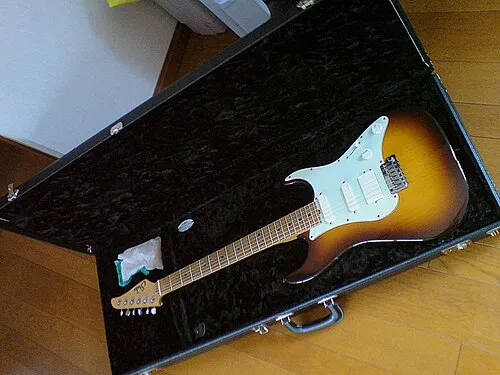
Photo: Akkun542 / Wikimedia Commons / Public domain Suhr
Classic S
2018
It looks like a Strat on purpose. Everything that’s different about it, you feel instead of see.
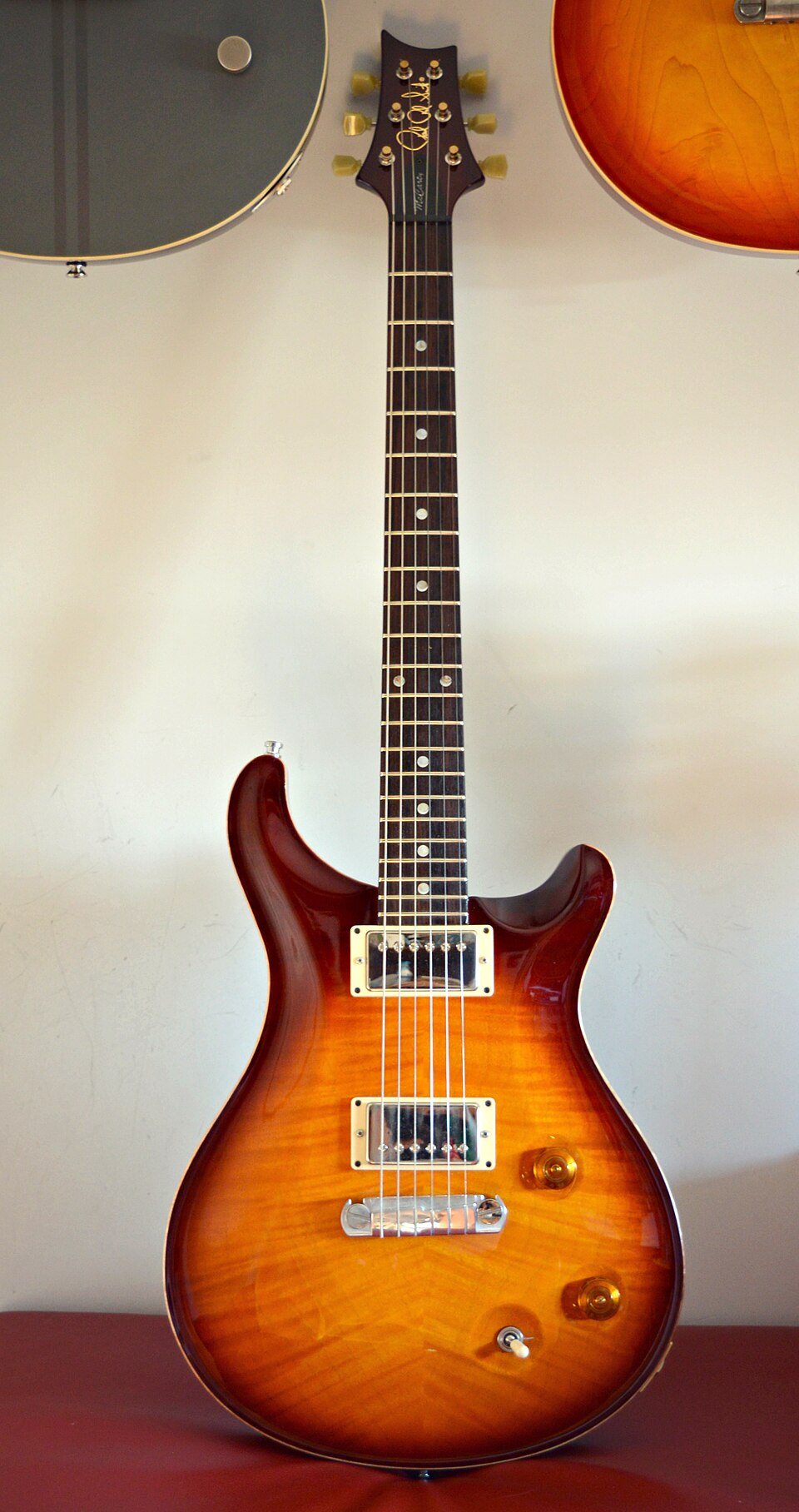
Photo: Freebird / Wikimedia Commons / CC BY-SA 2.0 PRS
McCarty
1994
Named for a man who never played guitar, built for a player who turned down having his own name on it.