PRS
McCarty
Named for a man who never played guitar, built for a player who turned down having his own name on it.
The early 1990s. David Grissom, playing guitar for John Mellencamp, asks Paul Reed Smith for a special order. He wants more bottom end and more of that old humbucker sound. He wants Duane Allman at the Fillmore.
- Introduced
- 1994
- Type
- Solidbody electric
- Class
- Production
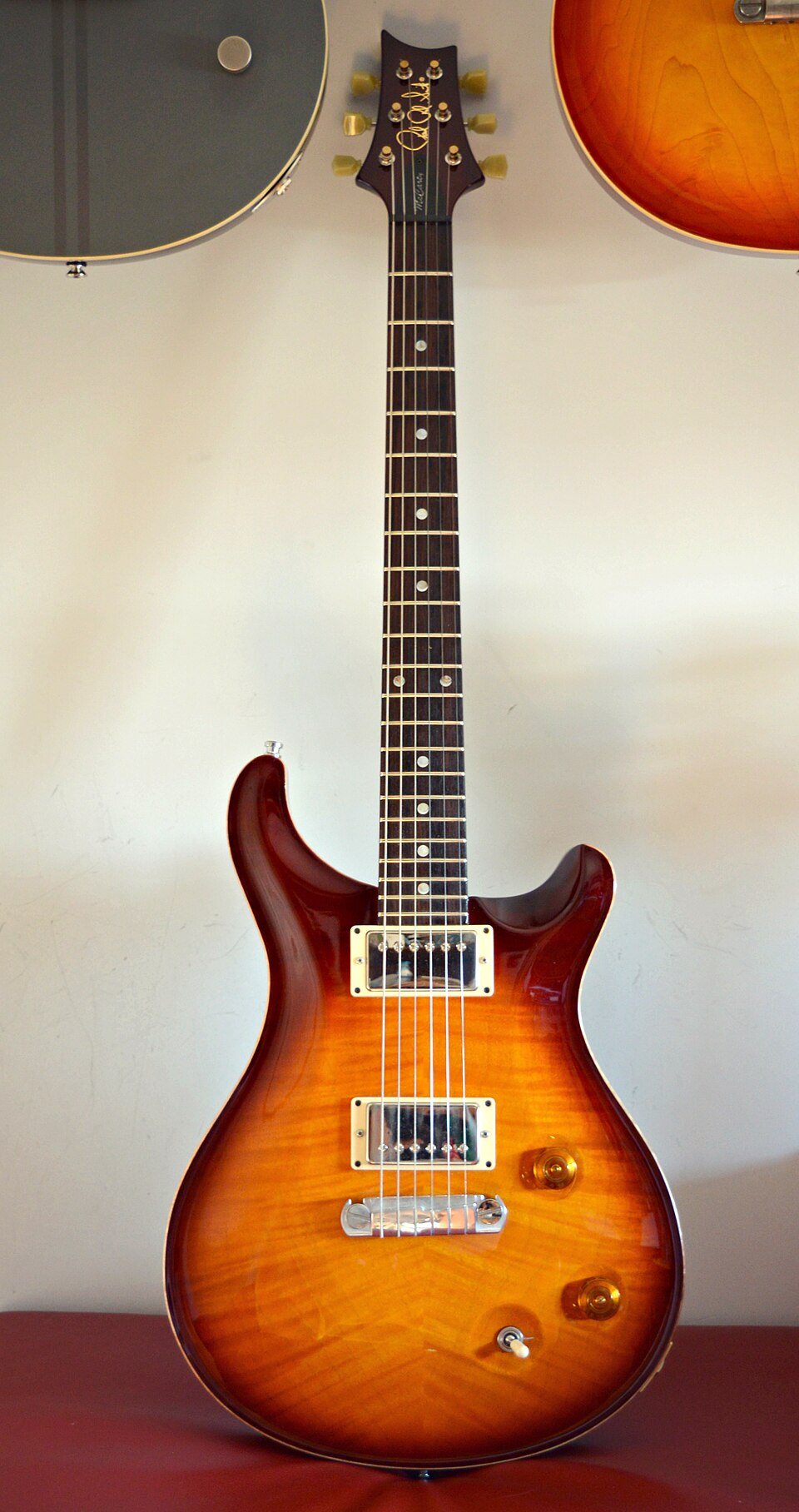
The short version
1986
The phone call
Smith tracks down Ted McCarty, the name on patent after patent.
1991
The prototype
Grissom’s guitar shows up at NAMM. He remembers it as ’91 or ’92.
1994
The McCarty
The first hundred are signed and numbered.
1995
Its own pickups
McCarty pickups replace the Dragon pickups it launched with. A coil split follows.
2007
Retired
The original run ends.
2010
The 58
The McCarty comes back as the McCarty 58.
2016
Back for good
The McCarty returns to the Core line, in 2015 or 2016 depending who you ask.
Side A
A1
More bottom, more PAF
David Grissom was playing with John Mellencamp in the early ’90s, and he wanted a PRS that could do something the standard ones didn’t. He wanted more low end and more of the old PAF humbucker sound. He had a specific record in his head: “Duane Allman’s sound on Live At The Fillmore.”
So he special-ordered one. An eighth of an inch of extra mahogany on the back. Covered pickups, like an old Gibson. Kluson-style tuners. A prototype turned up at NAMM, in ’91 or ’92, as he remembers it.
PRS offered to put his name on it. He said no.
That’s rarer than you’d think in the guitar business. Most people who get asked say yes before the sentence is finished. Grissom would get his own signature model eventually, the DGT, but not this one. Smith had somebody else in mind.
A2
The name on the patents
In 1986, the factory’s second year, Paul Reed Smith kept running into the same line on the patents he was reading: “Ted McCarty, Kalamazoo, Michigan.” It was on patent after patent. So he got in touch.
McCarty had run Gibson through the 1950s and into the ’60s, but that’s the Les Paul’s story and the Flying V’s. What matters here is what happened next. He became Smith’s consultant, and then his mentor.
So when it came time to name Grissom’s guitar, Smith knew what he wanted to call it. In his words:
When I told David I wanted to name it the McCarty model, he generously agreed.
A3
An eighth of an inch
The McCarty came out in 1994. Next to the Custom 24 it looks like a close cousin, and it is. Smith himself later said it was “basically a Dragon I with a thicker body, thinner headstock, lighter tuners, different pickups.” The Dragon I and the Custom 22 already had 22 frets and a stoptail. Grissom’s order put the whole combination on a production card.
The first recipe was 22 frets, a big fat neck, a stoptail, vintage-style tuners, covered humbuckers, and a mahogany back an eighth of an inch thicker than the Custom’s. It was the first production PRS with PAF-style covers and a Gibson-style three-way toggle. It cost about $700 more than a Custom. The first hundred were signed and numbered, and at least one of them has Ted’s signature on the backplate.
That eighth of an inch is the whole point. It’s what Grissom asked for: more wood, more bottom. Somebody once asked Grissom why he didn’t just buy a Les Paul. His answer: “A Les Paul is a Les Paul.”
Flip the record · By the numbers
1/8"
Extra mahogany on the back, the thing Grissom asked for. About 3 mm.
22
Frets. The Custom had 24.
100
Signed and numbered guitars in the first 1994 run.
~$700
How much more than a Custom it cost at launch.
Side B
B1
Gone, back, and back again
The McCarty got its own pickups in 1995, and a coil split in 1995 or 1996, depending who you ask. The original run ended in 2007. It came back in 2010 as the McCarty 58, and then returned to the Core line as plain McCarty in 2015 or 2016. The paperwork doesn’t agree, so I won’t pick.
Today it’s still a Stevensville Core guitar: 22 frets, bound rosewood, birds, a stoptail with brass inserts, and covered McCarty III humbuckers. Smith says the McCarty III and the Custom 24’s DMO are “basically the same pickup, but one has a cover and the other one doesn’t.”
As for Grissom, his DGT came along years later, and Smith’s buying advice sorts the two out: if you want Grissom’s pickups with a vibrato, get a DGT. If you want a stoptail with clearer pickups, get a McCarty.
B2
Paul’s design
The funny thing about this guitar is that the man it’s named after didn’t design it, and said so. He never played it, either. Ted McCarty never played guitar. In 1998 he put it plainly:
I didn’t contribute any specific designs… The PRS McCarty is Paul’s design.
Smith’s answer, then and later: they called it the McCarty because everything Ted was teaching him is in it.
So here’s the McCarty: a guitar Grissom asked for and wouldn’t put his name on, named for a man who wouldn’t take credit for it, built by a guy who gave the credit to his teacher. Everybody in this story kept handing it to somebody else.
The cast
The people, and the specific guitars, that made the legend.
1991
David Grissom
The special order
Asked for more bottom and more PAF, then declined to have the guitar named after him. His DGT signature came much later.
1986
Ted McCarty
The name
Smith’s consultant and then mentor. He never played guitar, and he said himself he didn’t design this one.
1994
Paul Reed Smith
Designer
Built it from Grissom’s order and named it for everything McCarty had been teaching him.
Liner notes
Specs, construction, rarity, value, and every source we used.
Twenty-two frets and an eighth-inch more mahogany — PRS’s McCarty, Ted’s name on a Core that is not a Custom 24.
- Body
- Solidbody; maple top with violin carve; mahogany back. Optional 10-Top
- Neck
- Set one-piece mahogany; Pattern; PRS double-acting truss rod
- Fingerboard
- Rosewood with faux-bone binding, 10" radius, 22 frets, bird inlays
- Scale
- 25"
- Pickups
- PRS McCarty III treble and bass humbuckers
- Hardware
- PRS stoptail with brass inserts; PRS Phase III non-locking tuners with wing buttons and brass shafts; nickel; “McCarty” truss-rod cover
- Electronics
- Volume and push/pull tone; 3-way toggle
- Finish
- High-gloss nitro
- Nut
- Bone, 1 11/16"; body end 2 1/4"
Open the full research fileConstruction details, the complete player record, production numbers, dated value estimates, and sources
Current US Core McCarty (PRS electrics page McCarty, fetched 8 September 2026; PRS Japan Core table for numeric depths). 2024 Core used McCarty LT pickups and vintage-style non-locking tuners. McCarty 594 is 24.594" with four knobs — not this table. SE McCarty 594 and S2 McCarty 594 are other series. Mixed inch/mm flagged: Guitar World 2020 prints 635 mm (25") scale, extra back ~3 mm / 1/8" to just over 52 mm, nut 43.13 mm. Do not average those with the factory inch table.
Construction
The job was a vintage-aimed PRS the Custom 24 was not. Twenty-two frets. A thicker mahogany back. Covered humbuckers. A stoptail. Paul Reed Smith’s first factory guitar, 1985, stayed 24 frets and a rotary; this one was meant to sit closer to the maple-and-mahogany dual-humbucker world Ted McCarty had run at Gibson, without becoming a Gibson.
Name, not designer. PRS support and the current Core page: first McCarty 1994. Advance product information, 21 January 1994 (MusicRadar / Guitarist): tribute to Theodore “Ted” McCarty, Gibson vice president 1949, president 1950–1966. Smith reached him in 1986, year two of the factory, after finding “Ted McCarty, Kalamazoo, Michigan” on patent after patent (PRS blog, Paul in his own words). Consultant, then mentor. Ted in 1998 (MusicRadar): “I didn’t contribute any specific designs… The PRS McCarty is Paul’s design.” Smith’s line, same piece and the later PRS “Unforgotten Man” blog: they called it McCarty because everything Ted was teaching him is in it. Keep both. Ted did not draw this guitar. He also never played guitar.
Grissom’s special order. David Grissom, then with John Mellencamp, asked for more bottom and more PAF — “Duane Allman’s sound on Live At The Fillmore” (Grissom, MusicRadar; Smith, PRS blog). He wanted an 1/8" extra mahogany on the back, covered pickups, Kluson-style tuners. Prototype at NAMM, “’91 or ’92,” Grissom’s memory. PRS offered to put his name on it. He declined. Smith: “When I told David I wanted to name it the McCarty model, he generously agreed.” Smith later to Guitarist: the McCarty was “basically a Dragon I with a thicker body, thinner headstock, lighter tuners, different pickups.” Dragon I (1992, 50 made) and Custom 22 (1993) already had 22 frets and the stoptail. Grissom’s request put the combination on a production card.
The 1994 recipe. PRS support, McCarty Model row: first 100 signed and numbered; Wide-Fat 22-fret only; East Coast maple top; 1/8" thicker mahogany back; stoptail; vintage-style tuners; covered Dragon Bass humbuckers. Guitar World (Burrluck, 2020): mahogany back up by about 3 mm (1/8") to just over 52 mm — a change he says later Core guitars kept, “with the exception of the 49 mm-thick Custom.” First production PRS with PAF-style covers and a Gibson-style 3-way toggle (MusicRadar, 30 years of PRS). 25" scale still. MusicRadar: about $700 above the Custom at launch. Historical list, not 2026 street.
Pickups and the coil-split. PRS support: Dragon Bass at intro, McCarty pickups from 1995, “now includes a push/pull coil-tap on the tone control.” Burrluck dates the coil-split “around 1996,” partial splits with resistors later still (2011). Keep 1995 and 1996. East Indian rosewood neck option 1998.
Out, 58, back. PRS support: McCarty Model 1994–2007, 2010–present. guitar-list and the support row treat the 2010 return as the McCarty 58 (57/08 pickups 2010–2015). PRS press, June 2015, “reintroduces the McCarty model” with 58/15s. Vintage Guitar (Prown, June 2016): reintroduction 2015. Burrluck 2020: “returned recently in 2016,” and the support table has 58/15 from 2016. Keep 2007, 2010, 2015, and 2016. McCarty 58 is a chapter of this line, not a Gibson year.
Current Core. Stevensville. Violin carve. Pattern neck — Burrluck: previously Wide Fat; depth 7/8" at the 1/2 fret, 61/64" at the 12 1/2. Bound rosewood, birds, inlaid signature, high-gloss nitro, bone nut, hardshell. Stoptail with brass inserts (the Paul’s Guitar-era witness-point brass, on this guitar by the 2020 refresh). 2024: McCarty LT, vintage-style non-locking tuners with wing buttons. 2025–26: McCarty III covered humbuckers; Phase III non-locking tuners with brass shafts. Guitar World (Burrluck with Smith, April 2025): McCarty III and DMO are “basically the same pickup, but one has a cover and the other one doesn’t.” DMO is the Custom 24 voice. This cover is the McCarty voice. Ask the year before you assume the sound.
Not this guitar. Custom 24 (prs-custom-24): 24 frets, Pattern Thin, 5-way blade, typically a tremolo, uncovered DMO on current Core. CE 24 (prs-ce-24): bolt-on maple. McCarty 594: 24.594" scale, Pattern Vintage, four knobs — Core cousin, different SKU. SE and S2 McCarty 594s are other factories and lines. DGT is Grissom’s later signature (PRS support 2008–; Guitar World 2007 as working title “McCarty II”) — vibrato, his pickups, not this stoptail. Santana signatures are a different scale/family. Grissom, asked why not just buy a Les Paul (MusicRadar): “A Les Paul is a Les Paul.” No Gibson SKU.
Players
Do not default Carlos Santana here. Do not default Custom 24 names here. Do not file Opeth or Linkin Park here — those CE 24 records live on prs-ce-24. Ted McCarty never played guitar.
David Grissom. The player this plate is named around, not after. MusicRadar: “The McCarty is literally the guitar I special ordered when I was working with John Mellencamp.” Mellencamp years in that interview are the special-order window, not a factory-McCarty session log. Big Daddy / Whenever We Wanted / Human Wheels are not pinned to a 1994 Core here. Prototype NAMM 1991 or 1992. He turned down a Grissom model then; the DGT is the later guitar. Smith to Guitarist: if you want the pickups Grissom relies on, with a vibrato, buy a DGT; if you want a stoptail with clearer pickups, buy a McCarty. Known-to-play the line; no named 1994 serial forced onto a Mellencamp track this pass.
Also known to play stays short. None invented.
Rarity
Current Core McCarty is regular production, not rare. SE/S2 McCarty 594 volume is a different factory and should not be used to judge Core scarcity. PRS does not publish annual McCarty unit counts. None invented.
What is actually thinner: the first 100, signed and numbered (PRS support; Premier Guitar Vintage Vault treats #17 as one of that hundred). Brazilian Rosewood McCarty 1999: 250, signed and numbered. Brazilian Series McCarty 2003: 500, 10-Top only. Those are limited runs, not a year census. 2007–2010 gap, then McCarty 58, then the 2015/2016 Core return: used market is leftover 1994–2007 instruments plus post-2010 Core. Don’t invent a produced total for either chapter.
Value
Informal estimate, 8 September 2026. Not an appraisal.
Ask vs sold. Celebrity lots are not-comps. No invented medians or factory counts.
New street (US Core McCarty). zZounds Core McCarty 2025 $4,740. Guitar Sanctuary same list ($4,029 as a dated sale). Round Hill 10-Top $5,540. Do not mix Core McCarty 594 Sweetwater list ~$4,820. SE McCarty 594 ~$999 (Sweetwater) — not a Core comp.
Used modern Core (2015/2016–). Named Reverb solds, May–August 2026: Excellent $2,969–$3,300; Very Good $2,100–$2,399. Reverb Price Guide snippet on PRS McCarty (years 2015–2026): estimated used $1,684–$2,716 (144 orders, Good to Mint); typical-new widget $3,899. That typical-new sits under current zZounds street and may mix years. Don’t average the Guide band with a 2025 Core cart.
Vintage / first 100 / limited. Thin public hammers this pass. Premier Guitar Vintage Vault (July 2026): 1994 #17 of 100, Ted-signed backplate, about $8,500 asking (Joel’s Vintage Guitars). Ask, not a sold. 1999 Brazilian (250) and 2003 Brazilian Series (500): no clean 2024–26 sold sample extracted. Don’t invent a band.
See also
- prs-custom-24 — 24-fret Core; this is the 22-fret deeper-carve cousin
- gibson-les-paul-standard — the Kalamazoo dual-humbucker this Maryland guitar is not
- prs-ce-24 — bolt-on Core; 24 frets, maple neck, not this set mahogany
Sources
- PRS McCarty — current Core copy; 1994 intro; McCarty III; stoptail with brass inserts; Phase III non-locking tuners
- PRS McCarty - 2024 — prior-year Core; McCarty LT; vintage-style non-locking tuners
- PRS Japan, McCarty Core table — 22-fret Pattern; 25"; 7/8" / 61/64"; 1 11/16" / 2 1/4"; McCarty III; bone nut; high-gloss nitro
- PRS Model History — McCarty 1994–2007 / 2010–; first 100 signed; 1/8" thicker back; pickup eras; rosewood-neck option 1998; Brazilian 250 / 500
- PRS, The Unforgotten Man — 1986 call; 1994 name; Grissom / Fillmore; Ted as mentor not designer
- PRS, The Legacy of Ted McCarty — first McCarty 1994
- PRS, From the Archives: The First McCarty Prototype — early-90s deviation from Custom 24; Grissom
- MusicRadar / Guitarist, Making the PRS McCarty — 21 January 1994 advance sheet; Grissom Mellencamp special order; 1/8" back; Ted 1998 “Paul’s design”; ~$700 over Custom at launch
- MusicRadar, 30 years of PRS — 1994 intro; deeper body, thinner headstock, 3-way toggle, covered pickups
- Guitar World, Burrluck, PRS McCarty 2020 review — 1994 vs Custom; ~3 mm / 1/8" back to just over 52 mm; 635 mm (25"); 43.13 mm nut; 2016 return vs 2020 refresh; Pattern = ex–Wide Fat
- Guitar World, Burrluck with Smith, April 2025 — McCarty III as covered DMO
- Vintage Guitar, Pete Prown, PRS Guitars’ McCarty (June 2016) — reintroduction 2015; thicker body; 58/15; Pattern as beefy D; list as tested $3,900
- Guitar International / PRS press, 2 June 2015 — 2015 reintroduction; 58/15
- Premier Guitar Vintage Vault, first-run McCarty — 1994; #17 of 100; ~$8,500 ask (Joel’s Vintage Guitars); Grissom / Fillmore
- zZounds, PRS McCarty 2025 — Core street $4,740; McCarty III spec
- Reverb, PRS McCarty — years 2015–2026; Price Guide used $1,684–$2,716; typical-new $3,899; named 2026 solds
- Sweetwater, PRS McCarty 594 — 594 list ~$4,820; not this SKU
- Sweetwater, SE McCarty 594 Singlecut — SE ~$999; not Core
- Guitar World, Grissom and the DGT — Grissom declined an early named model; DGT later
Keep digging
Guitars this one gets compared to, confused with, or descended from.
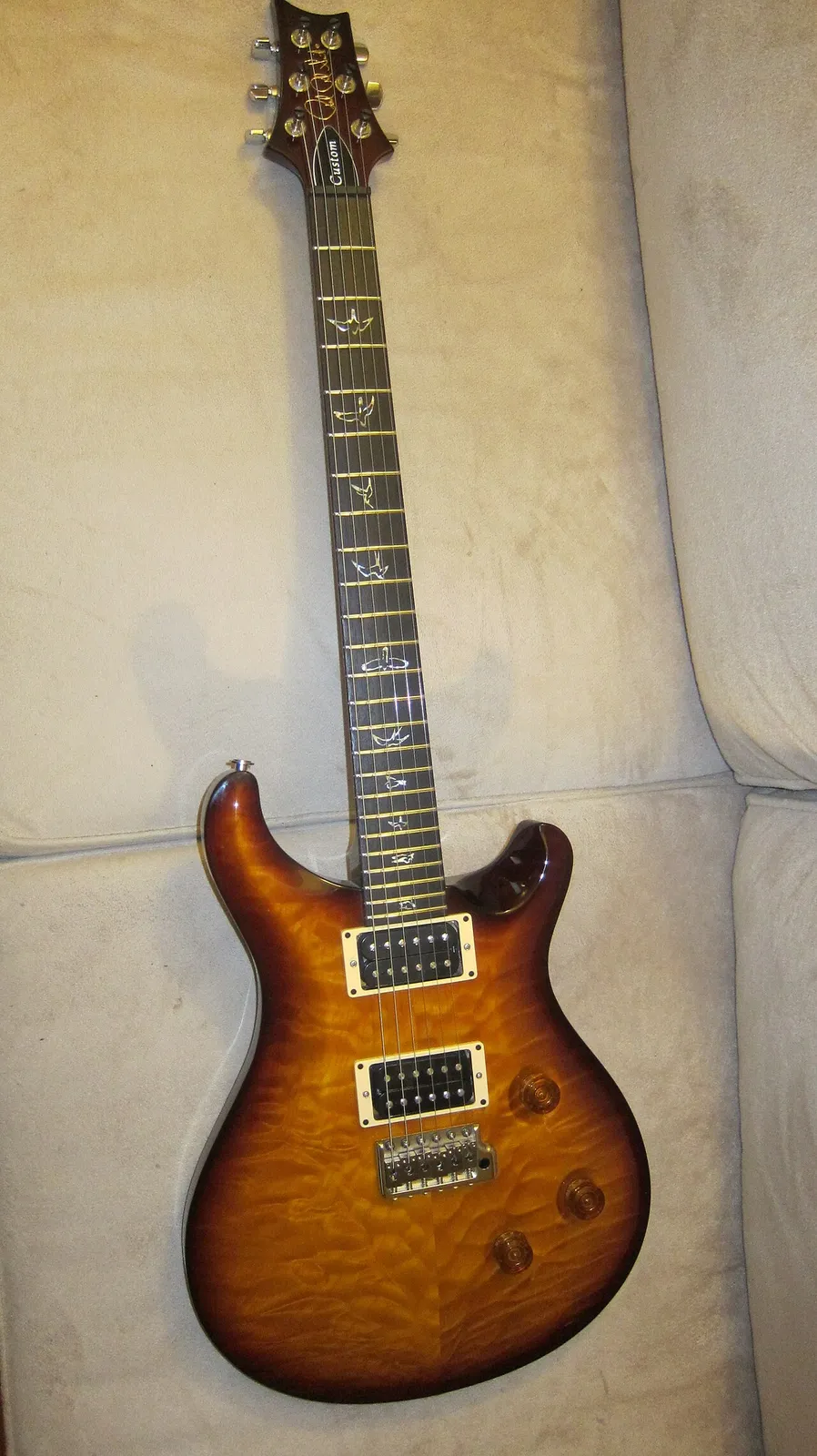
Photo: sbaimo / Wikimedia Commons / CC BY 2.0 PRS
Custom 24
1985
Paul Reed Smith spent a decade building guitars one at a time for touring stars. The Custom was for everybody else.

2006 Gibson Les Paul Standard (SN 000660573). Photo by wetwebwork. Licensed under CC BY-SA 2.0. Via Wikimedia Commons. Gibson
Les Paul Standard
1952
Gibson made about 1,500 sunburst Les Pauls, decided nobody wanted them, and stopped. Then the British blues boom happened.
- Send a picture
PRS
CE 24
1988
PRS meant it to be the cheaper, quicker one. Then a second-hand black one made Opeth’s Blackwater Park.