Music Man
Reflex
Music Man built an anniversary guitar for one year. The Reflex was the plain one that let it stay.
Summer NAMM, 2010. A Music Man rep stands next to a single-cut in a plain maple top and explains what it is: the guitar they did for the anniversary last year, made normal. Four colors, no figure, the same ten sounds.
- Introduced
- 2010
- Type
- Solidbody electric
- Class
- Production
Have a photograph of this guitar? Send a picture
The short version
2009
The 25th
Winter NAMM. One guitar to mark 25 years since Ernie Ball took the Music Man name. One finish, one year.
2010
Introducing the Reflex
Summer NAMM. Plain maple top, four colors, trem or hardtail.
2010
The first Reflex
In December, Dudley Gimpel shows an earlier prototype that already had the name.
2011
The Game Changer
Digital switching arrives on select Reflex guitars. Series/parallel carries on beside it.
2015
Madness
Jack Fowler of Sleeping with Sirens says he used a Reflex on the record, for the twangy parts.
2015
Going away
The Reflex guitar line and the bass are discontinued on 31 October.
Side A
A1
The normal one
Summer NAMM, 2010. A Music Man rep named A.J. is standing next to a single-cut with a plain maple top, and he has a short way of explaining it: “a normal production version of our 25th anniversary guitar we did last year.”
That’s the whole pitch. Last year’s guitar was the special one. This one is the one you can keep buying.
Plain maple, not figured. Four colors: black, white, vintage sunburst, vintage gold. Trem or hardtail. Same woods, same pickups, same switching as the anniversary guitar. Music Man called it the Reflex.
A2
One year, one finish
The anniversary was Ernie Ball’s. In 2009 it had been twenty-five years since Ernie Ball took over the Music Man name, and at Winter NAMM the company marked it with one guitar, and basses.
Dudley Gimpel of Music Man said the body was “very similar to our Axis,” with a new forearm contour and pickup mounts borrowed from the Silhouette 20th Anniversary. It came with a flame top, or quilt on the one a magazine shot, in a single finish, Venetian Redburst. It picked up a Best in Show award. Then the year was over.
On the forums, the difference got spelled out: the 25th has the figured top and the fancy pearloid dots. The Reflex has the plain top and black dots. Underneath, it’s the same guitar.
A3
A sandwich with a stick in it
Inside, it’s more interesting than it looks. The body is basswood with parallel grooves cut into it, which makes it chambered. A mahogany block runs down the middle, then the maple top goes on. The sandwich first turned up on the 20th Anniversary Silhouette. Music Man’s own news post called the Reflex “a slightly larger, basswood chambered body.” Larger than an Axis, that is, and with a flatter 12-inch board instead of the Axis’s 10.
Two covered DiMarzio humbuckers sit in rings on spring-loaded screws, so the cover follows the strings. Gimpel, talking about the 25th’s pickups, said they had more wire, “like the Stingray pickup,” with ceramic magnets like the Sterling bass.
Last year’s guitar was the special one. This one is the one you can keep buying.
Flip the record · By the numbers
10
Sounds from two humbuckers, a five-way lever, and a series/parallel toggle.
12"
Fingerboard radius. Flatter than the Axis next to it on the wall, at 10".
$3,250
The US price at the end of 2010. £2,250 in the UK.
2010–2015
The whole series/parallel run.
Side B
B1
Ten sounds, two switches
The five-way lever picks either humbucker, or both, and then the inside coils or the outside coils. A separate toggle runs each of those series or parallel. Series is the fat, loud humbucker sound. Parallel thins it toward a single coil without the hum. Five positions, two ways each. Ten sounds.
The trem was an option, a twin-pivot with a brass block, set flat to the body so it only dives unless you want it floating. At the end of 2010 the Reflex was £2,250 in the UK, $3,250 in the US.
B2
The name was already taken, by Music Man
At the end of 2010, Gimpel showed a magazine something odd: an earlier prototype already called Reflex. Steve Morse outline, Silhouette contours, a Schaller trem, three Schaller pickups. He had trademarked the name on that guitar, and then reused it on this one. Different body. Same word.
B3
The switch they couldn’t stop
In January 2011, at NAMM, Music Man went further. The Game Changer put the pickup wiring under digital control on select Reflex guitars: series, parallel, in or out of phase, saved to the guitar. Sterling Ball called it “The most significant innovation our company has developed.” Somewhere around 9,000 combinations on four coils, and a quarter of a million on five.
It came from the Reflex, in a way. Drew Montell said it started as a way past the 25th’s five-way.
But the plain series/parallel Reflex kept going alongside it, and in 2015 it turned up on a record. Jack Fowler of Sleeping with Sirens, talking about Madness, said he went “back and forth between all of my Gibson Les Pauls and then this one Ernie Ball Reflex because it sounds really good for twangy stuff.” He didn’t name the songs.
That August, customer service posted the list. The Reflex guitar and the Reflex bass, entire lines, discontinued 31 October 2015. A.J. added a line: “Aside from The Game Changer, the Reflex will be going away.” The Game Changer is discontinued now too.
Ernie Ball doesn’t publish how many were made. There’s no new one to order. What’s left are the plain-topped guitars that were supposed to be the ordinary version, sitting next to somebody’s Les Pauls, and getting picked for the twangy parts.
Put this on
You’ve read about it. Now hear it. Here’s what this guitar sounds like, and what to listen for.
Madness
Jack Fowler went back and forth between his Les Pauls and “this one Ernie Ball Reflex” on this record, the Reflex for the twangy stuff. He doesn’t say which songs, so listen for the brighter, snappier parts.
Find it on YouTube (opens in a new tab)
The cast
The people, and the specific guitars, that made the legend.
2015
Jack Fowler
Reflex
Sleeping with Sirens. Used one Reflex on Madness alongside his Gibson Les Pauls, “because it sounds really good for twangy stuff.”
2009
Dudley Gimpel
The 25th Anniversary, and the original Reflex prototype
Music Man. Explained the 25th at NAMM 2009, and later showed the older prototype that first carried the Reflex name.
2010
Paul Day
Reflex HH
Reviewed the Reflex in December 2010 and laid out what each switch position actually does.
Liner notes
Specs, construction, rarity, value, and every source we used.
A chambered single-cut, a mahogany block, and ten sounds from two humbuckers — Music Man’s Reflex, the plain guitar after the 25th, not Axis and not the bass.
- Body
- Chambered basswood, maple top, mahogany tone block; bound single-cut; 12-7/8" wide, 1-3/4" thick, 37-3/4" long (32.7 cm, 4.5 cm, 95.9 cm). Mix flagged.
- Neck
- Bolt-on select maple, asymmetric, 5-bolt sculpted joint; gunstock oil and hand-rubbed wax
- Fingerboard
- Select maple or rosewood, 12" (30.5 cm) radius, 22 high-profile medium-width frets. Mix flagged.
- Scale
- 25-1/2" (64.8 cm). Mix flagged.
- Pickups
- HH — two DiMarzio custom covered humbuckers in Music Man rings
- Hardware
- Strings-thru standard: chrome hardened steel, bent steel saddles. Optional Music Man vintage tremolo. Schaller M6-IND locking; 4+2 headstock 5-7/8" (14.9 cm)
- Electronics
- 500k volume and tone, .022µF; 5-way lever; series/parallel toggle. Graphite-acrylic cavity, aluminum control cover
- Finish
- High-gloss polyester. Black, white, vintage sunburst, vintage gold
- Nut
- Compensated; 1-5/8" (41.3 mm) at nut, 2-1/4" (56.9 mm) at last fret. Mix flagged.
Open the full research fileConstruction details, the complete player record, production numbers, dated value estimates, and sources
Classic living example = 2010 Reflex HH (San Luis Obispo), series/parallel, not the Game Changer. Factory mixed inch/mm flagged; no millimetres invented. The hosted page this pass is Reflex TGC. It is not a 2026 cart, and it prints frets high profile, wide against medium width on the 2010 sheets and in Paul Day’s review. Weight sheets disagree: Guitar Center and Guitar Planet 7 lb 0 oz (3.18 kg); Casey Ball, 2017, 7 lb 8 oz (3.29 kg). Both add 7 oz for a tremolo and say it varies. Do not average. Strings disagree the same way: a dealer sheet prints RPS 9 (#2239); the TGC table prints RPS 10 (#2240). HSH, piezo, and the Game Changer are sisters. Reflex bass is ash, 34". The 2009 25th is the figured predecessor. Axis, Silhouette, Cutlass, Albert Lee, Steve Morse, and StingRay are other slugs. Reverb’s card (poplar, double-cut, 2014–2015) and a Toronto listing (alder, introduced 2011) are wrong. Factory copy is basswood, 2010.
Construction
The job was to keep the anniversary guitar after the anniversary. San Luis Obispo already had a small Floyd single-cut, and a 24-fret alder. What they catalogued in 2010 is bigger than the Axis, plainer than the 25th, and built on a mahogany stick. Two covered humbuckers. A toggle. That is this guitar. Not Axis. Not Silhouette. Not the Reflex bass. Not the Cutlass of 2016.
2009. Twenty-five years since Ernie Ball took the name. Winter NAMM: one guitar, and basses, to mark it. Dudley Gimpel told Premier Guitar the body was “very similar to our Axis,” with a new forearm contour and the pickup mounts from the Silhouette 20th Anniversary. Premier’s review: flame standard, quilt on the guitar they shot, Venetian Redburst, a Best in Show award. Same chambered sandwich, same switching. One finish. One year. Ernie Ball forum, January 2011: the 25th is that figured top and the special perloid dots; the Reflex is the plain top, four colors, black dots, same woods, same electronics. Predecessor. Not this headstock.
2010. Summer NAMM. A.J., from Music Man: “a normal production version of our 25th anniversary guitar we did last year.” Plain maple, four colors, trem or hardtail. The news post, 23 July: “Introducing the Reflex,” ten sounds, “a slightly larger, basswood chambered body.” Day, 6 December: introduced earlier that year, alongside the Albert Lee HH, which is another guitar. A caption on that review mashes the Reflex, the 25th, and the Lee into one line. Don’t use it. This plate starts in 2010.
Premier’s factory visit that December: parallel grooves in the basswood, then the block and the maple top. Day: that sandwich first showed up on the 20th Anniversary Silhouette. Outline “slightly bigger” than an Axis. Vinnicombe, on the Game Changer, a shade under 4 cm longer. Radius 12", not the Axis 10". Day’s frets were tall and medium, the dots ordinary rather than Music Man’s tiny ones, gloss only on the matching headstock, the compensated nut the range had used since 2005. Rings on three spring-loaded screws so the cover follows the strings. Same covered DiMarzios as the 25th. Gimpel, NAMM 2009, on those pickups: more wire, “like the Stingray pickup,” ceramic magnets like the Sterling bass. A forum later files them as the Axis set Eddie used. Keep Gimpel.
Day: the 5-way is either humbucker or both, plus the inside coils or the outside coils, and the toggle runs each series or parallel. “Ten very distinct sounds” is the factory count of that grid. Barrel jack. Trem optional: twin-pivot, brass block, flat to the body so it only dives, and floatable if you want it. £55. Sunburst £100. MusicRadar that month: £2,250 / $3,250.
The name is older than this catalog guitar. On 31 December 2010 Gimpel showed Premier a prototype already called Reflex, beside Steve Morse number two: Morse outline, Silhouette contours, a Schaller trem, Schaller pickups in HSH, 22 frets. He had trademarked Reflex on that object, then reused it. Not this body. The other drawing from that stretch “turned into the Albert Lee,” and they were calling it Axis then. Not the EVH Axis.
2011. Game Changer, 12 January, on select Reflex HH and HSH guitars and the Reflex bass. Sterling Ball: “The most significant innovation our company has developed.” The audio stays analog. Switching is digital: series, parallel, in or out of phase, saved to the guitar. Casey Ball, 2017: about 9,000 combinations on four coils, 250,000 on five. The press asterisk puts the quarter-million on five coils. Drew Montell: it started as a way past the 25th’s 5-way. USB powers the board and does not charge it. Vintage Guitar’s tester used AA batteries. No Treble’s AAA line is the bass article. Piezo and uncovered HSH live here. Not this table.
2015. Dargin, customer service, 10 August: Reflex Guitar 390 and 395, entire line, and the bass, discontinued 31 October 2015. A.J., aj@ernieball.com: “Aside from The Game Changer, the Reflex will be going away.” Casey was still describing that package in February 2017. The Game Changer site now says the product is discontinued, and flags Chrome Apps closing in June 2022. A seller’s “the app died in 2017” is not a factory date.
Sweetwater’s rosewood-top, all-rosewood-neck page says “no longer available,” with no price, and the truss-rod copy says “your Axis will be ready to rock.” Not an Axis. Not this maple top. Classic versus current: the 2010 HH against no new Reflex on 1 October 2026. The URL still up is the Game Changer spec.
Players
Do not hang an Axis, a Silhouette, a Cutlass, a StingRay, an Albert Lee, or a Steve Morse here. Do not recruit the bass. Travis Larson’s April 2009 film is the 25th, not this guitar.
Jack Fowler (Sleeping with Sirens). Total Guitar, via MusicRadar, 27 March 2015, on Madness: “back and forth between all of my Gibson Les Pauls and then this one Ernie Ball Reflex because it sounds really good for twangy stuff.” Same answer, the amps were an EVH 5153, a Soldano, a Satellite, and a Bad Cat Hot Cat 100. Cleans: the Satellite, “maybe” a Blues Deville, “with the Ernie Ball.” No song titles. Nick Martin, in that piece, names an Armada. Different Music Man. Fowler’s later Schecter is another maker.
Also known to play: no second name in the sources used here. None invented.
Rarity
You cannot order a new Reflex. Series/parallel left the roster 31 October 2015. The Game Changer was the exception A.J. named, and that package is discontinued now too.
Ernie Ball does not publish Reflex totals. None invented. Serials date a guitar. They don’t count a year, which is why a first-year census is unknown.
What is thinner: the 2009 25th, one finish and a figured top. The prototype in Gimpel’s hands. A 2010 guitar from before the Game Changer. Fowler’s Madness Reflex is one object, not a census.
Value
Informal estimate, 1 October 2026. Not an appraisal.
Ask versus sold, labeled. No invented medians or factory counts. The Reverb Price Guide widget on Reflex Tremolo did not print a USD band this pass. Flag: thin sold-comp access.
New street. None. No factory cart this pass. Historical prices do not agree, so they are not averaged. MusicRadar, 6 December 2010: £2,250 / $3,250; trem £55; sunburst £100. Guitar Center’s page still prints $1,995, sold out. Gear Music’s Vintage Gold page prints MSRP $2,750, out of stock, undated. Game Changer money is a sister: MusicRadar, 29 September 2012, £2,539 / $3,350; Vintage Guitar, December 2012, street $2,275.
Used modern. Named sold listing, not a series: 2011 Vintage Gold, Very Good, series/parallel trem, price shown $1,550, seller’s scale 7 lb 8 oz (Reverb; page says sold, listed about two years before this pass). Named ask: black gloss, Very Good, serial 662519, £1,999 (Reverb UK). A Simms refinish cut from $2,500 to $1,950 is a custom. A white hardtail that left with Seymour Duncans, sold at $1,290, is modified. Neither is a stock comp.
Game Changer numbers stay off this band. Named sold listing, sister: Norman’s, black HSH with USB, price shown $1,700, 7.8 lb. Do not average that into an HH median.
Vintage / collectible. A 2010 guitar. The 2010–15 series/parallel run is the used market, not a separate vintage SKU. The 2009 25th is the scarcer relative, and it is not this model. No clean 25th hammer this pass. Don’t invent one. The prototype and Fowler’s guitar are unique. Not comps.
See also
- music-man-axis — smaller single-cut, Floyd, 10" radius; not this 12" chambered body
- music-man-silhouette — 24-fret alder; the 20th Anniversary is where the tone-block sandwich showed up
- music-man-cutlass — 2016 Strat-layout alder; not this single-cut
Sources
- Music Man news, 23 July 2010 (Wayback, 27 March 2013) — “Introducing the Reflex”; ten sounds; 5-way and series/parallel; chambered basswood, mahogany tone block, bound maple
- Guitar International, Summer NAMM 2010 — A.J., Music Man: production version of last year’s 25th; chambered basswood; four colors; trem or hardtail
- Ernie Ball Forums: 25th Anniversary vs Reflex, January 2011 — figured top and perloid dots on the 25th only; Reflex plain top, four colors, black dots; same woods and electronics
- Ernie Ball Forums, April 2025 — a player files the Reflex humbuckers as the Axis / EVH set. Not Gimpel’s 2009 description. Not used as the spec
- MusicRadar, Paul Day, 6 December 2010 — introduced earlier in 2010, with the Albert Lee HH; £2,250 / $3,250; trem +£55; sunburst +£100; medium tall frets; compensated nut since 2005; brass block; barrel jack; the Albert Lee caption is not the review
- Premier Guitar, builder profile, 21 December 2010 — parallel chamber grooves, then mahogany tone block and maple top
- Premier Guitar, 31 December 2010 — Gimpel with Morse #2 and the original Reflex prototype; namesake, not the shelf guitar
- Ernie Ball: original Reflex prototype — Dudley: name already trademarked; Morse outline, Silhouette contours, Schaller trem, Schaller HSH, 22 frets; the other drawing became the Albert Lee and was then called Axis
- Premier Guitar, NAMM 2009 — Gimpel: 25th body similar to Axis; forearm contour; Silhouette 20th mounts; more wire like a StingRay pickup, ceramic magnets like the Sterling bass
- Premier Guitar, 17 March 2009 — NAMM 2009; flame standard, quilt shown; Venetian Redburst; Best in Show
- Premier Guitar, 12 January 2011 — Game Changer on select Reflex guitars and the Reflex bass; Sterling Ball; NAMM 2011
- MusicRadar, 12 January 2011 — 250,000 is the five-coil figure
- MusicRadar, Chris Vinnicombe, 29 September 2012 — £2,539 / $3,350; a shade under 4 cm longer than Axis; Drew Montell on the 25th
- Vintage Guitar, Tom Guerra, December 2012 — street $2,275; just under 8 lb on that tester; AA batteries; USB powers, does not charge
- Ernie Ball Music Man: What Is The Game Changer? (Casey Ball, 21 February 2017) — offered without the system for a time; ~9,000 / 250,000; 7 lb 8 oz; HH, HSH, piezo; Reflex bass is ash
- Ernie Ball Music Man: The Game Changer — hosted Reflex TGC table, fetched 1 October 2026; mixed inch/mm; frets “wide”; RPS 10; left-handed No; not a cart
- The Game Changer extension page — “This product is discontinued”; Chrome Apps closing June 2022
- Ernie Ball Forums, Dargin and A.J., 10 August 2015 — customer service: Reflex Guitar 390, 395 and the Reflex bass, entire lines, discontinued 31 October 2015; A.J., aj@ernieball.com: Game Changer excepted
- No Treble, 5 July 2010 — Reflex bass; ash; not this guitar
- No Treble, 27 January 2011 — Game Changer bass article; AAA batteries there, not the guitar
- MusicRadar / Total Guitar, 27 March 2015 — Fowler, one Reflex on Madness; Martin’s Armada is not this guitar
- Ernie Ball: Travis Larson, 25th Anniversary, 10 April 2009 — the predecessor, not the Reflex
- Sweetwater: Reflex HH, rosewood top and neck — no longer available, 1 October 2026; no price; “your Axis”; not this table
- Guitar Center: Reflex, black — $1,995, sold out; 7 lb 0 oz; medium-width frets
- Guitar Planet: Reflex — 7 lb 0 oz; binding by color; medium-width frets
- Gear Music: Reflex Vintage Gold — MSRP $2,750, out of stock, undated; RPS 9
- The Twelfth Fret, Toronto — dealer copy: “introduced in 2011,” body “alder.” Rejected. Factory is 2010 and basswood
- Reverb: Reflex Tremolo — Price Guide widget blank; poplar / double-cut / 2014–2015 card rejected; custom refinish ask $1,950 from $2,500 on that page
- Reverb: white hardtail, Seymour Duncan — sold listing, $1,290; modified, not a stock comp
- Reverb: 2011 Reflex gold — sold listing, price shown $1,550; 7 lb 8 oz
- Reverb UK: Reflex black — ask £1,999; serial 662519
- Reverb: Norman’s Rare Guitars HSH — Game Changer sister; sold listing, price shown $1,700; 7.8 lb
- Ernie Ball Music Man: Axis — 10" radius; the shorter single-cut this outline is not
Keep digging
Guitars this one gets compared to, confused with, or descended from.
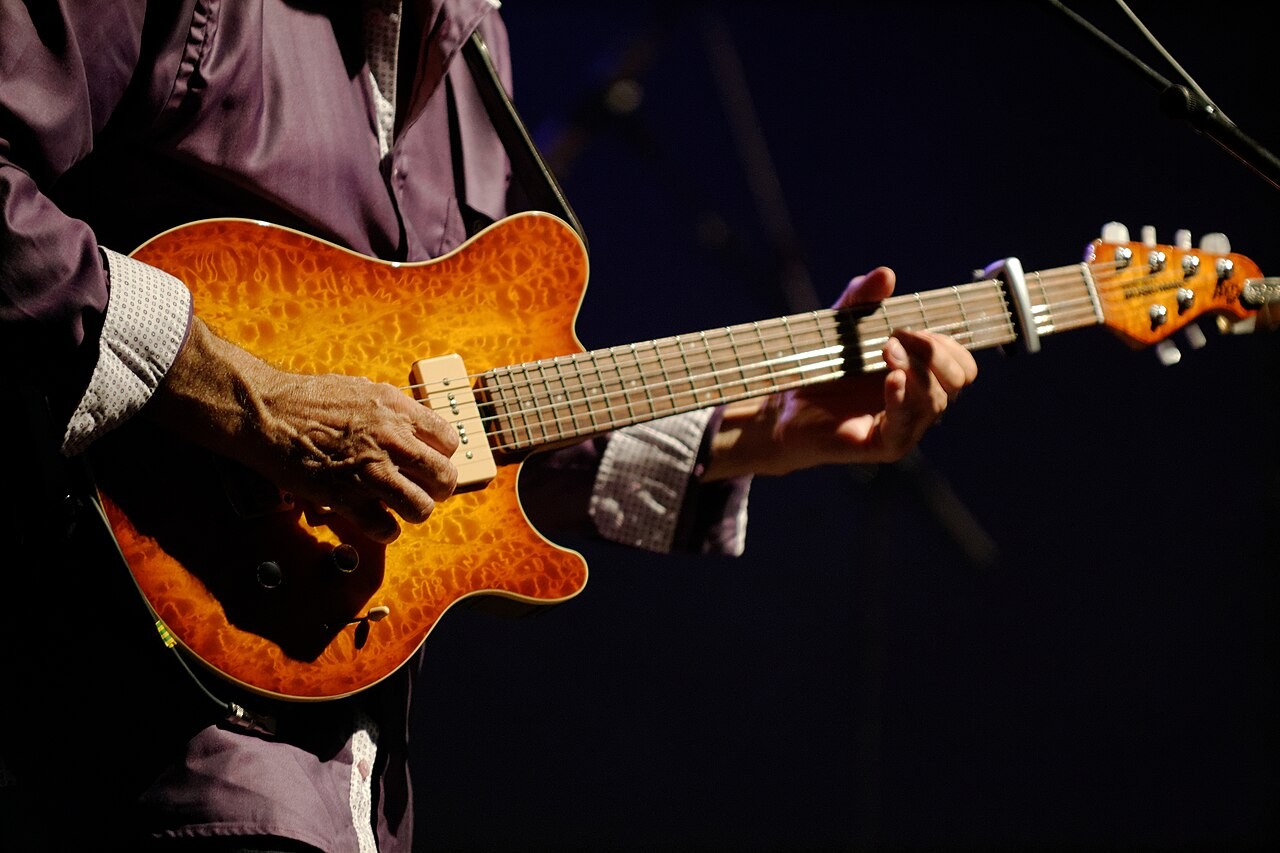
Photo: Kergourlay / Wikimedia Commons / CC BY-SA 3.0 Music Man
Axis
1991
They copied the neck off Eddie Van Halen’s worn-out Kramer. Then Eddie left, and the guitar stayed.
- Send a picture
Music Man
Silhouette
1986
People laughed at Music Man’s first guitar. Then Keith Richards picked one up.
- Send a picture
Music Man
Cutlass
2016
Leo Fender drew up the Cutlass in the ’70s. It took about forty years to make it onto a wall.