Peavey
T-60
Peavey’s guitar man said the big guys told dealers: no amps, no guitars. So the amp company built its own.
Houston, 1975. Chip Todd is working in a guitar repair shop when Hartley Peavey, the amplifier man from Meridian, Mississippi, offers him a job. For about a year, Chip will be the entire staff of Peavey’s guitar division.
- Introduced
- 1978
- Type
- Solidbody electric
- Class
- Production
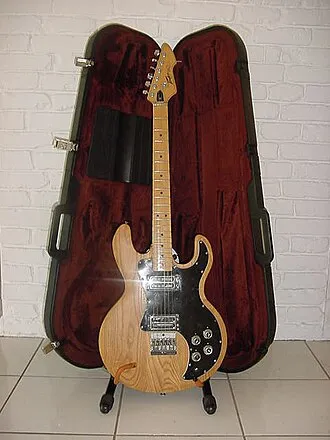
The short version
1975
A staff of one
Chip Todd moves to Peavey from a Houston repair shop.
1976
The carport prototypes
By Chip’s account, built in two days for that year’s NAMM show.
1978
The T-60
Debuts at NAMM alongside the T-40 bass, and production starts in Meridian.
1979
The tone patent
Orville Rhodes’s circuit, the one that turns a humbucker into a single-coil, is patented.
1981
Chip leaves
The designer goes to work for Fender.
1982
New colors
Blood Red and Burgundy join natural, sunburst, black, and white.
1988
Last call
The T-60 run ends.
Side A
A1
No amps, no guitars
The way Chip Todd told it, Peavey got into guitars because somebody tried to push it around.
In the mid-’70s Peavey was an amplifier company in Meridian, Mississippi. According to Chip, Fender and Gibson both told dealers that if they didn’t buy their amps, they wouldn’t get their guitars. That’s called tying, and it’s illegal. Hartley Peavey could have sued. Instead he hired a guitar repairman out of Houston and decided to make his own.
That repairman was Chip. He moved in 1975 and, for about a year, he was the only employee in the guitar division.
The first prototypes, by his account, were built in his carport in two days by Charley Gressett and Bob Lowe, for the 1976 NAMM show. One had six tuners in a row, because Hartley wanted that. One had three per side, because they didn’t want to copy Fender. The dates get slippery here. Marketing later said 1976, the design is usually dated 1977, and the guitar debuted at NAMM and went into production in 1978. Depends who you ask. The guitar was the T-60.
A2
Built by a computer, which you weren’t supposed to do
Here’s where Peavey did something the industry said couldn’t be done. The bodies came off a computer-controlled cutter. The necks came off a gunstock-style carving machine, four at a time. By 1978 there was a robot buffing necks. Hartley later called them the first guitars “totally made on computer controlled equipment.”
The industry line at the time was that you can’t build a guitar on a computer. A year later, everybody was looking at numerical controllers.
The neck was two pieces of maple glued together with a steel rod inside, and Peavey patented it. The body was ash, and it was heavy on purpose. Hartley wanted heavy. Chip said later that they both knew weight doesn’t mean sustain, but the market at the time wanted mass, so it got mass. Pick one up and you’ll believe it.
The pickguard is held on with a lot of screws, and people still complain. Chip’s explanation involved the top’s compound curve, which isn’t flat like a Strat’s, and the fact that Hartley was a Strat fan. Either way, every production T-series got a guard.
A3
The knob that does two jobs
Now the good part. A steel guitarist named Orville “Red” Rhodes invented the tone circuit, and to my mind it’s the whole reason to own one.
Each pickup is a humbucker. Each has its own volume and its own tone. Turn the tone knob all the way up to 10 and the humbucker becomes a single-coil: thinner, brighter, more Fender than Gibson. Back it off to about 7 and you’re at full humbucker, thick and round. From 7 down to 0, it’s an ordinary tone knob.
So one guitar gets you both of the sounds most players buy two guitars for, and you get there by turning a knob you were going to touch anyway. There’s a phase switch too, which only does anything with both pickups on. It isn’t on a Strat. It isn’t on a Les Paul.
Flip the record · By the numbers
10
Tone knob all the way up, and the humbuckers turn into single-coils. Back it off to about 7 for full humbucking.
4
Necks carved at a time on a gunstock-style carving machine.
2
Days, by Chip Todd’s account, to build the first prototypes in his carport.
~10
Early samples sent out to Chet Atkins and Jerry Reed, with made-up serial numbers.
Side B
B1
Pickers, not poster boys
About ten of the earliest T-60s went out to Chet Atkins and Jerry Reed, wearing made-up serial numbers. Reed played a T-60 on television.
Chet’s is the interesting one, because it isn’t really a T-60 anymore. His guitar man, Paul Yandell, took the body, bolted on a wide Strat neck, and put in two EMGs. They called it the Peaver, and Chet played it quite a bit. “Sunrise” was one tune on it, “Laughing at Life” another.
The scene most people mean when they bring up the T-60 and the blues is Johnny Copeland on stage with Stevie Ray Vaughan for “Tin Pan Alley,” with what fans identify as a T-60.
Two traps while we’re here. Carl Perkins’s famous Peavey is a T-26, not a T-60. And Steve Cropper’s Peavey is a custom Telecaster-style guitar. Neither one belongs on this page.
B2
“A wild-ass guess”
Chip left for Fender in 1981. The T-60 kept going without him until 1988, picking up Blood Red and Burgundy finishes along the way.
Nobody knows how many they made. Peavey never published a total, and Chip said they didn’t even keep the date production started. The serial numbers came out of the amplifier blocks, with workarounds because the software couldn’t handle letters. His verdict on the serial list people use today: “a wild-ass guess,” at best.
It never had a pedigree and it never pretended to. It was a guitar an amp company in Mississippi built because somebody tried to push it around, cut on a computer, heavy because the market said so. What it had was that knob. Paul Yandell summed up Chet’s Peaver in a sentence that fits the whole T-60:
It wasn’t very pretty as guitars go, but sounded great.
The cast
The people, and the specific guitars, that made the legend.
1975
Chip Todd
Designer
Hired out of a Houston repair shop. For a year he was the whole guitar division.
1978
Hartley Peavey
The first one, in walnut
Wanted it heavy, wanted six tuners in a row, and was a Strat fan. The first T-60 is his.
1979
Orville “Red” Rhodes
The tone circuit
A steel guitarist who invented the knob that walks a humbucker into a single-coil.
Jerry Reed
An early sample
One of the first T-60s went to him. He played one on television.
Johnny Copeland
T-60
Fans identify his guitar on stage with Stevie Ray Vaughan for “Tin Pan Alley” as a T-60.
Chet Atkins
The “Peaver”
A T-60 body with a wide Strat neck and EMG pickups, put together by Paul Yandell. Not a stock T-60.
Liner notes
Specs, construction, rarity, value, and every source we used.
A CNC-cut ash body and a tone knob that splits the coils — Peavey’s first guitar, not a Strat, and not the matching T-40 bass.
- Body
- Offset double-cut ash. 1978 ad: northern ash. Three-piece typical (Crave). Gentle top carve.
- Neck
- Bolt-on bi-laminated rock maple, U.S. Pat. 4,237,944. Neck tilt. Two-piece typical.
- Fingerboard
- Maple or rosewood, unbound dots, 21 frets, 12" radius (owner’s manual)
- Scale
- 25½" (owner’s manual). Crave: 25½" (647 mm). Mix flagged. Do not invent 648 mm.
- Pickups
- Two epoxy-potted Super Ferrite blade humbuckers; toaster covers. Dual/single circuit U.S. Pat. 4,164,163 (Orville J. Rhodes).
- Hardware
- String-through die-cast chrome bridge; 14:1 tuners (manual). Early Gotoh octagonal; later P-logo.
- Electronics
- Two volume (treble-bleed), two tone (coil blend), 3-way, phase switch. 250 kΩ (Premier Guitar).
- Finish
- Polyester/urethane. Natural, sunburst, black, white; Blood Red and Burgundy 1982–88 (Blue Book). Satin body typical on natural.
- Nut
- Mix flagged. Owner’s manual: bone-hard polycarbonate. Crave / dealers: aluminium. Factory nut width unpublished.
Open the full research fileConstruction details, the complete player record, production numbers, dated value estimates, and sources
Classic living example = 1978–1988 Meridian T-60. No current T-60 SKU this pass (peavey.com: HP 2, Vandenberg, Raptor). T-40 is the matching bass. T-15 / T-25 / T-26 / T-27 / T-30 are later T-series. T-JR is the 1982–83 octave-neck sibling. No Gibson SKU. Mixed inch/mm flagged.
Construction
The job was a guitar Peavey could sell when Fender and Gibson were tying amps to instruments. Chip Todd, to Flat Eric (2012): both houses told dealers that if they didn’t buy amps they wouldn’t get guitars. Illegal tying. Hartley hired Chip out of a Houston repair shop instead of suing. Vintage Guitar (May 2023): Don Belfield recruited him; Chip moved June 1975, and for a year he was the only employee of the guitar division. Chip, to Flat Eric: the Texas rep was Bob Belfield; he started June or July 1975. Keep Don, Bob, June, and July. This plate starts in 1978.
What they built is a bolt-on double-cut that looks ordinary until you turn a knob. Offset ash. Deep contour. A pickguard held down with enough screws that people still complain; Chip’s answer was that the top had compound curvature, unlike a Strat’s flat face, and Hartley was a Strat fan, so production T-series all got guards. Northern ash on the six-string, southern ash on the bass, per the 1978 ad. Three-piece typical. They are heavy because Hartley wanted them heavy. Chip, via T-60Mafia: both men knew weight was not sustain, but the market of the moment asked for mass.
The neck is the factory argument. Two maple halves, a steel torsion rod with rolled threads, U.S. Pat. 4,237,944, filed 17 January 1978, issued 9 December 1980, Todd and Hartley as inventors. Vintage Guitar (Willie G. Moseley, October 2007): bilaminated and pre-stressed. Four necks at a time off a gunstock-pattern carver; the 1978 ad has the same four-at-a-time claim, then a fingerboard of East Indian rosewood or maple, frets, and finish in one operation. Bodies off a computer-controlled cutter. Hartley, Guitar Summit 2020: first guitars “totally made on computer controlled equipment”; robot neck buffing in 1978. The industry line, via Michael Wright in the Blue Book, was that you can’t build guitars on a computer. A year later everybody was looking at numerical controllers.
The circuit is the other half. Orville J. Rhodes, U.S. Pat. 4,164,163, filed 22 June 1977, issued 14 August 1979: a pot on a center tap that walks a humbucker into a single-coil. Blue Book: steel guitarist Orville Red Rhodes invented the tone circuit. The owner’s manual (80370017, 11/82) is the factory voice: rotate the tone fully clockwise (10) for single-coil; back to about 7 for full humbucking; 7 to 0 is ordinary tone. Independent volume and tone per pickup. Phase switch on the bridge coil; it only works with both pickups on. Premier Guitar (Dirk Wacker, 3 July 2020): 250 kΩ, 1000 pF treble-bleed on the volumes, 0.033 µF bridge tone cap, 0.022 µF neck. Super Ferrite blades, epoxy-potted, four-conductor, toaster covers in PAF-size rings. Early pickups have solid black inserts; later ones a blade down each bobbin (Crave).
Hardware is a die-cast string-through bridge, neck tilt in the plate, and a nut the sources will not agree on. Manual: bone-hard polycarbonate. Crave and dealer sheets: aluminium. Keep both. 14:1 tuners in the book. Early examples Gotoh octagonal; later Peavey “P.” Headstock: “Patents Applied For” on the first ones. 21 medium, high-crowned 18% nickel-silver frets. Scale 25½". 12" radius in the saddle-height paragraph of the same manual.
Not a Strat. Six-on-a-side because Hartley wanted it, and a 3-per-side version because they didn’t want to copy Fender. Chip: 3-per-side prototypes for the 1976 NAMM show, built in his carport in two days by Charley Gressett and Bob Lowe — CT-1 (6-inline), CT-2 (3-per-side), CT-B (bass). Peavey’s own archive post: those 1977 prototypes, heavy V necks, no truss rods, nitro, released the following year as T-60 and T-40. Vintage Guitar: 1977 prototypes with Chip’s initials on the headstocks. Blue Book (Wright): designed 1977, debuted 1978 NAMM — T-60, T-30, T-40. 12fret: late 1977 for the 1978 model year. Crave: marketing said 1976; manufacture 1978–1988. T-60Mafia: 1976–1987. Sam Ash: 1977–1988. Reverb / Premier Guitar / Blue Book: 1978–1988. Keep 1976, 1977, and 1978. Production on this plate is 1978.
Not the T-40. Same wiring, 34" bass, southern ash. Not T-15, T-25, T-26, T-27, T-30. Later T-series, different pickup counts and scales. Carl Perkins’s famous Peavey is a T-26 (Stringjoy), not this table. Not T-JR (Blue Book: octave neck, mandolin-sized, 1982–83). Not the Cropper Classic. Steve Cropper’s Peavey is a custom Tele (Guitar World, 22 May 2024). Do not hang it here. Chip left for Fender in 1981 (Vintage Guitar; Wright). Blood Red and Burgundy from 1982 (Blue Book). The line ends 1988.
Classic vs current: 1978 Meridian T-60 — CNC ash, bi-lam maple, Rhodes tone circuit — against no T-60 you can order from peavey.com in 2026.
Players
Do not hang a Strat, a Cropper Tele, or a T-26 on this plate.
Johnny Copeland. The scene people mean. OffsetGuitars: SRV’s Tin Pan Alley with Copeland on a T-60. Equipboard: T-60 into a Peavey Heritage VTX, with a YouTube clip. Named guitar on a named stage. Not a session log for the original record.
Jerry Reed. T-60Mafia (Chip’s corner): about 10 early samples went out to Chet Atkins and Jerry Reed, with bogus serials. Equipboard: Reed on a T-60, verified via YouTube. Television and endorsement, not a pinned album credit. Album-to-guitar sides are unpublished here.
Chet Atkins / the Peaver. Not a stock T-60. Paul Yandell, on Atkins’s misterguitar FAQ (via Equipboard): Chet had a T-60; Yandell took the body, put a wide Strat neck on it, and two EMGs. Chet used it quite a bit. “Sunrise” was one tune, “Laughing at Life” another. “It wasn’t very pretty as guitars go, but sounded great.” That object is a T-60 body with a Fender neck. It is not this table.
Also known to play stays short. Stringjoy lists Hank Williams Jr and Conway Twitty “at some point,” no named guitar. Nick Reinhart (Death Grips) on Instagram via Equipboard. None invented.
Rarity
You cannot buy a new T-60 from Peavey. The run ended with the catalog. Living HP 2, Vandenberg, and Raptor SKUs are other factories and other names. They are not a 1978 T-60.
Peavey did not publish T-60 unit totals. Chip, to Flat Eric: they did not even keep the starting date of production; the current serial list is “a wild-ass guess,” at best. Serials were taken from amplifier blocks in the 25000000 range; six-digit numbers and the first-year 8M prefix were workarounds because the program did not recognize letters. An 8M dates a first-year guitar. It does not count a year. The 1978 ad’s “over 300 a day” is marketing copy, not a factory total. None invented.
What is actually thinner: carport CT-1 / CT-2 prototypes; serial #1 (Hartley) and #2 (Chip), walnut, rear-routed (T-60Mafia); first-year 8M with “Patents Applied For” and solid-insert toasters; complete originals that still have the Rhodes circuit uncut. The Peaver is one object. It is not a vintage T-60.
Value
Informal estimate, 18 September 2026. Not an appraisal.
Ask vs sold labeled. Celebrity lots are not-comps. No invented medians or factory counts. Period $500,000 research claim (1978 ad) is 1970s money, not 2026 street. Original list unpublished in a named catalog this pass. One Equipboard owner’s $375 at Coast Music, late ’70s or early ’80s, stays anecdotal.
New street. None under T-60 this pass. peavey.com current electrics are HP 2, Vandenberg, Raptor — other cards.
Used modern / vintage. Same market: the 1978–88 Meridian guitar. Reverb Price Guide widget on T-60 listings (Good to Mint, 1,365 orders, fetched 18 September 2026): estimated used $524–$888. Dedicated Price Guide URL bot-walled this pass; the widget on the product / listing pages is the source. Named recent hammers from that same tape, not a series: 23 December 2025 Excellent $699; 19 December Excellent $975; 11 December Very Good $600; 5 December Excellent $665; 3 December Excellent $680; 2 December Good $650; 29 November Excellent $769. Do not average those solds into a midpoint.
Named asks this pass, not hammers: 1979 Natural Ash Good $525 (was $995); maple-board Excellent $950; 1981 OHSC Very Good $1,350; sunburst Excellent $1,375. Equipboard store scrape, 17 September 2026: average $525. Stringjoy’s “well under $1,000” is the same used band, not a new cart. A refin, a swapped set of pickups, or a dead tone pot is a different guitar. The Peaver is one object. Not a comp.
See also
- fender-stratocaster — six-on-a-side bolt-on Hartley wanted without copying; not this Mississippi CNC guitar
- evh-wolfgang — later Peavey USA guitar, after Music Man; not T-series
- fender-telecaster-deluxe — 1970s dual-humbucker bolt-on contemporary, Fullerton, not Meridian
Sources
- Peavey T-60 / T-40 owner’s manual, 80370017, 11/82 — 25½" scale; 12" radius; bi-lam U.S. Pat. 4,237,944; dual/single U.S. Pat. 4,164,163; polycarbonate nut; 14:1 tuners; polyester/urethane; tone-circuit 10 / 7 / 0; Meridian 711 A Street
- U.S. Pat. 4,164,163, Electric guitar circuitry — Orville J. Rhodes; filed 22 June 1977; issued 14 August 1979; Peavey Electronics Corp.
- U.S. Pat. 4,237,944, Method for forming the neck of a guitar — Charles H. Todd III, Hartley D. Peavey; filed 17 January 1978; issued 9 December 1980
- Vintage Guitar, Chip Todd obituary (May 2023) — hired via Don Belfield; June 1975 move; sole guitar-division employee for a year; T-60 / T-40 designer; 1977 prototypes with his initials; left 1981 for Fender
- OffsetGuitars, A Tale of Two T-60’s, 17 December 2024 — Copeland on T-60 in SRV Tin Pan Alley clip
- Vintage Guitar, Willie G. Moseley, Peavey T-20 (October 2007) — T-60 / T-40 first CNC-carved instruments; bilaminated pre-stressed necks; humbucking-to-single-coil pickups
- Premier Guitar, Dirk Wacker, The Fascinating Peavey T-60 Tone Circuit, 3 July 2020 — built 1978–1988; Super Ferrite toaster humbuckers; 250 kΩ; 1000 pF treble-bleed; tone-cap values; factory tone-circuit quote
- Blue Book of Guitar Values, Peavey Electric T Series — Chip Todd 1977; 1978 NAMM (T-60, T-30, T-40); Red Rhodes circuit; Wright / Guitar Stories Vol. 1; T-60 spec; mfg. 1978–1988; Blood Red / Burgundy 1982–88; T-JR 1982–83
- Chip Todd, to Flat Eric, 2012 — hired mid-1975; Bob Belfield; tying-in story; 1976 NAMM 3-per-side prototypes; CT-1 / CT-2 / CT-B in two days; serials from amp blocks; 8M / six-digit workarounds; “wild-ass guess”
- T-60Mafia — 1976–1987 claim; northern ash; serial #1 Hartley / #2 Chip, walnut, rear-routed; ~10 samples to Atkins and Reed
- Peavey Electronics, archive post on CT-1 / CT-2 / CT-B — 1977 Chip Todd prototypes; released the following year as T-60 and T-40
- Hartley Peavey, Guitar Summit 2020 — CNC in 1976–77; robot neck buffing 1978; T-60 / T-40 first fully computer-controlled guitars
- 1978 Peavey T-60 advert, via guitar-list — three-year / $500,000 research; Chip Todd; four necks at a time; northern vs southern ash; maple or rosewood; 300-a-day claim
- Crave Guitars, Feature – 1979 Peavey T-60 — mfg. 1978–1988 vs marketing 1976; 25½" (647 mm); aluminium nut; Gotoh; 9 lb 11 oz; early solid-insert pickups
- The Twelfth Fret, Peavey T-60 Natural, 1978 — late 1977 for 1978 model year; production 1978–1988; serial 8M258832; 9.768 lb
- Guitar Gavel, Practical Guide to Peavey Guitars, 13 February 2023 — plans 1976; T-60 in 1978; Chip Todd; CNC first
- Stringjoy, Peavey T-Series — 1978 first run; Super Ferrite; T-26 as Perkins’s famous Peavey; T-60 used-band “well under $1,000”
- Reverb, Peavey T-60 — years 1978–1988; ash; maple or rosewood; 21 frets; HH; string-through; Price Guide widget $524–$888 (Good to Mint, 1,365 orders)
- Reverb Price Guide, Peavey T-60 — dedicated URL bot-walled this pass
- Equipboard, Peavey T-60 — Yandell / Peaver FAQ quote; Reed via YouTube; Copeland; Reinhart Instagram; average $525 (17 September 2026)
- Guitar World, Joe Matera, Steve Cropper, 22 May 2024 — Cropper’s Peavey is a custom Telecaster, not a T-60
- Peavey, electric guitars — current HP 2, Vandenberg, Raptor; no T-60 SKU
- Elderly Instruments, 1979 T-60 — 1-11/16" nut; 25-1/2" scale; 21 frets; 9.8 lb
- Sam Ash Spotlight, Peavey T-60, 7 March 2021 — 1977–1988 claim; four necks; CNC body
Keep digging
Guitars this one gets compared to, confused with, or descended from.

Photo: Lightburst / Wikimedia Commons / CC BY-SA 4.0 Fender
Stratocaster
1954
The guitar most people mean when they say “electric guitar.” Designed by a man who didn’t play one.
- Send a picture
EVH
Wolfgang
2009
Eddie named it for his son. It took three companies before it lived under the family name.
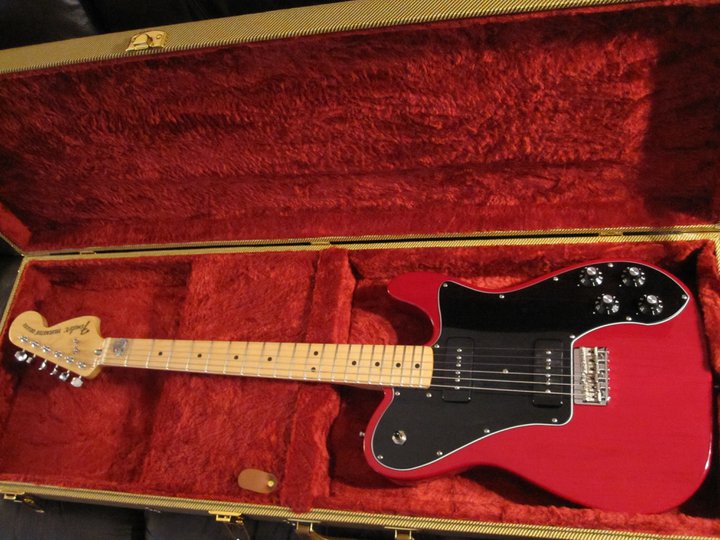
Telecaster Deluxe Black Dove. Photo by Mastermetal666. Licensed under CC BY-SA 3.0. Via Wikimedia Commons. Fender
Telecaster Deluxe
1973
A Tele body, a Strat headstock, and two big humbuckers. The odd cousin in the family, and somebody’s favorite.