Peavey
T-40
Peavey’s first production bass got two basses’ worth of sound out of one tone knob, and no battery.
Meridian, Mississippi, 1978. An amplifier company that has just taught itself to carve guitars on a computer puts out its first production bass: 34 inches, strings through the body, and two humbuckers that stay exactly where the factory screwed them. All the moving happens in the tone knobs.
- Introduced
- 1978
- Type
- Solidbody electric bass
- Class
- Production
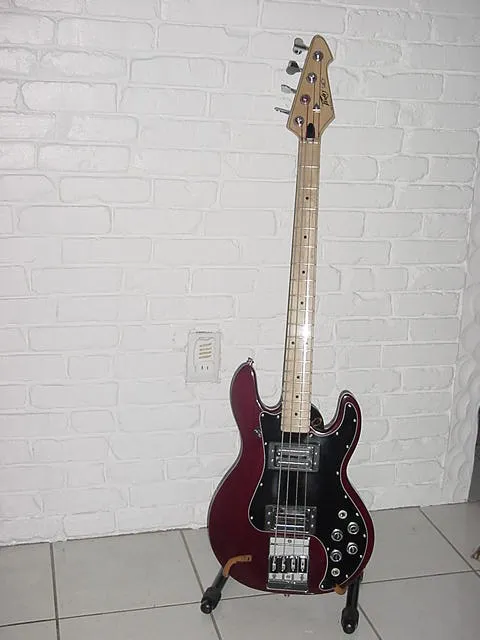
The short version
1977
Chip Todd’s T series
Peavey’s guitar designer draws the family the T-40 belongs to.
1978
The bass
Debuts with the T-60 and T-30, or shortly after the six-string. The accounts differ.
1979
The tone patent
Orville J. Rhodes’s humbucker-to-single-coil circuit is issued a patent.
1980
The ad
“Ross Valory Lays Down the Bottom Line with the Peavey T-40.”
1981
Todd leaves
The designer is gone. The bass keeps going without him.
1982
New colors
Blood Red and Burgundy join natural, white, black, and sunburst.
1984
Still on the list
The T-40 is on Peavey’s November Technology Series list.
1988
Last call
The run ends.
Side A
A1
For working musicians
Hartley Peavey had a line he liked about what his company made: “quality products for working musicians at fair prices.” The T-40 was that line, strung up as a bass.
The owner’s manual is blunt about the idea. The circuit is there to get you the tonal range without a powered preamp. Active basses with a battery in the back were the new trick in the late ’70s. Peavey wanted the range without the battery, which means nothing to die halfway through the third set.
Chip Todd designed the T series in 1977. In 1978 three models debuted: the T-60 guitar, the T-30, and this bass. Some accounts say all three were prototypes at that year’s NAMM show. Another says the bass came shortly after the six-string. Either way, it was Peavey’s first production bass.
A2
Carved by a computer
The T-40 and the T-60 were the first instruments whose parts Peavey cut on computer-controlled machines. The neck is two halves of maple glued up around a steel rod, and Peavey patented the method. The tilt adjustment is in the neck plate, so you set the playing height there before you start chasing saddles.
The strings go through the body and over a die-cast bridge with rectangular saddles. The tuners are geared 22:1. It is a lot of hardware, and it feels like it. Shop scales put these basses anywhere from just under eleven pounds to thirteen.
What the body is made of is a fight. The manual says “select hardwood” and stops. Owners say natural and sunburst are ash and the solid colors are poplar. One says some painted bodies were natural ash that got rejected for the grain. Another says it’s all northern ash, no poplar at all. Nobody has a factory drawing to settle it.
A3
The knob that walks
Here’s where the T-40 earns its keep. There are two humbuckers, one at the neck and one at the bridge, and they don’t move. What moves is the tone knob, on a circuit designed by Orville J. Rhodes.
Turn a tone knob all the way up to 10 and that pickup is a single-coil: leaner and brighter. Back it off to about 7 and the second coil comes in, so you’re at full humbucker, thick and round. From 7 down to 0 it’s an ordinary tone knob. Each pickup has its own.
The pickups don’t travel. The knob does the traveling.
There’s a phase switch too. It flips the bridge pickup only, and it only does anything with both pickups on. Down is out of phase, the thin, hollow sound. So one passive bass, with the knobs you were going to touch anyway, covers ground most players need two basses for.
Flip the record · By the numbers
10 → 7
Tone knob at 10, single-coil. Back to about 7, full humbucker. Below that, an ordinary tone control.
0
Batteries. The circuit is passive on purpose.
34"
Scale length. Full-size, like the Precision already on the counter.
20 or 23
Frets, depending on who’s counting. The owner’s manual never says.
Side B
B1
Counting frets
For a bass built on a computer, the T-40 is surprisingly hard to pin down. The fret count is 20 in some specs and 23 in others, and the owner’s manual never counts them. The radius is 12" in the manual. One measured 1980s bass came in at 9.5".
The pickups changed in the middle of the run. Early humbuckers wore covers that looked like a toaster. Later ones showed the blades. Owners put the switch around 1981, or 1982 to ’83. Blood Red and Burgundy were offered in 1982, and so was a fretless neck.
Chip Todd left Peavey in 1981. The T-40 was still on the price list in November 1984, and the run ended in 1988. Peavey never published how many it made.
B2
Before anybody knew their names
The famous name came first, in an ad. In 1980, Peavey ran a page that read “Ross Valory Lays Down the Bottom Line with the Peavey T-40.” Valory, from Journey, stood with a maple-neck sunburst and a Mark III head, and said:
The T-40 gives me the widest range of any bass I’ve performed with … i’m satisfied.
That’s an endorsement, not a record credit. Don’t hang a Journey album on it.
The rest of the T-40’s life is less glossy. Jay Bentley of Bad Religion owned one until it was stolen in 1982, then bought a G&L. Curt Smith played one at gigs with Graduate, before Tears for Fears. Steve Albini was photographed with one, though Bob Weston is the bassist in Shellac, so that isn’t a Shellac record.
Peavey doesn’t make it anymore. The basses on its site now are other ideas at other prices. But Cameron Picton of black midi played a T-40 at a show in Birmingham, decades after Meridian stopped building them. The two pickups were still where the factory put them, the tone knobs were still doing the walking, and there was still nothing to put a battery in.
Put this on
You’ve read about it. Now hear it. Here’s what this guitar sounds like, and what to listen for.
Live in Birmingham
A black midi performance in Birmingham with Cameron Picton on a T-40. Which songs are in the set isn’t logged, so watch the bass, not the setlist.
Watch it on YouTube (opens in a new tab)
The cast
The people, and the specific guitars, that made the legend.
1980
Ross Valory
Maple-neck sunburst T-40, in the ad
Journey’s bassist, in a Peavey ad with a Mark III head. An endorsement, not a record credit.
1982
Jay Bentley
T-40
Bad Religion. His T-40 was stolen in 1982, and he bought a G&L to replace it.
Curt Smith
T-40
Photographed playing one with Graduate, before Tears for Fears. Not the bass on “Shout.”
Cameron Picton
T-40
black midi. On a T-40 for a performance in Birmingham that’s on YouTube.
1979
Orville J. Rhodes
The tone circuit
Invented the pot that walks each humbucker between single-coil and full humbucker.
1977
Chip Todd
Designer
Designed the T series. Left Peavey in 1981.
Liner notes
Specs, construction, rarity, value, and every source we used.
A 34-inch string-through bass whose tone knobs walk the coils — Peavey’s first production bass, not a Precision, and not the T-60.
- Body
- Offset double-cut, deep contour. Manual (11/82): select hardwood. Species contested — see caption. String-through.
- Neck
- Bolt-on bi-laminated rock maple, U.S. Pat. 4,237,944. Neck tilt. Gloss on a measured 1978 (Chicago Music Exchange).
- Fingerboard
- Maple or rosewood (Reverb). Manual names the neck, not the board. 12" radius in the manual; one Carter 1980s measured 9.5". Frets: 20 (Vintage Guitar; Reverb) vs 23 (Blue Book). Mix flagged.
- Scale
- 34" (owner’s manual; Vintage Guitar). Millimetres unpublished. Do not invent 864 mm.
- Pickups
- Two epoxy-potted blade humbuckers. Dual/single coil, U.S. Pat. 4,164,163. Fixed. They do not slide. Toaster covers, then exposed blades.
- Hardware
- Die-cast chrome bridge, rectangular saddles, string-through (Vintage Guitar). Individual saddles. 22:1 tuners (manual). Four-on-a-side.
- Electronics
- Two volume (treble-bleed 0.01 µF on the bass), two tone (coil blend), 3-way, phase switch. 250 kΩ; tone caps 0.033 µF bridge, 0.022 µF neck (Premier Guitar). Passive.
- Finish
- Polyester/urethane. Natural, white, black, sunburst (Blue Book). Blood Red and Burgundy offered in 1982 (Blue Book). Satin natural typical (TalkBass infosheet).
- Nut
- Manual: bone-hard polycarbonate. Factory width unpublished. Measured: 1-11/16" (CME 1978); 1 11/16" metal (Cream City 1978); 44 mm (Andy Baxter 1979); 1.7" (Carter). Mix flagged.
Open the full research fileConstruction details, the complete player record, production numbers, dated value estimates, and sources
Classic living example = 1978–1988 Meridian T-40. No current T-40 SKU this pass (peavey.com basses: Milestone, Cirrus). T-60 is the six-string from the same program, not this table. T-45 is the later single-pickup bass. T-20 is Mike Powers’s different body. T-40FL is the fretless neck, not the fretted spec. No Fender SKU. Mixed inch/mm flagged. Do not average 20 and 23 frets, 12" and 9.5", or 1-11/16" and 44 mm.
Construction
The job was a bass you could work a night on without a battery. The owner’s manual (80370017, 11/82) is blunt about it: the T-60 / T-40 circuit is there to get the tonal range without a powered preamp. Long 34" scale. Strings through the body. Two blade humbuckers that sit where the factory screwed them. The motion is in the tone pot.
Vintage Guitar (Willie G. Moseley, October 2007): Hartley Peavey’s line was “quality products for working musicians at fair prices.” The T-40 and the T-60 were the first instruments whose parts were carved on CNC machines. Necks bilaminated and pre-stressed. Blue Book: Chip Todd designed the T series in 1977; three models debuted in 1978 — T-60, T-30, and this bass. The guitar-page wording says those three were the prototypes shown at the 1978 NAMM show. Crave, on the six-string, says the bass came shortly after. Keep both. This plate starts in 1978. Manufacture 1978–1988 (Blue Book; guitar-list).
Not a sliding pickup. The manual draws a neck pickup and a bridge pickup and leaves them there. A pot on Orville J. Rhodes’s center-tap circuit, U.S. Pat. 4,164,163, walks each humbucker. Fully clockwise, 10, is single-coil. Back to about 7, the second coil comes in and you have the full humbucker. From 7 to 0 it is an ordinary tone control. Premier Guitar (Dirk Wacker, 3 July 2020): same wiring as the T-60, except the treble-bleed on the volumes. Guitar: 1000 pF. Bass: 0.01 µF. Besides that, he says, the wirings are the same — 250 kΩ, 0.033 µF on the bridge tone, 0.022 µF on the neck. Phase switch reverses the bridge coil only, and the manual says it works only with both pickups on. Up is in phase. Down is out. That is the whole trick. The pickups do not travel.
The neck is the other factory argument, shared with the six-string and not identical to it. Two maple halves, steel torsion rod with rolled threads, U.S. Pat. 4,237,944. Neck tilt in the plate, so you set the playing height there before you chase the saddles. Manual action for this bass, not the guitar: 1/32" to 1/16" at the first fret, 1/16" to 1/8" at the twelfth. Saddle clearance off the 12" radius is 1/16" on the T-40 and 3/64" on the T-60. Tuners are 22:1 here. The guitar’s book says 14:1. Medium, high-crowned 18% nickel-silver fret wire. How many of them is the fight. Moseley: the T-40 had a 20-fret neck and the T-45 a 21. Blue Book’s model line: 23-fret fingerboard. Reverb’s product spec says 20. The manual never counts them. Keep 20 and 23.
Body wood is the other fight. The manual says select hardwood and stops. TalkBass’s infosheet: natural and sunburst are ash; solid colors are poplar; a very few early solids are alder. On the same site, mech says southern ash, oak never, and a lot of painted bodies were natural ash rejected for the grain, then painted when dealers asked for color. The next poster says all northern ash — no poplar, oak, or alder. Reverb lists ash and poplar. Cream City calls its 1978 southern ash. A Sweetwater seller called one 1979–80 natural “Northern Ash.” No factory drawing in this pass.
Chicago Music Exchange’s 1978, serial 8M274148, is three-piece ash, two-piece maple, maple board, black dots, radius 12.00", nut 1-11/16", 10 lb 15 oz, pot codes 1977. Cream City’s 1978 nut is 1 11/16" and metal. The manual says bone-hard polycarbonate. Keep both. Andy Baxter’s 1979: nut 44 mm, 11 lb 12 oz / 5.34 kg. Carter’s 1980s natural: nut 1.7", radius 9.5". A TDPRI owner’s five-piece weighed 13 lb. Shop scales. Not a factory weight. Do not average them. The bridge under that mass is the die-cast piece Moseley calls the monster next to the later T-20: rectangular saddles, strings through the body. The T-20, 1982, loads through the bridge and uses 24:1 tuners. Different bass.
What changed is the covers and the paint. Early humbuckers are the covered toaster. Later ones show the blades. TalkBass puts the change around ’81 or ’82/’83. A former Peavey employee on that thread: always one ceramic bar and two blades; early blades 1/16" cold-rolled steel under the cover; later blades 1/32" chrome, exposed. Blue Book lists Natural, White, Black, Sunburst, then says Blood Red and Burgundy were offered in 1982, and that a fretless neck was offered. Reverb calls that neck a T-40FL. It is not this fretted table.
Not the T-45. Blue Book: 1982–86, one blade humbucker. Moseley: 21 frets, pickup not where either T-40 pickup sits, catalogued as “harmonically placed,” no guard, controls in the back. Not the T-20, and not the Fury that took the T-20’s job. Not the Foundation (August 1983 list, same article). Not the T-60. Same Rhodes pot. Different scale, tuner ratio, and treble-bleed. Chip Todd left in 1981 (Blue Book, citing Michael Wright). This bass was still on the November 1984 Technology Series list. The line ends 1988.
Classic vs current: a 1978 Meridian T-40 — 34", string-through, bi-lam maple, two fixed humbuckers, tone knobs that walk the coils — against no T-40 you can order from peavey.com in 2026. The living basses there are Milestone and Cirrus. Cirrus is a 35" neck-through with VFL humbuckers and an active preamp, Czech-built, Mike Powers’s later idea. It is not this circuit.
Players
Do not hang a Journey album on the ad. Do not hang Age of Unreason, a Darkthrone record, or Big Black’s Pig Pile on an Equipboard tag. A display labeled as Robert Plant’s, and a Reverb listing that says Matt Freeman owns a 1978 sunburst, are labels, not session logs. Not a T-45, a Foundation, or a Stingray.
Ross Valory. The ad. Vintage Guitar and Bass’s scan of a 1980 Peavey page: “Ross Valory Lays Down the Bottom Line with the Peavey T-40.” Their transcription of his line: “The T-40 gives me the widest range of any bass I’ve performed with … i’m satisfied.” The bass in the ad is a maple-neck sunburst, shown with a Mark III head. Endorsement. Not a pinned Escape or Departure credit.
Jay Bentley. Equipboard, from his own post: the G&L was bought after the T-40 he owned was stolen in 1982. That is a bassist saying he had this bass, and then he didn’t. It is not a track list for Bad Religion.
Curt Smith. Equipboard’s photo: during Graduate, far left, a T-40 at gigs. That is before Tears for Fears. Not “Shout.” Not “Everybody Wants to Rule the World.”
Cameron Picton. Equipboard: a black midi performance in Birmingham, on YouTube, Picton on a T-40. Named stage. Which songs in that set are unpublished here.
Also known to play stays short. Adam Neely on a YouTube clip Equipboard reads as BEAD — “it seems.” Steve Albini photographed playing one. That photo is not a Shellac record; Bob Weston plays bass in Shellac. Dixie Dave Collins (Weedeater) in a photo Equipboard captions as a T-40. None of those is a session log. None invented.
Rarity
You cannot buy a new T-40 from Peavey. The run ended with the catalog. Milestone and Cirrus are other basses at other prices. They are not a 1978 T-40.
Peavey did not publish T-40 unit totals. None invented. The TalkBass infosheet says Peavey stopped dating the old instruments after a database failure, and then offers its own approximate serial bands. Those bands are a forum chart. They are not a factory census. An 8M prefix dates a first-year bass when a shop says so — CME’s 8M274148, called 1978, with 1977 pot codes. It does not count the year.
What is actually thinner: first-year 8M basses that still have the Rhodes circuit uncut; toaster-cover examples before the blades were exposed; a fretless neck that is still the original one. Valory’s ad bass, if it survives, is one object. It is not a vintage T-40.
Value
Informal estimate, 25 September 2026. Not an appraisal.
Ask vs sold labeled. Celebrity lots are not-comps. No invented medians or factory counts. No Peavey price-list scan in hand this pass. TalkBass, anecdotal: kodiakblair says an ’85 list he has reads $319 RRP, $35 for a color, $75 for metallic, rosewood board $25, case $80. Two owners on that thread say they paid $325 and $280 in 1979. Memories. Not 2026 street.
New street. None under T-40. peavey.com this pass: Milestone at $299.99, Cirrus 4 from $2,999.99. Other cards. A 35" active Cirrus is not a Meridian T-40.
Used / vintage. Same market: the 1978–88 Meridian bass. Dedicated Reverb Price Guide URL bot-walled this pass. The widget on listings fetched 25 September 2026 (a 1978 natural, and a 1981 with warranty card) prints estimated used $648–$845. Those widgets did not print an order count. Do not invent one. Equipboard’s store scrape the same day: average $500, with “23 available Used” shown at a $500 tier. That is an ask average, not a hammer.
Named asks, not hammers: Reverb’s top pick, a 1983 sunburst rosewood in Good, was $1,200, now $1,100; a 1978 natural Very Good $949.99 plus $79.99 shipping; Carter Vintage, 1980s natural, $950; Musician’s Friend, 1980 antique white, $1,099.99. Named sold listing, not a series: Sweetwater Gear Exchange, a 1979 in Excellent, sold 31 May 2026 at the listed $900. Do not average those figures into a midpoint.
A refin, a harness someone rewired to ordinary 500k pots, or a dead tone pot is a different bass. The fretless is a different neck. Valory’s sunburst is one object. Not a comp.
See also
- peavey-t-60 — same Meridian circuit and CNC program; 25½", 14:1 tuners, 1000 pF treble-bleed; not this bass
- fender-precision-bass — the 34" bass already on the counter; one split-coil, not this tone-pot walk
- music-man-stingray — the late-1970s American bass with the active preamp this circuit was built to skip
Sources
- Peavey T-60 / T-40 owner’s manual, 80370017, 11/82 — select hardwood; bi-lam U.S. Pat. 4,237,944; dual/single U.S. Pat. 4,164,163; blade humbuckers, epoxy-potted; 34" bass scale; 12" radius; 1/16" T-40 saddle distance; first-fret 1/32"–1/16", twelfth 1/16"–1/8"; polycarbonate nut; 22:1 bass tuners; polyester/urethane; tone 10 / 7 / 0; phase only with both pickups; Meridian, 711 A Street
- U.S. Pat. 4,164,163, Electric guitar circuitry — Orville J. Rhodes; filed 22 June 1977; issued 14 August 1979
- U.S. Pat. 4,237,944, Method for forming the neck of a guitar — Charles H. Todd III, Hartley D. Peavey; filed 17 January 1978; issued 9 December 1980
- Vintage Guitar, Willie G. Moseley, Peavey T-20 (October 2007) — T-40 / T-60 first CNC-carved instruments; bilaminated pre-stressed necks; humbucking-to-single-coil; T-40 20-fret, 34"; string-through; die-cast bridge, rectangular saddles; 22:1 tuners; T-45 pickup not in a T-40 position; T-40 and T-45 still on the November 1984 Technology Series list; Hartley “quality products for working musicians at fair prices”
- Premier Guitar, Dirk Wacker, The Fascinating Peavey T-60 Tone Circuit, 3 July 2020 — T-40 same wiring as the T-60; bass treble-bleed 0.01 µF vs guitar 1000 pF; 250 kΩ; tone caps 0.033 µF bridge, 0.022 µF neck
- Blue Book of Guitar Values, Peavey T-40 — 23-fret line; 34"; 1978–1988; first Peavey production bass; fretless offered; Blood Red and Burgundy in 1982; Rhodes 10 / 7 / 0; price table paywalled
- Blue Book, Peavey Electric Bass T Series — Todd 1977; 1978 debut of T-60, T-30, T-40; T-20 1982–85; T-45 1982–86
- Blue Book, Peavey Electric T Series — 1978 NAMM prototypes T-60, T-30, T-40; Red Rhodes circuit; Wright: Todd left 1981
- Vintage Guitar and Bass, 1980 Peavey ad — “Ross Valory Lays Down the Bottom Line with the Peavey T-40”; maple-neck sunburst; transcribed quote
- Crave Guitars, Feature – 1979 Peavey T-60 — T-40 “introduced shortly after” the six-string
- Reverb, Peavey T-40 Bass Guitar — years 1978–1988; ash or poplar; maple or rosewood; 20 frets; HH; passive; T-40FL mentioned; top-pick ask $1,100 (was $1,200)
- Reverb Price Guide, Peavey T-40 — dedicated URL bot-walled this pass
- Reverb listing, 1978 T-40 natural — ask $949.99; price-guide widget $648–$845
- Reverb listing, 1981 T-40 — price-guide widget $648–$845; order count not printed
- Equipboard, Peavey T-40 — Bentley’s 1982 theft post; Smith / Graduate photo; Picton in Birmingham; Neely BEAD “seems”; Albini photo; Collins photo; Plant display label and Freeman Reverb listing are not session logs; average $500, 23 used (25 September 2026)
- TalkBass, T-40 infosheet — ash vs poplar vs rare alder; toaster then blade; former employee on 1/16" vs 1/32" blades; satin natural; serial chart is approximate; Peavey dating stopped
- TalkBass, T-40 value — mech: southern ash, oak never; next poster: all northern ash; ’85 list memory $319; paid $325 and $280 in 1979
- Chicago Music Exchange, 1978 T-40 — 8M274148; three-piece ash; 12.00" radius; 1-11/16" nut; 10 lb 15 oz; 1977 pot codes
- Cream City Music, 1978 T-40 — southern ash on that listing; 1 11/16" metal nut; 10 lb 12 oz; 34"
- TDPRI, refurbishing a T-40 — one owner’s five-piece at 13 lb; not a factory weight
- Andy Baxter Bass, 1979 T-40 — 44 mm nut; 11 lb 12 oz / 5.34 kg; serial 00452939
- Carter Vintage, 1980s T-40 — ash; 34"; 1.7" nut; 9.5" radius; 11.2 lb; ask $950
- Sweetwater Gear Exchange, 1979 T-40 — listed $900; sold 31 May 2026
- Musician’s Friend, 1980 T-40 antique white — ask $1,099.99
- guitar-list, Peavey T-40 — manufacture 1978–1988; 34"; crowd spec says 23 frets
- Peavey, bass guitars — current Milestone $299.99 and Cirrus from $2,999.99; no T-40 SKU
- Peavey, Cirrus 4 — 35" neck-through; VFL; active; not a T-40
Keep digging
Guitars this one gets compared to, confused with, or descended from.
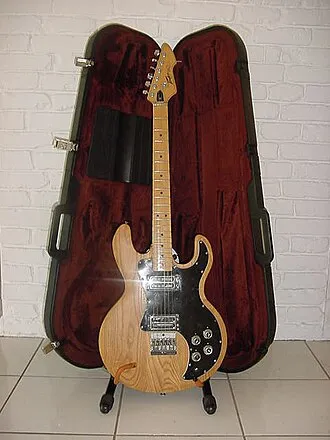
Photo: Michel Curi / Wikimedia Commons / CC BY 2.0 Peavey
T-60
1978
Peavey’s guitar man said the big guys told dealers: no amps, no guitars. So the amp company built its own.

Photo: Infrahertzz / Wikimedia Commons / CC BY-SA 3.0 Fender
Precision Bass
1951
Leo’s bass let the player at the back be heard. You know their lines by heart. You mostly don’t know their names.
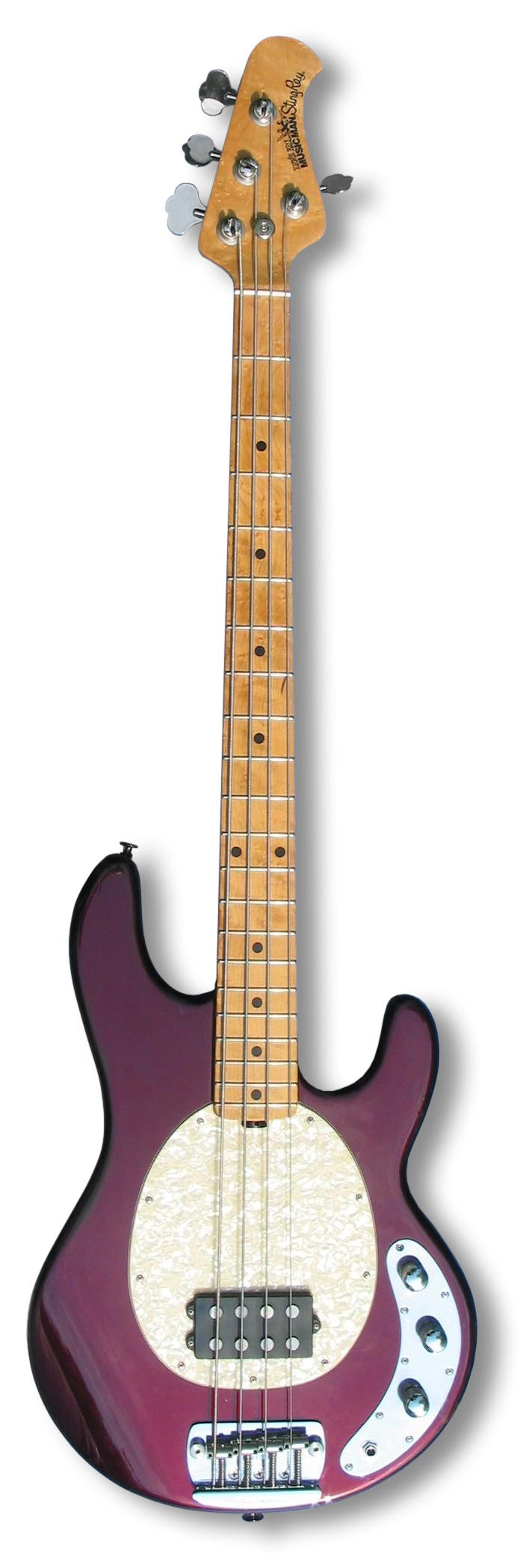
Photo: Th. Ott / Wikimedia Commons / CC BY-SA 3.0 Music Man
StingRay
1976
Leo Fender wanted a wide, bright bass. Louis Johnson hit it with his thumb, and funk had its sound.