Kawai
Moonsault
Fifty thousand guitars a month with other people’s names on them. Then Kawai had to draw its own.
Hamamatsu, the early 1970s. Kawai’s guitar line is running flat out, and not one guitar in the building is a Kawai. Then the orders stop, and a designer named Takahiro Inami has to work out what a Kawai guitar should look like. He starts with the space race and a gymnast.
- Introduced
- 1978
- Type
- Solidbody electric
- Class
- Production
Have a photograph of this guitar? Send a picture
The short version
1970
Inami joins
Kawai is building about 50,000 guitars a month, all of them with American badges.
1972
The moonsault
At the Munich Olympics, Mitsuo Tsukahara, a Kawai gymnastics-club man, wins gold on the bars with a move an announcer calls a moonsault.
1977
The prototype
Inami registers the design and shows a prototype at the instrument fair.
1978
MS-1000 on sale
March 1978, in Cosmo and Silver Sunburst. Some sources count from 1977, 1979, or even 1982.
1979
Olympia
A British reviewer finds one at Olympia and calls it the first Japanese limited edition he knows of.
1981
Moon Light Yellow
Yellow and Red join the colors. Yoshio Nomura of the Hatanokin Trio makes the yellow one catch on.
1985
The run ends
The original MS-1000 stops in February. Later crescents follow in small runs.
2007
The last Kawai guitar
Inami retires, and Kawai stops making guitars.
Side A
A1
Nobody’s name on it
Picture the guitar line at Kawai in 1970, the year Takahiro Inami joined. By his count it was turning out about two thousand guitars a day, around fifty thousand a month. Every one of them was built for an American brand. As he tells it, there wasn’t a single Kawai original in the building.
Then the 1971 dollar shock hit, and the 1973 oil shock after it, and the American buyers pulled out. Overnight, he says, that line went to zero.
Kawai was an old company by then. Koichi Kawai had opened his research laboratory in 1927, and the firm had been building electrics for export since 1963. It had bought Teisco in 1967. It knew how to make a guitar. It had just never had to decide what one of its own should look like.
A2
A gymnast, an ape, and a rocket
The first originals came in 1977, the X and M series. The next one got a theme, and Inami picked space. Planet of the Apes had come out in 1968. Apollo 11 landed in 1969. And at the 1972 Munich Olympics, Mitsuo Tsukahara, a man from Kawai’s own gymnastics club, won gold on the bars with a move that a foreign announcer called a moonsault.
So the guitar is a moonsault. Look at it with that in mind and everything is a space program. There’s a star on the headstock and a rocket on the truss-rod cover, for Apollo 11. The hardware is silver on purpose, because rockets and spacesuits aren’t gold. And down the rosewood board run moon phases in white butterfly shell, a full moon at the first fret and waning toward the body.
Inami registered the design, showed a prototype at the 1977 instrument fair, and shipped it the next year. The MS-1000 went on sale in March 1978, in Cosmo and Silver Sunburst.
That’s the date this page uses, but it depends who you ask. Japanese reference pages print 1977, Kawai’s own 25th-anniversary model counted from 1979, one historian lumps it in with Japan’s original-design wave of 1975, and the company that makes a modern copy says 1982.
A3
The crescent is an elbow rest
Everybody reads the body as a crescent moon, and fair enough: it looks like one. It isn’t.
The first drawing was a round body with a crescent headstock and star markers. It came out too big and too heavy. So they started cutting, using Japanese figures for height, weight, and center of gravity to carve out an elbow rest. The crescent is what was left. Inami says it’s ergonomics, not a phase of the moon. Look closely and the two curves don’t even share a radius.
The shop didn’t think of it as a weird-shaped guitar. Players did, and still do.
Flip the record · By the numbers
~50,000
Guitars a month at Kawai around 1970. None of them a Kawai design.
4
Mini-switches on the MS-1000, for preamp, booster/distortion, coil tap, and phase. Nine-volt battery included.
~£550
The UK price in August 1979, VAT included.
3
Magnets in each DSU humbucker, so the sound holds up when you tap it down to one coil.
Side B
B1
Fender and Gibson in one guitar
Under the space costume it’s a serious mahogany solidbody with a set neck, and the wiring is the other half of the idea.
It has two of Kawai’s DSU humbuckers, patented in 1977. Each coil is wrapped in foil, and each pickup has three magnets, so that when you tap it down to a single coil the sound doesn’t fall over. Then comes the panel. There’s a master volume, a preamp volume, a master tone, a three-way, and four mini-switches: preamp on or off, booster/distortion, coil tap, and phase, all running off a nine-volt battery. One description calls it Fender and Gibson in one guitar. That is about right. Flip the taps and you get something thin and bright, then kick in the booster and it gets thick and hot.
A British reviewer met one at Olympia in August 1979, priced at about £550 with VAT. He called it the first Japanese limited edition he knew of. He also read the wood as maple and the pickups as something else entirely. The Japanese sources say mahogany and DSU, so the story stays split.
B2
Mostly at home
The Moonsault barely left Japan. Export to the United States was small to nil, as far as anyone can tell, and nobody knows how many were made. In 1981 Moon Light Yellow and Red joined the colors, and Yoshio Nomura of the Hatanokin Trio played the yellow one until younger players wanted it too.
A short MS-700 run with abalone moons, December 1982 through April 1983, is the one that made it into a museum. The Museum of Fine Arts in Boston has one, dated 1982, Hamamatsu.
You’ll read that Ric Ocasek played one on the Cars’ Panorama. No interview backs that up. The famous “Touch and Go” parts are a Jaguar and a Fender Lead I.
The MS-1000 stopped in February 1985. After that came a Floyd Rose tenth-anniversary in 1987, the simpler MS-80, a 1997 MS-40 built on the same jig as the original, and a 2004 anniversary model. Inami retired in 2007, and Kawai stopped making guitars that year.
B3
A yellow one in Shibuya
Harold Sakuishi draws THE BAND for monthly Shōnen Magazine. He saw a yellow Moonsault in a shop in Shibuya, and ended up buying a deep navy MS-80, a 1990s reissue in the old Cosmo color. The moons in the board were the reason. He plays it, he says, only to hear what it does. Then he drew it into his hero’s hands.
In 2025 he sat down with Inami for Kawai’s own interview. Around the same time, Jeff Tweedy’s collection turned out to hold five MS-80s, some of them in cases with moon-cut foam, and the guitars turned up in the artwork for his triple album Twilight Override.
A factory that spent years building fifty thousand guitars a month under other people’s names finally drew one of its own. It came out looking like nobody else’s, and now a cartoonist draws it into his hero’s hands every month.
The cast
The people, and the specific guitars, that made the legend.
1977
Takahiro Inami
Designer
Joined Kawai in 1970, drew the Moonsault, registered the design, and retired in 2007.
1972
Mitsuo Tsukahara
The name
A Kawai gymnastics-club man whose gold-medal move at Munich was called a moonsault. He gave the guitar its name, not its sound.
1981
Yoshio Nomura
Moon Light Yellow
The Hatanokin Trio guitarist whose yellow Moonsault made that color catch on with younger players.
2025
Harold Sakuishi
Deep navy MS-80, a 1990s reissue
Bought it for the moon-phase board and drew it for the hero of his manga THE BAND.
2025
Jeff Tweedy
Five MS-80s
Keeps five in his collection, some in cases with moon-cut foam. They turn up in the artwork for Twilight Override.
Liner notes
Specs, construction, rarity, value, and every source we used.
A mahogany crescent, moon-phase markers, and a star head — Kawai’s Moonsault, not a Talbo and not a Bison.
- Body
- Mahogany crescent solidbody. Wikipedia: single-piece. Mexican-shell outline (Inami; Wikipedia). MFA’s 1982 MS-700: 106.7 × 30.5 × 4.1 cm (42 × 12 × 1 5/8"). Mix flagged.
- Neck
- Set mahogany. TCG: C, meant to feel familiar to a Gibson or Fender player. Music Zoo MS-1000: .860" at the 1st, .900" at the 12th
- Fingerboard
- Wikipedia: Indian rosewood, 22 frets, white-butterfly moon-phase markers (full moon at the first fret, waning toward the heel). Wright’s MS-700: bound ebony, abalone. Mix flagged.
- Scale
- Music Zoo MS-1000 and Reverb’s product card: 24¾" / 24.75". No millimetres on those originals. Eastwood prints 628 mm on its copy — not this table. Mix flagged.
- Pickups
- Two DSU Humbucking, patented 1977 (TCG). Sounds’ 1979 UK sample: Mighty Mite Vintage. Wright’s MS-700: appear to be Gotoh. Mix flagged.
- Hardware
- Badass-type adjustable stop (Wikipedia; TCG). Sounds: Leo Quan-type. Grover 102 (TCG); Sounds Grover; Wright’s MS-700 Gotoh. Mix flagged.
- Electronics
- Master volume, preamp volume, master tone, 3-way; mini-switches for preamp, booster/distortion, dual-sound (coil tap), phase. 9 V. Wright’s MS-700: master volume, two tones, push/pull coil tap and phase — not this row.
- Finish
- Launch: Cosmo (宇宙色) and Silver Sunburst (銀河色). Moon Light Yellow (月光色) and Red from 1981 (TCG; Inami)
- Nut
- Music Zoo: 1-5/8". Derby City’s 1980: 1.72". TCG’s Crystal Moon: 43.4 mm — acrylic, not this table. Mix flagged.
Open the full research fileConstruction details, the complete player record, production numbers, dated value estimates, and sources
Classic living example = original MS-1000 (TCG: sold March 1978–February 1985). No current Kawai guitar SKU this pass: English Wikipedia, Nico-nico Guitars, and developer Takahiro Inami’s retirement all put Kawai’s guitar manufacturing at 2007. Eastwood Moonsault is another factory on this silhouette, basswood and a maple set neck — not this table. Crystal Moon (acrylic, bolt-on), the bass, the 1987 Floyd Rose tenth-anniversary, MS-80 / MS-40 later runs, and MS-140CC colored acrylic stay off this row. Mixed inch/mm flagged on the MFA MS-700 and on Music Zoo’s 24¾" / 1-5/8" against Ishibashi’s 3.30 kg and TCG’s Crystal Moon 43.4 mm. Do not convert. Do not average 1-5/8" / 1.72" / 43.4 mm.
Construction
The job was a Kawai that was not an OEM. Koichi Kawai opened a research laboratory in 1927 and renamed the firm in 1929 (Kawai Global). Classical guitars 1958. Electrics for export 1963. Teisco absorbed 1967 (Japanese Wikipedia; the Spectrum 5 plate). Inami joined in 1970. Kawai’s own 4 November 2025 interview: two thousand guitars a day then, about 50,000 a month, all American-badge OEM, not a Kawai original in the building. The 1971 dollar shock and the 1973 oil shock pulled the buyers. Overnight, he says, that line went to zero. Then they had to make a Kawai.
1977 first: the X series and the M series, dual-sound and phase already on those (TCG, citing Guitar Graphic Vol. 7). The next original got a theme. Inami: space. Planet of the Apes (1968), Apollo 11 (1969), and Mitsuo Tsukahara’s gold-medal bars at Munich, October 1972 — a Kawai gymnastics-club man — which a foreign announcer called a moonsault. Inami registered the design, showed a prototype at the 1977 instrument fair, and shipped the guitar the next year. TCG: unveiled 1977, on sale March 1978 as MS-1000, through February 1985. Japanese Wikipedia’s infobox prints manufacture 1977–1985, and its 2004 “25th anniversary of appearance” model, MS-25ANV, counts from 1979. Wright (Vintage Guitar, June 2007) folds the shape into the 1975 Japanese original-design wave that also produced the Iceman, then dates many MoonSaults “after ’75.” Eastwood’s product copy, and guitar-list after it, print 1982. Keep 1977, 1978, 1979, and 1982. This plate starts in 1978.
The first drawing was a round body, a crescent head, star markers. TCG: too big, too heavy. They cut the elbow rest from Japanese height, weight, and center-of-gravity figures, and the crescent is what was left. Inami and TCG both say it is ergonomics, not a phase of the moon. The two halves of the outline do not share a radius. Wikipedia: the shop did not think of it as a “変形ギター.” Players still do.
What you get is a set-neck mahogany crescent with a star head, a rocket truss-rod cover (Apollo 11, TCG), and moons in the board that wax toward the nut. White-butterfly markers, Mexican-shell outline stuck on one piece at a time (Inami). Silver hardware on purpose — rockets and spacesuits, not gold (TCG). Two DSU humbuckers, patented 1977: foil around each coil, three magnets so a coil-tap would not fall over (TCG). The loom is the other half of the idea. TCG’s Karibe walk-through, on an ’80: master volume, preamp volume, master tone, 3-way; then preamp on/off, booster/distortion, dual-sound, phase. Wikipedia: Fender and Gibson in one guitar. Sounds (Tony Mitchell, 25 August 1979), a Rosetti UK sample at Olympia: volume, pre-amp volume, one tone; selector plus pre-amp, overdrive, coil-tap, and phase. He read the woods as maple and the pickups as Mighty Mite Vintage. Japanese pages say mahogany and DSU. Keep both. Mitchell’s RRP is about £550 inc VAT. 1979 money, not 2026 street. He also calls it the first Japanese limited edition he knew. That is his line.
Not a Talbo (tokai-talbo). Hamamatsu, 1983, two teardrops of sand-cast aluminum. Not a Bison (burns-bison). Horns off the face, Hackney, 1961. This is a crescent. Not the bass. Wikipedia lists one. Four strings. Off this table. Not Crystal Moon. TCG’s MS-2000 page: acrylic, 1979, named for Kawai’s Crystal Grand Piano (1971), bolt-on, DSU and preamp kept, 5.10 kg, nut 43.4 mm. Wikipedia files the clear acrylic as Crystal Moon. Same silhouette, other material, other joint.
Running changes sit on this plate, not as second slugs. TCG: Moon Light Yellow and Red in 1981; Nomura of the Hatanokin Trio on the yellow. Wright’s MS-700: December 1982 through April 1983, blue/silver burst, mahogany set neck, bound ebony, abalone moons, master volume and two tones with push/pull coil tap and phase, wide fine-tune bridge, tuners and pickups that look like Gotoh. MFA Boston has one, object 2009.2418, dated 1982, place Hamamatsu; overall 106.7 × 30.5 × 4.1 cm; the museum lists rosewood, not Wright’s ebony. Mix flagged. Wikipedia builds the line at Ryuyo West, old Ryuyo-chō, now Iwata. Hamamatsu is the company town. Keep both. Wright’s MyRareGuitars note on that run: “maybe 5 months,” serial D-150 read as December number 150 — a serial guess, not a total. TCG: a Floyd Rose tenth-anniversary in 1987; MS-80 as the later simplified regular; MS-130C / MS-140CC acrylic, 1993, bolt-on, one volume, one tone. Nico-nico: a 1991 limited, cosmetics stripped. Mike & Mike’s Guitar Bar: 1989 MS-80, hangtags Heisei 1, Schaller humbuckers in Kawai’s Rockoon years (English Wikipedia: Schaller partnership into 1990). 1997: TCG’s MS-40, same jig as the original, Cosmo / Silver Sunburst / Red / Moon Light Yellow — Kawai’s 70th, the guitar’s 20th, and 40 years of Kawai guitars in that shop’s copy. Wikipedia: Moon Sault '40 the same year; MS-25ANV in 2004. Inami retired 2007 and started i-Wave. Nico-nico and English Wikipedia: guitar manufacture ended that year. No new Kawai crescent after that.
Classic vs current: March 1978 MS-1000 — mahogany crescent, set neck, DSU pair, 9-volt preamp and distortion, Grover, Badass-type stop — against no Kawai you can order in 2026. Eastwood’s basswood copy is a living cart. It is not this guitar.
Players
Do not hang a Talbo, a Bison, or Eastwood’s basswood crescent here. Do not recruit the Crystal Moon, the bass, or a Floyd Rose tenth-anniversary as if they were the MS-1000. Dealer pages repeat Ric Ocasek on Panorama and in the “Touch and Go” video. Guitar World (Chris Gill, 7 December 2020) puts Ocasek on a Jaguar for that track’s first guitar line, and Easton on a Lead I for the solo. No named interview pins a Moonsault to a Cars session. Wright, in a MyRareGuitars feed, is “if I’m not mistaken” on Devo. No member, no song. Neither goes on this slug.
Yoshio Nomura. Hatanokin Trio. TCG: Moon Light Yellow, and that finish caught on with younger players because he used it. Which sides are unpublished here. The color is the fact.
Jeff Tweedy. Mark Greenberg, Starship Casual, 5 September 2025: five Kawai Moonsault MS-80s in the collection, some in rectangular cases with moon-cut foam, some in Kawai moon gig bags. Artwork for the triple album Twilight Override. Greenberg hopes they go on the road; that is hope, not a set list. The moon songs he lists from Tweedy’s catalogue are other records. Do not mash them onto this guitar.
Harold Sakuishi. THE BAND, monthly Shōnen Magazine. Kawai’s 4 November 2025 interview: he bought a deep navy MS-80 — Inami names the model a 1990s reissue, 宇宙色 — after a yellow one in a Shibuya shop, and drew that guitar for the protagonist. The moon-phase board was the reason. He plays it only to hear what it does. A manga cover, not a session log.
Also known to play stays short. Wright’s “most popular in Japan” is a relative judgment, not a census of hands. None invented.
Rarity
You cannot buy a new Moonsault from Kawai. The original MS-1000 run ends in TCG’s table in February 1985. Later Kawai crescents — MS-80, MS-40, MS-25ANV — are closed factory runs. Eastwood is another factory. Crystal Moon, the bass, and the acrylic fair guitars are other objects.
Wright: how many were made is unknown. Export to the U.S., as far as he knew, small to nil. Inami’s 50,000 a month is the OEM peak in 1970, not a Moonsault total. Nico-nico’s “a few a year” between 1985 and 1997 is a shop recollection, not a factory book. None of those is a census. Serials date a guitar. They do not count a year.
What is thinner: first-run MS-1000s with the full active loom and un-creamed binding; Wright’s MS-700 window, December 1982–April 1983; Crystal Moon acrylic; the MFA’s 1982 MS-700, bought from Wright in 2009. Tweedy’s five MS-80s and Sakuishi’s navy reissue are single objects. They are not a vintage Moonsault.
Value
Informal estimate, 24 September 2026. Not an appraisal.
Ask vs sold labeled. Celebrity lots are not comps. No invented medians or factory counts. Period £550 inc VAT (Sounds, August 1979) is 1979 money, not 2026 street.
New street. None under Kawai this pass. Eastwood Moonsault list $799 (fetched 24 September 2026) is a current cart on this outline, basswood, China in the product tags — another factory, not this table. TCG’s Crystal Moon ask ¥450,000, sold out, is the acrylic.
Used modern. Later MS-80s trade. Named sold, not a 2026 series: Mike & Mike 1989 MS-80 $2,649.99; a UK 1990 Silverburst £1,550 (listed four years ago). Named asks, ended: Garrett Park 1990s MS-80 $2,800 (Equipboard still showed $2,700, 14 January 2026); Southside £2,480.67 (listed a year ago). Don’t invent a midpoint.
Vintage / collectible. Reverb Price Guide exists on MoonSault MS-1000 (years 1978–1985); the dollar widget did not print a band this pass. Flag: thin sold-comp access. Named sold, not a series: SS Vintage 1982 MS-1000 Midnight Blue $3,995 (listed three years ago); Derby City 1980 blue burst $2,200 (same era of listing). Named ended ask: Ishibashi MS-1000 $2,215.15 (listed a year ago), 3.30 kg. Yahoo Auctions 180-day window this pass: ¥148,010 and ¥338,801 (the higher one an MS-80 tied to THE BAND). Do not average those with an Eastwood $799. Eastwood’s “under $3–4,000” line is that shop’s copy, not a hammer. Wright’s MFA guitar is one object. Not a comp.
See also
- teisco-spectrum-5 — Kawai bought Teisco in 1967; Hamamatsu/Ryuyo, not this crescent
- ibanez-iceman — the other 1970s Japanese original outline Wright pairs with it; that one exported
- tokai-talbo — Hamamatsu odd-body, sand-cast aluminum teardrops, not this mahogany crescent
Sources
- Kawai, Inami × Sakuishi interview (4 Nov 2025) — Inami joined 1970; ~2,000/day, ~50,000/month OEM; 1971/1973 shocks; design registered, 1977 fair, 1978 release; space theme; Tsukahara; 宇宙色 / 銀河色 / 月光色; Mexican shell; Sakuishi’s navy MS-80 as 1990s reissue; retired 2007
- Kawai Global, company history — 1927 laboratory; 1929 company name
- Japanese Wikipedia, カワイ・ムーンサルト — infobox 1977–1985; M/X then Moonsault; crescent / star / moon markers / rocket cover; Cosmo, Silverburst, Moonlight Yellow; Ryuyo West; mahogany set neck, Indian rosewood, Mexican shell, white-butterfly; DSU pair; Badass-type stop; Crystal Moon, bass, Floyd Rose, simplified; Moon Sault '40 1997; MS-25ANV 2004 (25th of appearance); Tsukahara / Kawai gymnastics club; Guitar Graphic Vol. 7
- English Wikipedia, Kawai Musical Instruments — Teisco 1967; guitar production ceased 2007; Schaller Rockoon into 1990
- TCG, MoonSault complete guide — 1927/1929/1958/1963/1967/1974/1977 X and M; 1978 release; MS-1000 March 1978–February 1985; DSU patent 1977; Cosmo and Silver Sunburst, then 1981 Red and Moon Light Yellow; Nomura / Hatanokin Trio; 1987 Floyd Rose tenth; 1993 MS-130C / MS-140CC; 1997 MS-40; Guitar Graphic Vol. 7
- TCG, Karibe on an ’80 Moonsault (4 Feb 2017) — 1977 fair, March 1978 sale; mahogany / rosewood / DSU / 3.3 kg; Grover 102; Badass; control layout; company withdrawn from electrics
- TCG, MS-2000 Crystal Moon — acrylic 1979; named for Crystal Grand Piano 1971; bolt-on; DSU and preamp; 5.10 kg; nut 43.4 mm; ask ¥450,000, sold out
- Vintage Guitar, Michael Wright, Kawai MS-700 MoonSault (June 2007) — 1975 Japanese originals / Iceman; after ’75; MS-700 December 1982–April 1983; mahogany set neck, ebony, abalone moons; Gotoh-looking hardware; push/pull tones; no significant U.S. marketing; production through the 1990s; plexiglass at the end; how many unknown
- MyRareGuitars, Kawai tag feed — Wright: Devo “if I’m not mistaken”; MS-700 “maybe 5 months”; serial D-150 as December number 150 (guess, not a total)
- MFA Boston, M5-700 MoonSault — 1982; Hamamatsu; mahogany, rosewood, mother-of-pearl; 106.7 × 30.5 × 4.1 cm (42 × 12 × 1 5/8"); Wright to MFA 2009
- Sounds, Tony Mitchell, 25 August 1979 — RRP about £550 inc VAT; Olympia; limited-edition claim; “apparently maple”; Mighty Mite Vintage; Grover; Leo Quan-type bridge; 22 frets; moon markers; Flying V weight (Wally Evans)
- Nico-nico Guitars, Moonsault (29 Sept 2023) — 1977 after M/X; 1991 limited simplified; 1985 stop, few per year until 1997 40th; guitar manufacture ended 2007
- Mark Greenberg, Gear Talkin’ #21 (5 Sept 2025) — Tweedy, five MS-80s; Twilight Override artwork
- Guitar World, Chris Gill, Elliot Easton / “Touch and Go” (7 Dec 2020) — Ocasek Jaguar on that track; Easton Lead I solo; not a Moonsault session log
- Reverb Price Guide, MoonSault MS-1000 — years 1978–1985; mahogany, rosewood, 22 frets, 24.75", nut 1.625"; dollar widget did not print a band this pass
- The Music Zoo, MS-1000 Silverburst — 24-3/4"; 1-5/8" nut; 12" radius; .860" / .900"; 7 lb 7 oz
- Eastwood Moonsault — Eastwood’s 1982 intro copy; $799; basswood; 24 3/4" (628 mm); 1 11/16" nut; not this table
- Mike & Mike’s Guitar Bar, 1989 MS-80 — sold $2,649.99; Schaller; 6 lb 12 oz; Heisei 1 hangtags
- SS Vintage, 1982 MS-1000 Midnight Blue — sold $3,995
- Derby City Gear, 1980 blue burst — sold $2,200; 7.7 lb; nut 1.72"
- Ishibashi, MS-1000 SN 12603 — ended ask $2,215.15; 3.30 kg
- Yahoo Auctions closed search, kawai ムーンサルト — 180-day window ¥148,010 / ¥338,801
Keep digging
Guitars this one gets compared to, confused with, or descended from.
- Send a picture
Teisco
Spectrum 5
1966
Five colored buttons, stereo out, and a Japanese badge nobody took seriously. Mark Knopfler ended up with three.
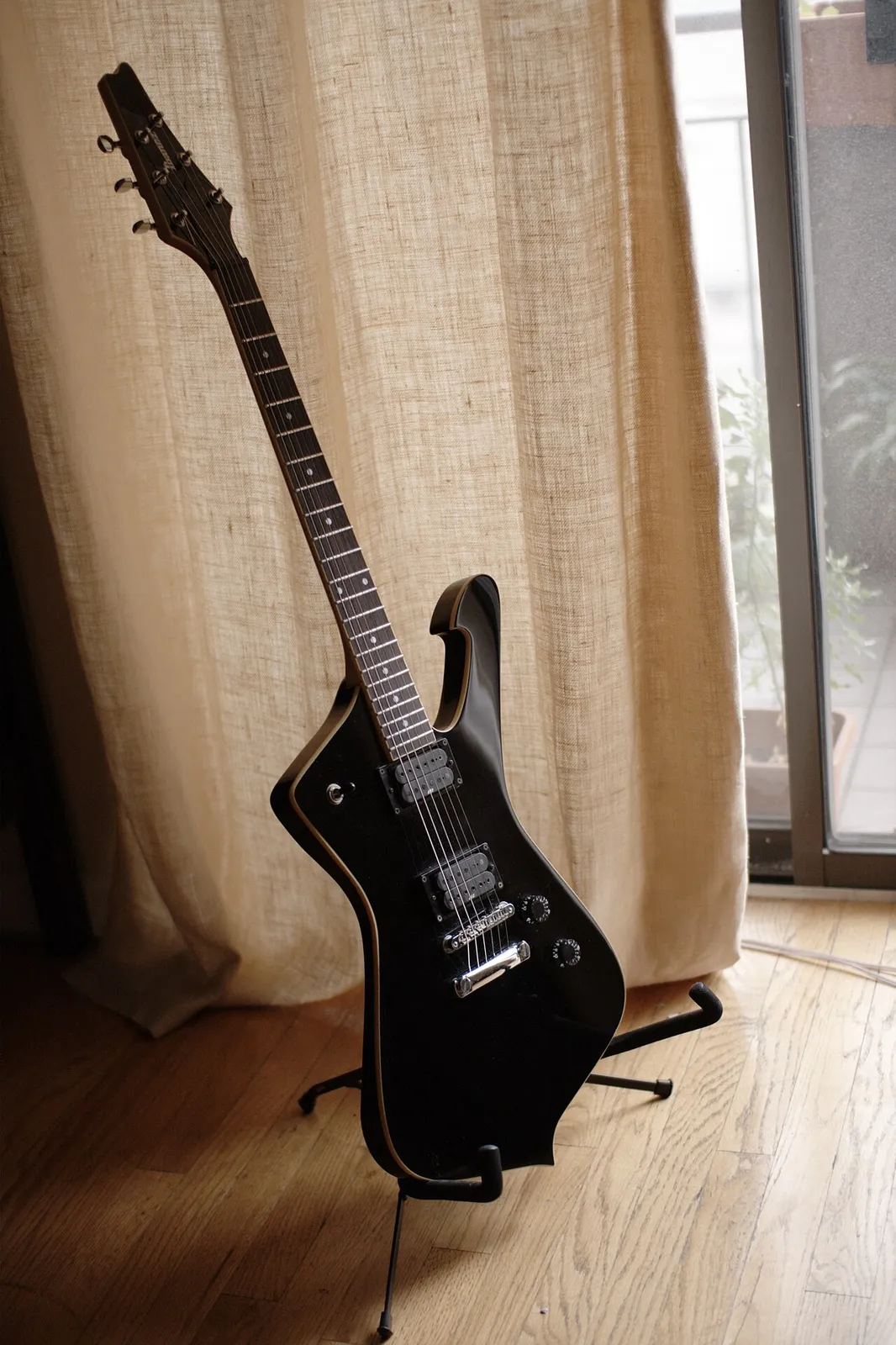
Photo: anders pearson / Wikimedia Commons / CC BY-SA 2.0 Ibanez
Iceman
1975
Ibanez drew this one itself in 1975. When the lawyers made the copies go away, it got to stay.
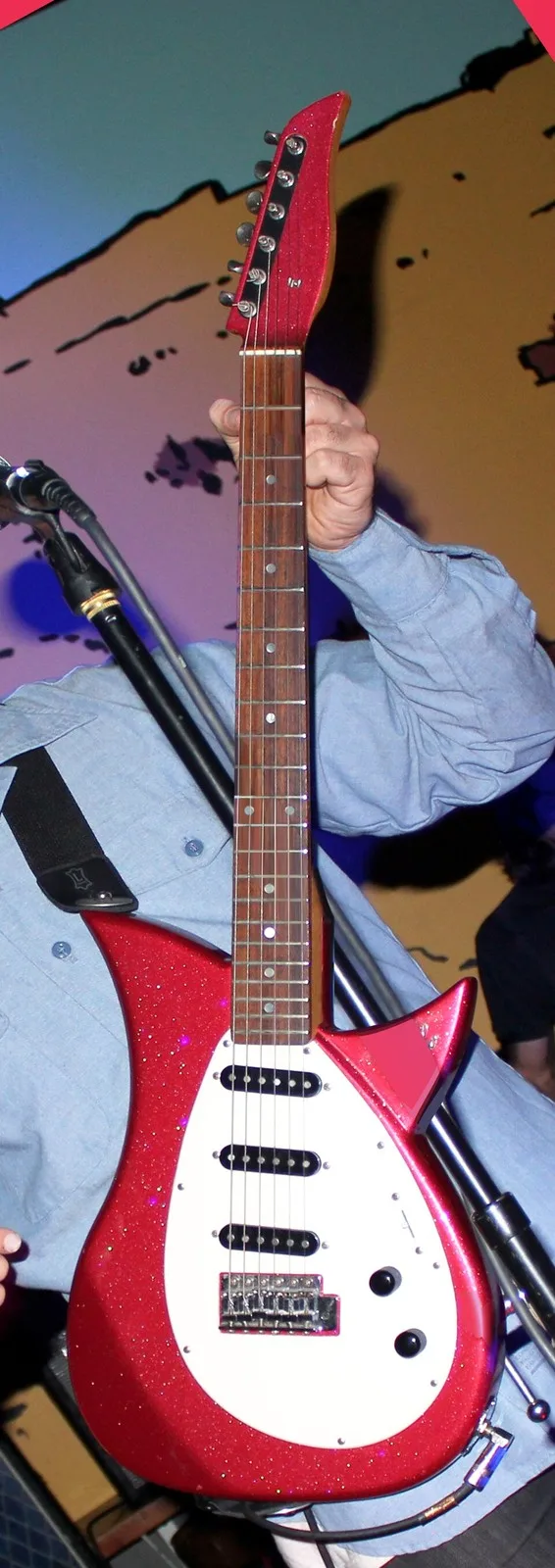
Photo: Jay Roc / Clusternote / Wikimedia Commons / CC0 Tokai
Talbo
1983
The copy company’s own idea: a guitar body poured like an engine block. Its fans wouldn’t let it stay gone.