Takamine
EG360SC
The stars played the Japanese Takamine. The EG360SC was the one that turned up for everybody else’s gig.
1 January 2006. A new price list goes out to Takamine dealers in America, and among the G-series dreadnoughts there’s a new line: EG360SC, dreadnought cutaway, solid spruce, rosewood, TP4T. $729.
- Introduced
- 2006
- Type
- Acoustic-electric
- Class
- Production
Have a photograph of this guitar? Send a picture
The short version
1978
Palathetic
Takamine’s own undersaddle pickup system arrives in Japan.
1979
Plugged in
The PT-007S, Takamine’s first acoustic-electric.
1980
Glenn Frey
Around now, Glenn Frey gets turned on to Takamine at Westwood Music.
2006
EG360SC
The G-series cutaway dreadnought lands on the U.S. price list at $729.
2010
$859
Same guitar, new price. It holds until the last list that prints it, in January 2013.
2013
Renumbered
Takamine redesigns the G-series that summer. The old numbers, this one included, go away.
Side A
A1
The poster and the Friday gig
Takamine’s reputation was built by people you’ve heard of. Springsteen took Takamine acoustic-electrics on stage. Don Felder played the intro to “Hotel California” on a Takamine 12-string. Glenn Frey got turned on to the brand around 1980 and ended up with his own signature model.
Takamine got there early. It came up with its own pickup system, the Palathetic, in 1978, and put out its first acoustic-electric the year after.
Those guitars were made in Japan, with that fancy pickup system, and they cost what that costs. Most people don’t play the guitar on the poster. They play the one that gets them through Friday night at the bar down the road. The EG360SC was built for Friday night.
A2
What the letters mean
Takamine names read like a license plate, so here it is. E means electronics. G means G-series, the more affordable line built outside Japan. 360 is the rosewood dreadnought slot. SC is the soft cutaway, the scoop out of the lower bout so your hand can get up the neck. Take away the E and the C and you’ve got the G360S, the same rosewood dreadnought with no cutaway and no pickup.
Here’s the trap. There’s also an EF360SC, and it isn’t this guitar. That one is a Japanese Pro model with a solid rosewood back and the good pickup system. One letter different, different factory, different electronics, different money. Glenn Frey’s signature, the EF360GF, is from that side of the family too.
A3
Spruce up top, rosewood around the back
The EG360SC is a big 14-fret dreadnought with a solid spruce top, which is the part that matters most for how it sounds. The back and sides are rosewood. The paperwork never calls them solid, and at least one says veneer, so assume layers and enjoy it anyway. Rosewood gives you that scooped, ringing bass that makes a strummed G chord feel bigger than you are.
It dresses up more than it needs to. Abalone snowflakes on the fingerboard, an abalone rosette, gold tuners with pearl buttons, gloss natural finish. There was a black one too, the EG361SC, for a few years. The named examples say China.
Most people don’t play the guitar on the poster.
Flip the record · By the numbers
$729
U.S. list price on the 1 January 2006 price list.
$859
List price from 2010 until the model’s last price list, in 2013.
3
EQ sliders on the TP4T preamp, plus a gain knob and a tuner.
±12 dB
How far the treble slider boosts or cuts, at 10 kHz.
Side B
B1
A little box on the side
The famous Takamines use the Palathetic pickup, six individually shielded piezo elements under the saddle. That system stays in Japan. The EG360SC gets a plain undersaddle piezo and a preamp called the TP4T, and the preamp is the part you’ll actually use at every gig.
You get a gain knob, three sliders for bass, mid, and treble, a chromatic tuner, and a little light that tells you the 9-volt is dying. You plug a cable into the strap button and it wakes up. You can tune between songs without a pedal, and if the room is boomy you can pull the bass down without asking the sound guy. Takamine says it only works in G-series guitars, not the Japanese ones, which tells you who it was for.
B2
Seven years on the list
It showed up in 2006 at $729 and went up to $859 by 2010, where it stayed. After that the paperwork gets fuzzy. Some reference dates stop it in 2011 and bring it back briefly in 2013. The price lists kept printing it straight through January 2013. A 2012 guitar exists either way.
That summer Takamine redesigned the whole G-series with new names and new preamps, and the rosewood cutaway job went to a model called the GD51CE. Nobody famous is on record with an EG360SC, and that’s all right.
The ones out there now trade as used working guitars, which is exactly what they were when they were new. Nobody put one on a poster. It was always going to the gig.
The cast
The people, and the specific guitars, that made the legend.
1980
Glenn Frey
EF360GF, not this guitar
The Eagles’ Takamine man, turned on to the brand around 1980. His signature is the Japanese Pro model.
Bruce Springsteen
Takamine acoustic-electrics
Took Takamines to the stage in the Palathetic era. Not a G-series guitar.
1976
Don Felder
A Takamine 12-string
The “Hotel California” intro, on a Takamine 12-string with a DeArmond pickup. A different guitar entirely.
Steven Wilson
EF360SC and others
His Takamines are the Japanese Pro models. Same “360,” different factory.
Liner notes
Specs, construction, rarity, value, and every source we used.
Solid spruce, rosewood sides, a cutaway, and a TP4T — Takamine’s G-series EG360SC, not the Japanese EF360SC.
- Body
- Dreadnought cutaway. Solid spruce top. Rosewood back and sides (factory and 2006–2013 price lists do not print “solid” on the back; Blue Book: rosewood veneer; a 2012 China listing: laminated rosewood sides). Nashville Guitar Store measured 15.875" wide, 4.875" deep. Mix flagged.
- Neck
- Mahogany, set. Chorder: dovetail. 14th-fret join.
- Fingerboard
- Rosewood, 20 frets, abalone snowflake markers. One 2012 listing: 12" radius.
- Scale
- Nashville Guitar Store: 25.3". 2012 China listing: 25.5". Mix flagged. Do not average. Millimetres unpublished on those sheets.
- Pickups
- Undersaddle piezo. Not Palathetic.
- Hardware
- Rosewood bridge; gold die-cast tuners with pearl buttons; black pickguard; abalone rosette. Nashville listing: ivory body binding with abalone purfling.
- Electronics
- TP4T: gain, 3-band EQ, chromatic tuner, 9 V. Factory: G-series only; not compatible with Japan Pro preamps.
- Finish
- Gloss natural (360). Gloss black is EG361SC.
- Nut
- Chorder 1.675". 2012 listing 1.68". Nashville listing 1.6875". Mix flagged. Do not average. Millimetres unpublished on those sheets.
Open the full research fileConstruction details, the complete player record, production numbers, dated value estimates, and sources
Classic living example = G-series EG360SC, Kaman U.S. lists 1 January 2006–1 January 2013. No current EG360SC cart: Musician’s Friend discontinued / unavailable (fetched 18 September 2026). Factory page still holds archival copy. G360S is the non-cutaway, no-electronics sibling. EG361SC is the black finish. EG340SC is mahogany G-series. EF360SC / EF360SC-TT / EF360GF are Japan Pro. GD51CE is the 2013 G50 replacement, not this table. Inch listings and unpublished millimetres — mix flagged; no extra millimetres invented.
Construction
The job was a rosewood-sided cutaway dreadnought a working player could plug in without buying Sakashita. Takamine already had the Palathetic guitar. Factory history: Palathetic 1978, first acoustic-electric PT-007S in 1979, Japan. This is the G-series version of that outline: import woods, a simpler preamp, the dreadnought cutaway people search when they type 360.
It is not the EF360SC. Factory Pro page: pro-series facility, solid spruce, solid rosewood back, Palathetic, CT4B II. Premier Guitar (19 February 2019) on the Thermal Top sister: a dreadnought with a Venetian cutaway, “hence the SC (soft cutaway) in the model name.” Same suffix. Different factory, different pickup, different preamp. EF360GF is Glenn Frey’s non-cutaway signature on a living Pro page. Do not hang that guitar here.
E is electronics. G is G-series. 360 is the rosewood dreadnought slot next to G360S. SC is the cutaway. Blue Book: similar to the G-360S except the cutaway and TP4T. Factory G360S page: solid spruce, Indian rosewood, no electronics, discontinued. That acoustic is the sibling. This table is the plugged cutaway.
What you get is a 14-fret dreadnought with a solid spruce top and rosewood back and sides the 2006 price list does not call solid. Keep the split. A 2012 China example (serial TC12035071) lists laminated rosewood sides. Blue Book prints rosewood veneer. Mahogany neck. Rosewood board, 20 frets, abalone snowflakes. Gold machines with pearl buttons. Gloss natural.
The letter is the electronics. Factory Palathetic page: six individually shielded piezos, “twelve times the element mass of the typical under saddle pickup,” through the bridge plate into the saddle. That system is Japan Pro. Factory preamp page: TP-4T is G-series only, not compatible with Pro Series made in Japan. TP-4T owner’s guide: 9 V, 450 mV out; bass 60 Hz ±9 dB, mid 600 Hz ±10 dB, treble 10 kHz ±12 dB; chromatic tuner. Gain knob, three sliders, low-battery LED. Endpin jack wakes it. TP-4TD is the dual-input split-saddle version on later G-series. This guitar’s lists print TP4T.
G-series is older than this SKU. Wikipedia: affordable instruments manufactured outside Japan, simpler proprietary preamps, after the 1990s CNC years. The 2002 Kaman catalog already has a G-series chapter. MusicRadar (29 March 2019) notes the affordable G-Series launch without a year. Do not invent one. EG360SC is not on the 2005 MAP list. It lands on Kaman’s U.S. price list effective 1 January 2006: dreadnought C/A, solid spruce, rosewood, rosewood board, TP4T, list $729.00. EG361SC black, same money. Audiofanzine timestamps the model 20 June 2006. This plate starts in 2006.
The lists keep it. 2010 and 2011: $859.00. 1 January 2013 still prints EG360SC_83654 at $859.00. Blue Book: mfg. 2006–2011, reintroduced 2013–mid 2013; black 361 2006–2010. A dated 2012 China guitar sits in the Blue Book gap. Keep 2011, 2012, and 2013. Do not pick a winner.
Summer 2013. Guitar World (18 July 2013) and Premier Guitar the same week: redesigned G-series, GD / GN numbering, pinless and split-saddle bridges, TK-40D and TP-4TD, MSRP $259.99–$859.99. The 2013 G-series leaflet puts GD51CE in the rosewood G50 slot: solid spruce, rosewood, TP-4TD, 43 mm nut. That is the replacement job, not this SKU. Living GD51CE carts (Guitar Center, 2026) print black walnut, laurel board, 25.4" (644 mm) scale, 1.6875" (42.8 mm) nut, TP-4TD — mix flagged on those sheets, not this table. GD71CE is G70, TK-40D, also walnut on current pages. Neither is an EG360SC.
Wikipedia: G-series outside Japan. Named EG360SC examples print China. Do not flatten Korean-made cousins onto this SKU.
Players
Do not hang a Japan Pro Takamine on this plate. Do not recruit Springsteen, Glenn Frey, Don Felder, Pete Townshend, or Steven Wilson as if they played an EG360SC.
Not this guitar. MusicRadar’s hardest-working piece is Palathetic and Sakashita: Springsteen to the Eagles; Felder’s Hotel California intro a Takamine 12-string with a DeArmond; Frey turned on around 1980 by Fred Walecki at Westwood Music, then EF360GF. Reverb News (Adam Perlmutter, 11 January 2016): Springsteen took Takamine acoustic-electrics to the stage — Palathetic story, not a G-series serial. Wilson’s named instruments are EF341SC / EF360SC / P7NC. None of those is EG360SC.
No named EG360SC, year, and record or stage was found this pass. Also known to play stays empty rather than borrowed.
Rarity
You cannot buy a new EG360SC from a living Takamine cart. The old G-series numbering ended in the 2013 redesign. Current G50/G70 cutaway dreads are other SKUs. They are not this guitar.
Takamine did not publish EG360SC unit totals. None invented. Serials date a guitar (the 2012 TC example dates 2012). They do not count a year.
What is actually thinner: EG361SC black, Blue Book 2006–2010; complete originals with the TP4T unmolested. A first-year 2006 census is unknown, not the chapter. This is a common used G-series dreadnought, not a vintage Japan Pro.
Value
Informal estimate, 18 September 2026. Not an appraisal.
Ask vs sold labeled. Japan Pro 360s are not-comps. No invented median or factory count. Period lists are historical money, not 2026 street.
New street. None under EG360SC this pass. Musician’s Friend last cart $599.00, discontinued, unavailable (fetched 18 September 2026). Historical U.S. lists, not a 2026 cart: Kaman 1 January 2006 $729.00; 2010 / 2011 / 1 January 2013 $859.00. Nashville Guitar Store refurbished overstock listed list $859 / ask $469 (listing 11 years old) — one shop, not a band.
Used modern. No clean Reverb Price Guide band isolated this pass. Flag: thin sold-comp access. Named used asks, not hammers: Excellent $389.99 (listed a year ago); Very Good $449.95 (two years); 2012 China Very Good $497.90; Excellent with case $600 (three years). Do not average those asks.
Vintage / collectible. There is no pre-war tape. A 2006–2013 G-series EG360SC trades as a used working guitar. EF360SC-TT new street around $2,299 (Reverb dealer snapshot) is Japan Pro Thermal Top. Not a comp. Frey, Felder, and Wilson objects are other guitars.
See also
- taylor-814ce — cutaway acoustic-electric flagship; Grand Auditorium, not a G-series dread
- martin-d-28 — the rosewood dreadnought silhouette this import copies in outline; Nazareth, not G-series
- ovation-balladeer — another stage acoustic-electric; Lyrachord bowl, not a rosewood box
Sources
- Takamine, EG360SC — G-series copy; solid spruce; Indian rosewood back and sides; undersaddle pickup; TP4T; gloss natural; dreadnought
- Takamine, G360S — discontinued non-cutaway sibling; solid spruce; Indian rosewood; no electronics
- Takamine, EF360SC — Japan Pro; solid rosewood back; Palathetic; CT4B II
- Takamine, EF360SC-TT — Pro Thermal Top; scale 644; nut 42.5 mm; CT-4BII
- Takamine, EF360GF Glenn Frey Signature — non-cutaway Pro signature; Palathetic; CT-4BII
- Takamine, History — 1959 Sakashita; 1962 name; Palathetic 1978; PT-007S 1979
- Takamine, Palathetic Pickup — six shielded piezos; twelve times typical UST mass; Pro system
- Takamine, Pre-Amps — TP-4T G-series only; not compatible with Japan Pro; gain / 3-band / tuner / 9 V; TP-4TD split-saddle; CT4B II Pro-only
- Takamine TP-4T / TP-4TD Owner’s Guide — 450 mV; bass 60 Hz ±9 dB; mid 600 Hz ±10 dB; treble 10 kHz ±12 dB
- Kaman, 2006 Takamine price list — effective 1 January 2006; EG360SC / EG361SC list $729.00; G360S $569.00
- Takamine, 2005 MAP price guide — G-series dreadnoughts without EG360SC; EF360SC $1,579.00
- Takamine, 2010 price list — EG360SC $859.00
- Takamine, 2011 price list — EG360SC $859.00
- Takamine, 2013 retail price list — 1 January 2013; EG360SC_83654 $859.00
- Takamine, 2013 G Series brochure — GD51CE solid spruce / rosewood / TP-4TD / 43 mm nut
- Guitar World, Redesigned G Series, 18 July 2013 — GD/GN redesign; TK-40D / TP-4TD; MSRP $259.99–$859.99
- Premier Guitar, G Series acoustic line, 18 July 2013 — same redesign release
- Premier Guitar, EF360SC TT review, 19 February 2019 — SC = soft/Venetian cutaway on the Pro sister; Palathetic; not this G-series guitar
- Blue Book, EG-360SC/EG-361SC — similar to G-360S plus cutaway and TP4T; Natural 360 / Black 361 (2006–2010); mfg. 2006–2011, reintroduced 2013–mid 2013; rosewood veneer; 20 frets
- Musician’s Friend, G Series EG360SC — discontinued; last cart $599.00; solid spruce; rosewood back/sides; TP4T; abalone snowflakes; pearl tuners; gloss natural
- Reverb News, A Brief History of Takamine Guitars, Adam Perlmutter, 11 January 2016 — Palathetic 1978/79; Springsteen on Takamine AE; lawsuit-era headstock; not a G-series serial
- MusicRadar, How Takamine acoustics became the hardest-working guitars in music, 29 March 2019 — Palathetic / PT-007S; Frey ~1980; Felder Hotel California 12-string; G-Series launch unnamed-year; Wilson EF341SC / EF360SC / P7NC
- Wikipedia, Takamine (guitar manufacturer) — G-series outside Japan, simpler proprietary preamps
- Audiofanzine, EG360SC — G Series Dreadnoughts; created 20 June 2006
- Chorder, EG360SC — dreadnought cutaway; spruce/rosewood; TP4T; 20 frets; abalone snowflakes; 1.675" nut; dovetail; gold hardware
- Reverb, 2012 EG360SC Gloss Natural — China; laminated rosewood sides; 25.5"; 1.68" nut; 12" radius; 20 frets; TP-4T; serial TC12035071; 4.85 lb; ask $497.90
- Reverb, Nashville Guitar Store EG360SC — discontinued overstock; list $859 / ask $469; 25.3"; 1.6875" nut; 15.875" / 4.875"; made in China
- Reverb, Parkway Music EG360SC — 2007; SN 07073842; ask $449.95
- Reverb, The Upper Bout used EG360SC — Excellent ask $389.99
- Reverb, Garrett Park EG360SC — Excellent ask $600; serial 08104332
- Guitar Center, GD51CE — living G50 cutaway; black walnut; 25.4" (644 mm); 1.6875" (42.8 mm); TP-4TD; $699.00
- Guitar Center, GD71CE — living G70; black walnut; TK-40D; $799.00
- Reverb, EF360SC TT — Pro Thermal Top new snapshot $2,299; not this guitar
Keep digging
Guitars this one gets compared to, confused with, or descended from.
- Send a picture
Taylor
814ce
1996
Taylor has rebuilt its flagship from the braces out, again and again, and kept the same three numbers on it.
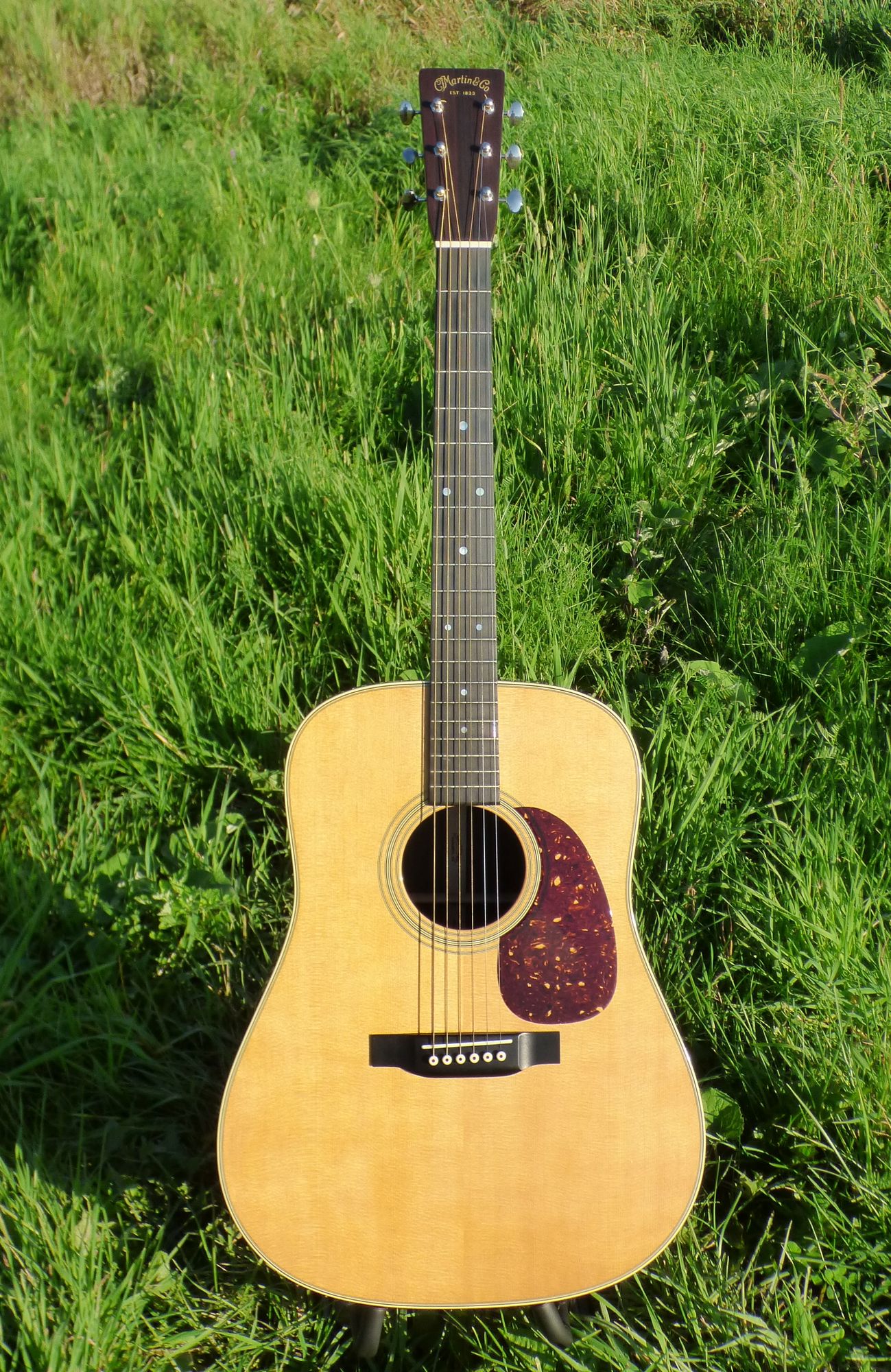
Martin D-28 Acoustic Guitar. Photo by Niranjan Arminius. Licensed under CC BY-SA 4.0. Via Wikimedia Commons. Martin
D-28
1931
You’ve heard a D-28 your whole life. It just never asked for the credit.
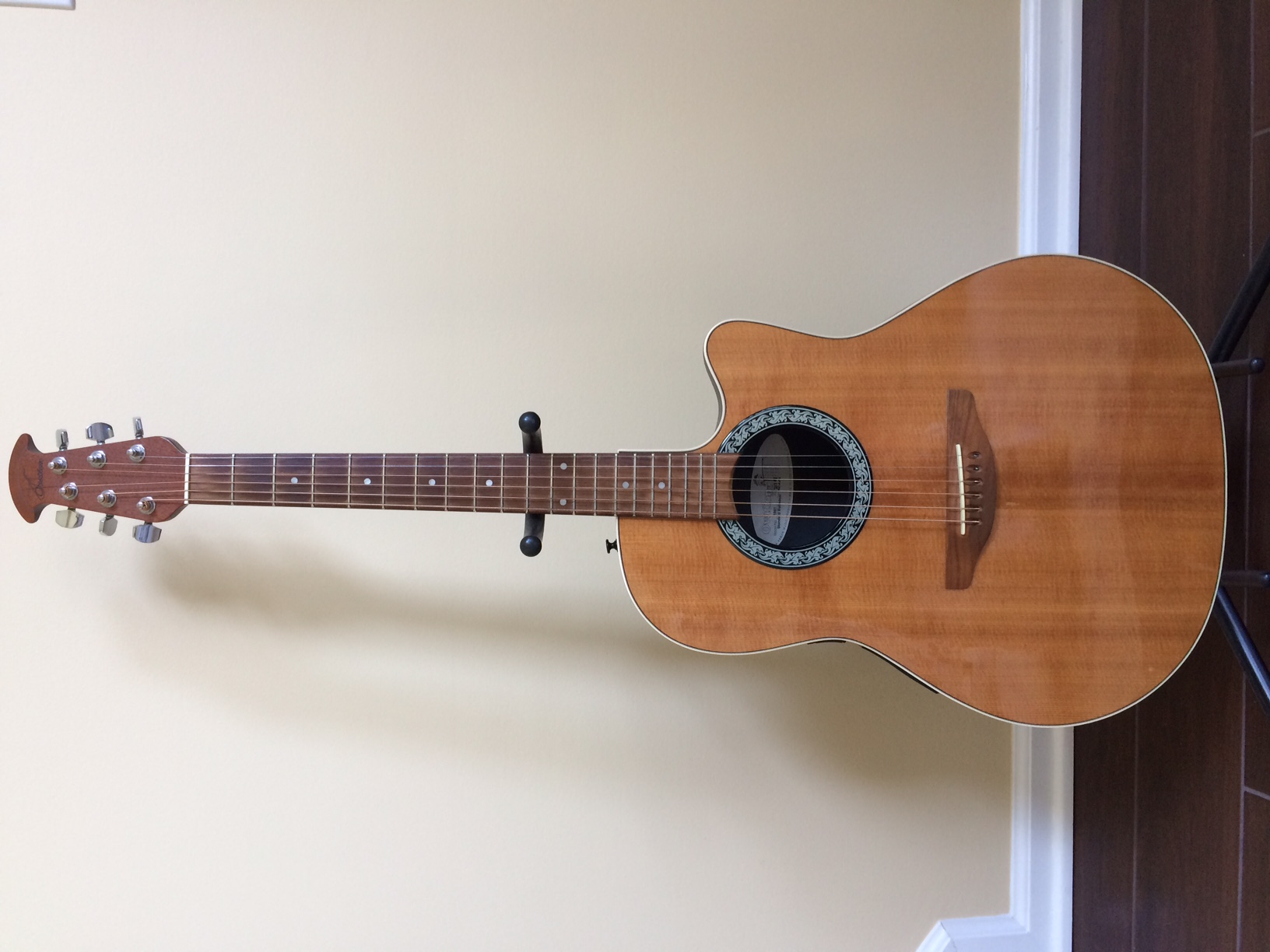
Ovation Model 1861 Standard Balladeer. Photo by Veradrive. Dedicated to the public domain under CC0 1.0. Via Wikimedia Commons. Ovation
Balladeer
1966
A helicopter builder looked at a guitar and asked why the back had to be made of wood. This was his answer.