Martin
D-28
You’ve heard a D-28 your whole life. It just never asked for the credit.
Rishikesh, India, February 1968. Two Beatles sit around an ashram with acoustic guitars, and both of them brought the same model: a Martin D-28. It isn’t a famous guitar. It’s just what a good acoustic is.
- Introduced
- 1931
- Type
- Flat-top steel-string acoustic
- Class
- Production
The short version
1931
The first D-28s
Martin puts its own name on a dreadnought. Twelve frets, and only a handful built.
1934
Fourteen frets
The 14-fret D-28 enters the catalog.
1937
One busy year
Martin builds 148 D-28s, more than every pre-war D-45 put together.
1947
Herringbone runs out
The German-made trim is used up early in the year. Multi-stripe binding replaces it.
1955
The leather one
Elvis trades his D-18 for a D-28 with a leather cover. It ends up on his first RCA album.
1968
Rishikesh
John Lennon and Paul McCartney take D-28s to India.
1969
Last Brazilian
Late in the year, Style 28 moves from Brazilian to Indian rosewood.
2025
Scallops again
The Standard D-28 gets scalloped braces, which used to be the HD-28’s job.
Side A
A1
Two Beatles, two D-28s
John Lennon bought a Martin D-28 in 1967. Paul McCartney got one the same year. In February 1968 both guitars went to Rishikesh, in India, and Lennon wrote a big chunk of his White Album material on his.
The story most often told puts McCartney’s D-28 on “Blackbird.” It’s a good story from a serious historian, but nobody has lined the tracks up against the session paperwork, so call it probable.
Nobody calls it the D-28 album, either. That’s the D-28 all over: the workhorse that never had one guitar hero’s face on it. You’ve heard it on record after record, and almost nobody thinks to put its name on the credits.
A2
Big, square, and rosewood
The D is Martin’s dreadnought: big, square at the shoulders, deep. The 28 is Style 28, rosewood back and sides. Rosewood on a body that size gives you a deep, round low end and a shimmer of overtones on top. Strum a chord and it keeps ringing after you’re done. Hit a bass run and it growls.
Martin built dreadnoughts for the Ditson company from 1916, and put its own name on a D-28 in 1931. The first few years were twelve-fret guitars, and nobody agrees how many: somewhere between seventeen and forty-one, depending whose count you trust. In 1934 the 14-fret D-28 entered the catalog.
The pre-war recipe is the one people chase now: Brazilian rosewood, Adirondack spruce, scalloped braces, herringbone around the top, a zipper stripe down the back. Martin wasn’t treating it like a treasure. It built 148 of them in 1937 alone.
A3
When the herringbone ran out
If you ever inherit a D-28, this is the part you’ll care about, because it’s how you find out what you’ve got.
It all comes down to the war. Late in 1944 Martin stopped scalloping the braces, the careful shaving that lets a top move. A couple of years later the spruce changed too. Then, early in 1947, the herringbone ran out. That little strip of wood marquetry around the top came from Germany, and after the war there wasn’t any more of it. Martin used up what it had, switched to plain black-and-white stripes, and that was that, give or take a few stragglers.
So read the top. Herringbone and scalloped braces: built before the end of 1944, and the one everybody wants. Herringbone with straight braces: a short window around the end of the war. Stripes: 1947 or later. Those postwar guitars still had Brazilian rosewood until the end of 1969, and even that wasn’t a clean line. A few leftover sets turned up on guitars the next year.
In 1976 the HD-28 brought herringbone and scalloped braces back, and for decades the counter rule was simple: D-28 stripes and straight braces, HD-28 herringbone and scallops. The 2025 Standard D-28 broke that. It has scalloped braces now. If someone quotes you the old rule, they’re a year or two out of date.
Flip the record · By the numbers
148
D-28s Martin built in 1937 alone. Only 91 pre-war D-45s were ever made.
17–41
Twelve-fret D-28s built from 1931 to 1933. Depends whose count you trust.
1947
The year the German herringbone trim ran out. Early in the year, and that was it.
1969
The end of Brazilian rosewood on the D-28, give or take a few leftover sets.
Side B
B1
Everybody’s workhorse
The list of people who played one is long, and it reads like a list of people at work.
Elvis traded his D-18 for a D-28 with a leather cover, and it’s on the front of his first RCA album. Who did the leatherwork depends on who you ask, and nobody knows where the guitar is now. Lester Flatt’s 1950 D-28 went to the Country Music Hall of Fame in 2008. Clarence White played a 1935 D-28 with an enlarged soundhole, and then Tony Rice played it, and it became the D-28 bluegrass people name first. Waylon Jennings wrote on a 1946. Billy Strings’s signature models come from his 1940.
Merle Travis played one. So did the Kingston Trio’s Bob Shane, with one straight off the rack, and Doc Watson for about four years, and Paul Simon on “Mrs. Robinson.” Don McLean is said to have written and recorded “American Pie” on a late-1960s D-28, though that one rests on a single account.
B2
The one called Hank
Neil Young plays a 1941 herringbone D-28 that he bought from Tut Taylor and calls “Hank.” It’s been his writing, recording, and touring guitar, and it’s the guitar in “This Old Guitar.” Young believes it belonged to Hank Williams. That’s his belief, not a closed chain of paperwork.
And that’s about as close as the D-28 comes to having a face: a nickname, a disputed story, and a song about the guitar rather than the man. Walk through the list again. Rishikesh, Tony Rice, Elvis on his first RCA cover, the Kingston Trio, probably “Blackbird.” None of them sound like a D-28 record. They just sound like somebody playing an acoustic guitar. That’s what a D-28 sounds like.
Put this on
You’ve read about it. Now hear it. Here’s what this guitar sounds like, and what to listen for.
Blackbird
The story most often told puts McCartney’s D-28 on this one, though nobody has matched it to the session paperwork. Listen to how much room one acoustic takes up when there’s nothing else in the way.
Find it on YouTube (opens in a new tab)This Old Guitar
From Prairie Wind, and it’s about “Hank,” his 1941 herringbone D-28. Young believes it was Hank Williams’s. That part is contested.
Find it on YouTube (opens in a new tab)American Pie
McLean is said to have written and recorded it on a late-1960s D-28. That rests on one account, so treat it as likely, not settled.
Find it on YouTube (opens in a new tab)
The cast
The people, and the specific guitars, that made the legend.
1935
Clarence White & Tony Rice
1935 D-28
Enlarged soundhole, and the most famous D-28 in bluegrass. White first, then Rice.
1956
Elvis Presley
1955 leather-covered D-28
On the cover of Elvis Presley. Who made the leather is unsettled, and the guitar itself is unaccounted for.
1946
Waylon Jennings
1946 D-28
His main writing guitar. A transitional one, with herringbone on top and dots on the board.
2005
Neil Young
“Hank,” 1941 D-28
Bought from Tut Taylor. Writing, recording, and touring guitar. The Hank Williams provenance is Young’s belief, not a closed chain.
1968
John Lennon
D-28
Bought in 1967, taken to India, and used to write much of his White Album material.
2025
Billy Strings
1940 D-28
The guitar his Martin signature models are based on.
Liner notes
Specs, construction, rarity, value, and every source we used.
The dreadnought everyone means when they say Martin — and the 2025 Standard scallops the braces the HD-28 used to own.
- Body
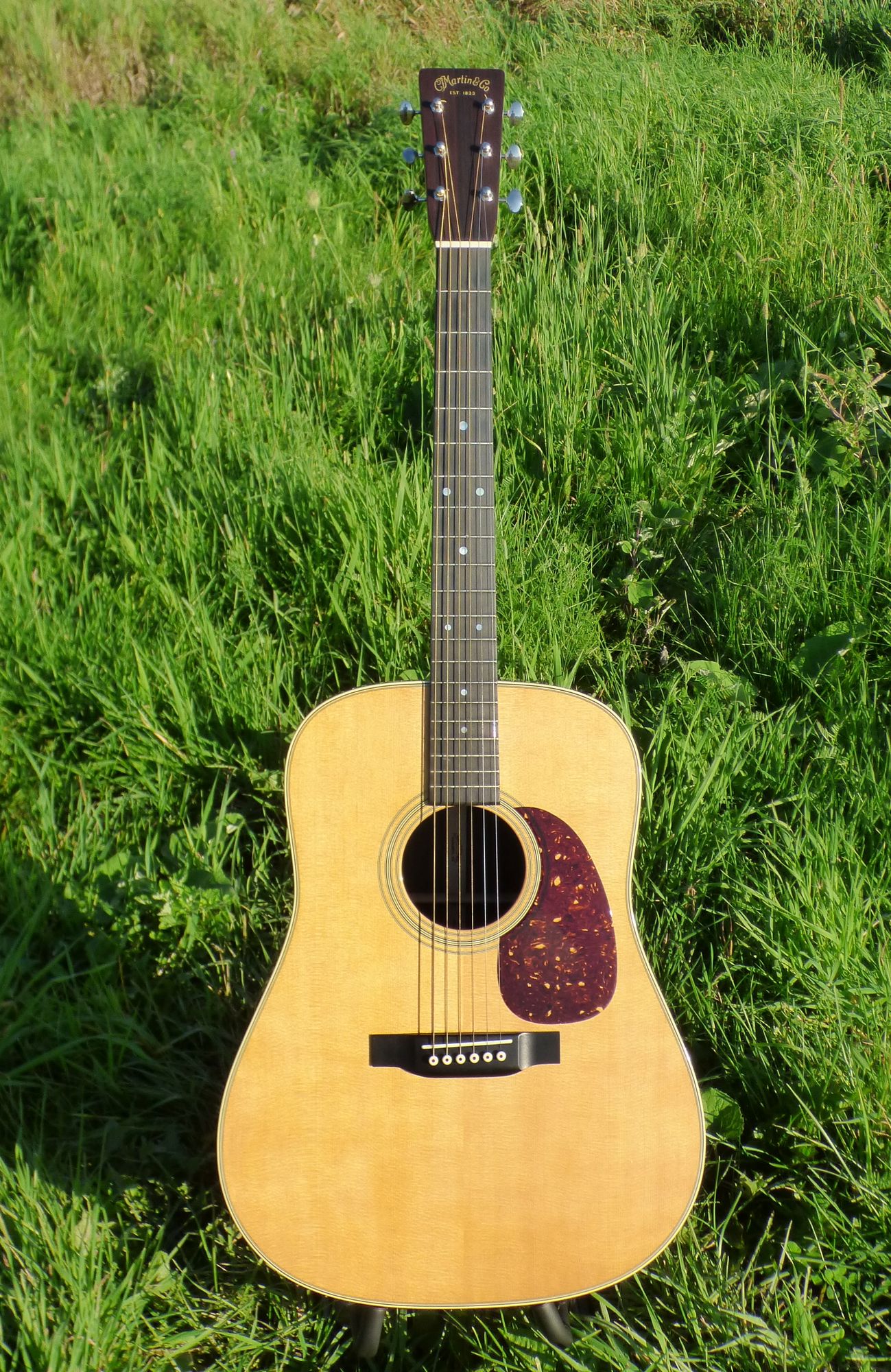
- Square-shoulder D-14 fret dreadnought; solid Sitka spruce top with aging toner; solid East Indian rosewood back and sides; antique white binding, Style 28 multi-stripe (not herringbone)
- Neck
- Select Hardwood (Martin spec — not explicitly mahogany), GE Modified Low Oval with High-Performance Taper; satin, dark mahogany color; dovetail joint
- Fingerboard
- Ebony, Style 28 mother-of-pearl dots, 20 frets, 14th-fret joint
- Scale
- 25.4"
- Pickups
- None on the current Standard. Optional/modern on other SKUs (e.g. HD-28E).
- Hardware
- Ebony GE Modern Belly bridge, drop-in saddle, 2 5/32" spacing; bone pins with faux-tortoise dots; compensated bone saddle (16" radius); nickel open-gear tuners with butterbean knobs; faux-tortoise pickguard
- Electronics
- None
- Finish
- Gloss top and back/sides; satin neck; aging toner on top
- Nut
- Bone, 1 3/4"; 12th-fret width 2 1/8"
Open the full research fileConstruction details, the complete player record, production numbers, dated value estimates, and sources
SKU 10Y25D28. This guitar is GE-scalloped. Older literature that says D-28 = non-scalloped is historically true and currently false for new Standards — see Construction.
Construction
C. F. Martin & Company, Nazareth. Square-shoulder dreadnought, 15 5/8" lower bout on the classic D size. Martin-built Ditson dreadnoughts from 1916 (VG: fan bracing on the earliest, then X-bracing; scarce). Martin-brand D-28 from 1931 — VG also notes D-1/D-2 experimentals and Martin-stamped D-18 that year. 14-fret catalog dreadnoughts from 1934.
Read the current spec first. The old shop-counter line is now a trap. For decades: D-28 = multi-stripe + non-scalloped; HD-28 = herringbone + scalloped. That split dates to 1976, when the HD-28 reintroduced herringbone and scalloped bracing. The 2025 Standard Series refresh puts Golden Era scalloped, forward-shifted X-bracing on the D-28 — 5/16" spruce. Cosmetic gap vs HD-28 is now primarily herringbone + diamond/square inlays versus multi-stripe + dots (UMGF 2025 comparison). Authentic/GE reissues recreate pre-war scalloped herringbone D-28s. Those are not the Standard.
Hide glue is not listed on the current Standard spec; guitarhq.com has it largely phased out after the 1964 factory move. Neck wood is "Select Hardwood," not "genuine mahogany" (the D-45 page does say genuine mahogany). The 1 3/4" nut is a return to the pre-1939 width, not the post-1939 1 11/16".
The 12-fret years are a count fight. Vintage Guitar / Gruhn (Martin records): 1931: 1 / 1932: 4 / 1933: 12. guitarhq.com Style 28 text: 41 D-28s with 12-fret necks 1931–1933. 1934: four 12-fret + 65 fourteen-fret (VG) vs UMGF forum 52 fourteen-fret — don't flatten. Keep both. Don't pick.
1934: 14-fret D-28 enters the catalog (VG). Early 1934 still bar frets / ebony neck reinforcement; by year's end, T-frets and steel T-bar (VG; guitarhq.com serial ~57305). Pre-WWII Style 28: Brazilian rosewood, Adirondack (red) spruce, scalloped X, herringbone purfling, zipper backstripe, ivoroid binding, slotted-diamond inlays. Late 1938: X-brace junction moved back ("rear-shifted" / "low X"). Mid/late 1939: nut on 14-fret D and 000 narrowed 1 3/4" → 1 11/16" (serial 72740); popsicle brace around 1939.
Late 1944: scalloped bracing discontinued (approx last scalloped serial 89926; last scalloped D-28 ~90014, exceptions both ways). Inlays: slotted diamonds → small dots. 1946: Adirondack → Sitka on D models first; herringbone still used that year (VG). Early 1947: herringbone ends. guitarhq.com last Style 28 herringbone serial 98223; VG: "After the first production run in '47, herringbone trim was discontinued." Replacement: black/white multi-stripe. Zipper backstripe ends mid-1947 (last ~99992). German-made herringbone stock exhausted, per guitarhq.com. A few later 1947 herringbones are reported (UMGF serial 98880 vs 98223). Treat 98223 as the canonical last, with possible stragglers.
1947–1975: non-herringbone, non-scalloped (tapered braces late 1944–c.1949, then straight). Brazilian rosewood until late 1969 — guitarhq.com serial 254497 last Style 28 Brazilian; 254498 first Indian (a D-21). Leftover Brazilian after that, including rare 1970 D-28s. Not a clean 1 January 1970 cutoff. 1968–69: maple bridgeplate → rosewood, then a larger rosewood plate (serials 235586 / 242454) — a collectibility line for many players.
Players
The D-28 became the workhorse without a single guitar-hero face (Walter Carter). Named instruments first.
Elvis Presley — 1955 D-28 (leather-covered), cover of Elvis Presley (1956). Graceland: traded a 1942 D-18 for it at O.K. Houck, Memphis. Leather-maker name is unsettled (Graceland: “an employee”; Scotty Moore archive: Marcus Van Story; a commemorative blurb: Charles Underwood). The guitar itself is unaccounted for.
Lester Flatt — 1950 D-28, donated to the Country Music Hall of Fame 14 February 2008 (Marty Stuart and Connie Smith). Do not collapse Flatt onto this one guitar: early Monroe-band photos show a Gibson J-35 (Carter); Tut Taylor via Bluegrass Heritage Foundation says Flatt preferred a 1942 D-18 for many 1950s recordings.
Clarence White, then Tony Rice — 1935 D-28, serial 58957. Enlarged soundhole; the named bluegrass D-28 (Fretboard Journal). Not a stock Standard.
Waylon Jennings — 1946 D-28, Martin Museum/archives. Transitional: herringbone top, already-dot board. Martin: primary writing guitar.
Billy Strings — 1940 D-28, serial 76283. Inspiration for his D-28 signature (Martin, 22 January 2025).
Neil Young — “Hank,” a 1941 herringbone D-28 bought from Tut Taylor. Writing/recording/touring guitar; “This Old Guitar”; Neil Young: Heart of Gold; Prairie Wind. Provenance to Hank Williams Sr. is contested — Young’s name and belief, not a closed museum chain. Do not credit Harvest’s main acoustic to a D-28 (that’s a D-45).
John Lennon bought a D-28 in 1967 (often described as 1965-built), took it to India in February 1968, and wrote much of his White Album material on it. He later gave a D-28 to Ronnie Hawkins (1969); subsequent ownership of that physical guitar is disputed (thecanteen.com). Paul McCartney also acquired a D-28 in 1967; both went to Rishikesh. Walter Carter names McCartney’s D-28 on “Blackbird” (1968) — serious source, still one essay. Track-by-track Beatles credits were not fully verified from primary session docs.
Don McLean — late-1960s D-28, “American Pie” written and recorded on it (Martin museum essay; single-source). Rich Robinson (Black Crowes) — 1954 D-28 from his father (Martin Dreadnought Buying Guide).
Also known to play (Carter unless noted): Hank Williams (a photograph with a D-28; Martin Museum’s Williams guitar is a 1947 D-18, not a D-28); Bill Monroe (stolen 1965 — year of that guitar 1939 vs 1941 unsettled); Merle Travis (1941 D-28, later Bigsby neck); Bob Shane / Kingston Trio (new off-the-rack, late 1950s–early 1960s); Doc Watson (about four years, then Gallagher 1968); Paul Simon, “Mrs. Robinson” (1967, Carter); Norman Blake (1933 12-fret sunburst D-28). Martin lists Johnny Cash and Bob Dylan as D-28 workhorse players. Cash’s famous Martin identity is the black D-35 / D-42 line. Dylan’s famous early Gibson is a J-50, not a J-45, and no named D-28 is documented here.
Rarity
Current production: regular; not rare. No current-year factory total found. Used modern Indian-rosewood D-28s are common. 1969-and-earlier Brazilian: finite; 1950s–60s examples are collectible but not rare like pre-war. 1946–early 1947 herringbone (non-scalloped Sitka): short window. Pre-1945 scalloped herringbone, especially 1934–1938 forward-X 14-fret: scarce relative to postwar D-28s — not in the same rarity class as pre-war D-45s (91 instruments). No verified herringbone grand total 1934–46. Do not invent one.
12-fret 1931–33: 1 / 4 / 12 (Vintage Guitar / Gruhn, Martin records). guitarhq.com Style 28 text: 41 D-28s with 12-fret necks 1931–1933. 1934: 4 twelve-fret + ~52–65 fourteen-fret (VG 65 vs UMGF/forum 52). Keep the conflicts. Don't pick.
Premier Guitar: Martin built 148 D-28s in 1937 alone, versus 91 total pre-war D-45s 1933–42.
Value
Informal estimate, 25 August 2026. Not an appraisal.
Ask vs sold. 12-fret 1931–34: no 2024–26 sold captured.
New street. Standard D-28 / HD-28 about $3,500. Martin.com $3,499.99 (fetched 25 August 2026). Sweetwater $3,499.99. Other dealer streets: The Music Den $3,299; Guitar Chalk (22 August 2026) Natural $3,199 / Ambertone $3,399; Peghead Nation $3,299. Satin lower. Authentic 1937 VTS Aged new $9,499 (Sweetwater); non-Aged VTS $8,499 — new street, not vintage.
Used modern. No clean Reverb sold band captured. Reverb’s all-models mix sits $1,403–$2,259 and likely includes older/cheaper Standards. Expect used to sit under current street; do not invent a midpoint.
Vintage / collectible. Postwar Brazilian (1945–1969) dealer guide (Garrett Park): mint/original $8,000–$15,000; excellent $5,000–$8,000; player-grade $3,000–$5,000. Use with caution: that page incorrectly describes 1945–1969 D-28s as Indian rosewood; they are Brazilian until the 1969 transition. Treat as one dealer’s posted guide, not solds. Carter Vintage 1967 D-28 asking $9,950. UMGF had three 1958s on Reverb at $10,000–$12,000 asking.
Pre-war herringbone: Joe’s Vintage Guitars, July 2026, all-original excellent with case: $80,000–$300,000 (1931–1944). 1941 herringbone Carter asking $120,000 (repairs disclosed). Reverb herringbone product page: a repaired example asking $170,000 — asking, not sold. Dealer asks also include Gruhn 1940 D-28 $125,000 and Carter 1940 $110,000 (UMGF) — asks, not hammers. 12-fret 1931–34: no 2024–26 sold figure captured. Public hammers are thin. Refinish/bridge-plate work cuts hard. Not D-45 money.
See also
- gibson-j-45 — the round-shoulder Gibson counterpart
- martin-d-45 — Style 45 pearl on the same D body; pre-war is a different guitar
- martin-d-35 — three-piece Style 35 on the same D body; Cash’s black Martin lives there, not here
Sources
https://www.pegheadnation.com/instruments-gear/instrument-demos/martin-d-28-standard-series/
https://umgf.com/2025-martin-d-28-std-vs-2025-martin-hd-28e-t237267.html
https://umgf.com/realistic-sale-price-for-50s-d28-t220299.html
Joe’s Vintage Guitars, D-28/D-18/D-45 guide — July 2026 pre-war D-28 $80k–$300k excellent
Carter Vintage, 1941 D-28 — ask $120,000
Sweetwater, D-28 Authentic 1937 VTS Aged — new street $9,499
https://umgf.com/pre-war-d-28-production-numbers-by-year-t165621.html
https://gpguitars.com/pages/post-war-martin-d-28-value-guide
Carter, How did the D-28 become the legendary D-28? — workhorse without a single guitar-hero face; named-track uses
Fretboard Journal, 58957 — White/Rice 1935 D-28
Graceland, Elvis’s guitars — 1955 leather-covered D-28, first RCA cover
Scotty Moore archive, 1955 D-28 — purchase window; leather-maker Van Story
Martin, Waylon’s 1946 D-28 — museum/archives; Don McLean “American Pie”
Martin, Billy Strings — 1940 D-28 serial 76283
https://reverb.com/p/1930s-40s-martin-d-28-dreadnought-acoustic-guitar
Keep digging
Guitars this one gets compared to, confused with, or descended from.
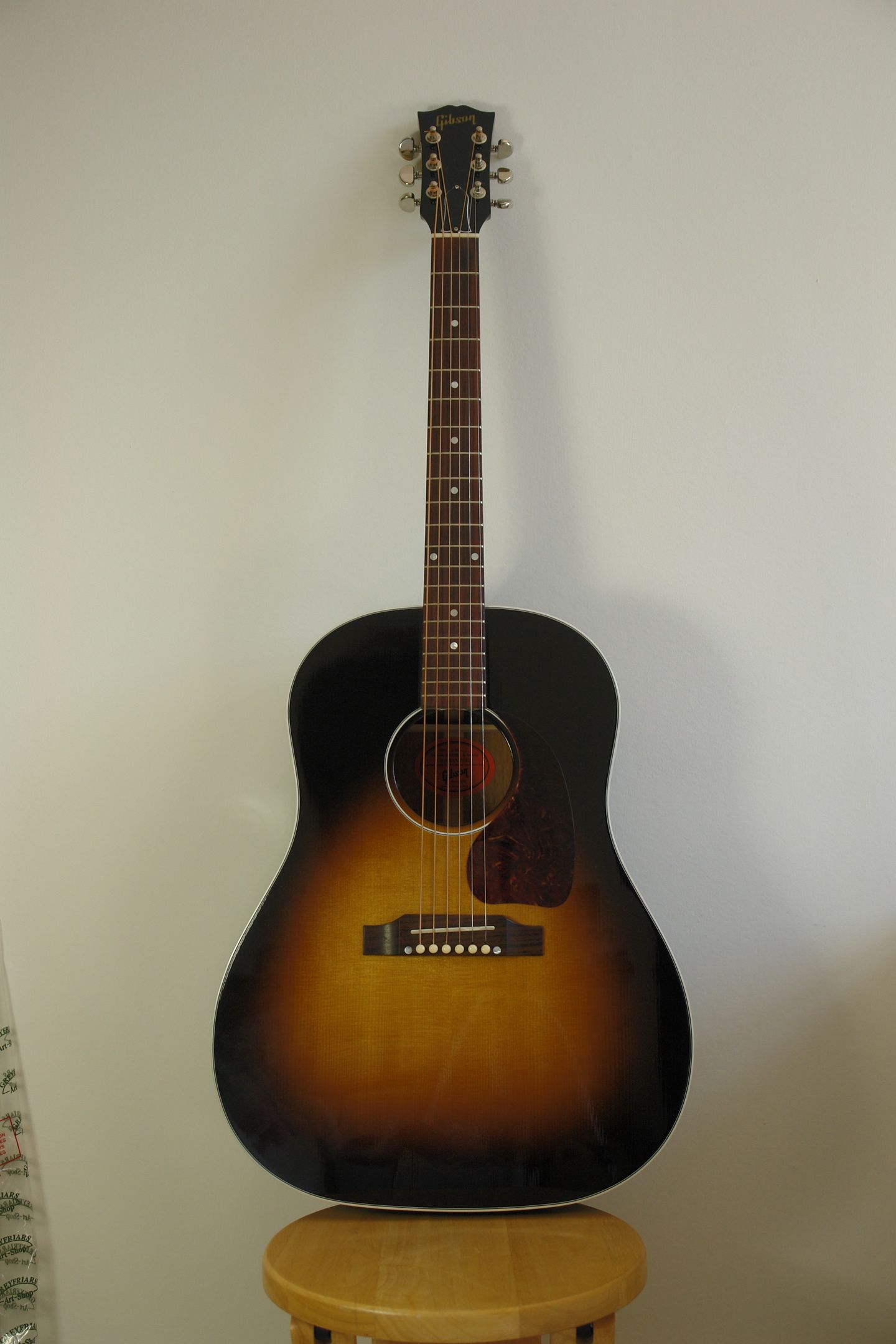
Gibson J-45. Photo by Jim Hutcheson. Licensed under CC BY 2.0. Via Wikimedia Commons. Gibson
J-45
1942
Born in 1942 out of whatever wood a wartime factory could find. Gibson calls it its best-selling acoustic ever.
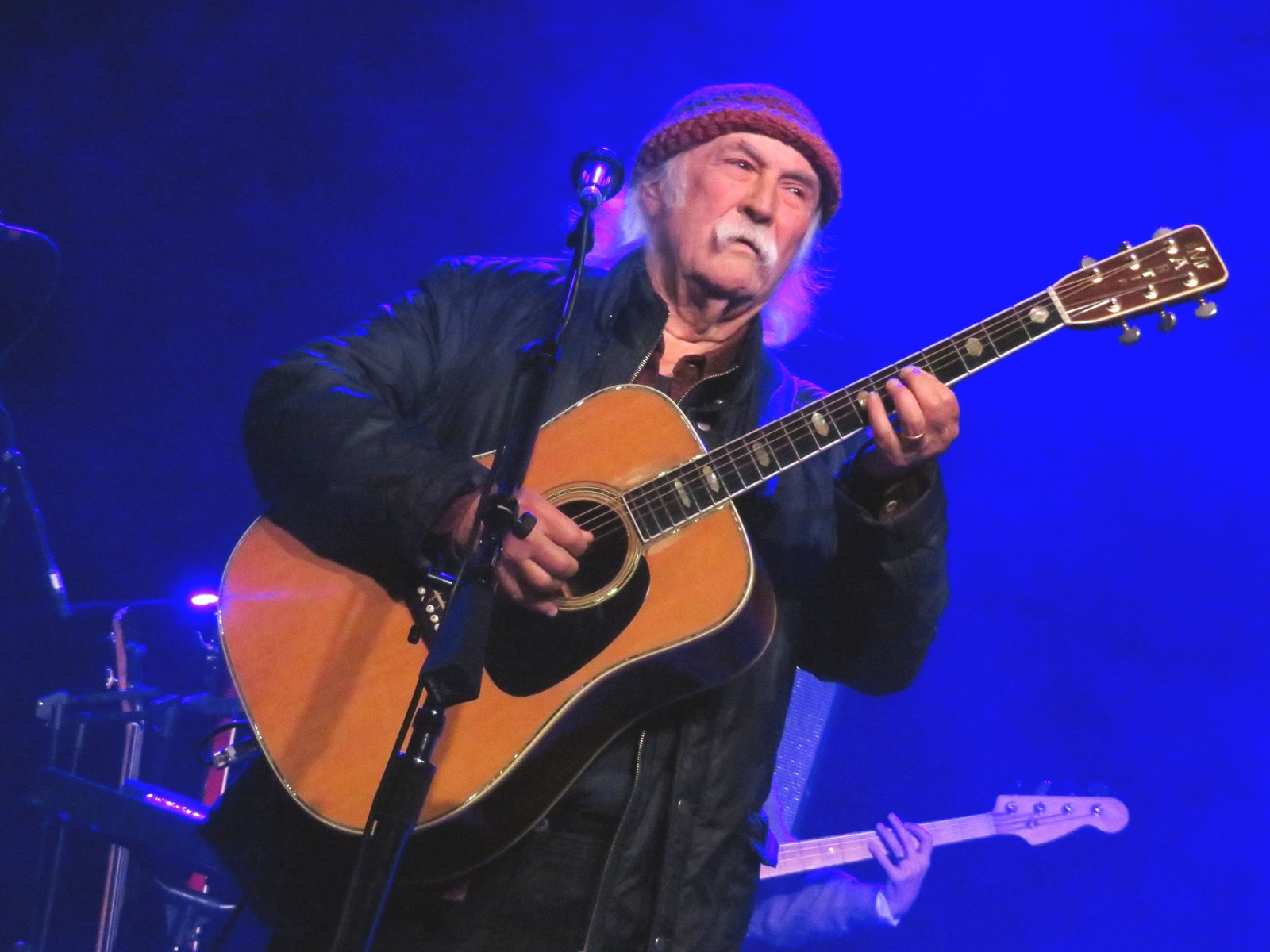
Photo: Eddie Janssens / Wikimedia Commons / CC BY-SA 4.0 Martin
D-45
1933
Pearl takes time. When the war took Martin’s time away, the D-45 stopped, and it waited 26 years to come back.
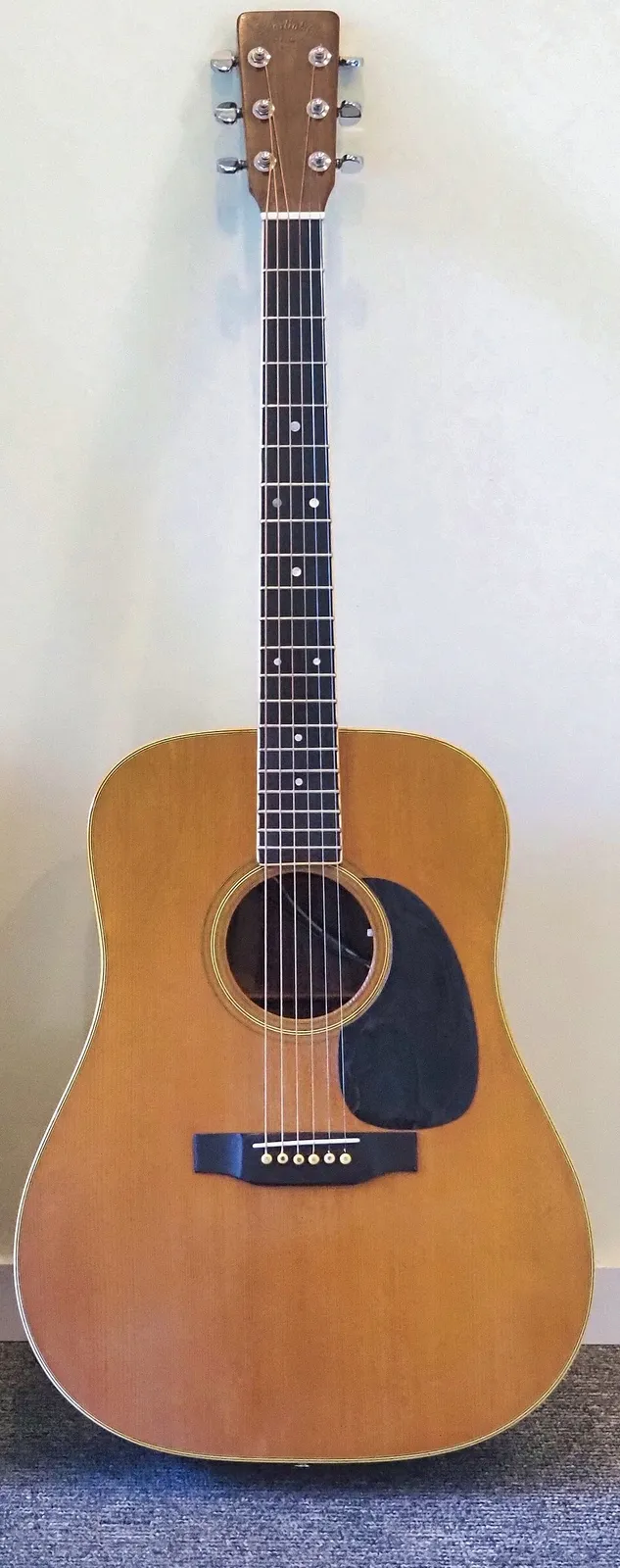
Photo: Tony Rees (Tony 1212) / Wikimedia Commons / CC BY 4.0 Martin
D-35
1965
Martin split the back in three to save rosewood. The bass it made was just what Johnny Cash’s voice needed.