Taylor
T5
Bob Taylor said Taylor would build an electric somewhere between never and a truly new idea. This was the idea.
NAMM, January 2005. People have been asking Taylor for years when it will make an electric guitar. Bob Taylor and David Hosler walk out with an answer that is half acoustic, half electric, and plugs into either kind of amp.
- Introduced
- 2005
- Type
- Hybrid acoustic-electric
- Class
- Production
The short version
2005
NAMM debut
Bob Taylor and David Hosler demo the T5. It ships that spring, with record dealer orders.
2006
Prince’s purple one
A custom T5, slightly smaller than stock, turns up in the “Te Amo Corazón” video.
2008
The Liberty Tree
Fifty T5s with tops from a historic Annapolis tree, each named for a state.
2010
Serj Tankian’s signature
Black, with red inlays he drew himself, after two years of touring on a T5.
2014
The T5z
A smaller sibling arrives, the shape Prince’s custom pointed toward.
2023
T5z refresh
Andy Powers reworks the smaller model. The full-size T5 has since left the catalog.
Side A
A1
Never, or something new
For years, people asked Taylor when it was going to make an electric guitar. Taylor was the acoustic company. Bob Taylor had a standard answer, and it was a good one:
somewhere between never and when we come up with a guitar that’s actually unique.
You can tell a lot about a builder from a line like that. He wasn’t going to make a Strat with a Taylor headstock on it. Everybody already had one of those.
And the players asking had a real problem. Plenty of them play the acoustic song and then the loud song in the same set, and that means two guitars, two cables, a stand, and a pause while you swap. The T5 was Taylor’s answer to that pause.
A2
Thinline, five-way
It showed up at NAMM in January 2005, and the name tells you the trick. T for thinline, 5 for the five-way switch on the side.
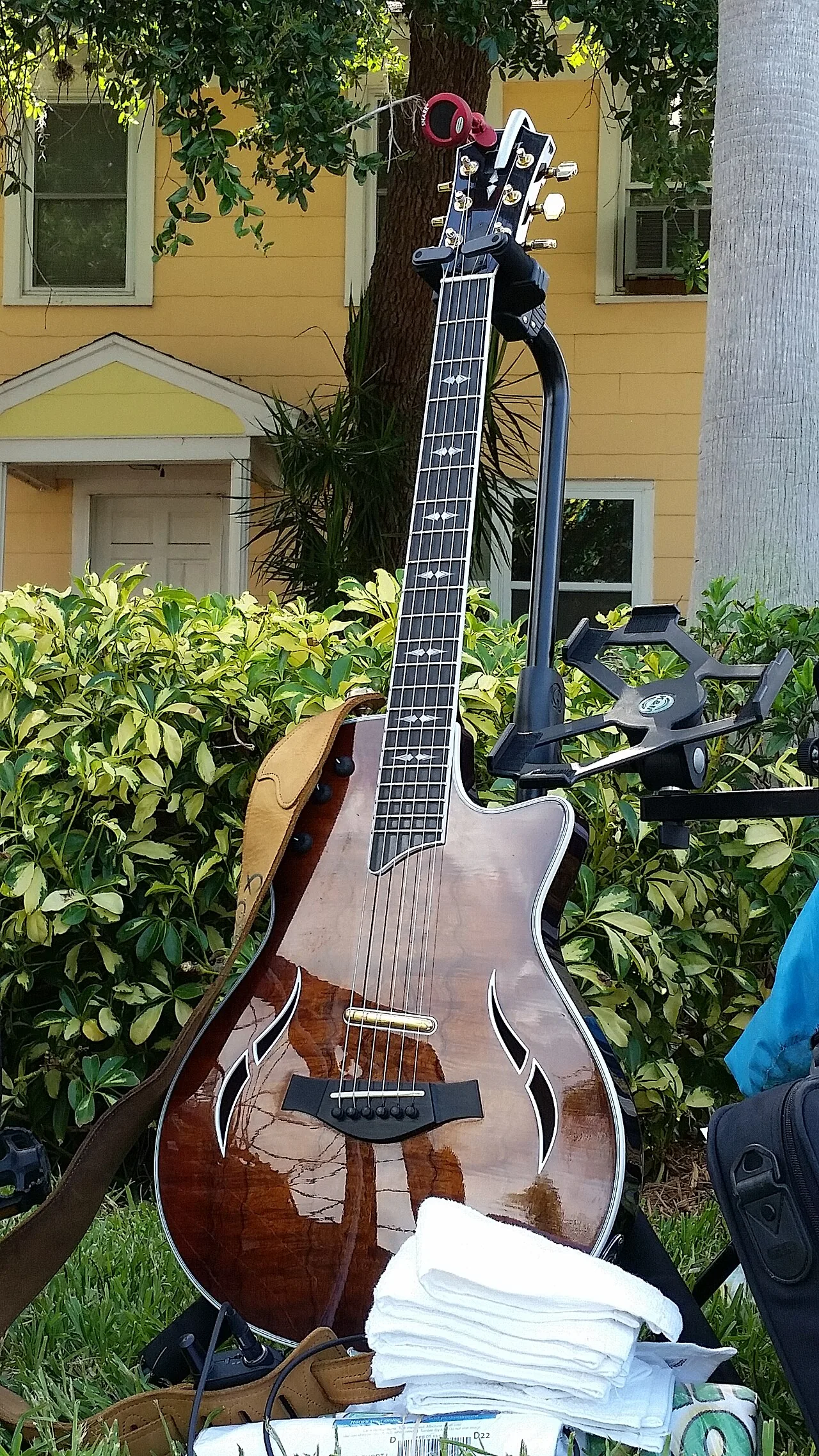
The body is Taylor’s Grand Auditorium outline, thinned down and hollowed out, with a cutaway and f-holes instead of a round soundhole. The scale is short for a Taylor, 24-7/8 inches, so it’s happy with electric strings or acoustic ones.
Then the clever part. There are three pickups and you can only see one. A small stacked humbucker sits at the bridge under a lipstick cover. Another humbucker hides under the end of the fretboard. The third is a sensor stuck to the inside of the top, listening to the wood move.
The switch mixes them five ways, from the neck pickup and the body sensor together, the most acoustic-flavored setting, out to both humbuckers in series, the hottest and hairiest. Plug a normal cable into a guitar amp or a stereo cable into a PA. It works either way.
You could dress it up, too. Spruce on top, or flame maple or Hawaiian koa if you wanted to show off. The Standard had chrome tuners and plain dots, the Custom gold tuners and fancier inlays. There were even metallic versions with two visible humbuckers and no body sensor at all.
A3
Best acoustic, best electric
David Hosler, who worked on it with Bob Taylor, was clear that it wasn’t meant to replace your Les Paul or your Taylor dreadnought. It was for the music in between the two. It turned out a lot of people lived there.
The T5 got more initial dealer orders than any guitar in Taylor’s history. It picked up awards for best acoustic and best electric, which is a strange pair of trophies for one guitar to hold. Within a couple of years it had its own shop inside the factory, and Taylor was making around 10,000 in a year.
The early road testers were Jason Mraz and bands like Switchfoot and Story of the Year. A fifteen-year-old Taylor Swift played a red one at NAMM in 2005, before most people knew her name. (Her famous small Taylor is a Baby Taylor. Different guitar.)
Flip the record · By the numbers
5
Positions on the switch. Thinline, five-way. That’s the name.
3
Magnetic pickups, one of them hidden under the fretboard and one inside the top.
~10,000
T5s Taylor made in a single year, around 2007.
50
Liberty Tree T5s, each named for a state.
Side B
B1
Prince, Serj, and a very old tree
Prince had a custom T5 built in purple flamed maple, a little smaller than the stock guitar, and it’s in his video for “Te Amo Corazón.” Taylor later said a custom built for him inspired the smaller body of the T5z.
In 2008 Taylor made 50 T5s with tops cut from Annapolis’s Liberty Tree, each one named for a state. Jason Mraz played one at the launch show in San Diego, “I’m Yours” and all.
Serj Tankian of System of a Down toured on a T5 for two years before Taylor gave him a signature model in 2010. Opaque black, maple top, and red “energy wheel” inlays he drew himself.
B2
The one in between
In 2014 Taylor added the T5z, a smaller version with a rounder fretboard and jumbo frets, more like an electric guitar under your fingers. In 2023 Andy Powers refreshed it. The T5z is the one Taylor still sells. The full-size T5 isn’t on its website anymore, and nobody agrees exactly when the standard model stopped.
It never replaced anybody’s electric or anybody’s acoustic. It wasn’t built to. It was built for the player who needs both inside the same four minutes, and for the song that isn’t sure yet which one it wants to be.
Put this on
You’ve read about it. Now hear it. Here’s what this guitar sounds like, and what to listen for.
Te Amo Corazón
Prince’s custom purple flamed-maple T5, a bit smaller than the stock one. Taylor later traced the T5z’s smaller body back to a custom built for him.
Watch it on YouTube (opens in a new tab)I’m Yours (live at the Liberty Tree launch)
Mraz road-tested the T5 before it came out. At the Liberty Tree launch in San Diego he played one of those guitars, “I’m Yours” included. That’s the live show, not the studio record.
Watch it on YouTube (opens in a new tab)What’s My Name? (live at NAMM)
Played at Taylor’s NAMM showcase, on a T5. A chance to hear what it does in someone else’s hands entirely.
Watch it on YouTube (opens in a new tab)
The cast
The people, and the specific guitars, that made the legend.
2008
Jason Mraz
T5, then a Liberty Tree T5
Road-tested it before launch. His signature Taylor is a nylon-string, which is a different guitar.
2005
Taylor Swift
A red T5
Fifteen, at NAMM. Her famous small Taylor is a Baby Taylor, not this.
2006
Prince
Custom purple T5
Flamed maple, a little smaller than stock. His famous purple Taylor 12-string is another guitar.
2010
Serj Tankian
STSM-T5 signature
Opaque black, with red “energy wheel” inlays he drew. Two years on the road with a T5 first.
2013
Miyavi
T5
Played “What’s My Name?” on one at Taylor’s NAMM showcase.
Liner notes
Specs, construction, rarity, value, and every source we used.
A hollow Grand Auditorium thinline, three pickups, and a five-way that talks to both amps — Taylor’s T5, not an 814ce and not the compact T5z.
- Body
- Fully hollow single-cut thinline; sapele back and sides; Venetian cutaway; stylized f-holes. Guitar Center Classic (T5-X): 16" wide, 20" long, 2.35" deep, 40 3/4" overall. Harmony Central 2005: carved hollow sapele. Mix flagged.
- Neck
- Tropical American mahogany (Harmony Central 2005; Vintage Guitar). Later Classic: sapele. MusicRadar: NT single Allen-keyed bolt / T-Lock.
- Fingerboard
- Ebony, 21 frets. Standard: micro-dots. Custom: Artist inlays. Original T5 radius 15" (Guitar World 2014). T5z is 12" — not this table.
- Scale
- 24-7/8" (Harmony Central 2005; Guitar Center). guitar-list: 24.875". Same number, two writings. Mix flagged. Millimetres unpublished on original T5 factory copy.
- Pickups
- Visible bridge stacked humbucker (lipstick cover); concealed under-fretboard neck humbucker; magnetic body sensor on the underside of the top. Not ES2 piezo.
- Hardware
- Ebony bridge; Taylor chrome tuners (Standard) or gold (Custom). Elixir electric .011–.049 typical; VG: acoustic strings also work.
- Electronics
- Active preamp; 5-way on the side (Harmony Central 2005). 9V (~40 hours, LED). Later running names: volume, bass, treble. 2005 copy: volume, resonance, and detail. Mix flagged. 1/4" TS or TRS.
- Finish
- Gloss typical on Standard/Custom; satin on Classic. 2005 bursts: Cherry, Honey, Tobacco. Optional flame maple or Hawaiian koa tops.
- Nut
- 1-11/16" on the Guitar Center Classic sheet. Harmony Central 2005 did not print nut width. Mix flagged. No millimetres invented.
Open the full research fileConstruction details, the complete player record, production numbers, dated value estimates, and sources
Classic living example = 2005 Taylor T5 (Standard / Custom, El Cajon). Factory inches on Harmony Central 2005 and the Guitar Center Classic table; millimetres unpublished on those pages. Mix flagged. No current typical full-size T5 SKU on Taylor.com this pass (fetched 21 September 2026). T5z is the compact sibling — current production, 12" radius, jumbo frets — not this table. T5 Classic / T5-X (ovangkol) is a later full-size Classic, not the 2005 spruce Standard. 814ce is a different plate. T3 is Taylor’s later semi-hollow electric, not this guitar.
Construction
The job was one guitar that could do the acoustic song and the electric song without a swap. Bob Taylor, to Vintage Guitar: people kept asking when Taylor would make an electric. His answer was “somewhere between never and when we come up with a guitar that’s actually unique.” That somewhere was 2005. Harmony Central, 20 January 2005: David Hosler and Bob Taylor would demo the T5 at NAMM; it would ship late spring. The name is the trick — Thinline, 5-way.
It is a Grand Auditorium silhouette, thinned and hollowed. Not a dreadnought. Not an 814ce (taylor-814ce). The 814ce is a flat-top GA with a soundhole and, on the living SKU, ES2 behind the saddle. This is a fully hollow thinline with stylized f-holes. guitar-list: completely hollow. MusicRadar (Dave Burrluck, 31 January 2008): hollow sapele back and sides, longitudinally braced spruce top. Vintage Guitar (April 2006 issue) called the review body “carved from maple.” Keep both. Harmony Central and Burrluck are the sapele shell. VG was looking at a maple-top guitar. Tops were the trim: spruce on Standard and Custom in the 2005 copy, optional flame maple or Hawaiian koa; Custom gold tuners and Artist inlays, Standard chrome and micro-dots.
Scale is short for a Taylor acoustic: 24-7/8", so the board takes electric or acoustic strings. Twenty-one frets. Burrluck: a single Allen-keyed NT bolt on an electric Taylor — T-Lock in later dealer files. Don’t print the 1999 acoustic Taylor Neck as if it were this joint.
The electronics are why it stuck. Three magnetic pickups, no piezo on the original recipe. A stacked humbucker under a lipstick at the bridge. A second humbucker hidden under the fretboard at the neck joint. A body sensor on the inside of the top, midway between saddle and tail — VG called it an Expression System sensor; Harmony Central called it a body sensor. Inspired by the ES research. Not the 2014 ES2 on the 814ce. Five-way on the side: neck + sensor in series, neck alone, bridge alone, neck and bridge in parallel, neck and bridge in series. Plug a standard cord into an electric amp, or a TRS into a PA. Hosler, in the VG review: it doesn’t replace your Les Paul, and it doesn’t replace your 810. It lives in the music between those two points.
2005 press (guitarsite): more initial dealer orders than any other guitar in Taylor’s history. Road-tested by Story of the Year, Switchfoot, and Jason Mraz. Burrluck, 2008: Taylor’s fastest-selling instrument; its own shop inside the San Diego plant; awards for Best Acoustic and Best Electric; The Music and Sound Retailer Product of the Year (Guitar World 2014). Burrluck: “last year Taylor made around 10,000 T5s.” That is a named ~2007 year, not a lifetime factory total. Dual visible-humbucker metallics that year lost the body sensor. They stay on this plate as a T5 option, not a second slug.
Not an 814ce. Different body, different pickup, different job. Not a Gibson ES-335 (gibson-es-335): the 335 is a double-cut laminate with f-holes and a maple stick, 1958, Kalamazoo. This is El Cajon, fully hollow, 2005.
2014: compact sibling T5z. Guitar World, 27 January 2014: scaled-down body, 12" radius against the T5’s 15", jumbo frets. Both T5 and T5z ran that year as Custom (koa), Pro (curly maple), Standard (Sitka), Classic (mahogany). Premier Guitar (7 October 2014) on a T5z Custom: about 14" wide, about 5 lb 7 oz. Wood & Steel (2021): the smaller T5z was inspired by a custom for Prince. Guitar.com’s 50-year piece (30 July 2024) collapses T5 and T5z onto 2005. Keep 2005 for T5. Keep 2014 for T5z. Do not nest T5z as a family card.
2023: Andy Powers refreshed the T5z (Wood & Steel, Colin Griffith): Shamel / Urban Ash instead of sapele, thinner carve, rounded edges, integral armrest, knobs moved below the bridge, single f-hole. T5z Classic kept the old contours that year. Living Taylor.com carts this pass are T5z, El Cajon — prices in Value. Those are T5z, not a 2005 T5.
Blue Book files T5 S Standard 2005–2019. Reverb’s T5-S Standard Spruce guide prints 2005–2013. Keep both. Classic vs current: 2005 T5 — 16" hollow sapele, 15" radius, three magnetics, 24-7/8" — against no new full-size T5 on Taylor.com in 2026.
Players
Do not hang an 814ce on this plate. Do not recruit Jason Mraz’s nylon signature, Prince’s purple jumbo 12-string, or Taylor Swift’s Baby Taylor as if they were this guitar.
Jason Mraz. 2005 factory press: road-tested the T5 in development. 11 October 2008, Anthology, San Diego: he played the Liberty Tree T5 for the launch, including “I’m Yours.” That object is this plate. His signature JMSM is a nylon NS72ce. Other plate.
Taylor Swift. Equipboard: fifteen, 2005 NAMM, a red T5 — “Beautiful Eyes,” “Your Face,” “Your Anything.” Gear4music later writes “T5 PRO”; the Pro trim as a named 2014 SKU did not exist yet. Keep it as a red T5. Equipboard also files a pink T5-S with a “Taylor” fretboard inlay from her site. Guitar World 2014 house-lists her with Mraz and Miyavi. The famous small Taylor is a Baby Taylor. Don’t upgrade a NAMM T5 into that, or into the Eras-tour Gibsons.
Serj Tankian. Taylor blog / MusicRadar, January 2010: STSM-T5, based on the T5-C, opaque black sapele, maple top, unbound f-holes, red “energy wheel” inlays he drew. Two years on the road with a T5 before the signature. List $3,198. Named signature. Not a census of every T5-C.
Prince. Guitarcloud: custom T5, 2006, flamed-maple purple, slightly smaller than the production T5, in the “Te Amo Corazón” video. Location unpublished. Wood & Steel (2021) treats a Prince custom as the seed of the T5z’s smaller body. The well-known purple Taylor jumbo 12-string is not this guitar.
Miyavi. Taylor Guitars NAMM 2013, “What’s My Name?” on a T5. Guitar World 2014 house list. Which studio sides are unpublished here.
Also known to play stays short. Taylor’s 2008 Liberty Tree copy names Tommy Shaw with Prince and Tankian. Julien’s later Shaw lot is a Taylor SolidBody Custom Koa, serial 20070801527 — not a T5. Don’t hang it here.
Rarity
You cannot buy a new full-size T5 from Taylor.com this pass. The living hybrid in the catalog is the T5z. Used original T5s are ordinary El Cajon production, not scarce closed runs.
Taylor did not publish a lifetime T5 total. None invented. Burrluck’s ~10,000 is one year (~2007), not a census. Serials date a guitar. They don’t count a year.
What is actually thinner: first-year 2005 Standards and Customs; maple- and koa-top Customs; the dual-humbucker metallics that dropped the body sensor. Liberty Tree T5, 2008: Taylor blog — 50 tulip-poplar tops from the Annapolis Liberty Tree, each named for a state. That is a labeled limited. Tankian’s STSM-T5 and Prince’s purple custom are unique objects. They are not a vintage T5.
Value
Informal estimate, 21 September 2026. Not an appraisal.
Ask vs sold labeled. Split T5 from T5z before you read a number. Celebrity lots are not-comps. No invented medians. Period VG $2,600–$3,700 retail (April 2006) and STSM-T5 $3,198 (2010) are historical lists, not 2026 street.
New street. No full-size T5 cart on Taylor.com this pass. Guitar Center leftover T5 Classic (T5-X) $1,499.00, sold out — dealer remainder, not a living factory SKU. Current hybrid street is T5z: Taylor.com Classic $2,499, Classic Rosewood $2,599, Classic Koa $2,799, Pro Black $2,999, Pro colorways $3,299, Custom Koa $3,799 (fetched 21 September 2026). Sweetwater T5z Classic Koa $2,799.00. Those are T5z, not this table. Acoustic Guitar 2014 T5z street $2,299 / list $2,998 and Premier Guitar T5z Custom street $2,999 are 2014 money.
Used, original T5. Reverb Price Guide widget on T5-S Standard Spruce did not print a clean band this pass. Named asks, not hammers: T5-S Standard Spruce $1,399; T5-S1 Standard Maple $1,425; 2011 T5 Standard Blue Edgeburst $1,949; T5-C2 Koa asks $1,600–$2,299. Sweetwater Gear Exchange, T5 Standard Blue Edge Burst used band $1,039–$1,539 (that page’s new reference $1,999). Don’t average those asks.
Used, T5z. Different guitar. Reverb T5z Standard: $1,021–$1,717 (159 orders, Good to Mint); sample sold 4 November 2025 Mint $1,475. Reverb Canada T5z Classic: C$1,158–C$1,776 (397 orders). CAD, not USD. Don’t invent a midpoint.
Vintage / collectible. There is no pre-war T5 market. 2005–teens full-size examples trade as used modern Taylors, not as Burst money. Liberty Tree (50) and Prince’s purple custom are labeled objects, not comps. No 2024–26 Heritage/Christie’s hammer isolated.
See also
- taylor-814ce — the Grand Auditorium AE this hollow hybrid is not
- godin-multiac — another stage hybrid; 13-pin nylon, not T5
- gibson-es-335 — 1958 Kalamazoo thinline with a maple stick; not this fully hollow T5
Sources
- Harmony Central, New T5 Thinline 5-Way Guitar from Taylor, 20 January 2005 — NAMM demo, Hosler and Bob Taylor; sapele hollow; mahogany neck; 24-7/8"; spruce top; optional maple/koa; late spring 2005 ship; 5-way; 9V ~40 hours; TS/TRS
- Vintage Guitar, Taylor T5 Thinline Fiveway (April 2006) — 2005 birth; Bob Taylor “never / unique”; maple-body wording on the review guitar; mahogany neck, ebony board; Elixir electrics; three pickups including ES sensor; Hosler Les Paul / 810 quote; retail $2,600–$3,700
- MusicRadar, Dave Burrluck, Taylor T5 Standard Metallic review, 31 January 2008 — fastest-selling; ~10,000 the previous year; sapele back/sides, braced spruce; single-bolt NT; dual-humbucker option drops body sensor; 5-way map
- Guitar World, NAMM 2014: Compact T5z, 27 January 2014 — T5 2005; T5z compact; 15" vs 12" radius; jumbo frets; 2014 Custom/Pro/Standard/Classic trims; Mraz, Swift, Miyavi house list; Music and Sound Retailer Product of the Year
- Taylor blog, Compact T5z, 21 January 2014 — T5z as sibling; 15" vs 12"
- Premier Guitar, Taylor T5z review, 7 October 2014 — T5 as early convincing hybrid; T5z narrower, jumbo, 12"; Custom ~14" / ~5 lb 7 oz; street $2,999
- Acoustic Guitar, Adam Levy, T5z review, 17 December 2014 — ten years after T5; Sitka/sapele; list $2,998 / street $2,299
- Wood & Steel, Colin Griffith, Electric Recharge, 2023 Issue 2 — 2005 T5 evolved into T5z; Powers 2023 ash refresh, armrest, single f-hole; Classic kept old contours; 1-11/16" nut
- Wood & Steel, Zurück zu den Klassikern, 2021 — T5 2005 debut; T5z smaller body inspired by a Prince custom; 12" / 30.5 cm radius
- Guitar.com, Cillian Breathnach, 50 years of innovation, 30 July 2024 — 2005 T5 (piece also names T5z in that year; keep 2014 for T5z)
- Taylor.com, T5z Pro Tobacco Sunburst — $3,299; Shamel ash, Big Leaf maple; 24-7/8"; 1-11/16"; fetched 21 September 2026
- Taylor.com, T5z Custom Koa — $3,799; related-rail Classic $2,499 / Koa $2,799 / Rosewood $2,599 / Pro Black $2,999; El Cajon; 5-way map (staff)
- Taylor.com, T5 features — T5 heading still present; no full-size cart this pass
- Sweetwater, T5z Classic Koa — $2,799.00; 24.875"; 12" radius; jumbo
- Guitar Center, T5 Classic (T5-X) — leftover $1,499 sold out; 16" / 20" / 2.35" / 40 3/4"; 24 7/8"; 1 11/16"; 21 frets; ovangkol/sapele; 5-way map
- guitar-list, T5 series / T5 Custom — 2005 intro; 24.875"; 16" / 20" / 2.35"; sapele/koa Custom
- Taylor blog, Serj Tankian T5, 16 January 2010 — STSM-T5 on T5-C; maple/sapele; $3,198; two years touring; Tankian quote
- MusicRadar, NAMM 2010 Serj Tankian T5 — same signature copy
- Taylor blog, Liberty Tree T5, 26 June 2008 — 50 state-named tops; Prince, Tommy Shaw, Tankian house list
- Anthology Press, Mraz Liberty Tree T5, 11 October 2008 — “I’m Yours” on the Liberty Tree T5
- Guitarcloud, Prince Taylor T5 — 2006 custom; purple flamed maple; smaller than production; “Te Amo Corazón”
- Equipboard, Taylor Swift T5 — 2005 NAMM red T5; pink T5-S with Taylor inlay
- Reverb, T5-S Standard Spruce — years 2005–2013; Price Guide band unpublished this pass; named ask $1,399
- Reverb, T5z Standard — used $1,021–$1,717 (159 orders); named solds 2025
- Reverb, T5z Classic (Canada) — C$1,158–C$1,776 (397 orders)
- Sweetwater Gear Exchange, T5 Standard Blue Edge Burst — used $1,039–$1,539; new reference $1,999
- Blue Book, T5 S Standard — sapele/Sitka; 2005–2019; T5 S-1 maple 2005–2013
- guitarsite, Win Taylor’s new T5, April 2005 — NAMM 2005 orders; Mraz / Switchfoot / Story of the Year road test; late-spring stores
- Julien’s, Tommy Shaw Taylor SolidBody Custom Koa — serial 20070801527; SolidBody, not a T5
- guitar-type, Taylor T5 / Miyavi — NAMM 2013 “What’s My Name?” on a T5
Keep digging
Guitars this one gets compared to, confused with, or descended from.
- Send a picture
Taylor
814ce
1996
Taylor has rebuilt its flagship from the braces out, again and again, and kept the same three numbers on it.
- Send a picture
Godin
Multiac
1993
A nylon-string guitar that can stand next to a drummer, and talk to a synthesizer while it’s at it.

Photograph of a vintage 1960 Gibson ES-335TD. Photo by Lightburst. Licensed under CC BY-SA 4.0. Via Wikimedia Commons. Gibson
ES-335
1958
Larry Carlton played three 335s off a shop wall, unplugged, paid $850 for one, and became Mr. 335.