Ovation
Balladeer
A helicopter builder looked at a guitar and asked why the back had to be made of wood. This was his answer.
Connecticut, the mid-1960s. Charles Kaman runs a company that builds helicopters, and in his spare time he plays guitar. His engineers spend their days thinking about how things vibrate. So he asks them a question nobody in the guitar business had bothered to ask.
- Introduced
- 1966
- Type
- Acoustic-electric roundback
- Class
- Production
The short version
1945
Helicopters first
Charles Kaman, an aeronautical engineer, starts his own aircraft company in Connecticut.
1966
The Balladeer
Ovation’s first production guitar, a spruce top on a round fiberglass bowl.
1967
Out the door
Some of the first shipments may have gone out as late as February. The catalog keeps 1966.
1970
Plugged in
Ovation adds a pickup, still in the Balladeer years.
1976
The sequel
The carbon-topped Adamas puts Kaman’s bowl under a very different top.
2007
New owners
Fender buys Kaman Music. GEWA dates its own takeover to 2021.
Side A
A1
The helicopter man who played guitar
Most guitar companies were started by people who grew up around guitars. They apprenticed, they swept up shavings, they learned how it’s done from somebody who learned it from somebody else. Ovation was started by a man who built helicopters.
Charles Kaman was an aeronautical engineer. He founded his own aircraft company in Connecticut in 1945, and it made its name on helicopters. He also played guitar, seriously. And he had a building full of engineers whose whole job was vibration: how a rotor blade shakes, where the stress goes, what a material does when you ask it to move.
Put those two things together and you get a question a luthier would never think to ask. Why is the back of a guitar a wooden box? Nobody in the trade needed to ask, because everybody already knew. Kaman didn’t know, so he went and found out.
A2
A bowl instead of a box
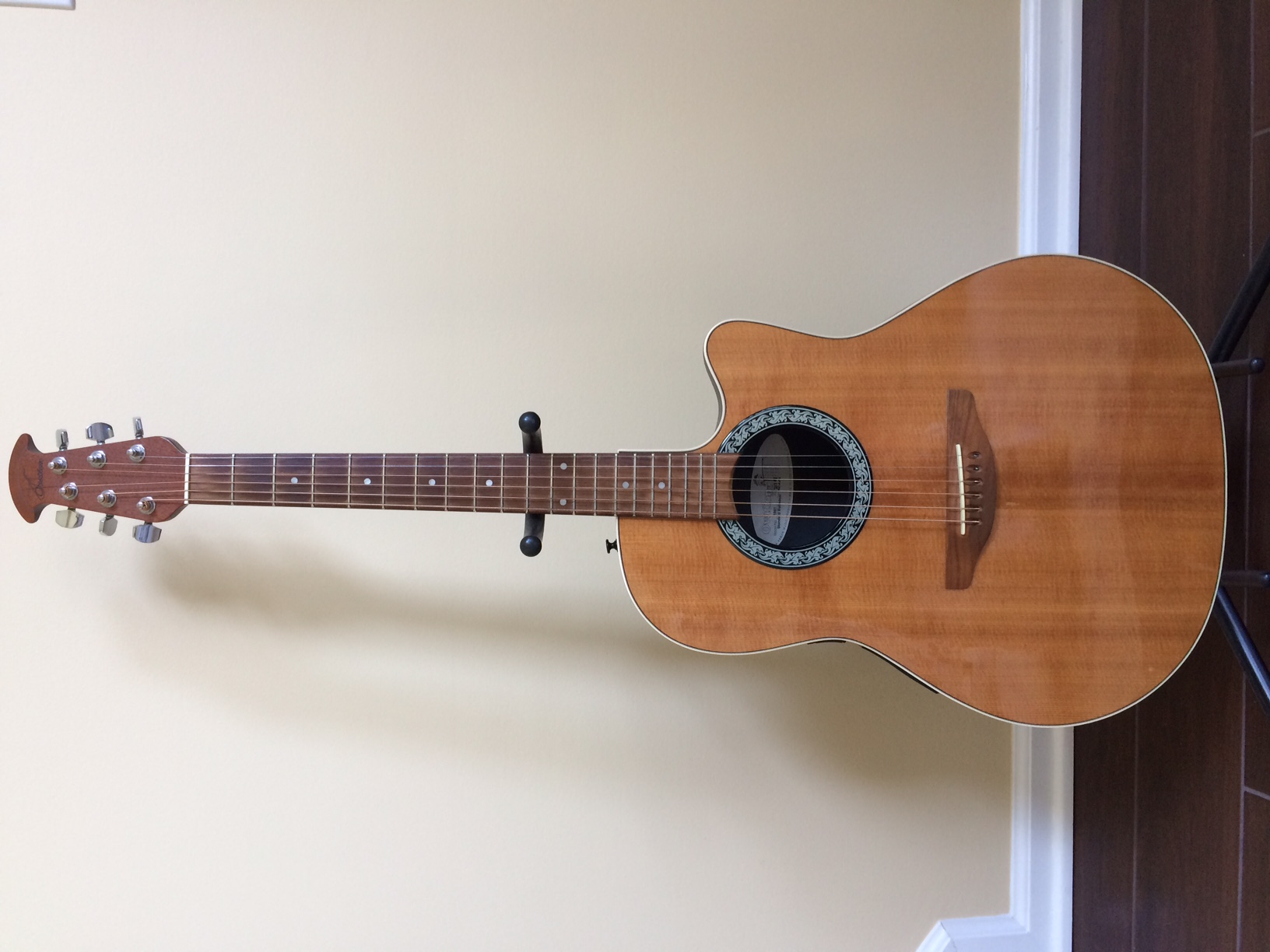
The answer was the Balladeer, in 1966. Look at it from the front and it’s a normal acoustic: a spruce top, a round soundhole in the middle, a neck, six strings. Turn it over and there are no sides and no back. There’s a bowl.
The bowl is Lyrachord, Ovation’s name for its fiberglass, the kind of material an aircraft company knew how to shape. The Balladeer was the first production guitar built that way. The early bowls were shiny and parabolic, and people called them “frying pans,” which is not wrong.
Depending on who you ask, some of the very first ones didn’t actually ship until February 1967. The catalog says 1966, and so do we.
I’ll be honest about one thing. To me, a round back sits differently on your lap than a flat one, and not everybody makes peace with that. That’s fine. It was never trying to feel like a Martin. It was trying to be something a guitar maker wouldn’t have built.
Flip the record · By the numbers
1966
The Balladeer’s catalog year. The first production guitar with a fiberglass round back.
1967
February, when some of the first ones may actually have shipped.
1970
The year a pickup arrives. Today’s Balladeer has a preamp with a tuner built in.
Side B
B1
The guitar on television
Glen Campbell, on his television show, is the man who made Ovation famous. Check the photo before you name the guitar, though. A lot of the Campbell pictures people pass around show a fancier Custom Legend or an Adamas, not a plain Balladeer. By one history, his 1969 signature Ovation and the pickup that came along in 1970 both belong to the Balladeer years, but the Balladeer wasn’t always the one in his hands.
That pickup matters more than it sounds. An acoustic you can plug straight in is an acoustic that can get loud on a stage without a microphone in front of it. Ovation had one by 1970, and the round back went with it.
B2
Still round in the back
You can still buy a Balladeer. The one in the catalog now is a cutaway with a solid Sitka spruce top on a deep Lyrachord bowl, and a pickup and preamp with a tuner built in. It isn’t the 1966 guitar. It’s the same idea, sixty years on.
The company has changed hands since then. Fender bought Kaman Music in 2007, and GEWA now runs Ovation. The bowl stayed. So did the Balladeer name, which is Ovation’s first word on the subject of what a guitar could be made of.
Guitar makers spent a few hundred years agreeing on what the back of a guitar should be. Somebody who built helicopters for a living never got the memo, and every Ovation you’ve ever seen on a stage came out of that.
The cast
The people, and the specific guitars, that made the legend.
1966
Charles Kaman
The man with the question
Aeronautical engineer, helicopter builder, guitar player. The Balladeer was his company’s first production guitar.
1969
Glen Campbell
Ovation roundbacks
The man who made Ovation famous. Plenty of his photos show a fancier Custom Legend or an Adamas, not a Balladeer.
Liner notes
Specs, construction, rarity, value, and every source we used.
Ovation’s first production roundback — Balladeer, not a Celebrity, and not an Adamas.
- Top
- Solid A-grade Sitka spruce, scalloped X-bracing, center soundhole
- Bowl
- Deep Contour Lyrachord GS
- Neck
- Five-piece mahogany/maple
- Fingerboard
- Pau ferro, 10" radius, pearl oak-leaf rosette, dot/diamond inlays
- Scale
- 643 mm (25.3"); nut 42.8 mm (1 11/16")
- Pickup
- OCP-1K piezo, OP-Pro preamp with tuner
- Hardware
- Die-cast Ovation machines, anthracite
- Finish
- Cherry Cherry Burst (2771AX-CCB-G)
- Binding
- Cream body binding, multi-part purfling
Open the full research fileConstruction details, the complete player record, production numbers, dated value estimates, and sources
Current production typical = Pro Series Standard Balladeer 2771AX-CCB-G (ovationguitars.com / GEWA, 26 August 2026). Factory MAP $1,128.00. Pro Audio Star $1,128.00. Music Store (US) $922.00 this pass — dealer, not MAP. This is a cutaway AE with a Lyrachord bowl, not the 1966 non-cutaway original.
Construction
Charles Kaman’s Ovation Balladeer is the first production guitar with a Lyrachord (fiberglass) round back. Introduced 1966; Wikipedia ranges into February 1967 for some first shipments — keep 1966 as the catalog year. Early bowls were the shiny parabolic “frying pan”; living Pro Series uses Deep Contour GS.
Not Celebrity (later mid-line roundbacks). Not Adamas (carbon/birch top, multiple soundholes). Not a Martin dreadnought (martin-d-28). Not a Taylor Grand Auditorium (taylor-814ce). Cutaway AE 1861-class Balladeers in the 1980s–90s are later objects on this plate, not 1966 originals.
Players
Glen Campbell made Ovation famous; many of those photos are Custom Legend / Adamas, not a 1966 Balladeer. Do not flatten Campbell to this SKU.
This pass does not pin a named studio album to 2771AX-CCB-G. Do not invent one.
Rarity
Pro Series Balladeer is regular production. Ovation/GEWA do not publish Balladeer unit totals. None invented. 1966–70s first-generation bowls are finite; no factory census found.
Value
Informal estimate, 26 August 2026. Not an appraisal.
Ask is not sold. No invented median.
New street. MAP $1,128.00. Dealer $922.00 (Music Store US) this pass. UK Absolute Music £825 (out of stock in the fetched listing).
Used. Vintage non-cutaway Balladeers and later 1861 cutaways are different tapes. No clean 2024–26 2771AX hammer isolated this pass.
See also
- ovation-adamas — carbon sandwich top, twenty-two epaulet holes; not a spruce Balladeer
- martin-d-28 — the flat-top dreadnought everyone means by acoustic; not a Lyrachord bowl
- taylor-814ce — cutaway AE flagship in wood; not a roundback
Sources
- Ovation, Pro Series Standard Balladeer 2771AX — MAP $1,128.00
- Pro Audio Star, 2771AX-CCB — $1,128.00
- Wikipedia, Ovation Guitar Company — 1966 Balladeer; lead only
Keep digging
Guitars this one gets compared to, confused with, or descended from.
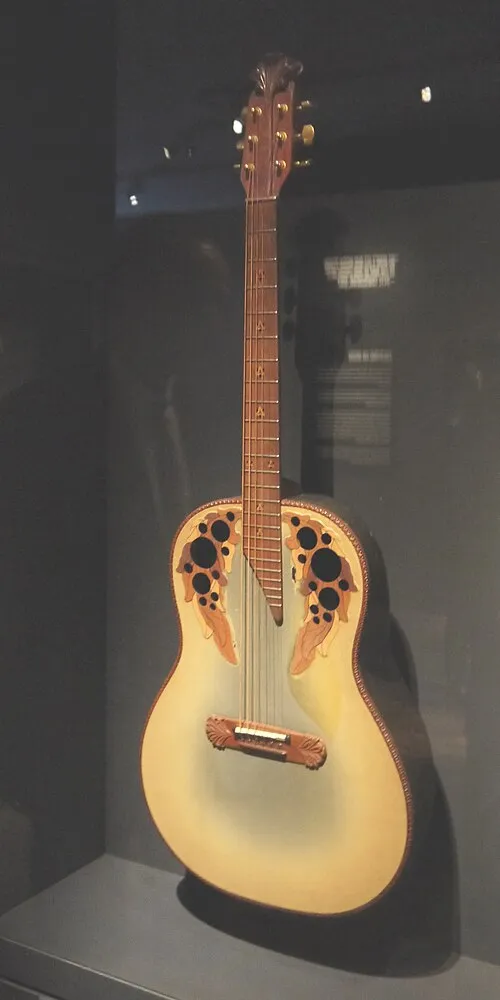
Photo: Eden, Janine and Jim / Wikimedia Commons / CC BY 2.0 Ovation
Adamas
1976
Seven years, 186 changes, and no hole in the middle. Ovation rebuilt the acoustic guitar top from scratch.
Martin D-28 Acoustic Guitar. Photo by Niranjan Arminius. Licensed under CC BY-SA 4.0. Via Wikimedia Commons. Martin
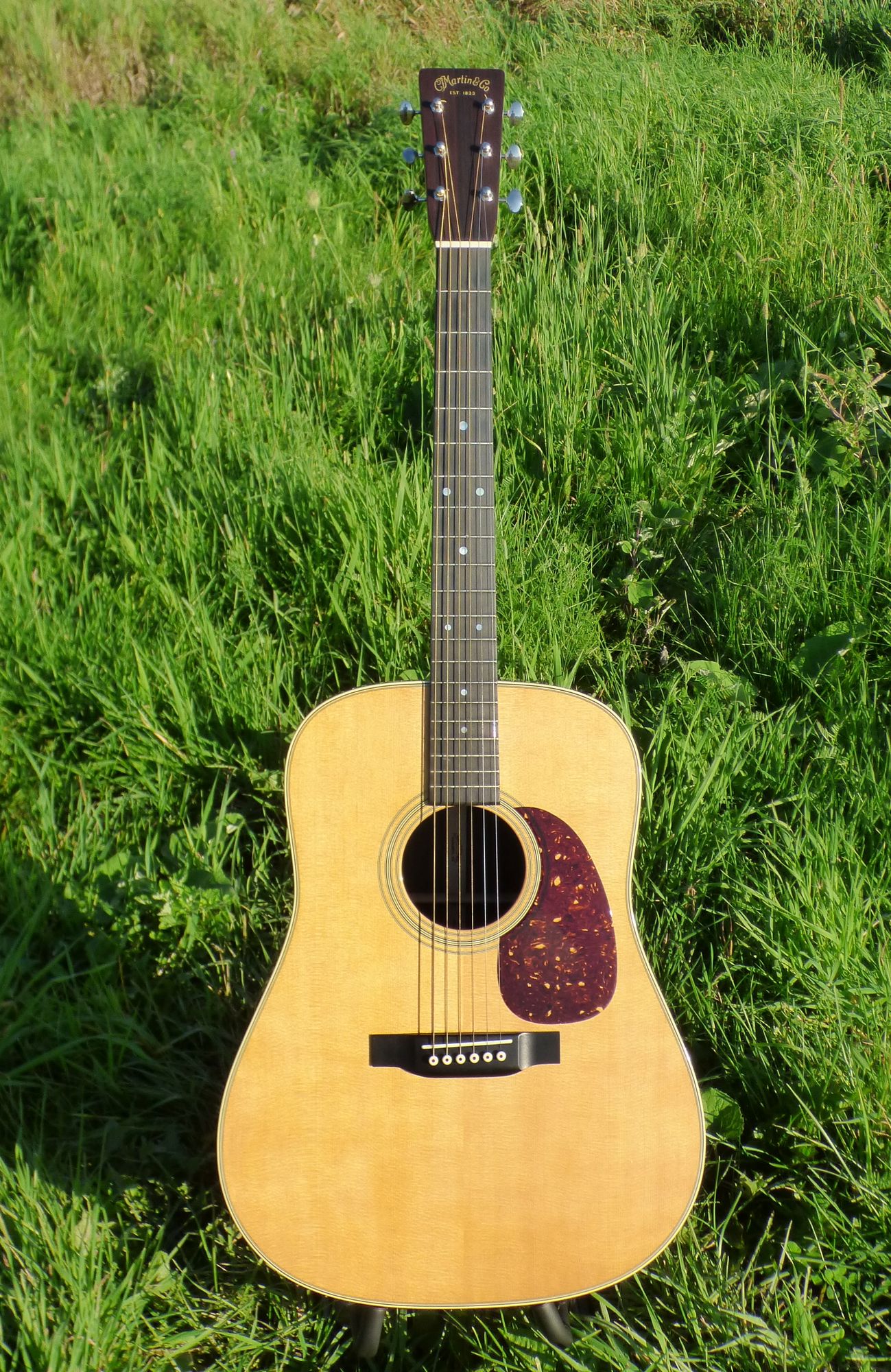
D-28
1931
You’ve heard a D-28 your whole life. It just never asked for the credit.
- Send a picture
Taylor
814ce
1996
Taylor has rebuilt its flagship from the braces out, again and again, and kept the same three numbers on it.