Gibson
ES-335
Larry Carlton played three 335s off a shop wall, unplugged, paid $850 for one, and became Mr. 335.
Southern California, 1969. A young guitarist named Larry Carlton is standing in a little music store in front of three brand-new Gibson ES-335s. He doesn’t plug any of them in. He plays each one acoustically, listens, and takes one home for $850.
- Introduced
- 1958
- Type
- Thinline semi-hollow electric
- Class
- Production

The short version
1958
Something new
Ted McCarty’s shop introduces a thin archtop with a solid block down the middle. Gibson ships 317.
1959
Cherry
A cherry finish joins the sunburst and natural, and the neck gets binding.
1962
Blocks
Dot inlays give way to small blocks, more or less on schedule.
1965
Chrome
Nickel hardware turns to chrome.
1967
Peak
Gibson ships 5,718 of them, the most of any year.
1968
Albert Hall
Clapton plays a cherry 1964 at Cream’s farewell on 26 November.
1969
Woodstock, and a shop wall
Alvin Lee plays “Big Red” at Woodstock on 17 August. Larry Carlton buys his 335 new.
Side A
A1
Three on the wall
Collectors love dates. They’ll tell you which year of 335 to buy, which months to avoid, and what the pickups have to say on the bottom. They’re not wrong. But a guitar doesn’t know what year it is.
In 1969 Larry Carlton walked into a little store in Southern California where three new ES-335s were hanging on the wall. He took each one down and played it unplugged, just listening to the wood. He bought the one he liked for $850.
He’s described it on camera: “the little store I went to in 1969… Brand new.” That guitar went on to a long life in the studio. When Gibson made a signature copy of it in 2004, the marketing called it a 1968. Carlton says 1969. It’s his guitar. I’ll go with him.
A2
Half hollow, on purpose
Gibson introduced the ES-335 in 1958, the same year as the Flying V, the Explorer, and the sunburst Les Paul. Ted McCarty’s shop was busy.
The idea is simple. Take a thin archtop, the kind with f-holes and a laminated maple top, and run a solid block of maple right down the middle. The wings on either side stay hollow. You get some of the air and warmth of a hollow guitar, and you can turn it up without it howling back at you like a big archtop does. Two cutaways let you reach the top of the neck.
In 1960 a sunburst listed for $292, and a natural was $307.50. Gibson figured jazz players would buy it. Blues and rock players took it over instead.
Two things people pin on it that aren’t so. Chuck Berry’s early hits, “Maybellene” and “Johnny B. Goode,” were played on a fully hollow ES-350T. The 335 came later. And B.B. King’s Lucille is based on the fancier ES-355, not this one.
Solid down the middle, hollow on the sides, and happy to go wherever you took it.
A3
The year game
Here’s where the collectors come in. The 1958s have an unbound neck and a thinner top, and Gibson shipped only 317 that year. Cherry arrived in 1959. The dots turned into small blocks around 1962, the early “Patent Applied For” pickups became patent-number pickups, and in 1965 nickel hardware became chrome. In 1967 Gibson shipped 5,718, the most ever. For a few years in the early ’70s, some sources say, the center block didn’t go all the way through.
Collectors care enormously where a 335 falls on that list. That tells you a lot about collectors. It tells you less about the guitar.
Flip the record · By the numbers
317
ES-335s shipped in 1958, the first year.
5,718
Shipped in 1967, the peak.
$292
1960 list price for a sunburst. The natural finish was $307.50.
$850
What Carlton paid for his new 335 in 1969.
Side B
B1
Big Red
Alvin Lee bought his cherry 335 in Nottingham around 1963 or 1964. It turned into “Big Red,” covered in stickers, including a peace sign. On 17 August 1969 he played “I’m Going Home” at Woodstock with Ten Years After, and a lot of people saw what a 335 could do when you played it fast and loud.
Nobody can say for sure if it’s a 1958 or a 1959. The neck was damaged onstage in the early ’70s and Gibson replaced it, and the Bigsby had already been swapped for a different tailpiece. The guitar kept working anyway.
B2
Nobody’s sure when Clapton bought it
Eric Clapton’s cherry 1964 335 is the one he played at Cream’s farewell at the Royal Albert Hall on 26 November 1968. It’s on Goodbye, including “Badge,” and at the Stones’ Rock and Roll Circus that December, and all over Blind Faith. Its case was stenciled “CREAM.”
When he got it is another question. Clapton remembered buying it back in the Yardbirds. The serial number doesn’t fit that. Jerry Donahue says he sold it to Clapton at Selmer’s in London a few weeks before the Albert Hall shows, and the people who’ve dug into it think that’s the likeliest story.
B3
Mr. 335
Larry Carlton kept the one from the wall. It played on Steely Dan’s “Kid Charlemagne” and Joni Mitchell’s “Help Me,” and people have called him Mr. 335 for decades. He even has a tune called “Room 335.” He swapped the tuners and the nut, and the Bigsby that was once on it left drill marks behind. The pickups are the originals.
It isn’t a 1958. It isn’t a 1959 with the magic pickups. It’s a 1969 he bought new, because it sounded right when he played it unplugged in a little store. Nobody checked the serial number first.
Put this on
You’ve read about it. Now hear it. Here’s what this guitar sounds like, and what to listen for.
Kid Charlemagne
Larry Carlton’s 1969 335, the one he picked off the wall by ear. Wait for the solo.
Find it on YouTube (opens in a new tab)Help Me
Carlton again, on the same guitar, playing quietly around the voice. The other side of the 335.
Find it on YouTube (opens in a new tab)I’m Going Home (Woodstock)
Alvin Lee on “Big Red,” the cherry 335 with the peace-sign sticker, at Woodstock on 17 August 1969. Fast, loud, and nothing like jazz.
Watch it on YouTube (opens in a new tab)Badge
From Goodbye. Clapton’s cherry 1964 335, the one from the Albert Hall farewell shows.
Find it on YouTube (opens in a new tab)
The cast
The people, and the specific guitars, that made the legend.
1969
Larry Carlton
1969 sunburst ES-335
Bought new for $850 after trying three unplugged. Gibson’s 2004 signature copy called it a 1968; Carlton says 1969.
1969
Alvin Lee
“Big Red,” a 1958 or 1959 cherry 335
Bought around 1963 or ’64 in Nottingham. Woodstock, “I’m Going Home.” The replacement neck makes the year hard to pin.
1968
Eric Clapton
Cherry 1964 ES-335
Cream’s Albert Hall farewell, Goodbye, the Stones’ Rock and Roll Circus, and Blind Faith. When he bought it is disputed.
1950s
Chuck Berry
Not a 335, at first
“Maybellene” and “Johnny B. Goode” were on a hollow ES-350T. The 335 didn’t exist yet. He played the 335 family later.
—
B.B. King
Not a 335, mostly
He played 335s, but Lucille, the guitar he’s known for, is based on the fancier ES-355.
Contact sheet
More photographs of this model, including one out in the wild.
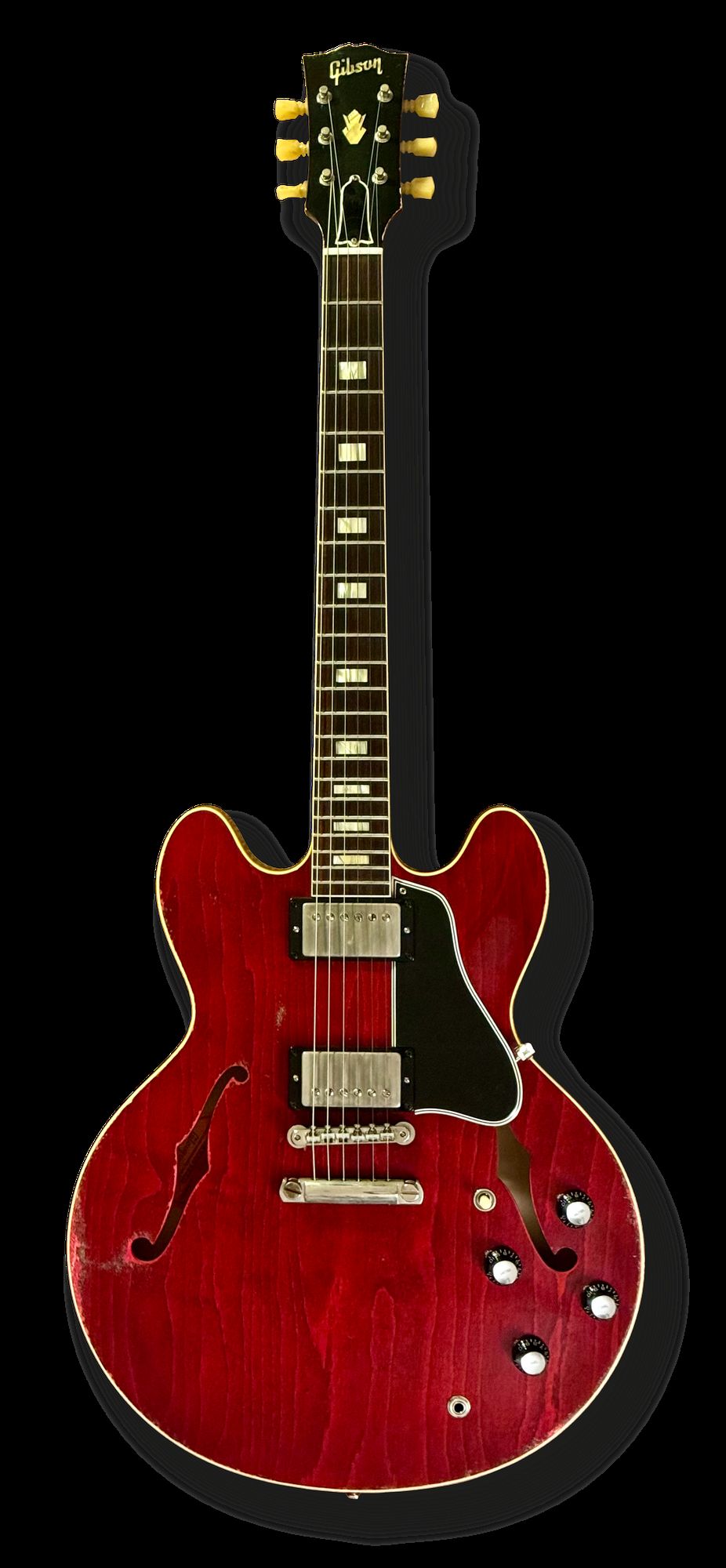
ColorwayGibson ES-335 64 / Dark Cherry Red / Gibson Custom Shop / Murphy Lab Heavy Aged / 2022. Photo by Auge=mit. Licensed under CC BY-SA 4.0. Via Wikimedia Commons.Gibson Custom Shop 1964-style ES-335, Murphy Lab Heavy Aged, dated 2022. Cherry reissue, not an original 1960s instrument. 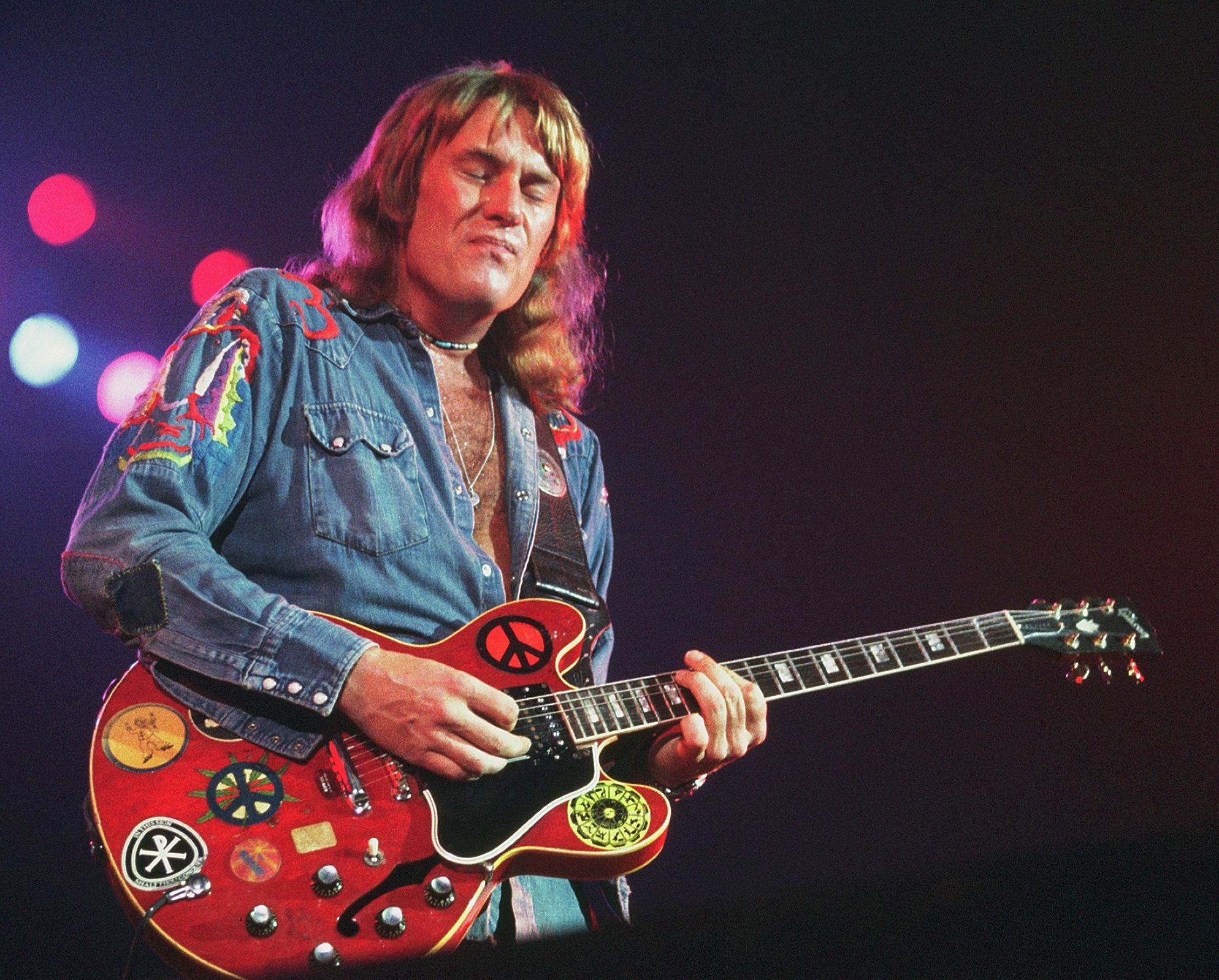
In playAlvin Lee, 1975. Photo by Jim Summaria. Licensed under CC BY-SA 3.0. Via Wikimedia Commons.Lee’s “Big Red” is a 1958 or 1959 cherry ES-335, later modified (extra pickup, stickers, stop bar). Not Lucille and not a stock current 335.
Liner notes
Specs, construction, rarity, value, and every source we used.
A laminated thinline with a maple center block — not a hollowbody, not Lucille, and not the guitar on Chuck Berry’s earliest hits.
- Body
- Double-cut thinline. 3-ply maple/poplar/maple top and back; maple centerblock; spruce bracing. Single-ply cream binding. F-holes. Semi-hollow, hollow wings.
- Neck
- Set mahogany; Rounded C.
- Fingerboard
- Bound rosewood; 22 medium jumbo; acrylic dots; 12 in radius. End-of-board 57.4 mm / 2.26 in.
- Scale
- 24.75 in / 628.65 mm
- Pickups
- Calibrated T-Type Rhythm (neck) / T-Type Lead (bridge)
- Hardware
- Aluminum ABR-1 Tune-O-Matic; aluminum Stop Bar; Vintage Deluxe Keystone tuners; nickel. Black 5-ply pickguard. Black Top Hats with silver reflectors.
- Electronics
- 2 volume, 2 tone; 3-way toggle. Hand-wired 500k pots; Orange Drop capacitors.
- Finish
- Gloss nitrocellulose (Sixties Cherry, etc.)
- Nut
- Graph Tech, 43.05 mm / 1.7 in (page prints 1.7 in vs 1.69 in on Les Pauls)
Open the full research fileConstruction details, the complete player record, production numbers, dated value estimates, and sources
Current USA ES-335, Sixties Cherry core, $3,499, model ES3500SCNH1. Not a first-year 1958. USA ES-335 50s and 60s era-spec models launched May 2026 share the $3,499 band; Figured is $3,999. Gibson Custom 1959 ES-335 Reissue VOS is a separate Historic (~$5,999 dealer).
Construction
Ted McCarty’s shop, 1958 — same year as the Flying V, Explorer, EDS-1275, and the Burst redesign. Thinline semi-hollow: laminated archtop, solid center block, f-holes. Not a full hollowbody. Continuous production since. Original Kalamazoo; current USA Nashville. Gibson Gazette: the 50s/60s models use the original ES laminate press from Kalamazoo.
May 2026, Gibson added era-spec USA 50s and 60s models, both $3,499 (Guitar.com). 50s: Rounded C; Custombucker Alnico 3; dot inlays; long wide-bevel pickguard; Vintage Natural, Vintage Tobacco Burst, Ebony. 60s: SlimTaper; T-Type Alnico 5; small block inlays; shorter 60s pickguard; Vintage Burst, Sixties Cherry, Dark Walnut.
Classic 1958 (not a current SKU): thinline archtop, solid maple center block, unbound rosewood neck (first year), thinner laminate top (1958–early 1959 “thin top”: three visible outer layers vs later four; thick spruce layer over the maple block vs later kerfed construction), often a shallow neck angle requiring a factory extra-thin ABR-1. Stopbar or Bigsby. PAFs. Dots, long pickguard, nickel. Sunburst standard; natural (TDN) scarce — True Vintage: 50 naturals in the 1950s run as stated for 1958-era naturals (dealer figure, not a factory table in-hand). 1960 list: ES-335TD sunburst $292; TDN natural $307.50; case $49.50.
Named years: 1959 cherry finish added; neck binding becomes standard after the first-year unbound; neck-angle fix. ~1961 shorter pickguard. 1962 dots → small block (widely reported; the 60s USA model follows this — factory lag exists). ~1962–63 PAF → patent-number humbuckers. 1965 nickel → chrome (es-335.com); nut width changes on Gibsons generally. 1972–1975: center block that only extended partway through the body (jazzguitar.be; flag — factory drawing not fetched). Neck tenon: long from 1958 into at least the early 1970s; shorter later / 1980s; Historics returned to long tenon ~2006 (es-335.com — not Gibson official). Current USA spec sheets do not publish tenon length.
ES-345 is the stereo/Varitone sibling. ES-355 is the fancy bound/ebony/Bigsby flagship. B.B. King’s Lucille is ES-355-based, not a stock 335. Custom Shop: 1959 ES-335 Reissue VOS ~$5,999; Clapton Crossroads limited replicas (2005) of his 1964 cherry 335.
Players
Gibson expected jazz players. Blues and rock took it. Do not file Lucille as a 335, and do not credit Chuck Berry's earliest hits to one.
Larry Carlton ("Mr. 335"). Player says 1969; Gibson's 2004 copy labelled 1968 — keep both. Guitar Player (Phil Weller, updated 24 April 2026): Carlton's sunburst 1969 ES-335, bought new from a Southern California shop after trying three hanging on the wall acoustically, unplugged, for $850. Equipboard transcribes Carlton on camera: "the little store I went to in 1969… Brand new… Yeah 1969." Gibson Memphis's 2004 Larry Carlton signature copy was marketed as recreating a "beloved 1968" 335. Prefer Carlton's own 1969; flag 1968 as a Gibson-marketing/copy error. Former Bigsby (drill scars); original humbuckers retained; graphite nut and Schaller tuners added. Sessions: Steely Dan "Kid Charlemagne," Joni Mitchell "Help Me," plus Crusaders/solo (Room 335). It is a 1969 335 — not a '59 PAF piece.
Alvin Lee, "Big Red" — 1958 or 1959 cherry ES-335. Ten Years After, Woodstock, 17 August 1969; "I'm Going Home." MusicRadar (Rob Laing, 27 October 2019): Gibson Custom Shop "'69 Festival" replica of the guitar as it stood in 1969. Lee bought it c. 1963/64 in Nottingham. Guitarist magazine (Woodstock 50th): Bigsby replaced with TP-6 c. 1970; neck damaged onstage 1972/73 and replaced by Gibson — which is why the date is hard to pin: 1958 vs 1959. Stickers (CND peace sign and others) are part of the public identity. Retired c. 1986. Year of manufacture: 1958 or 1959 — flag both.
Eric Clapton — cherry 1964 ES-335TDC, serial 67473, bought 1964 in some accounts. Christie's 24 Jun 2004 Crossroads sale: $847,500 to Guitar Center — celebrity outlier, not a typical 1964 335 comp. Tony Bacon, Guitar World, 9 August 2026: seen at Cream's Royal Albert Hall farewell, 26 November 1968; kept until the 2004 auction. Purchase date is contested: Clapton later recalled buying it in the Yardbirds; serial/shipping work rules out the Yardbirds 335s (those were mostly Chris Dreja's); Jerry Donahue says he sold this guitar to Clapton at Selmer's, London, weeks before the Albert Hall shows. Bacon judges the late-1968 Selmer purchase most likely. When he got it is uncertain; that he played it at Albert Hall 1968 is not. Where's Eric: used on Goodbye ("Badge" and other tracks), Stones Rock and Roll Circus (December 1968), and extensively in Blind Faith (1969). Case stenciled "CREAM." Christie's notes he was more often photographed with Les Pauls and the Fool SG during Cream.
B.B. King — Lucille is ES-355-based, not a stock 335. "Lucille" is the name King gave successive Gibsons. The guitar the public means, and the 1980 Gibson signature, is based on the ES-355 (often ES-355TD-SV), typically black, with Varitone, and — on the signature — no f-holes, at King's request to cut feedback. He had previously stuffed f-holes with cloth. He also played 335s and 345s, but the Lucille identity is 355-based. "The Thrill Is Gone" (1969) is cited for Varitone "honk," which is a 345/355 feature, not a stock 335's. Do not list Lucille as an ES-335.
Chuck Berry. Earliest hits were on a fully hollow ES-350T, not a 335. The 335 did not exist until 1958. Guitar Center: Maybellene / Johnny B. Goode era = ES-350T. He later became an early 335/345/355 player; Hail! Hail! Rock 'n' Roll (1987) features a red ES-355. Post-1964 titles ("Nadine," "You Never Can Tell") are 300-family semis/hollows, but which sibling on which track is not documented. Do not credit "Johnny B. Goode" to a 335.
Carlos Santana's Woodstock guitar was an SG Special, not a 335. Freddie King is at least as often associated with ES-345 — known-to-play, model not pinned here. Dave Grohl's famous later semi is a Trini Lopez Standard, a 335-shape relative, not an ES-335. Noel Gallagher and Johnny Marr are more often ES-355. Vintage Guitar's January 2008 "As Played By" list (Eric Johnson, Lee Ritenour, Warren Haynes, John McLaughlin, Buddy Guy, Keith Richards, Clarence "Gatemouth" Brown, Hank Garland) is a specialist magazine's association list without song-level citations — known-to-play, weakly specified. Do not invent named instruments from that list alone.
Rarity
Current USA 335: regular production.
First-year 1958 is the lowest vintage production: 317 shipped (Vintage Guitar and Bass / Joe’s, Meiners). 1959 592. 1960 514, then rising; 1967 peak 5,718. Factory shipping totals, not a survival census. Unbound neck plus thin-top is the tell. Natural/blonde 1950s–60s: True Vintage says often ~2× sunburst and “50” naturals in 1958-era production — dealer figure.
1958–64 nickel, stop-tail, PAF/early patent: the collected core. Bigsby originals exist; stop-tail usually preferred (jazzguitar.be). 1970s are commoner; partial center-block years are a known variant, not “rare 1950s.” Historic/Custom Shop is separate from the USA line.
Value
Informal estimate, 25 August 2026. Not an appraisal.
New street. USA ES-335 Satin: $2,999. USA ES-335 (e.g. Sixties Cherry) / Standard: ~$3,499 (gibson.com). USA ES-335 Figured: $3,999. USA ES-335 50s and 60s (May 2026): $3,499 (Guitar.com; dtownguitars.com). Gibson Custom 1959 ES-335 Reissue VOS: $5,999 (Round Hill Music Co dealer). Historic / Murphy Lab asks about $6,000–$12,000+. Reissues are not 1958 originals.
Used modern (USA 2010s–2020s). Sold-comp access is thinner than for Les Paul 50s/60s and SG ’61. Reverb Price Guide for current 335s was bot-blocked. guitarprice.net 2026: ES-335 used $2,500–$5,000 (wide bucket). Reverb “Dot” listings observed ~£2,100–£2,300 for a 2022 example (asking). Rounded informal: about $2,000–$3,300 for ordinary used current-spec USA 335s. Flag: thin sold-comp access. Custom Shop used sits higher (example dealer used 2026 Custom Dealer Select 1961-style $4,999 asking).
Vintage / collectible. Distinguish ask vs sold. Charlie Gelber / OK Guitars sold a 1961 stop-tail 335 for $40,000 mid-2025 (27 Nov 2025 post: “less than 6 months” earlier). He has never gotten more than $40,000 for a 1961 unless it had a long guard. Reverb asks for near-mint 1961 stop tails (Nov 2025) ran $52,500–$68,000 — asks, not solds. Working informal bands: 1958–59 sunburst dots, original stop/PAFs, excellent ~$50,000–$90,000; 1960–61 dots, original stop ~$35,000–$60,000, with Gelber’s $40,000 sold as an anchor. Mid/late-1960s block trapeze player-grade ~$6,000–$15,000. Blonde/natural 1958–60: often a large premium to sunburst (True Vintage “double”); public 2024–26 solds were not located in a clean series — thin. Original finish vs refinish, and provenance, can double or halve a result.
Garrett Park Guitars (dealer, undated): pre-1965 mint original $30,000–$80,000+; mid-1960s excellent original $25,000–$60,000+; 1970s original good $5,000–$10,000+; 1970s modified $2,500–$7,500. Joe’s groups 1958–64 all-original $30,000–$80,000+ — a band, not a median; dots at the top. True Vintage: 1960 value “at least 10×” inflation-adjusted original (~$3,100), i.e. ≥ ~$30k, case-by-case. es-335.com specialist: 1958/59/64 still relatively strong in a sluggish broader vintage market (qualitative, 2024–26 commentary).
Clapton 1964 335: $847,500 (2004) — celebrity lot, not a typical 1964 335 comp.
See also
- gibson-les-paul-standard — the 1958 solidbody counterpart; Burst is the sidebar, not this guitar
- gibson-es-295 — gold fully hollow 175-platform; Scotty’s first Elvis guitar, not a center-block 335
- gibson-sg — Santana’s Woodstock guitar was an SG Special, not a 335
- fender-stratocaster — the other working electric from the same decade, different construction entirely
Sources
- Gibson ES-335 Sixties Cherry
- Gibson ES-335 Figured
- Gibson Gazette: ES-335 50s and 60s
- Guitar.com: 50s/60s ES-335 launch (18 May 2026)
- True Vintage: 1958 ES-335 unbound
- True Vintage: 1960 ES-335
- Guitar Player: Larry Carlton’s ES-335
- Guitar Center Riffs: ES-335 history
- Where’s Eric: Clapton 335 sale
- Christie’s: 1964 ES-335TDC serial 67473
- Garrett Park Guitars: ES-335 value guide
- es-335.com: neck tenon
- es-335.com
- Round Hill: Custom 1959 ES-335 Reissue
- jazzguitar.be: ES-335 (shipments / 1972–75 block)
- Vintage Guitar and Bass: ES-335 shipping 1958–79
- Charlie Gelber, es-335.com, 27 Nov 2025 (1961 sold $40k)
- Joe’s Vintage Guitars: Gibson shipping totals 1948–1979
- Guitar Interactive: Gibson guitars of B.B. King (Lucille / ES-355)
- Equipboard: Larry Carlton ES-335 (player says 1969)
- Guitar Gallery: 2004 Carlton copy labelled 1968
- MusicRadar: Alvin Lee “Big Red” / ’69 Festival
- Guitar World: Tony Bacon on Clapton’s Cream guitars
- Vintage Guitar: Gibson's 1958–'62 ES-335TD — January 2008; McCarty design; 317 shipped 1958; "as played by" list.
- Vintage Guitar: Ted McCarty — McCarty designed the 335; Les Paul did not.
- Gibson Gazette: Seven reasons why you need an ES-335 — 29 Nov 2023; 1958 NAMM with V/Explorer/Burst.
- zZounds: Iconic Rigs — Chuck Berry — ES-350T on early hits; later red 335-family.
Keep digging
Guitars this one gets compared to, confused with, or descended from.

2006 Gibson Les Paul Standard (SN 000660573). Photo by wetwebwork. Licensed under CC BY-SA 2.0. Via Wikimedia Commons. Gibson
Les Paul Standard
1952
Gibson made about 1,500 sunburst Les Pauls, decided nobody wanted them, and stopped. Then the British blues boom happened.
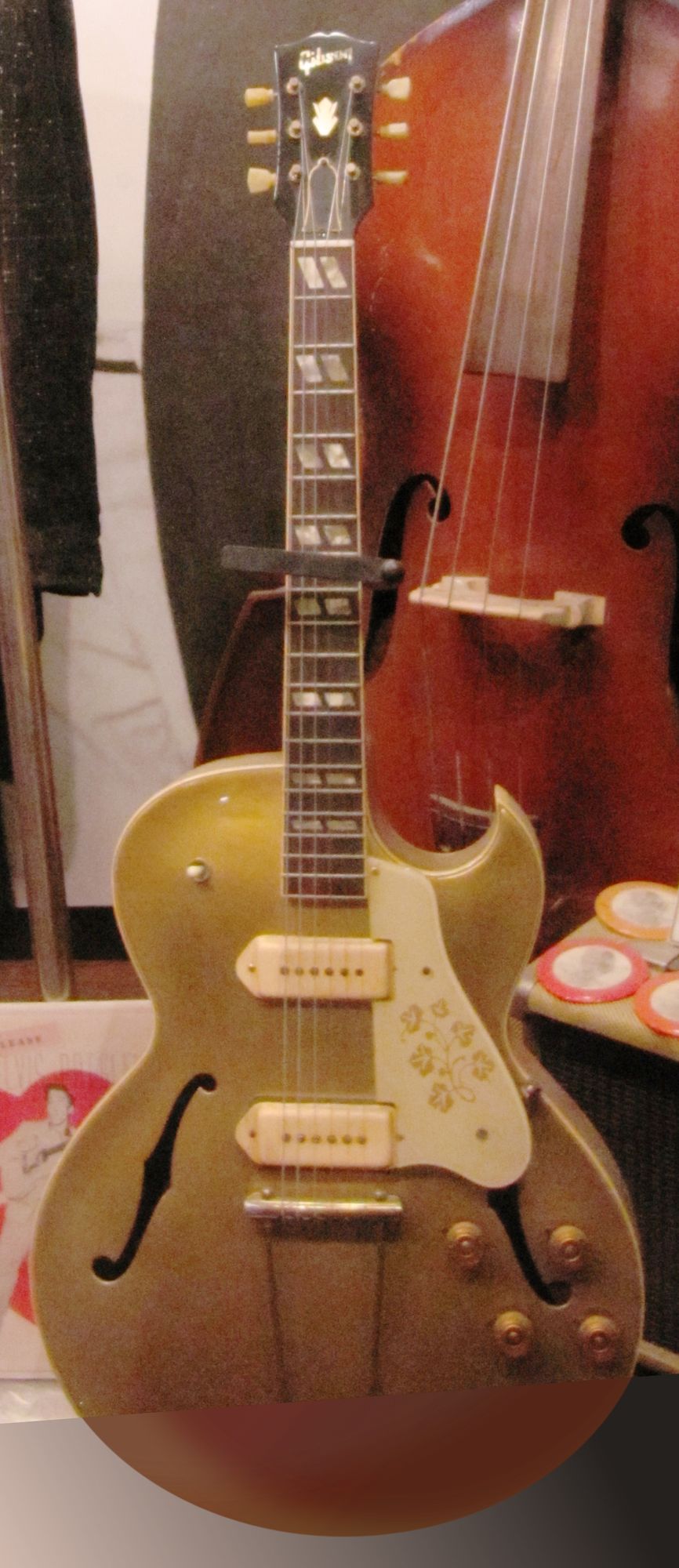
Gibson ES-295, Sun Studio. Clipped from Memphis Sun Studios Elvis instruments.jpg. Photo by Mr. Littlehand; derivative by Clusternote. Licensed under CC BY 2.0. Via Wikimedia Commons. Gibson
ES-295
1952
Scotty Moore traded a Fender for the gold guitar in the window. Four Elvis singles later, he traded it away.
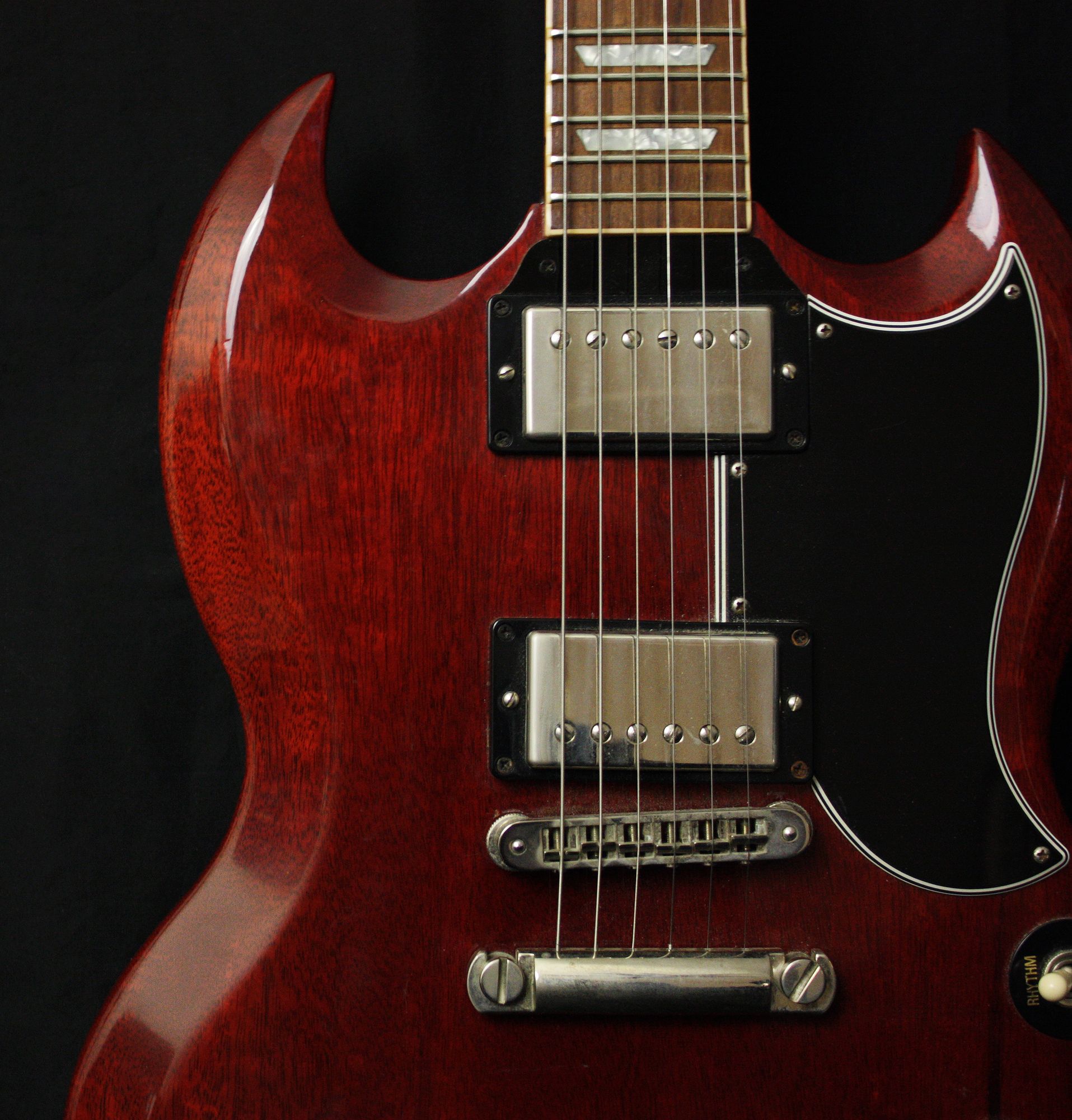
Gibson SG Standard ’61 Reissue, photographed 18 March 2010. Photo by John Tuggle. Licensed under CC BY 2.0. Via Wikimedia Commons. Gibson
SG
1961
Gibson has never stopped making SGs. Angus Young has lost count of his. He still only means one.