Godin
Multiac
A nylon-string guitar that can stand next to a drummer, and talk to a synthesizer while it’s at it.
Any nylon-string player who has plugged in on a loud stage knows the moment. The drummer counts in, the monitor comes up, and the top of the guitar starts to howl. In 1993, a factory in Richmond, Québec, shipped an answer.
- Introduced
- 1993
- Type
- Chambered hybrid acoustic-electric
- Class
- Production
Have a photograph of this guitar? Send a picture
The short version
1989
The chamber idea
Godin’s Acousticaster, a steel-string with a hollowed-out body and no soundhole, gets there first.
1993
Multiac Nylon SA
Nylon strings, two chambers, and a 13-pin jack for a guitar synthesizer.
1994
Steel joins
The Multiac Steel SA goes into production. Regular production runs to 2009.
2018
Doyle Dykes
A steel-string Multiac signature, made through 2021.
2023
“Thirty years ago”
Godin launches the Mundial and dates the Multiac’s start to three decades back.
2026
Twenty-five years of Stevens
A signed run of 100 anniversary guitars for Steve Stevens.
Side A
A1
Soft guitar, loud room
A nylon-string guitar is a quiet instrument. That’s most of its charm. The notes are round and warm and they don’t push. It was built for a room where people are listening.
The trouble starts when you want to play it somewhere people aren’t. Put a classical guitar on a stage with a drummer and a bass player, turn it up enough to hear it, and the body starts to feed back. For years you had two bad choices. You could stick a pickup on a regular flat-top and fight the howl all night, or buy a solidbody that pretended to be a classical guitar and didn’t sound much like one.
The Multiac refused to pick either.
A2
Two rooms and a lid
The trick is inside. A Multiac is a thin body with two hollow chambers and a solid spruce top closed over them. There’s air in there, so it still sounds like an acoustic guitar. There isn’t much of it, so the top can’t pump the way a big flat-top’s will when the drummer gets going.
Godin had tried the chamber idea before, on a steel-string called the Acousticaster. The Multiac took it and put nylon strings on it.
There’s enough air inside to sound like a guitar, and not enough to start a fight with the PA.
A3
Thirteen pins
The other trick is under the bridge. Instead of one pickup, the Multiac Nylon SA has a separate sensor for each string, an onboard preamp and EQ, and a 13-pin jack. That jack goes to a Roland- style guitar synthesizer, which gets each string on its own and can turn it into strings, pads, or whatever you like. SA stands for Synth Access. Godin calls the 1993 Nylon SA the first production guitar built that way.
Which Multiac came first depends on which Godin paperwork you read. The company’s timeline puts the nylon in 1993 and the steel in 1994. An older catalog says the steel-string players asked first and the classical players followed. A dealer newsletter in the spring of 1995 was already treating them as a pair after “over two years” of work.
The electronics kept moving. Early synth-access guitars used RMC pickups, and later ones use custom L.R. Baggs systems. There was even a Duet version with a little microphone inside the body and an XLR jack, like a vocal mic.
Flip the record · By the numbers
2
Chambers inside the body. They keep the top from pumping like a flat-top’s does.
13
Pins on the synth jack. One cable carries each string separately to a guitar synth.
100
Numbered, signed guitars in Steve Stevens’s 25th-anniversary run.
Side B
B1
A lot of cousins
The family grew. The ACS is thicker on top and made to stay quiet even when the band isn’t. The Grand Concert has a real classical neck, wide and flat and joined at the 12th fret. The Slim goes the other way. The Encore and Mundial skip the synth jack. Steel Multiacs came and went.
One rule stays the same. Unless it says Steel on it, it’s a nylon guitar, and Godin warns that steel strings will wreck it.
You’ll see Leonard Cohen photographed with a Godin. Nobody has shown that it was a Multiac, so he isn’t on this list.
B2
Flamenco, rock, and a synth
Steve Stevens has been with Godin for more than twenty-five years, and the ACS is the guitar he uses to put flamenco, rock, and electronics on one instrument. In 2026 Godin marked the anniversary with 100 signed, numbered guitars in purple quilted maple.
Doyle Dykes went the steel-string route, with a signature Multiac from 2018 to 2021 that blends a saddle pickup with a microphone inside the body.
A nylon-string guitar used to be something you put away when the band got loud. Stevens plays his right in the middle of it, and you can still hear the nylon.
The cast
The people, and the specific guitars, that made the legend.
2026
Steve Stevens
Multiac ACS nylon
More than twenty-five years with Godin. It’s the nylon guitar he uses for flamenco, rock, and electronics all at once.
2018
Doyle Dykes
Multiac Steel signature
Solid spruce on the chambered body, with a saddle pickup and a microphone blended together. Steel strings, not nylon.
1993
Robert Godin
The factory in Richmond, Québec
His shop built the chambered body that made a nylon guitar safe on a loud stage.
Liner notes
Specs, construction, rarity, value, and every source we used.
Two chambers, a thin body, and a 13-pin jack — the nylon (and steel) hybrid most players still mean by Godin.
- Body
- Two-chambered mahogany, solid spruce top
- Neck
- Bolt-on mahogany
- Fingerboard
- Richlite, 16" (406.4 mm) radius, 22 frets
- Scale
- 25.5" (647.7 mm)
- Pickups
- Undersaddle hex sensors (one per string)
- Hardware
- Richlite bridge, 16:1 machines
- Electronics
- On-board preamp; 1/4" out plus 13-pin synth (SA)
- Finish
- High gloss natural typical; limited high-gloss black
- Nut
- Graphtech, 1.9" (48.26 mm)
Open the full research fileConstruction details, the complete player record, production numbers, dated value estimates, and sources
Current typical = Multiac Nylon SA, founding SKU 004690 (Godin chooser; Sweetwater MPN 004690). Factory millimetres from the live Limited Run Nylon SA Black HG page. Sweetwater’s feature list still writes the nut 1-7/8"; the same page’s table says 1.9". Keep both. That dealer’s prose still says RMC Polydrive; its table and current factory copy say custom LR Baggs with 13-pin. Early SA used RMC. Encore, ACS, Mundial, Grand Concert, Slim, Deluxe, and steel Multiacs stay on this plate.
Construction
Robert Godin’s factory in Richmond, Québec, put a nylon guitar on a loud stage by refusing the usual compromise: a flat-top with a pickup stuck on, or a solidbody pretending to be classical. The Multiac is a thin, mostly closed chambered body with a solid top. Two cavities keep the top from pumping the way a dreadnought will when the drummer gets going.
That chamber idea is older than the name. Godin’s 2005 catalog calls the Acousticaster the first Godin to use it. The earlier nylon Acousticlassic / Acousti-Classical sits in the same workshop. They are not this guitar.
Godin’s 50-year timeline dates the Multiac Nylon SA to 1993 and calls it the first production guitar with multi-voice synth access: hex sensors in the bridge, onboard EQ, a 13-pin jack aimed at Roland GR-class devices. The 2023 Mundial page says the same origin, “thirty years ago.” The 2005 catalog puts steel-string players first and classical demand next. Factory later lists Multiac Steel SA as 1994–2009, special-order into 2010. Sweetwater’s spring 1995 SweetNotes already treats steel and nylon as a pair after “over two years” of development. Nylon SA is 1993 on this plate. Steel production is 1994.
SA is Synth Access. Founding Nylon SKU 004690 has that 13-pin system even when the badge does not say SA. ACS is Acoustic Solid: still chambered, thicker top, built to stay quiet when the band is not. Grand Concert is the classical-neck Multiac, 2" (50.8 mm) nut, 24" board radius, 12th-fret join, cedar top typical, against the regular 1.9" (48.26 mm) nut, 16" radius, 16th-fret join. Slim is the other way, 1.715" in factory copy and 1.7" (43.18 mm) in the same factory table. Encore and Mundial mix an undersaddle with body sensors and have no 13-pin. Deluxe is LR Baggs hex plus Lyric microphone, also no SA. Unless the name says Steel, Godin strings these with nylon and warns that steel will wreck a nylon Multiac. Nylon and steel share the silhouette and the chamber idea. They do not share strings.
Electronics moved with the years. Early SA and Duet stories are RMC 13-pin and LR Baggs Duet (foam microphone, later I-Beam, XLR). Later factory pages put custom LR Baggs on the living Nylon SA. Fishman ran the Duet Ambiance years. Encore and Mundial use Godin’s EPM dual-source preamp. Those are versions of one guitar, not a second encyclopedia object.
The silhouette is not a Godin Radius, LG, 5th Avenue archtop, or Artisan ST/TC solidbody. It is not a Seagull, Norman, or Art & Lutherie flat-top, not an A-series steel hybrid (A6 Ultra and kin), not Glissentar, not MultiOud.
Players
Steve Stevens. Premier Guitar’s 2026 25th-anniversary ACS piece is the factory relationship in public: more than twenty-five years, ACS as the nylon he used to put flamenco, rock, and electronics on one instrument. Godin’s Mario Biferali and Simon Godin both date the collaboration that long. The anniversary guitar is a numbered run of 100, signed, purple quilted maple, street $2,999. That object is this plate. It is not a census of every ACS.
Doyle Dykes. Premier Guitar, 26 January 2018, NAMM: Multiac Steel Doyle Dykes Signature, solid spruce on dual-chambered mahogany, Richlite board, custom LR Baggs blending an LB6 saddle with a Lyric microphone, street $1,995. Godin’s chooser later closes that signature 2018–2021. Steel, not nylon. Same plate.
Do not hang Leonard Cohen’s photographed Godin on this slug. Wikipedia’s Godin lead names the Multiac series; it does not name his guitar. Do not steal A-series, 5th Avenue, or Artisan credits.
Rarity
Current Nylon SA, Encore, ACS, Mundial, and Grand Concert are regular Canadian production. Godin does not publish Multiac unit totals. None invented.
Steel SA is the closed end of the original synth-access steel: factory 1994–2009, special-order into 2010. Doyle Dykes Steel is a short signature window, not a rare 1993. The Steve Stevens anniversary run is 100 numbered instruments — limited, not vintage scarce. First-year 1993–94 examples exist; no factory first-year count was found.
Value
Informal estimate, 25 August 2026. Not an appraisal.
Ask is not sold. No invented median. Nylon SA, Encore, ACS, and steel examples are different tapes. Signatures are not comps for a used 004690.
New street. Sweetwater Multiac Nylon SA Natural $2,329.00 (SKU 004690). Sweetwater Nylon Encore Natural SG $1,599.00 this pass; the same dealer’s thinline category listing also showed $1,669.00. Sweetwater ACS-SA Slim Natural $1,799.00. Sweetwater Mundial Ozark Cream $1,299.00. Premier Guitar: Steve Stevens 25th-anniversary ACS $2,999 street. Factory MAP on the Nylon SA was not captured this pass.
Used. Named asks, not hammers: Brian’s Guitars Nylon SA excellent $1,200 (sold out). Elderly 2016 Nylon SA $1,300. Guitar Center used Nylon SA Great $1,399.99. Musician’s Friend used Nylon SA $1,799.99. No clean 2024–26 public hammer isolated this pass.
See also
- Balladeer — another stage acoustic-electric; Lyrachord bowl, not a two-chamber Multiac
- 814ce — cutaway wood AE; not chambered nylon, not 13-pin
- Stratocaster — the solidbody layout Godin’s Artisan / Progression copies; not this guitar
Sources
- Godin: How to choose your Godin Multiac — SA / ACS / Encore / Deluxe / Slim / Grand Concert / Mundial glossary; Steel SA 1994–2009; Duet and signature windows; founding Nylon SKU 004690.
- Godin: 50 Years of Innovations — 1993 Multiac Nylon SA as first production multi-voice synth-access guitar.
- Godin: Limited Run Multiac Nylon SA Black High Gloss — factory millimetres: 25.5" (647.7 mm), 1.9" (48.26 mm) Graphtech, 16" (406.4 mm); two-chambered mahogany, solid spruce, custom LR Baggs 13-pin.
- Godin: Multiac Nylon Encore Natural SG — EPM dual-source Encore; silver-leaf maple / basswood wings; cedar top; no 13-pin.
- Godin: ACS Slim Nylon Natural SG — Slim 1.715" copy vs 1.7" (43.18 mm) table; thicker ACS top.
- Godin: Multiac Mundial Arctik Blue — 2023 Mundial; “thirty years ago” Nylon SA origin.
- Godin 2005 catalog (PDF) — Acousticaster as first two-chamber Godin; “original Multiac… steel-string guitarists” then classical demand; LG as 1995 solidbody foundation.
- Sweetwater: Multiac Nylon SA Natural — $2,329.00; MPN 004690; 1.9" table / 1-7/8" feature copy; RMC prose vs LR Baggs spec table.
- Sweetwater: Multiac Nylon Encore Natural SG — $1,599.00.
- Sweetwater: Godin thinline AE category — Encore also listed $1,669.00 this pass.
- Sweetwater: ACS-SA Slim Natural — $1,799.00.
- Sweetwater: Multiac Mundial Ozark Cream — $1,299.00.
- Sweetwater SweetNotes, spring 1995: Godin Multiac — two-plus years’ development; steel and nylon pair; nylon synth access as the new claim.
- Premier Guitar: Doyle Dykes Signature — 26 January 2018; Multiac Steel; $1,995 street.
- Premier Guitar: Steve Stevens ACS 25th Anniversary — 100 signed; $2,999 street; 25-year ACS relationship.
- Premier Guitar: Godin Artisan TC & ST II, NAMM 2025 — Artisan is a Strat/Tele-layout solidbody revival, not Multiac.
- Guitar Collecting: Godin Acousticaster — 1989 Acousticaster as chambered, no-soundhole steel predecessor.
- Wikipedia: Godin Guitars — lead only: Multiac series named as hybrid nylon or steel; no millimetres used.
- Brian’s Guitars: used Multiac Nylon SA — excellent ask $1,200.
- Elderly Instruments: 2016 Multiac Nylon SA — $1,300.
- Guitar Center: used Multiac Nylon SA — Great $1,399.99.
- Musician’s Friend: used Multiac Nylon SA — $1,799.99.
Keep digging
Guitars this one gets compared to, confused with, or descended from.
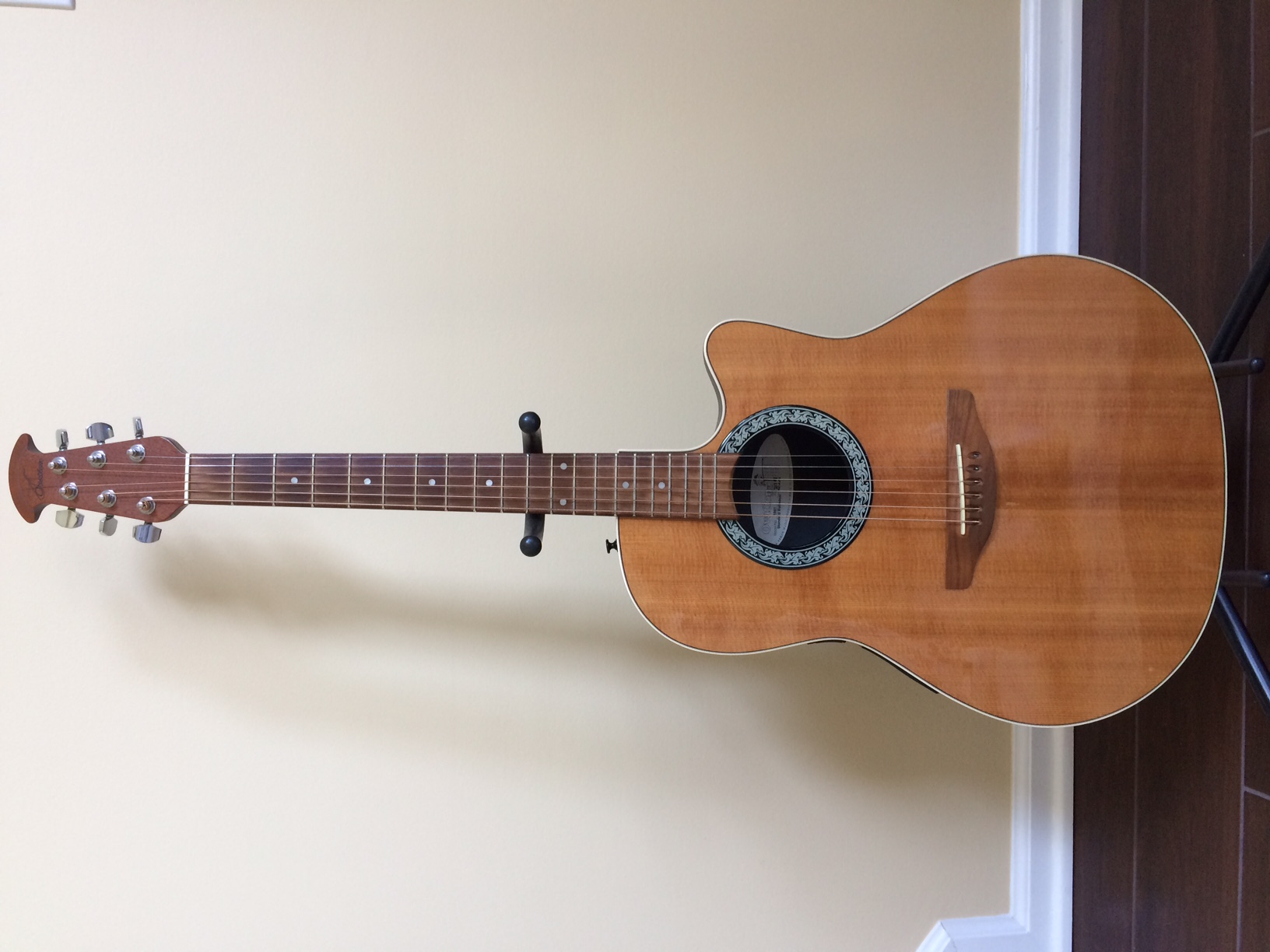
Ovation Model 1861 Standard Balladeer. Photo by Veradrive. Dedicated to the public domain under CC0 1.0. Via Wikimedia Commons. Ovation
Balladeer
1966
A helicopter builder looked at a guitar and asked why the back had to be made of wood. This was his answer.
- Send a picture
Taylor
814ce
1996
Taylor has rebuilt its flagship from the braces out, again and again, and kept the same three numbers on it.

Photo: Lightburst / Wikimedia Commons / CC BY-SA 4.0 Fender
Stratocaster
1954
The guitar most people mean when they say “electric guitar.” Designed by a man who didn’t play one.