Guitaripedia
Washburn
Culprit
Dimebag Darrell drew every inch of the Culprit, except the one part Washburn wouldn't let him have.
Late 1990s. Dimebag Darrell already has Washburn's pointed signature guitars, and they're selling. He wants a body of his own, so he draws one, with a curve in it like a bottle opener. The company says yes to all of it but the headstock.
- Introduced
- 1998
- Type
- Solidbody electric
- Class
- Closed run
Have a photograph of this guitar? Send a picture
The short version
1980–1994
The ML years
A Dean ML is his main guitar through Far Beyond Driven.
1994–96
To Washburn
A ten-year contract with Washburn. The accounts date the move to 1994, 1995, and 1996.
1995
Dime 3
His first Washburn signature, a pointed guitar in the ML's image.
1998
CP-2003
The Culprit appears on Washburn's price sheet, in Trans Bordeaux Red and in his graphics.
1999
Down to one line
Red and black only. The next year's sheet drops it, though two later guides run it through 2000.
13 November 2004
Back to Dean
Dean announces it has signed him.
8 December 2004
Columbus
Shot and killed onstage with Damageplan at the Alrosa Villa. He was 38.
2026
Dime Guitarz
Rita Haney and Dean Zelinsky put the Culprit back on sale, under a different company's name.
Side A
A1
A bottle opener
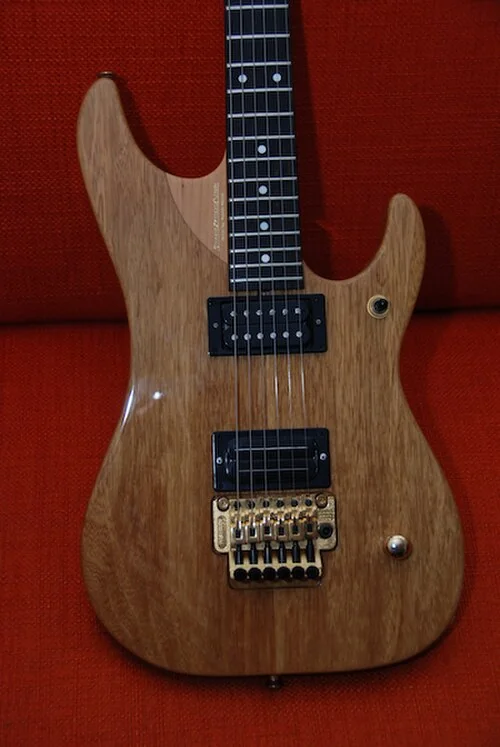
Look at the bottom of a Culprit and there's a notch below the bridge, a scooped curve cut up into the body. People say it looks like a bottle opener.
That's because it was supposed to. Rita Haney, his partner and now the estate's trustee, says the curve was the joke. Dimebag Darrell liked Coors Light. She also describes a cut on the back, so his hand could reach farther. Two different cuts, one for the beer and one for the playing.
It's the most Dimebag thing about the guitar. Washburn already had his pointed guitars. This one was the shape he drew himself.
A2
We couldn't say no
From 1980 through 1994 his main guitar was a Dean ML, the pointy one on Cowboys from Hell, Vulgar Display of Power, and Far Beyond Driven. Then, as Larry English at Washburn tells it, Dean went out of business in 1994, just after Pantera finished Far Beyond Driven. Dean's old marketing director, Del Breckenfeld, had moved to Washburn, and he brought Darrell a deal: ten years. Which year the switch counts as depends who you ask. English says the contract was 1994. One price guide says the endorsement started in 1995. Another book says 1996.
The first signature was the Dime 3 in 1995, a pointed guitar that looked like the ML it replaced, with an import, the Dime 333, alongside it. They sold. And once they were selling, English says, Darrell wanted something else.
"The Culprit was entirely his design. Dimebag wanted another body design, and we couldn't say no."
Haney remembers the order differently. In her telling the Culprit came first, the first thing he did at Washburn, before the Stealth. In English's, it came after the Dime 3s, and the Stealth came after it. They don't agree.
A3
The banana head
They could say no to one thing.
Haney says he hated that banana-shaped head. Washburn insisted on trying a different shape, and he let them. In the drawings she still has, a checkmark head was one of the options. It isn't the head on the guitar they sold. The Culprit went out with a black headstock and six tuners in a row, and no checkmark.
So the body was his, the notch was his, the joke was his. The head was Washburn's.
Flip the record · By the numbers
$1,099.90
1998 list for a Culprit in Trans Bordeaux Red. The graphic finishes were $1,149.90
2
Years Washburn's own price sheets carry it, 1998 and 1999
10
Years in the Washburn contract he signed
6
Tuners in a row on the Washburn head. The checkmark he drew didn't make it
Side B
B1
Two lines on a price sheet
On Washburn's own paperwork it doesn't even say Culprit. It says CP-2003, under the heading Dimebag Darrell. It isn't on the 1996 or 1997 sheets. In 1998 there are two lines: Trans Bordeaux Red at $1,099.90, and the black guitars with his graphics, Blackjack, Dime Slime, and Dime Bolt, at $1,149.90. In 1999, one line, red and black, $1,149.90. In 2000 it's gone from the sheet, while the pointed Dime models are still on it. Two later guides carry it through 2000. The paperwork says one thing and the guides say another.
What it was made of depends on the book too. Washburn's sheets say a basswood body with a set maple neck. A price guide says mahogany for both. The scale is 25 1/2" on the sheets. Nobody has published how many were made. Sellers say 100, or 52. Neither number comes from the factory.
B2
As far as it could go
He kept designing at Washburn. In 2002 there was the Southern Cross, a cross of ebony and abalone set into the top, 100 of them. In mid-2004 the endorsement ended. When it came out that he'd left, he put out a statement, because the company's press had made it sound as if he'd been dropped. They'd asked him to renew. He hadn't.
"I took the Washburn thing as far as it could go."
Dean, he said, was the way forward. Dean announced the signing on Saturday, 13 November 2004.
On 8 December 2004 he was shot and killed onstage with Damageplan at the Alrosa Villa in Columbus, Ohio. He was 38. The new Dean guitar he'd mentioned in that statement was the Razorback, a different shape. The Culprit was already a Washburn memory by then.
B3
The head he wanted
The name is on sale again now, from a different company. Dime Guitarz, Haney with Dean Zelinsky, builds a Culprit with a mahogany body, a flame-maple top, a Seymour Duncan Dimebucker, and a booster you charge by USB. It isn't a Washburn, and it isn't a 1998 CP-2003. Even the scale is different: 24.75", where Washburn's sheets printed 25 1/2".
The European shop says it's built to his original specs. That includes the head.
It's the checkmark from the drawings, the one he'd wanted on the guitar in the first place.
The cast
The people, and the specific guitars, that made the legend.
Late 1990s
Dimebag Darrell
His own Culprit
Designed the body. His verified account posted a photo in 2023 captioned "Dime with his culprit." No Pantera or Damageplan recording is tied to the model.
Rita Haney
The drawings
His partner and the estate's trustee. Keeps the drawings, with a checkmark head among the choices.
1990s
Larry English
Washburn, U.S. Music
Ran the consumer side, and gave the account of the Culprit being entirely Dime's design.
1994
Del Breckenfeld
Go-between
Dean's old marketing director, who had moved to Washburn and brought him the deal.
2026
Dean Zelinsky
Dime Guitarz Culprit
Builds the new Culprit with Haney. A different company's guitar, not a Washburn.
Liner notes
Specs, construction, rarity, value, and every source we used.
A notch under the bridge and a six-in-line head — Dimebag Darrell’s own body at Washburn, not a Dean ML.
- Body
- Basswood on Washburn’s 1998 and 1999 archive lines. Blue Book prints mahogany.
- Neck
- Set maple on those lines. Blue Book prints mahogany. Six tuners on one side.
- Fingerboard
- Rosewood, acrylic dots (the archives). Blue Book: 22 frets and dot inlays. The archives do not print a fret count.
- Scale
- 25 1/2" (1998 and 1999 archives). Those lines give no nut width.
- Pickups
- The electronics column reads N/A. Blue Book: two Washburn 600-series humbuckers.
- Hardware
- 600-S Floyd Rose type, chrome, Grover (the archives). Locking nut (Blue Book).
- Electronics
- Blue Book: two knobs, a three-way, jack on the front. MusicRadar: one volume and one tone.
- Finish
- 1999 archive: Trans Bordeaux Red and black. The 1998 CP-2003-B line also lists Blackjack, Dime Slime, and Dime Bolt.
- Nut
- Locking (Blue Book). No width on the archive line.
Open the full research fileConstruction details, the complete player record, production numbers, dated value estimates, and sources
Specs are the Washburn CP-2003 from the 1998 and 1999 archive sheets. No current Washburn carries the name. A Culprit from Dime Guitarz is a different company’s guitar.
Construction
The job was a body that was his. Washburn already had the pointed guitars, the USA Dime 3 and the import Dime 333, its version of the ML. Larry English, then running the consumer side at U.S. Music, told Guitar World the Culprit came after those were selling. “The Culprit was entirely his design. Dimebag wanted another body design, and we couldn’t say no.”
English, in the January 2010 Guitar World piece (online 25 March 2010), is the account of how he got there. The ML was Darrell Abbott’s main guitar from 1980 through 1994. Dean, English says, went out of business in 1994, just after Pantera finished Far Beyond Driven. Del Breckenfeld, Dean’s old marketing director, had moved to Washburn and brought him a deal. A ten-year contract with Washburn International, later U.S. Music, in 1994. The first signature, the Dime 3, in 1995. Blue Book dates the endorsement 1995 to mid-2004. Vintage Guitar Encyclopedia says he switched in 1996. Three clocks for the same move. The 1994 contract and the 1995 Dime 3 are English’s. The Culprit is not that first guitar.
The name on the old paperwork is a number. Washburn’s yearly archive sheets, price directories the company compiled on 10 June 2002, do not print the word Culprit. They print CP-2003, under the heading Dimebag Darrell. It is not on the 1996 sheet and not on the 1997 sheet. It is on the 1998 sheet, as two lines: CP-2003-TBR, Trans Bordeaux Red, list $1,099.90, and CP-2003-B, Blackjack, Dime Slime, and Dime Bolt, list $1,149.90. The 1999 sheet has one line, CP-2003, Trans Bordeaux Red and black, $1,149.90. Blue Book’s name for that guitar is Culprit CP2003, manufactured 1998–2000. MusicRadar (Stuart Williams, 8 December 2019) says released in 1998 and in production until 2000. Dime Guitarz’s page says designed by Darrell in 1998. The catalog year and the design year, in the accounts that date them, are the same year. None of them gives an earlier prototype year.
What the body is depends on who is describing it. Blue Book: a Flying V style, forward-pointing treble bout, a slightly elongated bass bout, notched below the bridge. MusicRadar: a knife taken to the X, with a notched cutaway at the bottom. Guitar.com, 11 March 2025, on the old Washburn: an ML with a scooped rear bout. Rita Haney, his partner and the estate’s trustee, to Guitar World (15 October 2026): people say it looks like a bottle opener, and that curve was the joke. He liked Coors Light. She also describes a cutout on the back, so the hand could reach farther. The bottom notch and the back cut are two different things in her account.
The head is the part Washburn would not give him. Blue Book: a black headstock, six tuners on one side. MusicRadar: six-a-side. Haney: he hated that banana-shaped head. Washburn insisted on trying a different shape, and he let them. In the drawings she has, a checkmark head was one of the choices. It is not the head on the guitar they sold. The Dean ML’s winged head is a different guitar’s. So is the checkmark Dime Guitarz puts on the new one.
The wood split is the maker against the price book, and the table above is that split. One more distinction sits in the columns. The 600-S on the archive line is the bridge, the same Floyd-type code the Dime 333 uses next to its own pickup entry. It is not, by itself, a 600-series humbucker. Blue Book is the source that names the pickups. The same sheets print the Dime 333 at 628 mm with a 43 mm nut, and print no nut width for the CP-2003. Black, Blue Book says, has a bound headstock and a mirrored pickguard. MusicRadar says a mirrored scratchplate, or translucent red. Vintage Guitar Encyclopedia calls one 1999 example a cherry stain. That is their word for the guitar in the photo, not the archive’s Trans Bordeaux Red. Blue Book and MusicRadar also skip the 1998 graphics, Blackjack, Dime Slime, and Dime Bolt. The 1999 line had already dropped them.
Haney’s order and English’s order are not the same story. She told Guitar World the Culprit predated the Stealth and was the first thing he did at Washburn, a very limited run, no number. English’s sequence is the 1995 Dime 3 first, Bolt and Blackjack, then Slime, and only then another body. The Stealth, he said, came next. Abbott finished that one in 1999 while recording Reinventing the Steel, and the quote English gives him is about the Stealth: Bill Lawrence pickups, set up for squeals, chunk, and the bar. The Stealth is not this guitar. It does not appear under that name on the 1998, 1999, or 2000 archive sheets. Washburn has said limited editions are left off those sheets, so an absence there is not a census.
The CP-2003’s own last year is the quiet argument. It is on the 1999 sheet. It is not on the 2000 sheet, compiled with the others in June 2002, while the Dime 3 and the Dime 333 still are. Blue Book still prints the Culprit through 2000. MusicRadar says production until 2000. The sheet and the two later books disagree. None of them is a return to Dean. That came later, and it closed the endorsement, not this model.
He kept designing there. English: a Southern Cross, a cross of ebony and abalone in the top, 100 guitars, 2002, and a matching pendant. Blue Book: the Washburn endorsement ran to mid-2004. Then he left. His own statement, carried by Blabbermouth on 18 November 2004: U.S. Music’s press had made it sound as if he had been dropped, and that was not true. They asked him to renew. He did not. “I took the Washburn thing as far as it could go.” Dean, he said, was the way forward, and the Razorback was on its way. Dean had announced the signing on Saturday 13 November 2004 (Blabbermouth, 16 November). The Razorback is the Dean guitar in that sentence. It is not a Culprit.
He was shot and killed on 8 December 2004, onstage with Damageplan at the Alrosa Villa in Columbus, Ohio. He was 38. Zelinsky, to Guitar World in 2026, and the St. Petersburg Times as carried by Blabbermouth on 20 January 2005, both say he died three weeks after the contract. The announcement is 13 November. The death is 8 December. Their “three weeks” is the span they give.
What you can buy with the name now is not a Washburn. Dime Guitarz, Haney with Dean Zelinsky, went to market with a Standard and a USA Culprit. Guitar World, 15 June 2026: mahogany bodies, flame-maple tops, three-piece maple set necks, 22-fret ebony boards on a 12–16" compound radius, a Floyd Rose 1000, Grover-style tuners, a Seymour Duncan Dimebucker and a ’59, and a DimeBooster that adds 15 dB, from $1,999 to $5,999. The same piece says the Z-Glide neck is designed to cut friction by 72%. The US product page lists the Standard at $1,999.00 and calls it designed in 1998. The EU shop says it is built to his original specs, including the checkmark head he had wanted, a 24.75" scale, and a volume / volume / tone layout. Thomann’s October 2026 sheet for a Standard Cherry Bomb prints the scale as 626 mm. The Washburn archive prints 25 1/2". Three figures, two of them in inches and one in millimetres, from three different pages. Zelinsky’s engraved neck and the USB-charged booster are this new guitar. They were not on a 1999 CP-2003.
Players
One player is sourced, and he is the designer. The records people reach for are other guitars.
Dimebag Darrell (Darrell Abbott). Pantera, then Damageplan. English is the shop account of the design. Haney is the drawing. The verified Dimebag Darrell account posted a photograph on 1 May 2023 with the caption “Dime with his culprit.” A picture from that account. It does not name a song.
No Pantera or Damageplan recording is tied to this model in these accounts. The ML, English says, was the main guitar from 1980 through 1994, which is Cowboys from Hell, Vulgar Display of Power, and Far Beyond Driven. The Stealth is the 1999 guitar, the one in the Reinventing the Steel quote. The Razorback is the Dean shape in the November 2004 statement. The Dime 333 is the pointed import, alder on the archive at 628 mm, not this line. Blackjack, Dime Slime, and Dime Bolt are that pointed guitar’s usual paint, and the 1998 sheet also puts them on a CP-2003-B, so the paint does not tell you the body.
No other player has been sourced.
Rarity
You cannot order a new one from Washburn. Dime Guitarz sells the shape. That guitar is current. It is not a 1998 CP-2003.
Washburn has not published a Culprit total. Haney says a very limited run and gives no figure. Sellers fill the gap, and they do not agree. One Reverb shop says 100 were made, 50 of them black, and has called that same guitar both a 1998 and a 1999. Another seller writes that he was told 52 were made. Neither number is a factory book. The 100 English gives is the 2002 Southern Cross. That is a different model.
The price list is the short part. Absent in 1996 and 1997, two lines in 1998, one in 1999, gone from the 2000 sheet while the pointed Dime models stay. Blue Book and MusicRadar still carry the name through 2000. A seller’s “2001” is the seller’s year. MusicRadar calls the Dime 333 the most common Washburn of that period. This is the other body.
His own, the one in the 2023 photograph, is one object. It is not a used CP-2003.
Value
Informal estimate, 30 October 2026. Not an appraisal.
Asks are not sold prices. No sale of his own Culprit has turned up. $1,099.90 and $1,149.90 are 1998 and 1999 list, from the archive sheets. They are not 2026 money.
New street. Washburn does not sell a Culprit. The new ones are Dime Guitarz. The US Standard page lists $1,999.00. The EU shop lists the Standard finishes at €1,999.00. Guitar World, 15 June 2026, put the USA and Standard range at $1,999 to $5,999. Thomann’s US page, a Standard Cherry Bomb, available since October 2026, was $1,885. That is the other company.
Used modern. There is no separate modern Washburn Culprit. Production was the late-1990s run. Reverb’s price guide, checked for this estimate, had no published band of its own for the model.
Vintage / collectible. Few sold prices are public, and several of the guitars had been opened up. Reverb listings marked sold, the price still on the page, not an offer log: a black Very Good with a Seymour Duncan set installed and the originals included, $3,062.66; a Good example, $3,200; a 1998 black Very Good at a last price of $2,985, the listing noting that EMGs had come out and the original pickups had gone back in; a seller’s “2001” gloss black, Excellent, $2,500. Roadhouse Vintage sold a black one, not perfect, a gig bag rather than the original case, at $2,499, the page current on 16 October 2026, and a 1998 black with the original case at $3,299 (that page dated 5 January 2025). Named asks, not hammers, on 30 October 2026: a translucent red, mint, factory plastic still on it, $5,995.99, down from $6,495.99. Blue Book’s for-sale strip the same day showed Reverb and eBay asks from $3,488 to $6,295, including a 1999 black at $5,200. One shop has called the same black guitar both a 1998 and a 1999. The year on that card moves. The ask does not date it.
See also
- Dean ML — the pointed guitar he played through 1994; not this notch
- N4 — Nuno Bettencourt’s 1990 Washburn signature; not a Dime model
Sources
- Washburn 1996 archive — Dime 3 lines; no CP-2003. Directory compiled 10 June 2002
- Washburn 1997 archive — Dime 333 and Dime 3; no CP-2003
- Washburn 1998 archive — CP-2003-TBR $1,099.90, Trans Bordeaux Red; CP-2003-B $1,149.90, Blackjack, Dime Slime, Dime Bolt; basswood; 25 1/2"; set maple / rosewood; electronics N/A; 600-S Floyd Rose type; Grover; acrylic dot. Dime 333 at 628 mm / 43 mm on the same sheet
- Washburn 1999 archive — CP-2003, TBR and black, $1,149.90; basswood; 25 1/2"; set maple / rosewood; electronics N/A
- Washburn 2000 archive — Dime 3 and Dime 333 still listed; no CP-2003
- Washburn, dating and the archive — limited editions are not listed in the guitar archive
- Blue Book, Culprit CP2003 — mahogany body and neck; 22-fret rosewood; 600-series humbuckers; Floyd Rose; black or Trans Bordeaux Red; mirrored pickguard and bound headstock on black; mfg. 1998–2000. For-sale asks on 30 October 2026
- Blue Book, Dimebag Darrell series — endorsement 1995 to mid-2004, then Dean until December 2004; Dime 3, 333, 332, 331 as other models
- Guitar World, Chris Gill, “Reinventing the Squeal” — January 2010 issue; online 25 March 2010. English: 1994 contract, Dime 3 in 1995, Culprit entirely his design, Stealth completed 1999 during Reinventing the Steel, Southern Cross run of 100 in 2002. ML from 1980 through 1994. Dean out of business in 1994
- Guitar World, Gregory Adams, 15 October 2026 — Haney on the bottle-opener curve, the banana headstock, the checkmark in the drawings, a limited run, the back cut; Zelinsky on three weeks after the contract, and on the USB booster
- MusicRadar, Stuart Williams, 8 December 2019 — released 1998, production until 2000; notch in the X; Washburn humbuckers; one volume and one tone; six-a-side; black with mirrored scratchplate or translucent red. Dime 333 as the common Washburn of the period
- Guitar.com, 11 March 2025 — original Washburn described as an ML with a scooped rear bout
- Vintage Guitar Encyclopedia, The Dime Culprit — switch dated 1996; a 1999 example called cherry stain
- Blabbermouth, 16 November 2004 — Dean announced the signing Saturday 13 November 2004
- Blabbermouth, 18 November 2004 — his statement: he left U.S. Music; the Razorback was coming
- Blabbermouth, 20 January 2005 — St. Petersburg Times: died three weeks after the Dean deal, age 38
- Blabbermouth, 16 August 2021 — 8 December 2004, Alrosa Villa, Columbus, Ohio, onstage with Damageplan
- Dimebag Darrell, Facebook, 1 May 2023 — “Dime with his culprit”
- Guitar World, 15 June 2026 — Dime Guitarz USA and Standard, $1,999–$5,999; mahogany, ebony, Floyd Rose 1000, Dimebucker and ’59, 15 dB booster; Z-Glide claimed to cut friction 72%
- Dime Guitarz, Culprit Standard — $1,999.00; “Designed by Darrell in 1998”; mahogany, flame maple, 24.75", 43 mm, ebony
- Dime Guitarz EU — Standard finishes €1,999.00; checkmark head, 24.75", volume / volume / tone
- Thomann, Culprit Standard Cherry Bomb — $1,885; available since October 2026; scale printed 626 mm
- Reverb, black Very Good, sold — sold at $3,062.66; Duncan set installed, originals included
- Reverb, Good, sold — sold at $3,200; seller’s “one of only 52”
- Reverb, 1998 black, sold — sold at a posted $2,985; EMGs removed, original pickups back in
- Reverb, seller’s 2001 gloss black, sold — sold at $2,500
- Reverb, translucent red, ask — ask $5,995.99, from $6,495.99
- Roadhouse Vintage, black, sold — $2,499, marked sold; page current 16 October 2026
- Roadhouse Vintage, 1998 black with case — $3,299, marked sold; page dated 5 January 2025
Keep digging
Guitars this one gets compared to, confused with, or descended from.