Line 6
Variax
One knob, and a plain solidbody is a 12-string, a sitar, or a banjo. It was built to be the rest of the gig bag.
In the summer of 2002 the company that had made its name modeling amplifiers announced it had modeled guitars, too, and put the whole collection inside one. The Variax had no pickups you could see. It found its work with players who needed a wall of guitars in one night.
- Introduced
- 2002
- Type
- Solidbody electric
- Class
- Production
The short version
2002
Summer NAMM
Line 6 announces “the world’s first digital modeling guitar.” It reaches stores at the end of the year.
2004
It gets a number
The Japan-built 700 arrives, and the original is relabeled the 500. A tremolo version, the 600, has already followed.
2005
The 300
An Indonesian Variax in agathis, with a wider nut. Gone by early 2009.
2010
Pickups you can see
The James Tyler Variax adds magnetic pickups. It ships in summer 2010, or arrives at NAMM 2011, depending who you ask.
2014
Yamaha
Yamaha buys Line 6 in January. The Variax Standard follows at NAMM 2015.
2017
Shuriken
Stevic MacKay’s shape, with a 27-inch baritone. A 25.5-inch SR250 follows in 2018.
2023
End of the line
Line 6 says the JTV, the Standard, and the Shuriken are no longer manufactured. No successor is named.
Side A
A1
The rest of the gig bag
In July 2002, at Summer NAMM, Line 6 put a guitar on the stand and called it “the world’s first digital modeling guitar.”
That company had already made its name modeling amplifiers. The guitar was the harder measurement. Marcus Ryle of Line 6 said they analyzed anything that changed an instrument’s sound, down to how much copper sat on a pole piece.
What they were after was the rest of the gig bag. The Tele, the 12-string, the acoustic, the thing you need for one song in the second set. One knob, and a plain solidbody was suddenly something else.
A2
Six little microphones under the strings
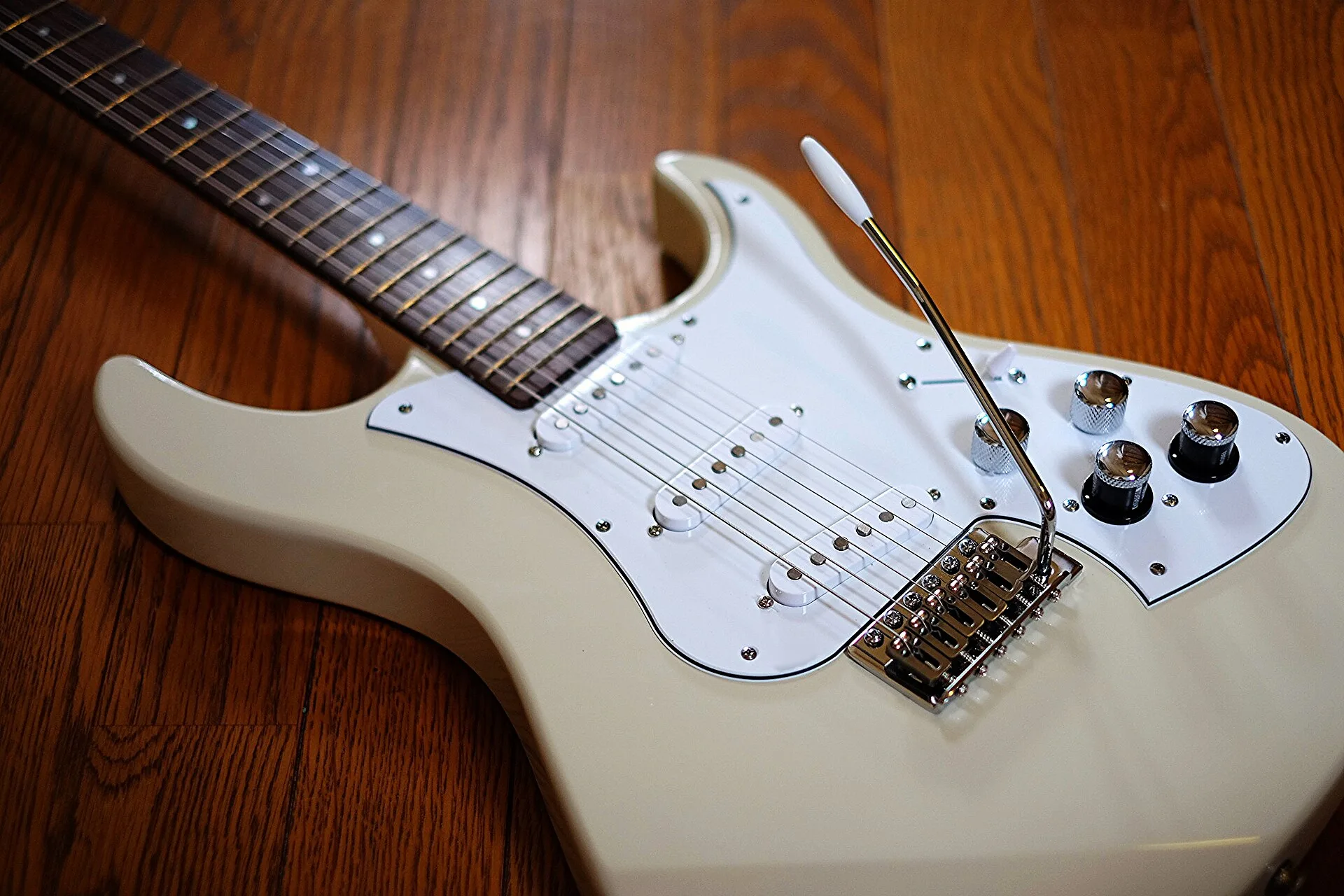
Look at a first Variax and something is missing. No pickups. Just a volume, a tone, a 5-way blade, and a rotary knob.
The sound starts in the bridge. Each saddle has a piezo in it, so the guitar hears all six strings on their own. A computer inside takes those six signals apart and puts them back together as a Strat, a Gretsch, a Martin, or a Dobro, then sends ordinary analog out to any amp. Because the strings are separate, it can fake how one string rings against another, and shift one string’s pitch without retuning the rest.
It isn’t a synthesizer, and it doesn’t send MIDI. Every sound starts with you hitting a real string. Roland had already modeled guitars, with a hex pickup on the guitar you owned and the models in a box on the floor. The Variax put the box inside the guitar, and stopped at being a guitar.
Ryle’s line for it was the first guitar “to break the physical barriers to great tone by digitally modeling, in software,” the pickups, the tone circuit, the body, and the way a string dies away.
A3
A Telecaster to a banjo in one turn
Turn the knob and you walk through the banks. Teles. A 1959 Strat. Les Pauls. Gretsches. A Rickenbacker 360 and its 12-string sister, an ES-335 and a Casino, jazz boxes. Then the acoustics: Martins, a Guild 12-string, a J-200. Then the odd shelf: a Dobro, a Coral electric sitar, a Danelectro, a banjo, a tricone.
Five sounds in each bank, one per blade position, so the switch is sometimes a pickup and sometimes another instrument. The 12-string is tuned in unison on the top two strings and in octaves on the bottom four, the way a real one is. None of the makers being modeled endorsed any of it.
No power, no sound. Six AA cells got you about 12 hours; a 9-volt, about an hour and a half. Or a footswitch fed it down the cable. With no magnetic pickups, the trade was hiss instead of single-coil hum, and high gain still found the hiss.
Flip the record · By the numbers
6
Piezos, one in each bridge saddle. No magnetic pickups on the first Variax.
$1,495
The expected list price on the 2002 show floor.
12 hours
On six AA cells. A single 9-volt gave you about an hour and a half.
Side B
B1
Korea, then a number
It was built in Korea, in black, sunburst, and candy-apple red, and it reached stores at the end of 2002. The list on the show floor was expected to be $1,495. Ask what the body is and you get two answers: one review guitar was basswood, and the show floor was promised alder. Keep both.
It didn’t have a model number. When the carved-top, Japan-built 700 came along in 2004, the original was relabeled the 500. A tremolo version, the 600, had already followed. An Indonesian 300 in agathis came in 2005. There was an acoustic Variax and a bass, too, which are other stories.
Line 6 wouldn’t say how many it sold.
A dead battery on the first Variax was silence.
The next one fixed that. James Tyler’s Variax, shipping in summer 2010 or at NAMM 2011 depending on who’s counting, added magnetic pickups you could see. Run the pack flat and it’s still an electric guitar. In January 2014 Yamaha bought Line 6, and the Variax Standard followed. Ryle promised a ’50s single-coil “without the hum and buzz.” The last new shape was the Shuriken, built with Stevic MacKay, whose first Variax had been a 500, “a regular guitar” with no pickups and extra controls. Then Line 6 said the JTV, the Standard, and the Shuriken were no longer made, and named nothing to replace them.
B2
The utility
On the 2013 Yes tour, Steve Howe’s main guitar was his 1964 ES-175. Next to it sat a Variax 600. That was the Danelectro sitar, the Guild 12-string, and the Martin 0-18. One guitar on a stand, three instruments in the set.
For the Asia reunion, Howe wanted the parts exact, a standard he says he learned in later Yes. That, he said, “was possible because I was using Line 6.” And: “I was fascinated with the Variax.”
John McFee of the Doobie Brothers started on one for the same reason. In that band, one song could ask for a distorted lead, a clean sound, and a baritone. He plays the banjo model live.
Nobody hung a Variax on the poster. It was on the stand next to the guitar that was, being every other guitar the set called for.
Put this on
You’ve read about it. Now hear it. Here’s what this guitar sounds like, and what to listen for.
Shuriken Variax demo, NAMM 2018
MacKay on the guitar he spent ten-plus years shaping with Line 6, a year after launch. He says it isn’t a signature, “otherwise it would be called the Stevic.”
Watch it on YouTube (opens in a new tab)
The cast
The people, and the specific guitars, that made the legend.
2013
Steve Howe
Variax 600
Of Yes and Asia. His sitar, Guild 12-string, and Martin 0-18 on the 2013 Yes tour. His main guitar stayed his 1964 ES-175. “I was fascinated with the Variax.”
2017
Stevic MacKay
Variax 500, then the Shuriken
Of Twelve Foot Ninja. His first Variax was a 500, “a regular guitar” with no pickups and extra controls. The Shuriken took ten-plus years with Line 6 and Yamaha.
John McFee
Variax
Of the Doobie Brothers. Started on one because a single song could ask for a distorted lead, a clean sound, and a baritone. Uses the banjo model live.
Liner notes
Specs, construction, rarity, value, and every source we used.
Six saddle piezos into an onboard DSP — Line 6’s Variax, the solidbody meant to be other guitars, not a pickup you bolt onto one you already own.
- Body
- Contoured double-cut solid. Sound on Sound’s 2003 review: basswood. Sonicstate’s NAMM note was “assured” of alder. Keep both.
- Neck
- Bolt-on maple
- Fingerboard
- Rosewood, 10" radius, 22 medium frets (Sound on Sound). Closest common wire is Dunlop 6130, “not exactly the same” (Line 6).
- Scale
- 25.5" (Line 6: all first-generation Variax electrics). No millimetres invented.
- Pickups
- One piezo in each bridge saddle. No magnetic pickups.
- Hardware
- String-through hardtail; bridge in the non-trem Strat pattern (Sound on Sound)
- Electronics
- Volume, tone, model rotary (pull to save), 5-way. Low impedance. Six AA cells or the XPS footswitch. Not MIDI.
- Finish
- Polyester. Black, sunburst, candy-apple red.
- Nut
- 1 5/8" on the guitar later badged 500 (Line 6). Material unpublished.
Open the full research fileConstruction details, the complete player record, production numbers, dated value estimates, and sources
Classic living example = 2002–03 Line 6 Variax, the Korea hardtail that had no model number until Line 6 badged it 500. No current typical SKU this pass: Line 6’s knowledge base says the James Tyler Variax, Variax Standard, and Shuriken are no longer manufactured. Factory inches for scale and nut. Factory millimetres for the wrenches — saddle 1.5 mm, bridge height 2.5 mm, truss 4 mm — and the tuner hole 10 mm (13/32"). Mix flagged. Do not convert 25.5". 300 is agathis, nut 1 11/16". 600 is the tremolo, maple board. 700 is the Japan carved-top. Acoustic 300/700/900 and bass 700/705 are other instruments. JTV, Standard, and Shuriken add magnetic pickups. No Gibson SKUs.
Construction
The job was the rest of the gig bag. Line 6 already modeled amplifiers with the POD. The guitar was the harder measurement. Marcus Ryle told USA Today they analyzed anything that changed an instrument, down to how much copper sat on a pole piece. Harmony Central, 19 July 2002, Summer NAMM: “the world’s first digital modeling guitar.” Ryle, in that release: the first guitar “to break the physical barriers to great tone by digitally modeling, in software,” pickup type, tone circuit, body resonance, string decay. One knob, and a single-coil solidbody is suddenly a 12-string.
It is not a synthesizer, and it does not send MIDI. Sound on Sound (Paul White, June 2003) and Line 6’s FAQ: every sound starts as the string. A piezo in each saddle, six signals, processed apart, so the model can fake what one string does to another and shift one string’s pitch without retuning the rest (Wikipedia). Then back to analog, into any amp. Roland had already modeled guitars. White names the VG-8 and VG-88: a hex pickup on a guitar you already own, the models in a floor box. Variax puts the box in the guitar, and stops at the guitar. The G-707 (roland-g-707) is a different Roland controller.
Dates do not collapse. Announced Summer NAMM 2002. Harmony Central: autumn 2002, black, sunburst, candy-apple red. Sonicstate, 21 July 2002: Korea, expected October, list $1,495, and the reporter was “assured” of alder. Ryle to USA Today, 9 December 2003: it “first hit stores at the end of 2002.” He would not give a sales figure. This plate starts in 2002. White’s June 2003 review is the shipping guitar, still just called Variax. Wikipedia: no model number until the 700 arrived in 2004 and Line 6 relabeled it the 500.
White’s guitar is basswood. Sonicstate’s NAMM floor was alder. Keep both. Bolt-on, string-through, piezos in the saddles, no magnetic pickups, and no tremolo yet. White: the only modeled guitars that even had one were a Strat, a 6120, and a Casino. Polyester. The 500 nut is 1 5/8"; the 300 is 1 11/16". Scale and nut are inches. The wrenches and the tuner hole are millimetres. Mix flagged.
Volume, tone, a 5-way, and a rotary. Ten banks plus two custom slots, five sounds on the blade, so the switch is sometimes a pickup and sometimes another instrument. White’s banks: Teles, a 1959 Strat (the tone control does reach the bridge), Les Pauls, Gretsch, a 360 and a 360-12, an ES-335 and a Casino, jazz boxes, Martins, a Guild 12, a J-200, then a Dobro, the Coral electric sitar, a Danelectro, a banjo, a tricone. The 12-string is unison on the top two and octaves on the bottom four. Line 6 told White none of those makers endorsed it. A Lester bank is not a Les Paul. No Gibson SKUs.
Unpowered, it is quiet. Six AA cells, about 12 hours; one 9-volt, about 1.5 hours (White). The XPS footswitch powers it down a TRS lead and splits a quarter-inch amp feed from an XLR to the PA. What you gain, he writes, is hiss instead of single-coil hum. High gain still finds the hiss.
Wikipedia: the 500 was dropped about a year after the 2004 relabel, Korea. Guitar-list: 2002 to about 2005. USA Today in December 2003 already listed a basic at $1,399.99 and a deluxe up to $2,099.99, before that 700 year. Keep the price tiers and the date. Do not declare them the same SKU. White, September 2004: a tremolo version had already followed, and Winter NAMM 2004 had previewed the acoustic. That tremolo is the 600 — maple neck and board, six-in-line, Korea then China, same 1 5/8" nut. The 300: 2005, Indonesia, agathis, wider nut, limited supply by 2007, gone early 2009. The electric 700: carved top, Japan, hardtail or vibrato. By November 2006 Line 6 says the line had moved from Korea to Indonesia and China, assembled in the U.S.
Not the acoustic. White’s September 2004 review: chambered mahogany, a soundhole that does not open a real box, cedar top, 24 frets, 25.5", 17" radius. Line 6’s legacy page says spruce. Wikipedia: cedar, later spruce. The Acoustic pilot’s handbook, not White, calls the original “the world’s first modeling guitar.” Wikipedia: acoustics discontinued 2010. A 900 is named there. No factory count found. Not this table.
Not the bass. Variax Bass 700 and 705. Sound on Sound, June 2005, £949 including VAT. Wikipedia and No Treble: discontinued 2007.
The second electric has pickups you can see. Tyler’s timeline: talks began 2007. Premier Guitar, 24 March 2010: three styles, ship summer 2010, 25 instruments and a dozen tunings. Tyler dates the three models at NAMM 2011. Keep both. U.S. and Korean builds (Wikipedia). Early Variax: no magnetics, so a dead pack is silence. These still make a sound on the magnetics if the pack is dead. JTV-59 is the set-neck single-cut at 24-9/16". JTV-69 is the 25.5" bolt-on with a Tyler tremolo. JTV-89 is 24-fret. JTV-89F, announced 24 January 2013: a Graph Tech Floyd-licensed bridge with the piezos in it. Line 6 Japan’s spec table: lithium-ion, 12 hours, and without the battery it is an ordinary electric. Line 6’s FAQ: post-2017 boards went to ebony where rosewood had been. Do not average 24-9/16" with 25.5".
Yamaha bought Line 6 in January 2014 (Line 6, 22 January 2015). First guitar of that marriage: Variax Standard, NAMM 2015, MSRP $1,119.99, on sale that quarter. Yamaha alder, one-piece maple, rosewood, custom-wound magnetics, Line 6 tremolo, Graph Tech nut. Push the model knob to leave the pickups. Ryle: a ’50s single-coil “without the hum and buzz.”
Shuriken is Stevic MacKay’s shape, same plate. Line 6, Yamaha Guitar Development, and MacKay. SR270 is the 27" / Japan 685.8 mm baritone, which his NAMM 2018 demo treats as launched the year before — 2017. MusicRadar, 28 June 2018: SR250 at $2,099 and 25.5". Line 6’s SR250 FAQ agrees: 25.5", Indian ebony, alder. Japan prints 648 mm. Wikipedia says both appeared early 2017 and calls the short scale 25 inches. Keep 2017 against 2018, and 25" against 25.5" / 648 mm.
Classic vs current: a 2002 Korea hardtail, piezo only, basswood in the review and alder on the show floor — against no new Variax in 2026. Line 6’s end-of-life page: JTV, Standard, and Shuriken are no longer manufactured. Wikipedia dates that page 10 October 2023. No replacement is named. No Gibson SKUs.
Players
Do not hang a modeled guitar on the player who made the original famous. Howe’s ES-175, the Spank bank’s 1959 Strat, and the Coral electric sitar (coral-electric-sitar) stay on their own plates.
Steve Howe (Yes, Asia). The electric this plate can name. Premier Guitar’s rig rundown, Shawn Hammond, 1 May 2013, Omaha: a Line 6 Variax 600, for the Danelectro sitar, the Guild 12-string, and the Martin 0-18. His main guitar on that tour is the No. 2 1964 ES-175, U.S. dates only. The 600 is the utility, not that Gibson. Guitar World, 18 June 2021: the accuracy he wanted for the Asia reunion, a bar he says he learned in later Yes, “was possible because I was using Line 6.” “I was fascinated with the Variax.” He does not pin Phoenix to a serial here.
Stevic MacKay (Twelve Foot Ninja). Line 6’s January 2017 film: the first Variax he played was a 500 — “a regular guitar,” no pickups, extra controls — and the Shuriken is a ten-plus-year collaboration, longer scale, with Line 6 and Yamaha Guitar Development. At NAMM 2018 he says he does not think of it as a signature, “otherwise it would be called the Stevic.” The SR270 and SR250 are this plate. They are not a census of every Twelve Foot Ninja guitar.
John McFee (Doobie Brothers). Line 6’s February 2011 James Tyler film, in his own words: he started on a Variax because one song in that band could ask for a distorted lead, a clean sound, and a baritone. He also uses the banjo model live with the Doobies. The song titles are not in that film.
Also known to play stays empty this pass. Laundry lists are not named instruments. None invented.
Rarity
No current Variax SKU. Line 6 does not publish Variax unit totals. Ryle declined to give USA Today one in December 2003. None invented.
The first-generation electrics ran from the unnumbered 2002 guitar through the 2010 Tyler change. A 500 is the common used object: Korea, hardtail, piezo only, and the name only exists because the 700 showed up. They are not scarce the way a first-year solidbody from the 1950s is. What is actually thinner: an unnumbered 2002, before the 500 badge; the Japan 700; a U.S.-built JTV against the Korean one. Acoustic 700s and the bass are other catalogs. Wikipedia’s 900 is a short acoustic variant with no count found here. Howe’s 600 and MacKay’s Shuriken are unique objects. They are not a vintage Variax.
Value
Informal estimate, 15 October 2026. Not an appraisal.
Ask vs sold labeled. Celebrity lots are not-comps. No invented medians or factory counts. A 2002 list and a 2015 MSRP are not 2026 street. Reverb’s price-guide widget did not print a clean U.S. dollar band for the 500 this pass.
New street. None confirmed. Line 6 says leftover JTV, Standard, and Shuriken stock may still sit at dealers, often cut to clear. Historical lists, not a cart: Sonicstate, July 2002, expected list $1,495. USA Today, 9 December 2003, basic $1,399.99, deluxe up to $2,099.99. Sound on Sound, June 2003, £799 including VAT. Variax Standard MSRP $1,119.99 (Line 6, 22 January 2015). Shuriken SR250 $2,099 (MusicRadar, 28 June 2018).
Used modern. The 500 is the ordinary tape. Named asks, not hammers: Sweetwater Gear Exchange, black, serial 03070674, seller says 2003, $249 (was $378). That exchange also showed a black 500 at $236.55 (from $249) — treat it as the same tape moving, not a second guitar. Reverb, Tulsa Guitar Co., black, Very Good, $449.65 (was $529). Reverb, Scott’s Boutique, 2004 sunburst, serial 04036567, Excellent, $310. Music Go Round, Aurora, sunburst, $269.98 (was $299.99). One named sold, not a series and not dollars: Reverb Sweden, 4 September 2025, Excellent, kr5,149.59. Gardiner Houlgate, 12 June 2024, a 2003 left-handed Korea Variax with gig bag, sold £200 (estimate £100–200). Do not average asks with that hammer.
Vintage / collectible. There isn’t a separate vintage market so much as a nicer old one. A Japan 700 and a U.S. JTV are not comps for a Korean 500. Named ask, different tape: Reverb, JTV-69 US, Excellent, C$5,005.67. Sweetwater’s used-price advisor for an SR270 printed $975–$1,155 — an advisor, not a sold median. No U.S. sold median computed here. Howe’s 600 is one object. Not a comp.
See also
- roland-g-707 — Roland’s hex-pickup controller; the GR-700 is the external synthesizer / floor module (voices), not a DSP under the bridge
- parker-fly — piezo plus magnetics in a carbon-skinned solidbody; the guitar is itself, not a model of another one
- coral-electric-sitar — the 1967 Vincent Bell sitar the Reso bank imitates; not this solidbody
Sources
- Harmony Central, Line 6 Variax announcement, 19 July 2002 — Summer NAMM; “world’s first digital modeling guitar”; autumn 2002; black, sunburst, candy-apple red; Ryle on pickup type, tone circuit, body, decay.
- Sonicstate, 21 July 2002 — Korea; expected October ship; list $1,495; alder “assured.”
- USA Today, 9 December 2003 — Ryle: stores at the end of 2002; no sales figure; basic list $1,399.99; deluxe to $2,099.99; Roland VG-88 named as the other modeler.
- Sound on Sound, Paul White, June 2003 — basswood; 25.5"; 22 medium frets; rosewood 10" radius; bolt-on; string-through; piezo saddles; no tremolo yet; six AA ~12 hours; 9V ~1.5 hours; £799 inc VAT; not MIDI; not a synth; VG-8 / VG-88 contrast; model-by-model tour; 12-string unison/octave split.
- Line 6 Knowledge Base, Variax electric specifications — 500 nut 1 5/8"; 300 nut 1 11/16"; 600 nut 1 5/8"; all electrics 25.5"; polyester; 1.5 mm / 2.5 mm / 4 mm wrenches; tuner hole 10 mm (13/32"); D’Addario 10–46; low impedance.
- Line 6, Variax general FAQ, 7 November 2006 — not a MIDI guitar; string vibrations first; originally Korea, then Indonesia and China, assembled in the U.S.
- Line 6, Variax 500/700 Pilot’s Handbook (Rev B) — XPS footswitch, PX-2, TRS, 1.5 mm and 4 mm wrenches; factory custom-bank assignments.
- Wikipedia, Variax — line 2002–2023; unnumbered original relabeled 500 when the 700 arrived in 2004; 500 dropped about a year later; 300 (2005–early 2009, Indonesia, agathis); 600 tremolo; 700 Japan; no magnetics until Tyler; acoustics discontinued 2010; bass discontinued 2007; EOL page dated 10 October 2023. Body-wood table omits the 500. SR250 “25 inch / early 2017” disagrees with Line 6 and MusicRadar.
- guitar-list, Variax 500 — manufacture window 2002 to about 2005.
- Premier Guitar, 24 March 2010 — Tyler line announced Frankfurt; three styles; ship summer 2010; 25 instruments and a dozen tunings.
- James Tyler Guitars, history and timeline — talks began 2007; three JTVariax models at NAMM 2011.
- Premier Guitar, JTV-89F, 25 January 2013 — Graph Tech Floyd-licensed tremolo; announced Anaheim, 24 January 2013.
- Line 6, JTV / Standard / Shuriken FAQ — JTV-59 scale 24-9/16"; post-2017 ebony boards.
- Line 6 press release, 22 January 2015 (PDF) — Yamaha acquisition January 2014; Variax Standard MSRP $1,119.99; alder; magnetic pickups; Q1 2015.
- MusicRadar, Joe Bosso, 23 January 2015 — Standard as the first Yamaha collaboration guitar; same MSRP and finishes.
- MusicRadar, Michael Astley-Brown, 28 June 2018 — SR250 at $2,099; 25.5" against the SR270’s 27".
- Line 6 Knowledge Base, Shuriken SR250 FAQ — 25.5"; Indian ebony; alder; Stevic MacKay presets; Yamaha Guitar Development.
- Line 6 Japan, Variax spec comparison — SR270 685.8 mm; SR250 648 mm; lithium-ion, 12 hours, plays as a normal electric with no battery; rosewood boards before 1 March 2018.
- Line 6 Knowledge Base, end of life — JTV, Standard, and Shuriken no longer manufactured; leftover retail stock possible; no successor named.
- Sound on Sound, Paul White, September 2004, Variax Acoustic 700 — tremolo version already existed; Winter NAMM 2004 preview; cedar top; chambered mahogany; 24 frets; 25.5"; 17" radius.
- Line 6 legacy, Variax Acoustic 700 — features list says spruce top; 24 frets; 25 1/2"; 17" radius.
- Sound on Sound, Phil Ward, June 2005, Variax Bass 700 — bass, not this table; £949 inc VAT.
- No Treble, 28 February 2013 — Variax Bass 700 discontinued 2007.
- Premier Guitar, Shawn Hammond, Rig Rundown, 1 May 2013 — Howe’s Variax 600 for Danelectro sitar, Guild 12-string, Martin 0-18; ES-175 is the main guitar.
- Guitar World, James Wood, 18 June 2021 — Howe: “I was fascinated with the Variax.”
- Line 6, Shuriken Variax film, 19 January 2017 — MacKay’s first Variax was a 500; ten-plus years to the Shuriken.
- Line 6, Shuriken NAMM 2018 demo — MacKay: launched “last year”; not a namesake signature.
- Line 6, James Tyler Variax film, 22 February 2011 — John McFee: Doobie Brothers; distorted, clean, and baritone in one song; banjo model live.
- Sweetwater Gear Exchange, Variax 500 black — ask $249 (was $378); serial 03070674; another black $236.55.
- Reverb, Variax 500 black — Tulsa Very Good ask $449.65 (was $529). U.S. price-guide widget did not print a clean band.
- Reverb, Variax 500 sunburst — 2004 Excellent ask $310; serial 04036567.
- Reverb Sweden, Variax 500 black — sold 4 September 2025, Excellent, kr5,149.59. Not a dollar median.
- Music Go Round, Aurora, Variax 500 — sunburst ask $269.98 (was $299.99).
- Gardiner Houlgate, 12 June 2024 — 2003 left-handed Korea Variax, sold £200.
- Reverb, JTV-69 US — Excellent ask C$5,005.67; U.S.-made; not a 500 comp.
- Sweetwater Gear Exchange, SR270 — advisor range $975–$1,155; not a sold median.
Keep digging
Guitars this one gets compared to, confused with, or descended from.
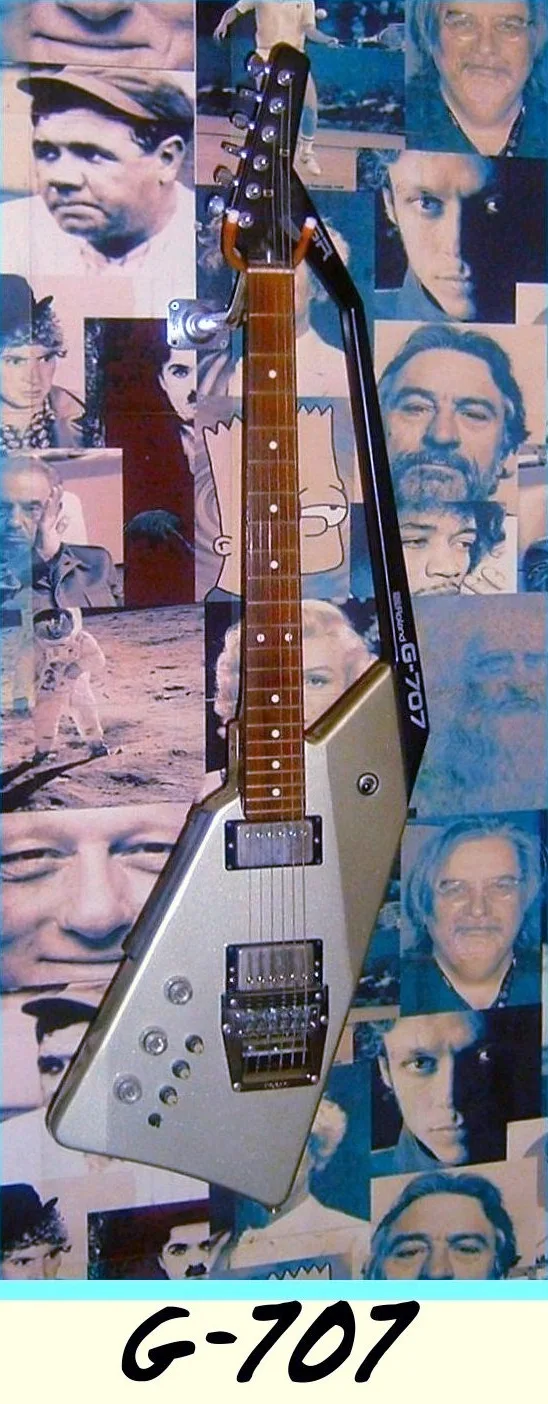
Photo: Some_of_my_lefty_guitars.jpg: Hugh Jarrse / Wikimedia Commons / CC BY-SA 3.0 Roland
G-707
1984
Roland bent a guitar into a strange shape so a machine could hear it. Then the machine learned to hear any guitar.
- Send a picture
Parker
Fly
1993
Ken Parker built it like a lobster: wood on the inside, and all the strength in a skin thinner than the paint.
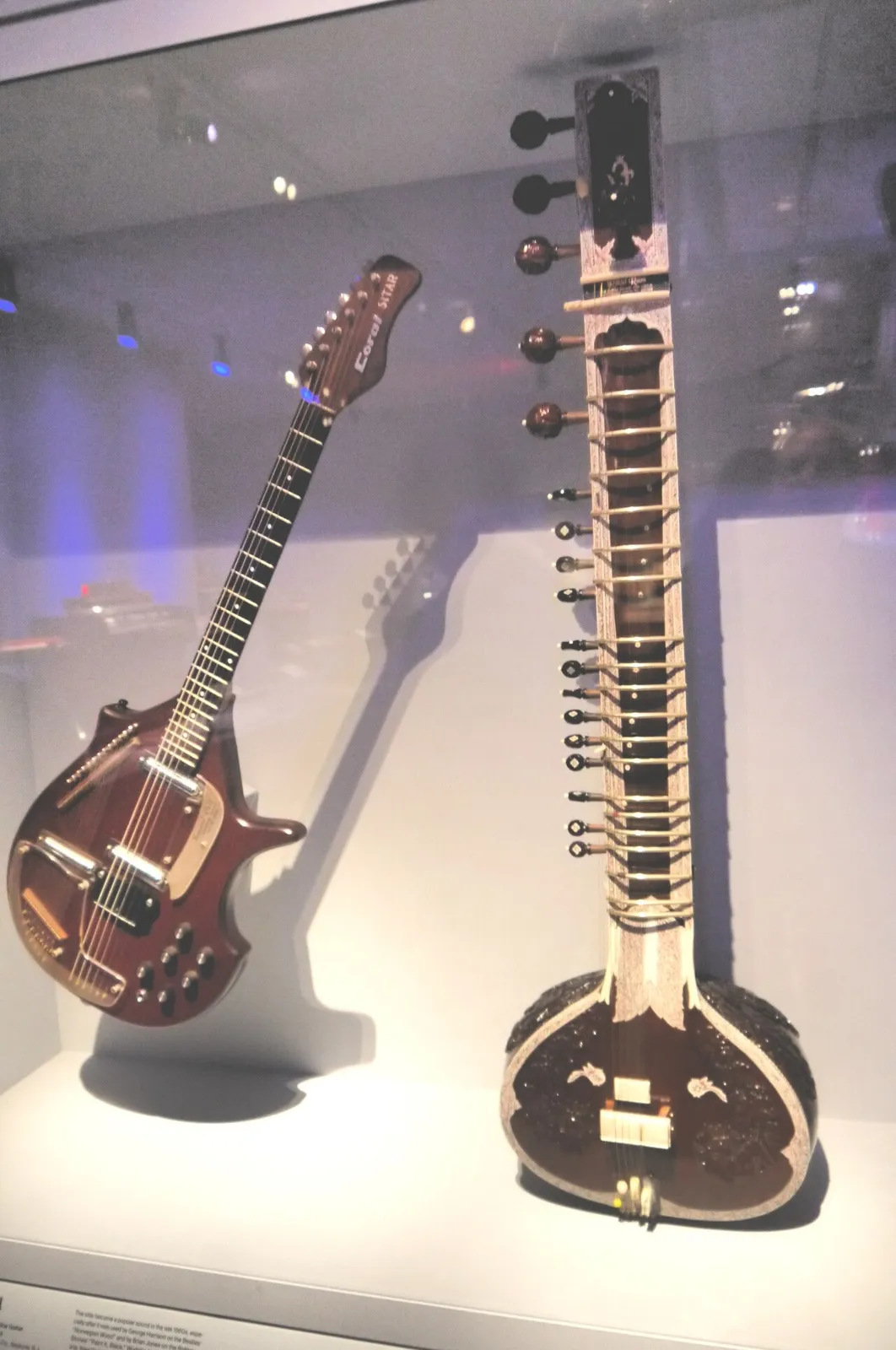
Photo: Eden, Janine and Jim / Wikimedia Commons / CC BY 2.0 Coral
Electric Sitar
1967
Built so a session player could fake a sitar before lunch. Some of those afternoons are still on the radio.