Nik Huber
Orca
Nik Huber admits his shapes are “a mix of everybody.” When Gibson wrote about the Orca, he didn’t argue.
Frankfurt, 1994. A German builder, a cabinet-maker’s son, walks up to Paul Reed Smith at the music fair and shows him a guitar he made. Faxes follow. A few years later, in a town called Rodgau, he draws a single-cut with a whale on the headstock.
- Introduced
- 1997
- Type
- Solidbody electric
- Class
- Production
Have a photograph of this guitar? Send a picture
The short version
1993
First guitars
Nik Huber starts building.
1994
Frankfurt
He shows Paul Reed Smith an early guitar at the Musikmesse.
1995
The Dolphin
His first body shape. The dolphin is also his logo.
1996
Rodgau
The company is founded, and the Orca outline gets drawn.
1998
The Orca
The model arrives, late 1997 or 1998 in Huber’s own telling.
2008
Ten years
Ten special anniversary Orcas, with sterling-silver creature inlays.
2026
Thirty years
The company’s 30th year, still in Rodgau.
Side A
A1
A mix of everybody
Nik Huber is a cabinet-maker’s son. He went to guitar-building school in Spain, started building in 1993, and in 1994 walked up to Paul Reed Smith at the Frankfurt music fair to show him a guitar. Faxes followed. By 1995 he was running a PRS authorized repair shop.
His first shape was the Dolphin. Then, in 1996, he drew something closer to a Les Paul, and he has never pretended otherwise. The Dolphin, he says, “was my first shape before I even came up with the [more Les Paul-like] Orca outline in ’96… although you can see it’s a mix of everybody.”
That’s a builder owning up to where his shapes came from. Most builders don’t say that part out loud.
A2
Thinner, longer, and a whale
The Orca model came out in late 1997 or 1998. On paper it’s the familiar recipe: a carved maple top on mahogany, a set neck, two covered humbuckers, a stop tailpiece. Then it walks away from that recipe in all the places you feel.
Huber’s own copy says it plainly: “a slightly thinner body and a longer scale.” About half an inch of mahogany comes out of the body compared with a typical Les Paul, and there’s a belly cut on the back. The scale is 25 inches instead of 24½, so the strings sit a little tighter and the notes a little clearer. The carve is deeper, with little dips around the knobs, and the neck set and headstock angle are shallower. One reviewer called those “features borrowed from the PRS playbook,” which is fair.
Another reviewer found the heel dressed away so hard it reminded him of a German target rifle. Up past the 16th fret, the back of the neck just scoops away and gets out of your hand.
The pickups are PAF-style humbuckers by Harry Häussel, with a coil split on the neck tone knob. And on the headstock there’s a whale. Rodgau, not Kalamazoo.
There’s also an Orca ’59, a sister with the same 25-inch scale but a full-thickness mahogany body, a Brazilian rosewood board, and crown inlays. It’s the most Les Paul-ish thing Huber makes. Keep it in mind. It comes back.
A3
Ten a month
This is a small shop. It built about ten guitars a month in 2006. Lately it’s somewhere around 350 to 400 a year, with about a dozen people doing the building. For the tenth anniversary in 2008, Huber made ten special Orcas and ten special Dolphins, with quilted maple and creatures inlaid in sterling silver.
Mike Sullivan of Russian Circles doesn’t hedge:
“The Orca is truly a remarkable guitar… My Orca out performs vintage guitars I’ve played for years.”
Scott Middleton of Cancer Bats could have taken free guitars from endorsement deals. He spent his own money on a Krautster and an Orca instead.
Flip the record · By the numbers
25"
Scale length. Longer than the usual single-cut’s 24½.
½"
About how much mahogany comes out of the body, compared with a typical Les Paul.
20–25%
Share of Huber’s business that was in the US before he stopped shipping Orcas there.
10
Special Orcas built for the company’s tenth anniversary in 2008.
Side B
B1
The letter from Gibson
And then there was the letter. Huber calls it a friendly one from Gibson, about Gibson’s US trademark on a traditional single-cut outline. He talked to Paul Reed Smith’s lawyers and to John Suhr’s lawyer. And then he decided not to fight.
His reasoning is the most honest thing I’ve read from a guitar maker in a while:
“To be totally honest, the Orca ’59 was just too close to a Les Paul.”
The US had been 20 to 25 percent of his business. He stopped shipping Orca-shaped guitars there anyway and leaned on the Dolphin for American customers. Go to the Orca page on his site today and it says it right there: “Not available in the USA.”
B2
Still in Rodgau
Everywhere else, you can still order an Orca, and the company is in its 30th year in 2026, in the same town it started in. Bernie Marsden’s later signature model was built on the Orca’s single-cut shape. The whale is still on the headstock.
Every guitar builder learns by borrowing. Huber borrowed from Gibson, from PRS, from everybody, and he says so. When the time came to put a price on that, he didn’t argue about it. He gave up the Orca in a market that had been a fifth to a quarter of his business, and kept building in Rodgau.
The cast
The people, and the specific guitars, that made the legend.
1996
Nik Huber
Builder
Cabinet-maker’s son. Drew the Orca in ’96 and still builds it in Rodgau.
1994
Paul Reed Smith
An early Huber
Saw one of Huber’s first guitars at Frankfurt. You can see some of his ideas in the Orca.
Mike Sullivan
Orca
Russian Circles. Says his Orca outperforms vintage guitars he’s played for years.
Scott Middleton
Orca
Cancer Bats. Turned down free endorsement guitars and paid for a Krautster and an Orca himself.
Bernie Marsden
Signature model
His later signature model was built on the Orca’s single-cut shape. An artist guitar, not a stock Orca.
Liner notes
Specs, construction, rarity, value, and every source we used.
Maple on a thinner mahogany single-cut, 25 inches, a whale on the headstock — Huber’s Orca, not a Les Paul, and not the Dolphin.
- Body
- Curly maple top on mahogany; single-cut, thinner than a typical Les Paul. Factory: slightly thinner body. Vintage Guitar (Sep. 2006): ½" quilted maple, 1⅝" total thickness (~½" less than a typical Les Paul), belly contour. Mix flagged.
- Neck
- Set mahogany, Orca Std. Factory: 0.92" (23.4 mm) at 1st, 1.00" (25.5 mm) at 12th. Mix flagged.
- Fingerboard
- East Indian rosewood; compound 10"–14" (255–355 mm); 22 medium-jumbo extra-hard frets (2.49 mm × 1.19 mm); abalone dots (7 mm). Mix flagged.
- Scale
- 25" (635 mm). Mix flagged.
- Pickups
- Two Häussel 1959 humbuckers, aged nickel covers
- Hardware
- ABM AVR-2 and aluminium tailpiece, nickel; Schaller Grandtune “Nik Huber” Kluson-style; ebony truss-rod cover; mahogany or ebony backplate; hardcase
- Electronics
- Two volumes, two tones (neck tone push/pull coil tap), 3-way toggle
- Finish
- Factory colors: Faded Sunburst, Tobacco Sunburst, Atlantic Blue, Charcoal Burst, Gold Top. MusicRadar (2011) and Station Music dealer card: nitro semi-matte / semigloss. Factory page does not name the system.
- Nut
- Polished bone, 1.67" (42.5 mm). Vintage Guitar 2006 guitar: 1⅝". Mix flagged.
Open the full research fileConstruction details, the complete player record, production numbers, dated value estimates, and sources
Current typical = factory Orca, Rodgau (nikhuber-guitars.com/orca, fetched 16 September 2026). Factory prints inches and millimetres; mix flagged, not averaged. Orca ’59 is full-thickness mahogany, Brazilian rosewood, maple binding, crown inlays — not this table. Dolphin is the first Huber outline. Krautster II is a slab on the Orca shape. Factory: Not available in the USA. No Gibson SKU. Standalone — not a Les Paul family card.
Construction
The job was a single-cut the Dolphin was not. Carved maple on mahogany. Two covered humbuckers. A stop. Thinner in the body, longer in the scale, a whale on the headstock. Rodgau, not Kalamazoo.
Nik Huber started building in 1993 (factory About). Cabinet-maker’s son; guitar-building school in Spain (MusicRadar, Neville Marten, 2 December 2011). 1994: he showed Paul Reed Smith an early guitar at Frankfurt; faxes followed (Guitar.com, Daniel Seah, 20 April 2020). Vintage Guitar (Phil Feser, Sep. ’06 issue): Huber ran a PRS authorized repair shop in 1995. Factory About: company founded 1996 in Rodgau; first Frankfurt Musikmesse 1997; NAMM 2002. World Guitars / dealer copy: workshop moved to a Rodgau commercial park in 1999. Guitar World (Dave Burrluck, 18 March 2024) treats 2026 as the company’s 30th year. Keep 1996.
Dolphin first. Huber to Riff (Brad Wendkos, 21 April 2016): he first built the Dolphin shape in 1995; dolphin imagery was the logo. Guitar World, 2024: Dolphin “was my first shape before I even came up with the [more Les Paul-like] Orca outline in ’96… although you can see it’s a mix of everybody.” Same Riff interview: “The Orca came later (late 1997/ 1998) when we introduced our Orca Model.” Keep 1996 (outline) and late 1997/1998 (model). This plate starts in 1997.
What you get is a set-neck single-cut that borrows the dual-humbucker layout and then walks away from it. Factory copy: “a slightly thinner body and a longer scale.” Feser, 2006: 1⅝" thick, about ½" taken out of the mahogany; ½" quilted maple; a generous belly cut; a deeper carve than a Les Paul, with PRS-style depressions around the knobs and a natural maple edge that reads as binding. Scale 25" against a typical 24½". Shallower neck set and headstock angle — “features borrowed from the PRS playbook.” MusicRadar, 2011: more svelte than a Les Paul; a hook-ish lower horn for the upper frets; the heel dressed away so hard it reminded Marten of a German target rifle. Neck meets the body at the 16th fret, same as the usual single-cut, then a big scoop on the back. That is the construction people mean.
Pickups have been Harry Häussel’s PAF-style 1959 covers since the named reviews. Two volumes, two tones, 3-way. Coil split on the neck tone — push/push on the 2006 and 2011 guitars; factory now prints push/pull. Feser’s test guitar: unbound Brazilian, 14" radius, no board markers, Dunlop 6150s, a mother-of-pearl whale and “Nik Huber” on the headstock, flame-maple cavity covers. Weight on that guitar 7.25 lb. MusicRadar’s tobacco sunburst: unbound Indian rosewood, abalone dots, Gotoh Keystone tuners, semi-matte nitro, just over 3 kg (7 lb). Current factory card: East Indian rosewood, compound 10"–14", abalone dots, Schaller Grandtune, ABM AVR-2, polished bone 1.67". Do not flatten Feser’s Brazilian 14-inch board onto the live card.
Not this guitar. Orca ’59 is the full-thickness sister — factory 2016 PDF: “Mahogany (full thickness)”; Brazilian, maple binding, crowns; Guitar.com (Chris Vinnicombe, 21 August 2019) measured about 57 mm on a Spanish-cedar example. Same 25-inch scale. Different body. Dolphin / Dolphin II / Dolphin ’59 are the other outline. Krautster (MusicRadar, 2010) put a slab Junior recipe on the Orca shape; Krautster II is that slab, not this carved top. Krautster III went back to Dolphin. Bernie Marsden’s later signature needed “a single-cut Orca shape” (Guitar World, 2024) — a named artist guitar, not this spec table. Not a Les Paul (gibson-les-paul-standard). Different factory, different thickness, different scale, different heel. Ancestor in the carved-top dual-humbucker job. Not that guitar. No Gibson SKU.
USA. Factory Orca page: “Not available in the USA.” Huber to Guitar World, 2024: a friendly letter from Gibson about the US trademark on a traditional single-cut outline; he asked Smith’s lawyers and John Suhr’s lawyer, then declined to fight. “To be totally honest, the Orca ’59 was just too close to a Les Paul.” US was about 20 to 25 percent of the business. He stopped shipping the Orca-shaped guitars there and leaned on Dolphin. Outside the US the factory still lists Orca and Orca ’59.
Players
Do not hang a Les Paul, a Dolphin, or an Orca ’59 on this plate. Foo Fighters, Red Fang, and the rest of Guitar.com’s 2020 backline list are Huber players, not pinned Orcas.
Mike Sullivan — Russian Circles. Factory artist page, named Orca: “The Orca is truly a remarkable guitar… My Orca out performs vintage guitars I’ve played for years.” Company quote, not a session log. Album-to-guitar credits unpublished here.
Scott Middleton — Cancer Bats. Factory artist page: he spent his own money on a Krautster and an Orca rather than take free endorsement guitars. Named model. Which records are unpublished here.
Also known to play stays short. Deniz Alatas (The Busters) and Boban Milunovic (Stray Train) are factory Orca ’59 names. They stay off this slug. None invented.
Rarity
You can still order a new Orca outside the United States. Current production is not rare as a model. Huber does not publish Orca unit totals. None invented.
Company-wide output, not an Orca census: Vintage Guitar 2006, about 10 a month; Premier Guitar (23 April 2008), about 120 a year; MusicRadar 2011, about 15 a month; Guitar.com 2019 and 2020, team of eight, about 240 a year; factory About (fetched this pass), about 350 a year in Rodgau; Guitar World 2024, Huber “looking at 400 guitars a year,” 12 people building. Those numbers date the shop. They do not count Orcas.
Serials on dealer cards this pass (#34336, Session #44708) date a guitar. They don’t count a year.
What is actually thinner: US-bound Orcas after Huber stopped shipping the shape there; Feser-era Brazilian, no-marker boards; the 2008 10th-anniversary run Premier Guitar put at ten special Orcas and ten special Dolphins (quilted maple, sterling-silver creature inlays). That is a limited object. It is not a census of the Orca. Orca ’59 scarcity is a different plate.
Value
Informal estimate, 16 September 2026. Not an appraisal.
Ask vs sold labeled. Celebrity lots are not-comps. No invented medians, dollar conversions, or factory counts. Vintage Guitar $5,230 (2006) and MusicRadar £4,199 (2011) are period lists, not 2026 street.
New street. Made in Rodgau; options move the ticket. Not sold new in the USA. Named dealer cards this pass: Station Music, Orca Charcoal Burst nitro semigloss, serial #34336, €5,990.00 (3.52 kg). Reverb, brand-new Charcoal Burst €6,755.29 / €6,699; brand-new 2024 Goldburst €5,479.72 (price-dropped from €6,356.63). Session.de Orca Standard CB Limba / Korina Charcoal Burst #44708, €7,099.00 — korina custom, labeled adjacent. Guitar Brando exceptional-top Tobacco Sunburst $9,259.00 (sold out) — exceptional-top upcharge, not the base card. Do not average those asks into a MAP. Do not mix Session Orca ’59 asks (€7,990 Tigereye; €8,899 / €7,999 Customs).
Used modern. Reverb Price Guide snippet on Nik Huber Orca (France page, Good to Mint): €2,014–€7,676. Named used asks, not hammers: World Guitars pre-owned Charcoal Burst exceptional flame #21394, £4,595; Reverb used Charcoal Burst Excellent €6,017.54 / €6,118.38. US Reverb Price Guide widget on /p/nik-huber-orca did not print a dollar band this pass. Flag: thin US sold-comp access. Orca ’59 has its own Price Guide row — do not fold it in.
Vintage / collectible. Early Brazilian no-marker Orcas trade as used Orcas, not a separate SKU. The 2008 10th-anniversary ten are limited moderns, labeled adjacent. No clean 2024–26 hammer sample extracted for those. Don’t invent a band.
See also
- prs-mccarty — 22-fret Maryland carved-top; this is Rodgau’s thinner 25"
- heritage-h-150 — Kalamazoo’s house single-cut after Gibson left; not this German carve
- gibson-les-paul-standard — the Kalamazoo dual-humbucker this Rodgau guitar is not
Sources
- Nik Huber, Orca — living spec; thinner body, 25" / 635 mm; Häussel 1959; ABM AVR-2; Schaller Grandtune; “Not available in the USA” (fetched 16 September 2026)
- Nik Huber, Orca ’59 — sister card; Brazilian, maple binding, crowns; not this table
- Nik Huber, About — building 1993; company 1996, Rodgau; Musikmesse 1997; NAMM 2002; ~350 instruments a year
- Nik Huber, Mike Sullivan — named Orca; Russian Circles
- Nik Huber, Scott Middleton — bought Krautster and Orca
- Vintage Guitar, Phil Feser, Nik Huber Orca (Sep. 2006) — PRS repair shop 1995; ~10/month; ½" quilted maple; 1⅝" body; 25" vs 24½"; 1⅝" bone nut; unbound Brazilian 14" radius; Häussel; $5,230; 7.25 lb
- MusicRadar, Neville Marten, Nik Huber Orca DSB, 2 December 2011 — ~15/month; £4,199; semi-matte nitro; Indian rosewood, abalone dots; dressed-away heel; ~3 kg / 7 lb; Gotoh Keystone; Jason Sidwell road test
- Guitar World, Dave Burrluck, 18 March 2024 — Orca outline ’96; Dolphin first; Gibson US letter; 20–25% US business; stopped Orca-shaped US shipments; ~400/year, 12 builders; 30th anniversary 2026; Marsden needed Orca shape
- Guitar.com, Chris Vinnicombe, Orca ’59 review, 21 August 2019 — team of eight, ~240/year; Orca ’59 ~57 mm full-thickness; 25"/635 mm; £7,250 (’59, not this table)
- Guitar.com, Daniel Seah, Meet the Makers, 20 April 2020 — PRS 1994; eight builders, 240/year; Musikmesse 1997
- Riff, Brad Wendkos, 21 April 2016 — company 1996 / 20th anniversary; Dolphin first built 1995; Orca Model late 1997/1998
- Premier Guitar, Nik Huber 10th Anniversary Models, 23 April 2008 — ten Orcas and ten Dolphins; ~120 instruments a year
- MusicRadar, Nik Huber Krautster, 1 November 2010 — Krautster on the Orca shape, not this carved top
- Nik Huber Orca ’59 2016 PDF — “Mahogany (full thickness)” on the ’59 sister
- Station Music, Orca Charcoal Burst — €5,990; nitro semigloss; serial #34336; 3.52 kg (fetched 16 September 2026)
- Session.de, Orca Standard CB Limba — €7,099 korina custom #44708; Orca ’59 sister asks on the same dealer rail
- Reverb, Nik Huber Orca — 25" set-neck card; US dollar widget unpublished this pass
- Reverb France, Nik Huber Orca — Price Guide €2,014–€7,676 Good to Mint; new Charcoal Burst €6,755.29; 2024 Goldburst €5,479.72
- World Guitars, Nik Huber — company 1996; Messe 1997; Rodgau move 1999; used Orca Charcoal Burst #21394 £4,595
- Guitar Brando, Orca Exceptional Top Tobacco Sunburst — $9,259 exceptional-top ask, sold out
Keep digging
Guitars this one gets compared to, confused with, or descended from.
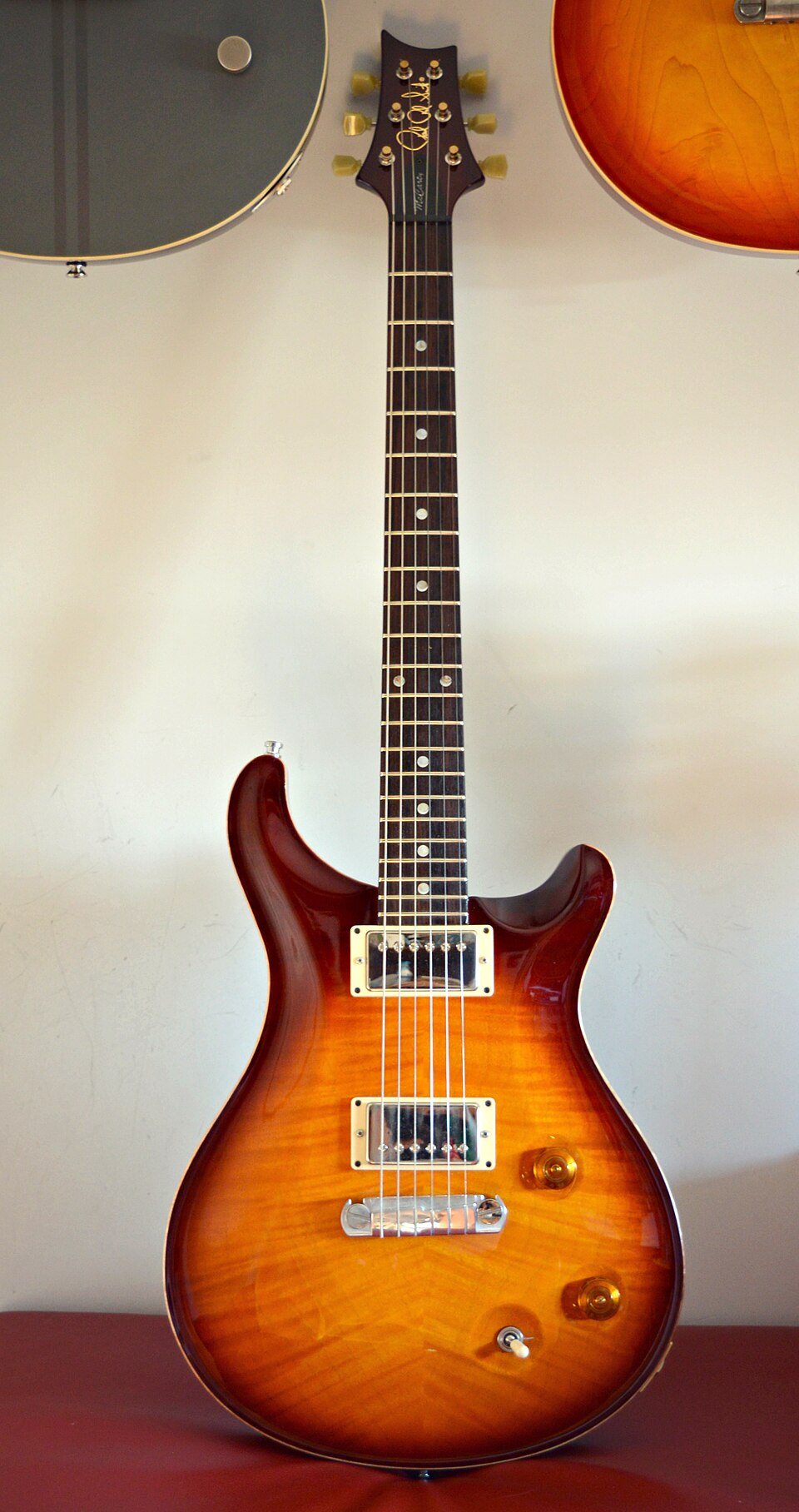
Photo: Freebird / Wikimedia Commons / CC BY-SA 2.0 PRS
McCarty
1994
Named for a man who never played guitar, built for a player who turned down having his own name on it.
- Send a picture
Heritage
H-150
1988
Gibson left Kalamazoo. A few of the people who built its guitars stayed in the building and kept going.

2006 Gibson Les Paul Standard (SN 000660573). Photo by wetwebwork. Licensed under CC BY-SA 2.0. Via Wikimedia Commons. Gibson
Les Paul Standard
1952
Gibson made about 1,500 sunburst Les Pauls, decided nobody wanted them, and stopped. Then the British blues boom happened.