Mayones
Regius
The copies sold in Poland. The guitar Mayones drew for itself had to go to Frankfurt, every year.
A garage in Gdańsk, under martial law, two guitars a month on a good month, magnets pulled out of cabinet locks. Sixteen years later the same family drew its own top model, and took it to Frankfurt to see if anyone would look.
- Introduced
- 1998
- Type
- Solidbody electric
- Class
- Production
Have a photograph of this guitar? Send a picture
The short version
1982
Gdańsk
Two friends start a company. The first bass was a year earlier.
1998
The top model
The Regius, made with Kombi's Grzegorz Skawiński, and a first Musikmesse booth. A later telling just says the late 1990s.
2006
Gothic and Elements
A Regius-6 Gothic for Anders Nyström, and Daniel Gildenlöw's Elements series. The fair streak reaches nine years.
2007
The earliest full spec
Eleven-piece neck-through, swamp ash, flamed maple, ebony. Nine years after the first one.
2009
Cologne
Wes Borland walks into a music store and the Regius stops him.
2017
A forearm cut
A review notes the new gentle slope. Before that, there wasn't one.
2024
Velvetrone
New orders get Mayones's own Ironside and Solium pickups.
2026
Another cut
A deeper forearm curve and a thinner upper back.
Side A
A1
Magnets from cabinet locks
Gdańsk, 1982. Two friends, a garage, and martial law. You couldn't buy guitar parts in Poland, so they made them: tuners, bridges, pickups. Switches came out of the scrap from a plant in Gniew that made switches for tanks. The magnets came out of cabinet locks, because the Baildon works wouldn't sell them a hundred. The pickup winder was built from a child's electric train.
Zenon Dziewulski did the woodwork. Halina kept the books and, in those years, wound the pickups. By her count they made one or two guitars a month.
The name belongs to the friend who left. Ask about it and you'll get a rock-and-roll nickname, or you'll get mayonnaise, because he put it on everything. Depends who's telling it.
A2
Copies don't travel
Then the border opened. Through the 1990s Mayones copied the look of Fender and Gibson, sold it cheaper, and Poland bought them. Dawid Dziewulski, the son, dates the "quality period" to when they could finally buy Schaller hardware.
But a copy is a copy. It wasn't going to make anybody outside Poland look twice.
A3
Frankfurt, every year
In Dawid's telling, the break came in 1998. With Grzegorz Skawiński, the guitarist from Kombi, they made a top model, the Regius, and that same season took a booth at Musikmesse in Frankfurt for the first time. A later account doesn't give the year, only the end of the 1990s: better wood, better hardware, Frankfurt, and no instant hit. They had to come back every year.
They did. By 2006 it was nine years running at the fair, by 2007 ten. That's the booth, not the first neck, and no spec sheet for the 1998 guitar has turned up. The earliest full one is from 2007. Don't read the swamp ash back onto the first.
A copy wasn't going to leave Poland. The Regius had to.
Flip the record · By the numbers
1–2
Guitars a month in the garage years, by Halina's count.
11
Plies in the neck that runs the length of the body. Maple, mahogany, wenge, and Amazakoe.
25.4"
The scale, 645 mm. A hair shorter than the Fender standard.
~800
Configurations on offer, by Dawid's count in 2013.
Side B
B1
Eleven stripes down the back
The Regius is neck-through. One long piece runs from the headstock to the tail, and the body wings are glued to its sides. Dawid says they patented their own way of making neck and body one piece, and the Regius is where they use it. Turn one over and you can see the eleven plies: maple, mahogany, wenge, and Amazakoe, which Polish catalogs spell amazaque. Same wood.
What that gets you is no bolted heel in the way. The heel is contoured, so your hand walks up to the 24th fret. The scale is 25.4 inches, 645 mm, a hair under the Fender number. The wings are swamp ash under a flamed maple top. Most are hardtails.
Everything bolted to it has moved. The 2007 bridge was an ABM; Hipshot is standard now. Pickups went from Seymour Duncan and DiMarzio to Bare Knuckle's TKO, wound for Mayones, and since 2024 to Mayones's own Velvetrone set. The top changed under your arm, too. A 2017 review noted a new gentle forearm slope where there had been none. The 2026 version cuts it deeper.
B2
The one that stopped him
June 2009, Music Store in Cologne. Wes Borland of Limp Bizkit is in a shop full of guitars, and the Regius is the one that stops him. He met the family at a show in Szczecin that July. In his own email the next spring, it was the Regius that made the sound he wanted, and at a Limp Bizkit concert in Poland he was given two, which he was still playing. Dawid says Borland liked the Regius PRO 6 best, and they built him one more after that.
He wasn't the first. Anders Nyström of Katatonia got a Regius-6 Gothic in 2006, Maltese crosses inlaid in the board. Daniel Gildenlöw got the Elements series, the first one on sale on the summer solstice. And at NAMM 2013, Misha Mansoor of Periphery was demoing a Regius 6 at the booth. On a later one, with a walnut top:
"Played this at NAMM and instantly fell in love."
Not everyone stayed. Behemoth left Mayones for ESP on a U.S. tour in 2005.
B3
Still from Gdańsk
Mostly, you don't buy a Regius. You order one, out of close to 800 configurations by Dawid's count, and a custom can take up to a year and a half. The shop keeps some finished ones for people who won't wait.
Mayones doesn't publish how many Regiuses there are. The whole company was making about 1,200 guitars a year in 2022, for more than thirty countries, and in 2022 only a few of any model were selling in Poland.
The copies sold at home. The guitar they drew for themselves went everywhere else.
Put this on
You’ve read about it. Now hear it. Here’s what this guitar sounds like, and what to listen for.
Mayones Regius 6 demo at NAMM 2013
Mansoor demoing a Regius 6 at the Mayones booth, with a Custom Shop 7 and an 8 on the bench beside it. The six-string, played at the booth.
Watch it on YouTube (opens in a new tab)Regius 6 MM CW
Mayones's own film of his walnut-topped Regius 6, the one he says he played at NAMM and "instantly fell in love" with.
Watch it on YouTube (opens in a new tab)
The cast
The people, and the specific guitars, that made the legend.
1998
Grzegorz Skawiński
The first Regius
Kombi's guitarist, on the model from the start. His Regius-7 signature came later, made to order.
2006
Anders Nyström
Regius-6 Gothic
Wanted a Flame Signum, which never left Poland, and got the Regius instead. Maltese crosses on the board and the knobs.
2006
Daniel Gildenlöw
Regius Elements
A limited series, one element per solstice and equinox. Mayones says he'd been on a Parker Fly for years.
2009
Wes Borland
Regius PRO 6
Found it in Cologne, was given two at a show in Poland, and was still playing them the next spring.
2014
Misha Mansoor
Regius 6 MM CW
Walnut top, swamp ash, the 11-ply neck. "This is probably the best Mayones I have ever laid my hands on."
2019
Aaron Marshall
Regius Core Classic V24 6
A carved top, a 12-inch radius, and a tremolo. A Regius, but not the flat-top hardtail in the standard spec.
Liner notes
Specs, construction, rarity, value, and every source we used.
Eleven plies through the body, on a 25.4-inch scale — Mayones’s Regius, not an ESP Horizon, a Dellinger, or a headless Boden.
- Body
- Profiled swamp ash wings, flamed maple top, flat. 3-ply white ABS / gray pearloid. Sapele mahogany is the factory option, not this row.
- Neck
- Neck-through, 11-ply maple / mahogany / wenge / Amazakoe. Contoured heel.
- Fingerboard
- Ebony, 16" (406 mm), 24 stainless. Mix flagged.
- Scale
- 25.4" (645 mm). Factory prints both. Mix flagged.
- Pickups
- Velvetrone Ironside (bridge) and Solium (neck), HH
- Hardware
- Hipshot fixed, string-through; Hipshot Grip-Lock, 3+3
- Electronics
- Volume and tone, 5-way on 2024–26 builds. Older block: volume with push/pull, tone, 3-way. Mix flagged.
- Finish
- Gloss or matte. Not one color.
- Nut
- Graph Tech Black TUSQ. Six-string factory block: 43 mm wide. Millimetres only.
Open the full research fileConstruction details, the complete player record, production numbers, dated value estimates, and sources
Current typical = Regius 6 (Gdańsk; factory page dated 22 June 2026, and the living configurator). Not one SKU. You order it. The table is the repeated six-string block, not a custom upcharge. Core is the carve: Reverb’s overview calls the standard flat, Core Classic smoothly sculpted, Core distinctly carved. The Core Classic page says discontinued, with backorders still being built. Not this table. Fret wire is three factory prints: the 2026 configurator 2.8 × 1.45 mm stainless; the 4Ever page 3.34 × 2.80 mm; a Ziricote page 2.64 × 1.20 mm. Do not average them. Brian’s Guitars prints 1.715" and .795" / .840" on one six. The factory six is 43 mm at the nut, 20.5 mm and 21.5 mm thick. Do not average millimetres into those inches. A seven-string block is 49 mm at the nut. Not this row. Thomann’s Regius 6 TPI (February 2026) prints 645 mm in the description and 686 mm in the spec table. Clash. Not a third scale. Configurator options 26.5" and 27", and the 4Ever page’s 28", stay off this row. VF (25.4"–27"), Pro (Floyd / Lockmeister), 4Ever (Evertune), V24 (Gotoh 510), Gothic, and the 7 and 8 are the same plate. Setius, Duvell, Hydra, Aquila, Legend, and Jassper are other Mayones guitars. No ESP SKU.
Construction
The job was a guitar Gdańsk could put its own name on. The 1990s copies were not going to leave Poland. Neck-through. Eleven plies. A scale the factory still prints as 25.4" (645 mm). The outline is theirs.
Two friends, a garage. Factory timeline: first bass, 1981. Company, 1982, Gdańsk (Polish Wikipedia; the company page). The name is the friend who left. Forbes (Jan Bolanowski, 20 April 2025, reprinting Forbes 6/2022): a rock-and-roll nickname. guitarguitar’s factory piece: Mayonnaise, because he put it on everything. Zenon Dziewulski did the lutherie. Halina kept the books and, in those years, wound the pickups — Dawid’s memory in an earlier Forbes (Piotr Karnaszewski, 13 November 2013), and Wikipedia. Martial law. Iron curtain. They made tuners, bridges, and pickups because the parts were not for sale. Bolanowski: scrap switches from a tank-switch plant in Gniew, magnets pulled out of cabinet locks because Baildon would not sell a hundred, a pickup winder built from a child’s electric train. One or two guitars a month. Halina’s count.
The 1990s opened the border and the company copied the look of Fender and Gibson, cheaper, and Poland bought them (Bolanowski). Dawid, to Karnaszewski: the “quality period” starts when they could buy Schaller. Copies still were not a European guitar. The breakthrough he dates, in that 2013 piece, is 1998: with Grzegorz Skawiński, Kombi’s guitarist, they made the top model, the Regius, and the same season took a booth to Musikmesse for the first time. Janusz Popławski helped them get there. Bolanowski’s later telling only says the end of the 1990s — pod koniec lat 90. — more expensive woods, better hardware, Frankfurt, and no instant hit. They had to come back every year. Keep 1998 and “late 1990s.” They are the same story, one of them dated. This plate starts in 1998. The factory photo timeline for 1996–2000 captions Maestro and a customized Setius, not a Regius. The fair counts fit 1998 anyway: the 13th Musikmesse in 2010, “nine years running” by 2006, “ten years” by 2007. That is the booth. It is not a drawing of the first neck.
What the first Regius was made of is not on a sheet in hand. The earliest full block is the 2007 catalog, including the Skawiński Regius-7 (Wayback, 18 May 2007): neck-through, 11-piece maple / mahogany / wenge / amazaque, profiled swamp ash, a radiused flamed-maple top, unmarked ebony, 24 frets, an ABM fixed bridge with the strings through the body, Schaller or Sperzel lockers, Seymour Duncan or DiMarzio, H or HH. Infomusic’s Regius-7 note, 3 April 2007, is the same guitar. That is nine years after 1998. Do not backdate swamp ash onto the first one.
Not an ESP Horizon (esp-horizon). Japan, 1987, arched double-cut, 25.5", Floyd, EMG. This is Gdańsk, eleven plies, 25.4", and usually a hardtail. Not a Caparison Dellinger (caparison-dellinger). Bolt-on, clocks, a Devil’s Tail, 648 mm. Not a Strandberg Boden (strandberg-boden). Headless, EndurNeck, tuners at the bridge. The Regius still has a headstock. Not a Setius. Owners on Sevenstring.org already had to say it: the Setius is not a cheaper Regius. Bolt-on, another outline. Not a Duvell (bolt-on, sharp horns; John Browne’s Qatsi lives there). Not a Hydra (headless). Not an Aquila (the S-type; Aaron Marshall’s NAMM 2020 demo is that guitar). Not a Legend. Not a Jassper (Jakub Żytecki’s offset). Not a Flame Signum. The 2006 Gothic note: Flame was the styled line for Poland only. Not the Virtuoso. Karnaszewski: the jazz guitar with Jarosław Śmietana was “built on a similar principle” to the Regius with Skawiński. A similar principle is not this outline.
Dawid, to Prestiż Trójmiasta (22 April 2010): they patented their own way of joining neck and body so the two are one piece, and that joint is what they use on the Regius, the top model. No patent number was in that piece. None invented. The stripes you see on the back are the 11-ply: maple, mahogany, wenge, Amazakoe. Polish pages spell it amazaque. Thomann, amazokoe. Same wood, three spellings.
The bridge moved. ABM is the 2007 block and the 31 March 2015 net list (Regius 6, Seymour Duncan JB and Jazz, €2,125). The 1 January 2021 net list makes Hipshot fixed the standard, with Bare Knuckle TKO, €3,030. The 2026 configurator opens on Hipshot fixed. Tim Mills (Bare Knuckle), on the Pitbull page: TKO was wound for Mayones, ceramic in the bridge, Alnico V in the neck, researched on a Regius and a Duvell they sent him. Ikebe, 30 September 2026: from 2024, new orders take the in-house Velvetrone set, Ironside and Solium, and TKO is no longer on the order sheet. Do not put TKO’s magnets into a Velvetrone.
The top changed under the arm. Gear Gods (25 May 2017): the Regius had no forearm contour, and the new one was a gentle slope. The 22 June 2026 page calls a further cut — a more bent forearm curve, and a thinner upper back. Two cuts. Not one. Control layouts split the same way. The long block is one volume with a push/pull, one tone, a 3-way. 2024–26 dealer builds and the NAMM 2026 Gothic print a 5-way, the volume sitting where a tone knob used to. Keep both.
First CNC is a company date, 2006 (factory timeline). It is not a Regius birthday. Dawid in 2013: close to 800 configurations. Bolanowski: the wait for a custom can run to a year and a half, so the shop keeps finished guitars for people who will not wait.
Classic versus current: Skawiński’s 1998 top model, woods unpublished — against a 2026 Regius 6 you order from Gdańsk. Swamp ash, flamed maple, 11-ply, ebony, 25.4", Velvetrone, Hipshot. Same outline. Different pickups, different bridge, a forearm the 2017 review says was not there before.
Players
Do not hang a Duvell, an Aquila, a Hydra, a Setius, or a Jassper on this outline. Do not recruit Behemoth: Karnaszewski says that in 2005, on a U.S. tour, they left Mayones for ESP. Sting’s miniature bass in the 2022 Forbes piece is a bass. John Browne is a Duvell. Żytecki is a Jassper. Adam Christianson’s Cardinal is an Aquila. Greg Mackintosh, Johan Edlund, and Wesley Geer are named in 2013 as Mayones players. The model is not.
Grzegorz Skawiński. The guitarist on the 1998 model, Kombi, then O.N.A., later Kombii. No album in hand is pinned to that first Regius. The 2007 catalog’s Skawiński Regius-7 is a signature seven on the same block — made to order, T-BLK, T-RED, or natural gloss. It is not the 1998 six, and it is not a Kombi record.
Misha Mansoor (Periphery). The named modern one. Mayones’s own film, 17 March 2014, Regius 6 MM CW: figured walnut top, oil, swamp ash, 11-ply, birdseye maple, 25.4", 16", 24 medium-jumbo Ferd Wagner frets, Bare Knuckle Black Hawk. His line, on that film: “Played this at NAMM and instantly fell in love.” And: “this is probably the best Mayones I have ever laid my hands on.” Premier Guitar (Charles Saufley, 7 February 2013) has him demoing a Regius 6 at the booth, next to a Custom Shop 7 and an 8. A second 2014 film is the Regius 6 MM 4Ever: quilted maple, korina back, ebony, True Temperament frets, Bare Knuckle Juggernaut, his signature set. Mayones also lists a Regius 6M Gothic, a 7, and an 8 under his name. No Periphery album is pinned here to one of them.
Wes Borland (Limp Bizkit). Karnaszewski: June 2009, Music Store in Cologne, the Regius is the one that stopped him. They met at the July show in Szczecin. Dawid: Borland liked the Regius PRO 6 best, and they built him one more after that. Wes’s email to Prestiż (22 April 2010): a shop in Cologne full of guitars, the Regius made the sound he wanted, and at a Limp Bizkit concert in Poland he was given two, which he was still playing. Cologne, Szczecin, two guitars, a PRO 6. Keep the lot. No song title in either piece.
Anders Nyström (Katatonia). Infomusic, 7 January 2006: a Regius-6 Gothic from the custom shop. Ash top, raw matte, DiMarzio D-Sonic at the bridge, a Fernandes Sustainer, Maltese crosses on the board and the knobs. He had wanted a Flame Signum. Flame did not leave Poland, so they offered the Regius as the top Mayones-logo guitar for hard playing. His line: the spec made for his Regius reflects his character, his style, and his sound. Katatonia’s 1990s records are not this guitar. It is a 2006 object.
Daniel Gildenlöw (Pain of Salvation). Regius Elements, shown at Musikmesse 2006, Fire on sale 21 June 2006, the summer solstice, the rest of the set planned for the next equinoxes and solstices, a fifth aimed at summer 2007 and the company’s 25th year (Mayones news, Wayback). Dawid, in that post: the second company to get him, after years on a Parker Fly. Magazyn Gitarzysta (20 April 2009): Regius Perfect, a baritone with MIDI and a piezo, fretted or fretless, the latest Elements guitar, a stir at that year’s fair. Limited. No Pain of Salvation track is pinned to one element.
Aaron Marshall (Intervals). Truth in Shredding (12 April 2020), a 2019 Regius Core Classic V24 6: carved flamed maple, swamp ash wings, 11-ply, ebony, 24 extra-jumbo stainless, 12" radius, 25.4", Seymour Duncan TB-4 and SH-2, volume with push/pull and a tone, 3-way, Hipshot US Contour tremolo. The 12" and the tremolo are why it is not the table above. His NAMM 2020 Aquila demo stays on the Aquila.
Also known to play stays short. Aaron Aedy (Paradise Lost): the old artist page says customized Regiuses, and quotes him — he had not stopped smiling since he opened the case. No album. Andrew Craighan (My Dying Bride): a company post archived 4 July 2008, three customized Regius 6s, and the next album to be cut on them plus two black BE basses. The title is not in the post. Acle Kahney (TesseracT): that page specs a Regius 7 baritone, ash top, black matte, red grain, Bare Knuckle Aftermath 7, one volume. He also had a Setius 7 GTM. Do not merge them.
Rarity
You can order a new Regius. The configurator is the catalog. Dawid, 2022: a custom can take a year and a half, and the shop holds finished guitars so not everyone waits. It is not vintage rare.
Mayones does not publish a Regius total. None invented. Karnaszewski’s 150 guitars a month is the company in 2013. Bolanowski’s about 1,200 a year is the company in the 2022 piece, with turnover of 7–8 million PLN, and only a few of any model sold in Poland. Do not average 150 a month into 1,200 a year. Neither number is a Regius. Build codes such as RF and a shop’s 0023/2025/17 date one guitar. They don’t count a year. That is why a 1998 census is unknown.
What is actually thinner: the first Regiuses, woods still unpublished; the Skawiński Regius-7; Nyström’s 2006 Gothic; Gildenlöw’s Elements, “strictly limited,” no copy count in the announcement; the 2007 25th-anniversary Regius, eye-poplar top, one of 25 anniversary fretboard ornaments (Infomusic, 1 April 2007) — ornaments, not a body count padded out to 25. Borland’s two, Mansoor’s walnut NAMM guitar, and Craighan’s three are single objects. They are not a 2026 configurator guitar. A 40th-anniversary Regius is a labeled one-off on dealer pages. No run total was in hand.
Value
Informal estimate, 2 October 2026. Not an appraisal.
Ask versus sold labeled. Celebrity lots are not comps. No invented medians. There is no 1954-style vintage market. The three bands are new street, used modern, and the early end of the same slug. Forbes’s 10–14 thousand PLN (2022 piece) is an average Mayones retail, złoty, the whole brand. Not a Regius, and not converted. The 2013 floor, guitars “from €1,200,” is the same kind of sentence.
New street. No single U.S. factory cart this pass. The configurator prices options, not a guitar. Do not read a right-handed line as the instrument. Named 2026 asks, not a series: Thomann U.S., Regius 6 Gothic NAMM, limited to one, $4,775 (March 2026); Thomann Regius 6 TPI, limited to one, $4,769 (February 2026) — the scale clash above, so not the table; Ikebe, one TKO Dirty Blue Burst, $6,150 (30 September 2026); Truetone on Reverb, Imperial Nebula Splash, one new guitar, $6,400 (fetched 2 October 2026). Named new hammers, one each, not a band: an Antique Black Matte Regius 6 sold at $4,179.69; a Dirty Blue Burst gloss sold at $6,647.90. Do not average those with a Gothic or a seven. Older lists, not 2026 street: Sonic State, 8 October 2009, £2,079; the 2015 net list, Regius 6 €2,125; Gear Gods, 25 May 2017, base from $2,820, the reviewed guitar MAP $3,499 with the case; the 2021 net list, Regius 6 €3,030. Do not convert the pounds, the euros, or the złoty into one American number.
Used modern. Reverb’s U.S. Regius 6 price-guide widget did not print a dollar band this pass. Flag: thin sold-comp access. The Brazil mirror showed a Good-to-Mint band on 41 orders and said it was U.S. sales, rendered only in reais. Not converted, and not quoted as dollars. Regius Core 7, a different top: three named euro finals, €2,900 (21 September 2025, Excellent), €3,099 (26 January 2025, Mint), €3,100 (7 November 2022, Mint). The page’s range was €2,920–€3,762, and the chart said two orders. Small, and not the flat six. Named asks, not hammers: a 2018 Regius 7 in teal, $3,443; a 2016 Regius 7 satine, $5,735.22; a 2021 Core Classic V24 6, $3,899. Do not average a seven into the six.
Vintage / collectible. No clean 1998 hammer was isolated this pass. Flag: thin sold-comp access on the first run. Elements, the 25 ornaments, and the artist guitars above are one owner or one series each. No price on Borland’s, Skawiński’s, or Nyström’s first Gothic. Not comps.
See also
- esp-horizon — Japan’s 1987 arched through-neck, 25.5" and a Floyd; not this Gdańsk 11-ply
- caparison-dellinger — bolt-on, clocks, a Devil’s Tail; not a neck-through Regius
- strandberg-boden — headless EndurNeck, tuners at the bridge; the Regius still has a headstock
Sources
- Forbes, Piotr Karnaszewski, Mayonesowe ostre granie, 13 November 2013 — Regius created 1998 with Skawiński; first Musikmesse the same time; Popławski; Schaller “quality period”; Halina wound pickups; Borland, Cologne June 2009, Szczecin July, Regius PRO 6 plus one more; from €1,200; about 800 configurations; 150 guitars a month; Behemoth left for ESP in 2005; Virtuoso with Śmietana on a similar principle; 27 markets
- Forbes, Jan Bolanowski, 20 April 2025, reprinting Forbes 6/2022 — two friends, 1982, nickname; garage, one or two a month; Gniew scrap switches, cabinet-lock magnets, train-set winder; 1990s Fender/Gibson copies; late 1990s Regius with Skawiński, Musikmesse, no instant hit; about 1,200 guitars a year; 7–8 million PLN; 30+ countries; few sold in Poland; retail 10–14 thousand PLN for a Mayones; custom wait up to a year and a half
- Prestiż Trójmiasta, Sekret tkwi w Mayonesie, 22 April 2010 — Dawid: patented neck-to-body joint, used on the Regius; Wes’s email, Cologne, two guitars at a Poland concert, still playing them; Nyström, the series of his dreams
- Mayones, company — founded 1982 by two friends; Halina and Zenon; sons Dawid and Tomasz; Gdańsk; hand-built
- Mayones, timeline 1982–1986 — first bass 1981; Halina winding pickups 1983–85; 1984 catalogue
- Mayones, timeline 1996–2000 — Maestro 1996–98; customized Setius 1999; 1999 Musikmesse. No Regius caption
- Mayones, timeline 2005–2009 — first NAMM booth 2005; first CNC 2006
- Mayones, timeline 2010–2013 — one-of-a-kind Regius at Musikmesse 2010
- Wikipedia (Polish), Mayones — 1982, Gdańsk, Narwicka 10; garage start attributed to 1981; martial law; Halina wound pickups; Flame brand; Regius among current models
- Mayones, Regius 6 (2026 page) — 22 June 2026; profiled swamp ash, optional sapele mahogany; flamed maple; contoured heel; new forearm contour and thinner upper back; 3-ply white ABS / gray pearloid; 6, 7, and 8
- Mayones, Regius 6 configurator — 25.4" / 26.5" / 27", stainless 2.8 × 1.45 mm; 11-ply; ebony; Hipshot fixed; Velvetrone, Bare Knuckle, or Fishman; flat, Core, or Core Classic
- Mayones, Regius Core Classic 6 — carved top, belly cut; discontinued, backorders still built; 25.4" (645 mm); 16" (406 mm); 43 / 53.5 / 58.5 mm widths; 20.5 / 21.5 mm thickness
- Mayones, Regius 4Ever 6 — neck-through; 25.4" (645 mm); optional 27" (687 mm) and 28" (711 mm); stainless crown 3.34 × 2.80 mm; Evertune on the model name
- Mayones, Regius VF 7 — multiscale 25.4"–27" (645–687 mm); 7-string nut 49 mm; Hipshot multi-scale fixed “new for 2018”
- Wayback, Skawiński Regius-7 catalog, 18 May 2007 — 11-piece; swamp ash; radiused flamed maple; ebony; 24 frets; ABM string-through; Schaller or Sperzel; Duncan or DiMarzio; made to order
- Infomusic, Regius-7, 3 April 2007 — same 2007 block, in Polish; amazaque spelling
- Infomusic, Regius Gothic, 7 January 2006 — Nyström’s Gothic; Flame Poland-only; DiMarzio D-Sonic and Fernandes Sustainer; his quote
- Infomusic, tenth Musikmesse, 1 April 2007 — 25th company year; ten years at the fair; Regius 25th Anniversary, one of 25 fretboard ornaments; Regius AIR in the Elements series
- Infomusic, Musikmesse 2006 report, 15 April 2006 — Gothic premiere; Elements preview; nine years at the fair
- Wayback, Regius Elements announcement — Gildenlöw; Fire 21 June 2006; fifth element planned summer 2007; Dawid on Parker Fly
- Magazyn Gitarzysta, Regius fretless, 20 April 2009 — Regius Perfect baritone, MIDI and piezo, fretted or fretless
- Gear Gods, Regius 6 review, 25 May 2017 — forearm contour added; before that, none; MAP $3,499 with case; base from $2,820
- guitarguitar, The Ranges Explained, Ray, 21 March 2024 — through-neck; often but not always carved; usually hardtail; typically 11 pieces; 25.4" and 26.5" baritone; Gdańsk since 1982
- Ikebe, Regius 6 Trans Dirty Blue Burst, 30 September 2026 — $6,150; TKO no longer on new orders; Velvetrone standard from 2024; 645 mm (25.4"); 11-ply; Hipshot; weight about 3.44 kg on this one
- Mayones EUR price list, valid 1 January 2021 — Regius 6 €3,030 net; flamed maple, swamp ash, ebony, Hipshot fixed, BKP TKO; Gothic, VF, Pro, V24, 4Ever, Core on the same sheet
- Mayones complete price list PDF, file date 31 March 2015 — Regius 6 €2,125 net; ABM; Seymour Duncan JB and Jazz; swamp ash or mahogany; 11-ply standard neck
- Sonic State, Regius review, 8 October 2009 — £2,079; 645 mm; 11-ply; ebony; 24 medium-jumbo; Schaller M6 mini; Floyd PRO among the options
- Pitbull Audio, Tim Mills on TKO — ceramic bridge, Alnico V neck; R&D on a Duvell and a Regius
- Premier Guitar, NAMM 2013 Regius demo, 7 February 2013 — Mansoor on a Regius 6; Custom Shop 7 and 8 also on the bench
- MayonesTube, Mansoor Regius 6 MM CW, 17 March 2014 — walnut / swamp ash; Black Hawk; 25.4"; his NAMM quote
- MayonesTube, Mansoor Regius 6 MM 4Ever, 13 June 2014 — quilted maple, korina, True Temperament, Juggernaut; Gothic, 7, and 8 also listed
- Truth in Shredding, Aaron Marshall Core Classic V24, 12 April 2020 — 2019; 12" radius; Hipshot US Contour; TB-4 and SH-2
- Thomann, Regius 6 Gothic NAMM 2026 — $4,775; limited 1; 645 mm (25.4"); 406 mm; Velvetrone Ironside and Solium; 5-way; Hipshot; made in Poland
- Thomann, Regius 6 TPI — $4,769; description 645 mm; spec table 686 mm; limited 1; February 2026
- Reverb, Mayones Regius 6 — flat top versus sculpted Core Classic and carved Core; U.S. dollar widget did not print this pass; Truetone Imperial Nebula ask $6,400
- Reverb, Regius Core 7 price guide — €2,920–€3,762; three named finals, 2022–2025; chart said two orders
- Reverb Brazil mirror, Regius 6 — 41 orders, Good to Mint, reais only, “based on US sales.” Not converted
- Wayback, Mayones artist pages, 2015–2016 — Aedy on customized Regiuses; Kahney’s Regius 7 baritone and a Setius 7; Craighan context sits in the July 2008 company post archived separately
- archive.fo, Mayones news, 4 July 2008 — Craighan, three custom Regius 6s; next album to be recorded on them; album title not in the post
- Brian’s Guitars, Regius 6 Natural Graphite Burst — one six at 1.715" nut and .795" / .840" thickness; not the 43 mm factory block
Keep digging
Guitars this one gets compared to, confused with, or descended from.
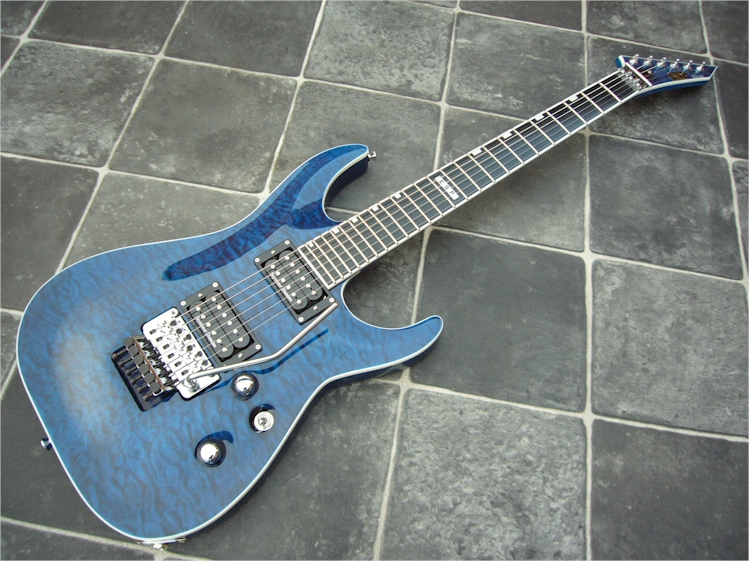
Photo: Cisco93 / Wikimedia Commons / Public domain ESP
Horizon
1987
Page Hamilton’s got smashed at First Avenue. Wooden dowels hold the horn on, and he says he’ll be buried with it.
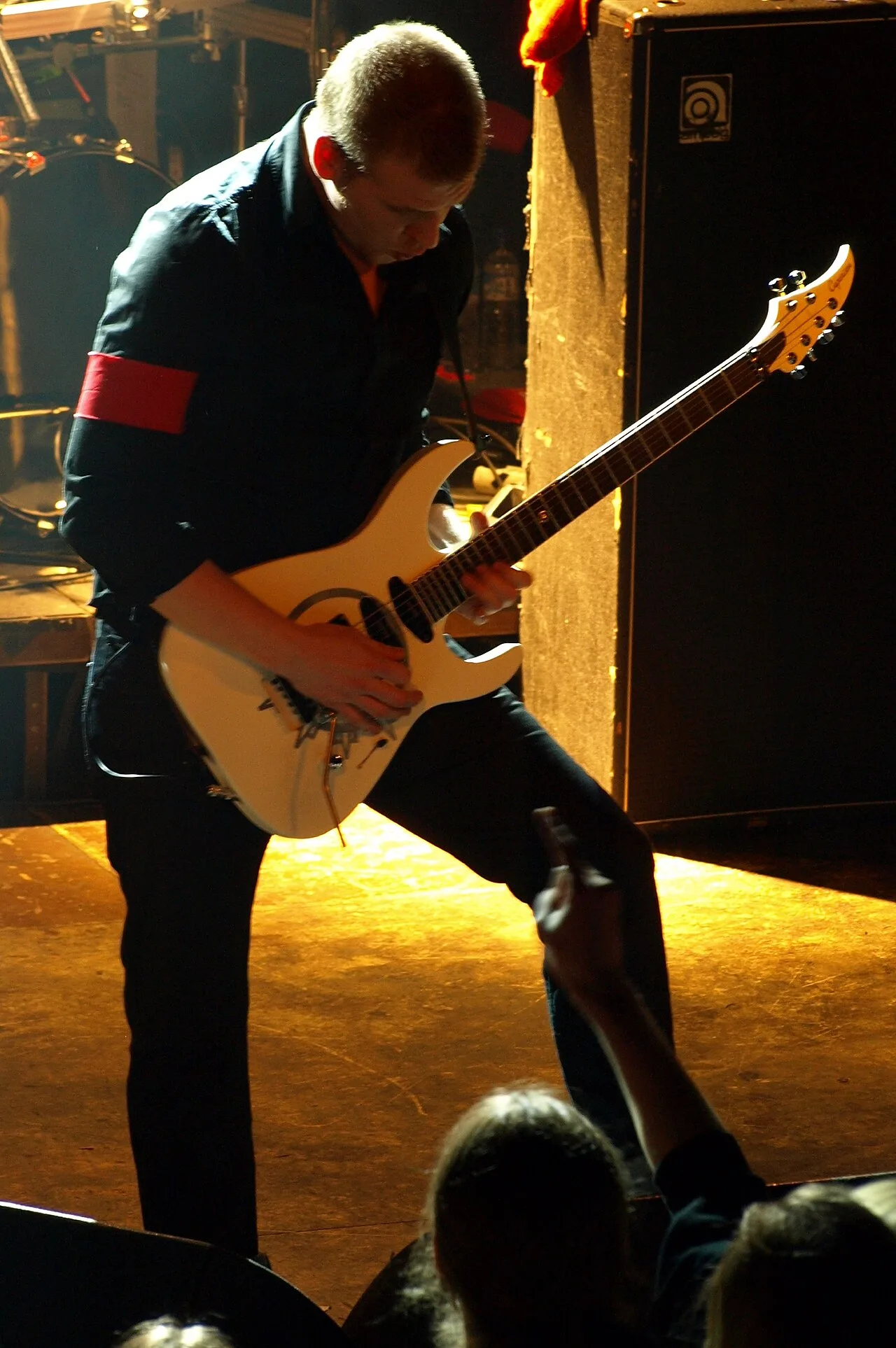
Photo: Cecil / Wikimedia Commons / CC BY-SA 3.0 Caparison
Dellinger
1998
Everyone thinks it was Caparison’s first guitar. Its designer made it wait about four years.
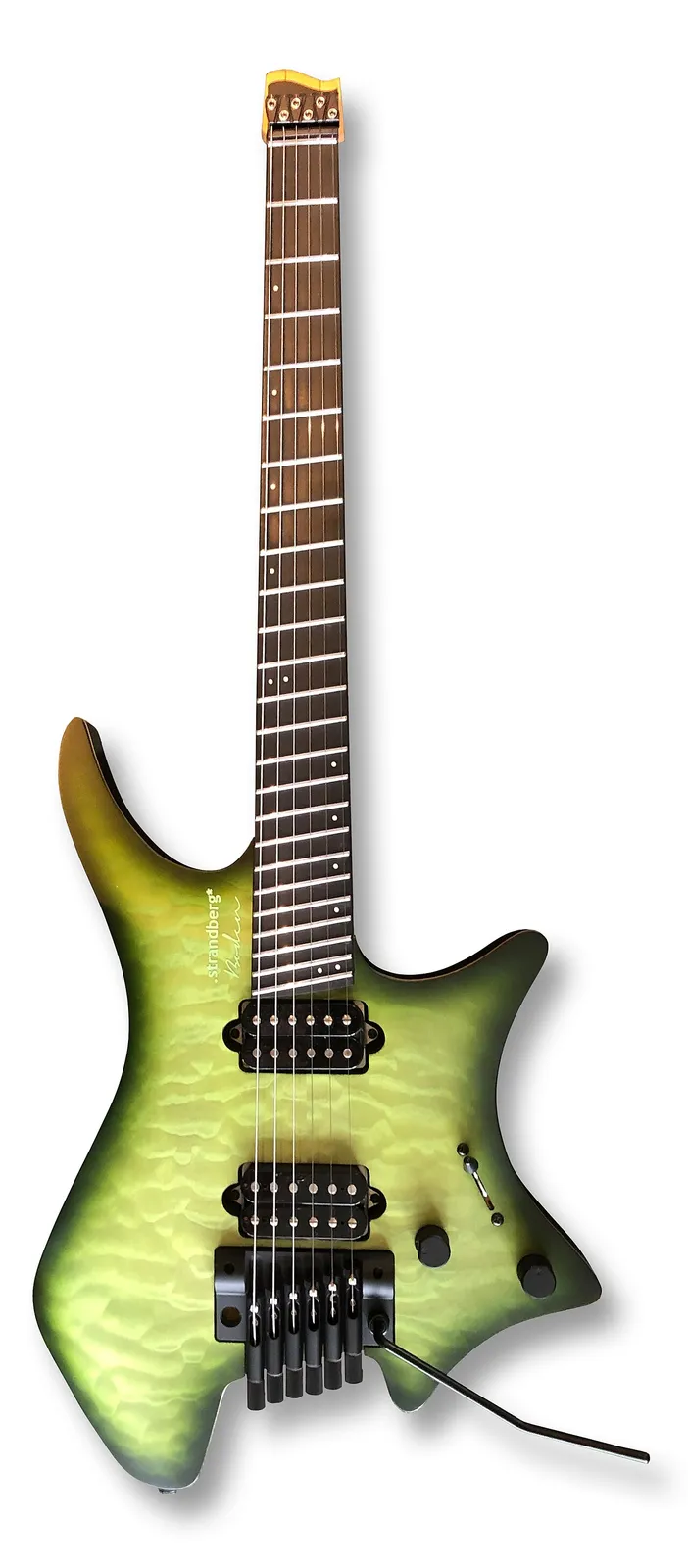
Photo: Auge=mit / Wikimedia Commons / CC BY-SA 4.0 Strandberg
Boden
2014
It started with a sore shoulder. A Swedish engineer built a guitar that would stop fighting him.