Dallas Arbiter
Fuzz Face
Two transistors in a round box that smiles, and the fuzz Jimi Hendrix bought by the handful.
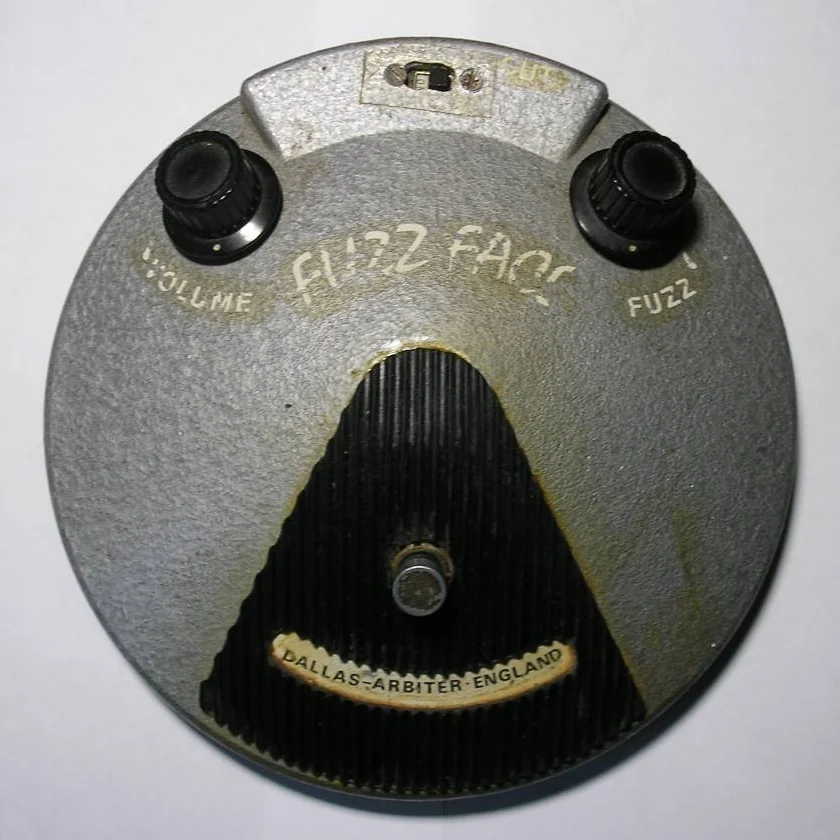
London, 1966. Ivor Arbiter runs a drum shop on Shaftesbury Avenue, and the American fuzz box, Maestro’s Fuzz-Tone, is hard to find here. So he makes his own: a round case inspired by a microphone stand, two knobs, and a logo underneath that turns the whole thing into a grin.
- Introduced
- 1966
- Effect
- Fuzz
The short version
1966
The smile
Arbiter shows the Fuzz Face at a British trade fair in August, a simpler take on the Maestro Fuzz-Tone.
1967
Purple Haze
Jimi Hendrix turns on the fuzz for his second single, and pairs it with Roger Mayer’s new Octavia for the solo.
1968
Dallas-Arbiter
Arbiter merges with Dallas, the label changes, and germanium starts giving way to silicon, in 1968 or early 1969 depending on who you ask.
1970
Machine Gun
Band of Gypsys comes out, recorded live with a Fuzz Face, a Uni-Vibe, an Octavia, and a wah, a combination Hendrix was trying for the first time.
1971
Pompeii
David Gilmour, now on a silicon Fuzz Face, plays the Black Strat through it in the amphitheatre at Pompeii.
1975
The original stops
Arbiter ends production of the original round Fuzz Face.
1993
Dunlop
Dunlop buys the rights and keeps the round box in production.
Side A
A1
The drum man’s fuzz box
In August 1966, at the British Musical Instrument Industries trade fair, Arbiter put a new fuzz box on show. It was round. It had two knobs. And with the logo curving under the footswitch, it looked back at you and grinned.
Ivor Arbiter wasn’t a circuits man by trade. He was a sax repairman and an amateur drummer who ran Drum City on Shaftesbury Avenue, in London’s West End. In 1962 he sold Ringo Starr a Black Oyster Pearl Ludwig kit and put “The Beatles” on it, and the drop-T logo was his design too. He knew how to make a thing you’d recognize from across a room.
What he wanted now was fuzz. The Maestro Fuzz-Tone had been out in America since 1962, but in mid-1960s London it was rare. So Arbiter made a simpler one. The case was inspired by a microphone stand, and the ad called it “the new fuzz box from Arbiter giving the ultimate in controlled effects.”
Controlled was optimistic. No two Fuzz Faces came out quite alike, and the only way to know what you had was to plug it in and listen.
A2
A circuit nobody sensible would build
Open one up and there’s almost nothing inside: two transistors, three capacitors, two pots, and a footswitch that takes the whole thing out of your signal when it’s off. Volume and Fuzz. That’s the pedal.
Roger Mayer, who built effects for Jimi Hendrix, knew exactly how bare that was:
It was such a basic circuit that most people in electronics would never have used it because it was fraught with many, many problems.
The early ones ran on germanium transistors, and germanium is fussy. Matched pairs were hard to get, so the units varied. Heat changes how they behave, and some studios put early Fuzz Faces in the fridge before recording with them. Denis Cornell, an engineer at Arbiter in the 1960s, later described auditioning the transistors for how they sounded.
The reward for all that trouble is the way it plays. A germanium Fuzz Face distorts a little lopsidedly, which makes the fuzz come on more progressively. It also has a low input impedance, so it listens hard to your guitar’s pickup. Roll the guitar’s volume down and the fuzz cleans up into something closer to overdrive. The knob on your guitar is the third control, and it may be the one that matters most.
A3
The solo isn’t the fuzz
Hendrix is the Fuzz Face’s most famous fan, and it starts with his second single. Work on “Purple Haze” began on 11 January 1967 at De Lane Lea in London. Hendrix added his vocals and guitar between 3 and 8 February at Olympic, turned on the fuzz, and cut it. It was out in Britain on 17 March.
The solo is where people get it wrong. That high, octave-up shriek is the Octavia, Roger Mayer’s unit, on its first outing. The Fuzz Face is coupled with it, but the octave is the Octavia’s doing. Mayer remembers going back to Olympic after a gig:
He picked up his Telecaster, and that’s when we did the overdub for ‘Purple Haze’ and ‘Fire,’ using the Octavia.
A Telecaster, then, not a Strat. And whatever was inside Hendrix’s Fuzz Face in early 1967, it wasn’t silicon. That came later.
Flip the record · By the numbers
2
Transistors. With three capacitors and two pots, that’s nearly the whole circuit.
2
Knobs. Volume and Fuzz.
10
Fuzz Faces Hendrix was known to buy at once, to find the best one or two.
1975
The year Arbiter stopped making the original round box.
Side B
B1
Arbiter becomes Dallas-Arbiter
In April 1968 it was reported that Arbiter had merged with Dallas, and the boxes that had said “Arbiter England” started saying “Dallas-Arbiter England.” Around the same time, germanium gave way to silicon. Exactly when depends on who you ask: 1968, or somewhere around late 1968 and early 1969.
Silicon Fuzz Faces sound brighter and harsher, and they could pick up radio interference. The paint wandered too: red, black, hammered silver, assorted blues and greys. Nobody agrees on which came first.
Hendrix played the silicon versions, and he took many copies on tour, because they were so unreliable. Across New Year’s Eve 1969 and New Year’s Day 1970, Band of Gypsys played the Fillmore East in New York. Billy Cox, the band’s bassist, said Hendrix was using a new combination of effects for the first time: a Uni-Vibe, an Octavia, a Fuzz Face, and a wah.
“Machine Gun,” from the third show, is that rig pouring out of a Stratocaster. The album came out on 25 March 1970.
B2
Ten at a time
David Gilmour had a germanium Fuzz Face first, then a silicon Dallas-Arbiter from early 1971. In October that year, when Pink Floyd played the amphitheatre at Pompeii, it was the Black Strat, a 1969 Stratocaster, into a silicon Fuzz Face. And lying next to his amps, you can see a spare.
Eric Johnson still had a ’60s Dallas-Arbiter Fuzz Face on his board in 2018, next to a vintage TS-808 Tube Screamer, feeding a Two-Rock head. The list of other users runs long: Duane Allman, Stevie Ray Vaughan, Pete Townshend, George Harrison, Paul McCartney, Kevin Parker.
Arbiter stopped making the original in 1975. Crest Audio of New Jersey reissued it, Dunlop bought the rights in 1993 and has made it ever since, and Arbiter had its own go in the late 1990s, with Cornell putting AC128 transistors in it.
But the best picture of the pedal is still Hendrix with a pile of them. He was known to buy ten Fuzz Faces at once and play every one, looking for the best one or two.
Same round box, same smile, ten times over. The sound was in one or two of them, and the only way to find out which was to plug in and listen.
Put this on
You’ve read about it. Now hear it. Here’s what this pedal sounds like, and what to listen for.
Purple Haze
Hendrix turned on the fuzz to cut his second single. On the solo it’s coupled with Roger Mayer’s brand-new Octavia, on a Telecaster, and the octave-up shriek is the Octavia’s doing.
Find it on YouTube (opens in a new tab)Machine Gun
New Year’s at the Fillmore East, from the third show, with the Fuzz Face working alongside a Uni-Vibe, an Octavia, and a wah, by Billy Cox’s account.
Find it on YouTube (opens in a new tab)
The cast
The people who built it, and the players who made it famous.
1966
Ivor Arbiter
Creator
A sax repairman and amateur drummer with a London drum shop, who once sold Ringo Starr the kit with “The Beatles” on it.
Denis Cornell
Engineer, Arbiter
Described auditioning the transistors for their sound, and used AC128s in Arbiter’s own reissue in the late 1990s.
1967
Jimi Hendrix
Fuzz Face, wah, Uni-Vibe
Its most famous user, who took many copies on tour because the pedal was so unreliable.
1967
Roger Mayer
Hendrix’s effects man
Built the Octavia, and said the Fuzz Face was a circuit most people in electronics would never have touched.
1971
David Gilmour
Fuzz Face, Black Strat
Moved from a germanium Fuzz Face to a silicon one in 1971, and had a spare lying by his amps at Pompeii.
2018
Eric Johnson
’60s Dallas-Arbiter Fuzz Face
Still had one on the board in 2018, next to a vintage TS-808, feeding a Two-Rock head.
Often paired with
The pedals and guitars it usually shares a board or a record with.
- Send a picture
Univox (Shin-ei)
Uni-Vibe
1968 or 1969 · Modulation
Robin Trower plugged it in at Manny’s and heard Hendrix, then made the sound his own.
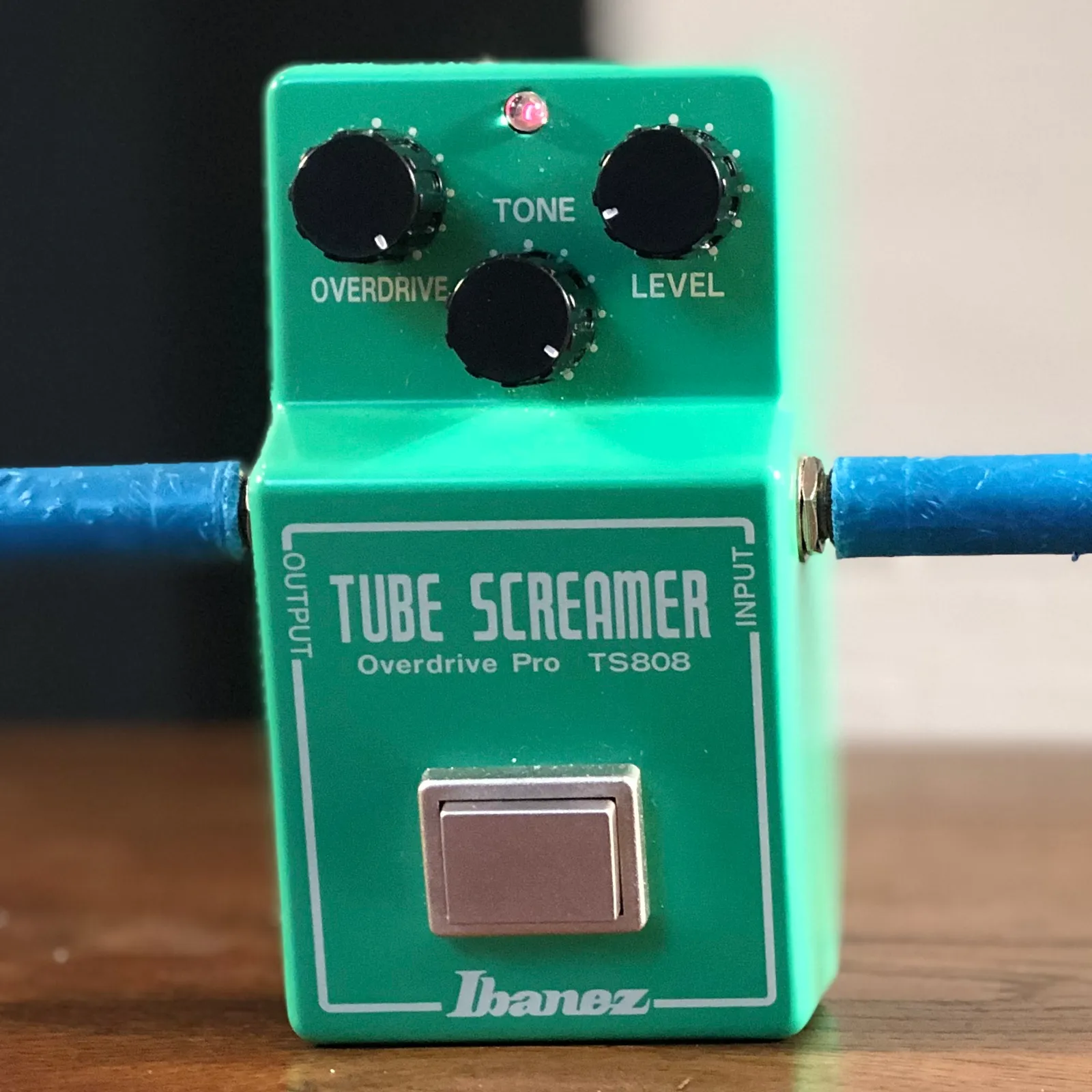
Photo: Guitar Chalk / Wikimedia Commons / CC BY 2.0 Ibanez
Tube Screamer TS808
1979 · Overdrive
Named for a screaming tube amp, and at its best when it hardly screams at all.
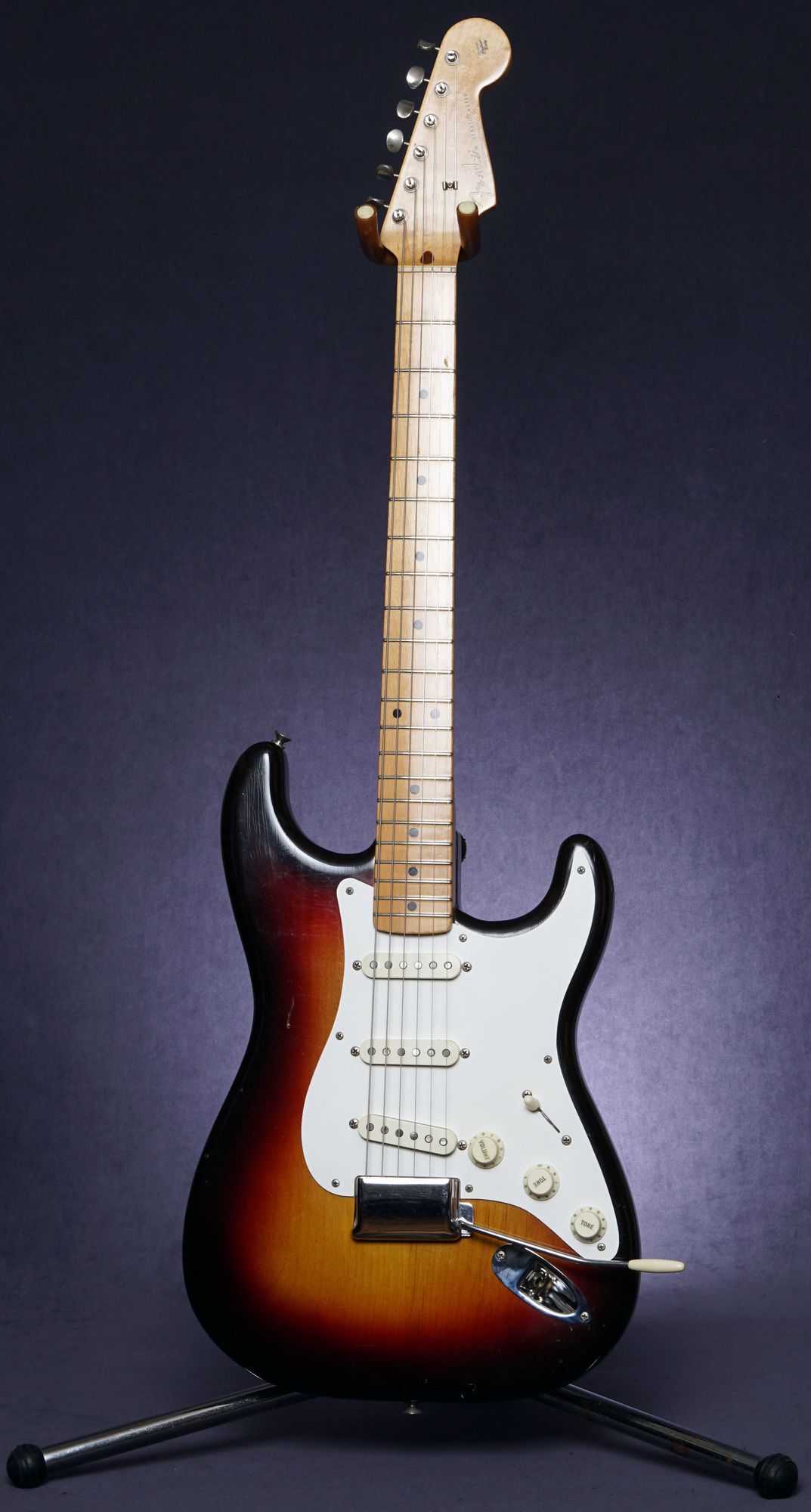
Photo: Lightburst / Wikimedia Commons / CC BY-SA 4.0 Fender
Stratocaster
1954
The guitar most people mean when they say “electric guitar.” Designed by a man who didn’t play one.