Univox (Shin-ei)
Uni-Vibe
Robin Trower plugged it in at Manny’s and heard Hendrix, then made the sound his own.
Manny’s, New York. Robin Trower is still in Procol Harum, trying out whatever the shop has. One box comes with a separate foot pedal for the speed. He plugs it in and hears “Machine Gun.”
- Introduced
- 1968 or 1969
- Effect
- Modulation
No photograph of this pedal yet. Have one? Send a picture
The short version
1960s
A light bulb and four sensors
Fumio Mieda designs a phase effect in Japan, first sold by Honey as the Vibra-Chorus.
1968
Uni-Vibe
The usual date for its debut, and for its North American release under the Univox name.
1969
Honey to Shin-ei
By another telling, Honey goes bankrupt in March, and Shin-ei takes over and badges the pedal Uni-Vibe.
1969
Woodstock
Jimi Hendrix plays through one at Woodstock. Mieda only hears about it about ten years later.
1970
Machine Gun
Band of Gypsys comes out, recorded live at the Fillmore East with a Uni-Vibe, Fuzz Face, Octavia, and wah.
1971
Song for a Dreamer
Robin Trower, still in Procol Harum, probably uses his for the first time on his tribute to Hendrix.
1973
Breathe
David Gilmour plays electric guitar through a Uni-Vibe on “Breathe,” from The Dark Side of the Moon.
1974
Bridge of Sighs
Trower cuts his solo record with a new Strat and two Marshalls. The Uni-Vibe, he says, “is the ‘Bridge of Sighs sound.’”
Side A
A1
Something on the shelf at Manny’s
Robin Trower was still in Procol Harum when he walked into Manny’s in New York and started trying things out. One of them came with a separate foot pedal for setting the speed. He plugged it in, and he knew the sound before he knew much else about the box.
It’s something I stumbled across when I was in Procol Harum. I think I was trying some stuff at Manny’s in New York, and I tried that and loved it, I immediately realized it’s what Hendrix had used on Machine Gun.
That was the Uni-Vibe. Hearing your hero’s sound come out from under your own fingers is a strange feeling, half thrill and half trap. Get it right and people hear him, not you.
People did hear him. Interviewing Trower decades later, Jimmy Vivino put it plainly: “The Hendrix comparison all comes from the univibe.” What Trower did with the box after that is the rest of the story.
A2
A light bulb in a tin box
Open one up and the first surprise is a light bulb. It pulses, slowly or quickly, depending on where your foot has the speed pedal. Around it sit four light sensors, each running one of four stages of phasing, and the whole lot is shut inside a square box of bent aluminum, a light shield with a reflective inside.
As the bulb brightens and dims, the sensors push the guitar’s signal in and out of phase with itself, four stages deep. The tone swells and swims. There are transistors in there but no op-amps. It’s a shift-the-phase circuit driven by a lamp.
It has two modes. Vibrato is the wet signal on its own, the whole note wobbling. Chorus mixes your dry guitar back in underneath, and that’s the one people mean when they say “Uni-Vibe.”
The man behind it was Fumio Mieda, a Japanese engineer whose first effect of his own was a thing called the Psychedelic Machine. The Uni-Vibe, he said, was its sequel “with the fuzz function removed.” He was chasing one idea: “At that time, I was madly enthusiastic about discovering what kind of effect would be created by phases.”
What it was meant to sound like depends who you ask. The common story is a Leslie rotating speaker, the spinning cabinet organ players used, and some tell it as a keyboard effect first. Mieda’s own account is stranger: radio signals, Radio Moscow among them, wavering under atmospheric modulation. Both stories are still around. Mieda went on to spend 55 years at Korg, where he’s known as the father of the MS-20.
A3
Three names on one box
Who made the Uni-Vibe is a short question with a long answer. Mieda designed it. Honey built it first, as the Vibra-Chorus. It was renamed Uni-Vibe, gained the speed foot pedal and an easier way to get at the fuse, and in North America the distributor Unicord sold it under its Univox brand. By one account Unicord gave it the name. It didn’t design it.
When that happened depends on the telling. The usual date is 1968. Another version has Honey going bankrupt in March 1969, and Shin-ei taking over and building the pedal as the Uni-Vibe until around 1970, which makes the name a 1969 thing. Elsewhere it wore other badges: the Jax Vibra-Chorus, the Shin-ei Resly Machine, the Nomad Verberola.
It didn’t stay a Japanese curiosity. Boutique recreations brought it back in the early 1990s, and today “Uni-Vibe” is a Dunlop trademark. None of those are the box Trower found at Manny’s.
Flip the record · By the numbers
4
Light sensors around the bulb, each running one of four phase stages.
1
Pulsing light bulb, shut in a bent metal box with the sensors.
2
Modes. Vibrato is all wet; Chorus mixes the dry signal back in.
0
Op-amps. Transistors, a bulb, and light sensors do the work.
Side B
B1
New Year’s at the Fillmore East
Jimi Hendrix had one at Woodstock on 18 August 1969. Back in Japan, Mieda didn’t find out for a long time: “I learned about Jimi Hendrix’s use of the Uni-Vibe at Woodstock about 10 years later.”
On 1 January 1970, Hendrix took the Band of Gypsys onto the stage at the Fillmore East with a Stratocaster and a new combination of effects: a Uni-Vibe, an Octavia, a Fuzz Face, and a wah. Those shows gave the world “Machine Gun,” released on Band of Gypsys on 25 March 1970.
Put it on and listen to the long, held notes. Under the fuzz and the feedback, the sound keeps moving, rising and falling like something breathing. That throb is the bulb.
Hendrix died that September. A few years on, the box turned up somewhere much calmer: David Gilmour ran his electric guitar through one on “Breathe,” on The Dark Side of the Moon.
B2
The Bridge of Sighs sound
Trower’s first time on record with it was probably “Song for a Dreamer,” on Procol Harum’s Broken Barricades in 1971, his tribute to Hendrix after his death. Asked if that was the first, he hedged: “I think it probably was.”
Then he went solo. Bridge of Sighs came out on 20 April 1974, made at AIR Studios with Geoff Emerick engineering and Matthew Fisher producing. The rig was small: a new Strat, two 100-watt Marshall heads into two 4×10 slant cabinets, a volume-boost pedal a friend built for him, a Cry Baby wah. And one more box: “I also had a Univibe,” Trower says, “which is the ‘Bridge of Sighs sound.’”
He thinks the title track is the most potent thing he’s ever made. Of Hendrix, he’s clear-eyed:
I think he influenced me a lot, but I do feel like I went on to make something of my own out of it.
Put on “Bridge of Sighs” and hear what he means. It’s slow and heavy, with the guitar swaying on the bulb’s pulse. He walked into Manny’s and heard Hendrix. Ask him about the Uni-Vibe now and he calls it by the name of his own record.
Put this on
You’ve read about it. Now hear it. Here’s what this pedal sounds like, and what to listen for.
Machine Gun
Live at the Fillmore East, with the Uni-Vibe in a chain with a Fuzz Face, an Octavia, and a wah. This is the sound Trower recognized at Manny’s.
Find it on YouTube (opens in a new tab)Bridge of Sighs
In Trower’s words, the Uni-Vibe “is the ‘Bridge of Sighs sound.’”
Find it on YouTube (opens in a new tab)Breathe
David Gilmour’s electric guitar, run through a Uni-Vibe.
Find it on YouTube (opens in a new tab)Song for a Dreamer
Trower’s tribute to Hendrix, and probably his first time on record with a Uni-Vibe. “I think it probably was,” he says.
Find it on YouTube (opens in a new tab)
The cast
The people who built it, and the players who made it famous.
mid-1960s
Fumio Mieda
Designer
Was “madly enthusiastic” about what phases could do. He’s also called the father of the Korg MS-20.
1970
Jimi Hendrix
Uni-Vibe, Band of Gypsys
Part of his new mix of effects at the Fillmore East, and on “Machine Gun.”
1974
Robin Trower
Uni-Vibe, Bridge of Sighs
Found one at Manny’s while in Procol Harum. A few years later it was the “Bridge of Sighs sound.”
1973
David Gilmour
Uni-Vibe, The Dark Side of the Moon
Played his electric guitar through one on “Breathe.”
Often paired with
The pedals and guitars it usually shares a board or a record with.
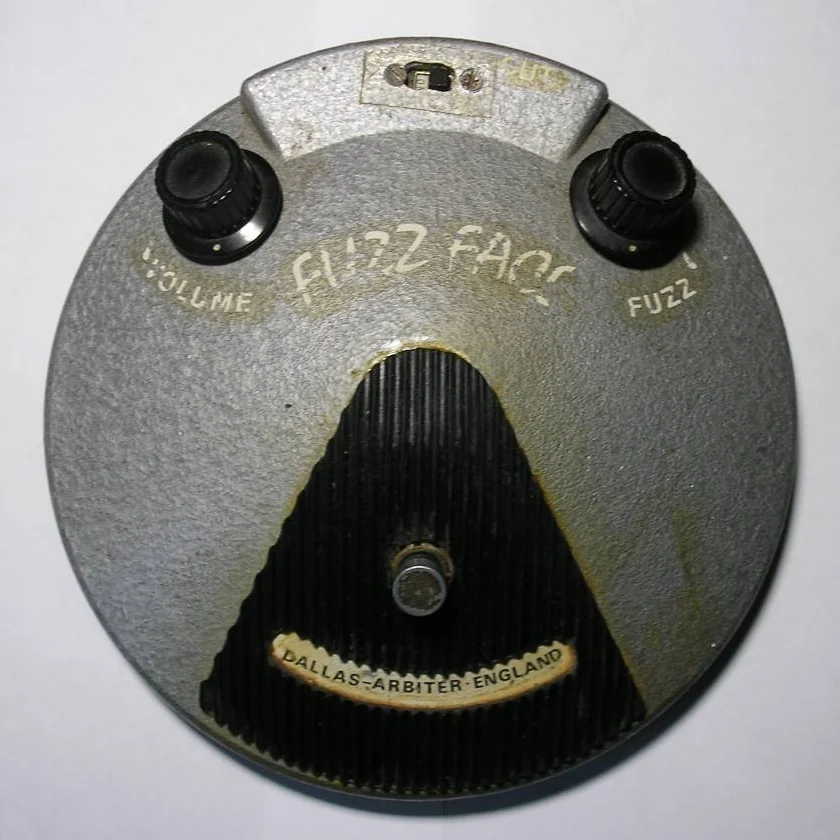
Photo: Djdaedalus / Wikimedia Commons / CC BY-SA 3.0 Dallas Arbiter
Fuzz Face
1966 · Fuzz
Two transistors in a round box that smiles, and the fuzz Jimi Hendrix bought by the handful.
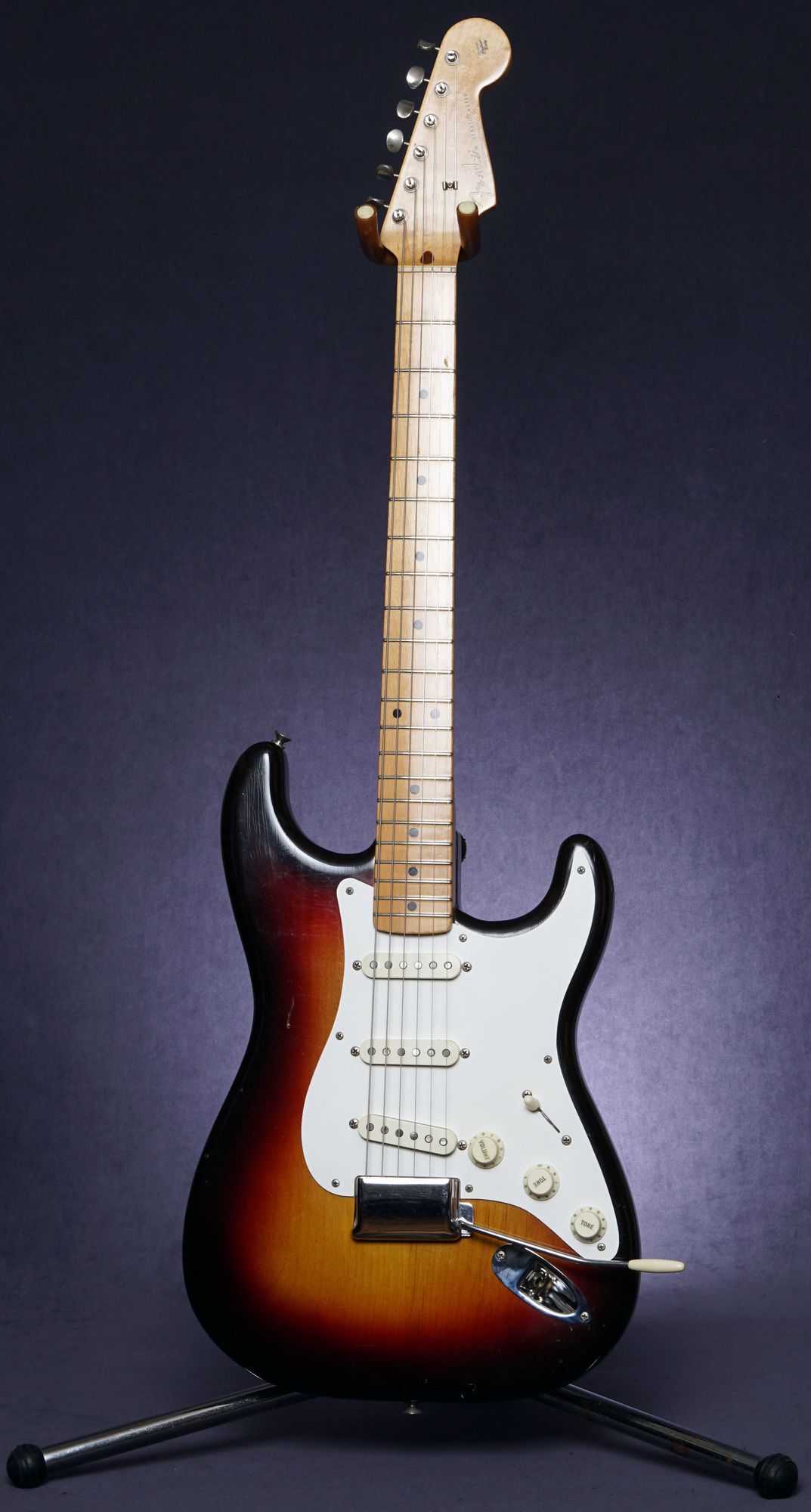
Photo: Lightburst / Wikimedia Commons / CC BY-SA 4.0 Fender
Stratocaster
1954
The guitar most people mean when they say “electric guitar.” Designed by a man who didn’t play one.
- Send a picture
Dunlop
Cry Baby
1967 · Wah
An amp engineer’s shortcut, built into an organ pedal for horn players. Guitarists plugged in anyway.