DigiTech
Whammy
Tom Morello used it to chase hip-hop’s high wail; Jack White used it to fake a bass line.
Early ’90s. Tom Morello has just got hold of a DigiTech Whammy, and he’s trying to make a guitar sound like Dr. Dre’s records, Cypress Hill, the Bomb Squad. The pedal rocks under his foot like a wah, and what comes out is a high-pitched wail.
- Introduced
- 1989
- Effect
- Other
No photograph of this pedal yet. Have one? Send a picture
The short version
1983
The pitch people
Phil Scott and Brian Gibson start IVL Technologies in Victoria, British Columbia, the company whose pitch-detection the Whammy would license.
1989
The red pedal
DigiTech puts out the Whammy, usually credited as the first mass-market digital pitch shifter.
1992
Killing in the Name
Tom Morello, freshly armed with a Whammy, goes “hog-wild” on Rage Against the Machine’s “Killing in the Name.”
1994
Octaves, twice
David Gilmour bends notes whole octaves on “Marooned,” and Jonny Greenwood shifts his guitar an octave on “My Iron Lung.”
1996
The wah of the ’90s
IVL’s Fred Speckeen says the Whammy “has been called ‘the wah‑wah pedal of the ’90s.’”
2002
A bass line with no bass
Jack White plays the “Seven Nation Army” riff through a Whammy set an octave down.
2012
Chords, finally
The 5th Gen Whammy bends whole chords in tune and adds true bypass, with a Classic switch for the old sound.
2019
Still on the board
Morello’s board, unchanged since the early ’90s, still carries an original WH-1.
Side A
A1
Trying to sound like the Bomb Squad
Tom Morello had a problem most guitar players never think to have. He didn’t want to sound like a guitar player.
In the early Rage Against the Machine songs he was chasing hip-hop records instead: Dr. Dre’s production, Cypress Hill, the Bomb Squad, Terminator X. Then a new pedal turned up, and he tells it plainly:
Well I had just gotten that DigiTech Whammy pedal and was exploring it. It was a harmonizer in a pedal, controlled in the same way as a wah-wah pedal. In a lot of those early songs, I was trying to approximate Dr. Dre’s production or Cypress Hill or the Bomb Squad, Terminator X stuff. And that provided the high-pitch wailing of some of that music. So I know I went hog-wild on a number of songs, one of them being ‘Killing in the Name.’
The riff for that song came out of a guitar lesson, of all places. He was demonstrating drop-D tuning, and in the middle of it a couple of the riffs just occurred. The solo is where the Whammy comes in, and it doesn’t sound like a guitar solo so much as a siren somebody taught to scream on cue.
A2
A cheaper way to change pitch
The brains of the thing came from Canada. IVL Technologies started up in Victoria, British Columbia, in 1983, founded by Phil Scott and Brian Gibson, and its first product was the Pitchrider 2000. Its specialty was working out what note you were playing, and fast.
John Johnson, president of DigiTech and its sister brand DOD, saw a use for that. Eventide’s pitch-shifting systems were the serious option, and they cost like it. Johnson suggested IVL build an intelligent pitch-shifter for less. Fred Speckeen, IVL’s vice president, later said their system could find the pitch in about two cycles of the signal.
DigiTech put the result out in 1989, or thereabouts, as the Whammy. It’s usually credited as the first mass-market digital pitch shifter. It was also painted Ferrari red, which means it stands out a mile on any pedalboard, as if anything that loud needed help being noticed.
A3
One note at a time
Here’s what it does. Rock the treadle and the pitch of your guitar slides up or down, as far as two octaves. Set it for an interval and it adds a harmony line above or below what you play. Set it for a slight detune and you get something like a chorus. Dive bombs, octaves, harmonies: all from your foot.
The early ones had a catch. They could only track one note at a time. Hit a chord and it comes out strange and artificial, with wobbly artifacts all over it. That sounds like a flaw. In the right hands it’s a color.
Jonny Greenwood used it to shift his guitar an octave on Radiohead’s “My Iron Lung,” cut from a May 1994 show at the London Astoria, and the result is glitchy and lo-fi. On “Just” he sent the solo up somewhere high and piercing. That same year David Gilmour put it on “Marooned,” bending notes whole octaves on The Division Bell. He says he pretty much improvised it, probably three or four passes, and kept the best bits of each. It won the Grammy for Best Rock Instrumental Performance in 1995.
Flip the record · By the numbers
2
Octaves up or down, set by the treadle under your foot.
1
Note at a time the early Whammys could track. Chords come out wobbly.
2
Cycles of the signal IVL’s system needed to find the pitch, by its own account.
1983
The year IVL started up in Victoria, British Columbia. Its pitch-detection is inside the Whammy.
Side B
B1
A bass line with no bass
The White Stripes had no bass player. In April and May of 2002, at Toe Rag Studios in London, Jack White recorded “Seven Nation Army” anyway, with a riff everybody hears as a bass line.
It isn’t. It’s a Kay hollowbody going through a Whammy set an octave down, with a Big Muff after it in the chain. Which Whammy is another question. The model isn’t pinned down, and plenty of people say it was a later one rather than the original red pedal. Call it a Whammy and you’re on solid ground.
Others found their own uses. Ed O’Brien used one on Radiohead’s “Dollars and Cents” to shift minor chords up to major. Matt Bellamy used one on Muse’s “Map of the Problematique,” and in 2020 he had one built into a Manson guitar. Steve Vai, the Smashing Pumpkins, and Justin Chancellor of Tool are on the list too.
B2
Still on the board
By 1996, Speckeen could say this without much fear of contradiction:
our Whammy Pedal has been called ‘the wah‑wah pedal of the ’90s’
Later Whammys got better at chords, then added drop-tuning, MIDI, and a dedicated dive-bomb mode. The Whammy DT got bigger and grew a second footswitch. In 2012 the 5th Gen could bend entire chords up or down with every note kept in tune, and it came with a Classic switch for the old sound. Its shape went back to the outline of the original, too.
Morello’s board hasn’t changed since the early ’90s. On “Voice of the Voiceless” he cycles through the intervals with the knob. And sitting there next to the wah and the delays is an original WH-1, Ferrari red, still the reason a guitar in his hands can sound like anything but a guitar.
Put this on
You’ve read about it. Now hear it. Here’s what this pedal sounds like, and what to listen for.
Killing in the Name
Morello had “just gotten that DigiTech Whammy pedal,” and he says he “went hog-wild” on this one. Listen to the solo.
Find it on YouTube (opens in a new tab)Marooned
Gilmour uses the Whammy to pitch-shift his improvised lines entire octaves.
Find it on YouTube (opens in a new tab)My Iron Lung
Jonny Greenwood shifts his guitar an octave with the Whammy, and it comes out “glitchy, lo-fi.”
Find it on YouTube (opens in a new tab)Seven Nation Army
That “bass” riff is a guitar through a Whammy set an octave down.
Find it on YouTube (opens in a new tab)
The cast
The people who built it, and the players who made it famous.
1992
Tom Morello
Whammy, Rage Against the Machine
Heard it as “a harmonizer in a pedal” and used it to chase hip-hop’s high-pitched wail. In 2019 an original WH-1 was still on his board.
1994
Jonny Greenwood
Whammy, Radiohead
Shifted his guitar an octave on “My Iron Lung,” glitchy and lo-fi, and pushed the solo on “Just” up high and piercing.
1994
David Gilmour
Whammy, The Division Bell
Bent notes entire octaves on “Marooned,” pretty much improvised, the best bits of three or four passes.
2002
Jack White
Whammy, octave down
Played the “Seven Nation Army” riff on a Kay through a Whammy, with a Big Muff after it.
1996
Fred Speckeen
Vice president, IVL Technologies
An executive at the Canadian company whose pitch-tracking DigiTech licensed.
John Johnson
President, DOD and DigiTech
Suggested IVL build an intelligent pitch-shifter that cost less than an Eventide. That’s where the relationship started.
Often paired with
The pedals and guitars it usually shares a board or a record with.
- Send a picture
Dunlop
Cry Baby
1967 · Wah
An amp engineer’s shortcut, built into an organ pedal for horn players. Guitarists plugged in anyway.
- Send a picture
MXR
Phase 90
1972 or 1974 · Modulation
One knob, and the quiet swirl Eddie Van Halen stepped on when he wanted to be heard.
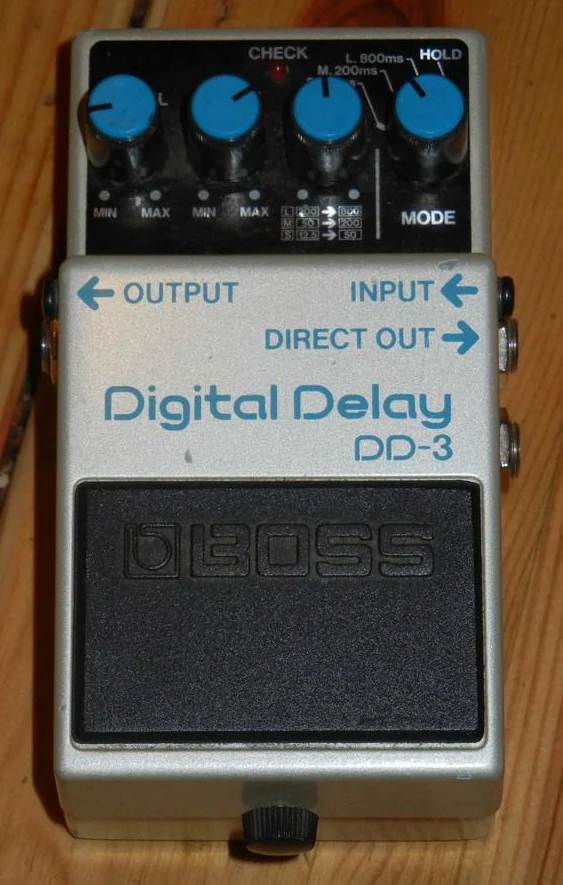
Photo: JuandiLOL / Wikimedia Commons / CC BY-SA 3.0 Boss
DD-3 Digital Delay
1986 · Delay
Boss changed only the name, and Noel Gallagher calls it the greatest delay pedal of all time.
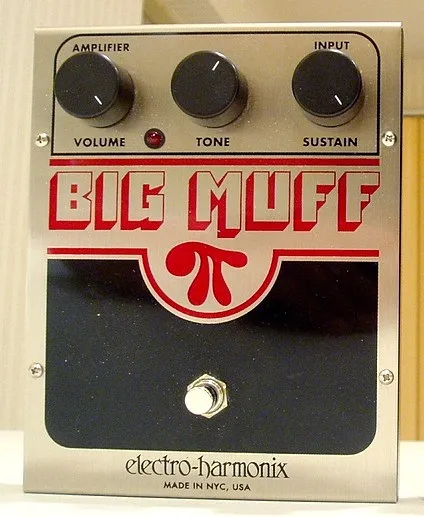
Photo: NIRVANA2764 / Wikimedia Commons / CC BY-SA 3.0 Electro-Harmonix
Big Muff Pi
1969 · Fuzz
Built to chase Hendrix, it missed, and made the smallest amp in the house sound like a wall.