BilT
Relevator
Brandon Darner was tired of bending over his pedals. Two luthiers in Des Moines put them on the guitar.
The Relevator began as a fix for one musician’s pedalboard and borrowed its outline from a Fender nobody could buy. It came with a fuzz and a delay built into the face, from a shop named for two first names: Bill and Tim.
- Introduced
- 2009
- Type
- Solidbody electric
- Class
- Production
Have a photograph of this guitar? Send a picture
The short version
1966
The Fender that never shipped
The Marauder is in the catalog. By Tim Thelen’s count about eight were prototyped, and it never went into production.
2008
The Monster
Thelen cuts up a new Telecaster Deluxe for Brandon Darner and fills it with effects. Not a Relevator.
2009
The first BilT
The Relevator is the company’s first model, announced from Des Moines in September.
2009
Wilco gets one
By December the model has been onstage with the Killers and Blitzen Trapper, and Nels Cline owns one.
2013
Full-time
BilT becomes a full-time shop in 2013, or 2014, depending who you ask.
2016
Less stuff
The Relevator now comes two ways, with effects or as the LS, same body, no effects.
2026
The Josh Scott Relevator
A signature made in Korea for the JHS Pedals founder. The first hundred go in fifteen minutes.
Side A
A1
Bending over the board
Brandon Darner played in a Des Moines band called the Envy Corps, and he was tired of bending over a pedalboard. In 2008 he took a brand-new Fender Telecaster Deluxe to Tim Thelen and had it cut up. In went a Sustainiac, a Red Witch Fuzz God II, and an MXR Carbon Copy delay, plus a Jazzmaster vibrato and a Mastery bridge. Later it got a name: the Monster.
That guitar is a Telecaster, and it stays one. It isn’t a Relevator. But it asked the question the Relevator answers: what if the knobs you reach for with your foot were already under your hand?
A2
The Fender nobody could buy
Thelen and Bill Henss worked at The Lutherie Shop in Des Moines. BilT is their first names, run together. The next year they built a guitar of their own around the Monster’s idea, and for the outline Thelen looked at a Fender that never made it to the stores.
By Thelen’s count, the Marauder made Fender’s 1966 catalog, about eight were prototyped, and it never went into production. He thinks the one he studied is in Dave Rogers’ collection at Dave’s Guitar Shop in La Crosse. Three control plates, room for knobs, and an offset Fender wasn’t selling.
“We studied the Marauder and ended up prototyping our first Relevator,” Thelen said. “We started by doing a run of 10.” Another telling has a prototype and then eight more. Keep both.
The Relevator was BilT’s first model, announced in September 2009. Thelen said clients wanted those effects under their fingers. Henss said players were already taking them out.
A3
Space racey
The first one was contoured alder with a headstock a little like a Starcaster’s, and three Seymour Duncan Antiquity pickups: two where a Jazzmaster keeps its pair, and a Jaguar pickup in the middle, claw and all. Jazzmaster controls, rhythm circuit included. A Mastery bridge and a Jazzmaster-style vibrato. And on the face, a fuzz and a delay.
The first press release said a 25-inch scale and a compound radius of 7 to 9. Eight days later the figures were 25.5 and 7.25 to 9.5, and the current sheet still says 25.5. Street price in that first review: $2,200.
The reviewer called the look “space racey,” and the guitar heavy, without printing a weight. He called it a mash-up of the Jazzmaster, the Jaguar, and the Marauder, and “not in any sense a replica.”
What if the knobs you reach for with your foot were already under your hand?
Flip the record · By the numbers
10
Thelen’s first run. Another telling has a prototype and eight more. Keep both.
~8
Fender Marauders prototyped, by Thelen’s count. The guitar the Relevator studied.
$2,200
Street price of an effects Relevator in its first review, December 2009.
15 min
How long the first hundred Korean signature models lasted in 2026.
Side B
B1
A pedal inside a guitar
The delay isn’t a copy of anything. It’s an actual Carbon Copy circuit board, rerouted so the knobs come up through the top. The fuzz is BilT’s own, in Thelen’s words “along the same lines as a ZVEX Fuzz Factory,” not a clone, with a tone control and a voltage sag knob that starves the circuit for that sputtering, dying-battery sound.
Power was the hard part. A 9-volt battery died too fast, and the homemade supply they tried was, in Thelen’s word, “ginormous.” By 2015 the answer was a box: a 1 Spot adapter, a mono cable to the amp, a stereo cable to the guitar.
B2
Who plays one
It got around fast. By the end of 2009 a Relevator had been onstage with the Killers and Blitzen Trapper, and Nels Cline of Wilco was the proud owner of one. Thelen also remembers building Cline an earlier Jazzmaster-style guitar before the first Relevator prototype, so there may be two.
By 2015 the users included Dave Keuning, Wayne Sermon, Brent Hinds, Buzz Osborne, and Wes Borland. Sermon played a BilT at the 2014 Grammys. Which model isn’t on the record, so it stays a BilT.
The shop went full-time in 2013 or 2014. Depends who you ask.
B3
Less stuff
By 2016 there were two Relevators. One had the effects. The other was the LS, for “less stuff”: the same body, no pedals inside. Today’s LS is solid alder, roasted maple, a Jazzmaster-style pickup at the neck and a P-90 in a Jazzmaster cover at the bridge, a stopbar tailpiece, and the upper control plate left open. Effects guitars are still built, one at a time. Thelen says rarely are any two alike.
The Relevator most people have actually watched belongs to Josh Scott, who runs JHS Pedals. He demos pedals on a white one, built in the USA. In 2026 his signature version, made in Korea, sold its first hundred in fifteen minutes.
So the guy who builds pedals for a living plays them through a guitar made so you wouldn’t have to bend over yours. Thelen put it plainly in 2015. “We’re not trying to take away a pedalboard,” he said. “We’re trying to add.”
The cast
The people, and the specific guitars, that made the legend.
2008
Brandon Darner
2008 Telecaster Deluxe, “the Monster”
Of the Envy Corps. The guitar that started it, with a fuzz, a delay, and a Sustainiac built in. A Fender, not a Relevator.
2009
Tim Thelen
The Relevator, from the first run
The T in BilT. Cut up Darner’s Telecaster, studied the Marauder, and built the first Relevators with Bill Henss.
2009
Nels Cline
A Relevator
“The proud owner of a Relevator” by the end of its first year. Thelen also describes an earlier Jazzmaster-style guitar for him, so there may be two. No Wilco track is pinned to it.
2015
Dave Keuning
Relevator
Named as a Relevator user in 2015. The Killers had one onstage in 2009. No song credit.
2015
Wayne Sermon
Relevator, and other BilTs
Named as a Relevator user in 2015. Plays several BilTs, each built for an effect. The guitar he played at the 2014 Grammys is a BilT, model unnamed.
Josh Scott
White USA Relevator
The JHS Pedals founder demos pedals on it. His 2026 signature, made in Korea, copies the brief, not the guitar.
Liner notes
Specs, construction, rarity, value, and every source we used.
BilT’s Des Moines offset put the fuzz and the delay on the guitar — Jazzmaster real estate, not a Jazzmaster, and not a Gretsch.
- Body
- Solid alder; low-gloss nitro; parchment/black/parchment guard
- Neck
- Roasted hard maple, parchment-bound, Classic Medium “C”
- Fingerboard
- Rosewood, clay dots, 9.5" radius. Fret count unpublished on the base sheet.
- Scale
- 25.5"
- Pickups
- Jazzmaster-style single-coil (neck); P-90 in a Jazzmaster cover (bridge). No winder named.
- Hardware
- TonePros Tune-o-matic and stopbar; Kluson tuners
- Electronics
- Master volume, tone, 3-way. Upper plate left open. No effects on this base.
- Finish
- Low-gloss nitro
- Nut
- Bone. Width unpublished on the sheet. Glossary: this “C” is a ’62 Jazzmaster profile at 1 11/16".
Open the full research fileConstruction details, the complete player record, production numbers, dated value estimates, and sources
Current Relevator LS base, biltguitars.com, fetched 8 October 2026. The 2009 effects Relevator — compound radius, three Seymour Duncan Antiquities, Mastery, a tremolo, fuzz and delay — is the original job, and it is not this table. The 2026 Josh Scott signature is made in Korea. Reverb files the LS as a bolt-on solidbody; BilT’s sheet never names the joint. Mix flagged on one dealer’s millimetres.
Construction
The job was to get the knobs off the floor. Brandon Darner, of Des Moines’s Envy Corps, was tired of bending over a pedalboard. In 2008 he got Tim Thelen to cut a new Fender Telecaster Deluxe — later “the Monster” — and drop in a Sustainiac, a Red Witch Fuzz God II, and an MXR Carbon Copy, plus a Jazzmaster vibrato and a Mastery bridge (Premier Guitar, Shawn Hammond, 9 April 2015). That guitar is a Telecaster Deluxe (fender-telecaster-deluxe). It is not a Relevator.
Thelen and Bill Henss — BilT is their first names — were at The Lutherie Shop in Des Moines. Business Record’s Made in Iowa (Kathy A. Bolten, 27 September 2024): the year after that Tele they developed a prototype, then eight more, and debuted them as BilT. Thelen says he had been looking at a Fender Marauder he thinks is in Dave Rogers’ collection at Dave’s Guitar Shop in La Crosse. His count: about eight prototyped, in the 1966 catalog, never produced. Three plates, room for knobs, an offset Fender was not still selling. “We studied the Marauder and ended up prototyping our first Relevator… We started by doing a run of 10.” Eight more, or a run of 10. Keep both. Neither is a lifetime total.
Nothing before 2009 is sourced. BilT’s about line and that Business Record piece both start the company then. Premier’s Des Moines release, 10 September 2009, calls the Relevator the first model. Thelen: clients wanted those effects under their fingers. Henss: players were already taking them out.
That release prints “a 25 scale” and “a 7 to 9 compound radius.” Eight days later, and again in Chris Burgess’s review of 11 December 2009, the figures are 25.5" and 7.25" to 9.5". The current sheet is 25.5". Don’t average the radii, and don’t invent a 25" guitar out of the short line. Review street: $2,200. 2009 money.
Burgess’s guitar: contoured alder, a Starcaster-ish headstock, vintage Klusons, one string tree, a thick “C” of lightly figured hard maple, bone nut, bound rosewood, vintage frets, 1.75" nut (2" at the 12th fret — that instrument). Two Seymour Duncan Antiquity II pickups “form the regular Jazzmaster complement,” plus an Antiquity for Jaguar in the middle, claw and all. Jazzmaster controls and a rhythm circuit. Mastery bridge. A modified Jazzmaster-style tremolo; the release had said USA tremolo. Fuzz and delay on the face. They called the look “space racey.” Premier tagged the review solidbody. Burgess called it heavy and printed no weight.
Thelen, 2015: the delay is an actual Carbon Copy board, rerouted to the top. The fuzz is their own board, “along the same lines as a ZVEX Fuzz Factory,” not a copy, with a tone control and a voltage sag. A 9V died too fast and a homemade supply was “ginormous.” By 2015 they were sending a box, a 1 Spot, mono to the amp, TRS to the guitar. “We’re not trying to take away a pedalboard. We’re trying to add.”
It is not a Jazzmaster (fender-jazzmaster). Henss told the Des Moines Register (Matthew Leimkuehler, 6 April 2016) the influence is offsets such as the Jazzmaster or the Jaguar. Burgess: a mash-up of those two and the Marauder, “not in any sense a replica.” A Jaguar-voiced middle pickup does not make it a Jaguar (fender-jaguar).
Not chambered as the model. The living LS sheet says solid alder. Reverb files “Relevator with Effects” as semi-hollow and bolt-on, and files the LS as a solid bolt-on. The maker’s sheet says neither “bolt-on” nor “chambered.” The glossary describes a semi-solid method the shop can use — back, sides, and a center block from one piece, then a cap. One commissioned LS, Relic Music’s “Gazing Guitar” no. 3 of 5, was ordered chambered alder. That is an order, not the standard.
The hollow and chambered BilTs are other models. Premier, 4 January 2012: the S.S. Zaftig is a “semi-hollow body (or semi-solid as they prefer).” The March 2012 review calls that body chambered. El Hombre’s current sheet says alder chambered, a set neck, and 24.62". The 2012 unveil printed 24.75" for the El Hombre, and the review that March called it a solidbody. Keep that split on the El Hombre. None of it is this table.
Not a TV Jones guitar, and not a Gretsch (gretsch-6120). Stock in 2009 was Duncan Antiquity. The LS sheet names types and no winder. Gallery effects guitars carry Fralin, Lollar, Novak, the shop’s fuzz, often still a Carbon Copy, sometimes an Old Blood Noise Dark Star. One owner’s Relevator (OffsetGuitars, 2021) had TV Jones T-Armonds and weighed 7 lb 14.9 oz. A gallery Zaftig, ZAF21760T, has TV Jones Filter’Trons. Those are those guitars.
The LS is “less stuff.” Register, 2016: two forms. CME’s copy: same body, no effects. The orderable base, this pass, is the table: $2,499, $500 deposit. Don’t average the glossary’s 1 11/16" with Burgess’s 1.75". Guitar Magazine (Japan, 13 April 2026) prints one LS at 21 frets and 647.7 mm. Mix flagged. Not a second scale. Effects guitars are still one-offs, with no 2026 SKU for the table. Named weights, not a spec: CME serial 1628, 8 lb 8 oz; Soundpure serial 19570, 7.95 lb; the T-Armond guitar, 7 lb 14.9 oz. Don’t average.
2026, other factory. Josh Scott of JHS Pedals demos pedals on a white USA BilT Relevator. The signature is not that guitar. JHS’s page: alder, Arctic White gloss poly, hard maple, rosewood, pearloid blocks, 25.5", 12" radius, Classic Medium C, Adjust-o-matic roller, “JM style” vibrato, Kluson-style buttons, Firebirds at neck and bridge, a Jaguar and a lipstick between them, volume, tone, a 3-way, a kill slider, two more sliders. Korea, World Musical Instruments. $1,599. Guitar World (Phil Weller, 22 May 2026): 22 frets, a Mastery tailpiece in that piece, $1,600. First 100 gone in 15 minutes, more coming. Keep the vibrato split. Not a Des Moines guitar.
Rele (from $1,999; $1,799 in Premier’s December 2023 review), Merc, ESG, Volaré (from $3,999), and a Relevator Bass at 30", 32", or 34" are other instruments. Zaroc and El Rey are not on the builder list or in the articles checked. Eastman’s El Rey is another maker. Adams’s green-sparkle BilT, four Lollar Firebirds, is an El Hombre (Register). Not this guitar.
Thelen, 2024: rarely are any two alike. The site says no CNC; the Business Record says a pin router follows a template. Henss had left by that piece. Darner was in. Full-time is 2013 in the Business Record and 2014 in the Register, after a BilT — model unnamed — on the Grammys with Imagine Dragons. Keep both.
Players
Don’t hang the 2008 Tele on this plate. Don’t hang Adams’s El Hombre here. A BilT is not automatically a Relevator.
Nels Cline. Burgess, December 2009: in a short life the model had been onstage with the Killers and Blitzen Trapper, “and more recently Wilco (Nels Cline is now the proud owner of a Relevator).” Thelen in 2015 also describes an earlier rosewood Jazzmaster-style guitar for Cline, before the Marauder and the first Relevator prototype, and then lists Cline among Relevator users. Possibly two guitars. No Wilco title is pinned here.
Dave Keuning. Premier, 2015: uses the Relevator. The 2009 review had the Killers onstage with one and did not name him. No song credit in these sources.
Wayne Sermon, Brent Hinds, Buzz Osborne, Wes Borland. Same 2015 sentence: they use the Relevator. Business Record, 2024: Sermon plays several BilTs, each for an effect he wanted, and played “his BilT” at the 2014 Grammys. That sentence does not say Relevator. Don’t upgrade the broadcast guitar.
Josh Scott is the Relevator people have watched, and he is not Josh Homme. Homme is not tied to this model in the sources checked. Scott’s white offset is the JHS demo guitar. The Korea signature copies that brief. A demo instrument, then a production model. Not a record.
Also known to play stays inside the 2015 list. Sean Lennon and Taylor York are Register names for company guitars, model unnamed. Blitzen Trapper is a band in the review, not a player.
Rarity
You order one. You do not find the same one twice. No Relevator census is published.
Thelen’s first run is 10. Business Record’s is a prototype and eight more, then about a dozen company electrics a year for about four years. Register, 2016: batches up to 10, one full-time employee hired that January, a three-to-four-month wait. The 2024 piece: over 100 electrics a year, batches of five, six people, four to six months. Company figures, not a model total. Darner says scarce on purpose. The terms page quotes a build time only after you call.
The stated quantity is the Korea signature: 100 in the first drop (Guitar World), with more coming. World Musical Instruments. Not a 2009 Des Moines Relevator, and not a reason to treat the early effects guitars as common.
Value
Informal estimate, 8 October 2026. Not an appraisal.
The price is the spec you order. Asks are not solds. Korea is another factory. Another person’s BilT is not a comp.
New street. LS from $2,499 (BilT, this pass). $500 non-refundable to hold the slot. That is the table: stopbar, two pickups, no effects. A Mastery, a vibrato, or a fuzz is a different order. After the order is finalized, changes are $100 each (terms, this pass) — a change fee, not a price list. No 2026 list for a standard effects Relevator. Company-wide, September 2024: from $1,999 (Rele territory), average about $3,300, customs past $9,000. Not a Relevator street. Historical: 2009 review $2,200. Register, 2016: El Hombre $1,850 to Volaré $3,250, no Relevator price in that copy. Korea signature $1,599 (JHS) or $1,600 (Guitar World).
Used modern. Reverb’s effects-model guide says the estimate is unavailable, then lists five finals: 15 December 2024, excellent, $2,300; 8 November 2023, excellent, $3,600; 29 August 2023, mint, $2,600; 1 July 2020, very good, $1,949; 30 November 2016, excellent, $1,650. The chart says “based on 2 orders.” Don’t average. The LS guide had no estimate this pass. One excellent custom LS (four pickups, Mastery, a “JHS style” plate) asked $2,700, down from $2,900. A widget under it showed $1,890–$2,295. The model guide would not stand behind that band. Not a hammer.
Vintage / collectible. Not a vintage market in the old sense. These are 2009-and-after shop guitars. What thins out is a spec they stopped shipping as standard: Duncan Antiquities, the first effects layout. Scott’s USA demo guitar is one object. Adams’s El Hombre is another model. The Korea run is new production.
See also
- fender-jazzmaster — Henss named the Jazzmaster and the Jaguar; a Relevator is neither
- fender-telecaster-deluxe — Darner’s 2008 “Monster,” the guitar that prompted BilT, and not this one
- gretsch-6120 — Filter’Tron territory; TV Jones is not the stock pickup here, and this is not a 6120
Sources
- Premier Guitar, BilT introduces the Relevator, 10 September 2009 — first model; Des Moines; “25 scale”; “7 to 9” compound radius; Mastery; Duncan Antiquity II; USA tremolo; delay and oscillating fuzz; Thelen and Henss
- Premier Guitar, Relevator blurb, 18 September 2009 — 25.5"; 7.25" to 9.5"; The Lutherie Shop
- Premier Guitar, Chris Burgess, Relevator review, 11 December 2009 — street $2,200; 1.75" nut; thick C; Mastery; Jazzmaster-style tremolo; Antiquity II pair plus Jaguar Antiquity; solidbody tag; Cline; Killers and Blitzen Trapper; “not in any sense a replica”
- Premier Guitar, Shawn Hammond, Mod Scientist, 9 April 2015 — 2008 Tele Deluxe; Marauder, “like, eight,” never produced; run of 10; Carbon Copy board; fuzz not a copied Fuzz Factory; Cline, Hinds, Osborne, Borland, Sermon, Keuning
- Premier Guitar, El Hombre and S.S. Zaftig, 4 January 2012 — Zaftig “semi-hollow” / “semi-solid as they prefer”; El Hombre 24.75" in that release
- Premier Guitar, S.S. Zaftig review, 9 March 2012 — chambered, semi-hollow; not this model
- Premier Guitar, El Hombre review, 20 March 2012 — calls that model a solidbody
- Business Record, Made in Iowa, Kathy A. Bolten, 27 September 2024 — prototype then eight more; company 2009; dozen a year for about four years; full-time by 2013; Henss gone; over 100 a year; pin router; $1,999–$9,000+, average about $3,300; Sermon’s Grammy BilT, model unnamed
- Des Moines Register, Matthew Leimkuehler, 6 April 2016 — Relevator then LS; Jazzmaster or Jaguar; El Hombre $1,850 to Volaré $3,250; Adams’s guitar is an El Hombre; full-time framed as 2014
- BilT, Relevator LS — solid alder, 25.5", 9.5", Classic Medium C, TonePros stopbar, from $2,499, $500 deposit
- BilT glossary — Classic Medium C, 1 11/16" nut; semi-solid method
- BilT, El Hombre — current sheet: chambered alder, set neck, 24.62", from $2,999
- BilT, about — Des Moines electrics since 2009
- BilT, terms — $500 deposit; $100 per change after finalizing
- BilT, no CNC — “No CNC machine in our shop”
- BilT, Relevator + Effects gallery — one-off effects specs
- BilT, S.S. Zaftig gallery — ZAF21760T, TV Jones Filter’Trons; not a Relevator
- BilT builder prices — LS $2,499; Rele $1,999; Volaré $3,999; Relevator Bass $2,499
- Reverb, Relevator with Effects — estimate unavailable; five finals, 2016–2024; “based on 2 orders”; filed semi-hollow
- Reverb, Relevator LS — filed solid, bolt-on; no estimate this pass
- Reverb, custom LS ask — ask $2,700 from $2,900; widget $1,890–$2,295
- Reverb, Gazing Guitar no. 3 of 5 — one chambered-alder LS
- Guitar World, Phil Weller, 22 May 2026 — Scott signature; 22 frets; Mastery in that piece; $1,600; 100 in 15 minutes
- JHS + BilT Relevator — $1,599; Korea; JM-style vibrato; four pickups
- OffsetGuitars, NGD, April 2021 — one Relevator, TV Jones T-Armonds, 7 lb 14.9 oz
- Guitar Magazine (Japan), 13 April 2026 — one LS: 21 frets, 647.7 mm. Mix flagged
- Chicago Music Exchange, LS serial 1628 — “less stuff”; 8 lb 8 oz
- Soundpure, LS serial 19570 — 7.95 lb; one guitar
- Premier Guitar, Rele review, 14 December 2023 — Rele base $1,799 then; not this model
Keep digging
Guitars this one gets compared to, confused with, or descended from.
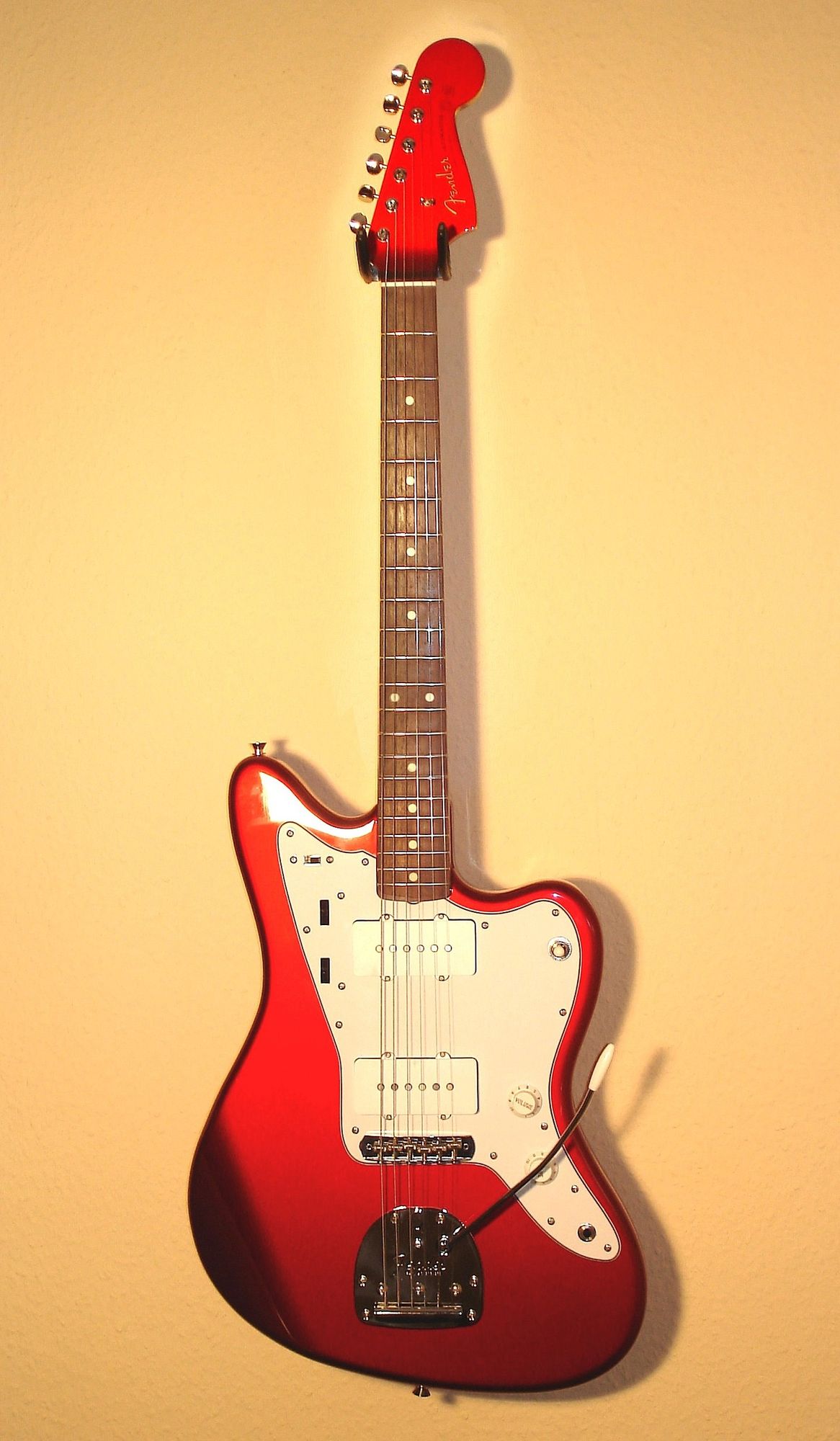
Photo: Dirk-X / Wikimedia Commons / CC BY-SA 4.0 Fender
Jazzmaster
1958
Fender built it for jazz players. Jazz players said no thanks. Surfers, punks, and noise bands said yes.
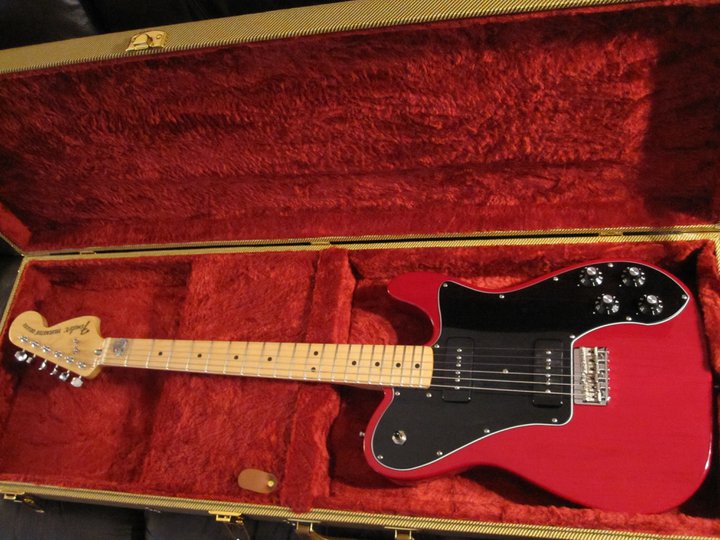
Telecaster Deluxe Black Dove. Photo by Mastermetal666. Licensed under CC BY-SA 3.0. Via Wikimedia Commons. Fender
Telecaster Deluxe
1973
A Tele body, a Strat headstock, and two big humbuckers. The odd cousin in the family, and somebody’s favorite.
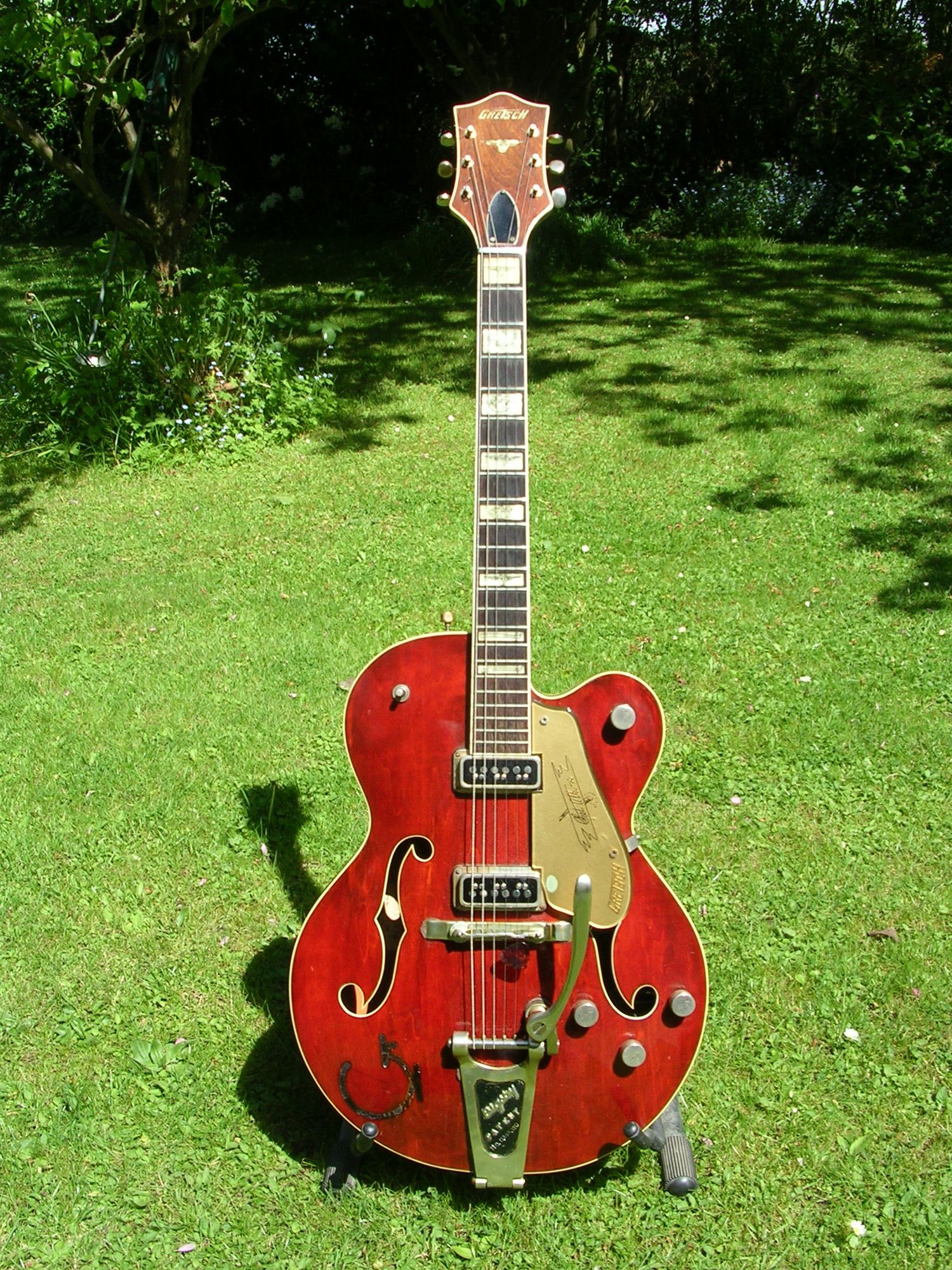
Gretsch 6120 G-Brand 1955. Photo by Francis pullen. Public domain (PD-self). Via Wikimedia Commons. Gretsch
6120
1955
Joe Walsh gave Pete Townshend one. Steve Miller gave Brian Setzer one. Chet Atkins just lent it his name.