Gretsch
6120
Joe Walsh gave Pete Townshend one. Steve Miller gave Brian Setzer one. Chet Atkins just lent it his name.
1970. Joe Walsh gives Pete Townshend a 1959 Gretsch 6120, a big hollowbody that is nothing like the SGs Townshend has been smashing. He takes it into the studio. By his own account, it ends up on every track of *Who’s Next*.
- Introduced
- 1955
- Type
- Hollowbody electric
- Class
- Production
The short version
1954
Chet’s prototypes
Gretsch builds the first ones for Chet Atkins. He asks for a Bigsby on the second.
1955
On sale
The Chet Atkins Hollow Body ships with his endorsement, for $385.
1956
“Twenty Flight Rock”
Eddie Cochran plays his 6120 in the film The Girl Can’t Help It.
1958
Filter’Trons
Gretsch’s humbuckers become standard, after some overlap in 1957.
1962
Two cutaways
The 6120 becomes a double-cut, and some get painted-on f-holes.
1970
Walsh to Townshend
A 1959 6120 changes hands, and heads for Who’s Next.
1974
A magazine prize
A 1957 6120 that Jimmy Page owned becomes the prize in an NME competition.
1984
Miller to Setzer
Around now, Steve Miller gives Brian Setzer another 6120.
Side A
A1
A gift from Joe Walsh
Most guitars get bought. You walk in, you pay, you walk out. A surprising number of Gretsch 6120s have moved a different way: one player handing one to another.
In 1970, Joe Walsh gave Pete Townshend a 1959 6120. Townshend had been beating up SGs on stage for a couple of years. This was a big hollow Gretsch with a Bigsby, and it went into the studio. In 1972 he told Guitar Player: “I used that guitar on every track on Who’s Next.”
That’s his memory. His longtime guitar tech later said it wasn’t quite every track, and some of the sounds are an SG. But you can hear the Gretsch on “Won’t Get Fooled Again,” plugged into a Fender amp. It mostly stayed a studio guitar, because on stage it wouldn’t stay in tune. He went back to it for Quadrophenia, too.
A2
Chet’s name, not Chet’s taste
The 6120 started as Chet Atkins’s guitar. Gretsch built him prototypes in 1954, and on the second one he asked for a Bigsby, which is why nearly every 6120 since has one. It went on sale in 1955 as the Chet Atkins Hollow Body, at $385.
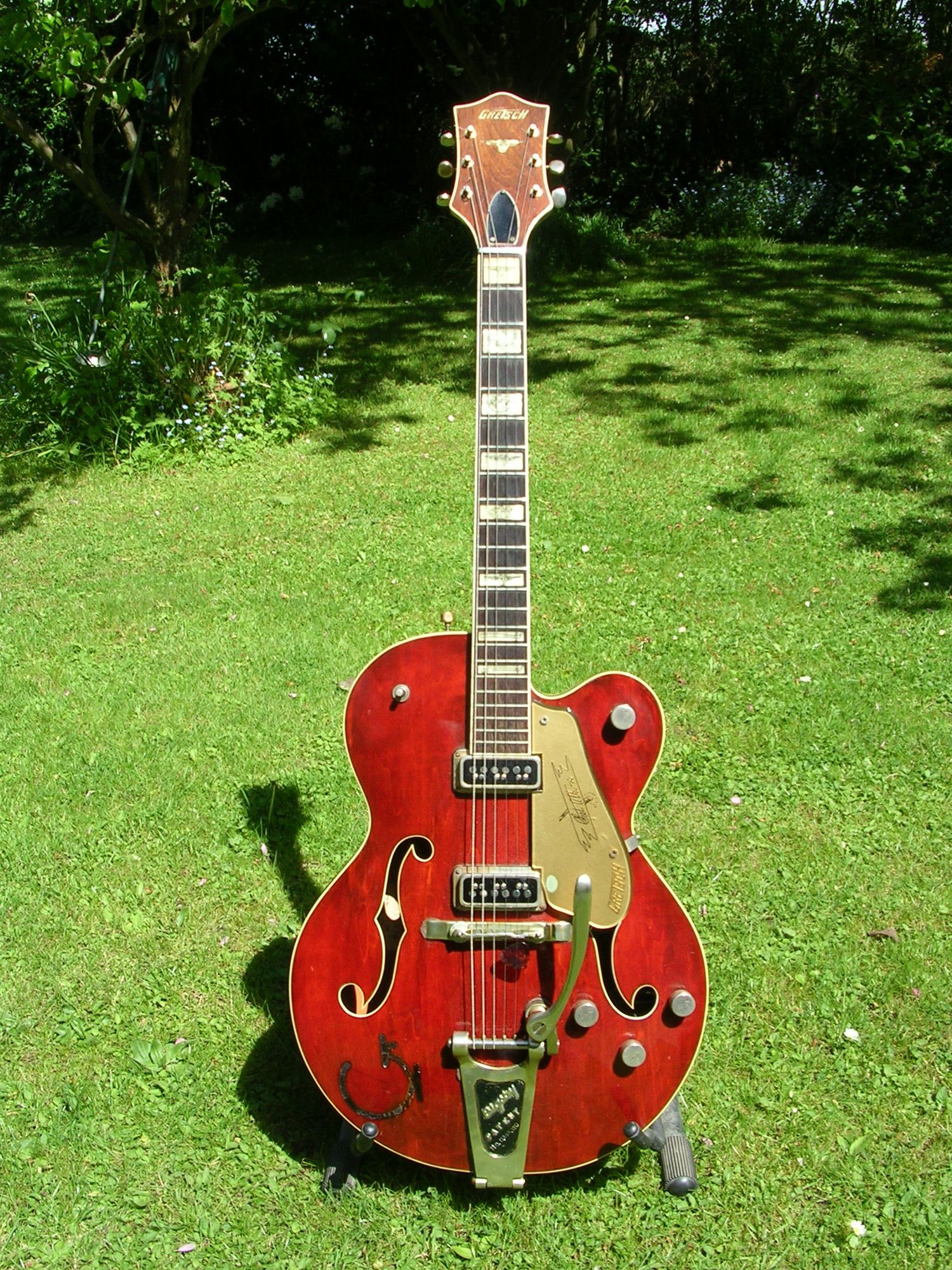
Gretsch dressed it up as a cowboy. The early ones had a G branded into the top, steer heads and cactus on the fingerboard, and a steer on the headstock. People call those the Full Westerns now. The prototypes and the first batch had 21 frets; after that, 22. How wide the body is depends on who measured. One says 15½ inches, another says 16. Bring a tape.
Atkins didn’t like any of it. Before long he was favoring a different Gretsch with his name on it, the Country Gentleman. His name stayed on the 6120. His attention went somewhere else.
A3
The kids who picked it up
Eddie Cochran bought a 1955 6120 new, at Bell Gardens Music Center in California, and made it his by swapping a Gibson P-90 into the neck position. In 1956 he played it in the film The Girl Can’t Help It, doing “Twenty Flight Rock.” He had it through the “Summertime Blues” years and on his 1960 UK tour.
Duane Eddy had a 1957, from his “Rebel Rouser” years. When Gretsch built Eddy a signature model, it copied that ’57.
Chet Atkins put his name on it and moved on. The guitar has been changing hands ever since.
Flip the record · By the numbers
$385
The 1955 list price for the Chet Atkins Hollow Body.
2
Known guitars from 1954 stamped 6120. The rest of the story starts in 1955.
3
Core 6120s Gretsch makes today, before you count the signatures. Say which one you mean.
Side B
B1
Thinner, then gone
The 6120 kept changing. DeArmond single-coils gave way to Filter’Tron humbuckers, Ray Butts’s design, around 1957 and ’58. They kept the twang and lost the hum. The body got thinner in 1960 and again in 1961, because Gretsch was chasing Gibson’s ES-335. By 1962 it had two cutaways, and some had f-holes painted on instead of cut.
The original line quietly stopped in the late ’70s. If you find an old one now, check the binding. Gretsch’s celluloid binding rots, and the old necks have their own problems at the heel.
B2
Passed along
Then a teenager named Brian Setzer bought a 1959 6120. In the early ’80s, with the Stray Cats, he put it in front of a whole new audience. Gretsch gives him the credit for bringing the model back. Around 1984, Steve Miller gave him another one.
Poison Ivy of the Cramps got a 1958 in 1985, and it was her main guitar from then on. A 1957 that Jimmy Page owned ended up as the prize in a 1974 NME competition.
Eddie Cochran’s 6120 is still with his family, on loan to the Rock & Roll Hall of Fame. Townshend’s came from Walsh. Setzer’s second came from Miller. Page’s went to whoever won a contest in a music paper. And the first person to let it go was Chet Atkins himself, the day he decided he liked a different Gretsch better.
Put this on
You’ve read about it. Now hear it. Here’s what this guitar sounds like, and what to listen for.
Twenty Flight Rock (The Girl Can’t Help It)
Cochran on screen with his 1955 6120, the one with a Gibson P-90 swapped into the neck position.
Watch it on YouTube (opens in a new tab)Won’t Get Fooled Again
Townshend said the Walsh Gretsch was on every track of Who’s Next. His tech later said some of it was an SG. On this one, you can hear the Gretsch.
Find it on YouTube (opens in a new tab)
The cast
The people, and the specific guitars, that made the legend.
1955
Chet Atkins
The 1954 prototypes
His name was on it. He never liked the cowboy trim, and moved on to the Country Gentleman.
1956
Eddie Cochran
1955 6120 with a P-90
Bought new at Bell Gardens Music Center. His family still has it, on loan to the Rock & Roll Hall of Fame.
1958
Duane Eddy
1957 6120
Gretsch calls it the original of his twang, and copied it for his signature model.
1970
Pete Townshend
1959 6120, from Joe Walsh
A studio guitar more than a stage one. It wouldn’t stay in tune live.
1980s
Brian Setzer
1959 6120
Bought as a teenager. Gretsch credits him with bringing the model back.
1985
Poison Ivy
1958 6120
The Cramps’ guitarist got hers in 1985, and it was her main guitar from then on.
Liner notes
Specs, construction, rarity, value, and every source we used.
If you want a new 6120, say which one. Gretsch is shipping a Players Edition, a ’55 clone, and a ’59 clone — and none of them is a 1954 Full Western.
- Body
- Laminated maple hollow single-cut, 2.5" deep, ML bracing
- Neck
- Set maple “U”
- Fingerboard
- 12" ebony, 22 medium-jumbo, neo-classic thumbnails, Luminlay side dots
- Scale
- 24.6"
- Pickups
- FT-67 Filter’Trons
- Hardware
- Adjusto-Matic on pinned ebony; string-thru Bigsby B6GP; Gotoh locking tuners; gold
- Electronics
- Two volumes, master volume with treble bleed, no-load master tone
- Finish
- Gloss urethane
- Nut
- TUSQ XL
Open the full research fileConstruction details, the complete player record, production numbers, dated value estimates, and sources
Current typical player spec: G6120TG Players Edition Nashville (Japan Professional Collection). Parallel current SKUs — G6120T-55 and G6120T-59 Vintage Select — are year-clones. They are not this table. 1954–56 Full Western is vintage, not a current SKU.
Construction
Gretsch 6120 Chet Atkins Hollow Body: a 16"-class single-cut archtop hollowbody with f-holes, set maple neck, and a Bigsby. Orange/Western stain is the stereotype. Not the only finish.
Keep the neighbors straight. 6122 Country Gentleman is a separate Chet Atkins model. Atkins moved toward it because he disliked 6120 Western cosmetics (Vintage Guitar / Edward Ball). Duo Jet / Jet Firebird are chambered/solid single-cuts. Malcolm Young’s famous Gretsch is a Jet Firebird, not a 6120. G6620T is a Players Edition Nashville center-block double-cut. Don’t file it as “the” 6120.
Prototypes 1954 (Streamliner Special SN 13753 to Atkins; second prototype 13770 with vibrato + metal nut). Vintage Guitar documents SN 13767 as the earliest guitar labeled 6120; pot codes April 1954. Retail production 1955 (first batch ~16450–16549). Original list $385. Current professional 6120-shaped guitars are Japan (Terada) Professional Collection / Artist signatures, plus US Custom Shop one-offs. Confirm factory on a given SKU.
Vintage identity. Laminated maple, single-cut hollow. Body width: Premier Guitar’s 1956 piece says 15.5"; Joe’s Vintage Guitars says 16". Attribute both; measure the guitar. Depth ~2.75" mid-1950s; thinned ~2.5" (1960) then ~2.25" (1961) as Gretsch chased ES-335 competition. 1962: double-cut “Nashville”; some with painted-on f-holes.
Set maple, rosewood board. Prototypes and first batch: 21 frets. From the second 1955 batch: 22. Scale 24.5" / later 24.6" class.
1954–56 “Full Western”: G-brand, steer/cactus inlays, horseshoe/steer headstock, DeArmond Dynasonic single-coils, Bigsby (B6 on ’55 production; one 1954 prototype had a smaller B3). Vintage. Not a current catalog guitar.
1957: Western ornament stripped; hump-block inlays; still Dynasonics.
Filter’Trons: Ray Butts humbuckers. Sources disagree on the start year. TV Jones (from Butts papers): Gretsch began installing them mid-1957, intending exclusive use by early 1958. Wikipedia 6120: DeArmonds discontinued 1958, neo-classic thumbnails introduced. Joe’s groups Filter’Trons under 1958–59. Safe line: Dynasonic through 1957; Filter’Tron standard by 1958, with 1957 overlap. Trestle bracing appears in that late-’50s window.
1960–61: thinner body, zero fret on many, last full years of classic single-cut. Mid-1960s catalogs shift toward “6120 Nashville.” Original-line production ceased late 1970s. Revival after Setzer visibility in the early 1980s. Bigsby is part of the identity from Atkins’ second-prototype request.
Current Japan line is three 6120s, not one spec. G6120T-55 Vintage Select (’55 clone): 2.75", parallel tone bars, rosewood, Western blocks, TV Jones T-Armond single-coils, nitro, $3,799.99 street. Manufacturer spec wins over a retailer table that wrongly listed Filter’Trons on this SKU. G6120T-59 Vintage Select (’59 clone): 2.75", trestle bracing, ebony, thumbnails, TV Jones Filter’Tron Classic, bone nut, same $3,799.99. G6120TG Players Edition is the modern player 6120 (the table above): 2.5", ML bracing, urethane, FT-67s, string-thru Bigsby, $2,599.99. G6120TG-DS swaps in DynaSonics and hump-blocks. Setzer signatures (Hot Rod; Nashville ’59-style) stay in the family. Eddie Cochran signature copies his P-90-modded 6120.
Players
Chet Atkins — namesake. 1954 prototypes (13753 Streamliner Special; 13770 with Bigsby/metal nut). Endorsed the production 6120 from 1955 shipping (1 January 1955, Gretsch). Later preferred other Atkins models, especially the 6122, as Western décor came off. Do not treat late-career Atkins photos as 6120 by default.
Eddie Cochran — 1955 6120 SN 16942. Official Gretsch feature / Vintage Guitar: bought new at Bell Gardens Music Center; replaced the neck Dynasonic with a Gibson P-90. The Girl Can’t Help It (1956) “Twenty Flight Rock”; “Summertime Blues” era; 1960 UK tour. Remains with the family; on loan to the Rock & Roll Hall of Fame.
Duane Eddy — original 1957 G6120. Gretsch feature and Premier Guitar on the G6120DE signature: based on Eddy’s 1957. “Rebel Rouser” / “Forty Miles of Bad Road” era. Named original of that twang in maker copy.
Brian Setzer — 1959 6120, bought as a teenager (Guitar World 2015). The Stray Cats / revival instrument. Gretsch credits his early-’80s visibility with the model’s return. Later received another 6120 from Steve Miller around 1984 (Guitar Player, 14 June 2026).
Pete Townshend — 1959 6120, gift from Joe Walsh, 1970 (Whotabs; Guitar Player). Townshend to Guitar Player (May/June 1972): “I used that guitar on every track on Who’s Next.” That “every track” line is Townshend’s own 1972 statement; Alan Rogan later nuanced it (some Who’s Next sounds are SG; Gretsch+Twin/Bassman audible on “Won’t Get Fooled Again”). Studio identity more than live (wouldn’t stay in tune on stage). Also placed on Quadrophenia (Whotabs/Rogan).
Poison Ivy (The Cramps) — 1958 6120, acquired 1985 (Vintage Guitar, November 2003). Main guitar thereafter.
Jimmy Page — 1957 6120, serial 23243. Guitar World (Huw Price, 24 October 2025). Documented ownership; 1974 NME competition prize. Not sourced here to a specific Led Zeppelin master take.
Reverend Horton Heat has a G6120RHH signature in the catalog.
Wikipedia’s 6120 page also lists Eric Clapton, Neil Young, Randy Bachman, and Manu Chao. Lead list only; not independently confirmed here as named-6120 + song. Malcolm Young is not a 6120 player (Jet Firebird).
Rarity
Modern Japan 6120s are regular production. Not rare.
Vintage: 1954 labeled 6120s are museum-scarce (Ball: two known 1954 6120-stamped guitars, 13767 and 13770). 1955–61 single-cuts are the collector core. 1962+ double-cuts are commoner and cheaper. Binding rot (celluloid) and neck-angle/heel-screw issues are endemic (Joe’s). Originality of Filter’Trons, Bigsby, harness, and G-brand (where applicable) drives value more than “it’s a 6120.” Yearly totals unpublished. Do not treat serial ranges as shipping totals.
Value
Informal estimate, 25 August 2026. Not an appraisal.
Factory yearly totals unpublished. No 2024–26 auction hammer for a clean 1950s 6120 was captured. Prefer labeled asks over invented medians.
New street. G6120T-59 Vintage Select about $3,800 (manufacturer $3,799.99; Dave’s Guitar Shop). G6120T-55 Vintage Select $3,799.99. G6120TG Players Edition $2,599.99. Setzer signatures typically sit in the same Professional Collection band; not pulled as a full matrix. A Guitar Player “just under $3,500” Cochran-signature figure is date-sensitive, not 2026 street.
Used modern. Sold comps are thin; this is listings and anecdote, not a sold average. No Reverb guide number captured. Japan Professional used solds thin. Expect used PE/VS examples to trade below the $2,600 / $3,800 streets. Gretsch-Talk anecdotally puts used ’59 VS and Setzer SSLVO in a similar pocket. Anecdote, not a comp.
Vintage / collectible. Carter Vintage 2026 asks (authenticated dealer, not sold): 1956 $14,000; 1959 $12,500; 1961 $14,000. Limited/Custom Shop asks $12,500–$13,500 (Carter: 2007 6120-125 Anniversary LE $12,500; Stern 6120DSW 2008 $13,500). Joe’s Vintage Guitars dealer guide (13 February 2026) — asking/buy ranges, not hammers: 1954–56 Full Western $14,000–$18,000+; 1957 transition $10,000–$16,000; 1958–59 Filter’Tron/trestle $9,000–$16,000; 1960–61 thinner single-cut $6,000–$10,500; 1962 double-cut $4,000–$7,500. One US dealer’s 2026 working bands. Condition, binding rot, and originality swing this hard. Full Western is the vintage band, not a current SKU.
See also
- gibson-es-335 — the thinline Gretsch was chasing when the 6120 got thinner
- rickenbacker-330-360 — the other semi/hollow jangle platform
- fender-telecaster — country and rockabilly’s other working guitar
- gretsch-tennessean — Chet’s cheaper 6119 hollow; not this 6120
Sources
Wikipedia 6120 — $385 original list; 1958 Filter’Trons/thumbnails; Terada; artist names (secondary)
Carter Vintage, 1956 6120 — ask $14,000
Carter Vintage, 1959 6120 — ask $12,500
Whotabs, Townshend Gretsch 6120 — Walsh 1970 gift; 1972 GP “every track on Who’s Next”; Rogan nuance
Guitar Player, Townshend’s 1959 6120 — Walsh gift; 1972 quotes
Vintage Guitar, Eddie Cochran’s 6120 — SN 16942; P-90; films
Gretsch, 70 years of the Atkins deal — 1 January 1955 shipping
Gretsch, Duane Eddy — original 1957 G6120
Vintage Guitar, Poison Ivy — 1958 6120 acquired 1985
Guitar World, Page 1957 6120 — serial 23243; ownership, not a Zeppelin take
Guitar World, Setzer collection — 1959 6120 origin
Keep digging
Guitars this one gets compared to, confused with, or descended from.

Photograph of a vintage 1960 Gibson ES-335TD. Photo by Lightburst. Licensed under CC BY-SA 4.0. Via Wikimedia Commons. Gibson
ES-335
1958
Larry Carlton played three 335s off a shop wall, unplugged, paid $850 for one, and became Mr. 335.
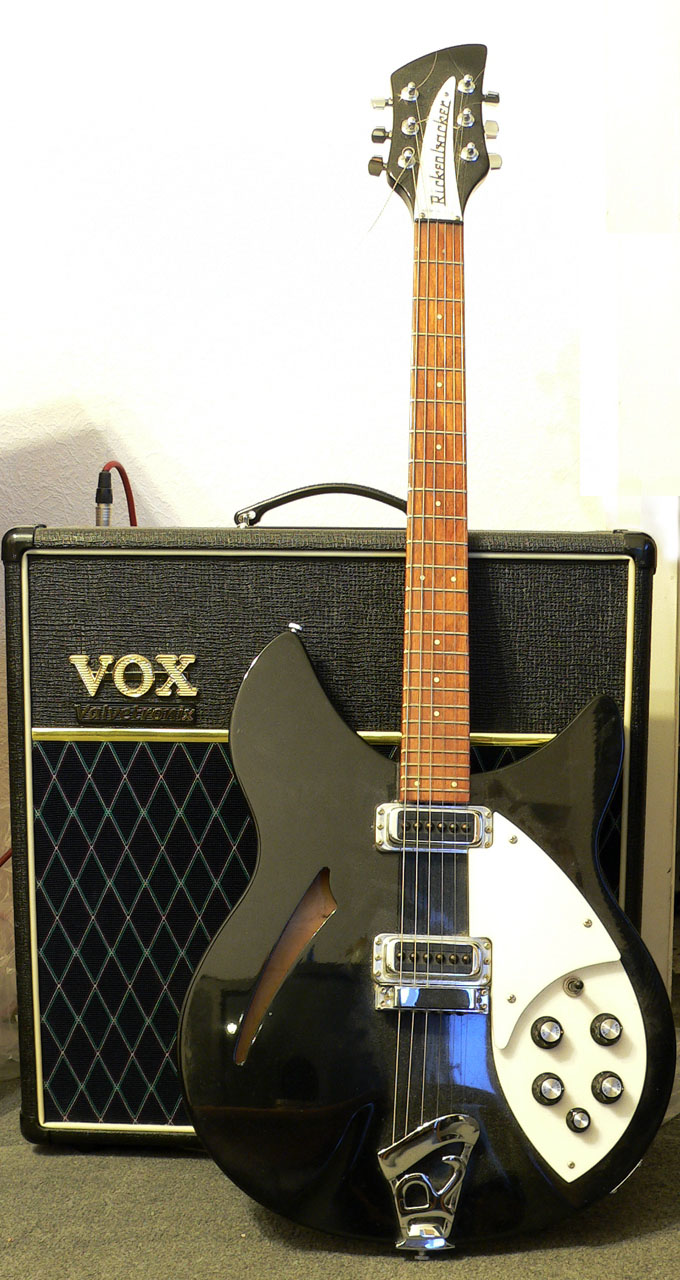
Rickenbacker 330JG. Licensed under CC BY-SA 3.0. Via Wikimedia Commons. Rickenbacker
330 / 360
1958
Same body, same neck, same pickups. The 360 got the binding. The 330 got Paul Weller’s, with “I AM NOBODY” on it.
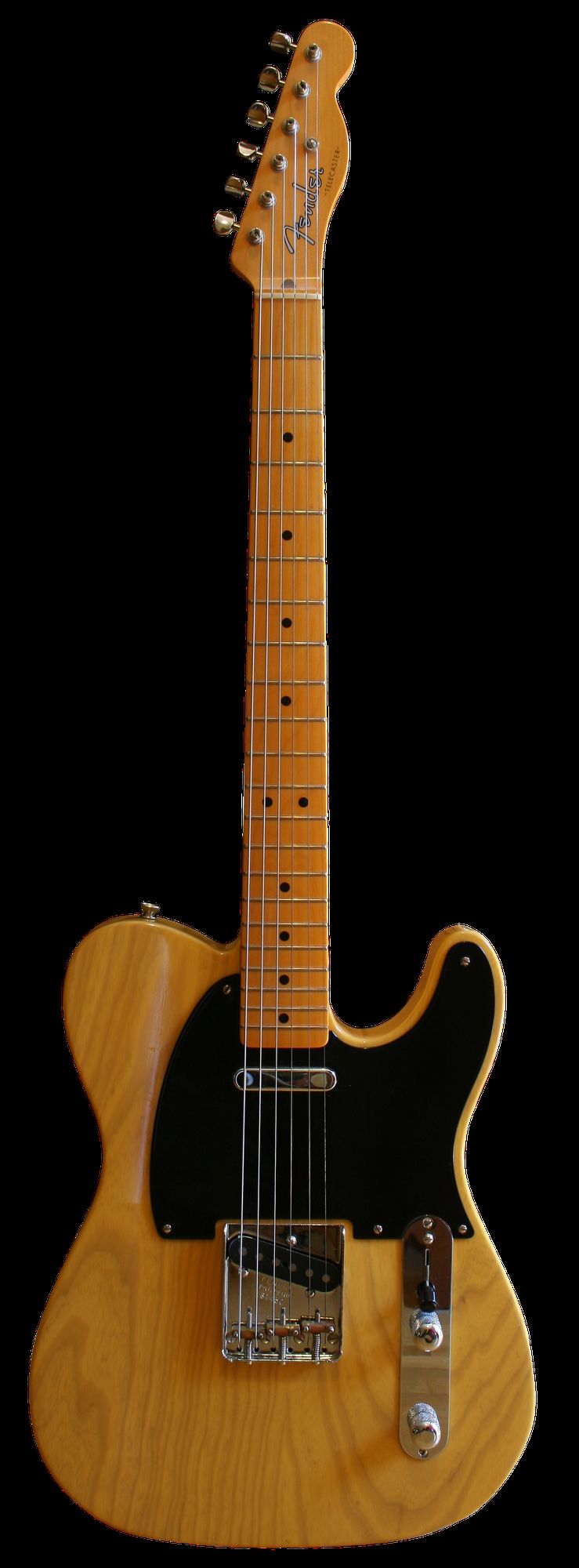
Fender Telecaster American Vintage 1952 with transparent background. Photo by Massimo Barbieri. Licensed under CC BY-SA 3.0. Via Wikimedia Commons. Fender
Telecaster
1950
Leo built it like a tool. The famous ones look like they just clocked off a double shift.