Caparison
Dellinger
Everyone thinks it was Caparison’s first guitar. Its designer made it wait about four years.
Japan, 1994. Itaru Kanno has spent years drawing Jacksons and Charvels for the Japanese catalog, and now he has shapes of his own on paper, including the one that becomes the Dellinger. The drawing is finished. He holds it back anyway.
- Introduced
- 1998
- Type
- Solidbody electric
- Class
- Production
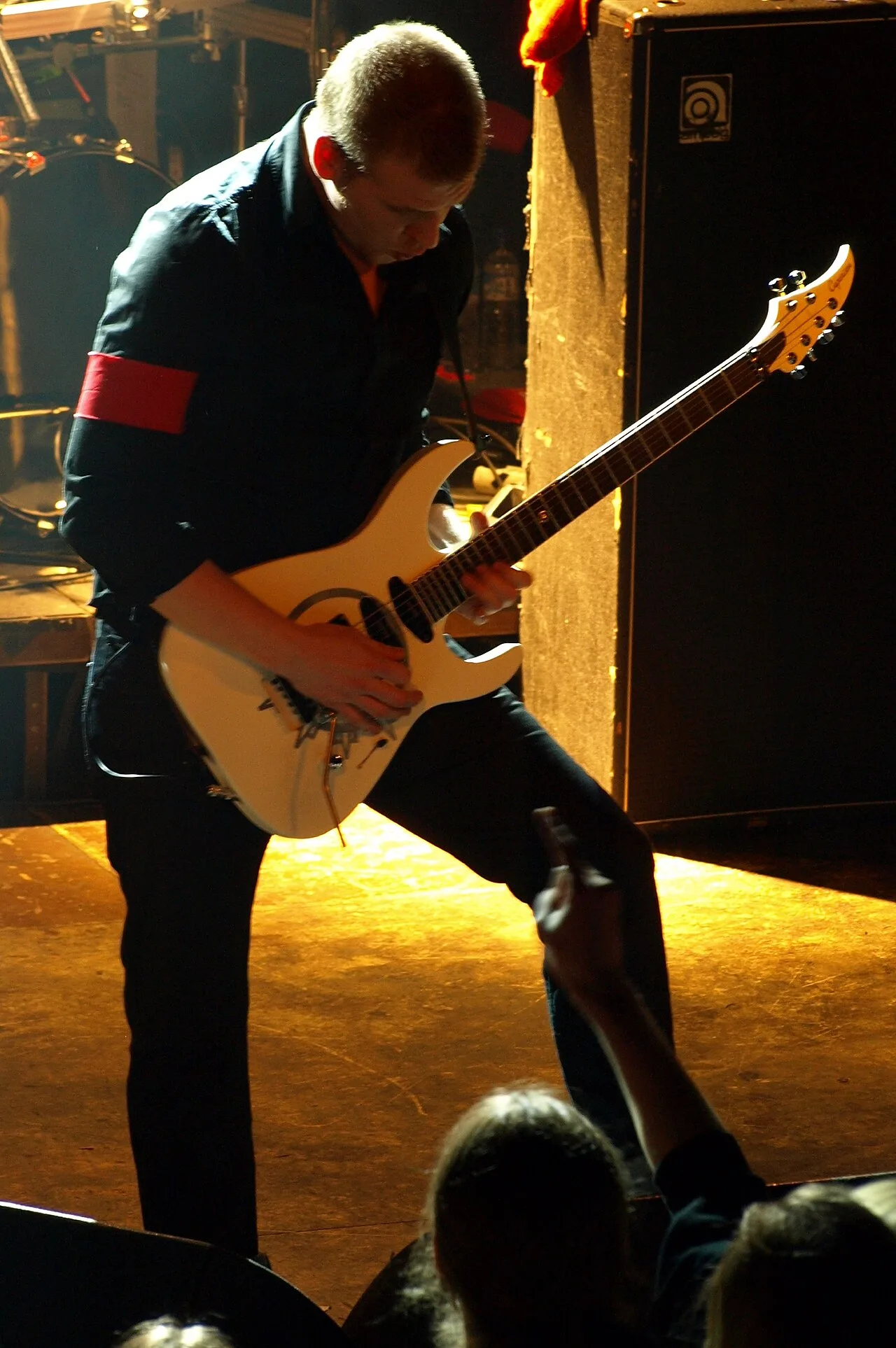
The short version
~1990
Drawing for Jackson
Kanno starts designing Charvel and Jackson models for the Japanese market.
1994
The drawings are done
The Dellinger’s shape is finished on paper, alongside the Horus, TAT, and Angelus.
1995
Caparison starts
The Horus comes first, then the neck-through TAT and the Angelus. Some sources date the company to 1990.
~1998
The bolt-on ships
About four years after ’94, by Kanno’s own estimate. There’s no catalog date.
2008
Heavy strings
The HGS version moves the bridge 3 mm for players who tune down.
2011
The company fails, and comes back
The parent company goes under in May. Production returns that fall under new owners in Cardiff, with Kanno still designing.
2015
The first arched top
The Dellinger Prominence puts a carved top on the bolt-on.
2024
The blackwood redesign
A flat Australian blackwood body with the pickups screwed straight to the wood.
Side A
A1
The one that came last
Picture the first Caparison and you probably picture the Dellinger. It’s the shape everyone knows: a 24-fret double-cut, a pointy headstock, and clock hands where the dots should be.
Itaru Kanno, who drew it, says that picture is backwards. The first Caparison was the Horus. Then came the TAT, then the Angelus, and only then the Dellinger. When an interviewer said the Dellinger was quite a bit later, he agreed.
The odd part is that it wasn’t late for lack of a design. The drawings for all of those shapes were done by 1994. What wasn’t done was the part you can’t see in a drawing.
A2
Drawing for somebody else
Around 1990, Kanno was the man Jackson and Charvel Japan called when they needed a guitar for the local catalog. The Soloist Special, the Dinky, the Falcon: he was drawing other people’s guitars, and getting good at neck-throughs.
Caparison started in 1995, with real sales in 1996. (One encyclopedia puts the company at 1990, which is really when Kanno started drawing Jacksons.) He opened with the Horus on purpose, with 27 frets, because the market was already full of guitars. The TAT was the flagship, and the name tells you how it was built: Through And Through.
Neck-through was what they did best, so neck-through went out first.
A3
Four years for a joint
The Dellinger is a bolt-on, and Kanno wasn’t going to ship a bolt-on he didn’t trust. So he held it and reworked the joint. By his own estimate it came out about four years after ’94. Nobody has published a catalog date, so this page uses 1998 and keeps the “about.”
It was worth the wait. The neck sits at a flatter, more familiar angle than the TAT’s. It feels like a guitar you already know, with 24 frets on top.
Then there are the details that make it a Caparison. The inlays are clock hands, and the time tells you the fret: one o’clock at the first, three o’clock at the third, five at the fifth. The headstock is the Devil’s Tail, and on today’s guitars it’s angled back 15 degrees so the strings sit low at the nut without a string bar. The pickups are designed in-house and wound by a Japanese maker. The company tried branded pickups and went back to its own.
Flip the record · By the numbers
~4 years
How long Kanno held the finished design, by his own estimate, to get the neck joint right.
24
Frets, with clock hands for markers. One o’clock at the first fret, three at the third.
3 mm
How far the 2008 HGS models moved the bridge, so heavy strings kept their tension on the same scale.
~30
Guitars a month from the whole brand in 2013, by the company’s count. Not just Dellingers.
Side B
B1
Built for tuning down
When Caparison started, Jackson’s bright high-mids were the fashion. Kanno aimed the other way, at the mids and lows, and that landed right in the middle of Europe’s down-tuning scene.
For a long time every Dellinger had a solid mahogany body. In 2008 he went further for the drop-tuned crowd with HGS, for Heavy Gauge Strings. He moved the bridge 3 mm down the body and the pickups with it, so a heavy set kept its tension without changing the scale. Late in 2009 came a fixed Gotoh bridge for the hardtail Dellingers, its brass saddles locked so the whole bridge acts as one mass.
Christopher Amott got there early. In a 2008 video shoot on his signature model, he said he’d “been with this company for 10 years.” That’s his count, not a factory date. Don’t move the first Arch Enemy album onto it, though. That record was a borrowed Ibanez.
B2
The company falls over
In May 2011 Caparison’s parent company failed. Operations stopped within days. By one account production was back that September; the restart was announced on October 12, under George and Gabriel Osztreicher in Cardiff. Kanno kept designing, and he said the way the guitars were built didn’t change when the rights moved.
It was never a big operation. In 2013 Gabriel put the whole brand at about 30 guitars a month.
The players stayed. Amott’s Vintage White Dellinger-CA was out by the end of 2011, with inlays he says the founder took from an old banjo, every one different. Joel Stroetzel of Killswitch Engage got a Dellinger with a walnut top over mahogany, black clocks, and the company’s first pickguard. He said the top
gives it a unique sound. I find it to be a little bit darker than a lot of typical bolt-on-neck guitars.
Michael Romeo of Symphony X, with the company since 2005, got an arched-top Prominence, pitched as a through-neck feel on a bolt-on neck.
B3
The one everybody remembers
In 2024 the standard Dellinger was redesigned with a flat Australian blackwood body, a five-piece maple and walnut neck, and pickups screwed straight into the wood. It is not the mahogany guitar of the late ’90s. It still has the clocks and the Devil’s Tail, and it’s still bolted on.
For the company’s 30th anniversary in 2025 there was a run of 24 guitars with a burl-maple top. They were Dellingers, bolted on like the rest.
The fans still get the order wrong. They think the Dellinger came first because it’s the one they see. It wasn’t even second. It was the design Kanno finished early and refused to rush, and it’s the one everybody remembers.
Put this on
You’ve read about it. Now hear it. Here’s what this guitar sounds like, and what to listen for.
Christopher Amott at Musikmesse 2012
Amott demos his signature Dellinger, bolt-on, and explains the inlays. They aren’t clocks. They came from an old banjo.
Watch it on YouTube (opens in a new tab)
The cast
The people, and the specific guitars, that made the legend.
1994
Itaru Kanno
Designer
Drew the Dellinger by 1994 and held it until the bolt-on joint was ready. Still designing after the 2011 restart.
2008
Christopher Amott
Signature Dellinger, later the Dellinger-CA VW
Said on camera in 2008 that he’d been with the company ten years. The first Arch Enemy album was a borrowed Ibanez, not a Dellinger.
2020
Joel Stroetzel
Dellinger-JSM
Walnut top on mahogany, black clocks, and the first Caparison with a pickguard. He finds it darker than most bolt-ons.
2017
Michael Romeo
Dellinger Prominence-MJR
With Caparison since 2005. His signature is an arched top on the bolt-on, with a neck he asked them to change.
James Murphy
Standard Dellinger
The Death, Obituary, and Testament guitarist is listed with a standard Dellinger and an Angelus. No album is pinned to either.
Liner notes
Specs, construction, rarity, value, and every source we used.
Clock hands on a 24-fret bolt-on, under a Devil’s Tail — Caparison’s Dellinger, not the neck-through TAT, and not a King V or a KH-2.
- Body
- Australian blackwood, flat top, Dellinger outline. No carved top on this model.
- Neck
- Bolt-on, five-piece maple/walnut. Profile: Caparison. Urethane matte.
- Fingerboard
- Maple or ebony, white binding, black side dots, clock inlays, 24 jumbo stainless. Radius 350 mm to 400 mm.
- Scale
- 648 mm (25 1/2"). The collection header also prints 648 mm (25.5"). Mix flagged.
- Pickups
- Caparison SH-NC (neck, single-coil size), VS-IA (middle), PH-bc (bridge). Direct-mounted.
- Hardware
- Schaller S-FRT II tremolo; Gotoh SG381-07 H.A.P.; Devil’s Tail headstock, 15°
- Electronics
- CTS volume, 5-way lever, tone push-pull (splits neck and bridge together)
- Finish
- Interstellar Black, Cobalt Blue, or Tangerine Orange. Body chemistry is not on the factory block.
- Nut
- 42 mm, Schaller locking. Millimetres only.
Open the full research fileConstruction details, the complete player record, production numbers, dated value estimates, and sources
Current typical = Dellinger EF/MF (caparisonguitars.com, 24 September 2026). $3,949. Living standard HSS bolt-on. Ebony or maple is EF or MF, same cart. Dellinger II is the HH sibling, PH-bc and PH-nc, 3-way, same $3,949 — not this table. Not the seven, not a signature, not the 30th-anniversary SH, not C2, not a Korean Chatting Bird, not the bass. MusicRadar (2 June 2008) still had every Dellinger on solid mahogany, with a two-piece maple neck on the II it reviewed. Do not average mahogany with Australian blackwood, or two neck pieces with five. Radius and nut are millimetres on the factory page. Scale is printed both ways. Mix flagged. Do not invent an inch figure for 42 mm or for 350–400 mm.
Construction
The job was a bolt-on they trusted. Itaru Kanno already knew neck-through. The Dellinger waited until the joint was worth shipping.
He told Music Land Key — the talk that puts a 2014 limited in “next year,” so 2013 — that the brand started in 1995 and real sales began in 1996. First model: the Horus. Then the TAT, then the Angelus, then the Dellinger. The interviewer said the Dellinger was quite a bit later. Kanno agreed. People picture it as the first Caparison. He said that picture is backwards. The drawings for those shapes, and for the TAT Special, were already finished at the ’94 stage, while he was still the man Jackson and Charvel Japan called for the local catalog. Neck-through was the thing they were good at, so neck-through went out first. The Dellinger is bolt-on. He held it to rework the joint, and put the release at about four years after ’94. This plate uses 1998 for that “about.” It is his estimate. It is not a catalog date. Do not steal the Horus year, and do not move the brand to 1990. English Wikipedia’s body says the company was established in 1990. Kanno, and the Japanese Wikipedia, put the Caparison launch in 1995. About 1990 is when he started drawing Charvel and Jackson for Japan: CDS, Questar, the Doug Aldrich, Soloist Special, Dinky AXE, Falcon.
Not a TAT. Japanese Wikipedia: TAT is the flagship, neck-through, and the name is Through And Through. MusicRadar, 2 June 2008: the Dellinger’s bolt-on sits at a flatter, more familiar angle than the TAT’s wrap-around. Not a Jackson King V. Not an ESP KH-2. Other plates, other neck joints, other headstocks. Not a Soloist, even though that Japanese Jackson work is why the Dellinger gets filed next to one. The Soloist is jackson-soloist. Not a Horus. The factory collection dates the Horus to 1995: bolt-on, 27 frets, 628 mm (24.75"). Kanno said he opened on 27 frets on purpose, because the market was already full of guitars. Japanese Wikipedia adds Chachamaru as the partner on that first model. Different scale, different fret count, different job.
What left the bench is a 24-fret double-cut with clocks and a Devil’s Tail. Guitar World (Ace Presley, 30 July 2014): 1 o’clock on the first fret, 3 o’clock on the third, 5 o’clock on the fifth. Japanese Wikipedia: the time marks the fret. Pegs are two and four, not a six-in-line. The current page sets the head at 15° so the strings sit low at the nut with no bar, and Gotoh H.A.P. posts change height with the gauge. The pickups are theirs. Japanese Wikipedia: designed in-house, wound by Gotoh Pickups (株式会社ゴトー), not the G-Gotoh tuner firm. Guitar World: branded pickups were tried, then rejected, and the wind stayed exclusive.
Mahogany was the body for a long time. MusicRadar, 2008, reviewing a Dellinger II: every Dellinger has a solid mahogany body; that neck was two-piece hard-rock maple, bolt-on. The current neck is five-piece maple and walnut. Do not average them.
The guitar then moved for players who tune down. Kanno, same interview: Jackson’s high-mid was the fashion, so he aimed Caparison at mid and low, and that met the European down-tuning scene. Guitar World, 2014: in 2008 he offered HGS — Heavy Gauge Strings — on the Dellinger, the Angelus, and the 27-fret Horus. The bridge moved 3 mm down the body, pickups with it, so a heavy set kept its tension without a new scale. Late 2009, a Gotoh fixed bridge for hardtail Dellingers: a light Duralium plate, brass saddles, two grub screws locking those saddles so the bridge acts as one mass. Late 2011 into 2012, the same piece: M3, a maple core between mahogany sides, and WM, walnut against mahogany. Neither is the wood on the table above.
The company broke in the middle of that. Japanese Wikipedia: parent Kyowa Shokai failed on 6 May 2011, debts about ¥850 million, operations ended 9 May 2011; the restart was announced 12 October 2011 under George and Gabriel Osztreicher in Cardiff. Chris Gill (Guitar World, 3 February 2015): bankruptcy in May 2011, production back that September, Kanno still designing. Keep September and 12 October. Kanno told Music Land the build did not change when the rights moved. Gabriel, same conversation: about 30 guitars a month, roughly 15–20 exported and 10–15 for Japan. That is 2013, the whole brand. Not a Dellinger total. Not 2026. English Wikipedia still says Iida in Nagoya. Kanno’s account of the first two years is two factories splitting Horus, TAT, and Angelus — the Dellinger was not out yet — and a design argument about the TAT with Sugimoto, then at Fujigen, later of Sugi. He did not put this bolt-on on either bench. The company has not published the factory. Do not fill the blank.
2014 NAMM, Guitar World: the C2 line. Japanese, Devil’s Tail, but DiMarzio or EMG, solid mahogany, dot inlays, priced under the regular series. Dots, not clocks. Not this table. A Korean Chatting Bird “Dellinger” is a clone on another badge. Not this guitar. 2015, Premier Guitar (6 February): Dellinger Prominence, the first arched-top Dellinger, M3 body, MAP $2,659 for the six and $3,119 for the seven.
The living standard is the flat-top redesign. Australian blackwood, pickups screwed to the wood, HSS as in the table, one push-pull that splits neck and bridge together. Gear Gods (1 April 2024) had that Dellinger, and the HH Dellinger II, at $3,499.99 in Interstellar Black, Cobalt Blue, and Tangerine Orange. The factory cart on 24 September 2026 is $3,949. Do not average the two. Strings on the current page are RotoSound .009–.042, standard tuning, in a Reunion Blues Voyager, with a certificate signed by the lead designer.
Classic versus current: Kanno’s late-’90s bolt-on, mahogany, the joint he held the model for — against blackwood, a five-piece neck, and direct-mount HSS.
Players
Do not hang a TAT, a Horus, an Apple Horn, or an Angelus on this outline. Mattias “IA” Eklundh is the Apple Horn on the Japanese Wikipedia artist list. Adam Dutkiewicz is a Pete Lesperance model and a TAT Special there, not a Dellinger. Michael Amott’s ESP is not his brother’s Caparison.
Christopher Amott (Arch Enemy, Armageddon). The guitar this plate is known for. darkstars.de (21 May 2022): the first Arch Enemy album is a borrowed Ibanez RG550. Caparison came after. Do not move that first album onto a Dellinger. A 2008 Young Guitar shoot (uploaded 21 April 2008) has him on a signature — 24-fret ebony, Seymour Duncan pickups, the Arch Enemy mark — and “been with this company for 10 years.” That ten is his count, on camera, not a factory start date. Blabbermouth (25 December 2011), on the later Dellinger-CA VW: Vintage White, chrome, art-deco inlays, DiMarzio pickups on solid mahogany, one volume and no tone, the knob moved off the usual spot. Premier Guitar’s Musikmesse 2012 demo has him calling the guitar in his hands mahogany with a maple top, bolt-on, and saying the founder took those special inlays from an old banjo, each one different. Solid mahogany in the press copy, a maple top in his hands. Keep both. They are not the clocks on a standard Dellinger. He told darkstars he was buying that Vintage White back from a private buyer. No price. Not a comp.
Joel Stroetzel (Killswitch Engage). Guitar World (Rob Laing, 27 February 2020), with Atonement just out: the Dellinger-JSM is based on the Dellinger II FX-WM, walnut top on mahogany, which the company said was there to put back the low end a pickguard takes away. Stroetzel: the top “gives it a unique sound. I find it to be a little bit darker than a lot of typical bolt-on-neck guitars.” The neck is maple with walnut reinforcement, “much more impervious to the elements than say a two-piece neck.” First Caparison with a pickguard, he said, and the first with black clocks and black binding. Fishman Fluence Killswitch Engage set: the bridge “a little bit quieter” than a standard Fluence, the neck “pretty much a standard Modern,” push-pull for the two voices, and a coil-tap on the tone instead of a high-frequency tilt. Retail then £3,229 / $3,499, White Gloss or Black Gloss. The interview does not pin a track on Atonement. The JSM V2 (Guitar World, 23 February 2025) is the later one: Australian blackwood with a walnut top, five-piece maple/walnut bolt-on, maple board, compound 350–400 mm, 25.5", 24 small Jescar stainless, nut 42 mm, Fishman Fluence Ceramic Killswitch Engage in the bridge and a Fishman SSA in the neck, Caparison fixed bridge, Gotoh SG381-07, shipped .011–.049 in drop C (C–G–C–F–A–D). Review price $3,899. The factory cart on 24 September 2026 is $4,299, and the Vintage Blue limited is $4,599. Do not average those with the 2020 price or with each other. Not the HSS table.
Michael Romeo (Symphony X). Guitar World (Joe Bosso, 31 March 2022): aligned with Caparison since 2005, and every guitar track on War of the Worlds, Pt. 2 is a Caparison. “A” Caparison. The same piece says they sent a seven-string for the rhythms. It does not name that seven a Dellinger. A 4 October 2018 Guitar World caption does: Romeo with a Dellinger. Premier Guitar (19 December 2017), from Nagoya: the Dellinger Prominence-MJR is an arched top on the bolt-on, “the greatly improved playing experience of a through neck model TAT on a bolt on neck guitar,” M3 body (maple between mahogany, neck bolted to the maple), Dunlop super-jumbo frets, a neck he asked them to change, DiMarzio Tone Zone in the neck and X2N in the bridge, maple board, Schaller double-locking tremolo. Living cart, 24 September 2026: $4,199. Not the blackwood HSS.
Also known to play stays short, and it stays on the Japanese Wikipedia list. James Murphy (Death, Obituary, Testament): a standard Dellinger and an Angelus. No album credit pinned here. Rob Marcello: Dellinger and Horus. Mircea Gabriel Eftemie and Rune Stigart: standard Dellingers. RYU (Blood Stain Child): a custom Dellinger-HGS. Tom S. Englund (Evergrey): that list still says custom Horus models. The factory collection now has a Dellinger Prominence-TSE at $4,299. Keep both. Do not describe a guitar the list and the cart disagree on.
Rarity
You can buy a new Dellinger tomorrow. EF/MF, the II, the seven, and the fixed-bridge WB-FX guitars are regular production on the factory collection. Caparison does not publish a Dellinger total. None invented.
Gabriel’s “about 30 a month” is the 2013 brand, split between export and Japan. It does not count this model, and it does not describe 2026. Serials are not a census here. No factory year-by-year was in hand.
What is actually thin: the early bolt-ons from the years after the neck-throughs, and the numbered short runs. The 30th-anniversary Dellinger-SH-BM-CL (factory page, 24 September 2026) is a 17 mm burl-maple top over Australian blackwood and maple, still bolt-on on the spec block. The essay on that page says the neck “rivals neck-thru.” The joint line says bolt-on. Do not promote it to a TAT. Same page: the essay calls the bridge a PH-bcm; the spec block prints PH-bc. MusicPlayers.com (6 June 2025) also says PH-bcm, and that the run is 24 guitars. The factory page fetched this pass did not print 24. Keep the press count. Do not average the two pickup names. First SH layout, no middle, SH-NC in the neck. Cart $4,949. Those guitars are not a vintage Dellinger, and a C2 with dots is not one either. Amott’s Vintage White and Romeo’s photographed Dellinger are single objects. They are not the model.
Value
Informal estimate, 24 September 2026. Not an appraisal.
Ask versus sold labeled. Celebrity lots are not comps. No invented medians. A 1950s-style vintage market does not exist for this guitar. The three bands below are new street, used modern, and the short-run end.
New street. Living Dellinger EF/MF and Dellinger II EF/MF: $3,949 (caparisonguitars.com, 24 September 2026). Gear Gods, 1 April 2024, had both at $3,499.99 when the blackwood flat-top was new. Do not average that launch price into today’s cart. Same pass: Dellinger 7 EF/MF $4,499. Dellinger-WB-FX and Dellinger II-WB-FX $3,949. Dellinger7-WB-FX $4,179. JSM V2 $4,299. JSM V2 limited $4,599. Prominence-MJR $4,199. Prominence-TSE $4,299. SH-BM-CL $4,949 — 24 guitars, not the standard. Older lists, not 2026 street: MusicRadar, 2 June 2008, Dellinger II at £1,510. Gill, 3 February 2015, Dellinger II FX-WM list $2,609. Premier Guitar, 6 February 2015, Prominence MAP $2,659 / $3,119. Stroetzel’s first JSM, Guitar World, 27 February 2020, £3,229 / $3,499. Do not convert the pounds, and do not average a 2008 UK review into a 2026 US cart.
Used modern. Reverb’s price guide for the Dellinger Prominence printed “Used estimate unavailable,” then six finals: $1,900 (1 March 2024), $1,350 (7 March 2024), $1,600 (9 March 2024), $1,537 (2 July 2025), $1,699 (17 May 2026), $1,850 (27 June 2026), all Excellent. Six sales. Not a series median, and not the blackwood EF. No clean 2025–26 sold band for the current EF/MF or the II was isolated this pass. Don’t invent a midpoint. One Musician’s Friend ask, a used Dellinger WBFX-EF, was $2,399.99 against a $2,999.99 tag. Ask, not a hammer.
Vintage / collectible. No clean late-’90s Japan Dellinger hammer was isolated this pass. Flag: thin sold-comp access on the first bolt-ons. The 24-guitar SH run is a numbered new guitar at $4,949, not a vintage comp. Amott buying his signature back, and Romeo’s photographed Dellinger, are one owner each. No price on either. Not comps.
See also
- jackson-soloist — neck-through superstrat from the Jackson book Kanno was writing before 1995; not this bolt-on
- jackson-king-v — symmetrical neck-through V; not a Dellinger
- esp-kh-2 — Hammett’s neck-through ESP; not this Caparison
Sources
- Caparison, Dellinger EF/MF — current table; $3,949; Australian blackwood; bolt-on five-piece; 648 mm (25 1/2"); nut 42 mm; radius 350–400 mm; SH-NC / VS-IA / PH-bc; Schaller S-FRT II; 15° head; RotoSound .009–.042 (fetched 24 September 2026)
- Caparison, Dellinger collection — 648 mm (25.5") in the header; II $3,949; 7 $4,499; WB-FX $3,949; II-WB-FX $3,949; 7-WB-FX $4,179; JSM V2 $4,299; JSM V2 limited $4,599; Prominence-MJR $4,199; Prominence-TSE $4,299; SH-BM-CL $4,949
- Caparison, Dellinger II EF/MF — HH; PH-nc and PH-bc; 3-way; same $3,949 and same neck block
- Caparison, Horus collection — Horus first introduced 1995; 27 frets; 628 mm (24.75")
- Music Land Key, メーカーに問う!! Caparison — Kanno: launch 1995, sales 1996, Horus first, then TAT, Angelus, Dellinger last; drawings done at the ’94 stage; bolt-on joint, about four years after ’94; two factories in the first two years for Horus, TAT, and Angelus; Sugimoto, then at Fujigen, on the TAT; Gabriel: about 30 a month, 15–20 export, 10–15 Japan. The talk schedules 2014 limiteds for the next year
- Guitar World, Ace Presley, A Brief History of Caparison Guitars — 30 July 2014; formed 1995; Tokyo 1996; clocks; own pickups; HGS in 2008, bridge moved 3 mm; Gotoh fixed bridge late 2009, Duralium and brass; UK company 2011; M3 and WM late 2011–2012; C2 at NAMM 2014
- Guitar World, Chris Gill, Dellinger II FX-WM — 3 February 2015; May 2011 bankruptcy, production resumed September 2011; list $2,609; walnut top about 3/4", mahogany back about 1"; 25 1/2"; 24 jumbo; clocks; .010–.052; dropped C
- MusicRadar, Caparison Dellinger II — 2 June 2008; £1,510; all Dellingers solid mahogany; two-piece maple bolt-on; flatter than the TAT
- Premier Guitar, Dellinger Prominence — 6 February 2015; first arched-top Dellinger; M3; MAP $2,659 / $3,119
- Premier Guitar, Michael J. Romeo signature — 19 December 2017; Prominence-MJR; arched top described as a TAT feel on a bolt-on; Tone Zone neck, X2N bridge; Dunlop super-jumbos
- Guitar World, Joel Stroetzel — 27 February 2020; JSM; walnut/mahogany; his quotes; £3,229 / $3,499; Atonement is the interview frame, not a track credit
- Guitar World, Dellinger-JSM V2 review — 23 February 2025; $3,899; blackwood and walnut; 25.5"; 350–400 mm; 42 mm nut; 24 small Jescar; drop C; .011–.049
- Guitar World, Michael Romeo — 31 March 2022; Caparison since 2005; War of the Worlds, Pt. 2 on Caparison models; a seven-string, not named as a Dellinger
- Guitar World, Romeo solo album — 4 October 2018; photo caption, Dellinger
- darkstars.de, Christopher Amott — 21 May 2022; RG550 on the first Arch Enemy album; buying back the Dellinger-CA Vintage White; no price
- Blabbermouth, Dellinger-CA VW — 25 December 2011; Vintage White; solid mahogany; DiMarzio; one volume, no tone
- Premier Guitar, Musikmesse 2012, Amott demo — 3 April 2012; bolt-on; he calls that guitar mahogany with a maple top; banjo-derived special inlays. Auto transcript
- Young Guitar shoot, Amott on his signature — uploaded 21 April 2008; 24-fret ebony; Seymour Duncan; Arch Enemy mark; “10 years” with the company
- Wikipedia (Japanese), キャパリソン — 1995 with Kyowa Shokai and Kanno; Jackson/Charvel work from about 1990; bankruptcy 6 May 2011, operations ended 9 May, restart announced 12 October 2011; TAT through-neck; Dellinger bolt-on; Horus first, with Chachamaru; Gotoh Pickups; about 30 a month in 2013, citing the Music Land interview; factory unpublished; artist list
- Wikipedia, Caparison Guitars — infobox founded 1995; body says established 1990; resumed September 2011; Iida, Nagoya. Keep the 1990/1995 split
- Gear Gods, 2024 Dellinger and Dellinger II — 1 April 2024; blackwood flat-top; $3,499.99; the three colors; HSS vs HH
- Caparison, Dellinger-SH-BM-CL — 30th anniversary; 17 mm burl top; bolt-on on the spec block, “rivals neck-thru” in the essay; essay PH-bcm vs spec block PH-bc; $4,949. The number 24 is not on this page
- MusicPlayers.com, 30th-anniversary Dellinger-SH-BM-CL — 6 June 2025; limited to 24; 17 mm; PH-bcm
- Reverb price guide, Dellinger Prominence — used estimate unavailable; six Excellent finals, March 2024 through June 2026, $1,350–$1,900. Not a median
- Musician’s Friend, used Dellinger WBFX-EF — ask $2,399.99 against a $2,999.99 tag. Not a hammer
Keep digging
Guitars this one gets compared to, confused with, or descended from.
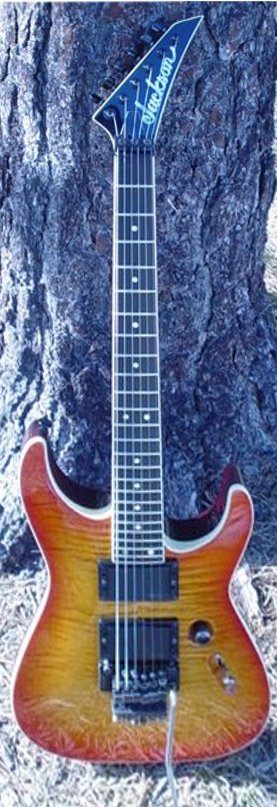
A 1987 Soloist archtop. Photo by Jimshine; perspective correction by GreyCat. Licensed under CC BY-SA 4.0. Via Wikimedia Commons. Jackson
Soloist
1984
Grover Jackson took the Strat shape and ran the maple neck straight through it. Jeff Beck’s was pink.
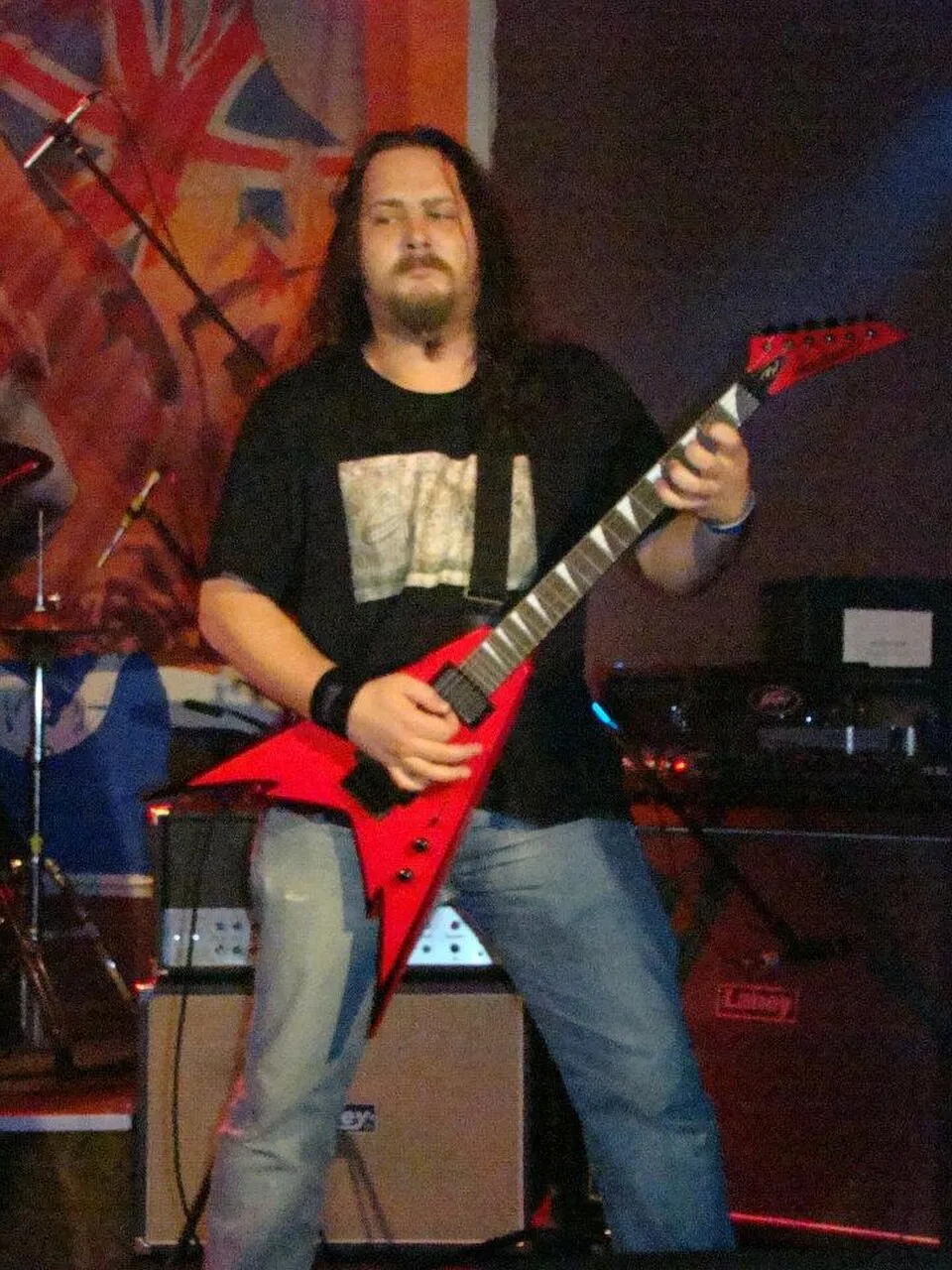
Photo: Deadbunny / Wikimedia Commons / CC BY-SA 3.0 Jackson
King V
1985
It started as a giant V for a giant guitarist. Then Jackson cut the wings down so everyone else could wear it.
- Send a picture
ESP
KH-2
1995
Kirk Hammett walked into ESP in 1987 knowing exactly what he wanted. He’s been playing it ever since.