ESP
KH-2
Kirk Hammett walked into ESP in 1987 knowing exactly what he wanted. He’s been playing it ever since.
New York, April 1987. Kirk Hammett and Scott Ian walk into ESP’s office on West 19th Street. Kirk doesn’t want to browse. He has the whole guitar in his head already, down to the skulls on the fingerboard.
- Introduced
- 1995
- Type
- Solidbody electric
- Class
- Production
Have a photograph of this guitar? Send a picture
The short version
1987
The order
In April, Kirk describes his guitar at ESP’s New York office and picks out the neck himself.
1987
First gigs
By August it’s on stage, at the 100 Club and then Donington.
1988
Justice
Early in the year it goes into the …And Justice for All sessions with his Flying V.
1995
The catalog KH-2
A signature model based on that first guitar reaches the ESP catalog. Custom orders may go back to 1993.
2006
Neck-through again
A neck-through KH-2 joins the bolt-on version that ESP had been selling.
2012
Twenty-five years
Kirk’s 25th year as an ESP player.
2018
Bone Breakers
New signature pickups for a cleaner, crisper Kirk.
Side A
A1
He already knew
In April 1987, Kirk Hammett and Scott Ian walked into ESP’s office at 151 West 19th Street in New York. Most players who walk into a guitar company want to see what’s on the wall. Kirk had already built his guitar in his head.
He wanted a Strat-style body with the neck running all the way through it. EMG pickups. A Strat headstock, upside down. A beveled heel so his hand wouldn’t hit a block of wood at the top of the neck. Twenty-four frets. A Floyd Rose. Two volume knobs and one master tone. And instead of dots on the fingerboard, skulls and crossbones.
Then he spent half an hour going through loose necks until he found one that felt right, and asked if they could make it a neck-through. They said yes.
A2
The Skully guitars
ESP’s custom shop in Tokyo built it and sent it over a few months later. By August 1987 Kirk was playing it on stage, first at the 100 Club in London and then at Donington.
It picked up a damaged-pirate Zorlac skateboard sticker, drawn by the artist Brian “Pushead” Schroeder, and that became its name. A second guitar followed, the one people call Caution, with an orange “CAUTION HOT” warning near the knobs and a strip of tape reading “KIRK’S GUITAR.” Kirk calls the pair his Skully guitars.
Early in 1988, the Zorlac went into the sessions for …And Justice for All, alongside his Gibson Flying V.
A3
Written on that guitar
The Zorlac didn’t just play Metallica songs. It helped write them. Here’s Kirk:
I wrote some of the stuff that ended up in ‘The Unforgiven,’ the main riff from ‘Enter Sandman’ was written on that guitar, as well as parts of ‘Of Wolf And Man.’
Notice what he’s claiming and what he isn’t. He wrote those parts on it. Which guitar is on the finished records is a separate question, and it isn’t one we can pin down. But that “Enter Sandman” riff came out of this guitar first.
Flip the record · By the numbers
24
Frets. Kirk asked for all of them in 1987.
30
Minutes Kirk spent picking out the neck that felt right, before asking ESP to make it a neck-through.
25
Kirk’s 25th year as an ESP player came in 2012.
Side B
B1
From one guitar to a catalog
The Zorlac became the basis for Kirk’s first ESP signature model, the KH-2. When that happened depends on who you ask. The first custom was 1987. Some dealers say shop orders for KH-2s go back to 1993. It was in the ESP catalog by 1995.
For years the production KH-2 had a bolted-on neck, which was a funny thing to do to a guitar whose owner had asked for a neck-through on day one. A neck-through version arrived around 2006, and that’s the one ESP’s custom shop in Japan builds today.
Caution got its own tribute, too. The KH-2 Vintage is a beaten-up black copy of it, with the same EMG pickups “just as Kirk’s own guitar uses.” And for players who can’t stretch to a Japanese custom-shop guitar, there’s the LTD KH-602, which ESP says does “just about everything that its higher-end cousin, the ESP KH-2, does.”
Kirk also used the shape as a canvas. In the early ’90s he had a KH-2 dressed in the poster for Boris Karloff’s 1932 The Mummy. When he opened the case, he thought it was as good as the poster, “maybe even better.” A Ouija-board version came after that. “I thought it would be freakin’ great to put this on a guitar,” he said.
B2
Same guitar, cleaner tone
In 2018 EMG gave Kirk his own pickups, the Bone Breakers, and he explained what had changed.
My taste in tone has definitely changed over the years. I don’t like to use as much distortion these days—I prefer my tone to be nice and crisp.
The sound moved. The guitar didn’t. 2012 was his 25th year as an ESP player, and ESP’s Matt Masciandaro says almost every guitar the company has made for Kirk since the beginning has been based, to a large extent, on the Zorlac. Skulls on the board, the headstock upside down, 24 frets, a Floyd. It’s the guitar he described at ESP’s office on West 19th Street in April 1987, and he has hardly needed to describe another one.
Put this on
You’ve read about it. Now hear it. Here’s what this guitar sounds like, and what to listen for.
…And Justice for All
The first ESP went into these sessions alongside his Gibson Flying V. Which parts are which isn’t spelled out, so listen for both.
Find it on YouTube (opens in a new tab)Enter Sandman
Kirk says the main riff was written on the Zorlac, the ESP the KH-2 is based on. Which guitar is on the finished record is a different question, and we won’t guess.
Find it on YouTube (opens in a new tab)The Unforgiven
Some of what ended up in this song was written on the Zorlac too, by Kirk’s account. Written, not necessarily recorded.
Find it on YouTube (opens in a new tab)
The cast
The people, and the specific guitars, that made the legend.
1987
Kirk Hammett
The 1987 Zorlac ESP, and the KH-2 that copied it
Designed it in one visit. Nearly every guitar ESP has built him since comes from it. His Les Paul, Greeny, is a different story.
1987
Scott Ian
Along for the ride
Walked into ESP’s New York office with Kirk on the day he ordered it.
Brian “Pushead” Schroeder
The Zorlac sticker
The artist behind the damaged-pirate Zorlac sticker that ended up on the first guitar.
2012
Matt Masciandaro
ESP
Later ESP’s US president. Says almost every guitar ESP has made for Kirk is based largely on that first one.
Liner notes
Specs, construction, rarity, value, and every source we used.
A reverse six-in-line, skull-and-bones on 24 frets, and a Floyd — Kirk Hammett’s ESP KH-2, not an Eclipse single-cut.
- Body
- Alder, double-cut
- Neck
- Neck-thru 3-piece maple, extra thin U
- Fingerboard
- Rosewood, 305 mm radius, 24 extra-jumbo, skull-and-bones. Mix flagged.
- Scale
- 25.5". Mix flagged.
- Pickups
- EMG KH Bone Breaker Limited Edition set (bridge and neck)
- Hardware
- Floyd Rose Original; Gotoh tuners; black; ESP strap locks
- Electronics
- Two volume, tone, 3-way toggle; active
- Finish
- Black
- Nut
- Locking, 42 mm. Mix flagged.
Open the full research fileConstruction details, the complete player record, production numbers, dated value estimates, and sources
Current typical = KH-2 Neck Thru Black (Japan Custom Shop; espguitars.com, fetched 2 September 2026). Factory mixed inch/mm flagged; no millimetres invented for the 25.5" scale. Factory $5,399.00, case and COA included. Sweetwater the same $5,399.00. Sibling KH-2 Purple Sparkle $6,049.00 (scalloped 17–24). KH-2 Vintage Distressed Black $6,549.00 is the Caution relic with EMG 81 / 60A — sister on this name, not this table. LTD KH-602 is the volume cousin (Floyd Rose 1000, Macassar ebony, 350 mm radius) — same plate, not a second slug. Bolt-on KH-2 was the catalog guitar Reverb dates 1995–2019; the living ESP page is NTB. KH-3 Spider, KH-V, KH-DC, and Eclipse are other slugs.
Construction
The job was Kirk Hammett’s guitar, not ESP’s single-cut. April 1987, New York: Kirk and Scott Ian walked into ESP’s office at 151 West 19th Street. Kirk, to Tony Bacon (Reverb News, 27 February 2020): a neck-through Strat-style with EMG pickups, an upside-down Strat headstock, a beveled heel, skull-and-crossbones as fret markers, 24 frets, a Floyd, two volumes and a master tone. He spent half an hour picking a loose neck that felt right and asked them to make it neck-through. They said yes.
A few months later the Tokyo custom shop sent the first one. He was playing it by August 1987 — 100 Club, then Donington. Early 1988 it went into the …And Justice For All sessions with his Gibson Flying V. That guitar later wore a damaged-pirate Zorlac sticker (Brian “Pushead” Schroeder). Bacon: it is the guitar that was the basis for Kirk’s first ESP signature model, the KH-2. A second guitar became Caution — orange “CAUTION HOT” near the controls, tape reading “KIRK’S GUITAR.” He calls the pair his Skully guitars. Matt Masciandaro, later ESP’s US president: almost every guitar ESP has made Kirk since has been based to a large extent on the Zorlac original.
Not Eclipse (esp-eclipse). Eclipse is ESP’s set-thru 24.75" single-cut. This is a 25.5" superstrat with a reverse six-in-line and a Floyd. Different joint, different scale, different job. Not a Horizon. Not KH-3 (Spider). Not KH-V. Not KH-DC. Not Snakebyte, Iron Cross, or Truckster (Hetfield). No Gibson SKU lives here.
Year fight: Kirk’s first custom is 1987. Reverb’s product database dates the named KH-2 signature 1995–2019. A manufacturer 1995 ESP catalog sits on the Internet Archive. Dealer copy (repeated on Reverb listings) puts Custom Shop KH-2 orders in 1993 and the first catalog page in 1995. Keep 1995 as the catalog year. Keep 1987 as the custom. Keep 1993 as dealer copy. Do not pick a winner. Do not promote a factory count.
The production KH-2 was a bolt-on for years — alder, maple, rosewood, 24 extra-jumbo, skull-and-bones, Floyd Rose Original, Gotoh, EMG 81 at the bridge and (later) a 60 at the neck, extra-thin flat or U. ESP’s 2011 archive still listed KH-2 as bolt-on and KH-2 NTB as neck-thru. Blue Book dates the Neck-Thru “mfg. 2006–present.” The living Japan Custom Shop page is the NTB: 3-piece maple through alder, extra thin U, 305 mm rosewood, locking 42 mm nut, Bone Breakers, Floyd Original. That is this table.
2018. EMG’s Kirk Hammett Bone Breaker set (BB-B ceramic bridge, BB-N Alnico 5 neck). Guitar.com, 21 January 2018, quoting Kirk: “My taste in tone has definitely changed over the years. I don’t like to use as much distortion these days—I prefer my tone to be nice and crisp.” Vintage keeps 81 / 60A “just as Kirk’s own guitar uses.” LTD KH-602 is the import cousin ESP itself calls “just about everything that its higher-end cousin, the ESP KH-2, does.”
Graphics sit on this silhouette, not as other slugs. Bacon: the movie-poster run started in the early ’90s with a KH-2 wearing the 1932 Boris Karloff Mummy poster. Ouija-board bodies followed. Those objects are Kirk’s. They are not the Black NTB table.
Classic vs current: 1987 Zorlac — neck-through, reverse headstock, skull-and-crossbones, 24 frets, Floyd, EMGs, two volumes and a tone — against the 2026 NTB Black: same idea, Bone Breakers, Japan Custom Shop, $5,399.00.
Players
Kirk Hammett. This is his guitar. Do not recruit Eclipse, Horizon, or Hetfield credits. Do not hang Greeny (a Les Paul) on this plate.
Zorlac, to Bacon: “I wrote some of the stuff that ended up in ‘The Unforgiven,’ the main riff from ‘Enter Sandman’ was written on that guitar, as well as parts of ‘Of Wolf And Man.’” Justice sessions, early 1988, with the Flying V. Caution is the touring twin ESP later relic’d as KH-2 Vintage. The Mummy KH-2, early ’90s: Kirk opened the case and thought it was as good as the poster, “maybe even better.” Ouija: “I thought it would be freakin’ great to put this on a guitar.” Those are named objects. They are not a street NTB.
Also known to play stays empty this pass. Other ESP Kirk SKUs (KH-3, KH-V, KH-DC, White Zombie) are other silhouettes. None invented.
Rarity
KH-2 Neck Thru, Vintage, Purple Sparkle, and LTD KH-602 are regular production. ESP does not publish KH-2 unit totals. None invented.
Serials date a guitar, they don’t count a factory. Early K-2xxx headstock stamps and later Signature Series badges overlap years; that is why a first-year count is unknown, not the chapter. Bolt-on catalog KH-2s (Reverb 1995–2019) and the 2006+ NTB share this slug. Zorlac, Caution, and the Mummy are unique. They are not a vintage KH-2.
Value
Informal estimate, 2 September 2026. Not an appraisal.
Ask vs sold labeled. Celebrity lots are not-comps. No invented medians or factory counts. Reverb Price Guide widget on the KH-2 product page did not print a clean band in the static fetch this pass.
New street. Factory KH-2 Neck Thru Black $5,399.00 (Sweetwater the same). Purple Sparkle $6,049.00. Vintage Distressed Black $6,549.00. LTD KH-602 $1,399.00 — labeled LTD, not this Japan NTB.
Used modern. Named ask this pass, not a hammer: Japan KH-2, Very Good, late-1990s–2000s dealer dating, $2,999 (Reverb product page, fetched 2 September 2026). No sold median computed here. Do not average LTD KH-602 streets into an ESP KH-2.
Vintage / collectible. 1987 Zorlac and Caution are unique. Early-’90s Mummy and Ouija customs are unique. They are not a street tape. First-catalog bolt-ons sit at the scarce end of the same slug, not a separate SKU.
See also
- esp-eclipse — ESP’s set-thru single-cut; not this 25.5" superstrat
- jackson-rhoads — the offset V Kirk brought into that 1987 ESP meeting; not a KH-2
- jackson-soloist — the other famous neck-through superstrat; not a Hammett signature
Sources
- ESP, KH-2 Neck Thru Black — $5,399.00; neck-thru; alder; 3-pc maple; 25.5"; rosewood 305 mm; 24 XJ; skull and bones; 42 mm locking; Extra Thin U; Floyd Rose Original; Gotoh; EMG KH Bone Breaker Limited Edition; Japan Custom Shop
- ESP, KH-2 Neck Thru Purple Sparkle — $6,049.00; scalloped 17–24
- ESP, KH-2 Vintage — $6,549.00; Distressed Black; CAUTION HOT / KIRK’S GUITAR; EMG 81 / 60A
- ESP, LTD KH-602 — $1,399.00; ESP’s “higher-end cousin, the ESP KH-2”; Floyd Rose 1000; Macassar ebony 350 mm
- Sweetwater, KH-2 Neck-thru Black — $5,399.00
- Reverb News, Tony Bacon, Kirk Hammett, George Lynch, and ESP’s Emergence, 27 February 2020 — April 1987 NYC; first custom by August 1987; Justice early 1988; Zorlac as basis for KH-2; Caution; Mummy; Ouija; Kirk quotes
- Internet Archive, ESP Guitar Catalog 1995 — manufacturer catalog year
- Reverb, ESP KH-2 Kirk Hammett Signature — product years 1995–2019; bolt-on overview; named used ask $2,999
- ESP archive, Kirk Hammett Signature Series, 1 February 2011 — KH-2 bolt-on; KH-2 NTB; KH-2 Vintage; KH-602
- Blue Book of Guitar Values, ESP Kirk Hammett KH-2 Neck-Thru — NTB mfg. 2006–present
- Guitar.com, Kirk Hammett has a new EMG signature pickup set, 21 January 2018 — Bone Breaker; Kirk on cleaner tone
- EMG, Kirk Hammett Bone Breaker KH-BB Set — BB-B ceramic bridge; BB-N Alnico 5 neck
- Guitar World, NAMM 2012: ESP Introduces Kirk Hammett KH-DC, LTD KH-DC, and LTD KH-25, 21 January 2012 — Masciandaro: 25th year as an ESP player in 2012
Keep digging
Guitars this one gets compared to, confused with, or descended from.
- Send a picture
ESP
Eclipse
1993
ESP’s single-cut has no famous record to lean on. It has to win you over the honest way, in your hands.
- Send a picture
Jackson
Rhoads
1981
Randy Rhoads drew it on a scrap of paper. He got about a year with it. A generation of metal kids got the rest.
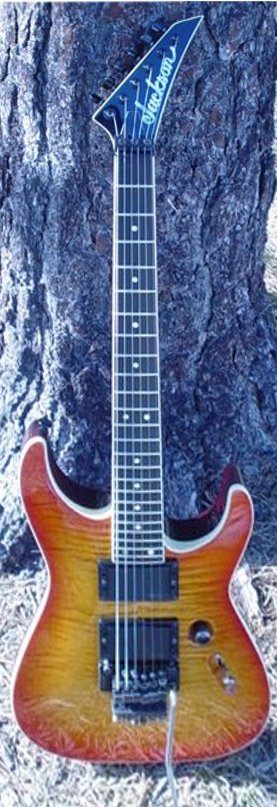
A 1987 Soloist archtop. Photo by Jimshine; perspective correction by GreyCat. Licensed under CC BY-SA 4.0. Via Wikimedia Commons. Jackson
Soloist
1984
Grover Jackson took the Strat shape and ran the maple neck straight through it. Jeff Beck’s was pink.