Carvin
Holdsworth
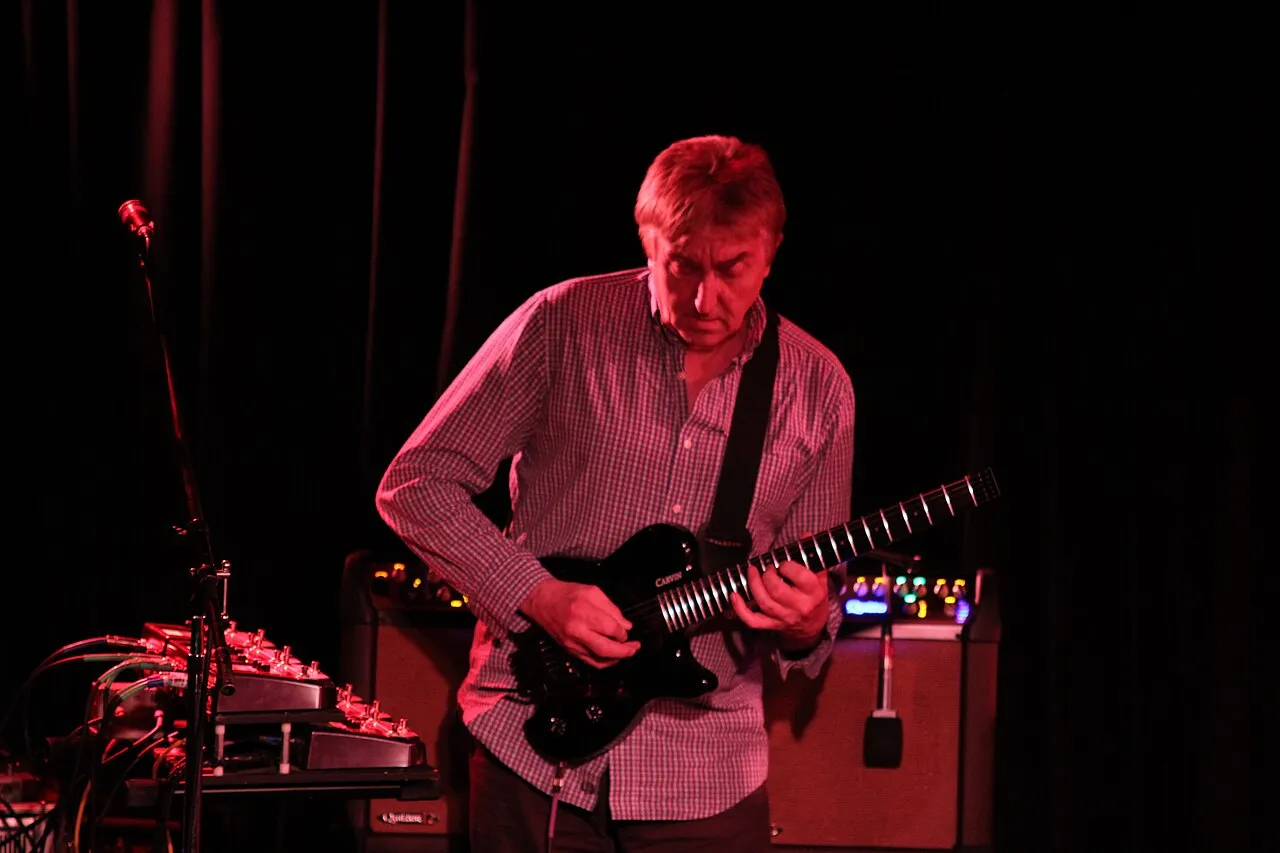
The guitar Allan Holdsworth couldn’t order, until Carvin built it: a flat board, a fat neck, hollow inside.
After the Gibson merger, Allan Holdsworth can’t get through to Steinberger, the company that makes the headless guitars he loves. Bill DeLap builds him wooden ones by hand. Then Bunny Brunel brings over a Carvin bass.
- Introduced
- 1996
- Type
- Solidbody electric
- Class
- Production
The short version
1985
The other signature
Ibanez’s AH10, bolt-on basswood from Japan. Not this guitar.
1989
“The most significant development”
That’s what he calls the Steinberger.
1993
Work starts
As Mark Kiesel remembers it.
1996
H1 and H2
Chambered alder, a 20-inch board, and a small headstock. Fall catalog only. The H2 lists at $859.
1999
The Fatboy
2⅜ inches deep, and he names it. One account says 1998.
2012
Headless
The HH1 and HH2, under 5.5 pounds. The release itself carries a 2011 dateline.
2015
Kiesel
The guitars leave Carvin for Kiesel. Same model, new logo.
2017
Vista
He dies at home in April, at 70.
Side A
A1
A guitar he couldn’t order
Allan Holdsworth had found the guitar he wanted, and then lost access to it.
In 1989 he called the Steinberger “the most significant development in the last fifty years.” After the Gibson merger, he had trouble getting through to the company at all. So Bill DeLap built him headless guitars out of wood, on Steinberger hardware, with the fingerboards flattened.
The flat board was the point. “I like the neck to be absolutely straight,” he said. Most fingerboards curve across the width, so chords sit comfortably in the hand. Holdsworth played wide, stretched legato lines across all six strings, and he wanted the board flat under them.
What he didn’t have was a wood guitar a company could just build him.
A2
Twenty inches, and new tooling
Then Bunny Brunel brought over a Carvin bass. By 1996 Holdsworth said he had “just recently” switched. None Too Soon, from that time, is mainly Steinbergers. The switch came after.
Mark Kiesel remembers the work starting in 1993. Nearly everything on the Carvin line got changed for him. Alder instead of their poplar. A chamber inside. A fatter neck, for tone and feel. 24 frets. A 25½-inch scale, where the other Carvins were 25. And a 20-inch radius where the others were 14, which meant new tooling. The pickup was new too, the H22, wound with plain-enamel wire.
It came out in 1996, Carvin’s 50th-anniversary year, as the H1 with one pickup and the H2 with two. Set alder neck, ebony board, one volume, one tone, and a compact headstock. It made the fall catalog only, with the H2 at $859.
Nearly everything on the Carvin line got changed for one player.
Yes, it had a headstock. The headless one was still sixteen years off.
A3
Put your hand right through it
The H was a solid guitar hollowed out under a cap. In 1999 came something hollower: a top and a back, 2⅜ inches deep against the H’s 1¾, with a maple neck and birch top and back. Two I-beams run inside it, and the top touches wood only behind the bridge. “I could put your hand right through it,” Holdsworth said. One account puts it at 1998. Mark Kiesel says “in 99 or just before.” He named it the Fatboy.
He explained what the hollow does. It “slows down some of the attack; it doesn’t slow down the initial attack. It slows down everything else.” That’s the thing to listen for in his playing from these years: the front of the note arrives on time, and the rest of it takes its time.
Around the release of The Sixteen Men of Tain, he put himself on the Carvin about 80 percent of the time, and a Steinberger the other 20.
Flip the record · By the numbers
20″
Fingerboard radius. The other Carvins were 14″, so it needed new tooling.
80%
How often he said he played the Carvin around the turn of the century. A Steinberger got the rest.
2⅜″
Depth of the Fatboy. The H was 1¾″.
$859
List price of the H2 in the fall 1996 catalog.
Side B
B1
Headless, finally
In 2012 Carvin gave him what the DeLaps had been: a compact H2 or Fatboy with no headstock, one he could simply order. He had played it on the road first. The HH1 has only a bridge pickup, which he’d long favored. The HH2 has two. Chambered alder, a white birch top, under 5.5 pounds.
He didn’t want stainless frets at first. Mark built him a guitar with them anyway, and he kept it.
Put the neck pickup over a hollow and the bridge pickup on solid wood, and he heard the difference: “it’s more dynamic… it’s snappier and quicker.”
In 2015 the guitars left Carvin for a new company, Kiesel. Same model, new logo. The strap button still sits off the horn, where he wanted it.
B2
You’ll never want to go back
Allan Holdsworth died at home in Vista, California, in April 2017. He was 70. One account says Saturday the 15th, of a heart attack. Others say he was found Sunday the 16th. His last listed show was April 10, at Ten Twenty Prime in San Marcos. Nobody wrote down which guitar was on the strap.
Kiesel still builds the HH2.
Days before he died, he put it plainly: “Once you play a headless guitar, you get used to the fact that there is no headstock. You’ll never want to play a regular guitar again.”
The cast
The people, and the specific guitars, that made the legend.
Allan Holdsworth
Carvin H2, Fatboy, and HH headless
Co-designed all three. Wanted the neck “absolutely straight.”
Mark Kiesel
The builder
Remembers the work starting in 1993. Built him a stainless-fret one he didn’t think he wanted, and he kept it.
Bunny Brunel
A Carvin bass
Brought it over, and Holdsworth switched soon after.
Bill DeLap
Wood headless guitars on Steinberger hardware
What Holdsworth played when he couldn’t get through to Steinberger. The Carvin headless was built to answer them.
Liner notes
Specs, construction, rarity, value, and every source we used.
Holdsworth’s Carvin, not his Ibanez or his Steinberger: a 20-inch board and a chamber, headed in 1996 and headless from 2012.
- Body
- Chambered alder, plain maple top. Headless. 31" long, 1.75" thick, 11" wide
- Neck
- Set, tung-oiled maple; two-way truss; dual carbon-fiber rods. 0.82" at the 1st fret, 0.94" at the 12th
- Fingerboard
- Ebony, 20" radius, 24 stainless medium-jumbo (.103" × .048"), white pearl dots
- Scale
- 25.5"
- Pickups
- Two bezel-mount passive Kiesel Holdsworth humbuckers
- Hardware
- Hipshot fixed bridge, .4125" (10.5mm) spacing; black. Mix flagged
- Electronics
- Master volume, master tone, 3-way mini switch
- Finish
- Custom. No single catalog color. Hardware black on the current sheet
- Nut
- 1.69" wide. Material not on the current sheet
Open the full research fileConstruction details, the complete player record, production numbers, dated value estimates, and sources
Current production typical = Kiesel Allan Holdsworth Signature, 6-string HH2, read 28 September 2026. Same page: prose says chambering is optional and about 5.75 lb; the table says chambered alder and 6 lb. Keep both. Not the 1996 H1/H2, not the 1999 Fatboy, not the 2012 birch-top HH. HH1 is one pickup. HH2X is the tremolo. HF2S is the 2009 MIDI Fatboy. Mix flagged: the bridge line is the only place this sheet prints millimetres, .4125" (10.5mm). MusicRadar’s 2012 review is millimetres throughout. Do not convert one into the other.
Construction
The job was a wood guitar he could not order: a straight neck, a fat profile, and a chamber that still let a distorted note be quiet.
He had already called a Steinberger “the most significant development in the last fifty years” (Guitar World, 1989). Guitar Shop, 1995: after the Gibson merger he had trouble getting through to them, so Bill DeLap built wood headless guitars on Steinberger hardware, boards flattened. TCG interview: “I like the neck to be absolutely straight.” That preference is this 20" board.
The first Carvin still had a headstock. Guitar Techniques, 1996: None Too Soon was mainly Steinbergers; he had “just recently” switched, after Bunny Brunel brought over a Carvin bass. Mark Kiesel, 6 August 2024: work from 1993, as he remembers it, guitar out in 1996. Alder instead of their poplar. A chamber. A fatter neck, for tone and feel. 24 frets. 25½", where the other Carvins were 25". A 20" radius against their 14", which meant new tooling. Plain-enamel pickups, no micronics: the H22. The current sheet says Kiesel Holdsworth humbuckers and does not say the wind is the same.
1996. H1 and H2. Museum: probably the significant new guitar of the 50th-anniversary year. Chambered alder, alder set neck so the body could be chambered, ebony, compact 2×4 headstock, one volume, one tone. H1 one H22, H2 a pair. Tune-o-matic and stopbar; Wilkinson optional. Fall catalog only that year. H1 $809 / $879 with trem, H2 $859 / $929. In 1997 the H2 base fell to $769. List price, not 2026 street. On Carvin’s film the H is a hollowed solid with a cap. The Fatboy is a top and a back: “I could put your hand right through it.” Two I-beams. The top touches wood only behind the bridge.
1999. Fatboy, HF1 and HF2. Same outline, 2⅜" against 1¾", maple neck instead of alder, birch top and back. Harmony Central, 17 April 1999, also says alder under the birch. Mark: “in 99 or just before,” and Holdsworth named it. The Guitar Column says the HF2 arrived in 1998. Keep all three; this plate uses 1999. Catalog: HF1 $849, HF2 $899. Harmony Central’s lists are $1,799 and $1,949. Do not average. Museum, 2003: H2 $879, HF2 $979. 2009: the HF2S adds the SH575’s MIDI. Not this table.
2012. Headless. A compact H2/Fatboy he could order, after the DeLaps. Premier’s release is dated 4 January 2012 and prints “4 January 2011” in the dateline. Museum year-page and Winter NAMM say 2012. Keep the printed 2011. HH1 is bridge-only. The Guitar Column calls that his long favorite. HH2 is two pickups. Chambered alder, white birch top, Eastern hard-rock maple, under 5.5 lb, 25.5", 20", nickel-silver medium-jumbo on the release. He didn’t want stainless at first; Mark built one; he kept it. JCustom hardtail, double-ball strings; XS-Trem optional. MusicRadar, 9 October 2012, on the review guitar: 785mm end to end, 648mm scale, 44mm thick, nut 42.8mm, neck 21.3 / 24.7mm, 22 poles per H22. Vintage Guitar: 11 poles per coil, base $1,199, tested $1,703, “just a hair over five pounds.” Mix flagged. Those millimetres are not this table.
Two quotes, two guitars. Kiesel’s page, 2013, neck pickup in a hollow and bridge pickup on solid wood: “it's more dynamic… it's snappier and quicker.” The Fatboy film, 4 June 2024: a hollower guitar “slows down some of the attack; it doesn't slow down the initial attack. It slows down everything else.”
2015. Guitars left Carvin for Kiesel, Escondido (San Diego Union-Tribune, 20 January 2015). Same model, new logo. The table is the guitar they sell now: maple top, not birch; carbon rods; Hipshot, not JCustom; the humbucker no longer named H22. Prose: optional chambering, about 5.75 lb. Table: chambered, 6 lb. A 10" or 14" board on a used one is an option. Strap button off the horn, where he wanted it.
The Fatboy returned as a 2024 limited run. Kiesel, 4 June 2024: orders closed. Mark, 6 August: reissued a few months earlier, selling. Bigfoot lists serial 171142 as a 2025 Fatboy; the woods on that card are not the 1999 birch recipe. One order, not an open page.
The Ibanez AH10 (1985–87, Japan, bolt-on basswood, 22 frets, 17" radius) is the other signature. Not ibanez-jem. Not a Steinberger, a DeLap, or the SynthAxe on Flat Tire.
Players
One signature, one player. Vai’s amps, Gambale, Becker’s JB, Walsh’s carved-top: other Carvins. Not this guitar.
Allan Holdsworth (Bradford, 6 August 1946) co-designed it. Guitar World (6 April 2025) keeps the earlier ones off this plate: Strat, SG, Strat again, Charvel, Ibanez by the mid-’80s, Steinberger by the late ’80s. The AH10 is that Ibanez. None Too Soon is the Steinberger record. In the archived TCG interview, with The Sixteen Men of Tain as the new CD, he put himself on the Carvin about 80% of the time and a Steinberger the other 20%. Wikipedia’s Tain personnel (late 1999, out March 2000) credit guitar and SynthAxe. Not a track sheet for an H2.
Premier, January 2012: Carvin sold the headless after he had played it on the road. Guitar World, days before he died at 70: “Once you play a headless guitar, you get used to the fact that there is no headstock. You’ll never want to play a regular guitar again.” Kiesel’s page has a shorter, undated line: “once you get used to playing a headless guitar, it's really hard to go back.” Two wordings.
He died at home in Vista. New York Times, 18 April 2017: Saturday the 15th, heart attack, via former manager Leonardo Pavkovic. Los Angeles Times and the San Diego Union-Tribune: found Sunday the 16th. Last stand the Union-Tribune names: 10 April 2017, Ten Twenty Prime, San Marcos. The guitar on the strap is not named.
Kiesel still builds the HH2. No second player is pinned to this model in the sources read here.
Rarity
You can order a new HH2. On 28 September 2026 the 6-string variant was marked available for sale. Custom shop, not a numbered run. Not rare the way a first-year Strat is rare.
No H, HF, or HH total has been published. Wikipedia’s “almost 4,000 custom made instruments per year” is the whole company after the split, not this model. None invented. A serial dates a guitar. It doesn’t count a year.
Thinner, without a census: a Fall 1996 H1. The 2024 Fatboy reissue, orders closed 4 June 2024, edition size unpublished. His own guitars, if one is documented, are single objects. They are not a used HH2.
Value
Informal estimate, 28 September 2026. Not an appraisal.
Ask versus sold, labeled. Catalog figures are old money. No factory count and no invented median. A signed pick or a memorabilia lot is not a comp for the guitar.
New street. Kiesel’s product data, 6-string HH2, SKU HH2: $2,099, available for sale (28 September 2026). Options move it. In-stock serial 167502 was $2,299 (from $2,399), soft case, sold out — one built guitar, not the base. No open Fatboy price. Period lists live in Construction (1996 H2 $859; 1999 catalog HF2 $899 against Harmony Central’s $1,949; Vintage Guitar HH2 $1,199 / $1,703 tested; MusicRadar 9 October 2012 £1,426 and $2,599 on one review). Old money. Do not average them, and do not turn the pounds into dollars.
Used modern. Clean 2024–26 solds are thin. Flag: thin sold-comp access. Reverb’s Poland guide for “Allan Holdsworth Signature 6” shows two orders, 27 February 2025 and 5 April 2026, in zloty only, and says the estimate is drawn from US sales. Not converted here. Named asks, not hammers: a 2021 natural HH2, excellent, $1,700. A red-flame Fatboy, excellent, $1,749, listed about eight days before this plate. Blue Book’s Reverb feed, also asks: a 2026 pink/black-crackle HH2 $2,200; a 2017 clear-gloss HH2 $2,100. Don’t average those with a 1996 H2.
Older solds, not a 2026 band. A 2017 deep-honeyburst HH2, serial 135470, excellent, sold at $1,400; the listing was about seven years old when read. A 2023 guitar the seller calls an HH1 — the title says HH2 — delivered 18 August 2023, sold at $1,500. A racing-green HH2 that sold at $1,299 had Lithium pickups, not the Holdsworth pair. Not a comp.
Vintage / collectible. No separate published guide band. Nineties H2s and Fatboys trade as used American customs. Blue Book’s feed, asks not solds: a 1996 H2 $2,220; a 1997 ruby-red H2 $1,699; a 2005 HF2 $2,250. An HF2S is the MIDI guitar. Price it on its own. His personal instruments are not a market level until one of them has a published hammer. None captured here.
See also
- steinberger-gl — the graphite headless on None Too Soon; not this wood Carvin
- strandberg-boden — another current headless solidbody; a different neck and a different job
- gibson-sg — an earlier Holdsworth guitar, “reputedly” his favourite when the Ibanez AH10 was reviewed in 1985; not this signature
Sources
- Kiesel, Allan Holdsworth Signature — current HH2 sheet, fetched 28 September 2026; chambered alder / plain maple / Hipshot .4125" (10.5mm) / 25.5" / 20" ebony / 1.69" nut / 0.82" and 0.94" / 6 lb in the table; prose ~5.75 lb and optional chambering; 2013 quote; 6-string variant SKU HH2 at $2,099, available for sale
- Kiesel in-stock 167502 — $2,299 from $2,399, soft case, sold out; one built guitar, not the base
- Kiesel Museum, 1996 — H1/H2 introduction; alder set neck; 25½" (half an inch over the other models); 2×4 headstock; H22; Fall catalog only; H1 $809/$879, H2 $859/$929
- Kiesel Museum, 1999 — Fatboy HF1/HF2; 2⅜" vs 1¾"; maple neck; HF1 $849, HF2 $899; H2 still $799/$849
- Kiesel Museum, 2003 — H2 $879/$919; HF2 $979
- Kiesel Museum, 2009 — HF2S MIDI Fatboy
- Kiesel Museum, 2012 — HH1/HH2; birch top; 24 frets; 25.5"; 20"; JCustom; double-ball strings
- Kiesel Museum, identification guide — H1/H2 alder set-neck from 1996; HF1/HF2 maple neck, birch top and back from 1999 (matrix through 2006)
- Premier Guitar, Carvin headless release, 4 January 2012 — dateline inside the piece prints 4 January 2011; birch top; Eastern hard-rock maple; under 5.5 lb; nickel-silver; H22; HH1 single / HH2 pair
- The Guitar Column, 4 January 2012 — H2 in 1996 and HF2 in 1998; single bridge pickup as his long favorite; DeLap headless as the thing the HH was answering
- MusicRadar, Dave Burrluck, 9 October 2012 — £1,426 and $2,599; 785mm overall; 648mm scale; 44mm; 42.8mm nut; 21.3/24.7mm; 508mm (20"); 22 poles per H22
- Vintage Guitar, Phil Feser, Carvin’s HH2 — base $1,199, tested $1,703; stainless on the review guitar; 11 poles per coil; a hair over five pounds
- Harmony Central, 17 April 1999 — Fatboy announcement; 2⅜"; birch top and back; alder called out; graphite nut; lists $1,799 / $1,949
- Mark Kiesel on Holdsworth, 6 August 2024 — 1993 to a 1996 guitar; alder, chamber, fat neck, 24 frets, 25½", 20" against a 14" standard; Fatboy “in 99 or just before”; the name; stainless; strap button off the horn; Fatboy reissue selling
- Kiesel, Fatboy limited edition, 4 June 2024 — orders closed; birch; two I-beams; Holdsworth on the hollow attack
- Kiesel, Holdsworth on the Fatboy — top and back; hand through it; beams; bridge the only contact
- Guitar Techniques 1996 and Guitar Shop 1995, quoted at Allan Holdsworth Information Center — None Too Soon mainly Steinbergers; “just recently” switched; Bunny Brunel and the Carvin bass; trouble reaching Steinberger after the Gibson merger; DeLap wood headless guitars
- TCG interview, archived — straight neck; about 80% Carvin / 20% Steinberger; Sixteen Men of Tain as the new CD
- Guitar World, 6 April 2025 — Strat, SG, Charvel, Ibanez, then Steinberger; 1989 quotes; 2017 headless quote, days before he died at 70
- One Two Testing, July 1985, Ibanez AH-10 — the other signature; SG “reputedly” his favourite then
- Ibanez Wiki, AH10 — 1985–1987; basswood; 25½"; 17" radius; 22 frets; bolt-on
- San Diego Union-Tribune, 20 January 2015 — Carvin / Kiesel split
- Wikipedia, Kiesel Guitars — 1946 / 1949 Carson-and-Gavin name; 2015 split; Escondido; “almost 4,000” instruments a year is the company, not this model; Holdsworth headless and MIDI variants (citation needed on the artist line)
- Los Angeles Times, 17 April 2017 — born 6 August 1946, Bradford; found dead Sunday 16 April, age 70
- New York Times, 18 April 2017 — Saturday 15 April, Vista; heart attack via Leonardo Pavkovic
- San Diego Union-Tribune, 16 April 2017 — found Sunday; last performance 10 April 2017, Ten Twenty Prime, San Marcos
- Wikipedia, The Sixteen Men of Tain — late 1999 / March 2000; guitar and SynthAxe on the personnel
- Reverb, 2021 HH2 natural — ask $1,700, excellent, seen 28 September 2026
- Reverb, Fatboy red flame — ask $1,749, excellent, listed about eight days prior
- Reverb, 2017 honeyburst HH2, serial 135470 — sold $1,400; listing about seven years old
- Reverb, 2023 listing titled HH2, seller text HH1 — delivered 18 August 2023; sold $1,500
- Reverb Poland price guide, Allan Holdsworth Signature 6 — two orders, 27 February 2025 and 5 April 2026, zloty only; not converted
- Blue Book, Carvin H2 Holdsworth — Reverb-feed asks, not solds: 1996 H2 $2,220; 1997 H2 $1,699; 2005 HF2 $2,250; 2026 crackle HH2 $2,200; 2017 HH2 $2,100
- Bigfoot Guitars, 2025 Fatboy — serial 171142, dated 2025; woods on the listing are not the 1999 birch recipe
Keep digging
Guitars this one gets compared to, confused with, or descended from.
- Send a picture
Steinberger
GL
1984
No headstock, no wood, and designed by a man who didn’t play. Eddie Van Halen wrote two songs on it in days.
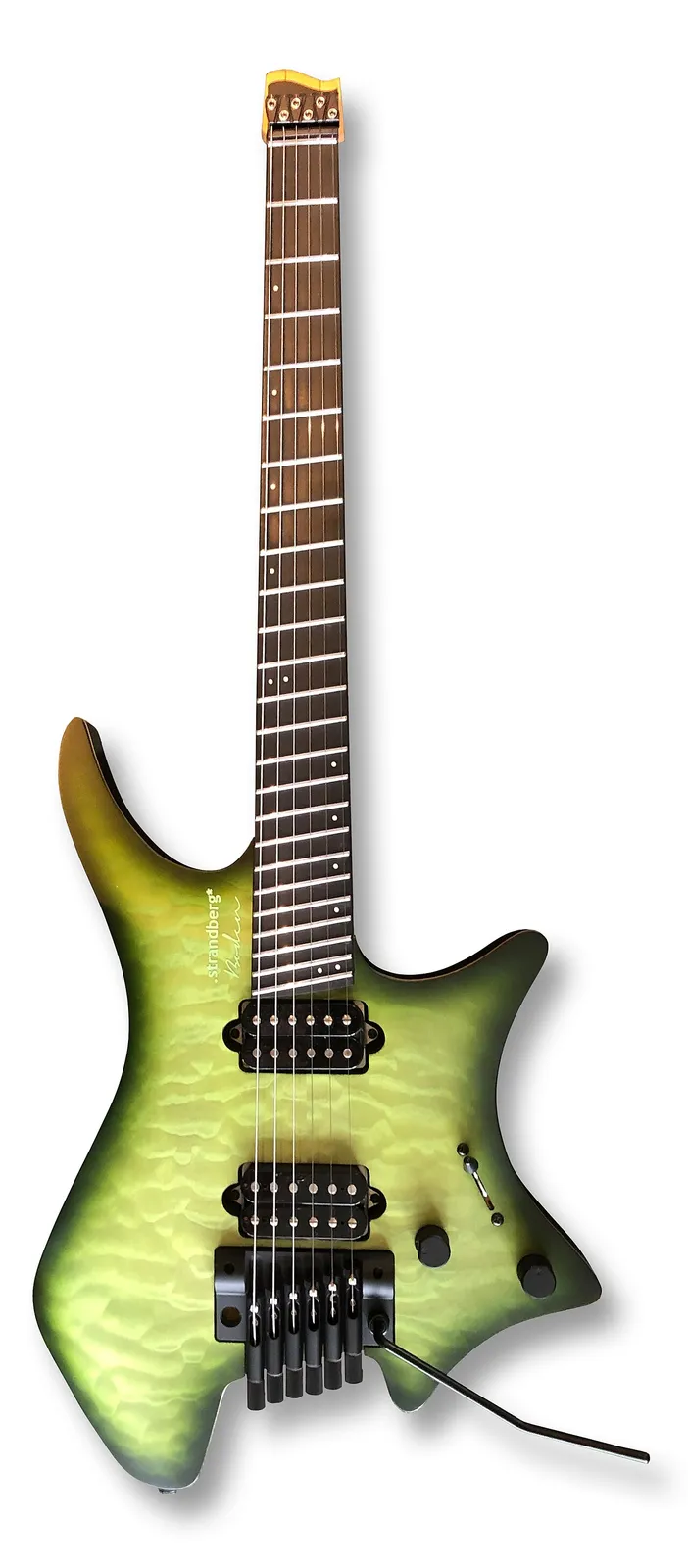
Photo: Auge=mit / Wikimedia Commons / CC BY-SA 4.0 Strandberg
Boden
2014
It started with a sore shoulder. A Swedish engineer built a guitar that would stop fighting him.
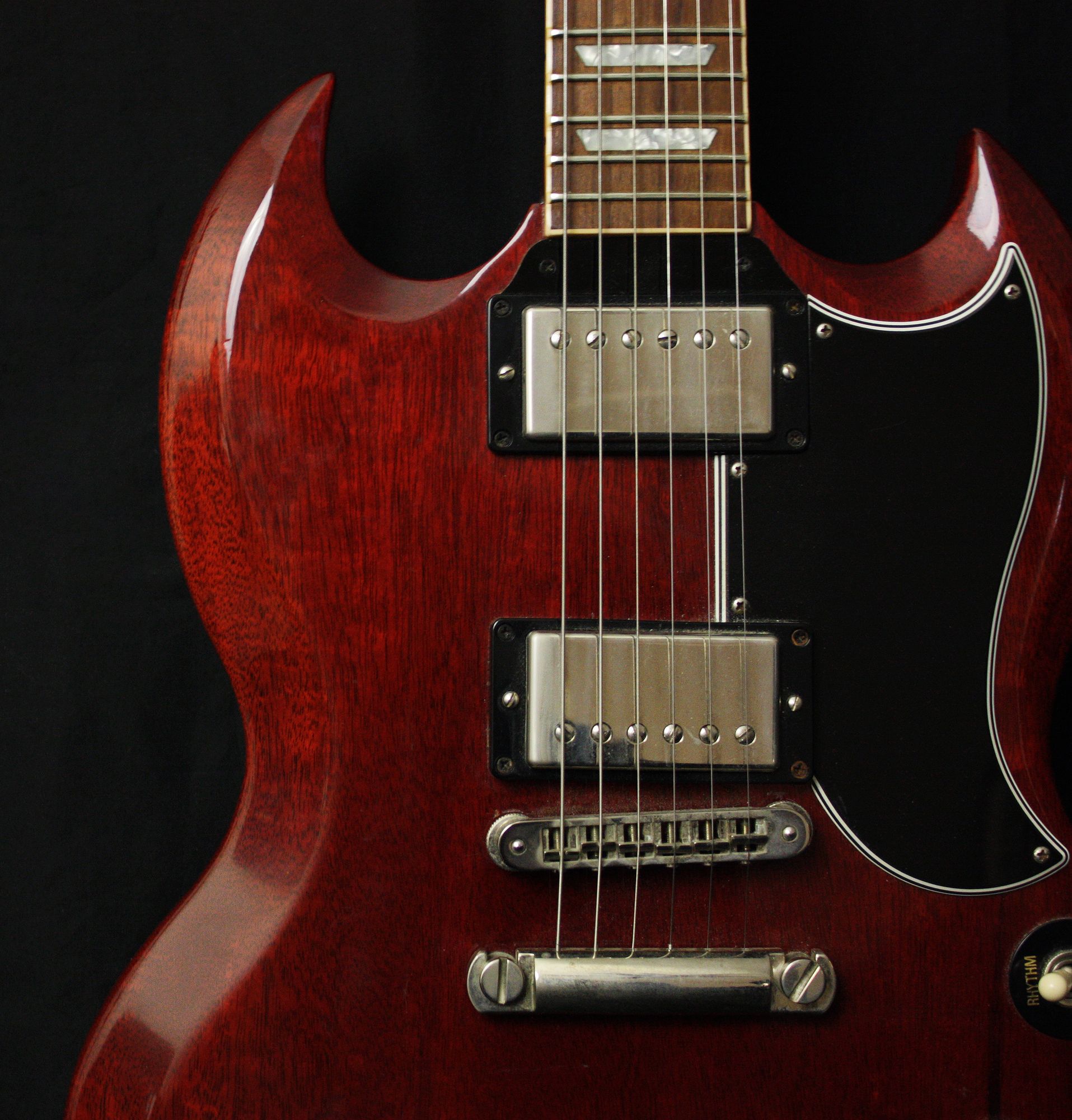
Gibson SG Standard ’61 Reissue, photographed 18 March 2010. Photo by John Tuggle. Licensed under CC BY 2.0. Via Wikimedia Commons. Gibson
SG
1961
Gibson has never stopped making SGs. Angus Young has lost count of his. He still only means one.