Guitaripedia
Emmons
Push-Pull
Buddy Emmons wanted one string to go up and down. Sho-Bud wouldn't rock the boat, so he left to build it.
Nashville, the early 1960s. A steel player has a guitar finished on paper and a company that won't make it. Two fingers to a string, one to pull and one to push, in a cabinet no bigger than the mechanism.
- Introduced
- 1964
- Type
- Pedal steel
- Class
- Closed run
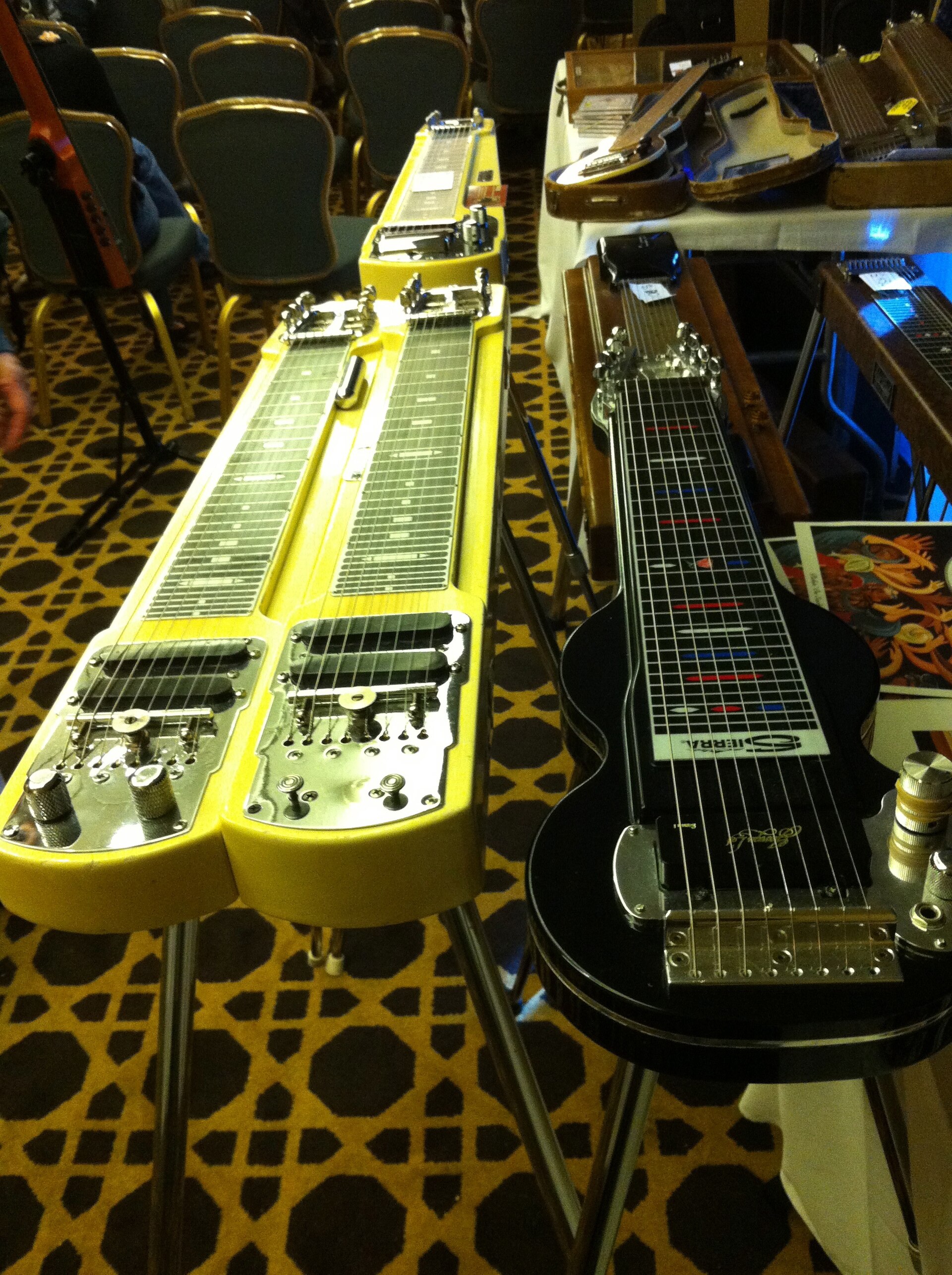
Have a photograph of this guitar? Send a picture
The short version
1961
Two years on paper
Buddy Emmons finishes the plans for a new pedal steel while he's still at Sho-Bud.
1963
Out of Sho-Bud
He leaves after Shot Jackson won't build it. Ron Lashley comes in.
1964
The name goes out
First guitars and the Emmons name in commerce, by April. Some accounts start in 1963.
1965
The patent
Lashley and Emmons file for the push-pull changer on 18 March. It's granted in 1969.
1966
Touch My Heart
Buddy plays one of the first production Emmons guitars on Ray Price's record.
c. 1967
The cut-tail
The neck changes for the last time, and the guitar settles in for the long run.
2014
Out of business
The Burlington company closes.
2020
The name comes back
Kelcey O'Neil files for the trademark. Within months there's a new shop in Sevierville.
Side A
A1
The one he couldn't buy
Here's the problem with a pedal steel. You hold a bar in your left hand and slide it along the strings. Your feet and knees work pedals and levers that pull strings up in pitch, or let them down. Every change you can make is a chord you can reach without moving the bar.
On the Sho-Bud Buddy Emmons was playing in the early 1960s, the way he tells it, a string could be raised or lowered. Not both. Pick one.
Emmons had been drawing a fix for two years, inside the company he was about to leave. By 1961 the plans were done: two fingers on every string at the changer, one to pull it up and one to push it down. A cabinet no bigger than the works inside it. Aluminum necks.
Shot Jackson, at Sho-Bud, wouldn't "rock the boat." So in 1963 Buddy left.
A2
Fifty decals
He'd been getting ready. A silk-screen shop in Nashville made him fifty fretboards and fifty decals reading "Emmons Stereo Guitar." His father had the dies for the changer fingers cut at Bendix in South Bend.
Some of the design came straight out of bad nights. Cigarette burns on his own guitar sent him looking for a finish that wouldn't scar. A Bigsby volume pedal had once slid off the guitar while he was hurrying on for a spot at the Opry, so on the new one the volume pedal went on the pedal bar.
What he needed was a builder. While he was still playing for Ernest Tubb he'd met Ron Lashley, who showed him a Sho-Bud copy he'd made. Good workmanship, Buddy said; pitted lacquer. Lashley had studied physics.
That's Buddy's version: his design, Lashley's hands. The company's own 1998 press release tells it the other way around, with Lashley, a physics professor at Appalachian State, forming the company in 1963. Both are in print. Neither man is around to settle it.
A3
Stiff at first
The first prototype caught up with Buddy at a Ray Price show in North Carolina. The action was stiff. Lashley took it back to Burlington, changed the raise fingers, and the second one, Buddy said, was right.
The stereo idea didn't last. Two pickups, so he could run two amps, made more trouble than they were worth, and production got one ordinary single-coil. The fancy finish he'd planned dried too slowly, so the first cabinets went out in gloss black Formica with polished aluminum trim. The scale came out at 24¼ inches, a quarter-inch shorter than the Sho-Bud.
When the guitars actually started leaving the shop is a little blurry. The name was in commerce by April 1964. The company was incorporated that June, by one account. One player who knows the early guitars describes some from 1963. Call it 1964, give or take the year before.
On 18 March 1965, Ronald T. Lashley and Buddie G. Emmons filed for a patent on the changer. It was granted in 1969. Springs on the rods hold the raise and give way when the lower pushes. Ask for both at once and the raise wins.
Flip the record · By the numbers
2
Fingers on every string. One pulls it up, one pushes it down.
24¼ in
Scale, against the Sho-Bud's 24½
50
Fretboards and decals Buddy had made before there was a company
<50
1965 wraparounds ever made, in the new shop's telling
Side B
B1
The record he didn't make on it
The record steel players reach for first is Steel Guitar Jazz, recorded in July 1963. It's the wrong guitar. Buddy said he cut it on a Sho-Bud and a Standel, "before I got my first Emmons." The cover photo shows a different steel again, printed backwards.
The one he tied to this instrument is Ray Price's "Touch My Heart," from 1966. He couldn't remember when the guitar arrived. A prototype or two had come first. But it was one of the first production Emmons guitars, and the first he took on professional jobs, and on that record, he said, the singer and the guitar were the combination. The single went to number 3 on the country chart.
Then the neck kept changing under the same changer. The first guitars were wraparounds, the neck hollow underneath and wrapped round the changer. Then a bolt-on neck, which Buddy found sounded good and wouldn't hold tune. Then, from about 1967, the cut-tail, which ran for the rest of the push-pull years, into the early '80s or the mid-'80s depending who you ask.
Demand took off, Buddy said, through Nashville sessions, shows, and players like Jimmy Crawford, Hal Rugg, Ben Keith, and Weldon Myrick. Bobbe Seymour had one from the early '70s and says it's been on more than 3,000 sessions.
B2
The Blade, and the other one
The company outlived the partnership. Buddy was gone by 1990, after what he called a year of legal wrangling and "fixing things that weren't broke." Lashley sold the company in a deal announced in 1998 and finalized the next year, and died in November 1999. His family kept building in Burlington until the business closed in 2014.
The name came back. Kelcey O'Neil took up the trademark in 2020, and with Darin Shiflett opened a shop in Sevierville, Tennessee, building a new guitar after the 1965 wraparound. Shiflett calls the original the best they ever had, "with fewer than 50 made altogether."
Buddy, for his part, ordered a rosewood Emmons in 1967. He called it The Blade, and he still had it in 2011. It had served him, he wrote.
It just didn't have what the "Touch My Heart" guitar had.
Put this on
You’ve read about it. Now hear it. Here’s what this guitar sounds like, and what to listen for.
Touch My Heart
Buddy said this was the record where the singer and this guitar came together. Listen to the opening lines.
Find it on YouTube (opens in a new tab)
The cast
The people, and the specific guitars, that made the legend.
1966
Buddy Emmons
One of the first production Emmons push-pulls, the "Touch My Heart" guitar
Designed the changer, in his account, and played this guitar on his first professional jobs with it.
1963–1999
Ron Lashley
Builder
Built the prototype in Burlington and ran the company. The 1998 press release tells the founding his way.
Early 1960s
Shot Jackson
Sho-Bud
Wouldn't "rock the boat" with Buddy's new design.
1960s
Ray Price
Bandleader
The prototype reached Buddy at a Price date in North Carolina. "Touch My Heart" is Price's record.
1970s–2011
Bobbe Seymour
An early-'70s Emmons push-pull
Says his guitar has been to eight countries and on more than 3,000 sessions.
2020
Kelcey O'Neil
The name, revived
Took up the cancelled trademark and reopened with Darin Shiflett in Sevierville.
Liner notes
Specs, construction, rarity, value, and every source we used.
Two fingers to a string, so the same string can rise or fall — the pedal steel Buddy Emmons left Sho-Bud to build.
- Body
- Half-inch cabinet, no larger than the mechanics. Buddy Emmons, 20 January 2002: three-quarter maple was the cabinet he was leaving. Gloss black Formica after a Mica Glass finish proved too slow, with polished aluminum trim. A D-10 is two necks. An S-10 is one. S-12 and D-12 necks were built as well. The SD-10, which players call a Loafer, is one neck on a double cabinet.
- Neck
- Aluminum, played with a bar. No fretted Spanish neck. Wraparound first: a two-piece neck, the bridge on the cabinet, the neck hollow under the changer. Bolt-on next. Cut-tail after that, a cutout filled with an aluminum block. Wood necks were built too.
- Fingerboard
- Black, chrome frets, atom symbols. Later boards change the atom colors. Rainer Hackstaette’s 2004 timeline, which he says includes guesses, tracks those changes.
- Scale
- 24¼ inches. Buddy, against the Sho-Bud’s 24½. Jerry Roller: center of the nut roller to center of the changer roller, the same 24¼ inches. No millimetre figure in those accounts.
- Pickups
- One single-coil to a neck, after a stereo pair was dropped. The Sevierville shop specifies 15k single-coils as the 1965 original. David Higginbotham, 31 December 2021: early push-pulls at 15k, later ones in the 19k–20k range. A note he posted the same day puts the earliest readings at 12k.
- Hardware
- Rollers in the keyhead. Pedals and knee levers; how many was the order. Eight pedals is the count on many D-10s that get described. Legs, and a volume pedal Buddy wanted on the pedal bar.
- Changer
- Two fingers on each string. One pulls a raise. One pushes a lower. Springs on the rods, strong enough to hold the raise and weak enough to yield when the lower pushes. U.S. patent 3,447,413. On a string that can do both, the raise wins if you ask for both at once.
- Electronics
- Passive. Single-coil once the stereo experiment was gone. A neck selector on a double. Buddy’s drawing list included a tone-bypass switch.
- Finish
- Gloss black Formica on the first cabinets. Lacquer later, including the fat-back apron. Kelcey O’Neil: fat-back from 1970, phased out about 1975.
- Nut
- Roller, so the string does not saw across it. No factory nut width.
Open the full research fileConstruction details, the complete player record, production numbers, dated value estimates, and sources
Specs are for the classic double-ten Push-Pull from Burlington. No current model carries the name. The ReSound ’65, from the shop in Sevierville, is a new push-pull built to the 1965 wraparound.
Construction
The job was a smaller steel that could raise a string and lower that same string. Bar in one hand. Pedals and knees under the other. Sho-Bud’s permanent changer, in Buddy’s telling, would raise or lower a string, never both on one string. This one does.
He had been designing it inside the company he was about to leave. Buddy Emmons, 20 January 2002: the plans were finished in 1961, after two years on paper. He wanted a cabinet no bigger than the mechanism, and aluminum necks. Shot Jackson, he writes, would not “rock the boat.” Cigarette burns on his own guitar pushed him toward a finish that would not scar. A silk-screen shop in Nashville made fifty fretboards and fifty “Emmons Stereo Guitar” decals. His father had the finger dies cut at Bendix in South Bend. The volume pedal went on the pedal bar because a Bigsby pedal had slid off the guitar while he was hurrying to an Opry spot.
Wikipedia has him leaving Sho-Bud in 1963 and forming the Emmons Guitar Company, after Shot would not build the new design. He met Ron Lashley while he was still with Ernest Tubb. Lashley showed him a Sho-Bud clone. Buddy calls the workmanship good and the lacquer pitted, and he says Lashley had a major in physics. The company’s May 1998 press release, which Bill Erchul received, calls Lashley a physics professor at Appalachian State and says Lashley formed the company in 1963. Buddy’s account has the design as his, and Lashley as the man who built the prototype. The press release tells it the other way around. Both versions are in print.
The first prototype reached him at a Ray Price date in North Carolina. The action was stiff. Lashley took it back to Burlington and changed the raise fingers. A second prototype, Buddy says, was right. Stereo pickups — two five-pole coils, so he could run two amps — made more trouble than they were worth. Production went to an ordinary single-coil. Mica Glass was too slow, so the cabinet became gloss black Formica, with aluminum strips for the trim.
The year the guitars left the shop is not one date. Chris Lucker, 30 August 2022, describes rear aprons on guitars from 1963 and on the first two of 1964. On 24 December 2008 he had number two as possibly January 1964, serial ES130002, and Billy Cooper’s as April 1964, serial 464001. A trademark filing by Emmons Guitar Co. By Lashley, Inc. gives first use in commerce as April 1964. Jack Strayhorn, who later ran assembly, says Ron incorporated the company in June 1964. Kelcey O’Neil, 27 July 2022: the wraparound, Buddy’s original, was released in 1964 and continued through 1965. The 1964 date is the year guitars and the name went out. It is not a claim that 1963 is empty. Sources differ.
The neck changed under the same changer. Wraparound: one piece, hollow underneath, wrapped around the changer, bridge on the cabinet. Then the bolt-on, the bridge moved onto the neck. Buddy says he was told both would be offered. He later played a bolt-on that sounded good and would not hold tune, and he says that version was dropped two years on. Kelcey dates the bolt-on to 1966 and 1967. Rainer Hackstaette’s timeline, guesses included, puts it at 1965–66, and puts wood necks on the bolt-on changer. Then the cut-tail, Buddy’s split-tail: a cutout at the end of the neck and an aluminum insert. He writes that he still only guesses why. Kelcey: the cut-tail from 1967 until push-pull production ended, which he gives as about 1982 in one post and the mid-1980s in another. Rainer runs the series 1964–1983. Bill Lowe’s D-10 chart, 31 January 2016, which he does not guarantee, starts at 1024 in 1966 and stops at 2948 in 1981. No factory last year was published.
The patent is U.S. 3,447,413, “Guitar tone changing device,” filed 18 March 1965 and granted 3 June 1969. Inventors: Ronald T. Lashley and Buddie G. Emmons. Assignee: Emmons Guitar Company. John Lacey’s setup guide, as Ian Worley posted it on 5 April 2019: on this changer a raise has priority over a lower.
In the eighties, Buddy writes, an all-pull changer was the thing to offer. Ron designed one. Buddy added a split-tune, so you could raise and lower the same string and tune the note between the two pitches. He named that guitar the LeGrande, a name he had once considered for this one. The LeGrande is a different model. A Pro-Mat push-pull is a different maker. Ned McIntosh, 15 August 2010, names those two brands as the ones using the split-finger changer.
Buddy had control of changes for two years, in his account. He reworked the relationship later and was gone by 1990, after what he calls a year of legal wrangling and “fixing things that weren’t broke.” The May 1998 press release announces the sale of Emmons Guitar Company, Inc., from Ron Lashley to Jim Aycoth of Aycoth Machine Company in Monroe, North Carolina, which had made the parts for eighteen years. Burlington was to stay put. Strayhorn, 11 November 2009, says Ron finalized that sale in July 1999. Announced in 1998, finalized in 1999: both sentences are on the record. Roger Rettig has Jim answering the company phone on 27 April 1998, and Jim’s death in May 2007. Carl Kilmer, a friend of Ron’s, wrote on 7 November 2009 that Ron Lashley Sr. died on 2 November 1999. Ron Lashley Jr. and Rebecca were building again in Burlington after that. An August 2004 order sheet is still “Emmons Guitar Company by Lashley, Inc.,” at 1771 East Webb Avenue. The Nashville Ledger, Nancy Henderson, 16 May 2025: the company went out of business in 2014. The Lashley trademark’s status date is 25 May 2018, cancelled.
Kelcey O’Neil picked the name up after that cancellation. A new filing, serial 90236084, went in on 5 October 2020 and registered on 29 March 2022, later held by Emmons Guitar Company, LLP, in Sevierville. Henderson: O’Neil had the trademark by a September 2020 dinner, and six months later he and Darin Shiflett relaunched the shop in Sevierville. O’Neil’s own note on the Steel Guitar Forum is 14 July 2021. What they sell is the ReSound ’65, which the shop calls a second-generation 1965 wraparound. Same changer idea. Different model name. A Black Rock student guitar, fretboard down on the cabinet and shorter fingers, was never this double-ten. A 20-string single Buddy had Lashley build for a Western Strings session, so he would not have to ask Shot Jackson to play one, is a one-off, not a D-10.
Players
The records people reach for first are the wrong guitar. Night Life, early 1963, is before this company. Steel Guitar Jazz was recorded 22 July 1963. Buddy, as Scott Murray posted his answer on 18 March 2017: a Sho-Bud and a Standel, “before I got my first Emmons.” The cover showed a Multicord, the negative flipped. He was hoping the new guitar might be the picture. It was not the guitar on the tape.
Buddy Emmons. The one he ties to this instrument is Ray Price’s “Touch My Heart.” On 14 February 2011 he wrote that he does not remember the year the guitar arrived, that a prototype or two came first, and that it was safe to call it one of the first production Emmons guitars and the first he used on professional jobs. “When I recorded Touch My Heart,” he wrote, the singer and that guitar were the combination. Kelcey O’Neil points at the opening lines of that record as the wraparound’s sound. SecondHandSongs dates the first recording to 11 August 1966. lpdiscography.com credits Buddy Emmons on steel and dates the album sessions to October 1966 at Columbia in Nashville. The single reached the country chart in October 1966, peak 3. The album came out in 1967 and went to No. 1 on Billboard’s country album chart. He ordered a rosewood guitar he calls The Blade in 1967, and in the same posts he has it in hand in early 1968. He still had it in 2011. It had served him, he wrote, and it did not have what the Touch My Heart guitar had.
Jimmy Crawford, Hal Rugg, Ben Keith, Weldon Myrick. Buddy’s 2002 account, and only that: through Nashville recordings, show dates, and those four, demand took off. He names no song. Crawford’s name also sits on a knee-lever cluster. Rainer Hackstaette, 17 February 2008: five levers on the left knee. Bobbe Seymour, the same day: he had used that cluster for 36 years on his main recording guitar. Rugg’s aluminum-neck work belongs to Sho-Bud’s later guitars. A Sho-Bud on a Rugg session is not this changer. Keith’s “I Fall to Pieces,” with Patsy Cline, is 1961. Harvest, with Neil Young, is 1971–72. Nothing in these sources puts either record on an Emmons. Nathan Golub, 9 May 2025, says a 1974 rosewood D-10 push-pull of his was once owned by Myrick, who sold it to Mike “Cookie” Jones. That is one later guitar. It is not “Once a Day.”
Bobbe Seymour. His newsletter of 16 June 2011: he had owned serial 1554D since the early seventies, and that guitar had been in eight countries and on more than 3,000 recording sessions. Lowe’s chart, which he does not guarantee, reads 1475–1588 as 1971. Seymour’s number sits in that bracket. The session claim is his.
Also known to play: JayDee Maness, in an April 2018 interview, said he plays an Emmons and Lloyd Green plays a Sho-Bud. He did not say the Byrds’ Sweetheart of the Rodeo was this model. Green’s Sho-Bud is a different guitar.
Rarity
You cannot order a guitar named Push-Pull. The Sevierville shop sells the ReSound ’65. Henderson, 16 May 2025: about 110 of those had been sold, including guitars for Jelly Roll and Slash. Shiflett, in that piece, calls the 1965 original the best they ever had, “with fewer than 50 made altogether.” That figure is the 1965 wraparound, not every push-pull Burlington built.
No production total was published. Lowe’s D-10 numbers are a player chart. He says so. A serial dates one guitar. It does not count a year. S-10s, 12-string necks, and Loafers were never in that D-10 list.
Thinner than a 1970s cut-tail: a 1964–65 wraparound; the bolt-on years, whichever of the overlapping dates you use; Buddy’s Touch My Heart guitar, if it is still the one he described; Seymour’s 1554D. Fat-back cut-tails are the ones that turn up. A LeGrande is the all-pull. A Black Rock is the student guitar.
Value
Informal estimate, 30 October 2026. Not an appraisal.
Asks below are asking prices unless marked sold. No 1960s catalog price for this guitar turned up. A LeGrande, a ReSound ’65, a Sho-Bud, and a Pro-Mat are other guitars. Artist-owned instruments are not comparable sales.
New street. None under the Push-Pull name. The ReSound ’65 D-10, on the company’s page the day of this estimate: eight pedals and four knee levers $9,700; eight and five $9,995; eight and six $10,290; eight and seven $10,585. Tax and shipping extra. Further pedals and levers $295 each; levers eight and nine $595. Nine pedals and nine levers is the maximum printed there. The shop’s standard D-10, it says, is eight pedals and five knees. That is the new guitar.
Used modern. No recent Burlington run to price. A Reverb listing titled as a 1990s SD-10 push-pull was at $3,750 on 19 October 2026. One title. Not a market.
Vintage / collectible. Reverb’s price guide showed no sold band for the Push-Pull. On 19 October 2026 the asks on Reverb’s Emmons page included a 1965 wraparound S-10 at $9,800 (it had been $12,000), a 1981 D-10 push-pull at $4,995, and a mid-to-late-1970s black D-10 push-pull at $5,100. Asks. A clean early single is being asked well above the 1970s and 1981 doubles on that page. An ask is not a sale.
Artist-owned, not comparable sales. The Touch My Heart guitar, The Blade, Seymour’s 1554D, and the 1974 Myrick owned, if Golub’s account holds. No hammer on any of them is in these sources.
See also
- sho-bud-pro-ii — Sho-Bud’s double-ten; the company Buddy left, and a different changer
- fender-stringmaster — Fender’s multi-neck console, no pedals; the steel his parents bought him before any of this
Sources
- Buddy Emmons, “The Emmons Guitar,” 20 January 2002 — plans finished 1961; half-inch cabinet; 24¼-inch scale against Sho-Bud 24½; chrome frets and atoms; two fingers, push and pull, springs on the rods; fifty fretboards and stereo decals; Bendix dies; Lashley, a major in physics; Burlington prototype; Formica; single-coil after stereo; Crawford, Rugg, Keith, Myrick; bolt-on dropped two years on; split-tail; LeGrande in the eighties; gone by 1990. Reposted on the Steel Guitar Forum, 24 December 2008
- Buddy Emmons, 14 February 2011 — Touch My Heart guitar as an early production Emmons and his first on professional jobs; The Blade ordered 1967; the record
- Steel Guitar Forum, Scott Murray, 18 March 2017 — Buddy’s answer: Sho-Bud and Standel on Steel Guitar Jazz, before his first Emmons; Multicord on the cover
- Wikipedia, Buddy Emmons — 27 January 1937–21 July 2015; left Sho-Bud in 1963 and formed the company; Night Life early 1963; triple-neck Stringmaster as a teenager; patent described
- Wikipedia, *Steel Guitar Jazz* — recorded 22 July 1963
- U.S. patent 3,447,413 — filed 18 March 1965, granted 3 June 1969; Lashley and Buddie G. Emmons; Emmons Guitar Co.
- Jack Strayhorn, 11 November 2009 — incorporated June 1964; sale to Jim Aycoth finalized July 1999. Carl Kilmer, 7 November 2009, on the same thread: Ron Lashley Sr. died 2 November 1999
- Bill Erchul, quoting the May 1998 press release — sale announced to Aycoth; Lashley as physics professor at Appalachian State; company formed 1963 in that text. Chris Lucker, 24 December 2008, on the first page of the thread: ES130002 possibly January 1964; 464001 April 1964
- Kelcey O’Neil, 27 July 2022 — wraparound 1964 through 1965; bolt-on 1966–67; cut-tail 1967 to the mid-1980s; “Touch My Heart” as the wraparound sound
- Kelcey O’Neil, 21 January 2021 — cut-tail about 1967 to about 1982
- Kelcey O’Neil, 30 August 2022 — fat-back introduced 1970, phased out about 1975. Chris Lucker, the same thread: 1963 aprons and the first two of 1964
- Kelcey O’Neil, 14 July 2021 — relaunch announced
- Rainer Hackstaette, 10 October 2004 — 1964–1983 timeline; S-10, S-12, SD-10, SD-12, D-12; years include his guesses
- Bill Lowe, 31 January 2016 — D-10 chart 1966 (1024) through 1981 (2948); not guaranteed
- Jerry Roller, 14 February 2020 — 24¼ inches, nut roller to changer roller
- Ian Worley, posting John Lacey, 5 April 2019 — raise has priority over a lower
- Ned McIntosh, 15 August 2010 — Emmons and Pro-Mat as the push-pull brands
- Skip Edwards and Larry Bell on the Loafer — SD-10 is a single neck on a double cabinet. Current shop: SD10
- Bobbe Seymour, 16 June 2011 — serial 1554D since the early seventies; eight countries; more than 3,000 sessions
- Steel Guitar Forum, Crawford cluster, 17 February 2008 — Rainer on five left-knee levers; Seymour, 36 years on his recording guitar
- Nathan Golub, 9 May 2025 — a 1974 rosewood D-10 once owned by Weldon Myrick
- SecondHandSongs, “Touch My Heart” — first recorded 11 August 1966
- lpdiscography.com, Ray Price, *Touch My Heart* — Buddy Emmons, steel; October 1966, Columbia, Nashville; album January 1967
- Wikipedia, *Touch My Heart* — Columbia, 1967; country albums No. 1. MusicVF: single October 1966, country peak 3
- Americana Highways, JayDee Maness, 20 April 2018 — he plays an Emmons; Lloyd Green plays a Sho-Bud. Sweetheart of the Rodeo is not named as this guitar
- David Higginbotham, 31 December 2021 — 15k early, 19k–20k later; earliest readings 12k in the note he added
- Emmons trademark, serial 85270489 — Emmons Guitar Co. By Lashley, Inc.; first use April 1964; cancelled, status date 25 May 2018
- Emmons trademark, serial 90236084 — filed 5 October 2020; registered 29 March 2022; Emmons Guitar Company, LLP, Sevierville
- Nashville Ledger, Nancy Henderson, 16 May 2025 — out of business in 2014; Sevierville relaunch; about 110 ReSound ’65s; fewer than 50 of the 1965 originals, in Shiflett’s words; Jelly Roll and Slash
- Emmons Guitar Co., D10 — ReSound ’65 prices on 30 October 2026; eight pedals and five knees as the standard setup
- Buddy Emmons, 7 February 2012 — 20-string single for the Western Strings project
- Reverb, Emmons electrics, 19 October 2026 — asks: 1965 wraparound S-10 $9,800 (was $12,000); 1981 D-10 push-pull $4,995; 1970s black D-10 push-pull $5,100; a listing titled as a 1990s SD-10 push-pull at $3,750
- Roger Rettig, 28 December 2008 — Jim Aycoth on the phone 27 April 1998; Aycoth died May 2007
Keep digging
Guitars this one gets compared to, confused with, or descended from.