Sho-Bud
Pro II
Sho-Bud would build you a Pro II any way you asked, which is why no two of them agree.
Two ten-string necks on a maple cabinet, eight pedals, two knee levers, and a new way of pulling the strings underneath. The Pro II came out of Nashville in the early 1970s and was still being made into the '80s. It's a pedal steel, not a lap steel, and not the metal-necked Pro III.
- Introduced
- 1973
- Type
- Pedal steel
- Class
- Production
Have a photograph of this guitar? Send a picture
The short version
1955
Shot and Buddy
Shot Jackson and Buddy Emmons start Sho-Bud in Nashville. Some accounts put the name in 1956.
1963
Emmons leaves
Shot won't build Emmons's next design, so Emmons leaves. From then on his guitar is an Emmons.
c.1970
The Professional
Sho-Bud's double-ten still pulls its strings with small metal racks and barrels.
1972–73
Pro II
Crossbars and pulling fingers replace the racks. Exactly when depends on who you ask.
1974
The Custom
Late in the year, nylon tuners and a smaller body arrive, with "PRO~II CUSTOM" on the decal.
1975
Square front
The Pro III arrives with metal necks, and the Pro II takes a square front and narrower pedals.
1979–85
Sold, and sold again
Baldwin buys the company in 1979, 1980, or 1981, and Fred Gretsch ends up with the name in 1985.
2024
Back with the Jacksons
Dawn and Will Jackson take the brand back in December. The new line doesn't include a Pro II.
Side A
A1
Upstairs on Broadway
The early 1950s. Harold "Shot" Jackson is hanging string-pullers on other people's steels, Fenders and Rickenbackers, so a player can change a string's pitch while the bar's still on it.
That's the whole idea of a pedal steel. Your right hand holds the bar. Your feet and knees work pedals and levers that raise or lower particular strings underneath it.
In 1955, the company says, Shot and Buddy Emmons started Sho-Bud, "the first manufacturer of pedal steel guitars." That's the family's line. Emmons was already playing a Bigsby with pedals when he got to Nashville that summer, the setup Bud Isaacs used on Webb Pierce's "Slowly." So Sho-Bud is the Nashville shop that came after the first pedals, not before them. The name is Shot plus Buddy. Emmons left in 1963, or '62 as he once remembered it, because Shot wouldn't build the next design he wanted.
David and Harry Jackson stayed. David patented a pedal-operated changer in the late '60s and ran Music City Manufacturing, where most Sho-Bud steels were built from 1970 to 1981. Harry and Shot worked upstairs at 416 Broadway.
A2
No more racks
Before the Pro II there was the Professional, around 1970, about $1,450. It pulled its strings with small metal racks and barrels. The barrels sit on the pull rod behind the puller, and with enough of them you can raise or lower a string as many times as you've got barrels.
The Pro II swapped the racks for crossbars and pulling fingers. The first ones have the Professional's round-front cabinet and "PRO~II" on the apron, and nothing else.
When that happened is a mess. One steel guide says late 1973, and a later repost of the same guide says "approximately late 1972." One longtime Sho-Bud expert calls the first series early 1973, maybe the last month of 1972. Another, going on "best I can tell," says mid-1973. One owner dates his to June 1973, and there's one dated 13 November 1973, built by Paul Franklin Sr. Nobody has a factory ledger to settle it.
The changer underneath doesn't agree either. The printed guide says double raise, single lower. People who've owned the early ones say single raise and single lower, with barrels. Either way, the guitar changed under your feet as the decade went on.
A3
What you get
A standard Pro II is a double-ten: two ten-string necks on maple, a 24-inch scale, eight pedals and two knee levers, one pickup per neck. Dealers still set them up with E9 on one neck and C6 on the other. There was a double-twelve too.
The fretboards are black with raised frets, and the markers are card suits, hearts, spades, diamonds, and clubs. The early round-fronts have rope inlay and red-and-white pips. Late in 1974 came nylon tuners, which lock the rod to the finger and move the tuning to the endplate, and a smaller body with "PRO~II CUSTOM" on the decal. In 1975 the metal-neck Pro III arrived, and the Pro II got a square front and narrower pedals. Pot metal crept into the changers in the later '70s. The early-'70s list price was $1,595, and the 1976 catalog still said $1,595.
And then there's the part that makes the history impossible. Eight pedals and two knees was the standard order. Extra levers were what you asked for. One of the experts who dates the first series says he's seen a Pro II with racks and barrels, the old Professional changer, which shouldn't exist. It does because Sho-Bud built what the customer wanted.
Flip the record · By the numbers
$1,595
List price in the early '70s, and still in the 1976 catalog
8 × 2
Pedals and knee levers as standard. More if you ordered them.
24"
Scale length on both necks
20
Strings, ten a neck, usually E9 on one and C6 on the other
Side B
B1
Mooney's green one
Ralph Mooney, in the Waylon years, played a green Pro II Custom. That's how steel players identify the guitar in a 1978 Waylon video, and one of them reads its serial number as 1976. A well-known steel dealer says he believes it, from pictures Mooney showed him, though he never had it in his shop. Mooney played other Sho-Buds before and after.
Steve Howe brought a Sho-Bud on stage with Yes for "To Be Over" and the early "Awaken," with its own board. He didn't say which model. A dealer selling one says it's a Pro II Custom built for him in late 1974, with a certificate in his handwriting. As recently as February 1973 he was still on Hawaiian steel and only curious about pedals.
B2
Sold, and sold, and back
Who owned Sho-Bud next is another argument. One history has the Jacksons selling to Baldwin in June 1979. Others say 1980, or 1981. Baldwin closed the factory, Fred Gretsch got the name in January 1985, and as one dealer put it, "He didn't really want Sho-Bud." The 1981 Gretsch price suggestion for a Pro II was $2,120. Whoever owned it, it's still a Sho-Bud.
In December 2024, Dawn and Will Jackson took the brand back. They build a Maverick II, a Madison, a Pro V, and a Pro VI. The double-neck is a Pro V now. There's no new Pro II.
B3
BJV
There's one Pro II Custom with "BJV" on the apron. It was built for Big Jim Vest. It's birdseye maple with card-suit pearl, double raise and double lower on both changers, an LDG pickup on the E9 and an Emmons pickup on the C6. And it has eight pedals and eight knee levers, four times the standard knees.
The man who later owned it says it was Vest's guitar at the Exit/In.
The catalog said eight and two. Vest asked for eight and eight, Sho-Bud built it, and put his initials on the front.
The cast
The people, and the specific guitars, that made the legend.
1976–78
Ralph Mooney
A green Pro II Custom
In footage with Waylon Jennings from the late '70s, as steel players identify it. He played other Sho-Buds too.
Big Jim Vest
Pro II Custom built for him, "BJV" on the apron
Eight pedals and eight knees, birdseye maple, card-suit inlays. The guitar he played at the Exit/In, per the man who later owned it.
1974
Steve Howe
A Sho-Bud pedal steel, said to be a 1974 Pro II Custom
Used a separate Sho-Bud on stage for "To Be Over" and early "Awaken." He didn't name the model; a dealer's certificate does.
1973
Paul Franklin Sr.
Builder
Built named Pro IIs, including one dated 13 November 1973.
1955
Shot Jackson
Founder
Spent the early '50s putting string-pullers on Fenders and Rickenbackers before he and Emmons started Sho-Bud.
Liner notes
Specs, construction, rarity, value, and every source we used.
Two ten-string necks and bellcranks where the racks had been — Sho-Bud’s Pro II, not a lap steel and not a Pro III.
- Body
- Maple console, two necks. Catalog 6155 is the double-10. First series: round front, the Professional’s cabinet without the racks (Kenny Davis; Ricky Davis). Custom era: smaller body, square front — Ricky Davis puts the “PRO~II CUSTOM” decal at late 1974; Becker’s field guide puts the square front in 1975. Cream City’s 6155, one guitar: second neck ¾" above the first. That is one guitar’s measurement, not a factory drawing.
- Neck
- Two wood necks on a 6155, ten strings each. 6165 is the double-12. The Pro III (1975) is the metal-neck sibling.
- Fingerboard
- Black plastic, raised frets. Cream City’s 6155: spade and diamond markers. The company pip is hearts, spades, diamonds, and clubs. David Doggett: early round-fronts, rope inlay and red-and-white card pips; later Customs often plain white.
- Scale
- 24". Cream City’s 6155; Classic City’s 1970s Pro II. Sho-Bud’s 2026 page calls 24" standard on the current line, which is a different model. No Pro II measurement gives millimetres. A 610 mm figure belongs to a Maverick or a Pro III, not a Pro II.
- Pickups
- One single-coil per neck and a 3-way, Cream City’s 6155. Split / coil-tap shows up on named early guitars. Ricky Davis, one 1973: a humbucker there was a Sho-Bud custom, not the catalog coil.
- Hardware
- Grover tuners and a roller nut on named 6155s. Catalog 6155: 8 pedals, 2 knee levers. Extra levers were orders. Field guide: pedals go from wide to narrow with the 1975 square front.
- Changer
- Not one system. First series (Kenny Davis; Ricky Davis): single raise, single lower, brass barrels, two-hole pullers on crossbars. Becker’s field guide prints the Pro II as double raise, single lower. Later Custom: nylon tuners, then triple raise and double lower.
- Electronics
- Passive. A 3-way on Cream City’s 6155. Anything past that is the individual guitar, not a catalog drawing.
- Finish
- Stain or lacquer on maple. Kenny Davis, sure of these by 1978: Natural, Red Rosewood, Walnut, Ebony stain. His November 1974 was ordered in blue. Green stain was the LDG’s unless custom.
- Nut
- 3" metal roller nut, Cream City’s 6155. No millimetres on that measurement. RetroFret’s 76 mm is a Pro III figure.
Open the full research fileConstruction details, the complete player record, production numbers, dated value estimates, and sources
The spec above is a Nashville double-10 Pro II, catalog 6155 (8×2), round-front first series through the square-front Pro II Custom. No current model is a Pro II. Pro I is the single-neck. Pro III is metal necks. LDG (6150) is Lloyd Green’s single. Super Pro II is a different guitar. Professional is the rack-and-barrel guitar beside this one. A 2026 Pro V or Pro VI is not a 6155.
Construction
The job was a double-ten you could pull without the Professional’s baskets. Bar in the right hand. Pedals and knees change the pitch under it. The guitars dealers still set up carry E9 on one neck and C6 on the other. Not a frying pan. Not a Dobro.
Harold “Shot” Jackson, 4 September 1920 to 24 January 1991, spent the early 1950s hanging string-pullers on Fenders and Rickenbackers. Sho-Bud’s history page says that in 1955 he and Buddy Emmons started the company, “the first manufacturer of pedal steel guitars.” That sentence is the family’s. Emmons’s own page has him in Nashville in July 1955 already on a Bigsby with pedals, the setup Bud Isaacs had used on Webb Pierce’s “Slowly.” Shot’s Wikipedia says he “designed the first pedal steel guitar (modified Fender lap steel),” on a page that flags itself as thinly cited. The company and Shot’s Wikipedia each claim a first. Neither erases Bigsby. Sho-Bud is the Nashville shop that followed, not the first pedal on a steel.
The name splits too. Sho-Bud’s Wikipedia: Shot asked Bud Isaacs first, then Isaacs left and Emmons joined in 1955. Emmons’s Wikipedia: Sho-Bud (“SHOt-BUDdy”) in 1956. He left in 1963 (both of those pages; Duane Becker’s compilation quotes him at 1962 or ’63, shop still on Nesbitt Lane) because Shot would not build the next design. Founder. Not a Pro II player. After that his guitar is an Emmons.
David and Harry stayed. The company site: late ’60s, David patented a pedal-actuated changer. No patent number on the page. He ran Music City Manufacturing, where most Sho-Bud steels were built 1970–1981. Harry and Shot were upstairs at 416 Broadway. Kenny Davis: a Pro II came out of Music City unless it was a “custom” or a “pro” guitar.
The Professional is the bench this model takes. Becker’s field guide, as Ricky Davis posted it on 12 February 2003: around 1970, still the small metal baskets off the Baldwin Crossover. Era 1970–1973. About $1,450. Ricky’s note under that text: being built in ’69, marketed about ’70, two knees standard. The guide’s model list calls 6143 the Professional double-10, 8 pedals, 2 knees. Ricky writes baskets as “(racks).” They pull barrels.
Then this guitar, and the year is not one sentence. The guide, in that 2003 post and as David Doggett quotes it on 16 March 2007: “Sho-Bud introduced the Pro Series in late 1973 with the Pro-II.” A 2015 repost says “approximately late 1972.” Ricky, under the 2003 text: overlap ’72–’73, a Professional body, crossbar and pulling fingers instead of racks — and he had seen a rack-and-barrel Pro II. In February 2023 he tightens it. An apron that says only “PRO~II” is the first series, early 1973, maybe the last month of ’72. Same body and changer as the Professional, except the crossbars. Kenny Davis, 12 April 2022, “best I can tell,” pointing at Gene Haugh’s notes: by mid-year 1973, catalog 6155, round front, single raise and single lower, two-hole bell cranks, 8 and 2 standard. Cody Stewart’s serial 3606 is June 1973 in its owner’s telling. Kenny dates one round-front 13 November 1973, built by Paul Franklin. The 1973 date is the guide’s late-1973 line. It is not a claim that December 1972 is empty. Sources differ, from late 1972 to late 1973.
The changer splits the same way. The printed guide gives the Pro II a double-raise, single-lower, and gives single/single-plus-a-collar to the early Pro I. Ricky’s later posts put single/single and barrels on the first Pro II, and nylon tuners at late 1974, with the smaller Custom body. Barrels are why that early finger gets the reputation. One rod, a barrel behind the puller, and you can raise or lower the string as many times as you have barrels (Ricky). Nylon locks the rod to the puller and moves the tuning to the endplate. The guide calls that the improvement. It is also a different guitar under the hands. Sho-Bud would still build what you asked, which is why a rack-and-barrel Pro II can exist at all.
1975, in the guide: Pro III, metal necks, double raise and double lower, round front becomes square, wide pedals become narrow. Start of the Pro/Custom series. Kenny: after that, the Pro II took the square front, the nylon, eventually a triple raise and double lower, and the Custom name. David Doggett: pot metal begins with the Fender/Sho-Bud guitars in 1976, then on the Sho-Buds after. His ’76 still has two-hole pullers and already a pot-metal changer. Black-and-white boards as a rule from 1977. Not every Custom is pot metal. Not every 1973 is a Custom.
Numbers, from that same guide as the Forum quotes it. 6155: double-10, 8 pedals, 2 knees. 6165: double-12, 8 pedals, 4 knees. 6148 Pro I. 6150 LDG. 6164 Pro III. A 12-string Pro II is still this model. Bobbe Seymour, 30 October 2003: a Super Pro II is not a Super Pro and not a Pro II, almost no shared parts, seven built in 1984. The name is a trap.
Period list, not 2026 money. Guide: early ’70s $1,595, 1976 catalog still $1,595, 1981 Gretsch suggestion $2,120.
The sale is as split as the birthday. Becker, via Robert Kramer: April 1972, Dickerson Road to 9th Avenue for about two years; April 1974, to 2nd Avenue, “until the Jacksons sold the company to Baldwin in June of 1979.” In that account Baldwin closed the factory a year later and the store ran to 1983. The company site dates the Baldwin sale 1981, and runs Music City through 1981. Shot’s Wikipedia: Baldwin-Gretsch, 1980. Sho-Bud’s Wikipedia: Gretsch purchased it in 1979, while the lead says ownership changed in the 1980s. Seymour, 30 June 2011: Fred Gretsch in January 1985, the name thrown in when he took Gretsch back from Baldwin. “He didn’t really want Sho-Bud.” Ricky in 2023 disclaims those years and says Gretsch had the name after a close in the “mid 80’s.” Sources differ: June 1979, 1980, 1981, and January 1985 all appear in print. A sale to Baldwin and a later sale to Fred can both be true. They are not one date. The maker is Sho-Bud either way.
Dawn and Will Jackson took it back from Fred Gretsch Enterprises in December 2024. What they build: Maverick II, Madison, Pro VI, Pro V. Wikipedia’s relaunch note adds a planned LDG and a Jimmy Day “Blue Darlin’.” Not a 6155.
Trigger is a different guitar. Company site: the Martin N-20 came off the Sho-Bud wall, Baldwin bridge, PrismaTone pickup, Shot’s install. A flat-top.
Classic against current is a 6155 — maple, 24 inches, a coil each neck, eight and two unless the order said more — against a 2026 Pro V you can buy as a double-neck. Same family. Different model.
Players
Buddy Emmons is not a Pro II player. He was gone by 1963. Lloyd Green’s Sho-Bud is the LDG, a single neck. PR Newswire, 23 April 2025, names Green, Jerry Byrd, Mooney, and Pete Drake as people the brand’s tone “helped define.” Brand, not model. None of the sources below ties Byrd or Drake to a Pro II. Hal Rugg’s aluminum-neck experiments are the road to the Pro III and then the Super Pro (Seymour, 12 May 2011). Paul Franklin Sr. built named examples — Kenny’s 13 November 1973, and a dealer’s claim on Steve Howe’s. Building one is not a record credit.
Ralph Mooney. The green guitar in the Waylon years, and not his only Sho-Bud. Joerg Hennig, 9 November 2003: a green Pro-II Custom on a 1978 Waylon video, then a black Super Pro in the ’80s. James Miles, 10 July 2013: the green one is serial 10563, which he reads as 1976, the guitar in the Lost Outlaw Performance and in footage from ’76 into the early ’80s. He also describes an earlier natural or brown Sho-Bud. Seymour, 10 November 2003, on the same thread: he believes the green one is the Pro II, Ralph showed him pictures, he never had it in the shop. A separate post there puts a flag-front Professional under Mooney around 1975. No Waylon studio side is tied to either guitar. The Super Pro Seymour says Waylon ordered in 1983, to match a “Half Moon,” is the other model.
Steve Howe. Premier Guitar’s 2013 rig rundown, in his own mouth: pedal steel on stage for “To Be Over,” from Relayer, and early on for “Awaken,” “a separate Sho-Bud pedal steel” with its own board. He does not say Pro II. In February 1973 he was still on Hawaiian steel and only curious about pedals. Lead Music offers a 6155C it says Paul Franklin Sr. built for him in October–November 1974, certificate in Howe’s hand, and it adds “To Be Over” plus “Cactus Boogie,” “All’s a Chord,” and “Look Over Your Shoulder” on The Steve Howe Album (1979). The songs he named are a Sho-Bud. The model number and the solo-album tracks are the dealer’s claims. Not every steel on a Yes record.
Big Jim Vest. Greg Cutshaw, who had the guitar: Pro II Custom, serial 5468, built for Vest, “BJV” on the apron. Birdseye, card-suit pearl, 8 pedals and 8 knees, double raise and double lower both changers, brass rollers. LDG pickup on the E9, an Emmons pickup on the C6. Cutshaw: that was the guitar at the Exit/In. One instrument, as the seller tells it. No session list.
Also known to play: no other Pro II player is named in the sources. A Sho-Bud on a country record is not this model until someone names it.
Rarity
You cannot order a new Pro II. The shop that came back in December 2024 builds other models. Its double-neck is a Pro V. An LDG reissue would be Green’s single.
No factory total was published. A serial dates a guitar. It does not count a year. Kenny Davis calls the dating “a little sketchy,” points at Haugh, and stops at “best I can tell.” Serial-year charts on the Steel Guitar Forum are player compilations. Not a ledger. Their breakpoints are not production counts.
Thinner than a used Custom: a round-front with only “PRO~II” on the apron, single/single, barrels, two-hole pullers. The rack-and-barrel overlap Ricky says he has seen. A 6165 against a 6155. Mooney’s 10563, if that reading holds. Vest’s 5468. Howe’s 6155C, if the certificate holds. Pot-metal Customs are the ones that turn up. Seven Super Pro IIs wear the wrong name.
Value
Informal estimate, 27 October 2026. Not an appraisal.
Asks below are asking prices, not sales, unless marked sold. Artist guitars are not comparable sales. Early-’70s and 1976 list $1,595, and Gretsch’s 1981 suggestion $2,120, are catalogs. A Professional, an LDG, a Maverick, a Pro III, a Super Pro, and a new Pro V are other guitars.
New street. None under Pro II. Sho-Bud’s compare page, fetched 27 October 2026: Maverick II from $3,250, Madison from $4,500, Pro VI from $6,000, Pro V from $7,500. Double-neck is a Pro V option.
Used modern. Nothing. The Jackson Steel years and the 2025 relaunch did not put a 6155 back on a cart.
Vintage / collectible. Reverb’s Price Guide showed no band for the Pro II. Few sold prices are public. No confirmed 2026 sale.
Named current ask, and not a stock double: Music Go Round Boston, Pro II U12 cut down to one neck, fair, needs work, listed about five months before this estimate, now $2,000 (was $2,500), pickup only. A conversion.
Named recent ended ask, not a hammer: Langford, Hamilton, Ohio, 1970s Pro II Custom, 8 pedals and 4 knees, one pickup swapped for a Bill Lawrence. Listed about three months before this estimate. Ended at $3,750.
Older ask, not a hammer: eBay, 1982 Pro II, 8×4, described as set up by David and Harry Jackson, $4,195 or best offer. Ended 15 January 2026 because it was no longer available. That is not a sale.
Older listings, not 2026, sale prices not shown. Steel Guitars Ohio, cherry Pro II Custom, listed about five years ago, marked sold, last ask $2,995. Shane Hudson, 1978, listed about three years ago, marked sold, printed $3,200. Classic City, 1970s, $2,800, out of stock. Cream City’s 6155 is marked sold and prints no price.
Seymour’s $12,000–$15,000 (30 October 2003) is the Super Pro II, and it is 2003. Wrong model. Wrong year.
Artist-owned, not comparable sales: Mooney’s green guitar if 10563 is it, Vest’s 5468, Howe’s 6155C if the certificate holds.
See also
- rickenbacker-a-22 — 1932 cast lap steel; no pedals, no second neck
- dobro-model-27 — spider-cone wood guitar; Shot played dobro, and this changer is not that
- gretsch-6120 — a hollowbody. Fred Gretsch later held the Sho-Bud name. Not a pedal steel
Sources
- Sho-Bud, history — 1955 with Emmons; “the first manufacturer of pedal steel guitars” is the company’s sentence; David’s late-’60s patent, number not printed; Music City 1970–1981; 416 Broadway; sale to Baldwin dated 1981; Trigger as a Martin N-20; brand back from Fred Gretsch Enterprises, December 2024
- Sho-Bud, compare pedal steels — fetched 27 October 2026; 24" on the current line; Maverick II from $3,250; Madison from $4,500; Pro VI from $6,000; Pro V from $7,500; double-neck on the Pro V. Not 6155 prices
- Wikipedia, Sho-Bud — Isaacs, then Emmons in 1955; Emmons leaves 1963; Gretsch purchase printed as 1979, lead also says the 1980s; Pro I, Pro II, Pro III, LDG on the model list; December 2024 relaunch; planned LDG and Jimmy Day reissues. “No models in production” on that page is stale against the relaunch
- Wikipedia, Shot Jackson — 4 September 1920–24 January 1991; “first pedal steel” sits on a thinly cited page; sold to Baldwin-Gretsch in 1980, in that article
- Wikipedia, Buddy Emmons — Nashville July 1955 on a Bigsby; Isaacs and “Slowly”; Sho-Bud dated 1956; left 1963; two chromatic strings on E9 in 1962, his playing, before this model
- Duane Becker field guide, posted by Ricky Davis, 12 February 2003 — Professional ~1970, $1,450, racks; Pro Series late 1973 with the Pro-II; guide prints double raise, single lower; Pro III 1975; $1,595 early ’70s and 1976; Gretsch 1981 suggested $2,120; Ricky’s note: overlap ’72–’73, and a rack-and-barrel Pro II he had seen
- Same guide, reposted on the Forum, 1 February 2015 — the “approximately late 1972” wording; model list 6143 Professional, 6148 Pro I, 6150 LDG, 6155 Pro-II double-10 8×2, 6164 Pro III, 6165 Pro-II double-12
- David Doggett, quoting the guide, 16 March 2007 — late 1973; rope and red-and-white pips versus the square-front Custom; pot metal from the 1976 Fender/Sho-Bud, then later Sho-Buds; his ’76 still on two-hole pullers
- Ricky Davis, 11 February 2023 — “PRO~II” alone is the first series, early 1973, maybe December 1972; nylon and the smaller Custom body, late 1974; he disclaims the Gretsch years
- Kenny Davis, 12 April 2022 — “best I can tell,” via Gene Haugh: mid-1973, #6155, round front, single/single, two-hole bell cranks, 8×2; Music City unless custom or “pro”; 1978 colours; one guitar 13 November 1973 by Paul Franklin. Robert Kramer on the thread quotes Becker on the 1972 and 1974 moves and the June 1979 Baldwin sale
- Duane Becker, Shot Jackson and Sho-Bud (Wayback) — June 1979 to Baldwin; factory closed about a year later; store to 1983; Emmons on leaving around 1962 or ’63
- Bobbe Seymour, Super Pro II, 30 October 2003 — seven in 1984; not a Pro II; $12,000–$15,000 is 2003 and the other guitar
- Bobbe Seymour, 30 June 2011 — Fred Gretsch, January 1985
- Bobbe Seymour, Hal Rugg, 12 May 2011 — aluminum-neck experiments toward the Pro III, then the Super Pro
- Steel Guitar Forum, Ralph Mooney, November 2003, and James Miles, 10 July 2013 — green Pro-II Custom, 1978 Waylon video (Hennig); serial 10563 read as 1976 (Miles); Seymour believes it and never serviced it; a flag-front Professional is the other guitar on the thread; 1983 Super Pro is not this model
- Premier Guitar, Yes rig rundown, 2013 — Howe: a Sho-Bud on stage for “To Be Over” and early “Awaken.” Model not named
- Steve Howe interview, February 1973 (Wayback) — Hawaiian only, at that date
- Lead Music, 6155C said to be Howe’s — dealer: Paul Franklin Sr., October–November 1974, Howe certificate; “To Be Over” plus three Steve Howe Album tracks. Model is the listing’s
- Greg Cutshaw, “BJV” Sho-Bud — serial 5468 for Big Jim Vest; Exit/In; 8×8; LDG pickup and an Emmons pickup
- Cream City Music, 1970s 6155 — maple double-10; second neck ¾"; 24"; 3" roller nut; Grover; one single-coil a neck; 3-way; 8×2; E9/C6. Sold, no price on the page
- PR Newswire, 23 April 2025 — brand-level names. Not model IDs
- Reverb, Music Go Round, U12 conversion — ask $2,000, was $2,500; not a stock double-10
- Reverb, Langford, 1970s Pro II Custom — ended ask $3,750; 8×4; pickup swapped. Not a hammer
- eBay 297566149282, 1982 Pro II — ask $4,195; ended 15 January 2026, unavailable. Not a hammer
- Classic City Vintage, 1970s Pro II — 24"; ask $2,800; out of stock
- Cody Stewart, serial 3606, 17 May 2020 — owner-dated June 1973; Ricky Davis called the humbuckers on it a Sho-Bud custom
Keep digging
Guitars this one gets compared to, confused with, or descended from.
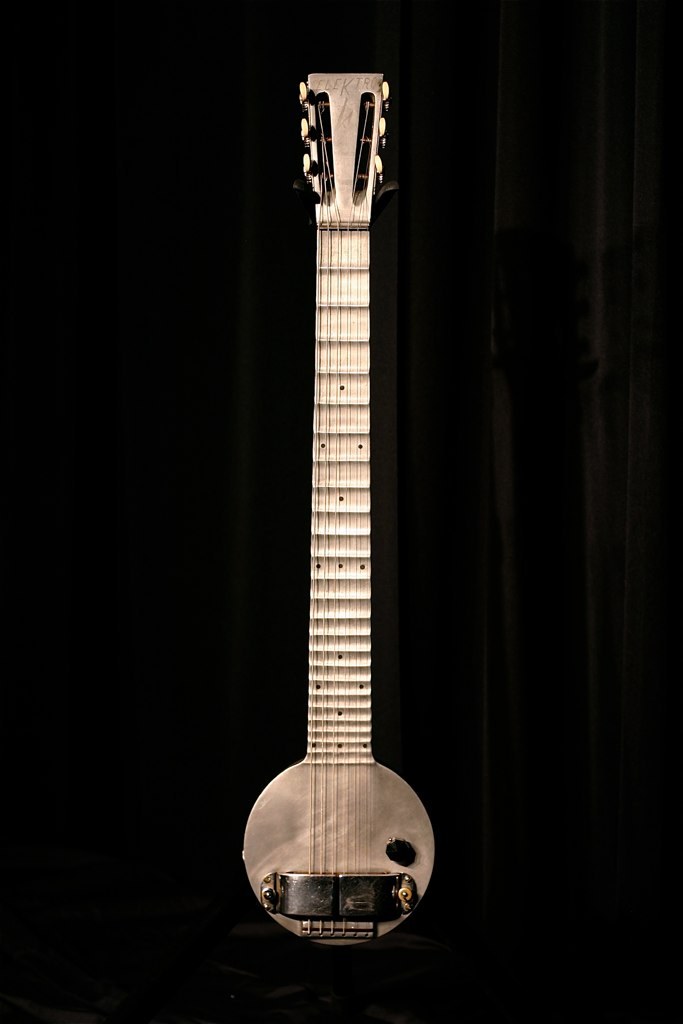
Photo: Museum of Making Music / Wikimedia Commons / CC BY 3.0 Rickenbacker
A-22 Frying Pan
1932
The first electric guitar you could buy looked like a frying pan. The patent office didn’t believe it worked.
- Send a picture
Dobro
Model 27
1932
It cost $27, so Dobro called it the Model 27. Josh Graves called his Julie.
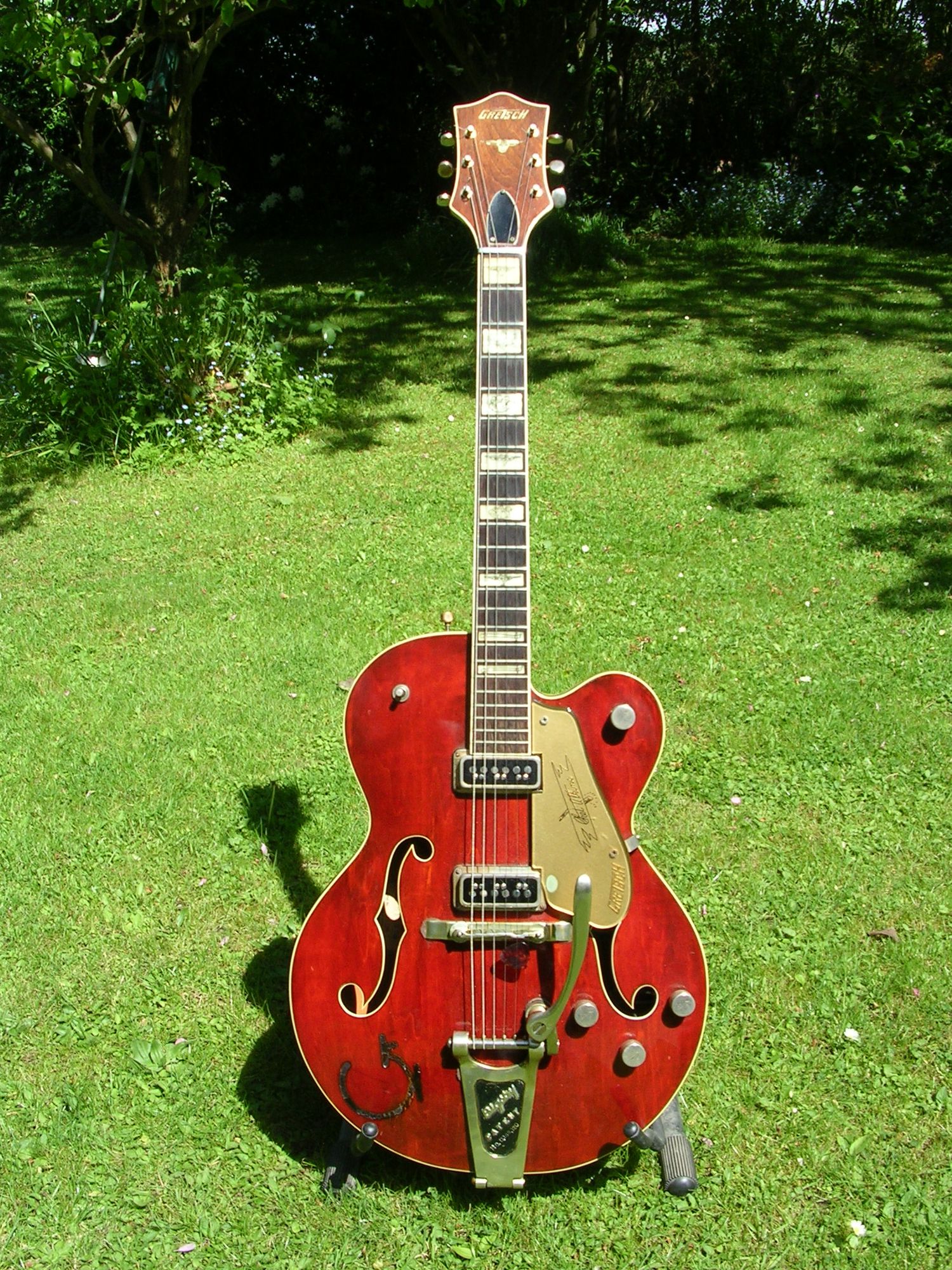
Gretsch 6120 G-Brand 1955. Photo by Francis pullen. Public domain (PD-self). Via Wikimedia Commons. Gretsch
6120
1955
Joe Walsh gave Pete Townshend one. Steve Miller gave Brian Setzer one. Chet Atkins just lent it his name.