Guyatone
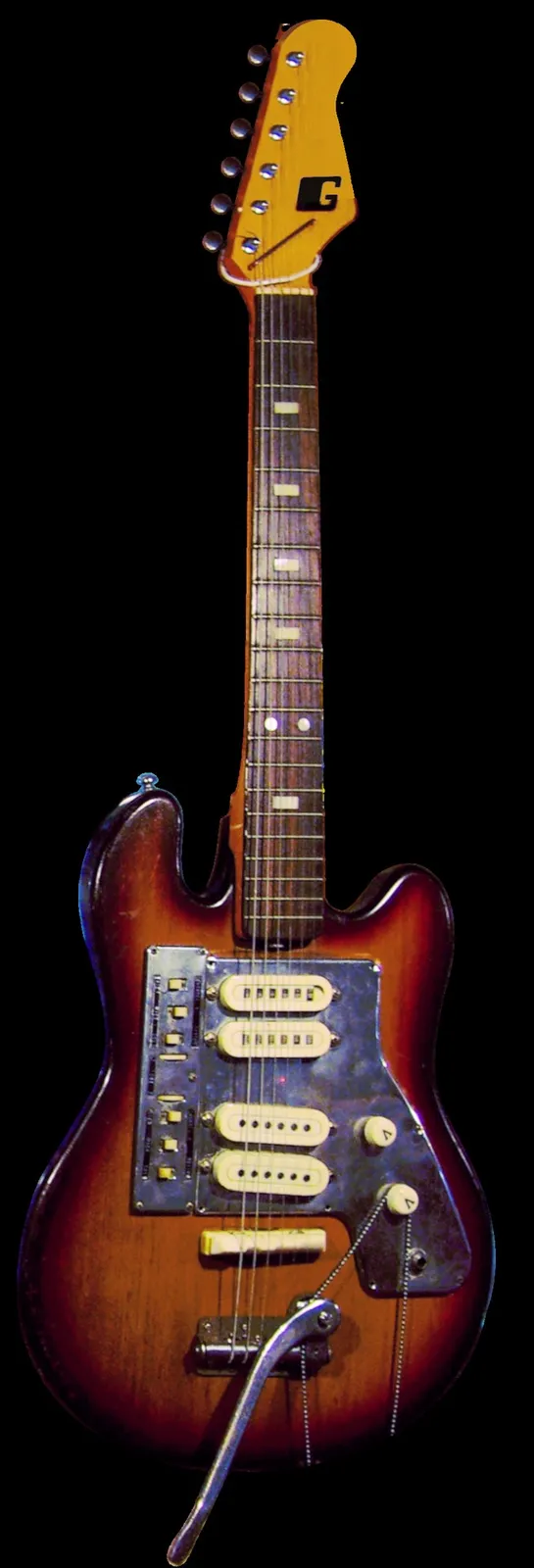
LG-140T
Four pickups, a slider for each, and at least three names. Every famous Guyatone is a different model.
Late 1964, or early 1965. Guyatone puts a new guitar at the top of its solidbody line: four pickups, an on/off slider for each one, and a vibrato made in the same building. In America it will say Kent on the tailpiece and go by a different number.
- Introduced
- 1964
- Type
- Solidbody electric
- Class
- Production
The short version
1933
Matsuki Seisakujo
Mitsuo Matsuki and Atsuo Kaneko start the company. Kaneko later leaves to co-found Teisco.
1951
Guyatone
The name goes on the instruments. The first solidbody follows in 1955.
1963
Two pickups
The catalog is still the LG-55, 65, and 85.
1964
The LG-140T
Late 1964 or early 1965. The deluxe of the line, with four pickups.
1965
Guitars on television
Kachinuki Eleki Gassen runs through 1966, with Sharp Five as the house band, on Guyatone.
1967
The Sharp 5
Nobuhiro Mine’s LG-350T. A different guitar, and the one people remember.
1968
The crash
Around this year the market goes under. Guyatone fails and comes back as Guya Co.
2013
The end of Tokyo Sound
The company stops on January 31.
Side A
A1
The top of the wall
Most guitar stories start with a player. This one doesn’t have one.
What it has is a factory. Guyatone had been going since 1933, when Mitsuo Matsuki and Atsuo Kaneko started a workshop called Matsuki Seisakujo. Kaneko left to co-found Teisco in 1946. The Guyatone name went on the instruments in 1951, and the first solidbody came in 1955. Around the turn of the ’60s, one month’s output could run to 1,600 electric guitars and basses, 1,500 steels, 2,000 amps, and 5,000 microphones.
The 1963 catalog was still two-pickup guitars: the LG-55, 65, and 85. Then, late in 1964 or early in 1965, came the deluxe. Four pickups. A slider for each. A vibrato from the same bench. The top of the line.
A2
Kent, Antoria, and a number nobody lists
A lot of Guyatones left Japan under somebody else’s name. In the U.S. they were Kents, through Buegeleisen & Jacobson. In Britain they were Antorias. Star and Ibanez badges went on them too, until Hoshino got its own factory in 1962.
In America the four-pickup was the Kent 533 Videocaster, $159.90 on a label. The collector who keeps the Kent tables calls his own dates guesses, and his 533 row doesn’t print “LG-140T.” A photo caption connects them anyway. Another guitar carries a headstock label that reads “No.633 Videocaster,” a number that doesn’t appear on the Kent list at all.
So: LG-140T, 533, 633. At least three names, and that’s before anyone argues about the body.
A3
Nobody agrees on the shape
They do argue about the body.
One shop calls it a slab double-cut with a belly contour, “not really a direct copy of any particular guitar.” The same shop later wrote that the two-pickup LG-85 “became the LG-140T.” Another says it’s an LG-65T with two more pickups. Others call it a compact offset. The wood is mahogany, or lauan, depending on the guitar. The scale is 24¾ inches, or 25, or 630 millimeters.
Four pickups is the agreement. The silhouette is not.
It isn’t a Stratocaster, whatever the six-in-a-row headstock suggests. It isn’t a Teisco, though the two companies shared a founder.
The parts stayed in the building. A plastic bridge on thumbwheels. A wrap-over vibrato under a cover. Open-gear tuners, and a metal G on the Guyatone headstock. The catalog colors were sunburst and white. Gold turns up anyway.
Flip the record · By the numbers
4
Single-coil pickups, in two pairs, each with its own on/off slider.
$159.90
U.S. list for the four-pickup Kent Videocaster, off a 1960s label.
3
Names for the third slider on each pair, depending on who opened the guitar.
1,600
Electric guitars and basses a month, around the turn of the ’60s. Every model, not this one.
Side B
B1
Four sliders, three names
The switches are the whole guitar.
Four single-coils, wired as two pairs. Each pickup has its own on/off slider, so you can run one, any two, three, or all four. Each pair gets a volume and a tone wheel. Then there’s a third slider on each pair, and nobody agrees what it is. One owner calls it a tone switch. One says it bypasses that pair’s tone wheel. Two others call it rhythm/solo.
One piece of hardware, three names. Very on brand for this guitar.
That’s what you’re buying: four single-coils in whatever mix your thumb can find, and no selector switch anywhere. Try it on one where all four sliders still work.
B2
Every Guyatone but this one
The next famous Guyatone was a different drawing. From 1965 to 1966 a Japanese TV show called Kachinuki Eleki Gassen had Sharp Five as its house band. Nobuhiro Mine played Guyatone there, and designed the Sharp Five model: the LG-350T, 1967, ¥35,000.
That’s the pattern. Rory Gallagher’s Guyatone is a 1959 LG-60B. Hendrix’s early one was an Ibanez-badged model he traded toward a Danelectro in 1962. Hank Marvin’s late-’50s guitar has the LG-50 outline. Hound Dog Taylor’s is a Kawai. No session log or interview pins a named player to an LG-140T.
Around 1968 the market crashed. Guyatone failed and came back as Guya Co. Tokyo Sound stopped on January 31, 2013.
What counts now is whether one is all there. The vibrato cover. The original tuners. Four sliders that still click. The metal G still on the head. No famous owner is on the record. It’s just the top guitar on the wall, waiting for whoever flips all four switches on.
The cast
The people, and the specific guitars, that made the legend.
1967
Nobuhiro Mine
Guyatone LG-350T Sharp 5, not this guitar
Played Guyatone on Kachinuki Eleki Gassen and designed the Sharp Five model. The TV years overlap the LG-140T. The signature guitar doesn’t.
Hound Dog Taylor
A Kawai, not a Guyatone
Sellers hang his name on Kent four-pickups. The accounts of his guitars point to Kawai models, an S-180 or a pair of Kingston S4Ts.
Rory Gallagher
Guyatone LG-60B, not an LG-140T
A 1959 LG-60B. A photo of his collection puts one beside an LG-140T. The LG-140T isn’t his.
1962
Jimi Hendrix
Ibanez-badged Guyatone, not this one
An early Guyatone, traded toward a Danelectro in 1962.
Liner notes
Specs, construction, rarity, value, and every source we used.
Four single-coils, a slider for each, and a vibrato from the same bench — Guyatone’s LG-140T, the deluxe from just before the Sharp 5.
- Body
- Solid double-cut. Tym’s 2018 example: slab, belly contour, “not really a direct copy.” KOMEHYO and Cool Old: the four-pickup of the offset LG-130T. Wood: kentfoto “most” 500-series mahogany; Bridge and Kamogun lauan / lawan; Deep Tone “Natoh mahogany.” Mix flagged.
- Neck
- Bolt-on. Maple on the LG-140T shop notes (Tym, Bridge, Deep Tone, Kamogun). Jake Wildwood’s Kent 533: mahogany. Mix flagged.
- Fingerboard
- Rosewood, 20 frets (Bridge, Cool Old, Deep Tone, Kamogun). No factory radius. Jake’s 533: about 12–14". Deep Tone: flat. Mix flagged.
- Scale
- Tym’s example: 25". Jake’s 533, Mike & Mike’s, Deep Tone: 24¾". Bridge and Cool Old: 628 mm. Kamogun: 630 mm. Mix flagged.
- Pickups
- Four in-house single-coils, wired as two banks
- Hardware
- In-house. Plastic one-piece bridge, thumbwheel height; Jake’s 533 is cut for a wound G. Wrap-over vibrato with a cover (Tym). Six-on-a-side open-gear tuners. Metal “G” badge on the Guyatone head.
- Electronics
- On/off slider per pickup. A third slider per bank: tone switch (Tym), tone bypass (Jake), or rhythm/solo (Mike & Mike’s, Bridge). Volume and a wheel tone per bank.
- Finish
- Bridge, from an old catalog: mahogany sunburst and white. Gold and an export brown also exist. Kent 533 color group (kentfoto): shaded mahogany and Century Red.
- Nut
- No factory width. Jake’s 533: 1⅝". Mike & Mike’s: 1 11/16". Bridge: 42 mm. Kamogun: 43 mm. Deep Tone: 43 mm and 44 mm on two guitars. Mix flagged.
Open the full research fileConstruction details, the complete player record, production numbers, dated value estimates, and sources
Classic living example = c. 1964–65 Guyatone LG-140T (Tokyo Sound). No current LG-140T this pass: DeMont lists an LG50 E5, not this (fetched 28 September 2026). LG-130T is the three-pickup offset. LG-145T is the four-pickup offset Tym keeps off this number. LG-350T is the 1967 Sharp 5. Kent 533 is the U.S. four-pickup badge; kentfoto does not print “LG-140T” there. A Commons headstock reads No.633, a number that table skips. Mixed inch/mm flagged: scale 25" / 24¾" and 628 mm / 630 mm; nut 1⅝" / 1 11/16" and 42 / 43 / 44 mm. Deep Tone prints 24.75" beside 44 mm. Kamogun prints 630 mm, 43 mm, and 3.69 kg (8.13 lb). Jake’s 533 body is 12½" × 1⅜", inches only. Do not average.
Construction
The job was the top of Guyatone's mid-'60s solidbody line. Four pickups. A slider for each. A vibrato from the same shop. Not the two-pickup student guitar, and not the model Nobuhiro Mine would sign a couple of years later.
The company was already old. Mitsuo Matsuki and Atsuo Kaneko, Matsuki Seisakujo, 1933 (Wikipedia). Kaneko co-founded Teisco in 1946. A man leaving, not this guitar. Guyatone on the instruments, 1951. First solidbody, 1955. The title splits: Tokyo Sound in 1952 or 1956; the firm's records say 16 July 1956, and Toshihiko Torii told Wikipedia large-scale production began that year. Late 1950s or early 1960s, a month ran to 1,500 steels, 1,600 electric guitars and basses, 2,000 amps, 5,000 microphones. Every product. Not an LG-140T census.
Exports wore other badges. Kent in the U.S., through Buegeleisen & Jacobson. Antoria in Britain. Star and Ibanez through Hoshino, until Hoshino's Tama factory in 1962. Tym: a bigger plant that year. The 1963 catalog is still the LG-55 / 65 / 85, two pickups.
Tym (4 April 2018): the LG-140T in late 1964 / early 1965, deluxe of those simpler solids, top of the series as Kent orders grew. Wikipedia's gallery and Wikimedia: c. 1964–65. KOMEHYO: around 1964, and the four-pickup of the LG-130T. Keep late '64 and early '65. This plate starts in 1964.
The body will not settle. Tym's example is a slab double-cut, belly contour, "not really a direct copy of any particular guitar." His 2021 note: the LG-85 "became the LG-140T," and the four-pickup offset is the LG-145T. Bridge (21 May 2020): an LG-65T with two coils added, 628 mm, lauan. KOMEHYO and Cool Old call it a compact offset. Echotone: "not really copied from any guitar in particular." Four pickups is the agreement. The silhouette is not.
Not a Stratocaster (fender-stratocaster). Six-on-a-side is not a synchronized tremolo. Not a Les Paul. Tym's 1950s EG line is the set-neck one. Not a Teisco (teisco-spectrum-5).
The switches are the model. Four singles, two pairs. Tym: on/off each, a tone switch and a roller per pair, a volume per pair by the jack. Jake Wildwood (18 September 2021), headstock Model 533 Videocaster: the third slider is a bypass for that bank's tone wheel. Mike & Mike's and Bridge say rhythm/solo. One piece of hardware, three names.
The parts stayed in the building. Plastic bridge, thumbwheels, two screws tipping the base, wrap-over vibrato under a cover (Tym). Jake's 533 is cut for a wound G. Open-gear tuners. A metal G on the Guyatone head. "Kent" on an export tailpiece cover.
kentfoto: 533 Videocaster, Guyatone, 1964–65, four pickups, $159.90, off a label. He prints a factory model when he has one. The 530 is LG-65T. The 533 row is not. The dates, he says, are guesses. Solids, not plywood; "most" mahogany; a double steel T-bar; a truss rod on some. A Commons caption equates a Studio Gubi guitar with the LG-140T and the 533. Another Commons label reads No.633 Videocaster. The 600-series table skips it. Keep 533 and 633.
Bridge's catalog: mahogany sunburst and white. Gold and an export brown turn up anyway. kentfoto's 533 colors: shaded mahogany and Century Red. Truss rods do not agree. Jake's is maxed. Kamogun's listing has none. KOMEHYO's was nearly out of tightening travel.
The next famous Guyatone is a different drawing. Japanese Wikipedia: Kachinuki Eleki Gassen (勝ち抜きエレキ合戦), 1965–1966, house band 井上宗孝とシャープ・ファイブ. Mine played Guyatone there and designed the Sharp Five model. Guitar Magazine (11 May 2021) and Terry Carleton (27 January 2026): that is the LG-350T, 1967, German carve, ¥35,000; the DX in 1968 at ¥45,000. Carleton: about $95 in 1968. Off this plate.
Around 1968 the market crashed. Guyatone failed and returned as Guya Co. (Bacon, via Wikipedia). Tokyo Sound stopped 31 January 2013. DeMont and Torii have the name. They do not have this model.
Classic vs current: a 1964–65 four-pickup LG-140T, against no new one you can order in 2026.
Players
Do not hang a Sharp 5, an Antoria, or a Kawai four-pickup on this plate. No session log, album cover, or interview found here pins a named player to an LG-140T.
Nobuhiro Mine and Sharp Five. The band the era is named for. Japanese Wikipedia: Mine on Guyatone for Kachinuki Eleki Gassen, and he designed the Sharp Five model. Carleton: he helped design it, at 20. That model is the LG-350T, 1967. The television years overlap this guitar. The signature does not.
Hank Marvin. Before the Strat. Burns London, on its Drifter LG50: a close replica of the guitar Marvin used in the late 1950s. Antoria badge, LG-50 outline. Wikipedia’s Steve Howe page is the same neighborhood: a solidbody Guyatone bought around 1961, his first electric, model unnamed, and an Antoria LG50 later, on the end of “Perpetual Change.” Not a 1964 four-pickup.
Rory Gallagher. The official archive’s Guyatone is an LG-60B, 1959. Wikipedia’s gallery prints “(Left: Rory Gallagher’s collection exhibited at Harrods in 2007)” across a 60B and an LG-140T. The left-hand credit is the 60B. Japanese Wikipedia: on his first trip to Japan he went looking for an LG-50H. A separate artist model was presented in January 1975. Bonhams sold a Guyatone “probably 1970s,” not called an LG-140T. The famous one is still the 1961 Strat. Off this page.
Jimi Hendrix. Wikipedia: the early Guyatone is an Ibanez-badged 1830 or 1860 Rhythm Maker, the one he traded toward a Danelectro in 1962. Not this.
Hound Dog Taylor. The mash a listing will make. Premier Guitar, Richie Owens (17 January 2018): the debut-album guitar is a Kawai S-180, which he calls a four-pickup relative of the LG-130T, made in 1964 at the Guyatone plant. Ted Drozdowski (Premier Guitar, 14 October 2021): a pair of Kawai-made Kingston S4Ts. Keep the factory split. Either citation is a Kawai model, not an LG-140T. A seller who titles a Kent 533 with Taylor’s name has joined the wrong objects.
Also known to play stays empty. None invented.
Rarity
You cannot buy a new LG-140T. The original run ended with the catalog. DeMont’s LG50, and Eastwood’s LG 150T, are other outlines from other shops. They are not a 1964 140T.
Guyatone published no LG-140T total. The monthly 1,600 is every electric guitar and bass. None invented. A plate dates a guitar when the guitar even has one. It does not count a year, and kentfoto already calls his year column a guess. That is why a first-year census is unknown.
What is actually thinner is the four-pickup against the two- and three-pickup Kent professional group under it. KOMEHYO: fewer of the four-pickup version in circulation. Completeness is the scarce end. Original vibrato cover, tuners that were not swapped, four working sliders, the metal G still on the head. Gold, against a catalog that named sunburst and white. One photographed 633 label is one object. It is not a population.
Value
Informal estimate, 28 September 2026. Not an appraisal.
Ask vs sold labeled. No celebrity lot on this model. No invented medians or factory counts. Period $159.90 (Kent 533, kentfoto, label, 1964–65) is 1960s U.S. list for the four-pickup Videocaster. That row does not print LG-140T. The LG-130T’s ¥17,000 in 1965 (Tym) is the three-pickup offset. Sharp 5 yen, and Carleton's $95, are the LG-350T. Not this table.
New street. None under LG-140T. DeMont’s Guyatone page (fetched 28 September 2026) shows an LG50 E5 Edition at $6,599.99. Different model. Eastwood’s LG 150T, brand new on Reverb this pass at $849, is a later four-pickup drawing. Not a cart for this one.
Used modern. No LG-140T reissue turned up. Nothing in that band to price.
Vintage / collectible. No Reverb Price Guide band for the LG-140T this pass. Flag: thin sold-comp access. Named asks, not hammers. KOMEHYO’s Digimart page, updated 21 November 2025, asks ¥78,000 tax included; that page’s sale line ran through 5 January 2026. Kamogun on Reverb’s Malta mirror, this pass: €838.74 cut to €712.93. Echotone (Melbourne) asking A$995. Named older sold, not a 2026 series: gold, Reverb UK, £945.88, listed four years ago. The seller called gold the rarest color. One finish. Do not average yen, euros, Australian dollars, and a 2022 gold.
See also
- teisco-spectrum-5 — 1966 stereo deluxe from Kaneko’s other company; not this four-pickup LG
- fender-jaguar — the slide-switch offset Premier hears in the LG-130T sibling; not this body
- mosrite-ventures — the Ventures guitar the 1967 Sharp 5 answered; this plate is earlier, and not that carve
Sources
- Tym Guitars, 1960s Guyatone LG-140T (4 April 2018) — late 1964 / early 1965; top of that series; Kent exports; solid timber; in-house hardware; slab double-cut, belly contour, “not really a direct copy”; bolt-on maple, rosewood; 25" on that guitar; six-on-a-side, metal G badge; pairs, on/off sliders, tone switch and roller per pair, volume per pair; wrap-over vibrato with cover; plastic bridge
- Tym Guitars, 1965 Guyatone LG-130T (17 November 2021) — LG-85 “became the LG-140T”; four-pickup offset filed as LG-145T; LG-130T around 1964, offset, ¥17,000 in 1965; 1950s EG line set-neck and Les-Paul-ish
- Wikipedia, Guyatone — 1933 Matsuki and Kaneko; Kaneko co-founds Teisco 1946; Guyatone name 1951; first solidbody 1955; Tokyo Sound 1952 or 1956; records 16 July 1956; monthly 1,500 / 1,600 / 2,000 / 5,000; Kent, Antoria, Star/Ibanez; LG-140T gallery label c. 1964–65; 1968 crash and Guya Co. (Bacon); Tokyo Sound stopped 31 January 2013; DeMont and Torii; Hendrix 1830/1860; Hound Dog on the Kawai copy, not this model
- Wikipedia(日本語), グヤトーン — Kachinuki Eleki Gassen 1965–1966; Mine on Guyatone and the Sharp Five model he designed; closed 31 January 2013; Rory looked for an LG-50H
- Wikimedia Commons, Guyatone LG-140T (c. 1964–65) — uploader equates the Osaka guitar with LG-140T and Kent 533 Videocaster
- Wikimedia Commons, headstock label No.633 Videocaster — “No.633 Videocaster”; uploader notes 633 is not on the Kent 500–800 table
- kentfoto, Kent 500-series table — 533 Videocaster, Guyatone, 1964–65, four pickups, $159.90, label; 530 is the row that prints LG-65T; dates called guesses; “most” mahogany; truss on some
- Jake Wildwood, Kent 533 Videocaster (18 September 2021) — headstock “Model 533 Videocaster”; 24¾"; nut 1⅝"; body 12½" × 1⅜"; mahogany neck and body; rosewood; two banks; third slider as tone bypass; wound-G bridge
- Bridge Guitars, Guyatone LG-140T (21 May 2020) — from 1964; LG-65T plus two pickups; maple, rosewood, 20 frets, 628 mm, nut 42 mm, lauan; catalog sunburst and white; gold and export brown also
- KOMEHYO Digimart, LG-140T — around 1964; four-pickup model of the LG-130T; Kent Videocaster export; fewer in circulation; ask ¥78,000 tax included, page updated 21 November 2025, sale line through 5 January 2026
- Premier Guitar, Richie Owens, Vintage Vault: 1965 LG-130T (17 January 2018) — sibling, not this table; rhythm/lead likened to a Jazzmaster; Hound Dog’s album guitar a Kawai S-180
- Premier Guitar, Ted Drozdowski, Hound Dog Taylor (14 October 2021) — Kawai-made Kingston S4Ts; not an LG-140T
- Guitar Magazine, シャープ・ファイブ (11 May 2021) — LG-350T from 1967, ¥35,000; LG-350T DX 1968, ¥45,000
- Guitar Player, Terry Carleton, LG 350-T Sharp 5 (27 January 2026) — Mine; LG-350T; about $95 in 1968
- Burns London, Drifter LG50 — Marvin’s late-1950s guitar, LG-50 shape, not this model
- Wikipedia, Steve Howe — solidbody Guyatone around 1961, model unnamed; Antoria LG50 on “Perpetual Change”
- Rory Gallagher official archive, LG60B (1959) — the Guyatone on the archive page is the LG-60B, not an LG-140T
- Rory Gallagher official site, 1974 Guyatone — artist model presented January 1975
- Bonhams, The Rory Gallagher Online Sale — a Guyatone “probably 1970s,” not identified as an LG-140T
- Reverb, Mike & Mike’s LG-140T — 24¾"; nut 1 11/16"; rhythm/solo; ended ask, not used as a 2026 comp
- Reverb Malta, Kamogun LG-140T — seller: released 1964–65; lawan; 630 mm; 20 frets; nut 43 mm; 3.69 kg (8.13 lb); no truss on that guitar; ask cut from €838.74 to €712.93 this pass
- Deep Tone, early-1960s LG-140T — “Natoh mahogany”; maple; 20 frets; 24.75" and 44 mm in one spec line
- Cool Old Guitars, LG-140T — calls it a compact offset; 628 mm; 20 frets
- Echotone, c. 1960s LG-140T — “not really copied from any guitar in particular”; asking A$995 this pass
- Reverb UK, gold LG-140T — sold £945.88; listed four years ago; seller called gold the rarest color
- DeMont Guitars, GuyatoneUS — LG50 E5 Edition $6,599.99; no LG-140T (fetched 28 September 2026)
- Reverb, Eastwood LG 150T — brand new $849 this pass; not this model
_clipped.png)

Keep digging
Guitars this one gets compared to, confused with, or descended from.
- Send a picture
Teisco
Spectrum 5
1966
Five colored buttons, stereo out, and a Japanese badge nobody took seriously. Mark Knopfler ended up with three.
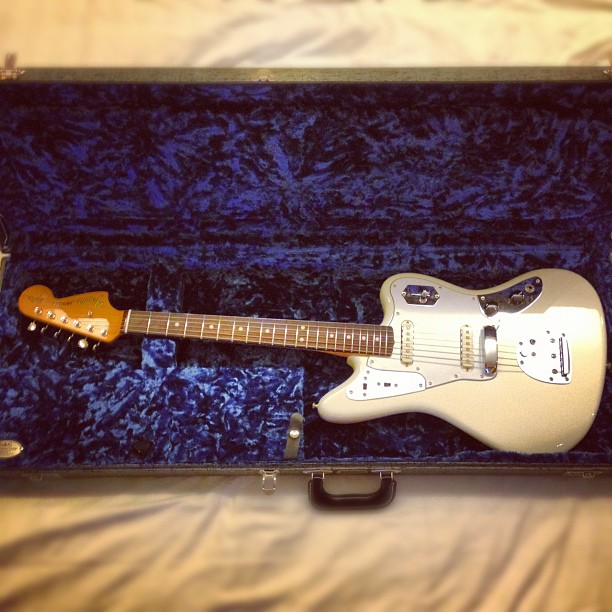
Fender Jaguar Johnny Marr signature. Photo by ToGa Wanderings. Licensed under CC BY 2.0. Via Wikimedia Commons. Fender
Jaguar
1962
It was the top of Fender’s catalog in 1962. By the late ’70s it was a pawn-shop guitar, and somebody’s only one.
- Send a picture
Mosrite
Ventures
1963
Semie Moseley offered Nokie Edwards the guitar free. He paid $200, and the Ventures dropped their Jazzmasters.