 Guitaripedia
Fender
Stringmaster
Fender's answer to every new tuning was another neck. Then players started bolting on pedals.
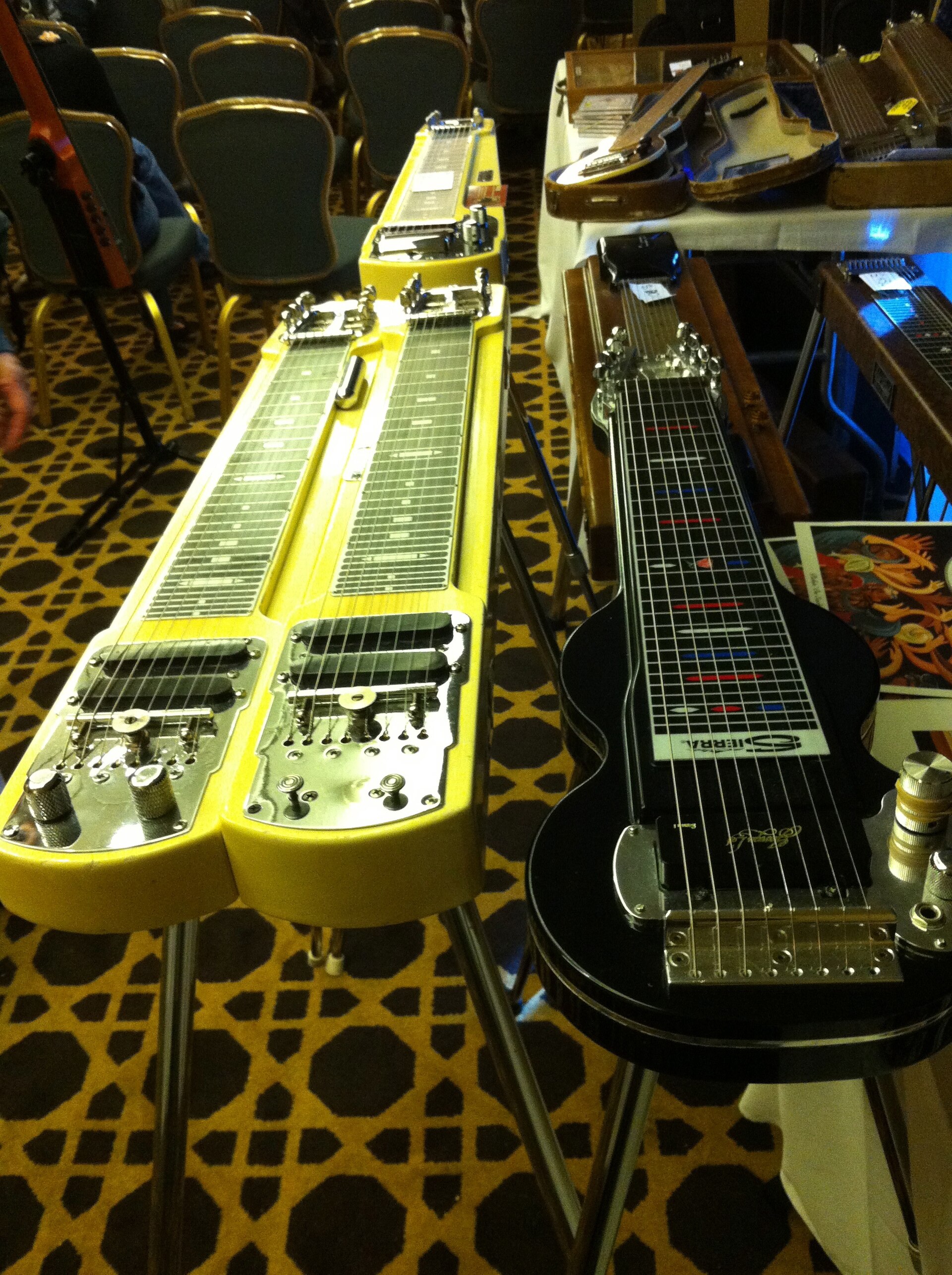
Fullerton, 1953. Two, three, or four eight-string necks on one console, four legs, and a steel bar. The Stringmaster is Fender's non-pedal steel. It isn't a Stratocaster or a Telecaster, and it was never one.
- Introduced
- 1953
- Type
- Console steel
- Class
- Closed run
The short version
1946
Boggs's doubleneck
Leo Fender builds Noel Boggs a doubleneck steel, Leo's first, and in 1949 Fender's first triple.
1953
Pencil under the pans
Four-neck guitars are being built by the summer. One is signed under the tuning pans on 31 July.
1953
A sale on paper
A 26-inch double-neck sells at Arcadia Music Mart on 19 October, receipt still with the guitar.
1954
In the catalog
The catalog introduces two, three, and four necks. Shorter 24.5- and 22.5-inch scales arrive.
1954–55
The blend wheel
A wheel behind the bridge fades in the neck pickup and cancels hum.
1965
CBS
CBS buys Fender on 5 January. The console stays in the book.
1968
Last of the quads
The four-neck drops out.
c.1979–80
The end
Made until about 1979, or 1980, depending on who's counting. Fender published no last serial.
Side A
A1
Pencil under the pans
Fullerton, summer 1953. Somebody at Fender lifts the tuning pans on a four-neck steel and writes in pencil underneath: 31 July, then 1 August.
That's a Stringmaster. Thirty-two strings, eight to a neck, on a console with four telescoping legs. You don't hold it. You stand or sit over it, with a steel bar in one hand, and slide.
A Stratocaster or a Telecaster is a Spanish guitar you fret with your left hand. This one never was, and it doesn't come from either of them.
The problem it solved was simple. A steel guitar plays in one tuning. If the song wants another, you stop and retune, or you have a second neck already tuned and waiting. Fender's answer was more necks.
A2
Leo's friend with four necks
The idea came before the catalog did. Leo Fender had been building multi-neck steels for Noel Boggs for years: a doubleneck in 1946, Leo's first, and Fender's first triple-neck in 1949. In the end Leo built him eight four-necks, most in the dark finish Boggs liked, with his name inlaid once he was on television. Sandra Boggs said each one was essentially a prototype, often without a real serial.
One magazine caption calls an early-'50s Boggs four-neck a Stringmaster. Maybe. But he was on a four-neck by January 1952, a year and a half before those pencil dates, so his guitars and the catalog model aren't quite the same thing.
One early sale is still on paper: a 26-inch double-neck sold at Arcadia Music Mart on 19 October 1953. The receipt is still with the guitar. The catalog introduced the line in 1954, two, three, or four necks, even though guitars dated 1953 were already out there.
A3
Two pickups and a wheel
Fender already had consoles, the Dual Professional and the Custom Triple, with one pickup per neck. The Stringmaster put two single-coils on every neck, and that's where the sound comes from.
The 1953 guitars have chrome covers and no blend knob. The tone control did the mixing: all the way off you got the bridge pickup, and as you turned it up the neck pickup came in. Then came a wheel behind the bridge. The bridge pickup stays on and you roll the neck pickup in under it, wound the opposite way so the pair cancels hum. One account dates the wheel to 1954. Another says 1954 or '55.
The original scale was 26 inches. From 1954 there were also 24.5- and 22.5-inch versions, and the short ones were what sold. You can tell the scale by counting the markers past the 24th fret: two on a 22.5, three on a 24.5, four on a 26. One Fender salesman remembered only 68 of the long ones being made. Fender's steel records are lost, so that's a memory, not a ledger.
Flip the record · By the numbers
8
Strings on every neck
2–4
Necks, so two to four tunings under the bar
26"
The first scale. Shorter ones came in 1954.
68
Long-scale guitars made, as one Fender salesman remembered it. The records are lost.
Side B
B1
The Model T pedal
Then Bud Isaacs's pedal work on Webb Pierce's "Slowly" came along, and non-pedal players went looking for pedals.
Fender never offered the Stringmaster with pedals. The ones you see now were added later, most of them by Shot Jackson. Lloyd Green, still a student at Mississippi Southern and playing around the state with the Wilburn Brothers, the Browns, and Hank Locklin, made his own: he took the pedal off a Model T Ford and rigged it to his Stringmaster.
As Green tells it, Faron Young wouldn't have the Fender on his show. He put Green on a triple-neck Bigsby for the year and a half Green worked for him. Shot Jackson eventually traded Green a pedal Rickenbacker doubleneck for the Fender. Green's big Nashville records, "D-I-V-O-R-C-E" with Tammy Wynette in 1968 among them, came after the Stringmaster was gone.
B2
Still in the book
Pedals or not, the Stringmaster stayed. CBS bought Fender on 5 January 1965 and kept it in the catalog. The four-neck was gone by 1968. The twins and triples went on until about 1979, or 1980, depending on who's counting. Fender never published a last serial.
Leon McAuliffe, who joined Bob Wills's Texas Playboys at sixteen, played a 26-inch four-neck. A Tulsa museum now has his Stringmaster quad, finished in a custom maroon it calls Cimarron Red, after his band, the Cimarron Boys.
B3
No volume pedal
And then there's Johnny Sibert, the player steel people mean when they talk about this guitar's sound.
His early sessions with Carl Smith were on a Bigsby and a Dual Professional. The Stringmaster came in 1954: a 26-inch triple, tuned A6, C6, and McAuliffe's E13, plugged into a Fender Bassman. No pedals, and no volume pedal either. Three necks, three tunings, and a bar.
By one steel player's account, that triple ended up in the Steel Guitar Hall of Fame.
The cast
The people, and the specific guitars, that made the legend.
1954
Johnny Sibert
26" triple Stringmaster
Through a Fender Bassman, no volume pedal, tuned to A6, C6, and E13. His early Carl Smith sides were cut on other steels.
Lloyd Green
Stringmaster with a Model T pedal
Rigged a homemade pedal on it, then traded it to Shot Jackson for a pedal Rickenbacker. His Nashville records came after.
Leon McAuliffe
Four-neck Stringmaster in Cimarron Red
A 26-inch four-neck, by one steel player's account. A Tulsa museum now has his quad, named for his band, the Cimarron Boys.
Early 1950s
Noel Boggs
Custom four-necks built by Leo Fender
Leo built him eight, essentially prototypes. One magazine caption calls one a Stringmaster, but they came before the catalog guitar.
Bobby Garrett
26" double-neck with chrome covers
One of the early long-scale guitars, by the same steel player's account.
Liner notes
Specs, construction, rarity, value, and every source we used.
Two, three, or four eight-string necks, a bar, and no pedals — Fender’s console steel, not a Stratocaster and not a Telecaster.
- Body
- Solid console. Two, three, or four necks, eight strings each. Wikipedia’s summary gives ash. Named 1955s differ: the Twelfth Fret calls a triple maple; Mike & Mike’s calls a Dual 8 maple; Carter Vintage’s 1963 Dual 8 sheet says ash, 14.4 lb. John Tipka, 2012, on a 24.5" guitar: width at the bridge end 8.6875" (two necks), 14" (three), 18.625" (four).
- Neck
- No fretted Spanish neck. Four telescoping legs. Played flat, with a bar in one hand.
- Fingerboard
- Flat board, screen-printed markers, not raised frets. Wikipedia: markers past the 24th fret number two on a 22.5", three on a 24.5", four on a 26". Block and arrowhead markers on Mike & Mike’s 1955 Dual 8 and on Carter’s 1950s Dual 8.
- Scale
- 26" on the 1953 guitars (Wikipedia; dated examples below). Wikipedia: from 1954, also 24.5" (31 fret markers) and 22.5" (29). Tipka, 2004, nominal overall length: 32¼" at 22.5", 34¼" at 24.5", 35¾" at 26". His 2012 note gives one 26" guitar at 36.25" overall. Inches, as measured. No millimetre factory figure.
- Pickups
- Two single-coils on each neck. Wikipedia: 1953 covers are stamped chrome, with no blend knob; a later version uses black plastic covers.
- Hardware
- Bridge and a cover over the pickups. Tuning pans. Mike & Mike’s 1955 Dual 8: “Pat. Pend.” trays, Kluson-style machines, string spacing 2 3/16" at the nut and 2 5/8" at the bridge. Four legs.
- Electronics
- Passive. One volume and one tone, and a neck selector: slide switches first, push-buttons on many 1955s, a blade later. Early guitars mix the second pickup on the tone control. The later wheel sits behind the bridge.
- Finish
- Blonde lacquer on the early guitars that turn up. Sunburst on later examples. Custom color on named artist guitars, including the maroon OKPOP calls Cimarron Red.
- Nut
- Metal. No factory nut width. Guitar-Place prints 2.716" (69 mm) on one 1955. Yeahman’s 1956 triple: 2.5375" from the first string to the eighth.
Open the full research fileConstruction details, the complete player record, production numbers, dated value estimates, and sources
Specs are for the original Fullerton Stringmaster. No current model carries the name.
Construction
The job was another tuning without a retune. One neck is one tuning. A second, a third, or a fourth is already under the bar: eight strings each, the guitar on legs, played flat. A Stratocaster and a Telecaster are Spanish guitars, fretted with the left hand. This one never was.
Fender was already building steels. The Dual Professional and the Custom Triple are the earlier consoles, one trapezoid pickup to a neck. Jeff Mead, 1 September 2014: Fender sold those beside the Stringmaster from about 1953 into 1956, and the 1954 catalog is where the Stringmaster is introduced, in two, three, and four necks, even though guitars dated 1953 already exist. Chris Scruggs, 11 May 2008, has the trapezoid steels and the 26" Stringmasters together through 1953 and 1954, and the Stringmaster line standardized in late 1955. Mark Durante, the same thread, has the trapezoid pickups gone by 1956. Sources differ on the last trapezoid.
Jerry Jones, 1 September 2014: his 26" double-neck, serial 0147, still has an Arcadia Music Mart receipt dated 19 October 1953, a week or two after the date he reads as manufacture. On that thread the owner of four-neck serial 0058 reports pencil dates under the pans, 31 July and 1 August 1953, and remembers two necks as Freddy Tavares’s. A Reverb listing of 0058 says the same July 1953 signature. Wikipedia runs the series 1953–1980. Jones’s receipt is a documented retail sale. The July dates are earlier manufacture. Mead’s 1954 catalog is the introduction he describes.
Scale splits the same way. Wikipedia: 26" in 1953, and from 1954 also 24.5" (31 fret markers) and 22.5" (29). Scott Thomas, 19 January 2014, still had the shop on 26" scales and slide switches in late 1954, and treated a push-button 22.5" as usually 1955, with overlap possible. Markers past the 24th fret show the scale. That is Wikipedia’s count, and Rick Alexander’s on the forum in 2005. Tipka’s two sets of overall lengths, in the specs above, do not match each other.
Wikipedia’s 1953 account: chrome covers, no blend knob, the tone control mixing the pickups, bridge at full off and the neck pickup coming in as the knob advances. Basil, on the forum, attributes that wiring to Tavares and says those first pairs were not reverse-wound. Wikipedia dates a blend wheel behind the bridge to 1954: bridge pickup left on, neck pickup faded in, the coils opposite in polarity so the blend cancels hum. Geoff Cline puts the wheel at about 1954 or 1955. Neck selection moves from slides to push-buttons to a blade. Mike & Mike’s 1955 Dual 8 carries Stackpole pots from the 36th and 41st weeks of 1955 and a paper-in-oil tone cap. One guitar.
Chris Scruggs, 1 February 2004, and Bob Knight, 10 February 2004, on the same thread: Fender never offered this model with pedals. Knight says the pedals that turn up are later additions, most of them by Shot Jackson. Fender’s pedal steels, in that post, are the 400, the 800, the 1000, and the 2000. The PS210, he writes, was a prototype, only a few of them, built by Gene Fields. Wikipedia says the single-neck Deluxe 6 and Deluxe 8 are not Stringmasters. The 1972 catalog index on vintageguitarandbass.com lists Stringmaster, Dual Six, and Deluxe 6 and 8 apart. A Dual 6 filed under this name is the six-string console. The four-neck, the quad or Q-8, leaves in 1968 in Wikipedia’s account. Tony Oresteen, 31 July 2024, reached 1968 from the guitars he could find. Wikipedia’s note on page 32 of the 1972 catalog describes the twin and the triple then on offer.
CBS bought Fender on 5 January 1965. The console stayed in the book. Doug Beaumier, 20 June 2004, says these guitars were made until about 1979. Wikipedia stops the series at 1980. Oresteen’s own triple is a 1978. Fender published no last serial. Ishibashi, on the Japanese SM-2, says American steel production had stopped in the early 1980s, and that the SM-2, around 1989–90, was a double-neck built after leftover American parts turned up in Fullerton. A different guitar.
Players
The people tied to this console wanted several tunings and, at first, no pedals. A Fender on a western-swing record is not this model until someone names it. The Dual Professional, the Bigsby, and the later pedal steels are other instruments.
Noel Boggs. Vintage Guitar, Ward Meeker: Leo Fender built eight four-neck lap steels for him, most in the dark finish Boggs liked, his name inlaid once he was on television. Sandra Boggs told Meeker each was essentially a prototype, often without a true serial. The same article keeps the earlier guitars separate. In 1946 Fender built him a doubleneck, Leo’s first. In 1949 he was given Fender’s first triple-neck. Rich Kienzle, in that piece, has Boggs on the four-neck with Wade Ray in January 1952, including an RCA session with Chet Atkins and Owen Bradley, and later the swinging “It’s All Your Fault” with Jimmy Bryant. January 1952 is before the July and October 1953 Stringmasters above. Meeker’s caption still calls an early-1950s four-neck, Boggs in his Spade Cooley uniform, a Stringmaster. The custom and the production name meet in that sentence. They are not the same claim as a 1953 catalog guitar.
His Wills sides are the wrong decade. Kienzle has him prominent on “Roly Poly,” “Texas Playboy Rag,” “Stay a Little Longer,” and “New Spanish Two-Step,” on the Epiphone Rocco, hired in 1944. Sandra Boggs’s recollection of the four-neck she recovered in Chino — home, Cecil B. DeMille sound effects, Spade Cooley, sessions with Nat King Cole, Frank Sinatra, Louis Prima, Keely Smith, Shasta, Capitol — is her memory of that guitar, not a session log that names a master. He later moved to pedal steel. He died 31 August 1974.
Leon McAuliffe. Bobbe Seymour, 1 February 2002, on the 26" chrome-cover guitars: McAuliffe used one in a four-neck. OKPOP Museum, 20 March 2025: the museum had just added his Fender Stringmaster quad, a custom maroon the post calls Cimarron Red, after his band the Cimarron Boys, from the collection of Larry Shaeffer at Cain’s Ballroom. Mike Neal, Tulsa Regional Chamber, 27 March 2025, on the same Shaeffer gift, calls one piece “Leon McAuliffe’s 1955 steel guitar” and does not name the model. The quad and the 1955 steel may be one object. The two posts do not say so. OKPOP also has him joining Bob Wills’s Texas Playboys at sixteen. That is years before a 1953 console. No side in these sources is tied to the quad.
Johnny Sibert. Chris Scruggs, 17 June 2004: the sound people mean is a 26" triple Stringmaster through a Fender 4×10 Bassman, no volume pedal, main tuning A6, plus a C6 and McAuliffe’s E13. Scruggs dates the Stringmaster to 1954. From 1952 to 1954 Sibert was on a non-pedal Bigsby D-8, then briefly a Dual Professional. “Are You Teasing Me,” his first Carl Smith session, is February 1952. Scruggs puts “Hey Joe,” “Satisfaction Guaranteed,” and “Doggone It, Baby, I’m in Love” on the Dual Professional. A 7 June 2003 post that Rick Collins answers as Chris’s says the triple went to the Steel Guitar Hall of Fame. The 26" Stringmaster is the later guitar. It is not the 1952 session.
Lloyd Green. Vintage Guitar: Bud Isaacs’s work on Webb Pierce’s “Slowly” sent him, like other non-pedal players, to a homemade pedal — the pedal from a Model T Ford — on his Stringmaster, while he was at Mississippi Southern and working around Mississippi with Justin Tubb, the Wilburn Brothers, the Browns, and Hank Locklin. Faron Young, in Green’s telling there, would not have that Fender on the show and put him on a triple-neck Bigsby for the year and a half Green worked for him. Shot Jackson later traded Green a pedaled Rickenbacker doubleneck for the Fender. A 2022 interview has him on a double-neck Fender at fourteen, in Mobile, with a pedal somebody else made. That interview does not say Stringmaster. The Nashville records, including “D-I-V-O-R-C-E” with Tammy Wynette in 1968 in the same Vintage Guitar piece, come after the Fender was gone.
Bobby Garrett. Seymour, in that 2002 post, also has Garrett on a 26" double-neck of the chrome-cover type. No session list.
Rarity
You cannot order a new Stringmaster from Fender. The name is off the current list. The Japanese SM-2 is a later double-neck.
No production total has been published. Jeff Mead, 21 August 2019, reporting Jody Carver, who had been a Fender salesman: Carver’s figure for the long-scale model was 68, across those years, and the shorter scales were the popular ones. Mead adds that Fender’s steel-guitar production records were lost. Carver’s 68 is a salesman’s number, not a factory book, and it is the 26" guitar only. A serial dates one instrument. It does not count a year.
Thinner than a 1970s triple: a 26" guitar with chrome covers and slide switches; a four-neck, which Wikipedia and Oresteen both stop in 1968; Boggs’s name-inlaid four-necks; the quad OKPOP calls McAuliffe’s, if that reading holds. Push-button 22.5" doubles are the ones that turn up.
Value
Informal estimate, 28 October 2026. Not an appraisal.
Asks below are asking prices unless marked sold. A Dual 6, a Deluxe, a Dual Professional, a Fender 1000, and a Japanese SM-2 are other guitars. No period catalog list for the Stringmaster is among the sources below. One case tag is not a list. Dale Carter, 19 January 2014, read a Fender sales tag in his triple’s case as $418.50 and was not sure the guitar was 1954. Scott Thomas, same day, would not put a push-button short-scale earlier than the overlap into 1955–56.
New street. None. Fender does not sell this model. Ishibashi’s used SM-2, year given as 1989–90, was ¥154,500 and is sold out. Different factory, different guitar.
Used modern. None. There is no recent Fullerton run to make a used-modern band.
Vintage / collectible. Reverb’s price guide for the four-neck, read 28 October 2026, estimated $1,542–$2,856 from 15 orders in Good to Mint. Orders on that page: 29 June 2026, Very Good, $2,500; 26 February 2026, Good, $2,111.96; 3 June 2025, Very Good, $2,449; 29 April 2025, Good, $2,000; 7 April 2025, Very Good, $1,450; 4 November 2024, Good, $2,099; 6 March 2024, Very Good, $2,599.99. Reverb’s two-neck page, the same day, showed a guide range of $1,469–$1,850. A guide range is not those four-neck orders.
Named asks, not hammers, the same day. Carter Vintage, 1963 Dual 8, blonde, ash, original case and four legs, switch replaced, $2,500. Mike & Mike’s Guitar Bar, 1955 Dual 8, push-button, body refinished red, legs and tweed case, $3,474. Yeahman’s, 1956 triple, sunburst, 22.5", $3,075. Guitar Hotline, a 1953 triple at 26", $3,495. Music City Canada, a triple the shop dates to 1954, black, $3,250. Guitar-Place, a 1955 double, €1,750. Clean early triples are being asked above the four-neck orders Reverb prints. An ask is not a sale.
Heritage Auctions, 9 October 2024, sold a circa-1957 triple, serial 00380, finish stripped, condition Fair, with legs and a tweed case. The public lot page does not print the hammer.
Artist-owned, not comparable sales. Boggs’s four-necks, and the quad OKPOP identifies as McAuliffe’s, have no published sale in the sources above.
See also
- rickenbacker-a-22 — 1932 cast lap steel, one neck, played on the lap; no second neck
- sho-bud-pro-ii — pedal steel, two ten-string necks; the changer this console never had
- fender-telecaster — Fender’s Spanish bolt-on; not a steel, and not where this guitar comes from
Sources
- Wikipedia, Fender Stringmaster — 1953–1980; two, three, or four necks, eight strings; ash in the summary; 26", then 24.5" (31 fret markers) and 22.5" (29); chrome covers and tone-control blend on the 1953 guitars; blend wheel dated 1954; quad discontinued 1968; Deluxe 6 and 8 are not Stringmasters; note on the 1972 catalog, page 32, twin and triple
- The Steel Guitar Forum, Stringmaster timeline, 1 September 2014 — Jeff Mead: 1954 catalog introduces two, three, and four necks, with 1953-dated guitars already extant; trapezoid D-8s beside them about 1953–56. Jerry Jones: serial 0147, Arcadia Music Mart receipt 19 October 1953. Owner of serial 0058: pencil dates 31 July and 1 August 1953, two necks remembered as Tavares’s
- Reverb, Stringmaster Quad serial 0058 — seller: July 1953, Tavares signature under the pans. Listing ended
- The Steel Guitar Forum, 11 May 2008 — Scruggs: trapezoid steels and 26" Stringmasters together through 1953–54; line standardized late 1955. Durante: trapezoid pickups gone by 1956. Brad Bechtel quotes Gruhn’s Guide on Deluxe features by 1957, which is the single-neck, not this model
- The Steel Guitar Forum, John Tipka, 31 March 2004 — nominal overall lengths: 32¼", 34¼", 35¾"
- The Steel Guitar Forum, John Tipka, 26 March 2012 — assembled widths; one 26" guitar at 36.25" overall
- The Steel Guitar Forum, Rick Alexander, 10 October 2005 — markers above the 24th fret: two for 22.5", three for 24.5"
- The Steel Guitar Forum, basil and Geoff Cline — early tone-control blend attributed to Tavares; first pairs not reverse-wound; blend wheel about 1954 or 1955
- The Steel Guitar Forum, Dale Carter and Scott Thomas, 19 January 2014 — case tag read as $418.50; push-button 22.5" usually 1955
- Mike & Mike’s Guitar Bar, 1955 Dual 8 — maple, per the shop; 24.5"; spacing 2 3/16" and 2 5/8"; pots weeks 36 and 41 of 1955; ask $3,474 on 28 October 2026
- The Twelfth Fret, 1955 triple (sold) — maple, per the shop; 22.5"; push-buttons; one balance knob per neck
- Carter Vintage, 1963 Dual 8 — ash, 14.4 lb, blonde; ask $2,500 on 28 October 2026
- Carter Vintage, 1950s Dual 8 — ash, 15.4 lb, 22.5", block and arrowhead markers
- Guitar-Place, 1955 double — 24.5" (623 mm) and nut 2.716" (69 mm) as printed; ask €1,750
- Yeahman’s, 1956 triple — 22.5"; 2.5375" string spread; ask $3,075
- vintageguitarandbass.com, 1972 Fender catalog index — Stringmaster, Dual Six, and Deluxe 6 / 8 listed apart
- Vintage Guitar, Ward Meeker, Boggs’ Quad — eight four-necks; 1946 doubleneck; 1949 triple; January 1952 with Wade Ray; Wills sides on the Epiphone; Sandra Boggs on the Chino guitar; died 31 August 1974
- OKPOP Museum, 20 March 2025 — McAuliffe Stringmaster quad, Cimarron Red, from Larry Shaeffer; joined Wills at sixteen
- Mike Neal, Tulsa Regional Chamber, 27 March 2025 — Shaeffer gift includes “Leon McAuliffe’s 1955 steel guitar”; model not named
- Bobbe Seymour, 1 February 2002 — McAuliffe on a four-neck 26"; Bobby Garrett on a 26" double; chrome covers, no fader, the early wiring
- Chris Scruggs, 17 June 2004 — Sibert’s 26" triple, Bassman, 1954; Bigsby 1952–54; Dual Professional on “Hey Joe,” “Satisfaction Guaranteed,” and “Doggone It, Baby, I’m in Love”; “Are You Teasing Me,” February 1952
- The Steel Guitar Forum, 7 June 2003 — the post Rick Collins answers as Chris’s: the triple went to the Steel Guitar Hall of Fame
- Guitar Center, Stratocaster changes 1954–1965 — CBS bought Fender on 5 January 1965
- Vintage Guitar, Lloyd Green — Model T pedal on a Stringmaster; Faron Young; Shot’s trade for a Rickenbacker; “D-I-V-O-R-C-E,” 1968, after the Fender
- Music Makers and Soul Shakers, Lloyd Green, 22 January 2022 — double-neck Fender at fourteen; the interview does not say Stringmaster
- Bob Knight and Chris Scruggs, February 2004 — Scruggs, 1 February, and Knight, 10 February: never offered with pedals; Knight on aftermarket pedals, most by Shot Jackson; 400, 800, 1000, 2000; PS210 a prototype, a few, by Gene Fields
- The Steel Guitar Forum, Jeff Mead, 21 August 2019 — Carver’s figure of 68 long-scale guitars; steel production records lost
- Doug Beaumier, 20 June 2004 — made until about 1979
- Tony Oresteen, 31 July 2024 — quads stop in 1968 in what he could find; his own triple is a 1978
- Ishibashi, Fender Japan SM-2 — American steel production stopped in the early 1980s, in that account; SM-2 about 1989–90; used ask ¥154,500, sold out
- Reverb price guide, Stringmaster Q8 — $1,542–$2,856; orders listed in the Value section; read 28 October 2026
- Reverb, two-neck Stringmaster page — guide range $1,469–$1,850 the same day
- Guitar Hotline, 1953 triple — 26"; ask $3,495
- Music City Canada, triple dated 1954 by the shop — ask $3,250
- Heritage Auctions, 9 October 2024, lot 85355 — circa-1957 triple, serial 00380, stripped, Fair; hammer not on the public page
Keep digging
Guitars this one gets compared to, confused with, or descended from.
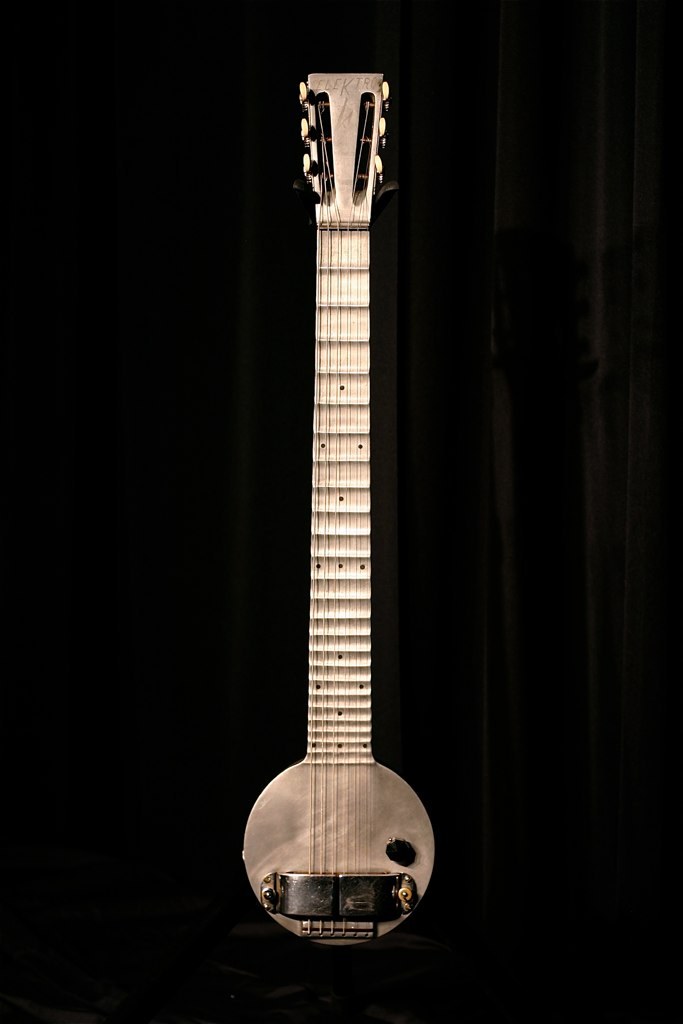
Photo: Museum of Making Music / Wikimedia Commons / CC BY 3.0 Rickenbacker
A-22 Frying Pan
1932
The first electric guitar you could buy looked like a frying pan. The patent office didn’t believe it worked.
- Send a picture
Sho-Bud
Pro II
1973
Sho-Bud would build you a Pro II any way you asked, which is why no two of them agree.
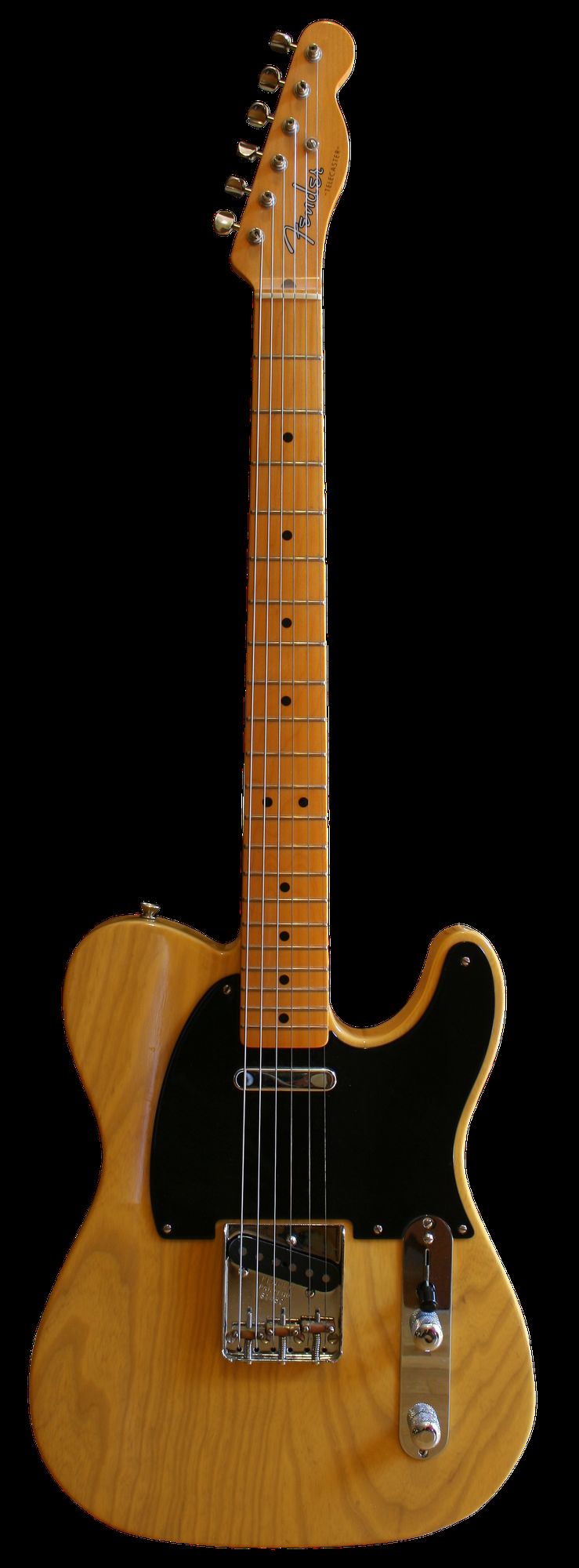
Fender Telecaster American Vintage 1952 with transparent background. Photo by Massimo Barbieri. Licensed under CC BY-SA 3.0. Via Wikimedia Commons. Fender
Telecaster
1950
Leo built it like a tool. The famous ones look like they just clocked off a double shift.