Burns
Marvin
Burns built Hank Marvin more than 30 prototypes to keep him in tune. Then somebody checked his jacket.
Late 1963. Hank Marvin and Bruce Welch of the Shadows are fed up with their Strats. The magnets drag on the strings, Hank’s whammy bar knocks everything out of tune, and Welch has walked out of the band over tuning once already. So they go to Burns and ask for something better.
- Introduced
- 1964
- Type
- Solidbody electric
- Class
- Production
The short version
1963
Prototypes
A Marvin without its upper guard turns up in studio photos in early November.
1964
On tour
The finished set is in full use on the Shadows’ spring European tour.
1964
Patents
Burns files for the design and the Rezo-Tube on 14 August, with production already underway.
1965
Baldwin
The American company buys Burns on 30 September. The Marvin carries on under the new owner.
1966
Puppet Shadows
Burns builds Mini Marvins for the Shadows’ puppet cameo in Thunderbirds Are Go.
1970
Stolen
Hank’s Marvins are stolen. Some tellings have him playing them into the early ’70s.
Side A
A1
Out of tune and out of patience
Every signature guitar starts with a complaint. This one had a good one.
Toward the end of 1963, Hank Marvin and Bruce Welch were unhappy with the white Strats they were using. The pickup magnets pulled on the strings (“magnet suck,” players call it), and Hank’s constant work on the whammy bar kept knocking everything out of tune. At one point Welch walked out of the band over tuning, and then came back. That’s a serious tuning problem.
They went to Jim Burns through Ike Isaacs, Hank’s old teacher and now Burns’s technical director. Hank’s brief was easy to say and hard to build: a guitar that stayed perfectly in tune with a wide-range tremolo, and more variety in the tones.
What followed wasn’t a sale. It was an argument, with a workshop on one side and two very particular guitarists on the other.
A2
Thirty guitars later
Hank told the story himself, in a 1964 column:
Those fellows up at Romford must have loved me! Over 30 models were completed before the final job appeared.
He blamed Welch, who would send back whatever Hank didn’t. He also wrote: “The 24 months of waiting was a nuisance.” Twenty-four months would put the first approach back in 1962. Other times Hank remembered starting in mid-1963, which seems more likely. Either way, it was a long wait.
Some of the ideas were Hank’s own. The scroll headstock, three tuners a side, was his, and carving it gave the shop a headache. The white finish with red tortoise guards was borrowed from the Strat look he was walking away from. By early November 1963 prototypes were turning up in the studio, one without its upper guard. By the spring tour of Europe, the finished guitars were in full use.
A3
Six tubes and a knife edge
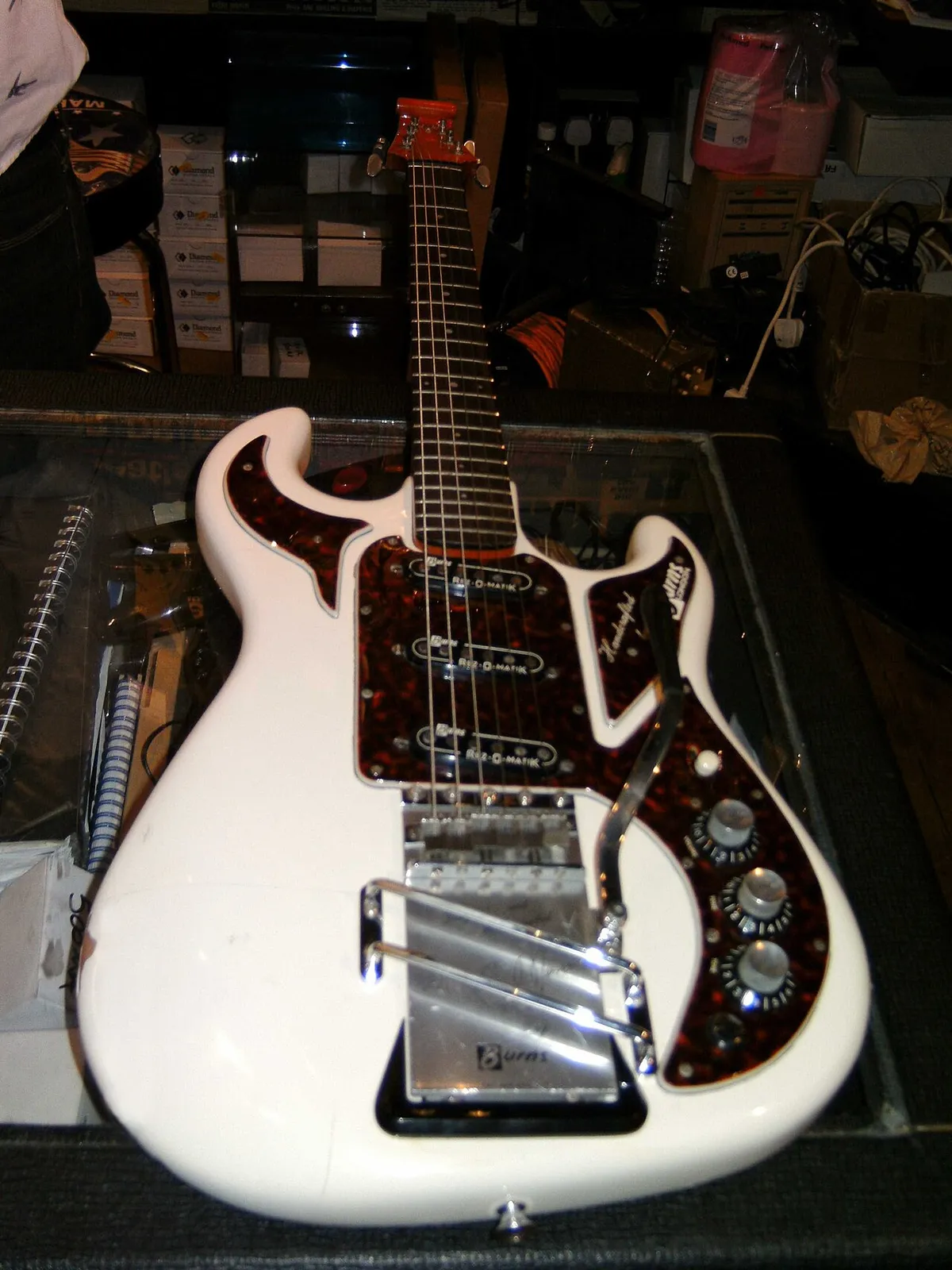
It has a Strat’s layout, but it’s its own animal. The scale is 25½", the first Burns at that length, with one extra fret. Three Rez-o-Matik pickups, a simple three-way lever, a master volume and two tones. After years of Burns chasing clever circuits, this was plain and useful on purpose.
The heart of it is the vibrato, the Rezo-Tube. A long aluminum plate pivots on a knife edge, so there’s very little friction to hang the strings up. Instead of a Strat’s block, the strings pass through six separate tubes set in a recess in the body, kept apart from the wood. Burns’s catalog promised “a new degree of resonance and sostenuto,” which is a catalog’s way of saying it rings. A cage armrest sits over the plate so your picking arm doesn’t foul it. Engraved on the unit: “Designed and handcrafted for Hank B. Marvin by Burns.”
In October 1964 Hank called it “a Burns solid costing £163.” By June 1965 the list was over £173, almost exactly the price of a Strat.
Flip the record · By the numbers
30+
Models Hank says Burns completed “before the final job appeared.”
£163
What Hank said the guitar cost, in his October 1964 column.
6
Tubes in the Rezo-Tube, one per string, set into the body.
300–400
Roughly how many were built. Nobody published a total, and the estimates don’t agree.
Side B
B1
Green guitars and puppet Shadows
Beat Instrumental made Hank its player of the month in June 1964, with “a guitar named after him.” By the early-1964 single “The Rise and Fall of Flingel Bunt” at the latest, the Shadows were recording with the new lineup. No session sheet says more than that.
For the short film Rhythm & Greens, Burns made a special set of Marvins in green sunburst. They showed up on TV and in the film, then only now and then. And in 1966, when the Shadows appeared as puppets in Thunderbirds Are Go, Burns built Mini Marvins for the puppet band. If you want proof a guitar had made it, a scale model in a Gerry Anderson film will do.
B2
The jacket button
Hank got his guitar. He did not stop having opinions about it. Later he said it looked “cluttered,” with “the profusion of plastic,” and the first one was very heavy. And for a while the Rezo-Tube, after thirty-odd prototypes, kept locking out of tune. The culprit was the button on his jacket, catching in the string-feed slot on the back.
Baldwin bought Burns in September 1965, and in mid-1966 factory manager Jack Golder flattened the carved scroll into a lump that wasted less wood. Baldwin halted the line by 1970. Nobody published a total. The guesses run from 300 to about 400.
Hank played his until 1970, when they were stolen, or into the early ’70s, depending who you ask. Either way, somewhere there are guitars with his name engraved on the vibrato, built after thirty rounds of send-it-back by a shop that kept saying yes. And the last thing standing between Hank Marvin and a guitar that stayed in tune was a button on his own jacket.
Put this on
You’ve read about it. Now hear it. Here’s what this guitar sounds like, and what to listen for.
Rhythm & Greens
Burns made a special set of green-sunburst Marvins to promote this short film. Look for them on screen.
Watch it on YouTube (opens in a new tab)
The cast
The people, and the specific guitars, that made the legend.
1964
Hank Marvin
The Marvin
The guitar is his name. He wanted a wide-range tremolo that stayed in tune and more variety in the tones.
1964
Bruce Welch
The Marvin
The other half of the signature set. If Hank didn’t send a prototype back, Welch would.
1963
Ike Isaacs
The introduction
Hank’s old teacher and Burns’s technical director. He brought the Shadows to Jim Burns.
1966
Jack Golder
The flattened scroll
Burns’s factory manager, who turned Hank’s carved scroll into a lump that wasted less wood.
The American Breed
A Marvin
A Marvin shows up with them on their first LP. Proof it made it across the Atlantic.
Liner notes
Specs, construction, rarity, value, and every source we used.
A carved scroll, three Rez-o-Matiks, and a Rezo-Tube — Burns’ Marvin, the Shadows guitar after Hank’s Fiesta Red Strat, not a Bison.
- Body
- Offset double-cut, curvier upper horn than a Strat. RetroFret’s 1967: African mahogany. Mix flagged.
- Neck
- Bolt-on, natural finish. Vintage Guitar: usually unbound rosewood board on the 1964. RetroFret 1967: maple with bound rosewood. Mix flagged.
- Fingerboard
- Rosewood; one extra fret vs a period Strat (Vintage Guitar). Bound on Baldwin-era examples
- Scale
- 25½" (648 mm) on RetroFret’s 1967. Mix flagged. First Burns at this length (Vintage Guitar)
- Pickups
- Three Rez-o-Matik (RetroFret; Vintage Guitar also writes Rez-O-Matic) single-coils, Strat-influenced, often slanted
- Hardware
- Rezo-Tube vibrato, knife-edge plate, six tubes in the body; cage armrest. Van Gent tuners on RetroFret’s 1967
- Electronics
- Master volume, two tones, 3-way lever (Vintage Guitar). Later reissues add a 5-way
- Finish
- Brilliant white with red tortoise guards typical (Vintage Guitar). Green-sunburst exists as a short Shadows run
- Nut
- 1⅝" (41 mm) RetroFret 1967. Mix flagged.
Open the full research fileConstruction details, the complete player record, production numbers, dated value estimates, and sources
Classic living example = 1964–65 Burns-logo Marvin (Romford). No current factory Marvin SKU this pass (burnsguitars.com did not serve a live Marvin page, 3 September 2026). Baldwin Model 524 is the September 1965 continuation — flattened scroll from mid-1966, not the carved 1964 head. 2004 40th Anniversary is a closed run of 2004. Shadows bass, Bison, and Double Six stay off this slug. Hank’s Fiesta Red Strat lives on fender-stratocaster. No Gibson SKU. Mixed inch/mm flagged on RetroFret’s 1967 (overall 40" (101.6 cm), lower bout 13½" (34.3 cm), depth 1½" (3.8 cm), scale 25½" (648 mm), nut 1⅝" (41 mm)).
Construction
The job was a guitar that stayed in tune when Hank Marvin leaned on the arm. The Shadows had been a Fender-and-Vox band. Toward the end of 1963, Vintage Guitar (Peter Stuart Kohman) has Marvin and Bruce Welch unhappy with the white tortoiseshell Strats they were then using — “magnet suck,” constant whammy, Welch leaving the band over tuning and then coming back. They went to Jim Burns through Ike Isaacs, Hank’s old teacher and Burns’ technical director. Tony Bacon (Reverb News, 26 April 2018): Hank wanted a guitar that remained perfectly in tune with a wide-range tremolo, and more variation in the tones.
What they built is a Strat-layout Burns, not a Strat. Offset cuts, bolt-on, rosewood board, 25½" scale — the first Burns at that length, with one extra fret (Kohman). The three-and-three scroll head was Hank’s idea; Kohman says it gave the shop a carving headache. Brilliant white with red tortoise was the last Fender look, borrowed. Three Rez-o-Matik coils, Strat-influenced, with a simple 3-way, master volume, two tones — a move away from Burns’ earlier Split Sound and low-impedance experiments. The Marvin was the first Burns with the fancier “Handcrafted by Burns London” guard markings.
The sound is the Rezo-Tube. Patents filed 14 August 1964 for the overall design and the tailpiece; production was already underway (Kohman). A long aluminum plate pivots on a knife-edge. The whole assembly raises and lowers, sprung from beneath. In place of a Strat inertia block, the strings pass through six individual tubes in a body recess, isolated from the wood. Burns’ catalog: “a new degree of resonance and sostenuto.” A cage armrest sits over the plate so the picking arm does not foul it. The unit is engraved “Designed and handcrafted for Hank B. Marvin by Burns.” Ads sometimes called the vibrato Rez-O-Matic; Kohman notes that marking actually belongs to the pickups.
It is not a Bison. The Bison was the flagship until this one arrived; Kohman has the Bison restyled to match the Marvin, not the other way around. It is not the Shadows bass. It is not Hank’s 1959 Fiesta Red Stratocaster, serial 34346, ordered by Cliff Richard — that object lives on the Strat plate.
Hank, quoted by Bacon and by Kohman from a 1964 column: “Those fellows up at Romford must have loved me! Over 30 models were completed before the final job appeared.” He blamed Welch for sending them back. “The 24 months of waiting was a nuisance.” Kohman: that timetable would put the first approach in 1962, around the second-generation Bisons; other Hank reminiscences start mid-1963, “which seems more likely.” Prototypes were in use by late 1963 — a Marvin without the upper guard in studio pictures from early November. The first complete signature set was in full use by early 1964, seen on that spring’s European tour. Beat Instrumental, June 1964: player of the month, “a guitar named after him.” The guitar appears in Burns literature by July 1964. Hank in his October column: “a Burns solid costing £163.” Bacon’s 1964 line lists Marvin at £162.50. Kohman: June 1965 list over £173, almost exactly a Strat.
Baldwin bought Burns on 30 September 1965 (Kohman, Volume 9). Bacon: £250,000, after Baldwin had failed to buy Fender. The U.K. company became Baldwin-Burns Ltd. Marvin became Baldwin Model 524. Collectors’ trap: logo plates swapped, “cut-in” Baldwin plaques, later Burns re-badges on Baldwin guitars sold as “True Burns.” Kohman: very few production instruments were double-logo’d Baldwin-Burns. Mid-1966, factory manager Jack Golder flattened the carved scroll into a lump that wasted less wood. RetroFret’s 1967 is that later neck, bound rosewood, metal-button Van Gent tuners, white polyester. A few late Marvins got bar-magnet pickups. Baldwin halted the line by 1970 (Bacon).
Classic vs current: 1964–65 Burns-logo Marvin — carved scroll, Rez-o-Matiks, Rezo-Tube — against no new factory Marvin you can order in 2026. Barry Gibson’s Burns London, from 1992, made Legend / Marquee descendants and a 2004 40th Anniversary limited to 2004 (Sonicstate, 4 April 2004). Those are later objects.
Players
Do not hang Hank’s Fiesta Red Strat on this plate. Do not recruit Bison, Shadows bass, or Double Six players as if they were this guitar. Do not flatten every Shadows record before 1964 onto a Marvin.
Hank Marvin. The guitar is his name. Kohman: at latest the early-1964 single “The Rise and Fall of Flingel Bunt” was cut with the new lineup. He kept using them through the early 1970s after the Shadows’ first split (Kohman). Sonicstate, 4 April 2004: he played them from 1964 until 1970, when the guitars were stolen. Keep both. Later interviews, still Kohman: he thought they looked “cluttered” with “the profusion of plastic”; the first one was very heavy; the Rezo-Tube would lock out of tune until they found his jacket button catching in the string-feed slot on the back.
Bruce Welch. Same signature set. Kohman: over 30 prototypes because if Hank didn’t send one back, Welch would.
Green-sunburst Marvins. Kohman: a special set used to promote Rhythm & Greens, on TV and in the short film, then sparingly. Beat Instrumental #21 (December 1964) mentions the Shadows’ service arrangement and special green Marvins. Premier Guitars Australia lists a 1964 Greenburst as one of three, the example Jim Burns kept; the two Shadows green ones stolen in 1970. One dealer object. Not a census.
Thunderbirds Are Go (1966). Kohman: Mini Marvins built for the puppet Shadows; Burns provided the minis, Vox the amps.
Also known to play stays short. Kohman, Volume 9: The American Breed on their first LP with a Marvin. Album-to-guitar credits beyond those named interviews are unpublished here. None invented. Rostill’s Shadows bass is the matching four-string, not this slug.
Rarity
You cannot buy a new factory Marvin. The 1964–late-60s run ended with Baldwin. Burns London’s 40th Anniversary was 2004 instruments, a closed numbered edition, not a 2026 cart. Legend, Marquee, and Apache are descendants, not this table.
Burns did not publish Marvin totals. None invented. Kohman: informed estimates put the number built at around 300 to 350. Guitar Buyer (review hosted on burnsguitars.com): around 400. Keep both. Neither is a factory ledger. Kohman: between early ’64 and late ’65 Burns ran through something like 6,000 serial numbers; the Marvin is a very small percentage of that output. Serials date a guitar. They don’t count a year.
What is actually thinner: 1964–65 Burns-logo carved-scroll examples (RetroFret: VERY scarce); complete green-sunburst Shadows pieces; un-rebadged Baldwin 524s vs Burns-logo swaps. Hank’s stolen 1970 pair, if they surface, are unique objects. They are not a vintage Marvin.
Value
Informal estimate, 3 September 2026. Not an appraisal.
Ask vs sold labeled. Celebrity lots are not-comps. No invented medians or factory counts. Period list £162.50 (Bacon) / Hank’s £163 / June 1965 over £173 (Kohman; RetroFret) is 1964–65 money, not 2026 street.
New street. None under Marvin this pass. The 2004 40th Anniversary was £749 at announcement (Sonicstate) — 2004 money, a closed run.
Used modern. 40th Anniversary and later Legend / “The Marvin” reissues. Named asks, not a Price Guide band this pass: Riviera Music, 40th Anniversary #1426, $4,100 (listed about three months before this pass). Foulds, Reverb UK, 40th Anniversary sold at £1,800. 2014 “The Marvin” 1964-style reissue, Reverb ask $2,410.73 this pass. Do not average those with a 1964 original.
Vintage / collectible. Reverb Price Guide on Burns Marvin did not print a clean Good-to-Mint band this pass. Don’t invent a midpoint. Named asks: RetroFret 1967 Baldwin Marvin, ended at $2,950 (sold listing, not a 2026 hammer). Current Reverb asks on 1965 white Marvins $7,407.55 and $8,889.34. Denmark Street’s old 1964 white asks (£6,999 / $11,277.98 ended, listed years ago) are not 2026 comps. Premier Guitars Australia’s Jim Burns Greenburst $17,912 is one object. Do not average those asks.
See also
- fender-stratocaster — Hank’s 1959 Fiesta Red, serial 34346; the guitar he put down for this one
- mosrite-ventures — the Ventures’ 1963 Fender-to-Mosrite switch, the U.S. rhyme Kohman draws
- vox-phantom — UK-built competitor; Kohman has the Phantom at £84 when the Marvin listed over £173
Sources
- Vintage Guitar, Peter Stuart Kohman, Beat Portraits: Burns Volume 4 — Shadows switch early 1964; 30 prototypes; 24 months; June 1964 Beat Instrumental; £163; July literature; patents 14 August 1964; scroll Hank’s idea; 25½" + extra fret; Rezo-Tube; Rez-O-Matic name mix; Flingel Bunt; green Marvins; Thunderbirds 1966; informed estimates 300–350; June 1965 list over £173
- Vintage Guitar, Peter Stuart Kohman, Beat Portraits: Burns Volume 9 — Baldwin paperwork 30 September 1965; Model 524; flattened scroll mid-1966, Jack Golder; re-badge trap; American Breed Marvin
- Reverb News, Tony Bacon, A Brief History of Burns (26 April 2018) — introduced 1964; Ike Isaacs; 30 models / 24 months; Rezo-tube; Marvin £162.50; Baldwin September 1965 £250,000; Baldwin halted ~1970; Gibson 1992 revival
- RetroFret, 1967 Burns Baldwin Marvin #11226 — introduced mid-1964; African mahogany; maple/bound rosewood; flattened scroll mid-1966; 40" / 13½" / 1½"; scale 25½" (648 mm); nut 1⅝" (41 mm); Van Gent; white polyester; June ’65 over £173
- Sonicstate, MESSE: Out Of The Shadows (4 April 2004) — 40th Anniversary limited 2004; £749; played 1964–1970 until stolen
- Guitar Buyer / Burns, Shadows 50th Anniversary Apache review — launched 1964; around 400 originals; vintage then up to £7,000; Apache as later descendant
- Premier Guitars Australia, 1964 Greenburst Marvin — one of three green; Jim Burns’ example; $17,912 ask; mahogany / beech / 25.5"
- Reverb, Riviera Music, 40th Anniversary #1426 — $4,100 ask
- Reverb UK, Foulds, Used Burns Marvin 40th Anniversary — sold £1,800
- Reverb, Burns Hank Marvin Signature White 1965 — named asks $7,407.55 / $8,889.34 this pass
- Reverb, RetroFret 1967 Baldwin Marvin — ended $2,950
Keep digging
Guitars this one gets compared to, confused with, or descended from.

Photo: Lightburst / Wikimedia Commons / CC BY-SA 4.0 Fender
Stratocaster
1954
The guitar most people mean when they say “electric guitar.” Designed by a man who didn’t play one.
- Send a picture
Mosrite
Ventures
1963
Semie Moseley offered Nokie Edwards the guitar free. He paid $200, and the Ventures dropped their Jazzmasters.
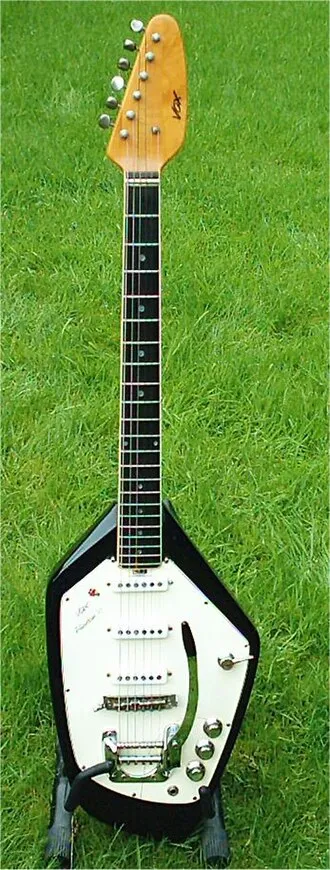
Photo: LittleRoughRhinestone / Wikimedia Commons / Public domain Vox
Phantom
1962
No Fenders in Britain, so Vox built a Strat in a five-sided coat you could spot from the back of the hall.