Guild
Starfire
Before they were the Grateful Dead, they were the Warlocks, and Jerry Garcia was playing a Guild Starfire.
California. Jerry Garcia’s band is still called the Warlocks, and hardly anybody outside the Bay Area has heard of them. The guitar in his hands isn’t a Les Paul yet. It’s a thin, hollow, single-cutaway Guild Starfire III, made across the river from Manhattan in Hoboken.
- Introduced
- 1960
- Type
- Thinline hollow / semi-hollow electric
- Class
- Production
The short version
1960
Three Starfires
Guild launches the I, II, and III in Hoboken. Thin, fully hollow, one cutaway.
1962
Colors
Custom finishes join the usual cherry, and the back gets binding.
1963
Anti-Hum
Guild’s mini-humbuckers replace the DeArmond single-coils.
1967
The first Dead album
The Starfire III is on it. By late in the year, Garcia has moved to a Les Paul.
1970
Buddy Guy’s ad
Guild puts Buddy Guy in an ad with a double-cut Starfire IV.
1973
The original III ends
After Hoboken and then Westerly, the first run is over.
Side A
A1
The band before the name
Every famous band has a before. A different name, smaller rooms, and whatever guitars they could get. The Guild Starfire keeps turning up in that part of the story.
Guild was a young company then, known for archtops, working out of Hoboken, New Jersey. In 1960 it brought out a thin electric called the Starfire. It grew out of an earlier Guild thinline called the T-100 Slim Jim, and it came three ways. The Starfire I had one pickup. The II had two. The III had two pickups and a Guild-branded Bigsby vibrato.
All three were fully hollow, with a single pointed cutaway. People call it a semi-hollow, and they’re wrong. There’s no block of wood down the middle, like a Gibson ES-335 has. It’s closer to Gibson’s ES-125TD, a plain, thin hollowbody, than it is to a 335.
A2
Thin, hollow, and cherry
Most Starfires were cherry red. From 1962 you could order other colors, and the back got binding to match the front.
To my ear, being fully hollow is the whole personality: airy, woody, and quick to howl if you turn it up too far. The neck meets the body at the 14th fret, two frets earlier than on the Gibson, and the scale is a short 24¾ inches. It’s an easy guitar to pick up and play.
The earliest ones had DeArmond single-coil pickups with white faces. A Guild historian reckons there were “probably less than 150” of those. In 1963 Guild switched to its own Anti-Hum mini-humbuckers, and that’s the line collectors draw: DeArmond Starfires on one side, Anti-Hum Starfires on the other.
A3
Garage bands and warlocks
Mike Mitchell of the Kingsmen is known to have played a single-cut Starfire. That’s the band behind “Louie Louie,” which is about as garage as rock and roll gets. Dave Davies of the Kinks had one with a Bigsby. Just don’t credit it with “You Really Got Me.” That riff came out of a Harmony Meteor.
And then there’s Garcia. In the Warlocks and on the Grateful Dead’s first album, in 1967, he played a Starfire III. That’s early Dead, not the whole career.
The Starfire was there for the bar gigs. It was gone by the time the posters got good.
Flip the record · By the numbers
3
Starfires in 1960. The I had one pickup, the II had two, and the III added a Bigsby.
<150
Early Starfires with white-faced DeArmond pickups, by one Guild historian’s estimate.
14th
Fret where the neck meets the body. Gibson’s comparable ES-125TD joined at the 16th.
24¾
Scale length, in inches.
Side B
B1
The other Starfire
Around 1963 or 1964, depending who you ask, Guild added the Starfire IV, V, and VI. Those are a different guitar under the same name: two cutaways, and a full-length block of wood down the middle. That makes them the 335-style semi-hollows the originals weren’t.
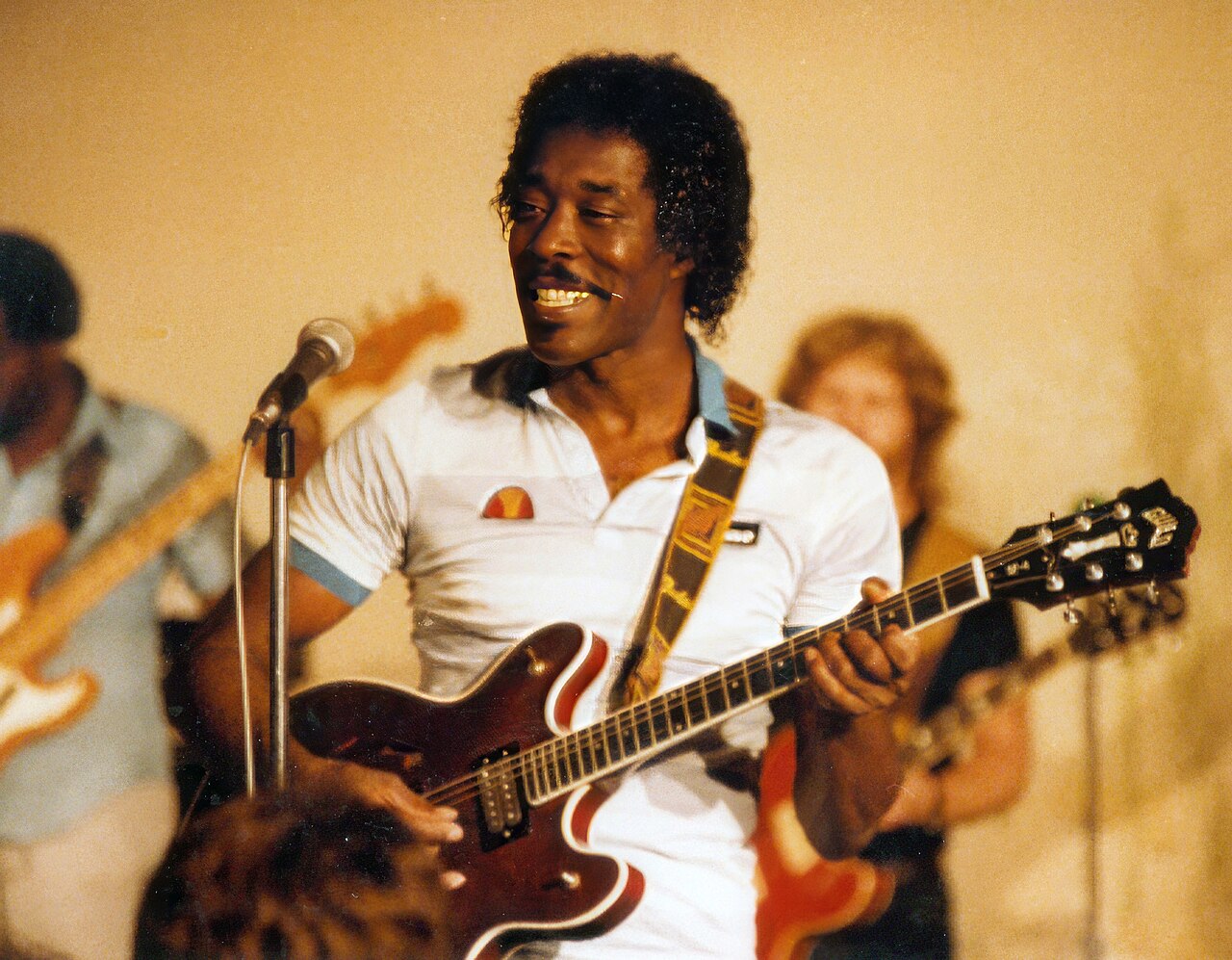
The double-cuts found their own crowd. In 1970 Guild ran an ad with Buddy Guy and a Starfire IV, and a 1982 catalog said the model had been “long preferred by Buddy Guy and Son Seals.” Feist has a 1965 IV. The cheaper Starfires in shops now are imported center-block models, which makes them cousins of the IV, not the 1960 hollow.
B2
Moving on
Guild moved to Westerly, Rhode Island, in 1967, and the original Starfire III kept going until 1973. It came back in the 1990s at Westerly, and again as a Korean-made hollow III from 2013 to 2021.
Garcia had moved on long before that. By late 1967 he was playing a Les Paul, and the Grateful Dead were on their way to being one of the most famous bands in America. The Starfire wasn’t in most of those pictures.
That was never its job. Its job was the Warlocks, a band in California that nobody had heard of yet, and a young guitarist who hadn’t made his name. Somebody has to play the guitar before the famous one. A lot of the time, it was a Starfire.
Put this on
You’ve read about it. Now hear it. Here’s what this guitar sounds like, and what to listen for.
The Grateful Dead
The band’s first album, with Garcia on his Starfire III, before he switched to a Les Paul.
Find it on YouTube (opens in a new tab)
The cast
The people, and the specific guitars, that made the legend.
1967
Jerry Garcia
Starfire III
With the Warlocks and on the first Grateful Dead album. Early Dead, not the whole career.
Mike Mitchell
Single-cut Starfire
The Kingsmen, the “Louie Louie” band. Known to play one.
Dave Davies
Starfire with a Bigsby
A Kinks Starfire, but not the “You Really Got Me” guitar. That was a Harmony Meteor.
1970
Buddy Guy
Starfire IV
The face of the double-cut, center-block Starfires. A different animal from the III.
Feist
1965 Starfire IV
A modern player on a vintage double-cut.
Liner notes
Specs, construction, rarity, value, and every source we used.
Fully hollow single-cut I–III from 1960 Hoboken — not a 335, not the IV–VI center-block doubles, not the current Korean Starfire I DC, not Davies’ Harmony Meteor, and not Duane Allman.
- Body
- Single Florentine cutaway thinline. Laminated maple or mahogany. Fully hollow — no center block. Bound front; bound back from 1962. VG&B table: 1 7/8" × 16 3/8" × 20 1/4". 1963 catalog: ~2" deep. F-holes.
- Neck
- 1-pc set mahogany. VG&B vs ES-125TD: join at 14th (Gibson at 16th).
- Fingerboard
- Rosewood; 20 frets; dots
- Scale
- 24 3/4"
- Pickups
- DeArmond single-coils 1960–63; Guild Anti-Hum mini-humbuckers from 1963
- Hardware
- Guild-branded Bigsby (VG&B: B-6)
- Electronics
- 2 volume, 2 tone, 3-way
- Finish
- Cherry typical; custom colors from 1962
Open the full research fileConstruction details, the complete player record, production numbers, dated value estimates, and sources
Vintage Starfire III (1960–73): two pickups + Guild Bigsby. I is one pickup + harp; II is two + harp. Current Starfire I DC/SC is a different 2020+ import semi, not 1960 I.
Construction
Hoboken, 1960 (VG&B, Guitar.com, MusicRadar). Guitar Gavel rounds to 1961 — flag it; do not pick 1961.
Evolved from the T-100 Slim Jim. Closer to a Gibson ES-125TD than to a 335. Do not call the family “a semi-hollow.”
I–III = fully hollow, single Florentine cutaway. I: one pickup, harp. II: two pickups, harp. III: two pickups + Guild Bigsby. Neck join I–III at the 14th (VG&B vs ES-125TD at 16th). About 1 7/8" × 16 3/8", 24 3/4", 20 frets, dots. Bound front; bound back from 1962. Staggered-edge pickguard 1965–66; volute from 1965 (RetroFret); Japanese tuners mid-1966. Original III 1960–1973 (VG&B).
Pickups: earliest white-face DeArmonds (Hans Moust: “probably less than 150” — book estimate, not factory ledger); then white-top Dynasonics; 1963 Anti-Hum mini-humbuckers. That 1963 change is the collector split inside the 1960s core.
IV–VI = center-block semi-hollow, double Venetian cutaway. VG&B / Vintage Guitar: 1963 (IV/V; VI 1964). Guitar World: “end of 1964.” Keep both. VG&B titles call IV a “hollow bodied electric” while describing a full-length maple center block — trust the block, not the heading. Double-cut neck join 16th through 1967, 18th after 1967; Newark St IV ST review joins at 16th.
Hoboken 1960–66 (Starfires); Westerly from 1967; original III through 1973. 1990s Westerly SF-III revival until the plant closed 2001. Newark St III (Korea, 2013–21, now EOL) was hollow. Current Starfire I DC/SC/Jet 90 = center-block import semis, ~$550–$700 street — not 1960s fully hollow. Current I DC: mahogany center block, HB-2, 22-fret, 18th-fret join.
Current typical catalog SKU is Starfire IV ST: arched maple, stopbar, 22 frets, Guild LB-1s. Guild.com fingerboard ebony; some dealers still say rosewood. Center-block species: Guild.com solid spruce vs MusicRadar Newark St IV ST maple — do not pick. Body depth: 1963 catalog ~2"; VG&B vintage 1 7/8"; current IV ST 1 3/4". Body length: vintage catalog 20 1/4"; current IV ST 18 1/4"; current I SC 20 1/4".
Not the Starfire 12-string. Not the Starfire bass.
Players
File by III vs IV/V. Do not dump 335 players here.
Jerry Garcia — Starfire III, Warlocks / debut Grateful Dead album. Early Dead, not the whole career (Les Paul from late 1967). Guitar Gavel’s two-guitar chronology is secondary. Garcia is a market factor, not a price for ordinary 1960s examples.
Dave Davies — Vintage Guitar August 2023: Guild Starfire + Bigsby. Guitar World files single-cut. Not “You Really Got Me.” That 1964 riff is a Harmony Meteor. The Kink Kontroversy cover as a 1963 III is a Hans Moust attribution, not independently re-verified here.
Mike Mitchell / Kingsmen “Louie, Louie” — Guitar World places a single-cut Starfire. Known-to-play.
Buddy Guy is the IV catalog face: 1970 Guitar Player ad, SF-IV; 1982 catalog “long preferred by Buddy Guy and Son Seals.” Guitar.com also groups him with Hopkins and Seals on the VI. Both double-cut; do not pick one as his only guitar. Do not assign “Damn Right, I’ve Got the Blues” without a citation. Guy is the IV–VI chapter, not I–III money.
Feist — 1965 IV. Glenn Tipton — 1982 catalog known-to-play, not a Priest identity guitar.
Duane Allman — no. Goldtop / Burst / SG. Do not merge Duane Eddy. Berry Oakley’s Starfire is a bass. Lennon’s Starfire XII is a 12-string relative, not this six-string identity.
Rarity
Factory I/II/III yearly totals unpublished. 1960s Hoboken I/II/III is the collectible core. Current I DC is common. 1990s Westerly SF-III is USA player value, not the 1960s object. Newark St III is a Korean reissue, now EOL. 1967–73 Westerly is still original-run. Moust “<150” white-face is a book estimate, not a ledger. 1960–62 DeArmond (especially III) is the early object; 1963–66 Hoboken Anti-Hum III is the common collectible 1960s Starfire. Custom colors from 1962: no public finish census; dealer talk says scarcer than cherry.
Value
Informal estimate, 25 August 2026. Not an appraisal.
Ask ≠ sold. 2024–26 public solds for 1960s Hoboken are thin. Do not price these as ES-335s. Do not fold IV–VI market into I/II/III. Garcia (and other artist lots) outside model ranges.
New / import player. Current Starfire I DC ~$550–$700 street (Sweetwater $649; Jet 90 $699.99; Liberty $549). Not 1960s hollow. Newark St Starfire III Korea 2013–21 EOL: Equipboard $999–$1,400; Reverb Canada solds C$880–C$1,470 VG/Excellent. Treat as CAD solds on the Korean reissue, not Hoboken. USD conversion not applied in this pass. 1990s Westerly SF-III asks ~$1,100–$2,000. Not 1960s Hoboken money.
1960s Hoboken III named asks (not solds): RetroFret 1966 $3,950; Watchtower 1966 Amber $3,995; Truetone 1964 $3,999.99; Carter 1961 II Rateliff (mods) $3,500 — do not use as clean-original DeArmond; Carter 1967 III $3,000; Sweetwater Gear Exchange 1965 refin $2,995. Working: clean original cherry ~$3,000–$4,000; modified/refin ~$1,600–$3,000. TGP early DeArmond “often $4k or more” is forum. No 2024–26 named public hammer. Moust “<150” white-face: no 2024–26 public sold. Do not invent a five-figure band.
Filters: fully hollow 1960s I/II/III vs Newark St semi I DC vs Westerly 1990s; Hoboken vs Westerly; DeArmond vs Anti-Hum; original Bigsby/tuners/finish; I vs II vs III.
See also
- gibson-es-335 — blocked double-cut cousin
- gibson-es-345 — stereo/Varitone 3x5 sibling
- epiphone-casino — fully hollow thinline, no 335 block
- guild-m-20 — all-mahogany concert acoustic; not this electric
Keep digging
Guitars this one gets compared to, confused with, or descended from.

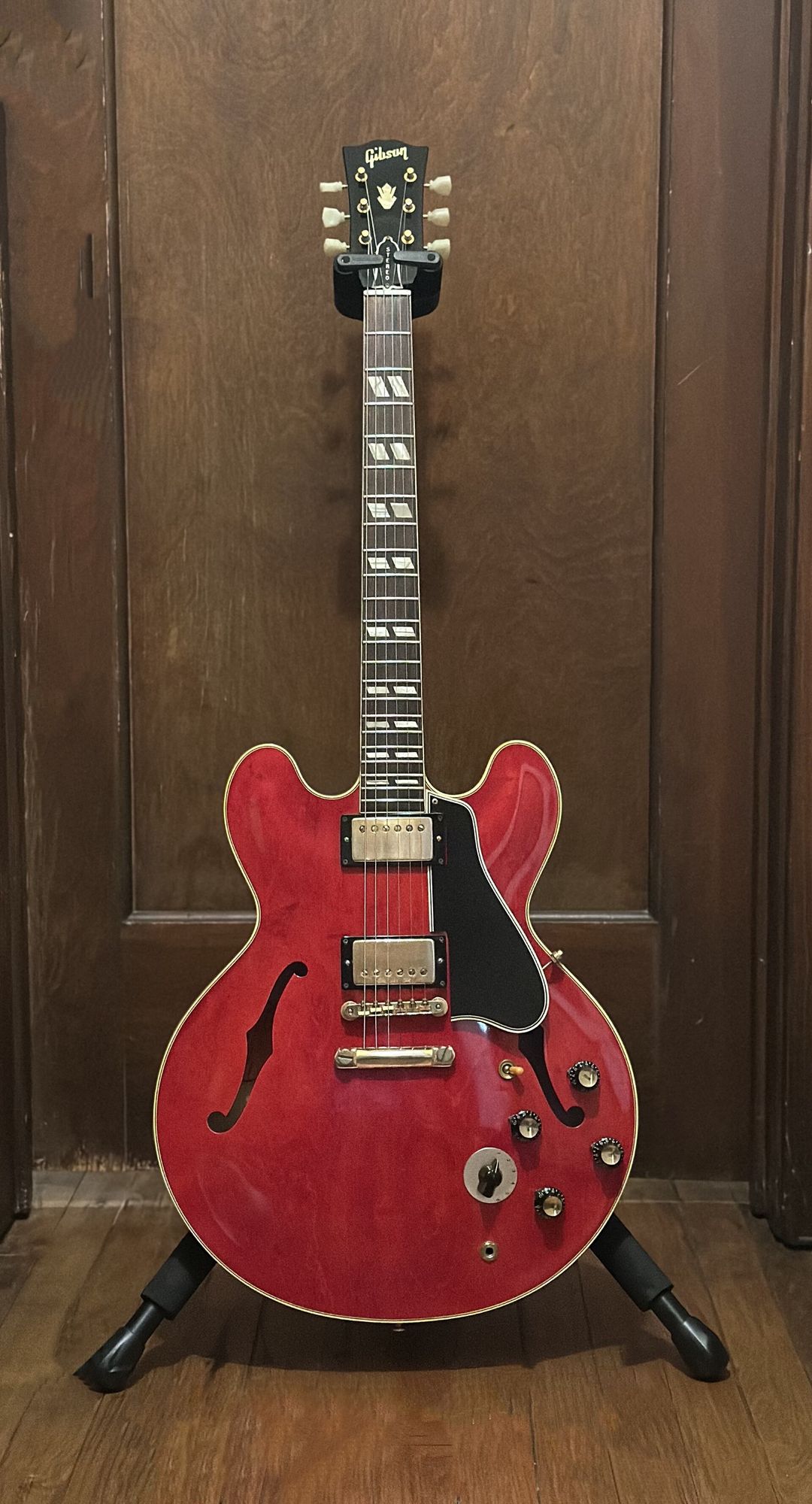
Photograph of a vintage 1960 Gibson ES-335TD. Photo by Lightburst. Licensed under CC BY-SA 4.0. Via Wikimedia Commons. Gibson
ES-335
1958
Larry Carlton played three 335s off a shop wall, unplugged, paid $850 for one, and became Mr. 335.
1960 Gibson ES-345TDC. Photo by Lightburst. Licensed under CC BY-SA 4.0. Via Wikimedia Commons. Gibson
ES-345
1959
Marty McFly plays one in 1955, four years before Gibson made it. Nobody in the theater minded.
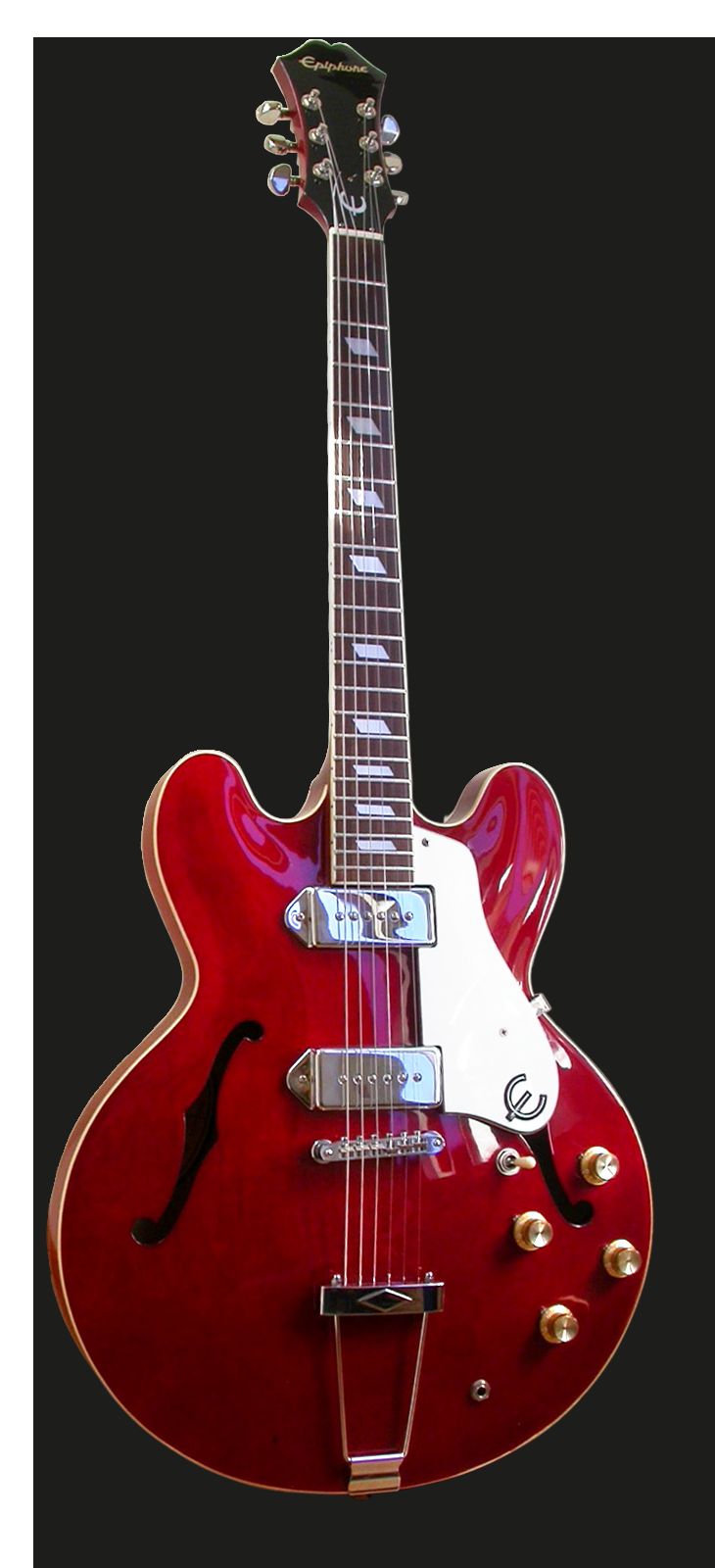
Epiphone Casino Cherry. Photo by Maxo; background removed by Auge=mit. Licensed under CC BY-SA 4.0. Via Wikimedia Commons. Epiphone
Casino
1961
Of all the Beatles’ famous guitars, the only one John, Paul, and George all had. Two sanded theirs bare.