Gibson
ES-345
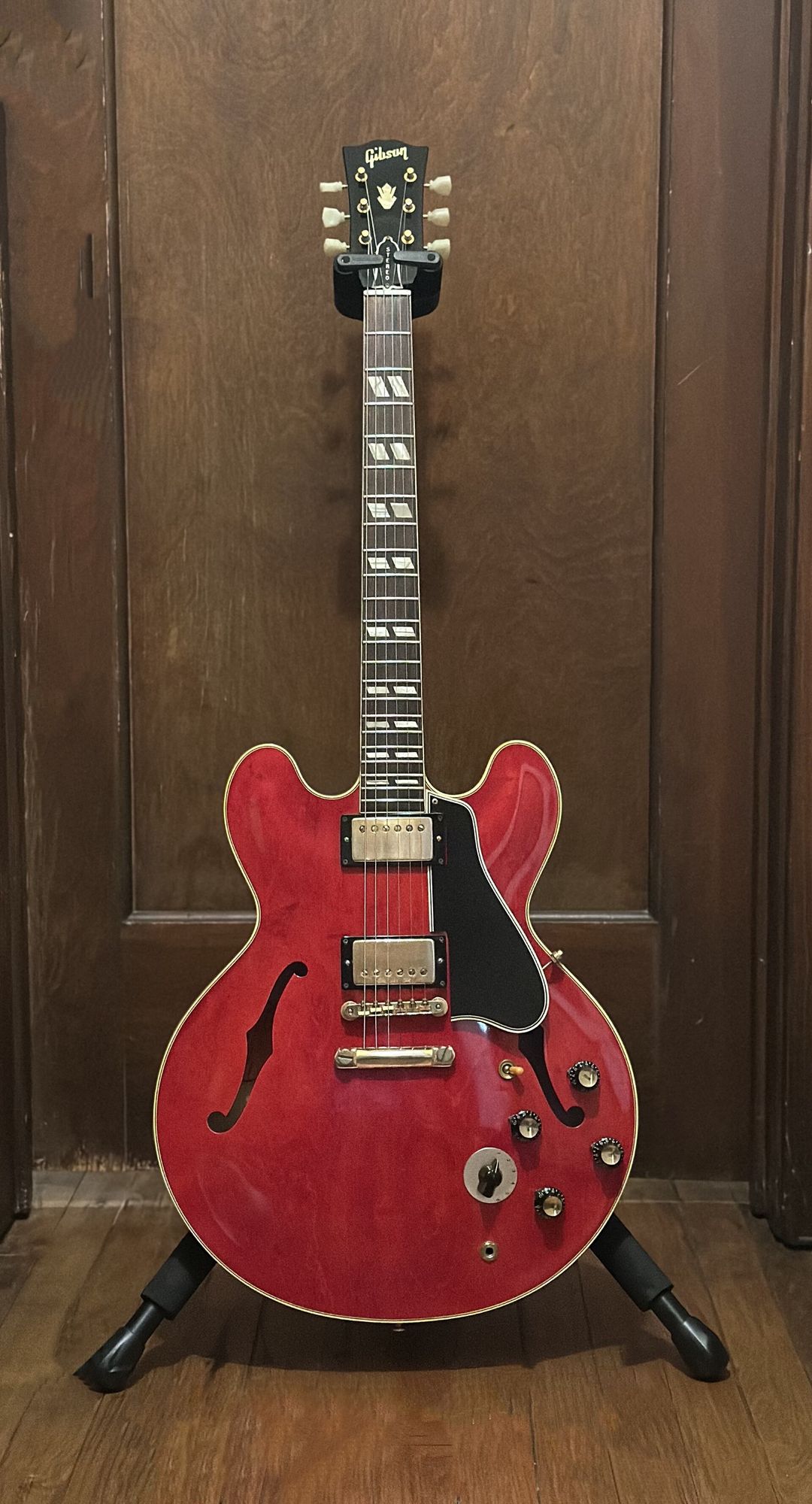
Marty McFly plays one in 1955, four years before Gibson made it. Nobody in the theater minded.
A high school dance in 1955, or a movie set built to look like one. Marty McFly steps up with a cherry Gibson ES-345 and tears into “Johnny B. Goode.” The guitar in his hands won’t exist for another four years. It’s 1985, and not one person in the audience cares.
- Introduced
- 1959
- Type
- Thinline semi-hollow electric
- Class
- Production
The short version
1959
Announced
Dealers read about the new ES-345T in the May/June Gibson Gazette. Stereo, Varitone, gold.
1960
Cherry arrives
By mid-year, a shorter pickguard, a gold ring on the Varitone, and a cherry finish.
1965
A Beatle and a trapeze
George Harrison plays a sunburst 345 in November promo films. Around now, trapeze tailpieces replace the stop bar.
1966
Full tilt
Freddie King on The !!!! Beat, playing a 345 as hard as it goes.
1972
In stereo
Steve Howe’s walnut 345 is his main electric on Close to the Edge, panned across the speakers.
1982
Discontinued
Gibson stops making the original.
1985
Hill Valley
A cherry 345 plays “Johnny B. Goode” in Back to the Future.
2025
Still missing
Forty years on, by Gibson’s account, the one from the film is still missing.
Side A
A1
Wrong year, right scene
The most famous ES-345 in the world was played by a kid who never existed, at a dance in a year when the guitar hadn’t been invented yet. It was the wrong guitar for 1955, and exactly the right one for the moment.
In Back to the Future, Marty McFly picks up a cherry 345 and plays “Johnny B. Goode” at the school dance. It’s a great scene, and it’s wrong in two ways. The 345 came out in 1959. And Chuck Berry’s early hits were made on an ES-350T, not a 345.
Nobody cared then, and nobody cares now. The kid had the right guitar for the scene, and that was that.
A2
Plain, deluxe, fanciest
In 1958 Gibson brought out the ES-335, a thin double-cutaway with a solid block of maple down the middle. It could get loud without feeding back. Then Gibson did what companies do and made a range of it.
One vintage dealer put the whole family in a single line:
335 plain, 345 deluxe stereo, 355 fanciest.
The 345 arrived in 1959. Same body, same center block, same humbuckers. What you paid extra for was gold hardware, fancier inlays shaped like split parallelograms, and two features that sound great on a spec sheet: stereo output and a knob called the Varitone.
A3
A guitar that wants two amps
Stereo sounds grander than it is. Each pickup gets its own channel, so with a special cable you can send the neck pickup to one amp and the bridge pickup to another. Great, if you own two amps.
The Varitone is a six-way rotary knob. Position one is off. The other five each cut out a different slice of the tone, so you get thinner, hollower, more nasal sounds, the kind of honk that’s great for a part and odd for a whole night.
Gibson pushed it, too. Stereo was technically optional, but nearly every original left the factory that way, and the hardware stayed gold for the whole vintage run. The first year, 478 went out the door with a long pickguard and a black ring around the Varitone. By the middle of 1960 the guard was shorter, the ring was gold, and you could get it in cherry.
A lot of owners never made peace with either feature. Converting a 345 to plain mono is extremely common, and Gibson’s own current ES-345 is mono with no Varitone at all. The fancy middle child has spent sixty-odd years being turned back into its plainer brother.
Flip the record · By the numbers
478
ES-345s shipped in 1959, the first year.
6
Positions on the Varitone knob. One is off; the other five carve out a slice of the tone.
50
Natural-finish 345s shipped, 32 in 1959 and 18 in 1960.
10,560
Shipped from 1959 through 1979. A middle child, but hardly a rare one.
Side B
B1
Full tilt
The people who kept them did good work. Freddie King played more than one. You can see him driving a 345 as hard as it will go on the TV show The !!!! Beat in 1966, and a 1968 model is on Getting Ready…, from 1971. That one later went to Leon Russell, and somebody ripped its Varitone out. (“Hide Away,” his big instrumental, was on a ’54 goldtop. People mix that up.)
George Harrison played a sunburst 345 in the Beatles’ promo films of 23 November 1965 and on the December tour of the UK. B.B. King played 345s too, though Lucille, the guitar with his name on it, is a 355.
And Steve Howe is the one who actually used the stereo. His walnut 345 was his main electric on Yes’s Close to the Edge, and he panned it around the mix the way the guitar was designed to do. The guitar itself is usually dated 1970, two years before the record. The use isn’t in doubt.
B2
Still missing
The ending is strange. The cherry 345 from Back to the Future came through Norman’s Rare Guitars, and it has a detail no other 345 has: a solid inlay at the 12th fret. As of August 2025, by Gibson’s own account, nobody knew where it was.
For the film’s 40th anniversary, Gibson also made an 88-piece run of 345s. You can guess why it was 88.
It’s a movie prop, and it turned up at a 1955 dance four years before Gibson built one. It’s also the 345 people would most like to find, forty years later. Somewhere out there is a guitar that was wrong for its year and right for its moment, and a lot of people would very much like it back.
Put this on
You’ve read about it. Now hear it. Here’s what this guitar sounds like, and what to listen for.
Back to the Future (“Johnny B. Goode” scene)
The cherry ES-345 with the one-off solid inlay at the 12th fret. Chuck Berry’s early hits were made on an ES-350T, not a 345. Wrong guitar, wrong year, great scene.
Watch it on YouTube (opens in a new tab)Close to the Edge
Steve Howe’s walnut 345 was his main electric on this album, and he used the stereo output to pan his guitar across the mix. Headphones help.
Find it on YouTube (opens in a new tab)Getting Ready…
A 1968 ES-345, the one he later sold to Leon Russell. (“Hide Away” is a different guitar, a ’54 goldtop.)
Find it on YouTube (opens in a new tab)
The cast
The people, and the specific guitars, that made the legend.
1966
Freddie King
More than one ES-345
A 345 at full tilt on The !!!! Beat, and a 1968 on Getting Ready…. Its Varitone was later stripped out.
1972
Steve Howe
Walnut ES-345
His main electric on Close to the Edge. The guitar is usually dated 1970. His lifelong guitar is an ES-175.
1965
George Harrison
Sunburst ES-345
In the 23 November 1965 promo films and on the December UK tour.
1960s
B.B. King
ES-345s, among others
He played 345s. Lucille, though, is built on the ES-355.
1985
Marty McFly
Cherry ES-345
“Johnny B. Goode” at the dance in Back to the Future. The guitar in Part II is a different one.
Liner notes
Specs, construction, rarity, value, and every source we used.
The 1959 stereo/Varitone middle of the 3x5 — split parallelograms from day one, never 1959–62 dots; not a 335, not Lucille.
- Body
- Double-cut thinline. 3-ply maple/poplar/maple top and back; maple centerblock; Adirondack spruce bracing. 3-ply cream binding. F-holes. Semi-hollow.
- Neck
- Set mahogany; Rounded C.
- Fingerboard
- Bound rosewood; 22 medium jumbo; acrylic split parallelograms; 12 in radius.
- Scale
- 24.75 in / 628.65 mm
- Pickups
- Calibrated T-Type Rhythm (neck) / T-Type Lead (bridge)
- Hardware
- Aluminum ABR-1 Tune-O-Matic; aluminum Stop Bar; Vintage Deluxe Keystone tuners; nickel default (gold on Ebony model). Black 5-ply pickguard. Black Top Hats with silver reflectors.
- Electronics
- 2 volume, 2 tone; 3-way toggle. Orange Drop capacitors. 1/4 in jack. No Varitone. No stereo.
- Finish
- Gloss nitrocellulose (Sixties Cherry)
- Nut
- Graph Tech, 43.05 mm / 1.7 in
Open the full research fileConstruction details, the complete player record, production numbers, dated value estimates, and sources
Current USA ES-345, Sixties Cherry, model ES4500SCNH1. This SKU is the simplified mono guitar, not the 1959 stereo/Varitone identity. Sheet body shape “ES-335” is mold language, not a collapse.
Construction
Kalamazoo, 1959 — not 1958. The 335 arrived spring 1958; a handful of 355s shipped that year. Dealers got the ES-345T in the May/June 1959 Gibson Gazette. Do not call original 345s 1958 models.
Same architecture as the 335: laminated thinline, maple center block, hollow wings. Not an ES-330 (fully hollow, no block). Joe’s: “335 plain, 345 deluxe stereo, 355 fanciest.” Vintage identity: stereo + six-position Varitone + gold + split parallelograms. 335 = mono, nickel, dots then blocks. 355 = bound ebony, block inlays, split-diamond headstock. Lucille lives on the 355.
Each pickup to its own channel via stereo jack and Y-cable / TRS. Varitone: position 1 bypass, 2–6 notches (Joe’s). guitarhq: stereo optional. Joe’s / True Vintage: nearly always stereo; rare custom-order monos exist. Gold PAFs earliest; patent-number ~1962–63, mixed. Joe’s: gold PAF stock may lag nickel 335s. Patent No. 2,737,842 is Gibson’s bridge patent; mid-1960s T-Tops wear the same sticker. Do not date a 345 by the sticker alone.
Gold ABR-1; stop or Bigsby typical. Gold for the entire vintage run (Joe’s) — nickel on a vintage 345 is a replacement, not a 1965 335-style change. Sideways Vibrola is a ~1961–63 option, not stock. Trapeze ~1965 (guitarhq / Joe’s) vs 1964 (wiki) — mix year, not a 1 January cut. Neck join 19th (guitarhq) vs 20th (1970 catalog).
1959: long guard, black Varitone ring, sunburst/natural, PAF, stop or Bigsby. Mid-1960: short guard, gold ring, cherry. Rounded horns 1959–~1963, then pointed. 1969: walnut. Discontinued 1982 (guitarhq).
Current USA 2026: mono, no Varitone, nickel-default, T-Type. No live Historic 1959 stereo/Varitone catalog SKU this pass.
Players
Carlton’s 1969, Alvin Lee’s Big Red, and Clapton’s 1964 cherry Cream guitar live on the 335 page. Vintage Guitar “Thinkin’ Thin” wrongly puts Lee on a 345 — do not follow. Lifeson’s later semi is more often a 355.
Freddie King. Hide Away / San-Ho-Zay = ’54 goldtop. Mid-60s: The !!!! Beat 1966, a 345 at full tilt. Vintage Guitar: a 1968 ES-345 on Getting Ready (1971), later sold to Leon Russell; Varitone subsequently stripped. More than one 345. Do not put Hide Away on a 345.
Steve Howe — walnut/brown ES-345 on Close to the Edge (1972). Guitar World: main electric; stereo panning. Premier Guitar: 1970 instrument. Instrument year vs album year: flag; use is not in doubt. Lifelong named electric is the ES-175. Fragile is Switchmaster.
Marty McFly — cherry ES-345, Back to the Future (1985). Norman’s Rare Guitars. Unique solid 12th-fret inlay. Still missing as of Gibson August 2025. Film prop, anachronistic for 1955. Part II is a different guitar. Not Berry’s “Johnny B. Goode” guitar.
Chuck Berry. Earliest hits = ES-350T. Do not specify 345 on “Johnny B. Goode.”
B.B. King played 345s. Lucille is ES-355-based. Do not file Lucille here.
George Harrison — sunburst 345, 23 November 1965 promo films and the December 1965 UK tour (Babiuk). Not known on Beatles studio this pass.
Bob Weir — 335 vs 345 unresolved. Known-to-play; do not steal 335 stories.
Rarity
Current USA is Nashville Original Collection, not a vintage stereo clone. 1980–2001 and Memphis/Nashville yearly counts unpublished.
Meiners factory shipping: 1959–69 = 5,839. 1959–79 total 10,560 (VGAB / Joe’s / wiki, same series). First year 478. Peak 1967: 1,144, then 1968: 938. 1963 decade low 278. 1975 trough 128.
1959–62 PAF / stop-bar cohort: 1,702. Natural 50 (32 in 1959, 18 in 1960) — 0.5% of 10,560. No 1959–62 dots on a 345. Split parallelograms from 1959. Dot-vs-block is a 335 fork. The 345 analogue is 1959–62 PAF / stop / rounded horns vs later patent / trapeze / pointed horns.
Stop-bar 1959–early 1965; trapeze ~1965 mix year (wiki 1964 looser). Factory Bigsby from the start. Stereo original vs mono conversion is extremely common; original stereo worth more.
The 2025 Back to the Future 88-piece is hype/anniversary, not a vintage-value reference (Joe’s: one-off ~$40,000).
Value
Informal estimate, 25 August 2026. Not an appraisal.
Label asks vs solds. Charlie Gelber (27 Mar 2025): asking prices ran ahead of solds through 2024.
New street. Original Collection ES-345 $3,799 (gibson.com, Aug 2026).
Used Memphis / 2000s. Thin 2024–26 US solds; high-$1,000s to low-$3,000s in older dealer solds.
1970s Norlin, player. Joe’s ask $4,500–$9,000; working ask ~$4,500–$8,000.
Custom Shop. 2026 Limited Collection 1959 Heavy Aged Ebony + Bigsby dealer ask $8,999. Joe’s Historic street ~$5,000–$9,000. Not vintage comps.
1962–64 stop-bar. Joe’s / Edgewater ask $12,000–$22,000. 1966–69 Joe’s ask $7,000–$12,000.
Top 1959–61 PAF stop-bar. Joe’s July 2026 asks: 1959 sunburst ~$22,000–$45,000+; 1959 natural ~$45,000–$75,000+; 1960–61 ~$18,000–$32,000. Edgewater dealer-comp 1959–62 $20,000–$40,000.
Named solds. Gelber first-rack 1959, 9/10, sold $37,000 (2022 year-ender). Gelber 2025: a 1960/61 listed ~$29k, sat, sold a few thousand less off Reverb. Gardiner Houlgate sold £3,600 (2 Dec 2025) for a circa-1964 with a wrecked neck — condition floor, not a market print.
Working sold-direction for clean PAF stop-bar 1959–61: high teens to mid-$30ks, first-rack/natural above. $40k–$80k Reverb asks exist and are sitting. A same-year ES-335 usually outvalues the fancier 345 (Joe’s: maybe half to two-thirds of a late-50s/early-60s 335). McFly missing cherry, artist lots, and the BTTF 88 are not comps for ordinary 345s. Mono conversion −10–25% (Joe’s) to −20–30% (Edgewater) if reversible.
See also
- gibson-es-335 — the plain mono sibling; Big Red and Carlton live there; the 345 did not wear 1959–62 dots
- gibson-es-175 — Howe’s lifelong named electric; Close to the Edge is the 345
Sources
- Gibson ES-345 Sixties Cherry
- Vintage Guitar and Bass: May/June 1959 Gibson Gazette (ES-345T)
- Vintage Guitar and Bass: ES-345TD
- Vintage Guitar and Bass: 1970 thinline catalog ES-345TD
- guitarhq: ES-345
- guitarhq: ES-335 / 345 / 355 intro lines
- guitarhq: hollowbody shipping 1955–69
- Joe’s Vintage Guitars: ES-345 history/value
- Joe’s Vintage Guitars: Gibson shipping totals 1948–1979
- True Vintage: 1959 ES-345 (nearly always stereo)
- Edgewater Guitars: 2026 vintage Gibson value guide
- Charlie Gelber, es-335.com, 27 Mar 2025 (Year Ender Special Edition)
- Charlie Gelber, es-335.com, Year Ender 2022 Part 2 (first-rack sold $37,000)
- Gardiner Houlgate: circa-1964 ES-345 TD sold £3,600 (2 Dec 2025)
- Vintage Guitar: Thinkin’ Thin
- Vintage Guitar: Freddie King’s Gibson ES-345
- Guitar World: Steve Howe on Close to the Edge / ES-345 stereo
- Premier Guitar: Rig Rundown — Howe 1970 ES-345
- Reverb: Norman Harris / Norman’s Rare Guitars — BTTF ES-345
- Guitar World: missing BTTF ES-345 (6 Aug 2025)
- Gibson Gazette: BTTF 40th / 88-piece ES-345
- Andy Babiuk’s Fab Gear: Beatles Gear Ultimate Edition
Keep digging
Guitars this one gets compared to, confused with, or descended from.

Photograph of a vintage 1960 Gibson ES-335TD. Photo by Lightburst. Licensed under CC BY-SA 4.0. Via Wikimedia Commons. Gibson
ES-335
1958
Larry Carlton played three 335s off a shop wall, unplugged, paid $850 for one, and became Mr. 335.
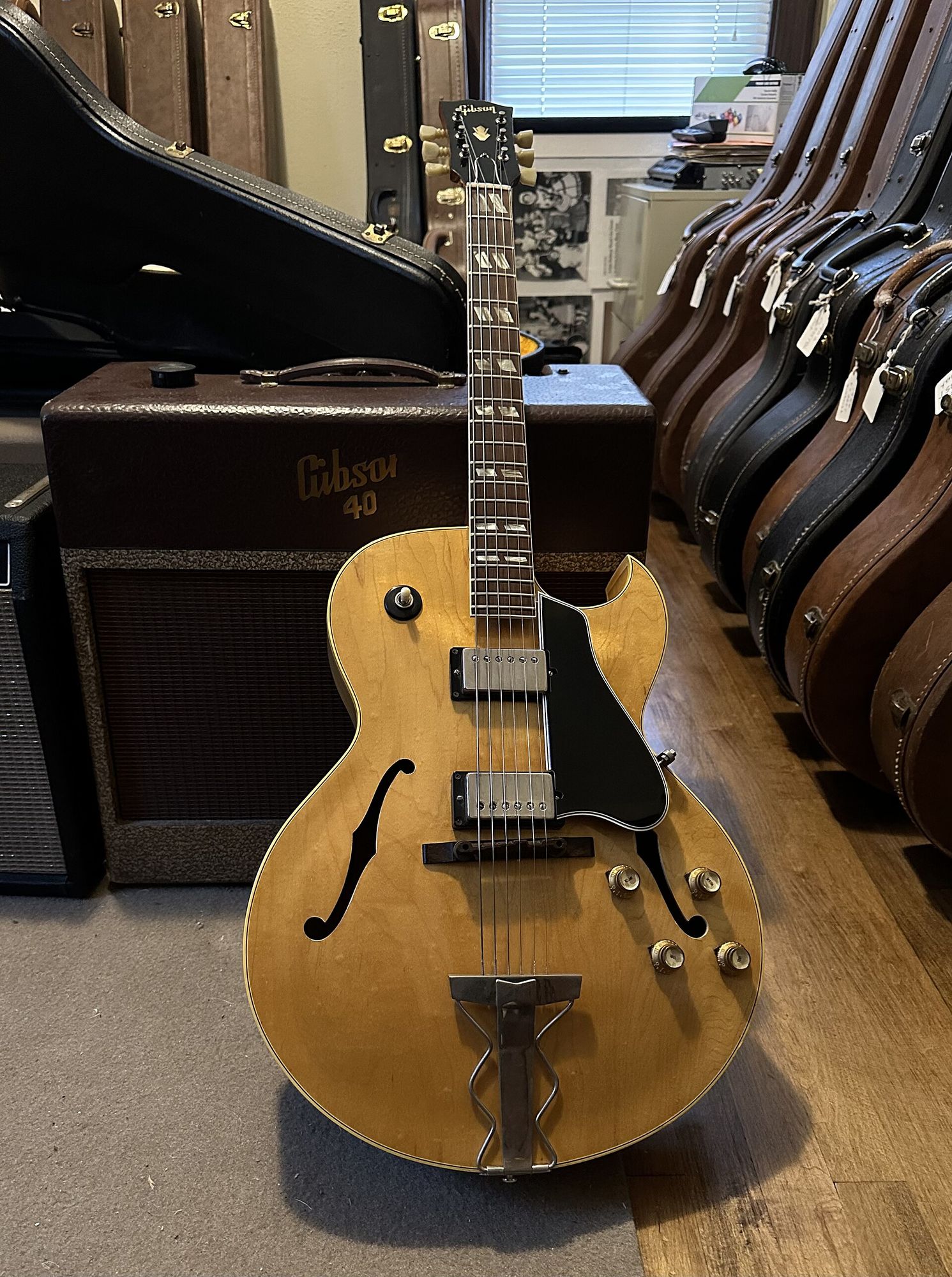
1963 Gibson ES-175DN. Photo by Lightburst. Licensed under CC BY-SA 4.0. Via Wikimedia Commons. Gibson
ES-175
1949
A laminated jazz box that kept changing hands: bought used, given as a gift, borrowed for a hit.