Guild
M-20
Guild’s plainest guitar trained a new factory’s workers, then ended up on the cover of a Nick Drake album.
1970. Nick Drake’s *Bryter Layter* comes out, and there in the cover photograph is a small, plain, all-mahogany Guild. It was Guild’s economy model. Whether it’s actually on the record is another question.
- Introduced
- 1958
- Type
- Flat-top steel-string acoustic
- Class
- Production
Have a photograph of this guitar? Send a picture
The short version
1956
The small body arrives
The spruce-top F-20 Troubador, 13¾ inches across.
1958
The Economy M-20
Same body, all mahogany, no binding. Around 1958.
1963
The lowest-price Guild
That’s how the catalog describes it.
1967
First off the line
In August, M-20s are the first guitars off the line at Guild’s new Westerly factory.
1970
Bryter Layter
Nick Drake’s second album, with an M-20 on the cover.
2016
First again
The M-20 and D-20 are the first American acoustics out of Guild’s new Oxnard shop.
Side A
A1
The cheapest one on the wall
When you’re starting something new and it might go wrong, you don’t start with the fancy model. You start with the plain one. Guild has done that with this guitar twice.
Back in 1956, Guild made a small flat-top called the F-20 Troubador, 13¾ inches across, with a spruce top. Around 1958 it added an all-mahogany version: mahogany top, back, and sides, no binding, plain dots on a rosewood fingerboard. Guild called it the Economy M-20. By the 1963 catalog, it was the “lowest-price Guild.”
Cheap didn’t mean cut corners on the wood. It was solid mahogany all over. The early ones even had a Gibson-style headstock, until Guild’s own peaked shape took over in 1962.
Guild’s own website starts the M-20 in 1967, at the Westerly factory. That’s the factory talking. The guitar had been around for the better part of a decade by then.
A2
Small, dark, and quiet
To my ear, an all-mahogany guitar is warmer and drier than a spruce top, more corner of the room than front of the stage. Add a short 24¾-inch scale and a body you can wrap your arm all the way around, and it’s a guitar that likes fingerpicking.
It’s the guitar you pick up at the end of the night, not the one you use to fill a hall.
A3
Training wheels for a factory
In 1966 a company called Avnet bought Guild, and in 1967 it opened a new factory in Westerly, Rhode Island. A factory full of new workers needed a first guitar to build, and in August 1967 it was the M-20, alongside a classical called the Mark I. Guild historian Hans Moust calls it
the logical choice [with which] to train the new employees.
Think about that. The first people to build Guilds in Westerly, a factory that ran for more than thirty years, learned the job on this plain little mahogany guitar. It also explains why Westerly M-20s vary so much. The workers were still learning.
The earlier Hoboken ones are harder to find than the Westerly ones. Neither is rare, exactly. They were built to be cheap, and they were.
Flip the record · By the numbers
13¾
Inches across the lower bout. Guild called this size a concert.
24¾
Scale length in inches. Shorter than a dreadnought’s, so the strings feel slinkier.
$1,299
Street price when the Oxnard M-20 launched in 2016.
Side B
B1
The guitar in the picture
In 1970, Nick Drake put out Bryter Layter, and an M-20 is in the cover photograph. That’s where most people meet this guitar. Guild’s own shop still uses the album’s name for it.
But nobody can say for sure that Drake played it on the album. One review put it gently: “there seems to be some discussion as to whether he used it on the album itself.” Robert Kirby, who arranged Drake’s strings, said: “I only remember a Martin D28 and his Spanish guitar,” and then, fairly, “that is not to say he did not have others.”
So it’s a cover guitar. That’s enough. For a lot of people, it’s the Nick Drake guitar because of one photograph.
B2
First through the door again
The original M-20 ran into the early 1970s. Then Guild went through a long run of owners and factories: Fender bought it in 1995, and production moved around the country until the Connecticut plant closed in 2014.
Cordoba took over and set up shop in Oxnard, California. They shipped the old machines west and put Ren Ferguson on the line. At NAMM in 2016, the first American acoustics out of that new shop were the M-20 and its mahogany dreadnought sibling, the D-20. Street price for the M-20 then was $1,299.
The new one has a wider nut, a satin finish, and scalloped bracing, and it still has no binding. Almost fifty years apart, Guild opened two new factories, and both times the first guitar through the door was the plain little mahogany one.
The cast
The people, and the specific guitars, that made the legend.
1970
Nick Drake
M-20
Photographed with one for the Bryter Layter cover. The session guitars are another matter.
1970
Robert Kirby
Witness
Drake’s arranger. He remembered a Martin D-28 and a Spanish guitar on the records, and said Drake may have had others.
1967
Hans Moust
Guild historian
Tells the story of the M-20 as the guitar Westerly’s new workers learned on.
2016
Ren Ferguson
Oxnard
On the line when Guild restarted American production in California with the M-20.
Liner notes
Specs, construction, rarity, value, and every source we used.
All-mahogany concert, no binding — Guild’s M-20, the Bryter Layter cover guitar, not a Starfire hollow electric.
- Body
- Concert (M). Solid African mahogany top, back, and sides; unbound. Scalloped X. ABS rings. Lower bout 13 3/4" (350 mm); upper 10 1/8" (257 mm); length 18" (457 mm); depth 3 1/4" / 4 1/8" (83 / 105 mm). Soundhole 3 11/16" (93 mm).
- Neck
- Mahogany, C; mortise and tenon (Guitar.com). Thickness 21 mm / 22.5 mm at 1st / 9th. Dual-action truss.
- Fingerboard
- Indian rosewood, 12" (305 mm), pearloid dots at 3, 5, 7, 9, 12 (×2), 15; 20 Jescar 43080; join at 14th
- Scale
- 24 3/4" (629 mm). MusicRadar / Guitar.com: 628 mm / 24.75". Mix flagged.
- Pickups
- None on this table. M-20E: LR Baggs Element VTC, volume and tone in the soundhole.
- Hardware
- Indian rosewood bridge, 2 1/4" (57 mm) spacing; compensated bone saddle; ivory-colored pins; Guild Vintage Open Gear with cream buttons; tortoiseshell pickguard; Guild Peak headstock inlay
- Electronics
- None (M-20). M-20E: master volume and tone.
- Finish
- Satin nitrocellulose lacquer; Natural or Vintage Sunburst
- Nut
- Bone, 1 3/4" (44.5 mm)
Open the full research fileConstruction details, the complete player record, production numbers, dated value estimates, and sources
Current typical = Guild USA M-20 (Oxnard; guildguitars.com M-20 Natural SKU 99-744-0160, fetched 1 September 2026). M-20E is the Baggs sibling on this plate, not a second slug. Westerly Collection M-120 / M-240E are import concerts, not this table. Factory sheet prints inches and millimetres together — mix flagged; no extra millimetres invented. Vintage Hoboken/Westerly: 1963 catalog 13.75" × 18" × 4.125", 24 3/4", often 1 5/8" nut (Gbase / guitar-list). RetroFret on a 1965–66 Hoboken (AH-1655): 13 1/2" lower bout, 24 1/2" scale, 1 11/16" nut. Keep the splits.
Construction
Hoboken, folk-boom Guild. The job was a cheap concert that was still all solid wood: mahogany top, back, and sides, no binding, dots, a rosewood board. Not a dreadnought. Not a Starfire.
Intro year is a catalog fight. MusicRadar (Dave Mead): the all-mahogany “Economy” M-20 “appeared around 1958,” after the 13.75-inch spruce-top F-20 Troubador (1956) and after F-20 / F-30 backs and sides had gone mahogany by 1959. Gbase and Reverb’s GAD-M20 copy: introduced as the Economy M-20 in 1958. Guild’s living copy starts in 1967, first guitar off the Westerly, Rhode Island line. Guitar.com’s 2017 review rounds that into “Guild made the first ones in 1967.” Keep 1958. Westerly is a factory move, not an invention.
F-20 is the spruce-top sibling on the same concert, not this slug. M-30 Del Rio is a larger all-mahogany. Starfire is the hollow / semi-hollow electric from 1960. Same badge. Different object.
1963 catalog (guitar-list): “lowest-price Guild,” Honduras mahogany 13.75" × 18" × 4.125", adjustable-rod mahogany neck, rosewood board, pearl dots. Headstock: old Gibson-style peghead 1958–61, Guild peak from 1962. Do not hang a Gibson SKU on that sentence.
Avnet bought Guild in 1966 (Music Museum of New England). Westerly opened 1967. MusicRadar, quoting Hans Moust: the M-20 was first off that line in August, paired with the Mark I classical — “the logical choice [with which] to train the new employees.” Moust on Let’s Talk Guild: first Westerly production M-20 shipped August 1967. AH-prefix serials straddle the move; they date a guitar, they don’t count a year. Dronge died 3 May 1972 (Guitar.com). guitar-list closes the original run 1958–1973. No factory ledger here.
Fender bought Guild in 1995 (Guitar.com). California kits, Tacoma, New Hartford. Plant closed 2014. Cordoba opened Oxnard, shipped the old machines west, and put Ren Ferguson on the line. NAMM 2016: M-20 and D-20 were the first USA acoustics out of that shop. Street then $1,299 (dshowmusic) — historical list, not 2026. The living guitar is that Oxnard concert: unbound African mahogany, scalloped X, satin nitro, 24 3/4", 1 3/4" bone nut, Peak inlay, humidified case. M-20E adds the Baggs. Current footer: Yamaha Guitar Group, 2026.
Classic vs current: Hoboken/Westerly Economy — often 1 5/8" or 1 11/16" nut, thinner finish on mid-60s Hoboken (RetroFret) — against the USA M-20 at 1 3/4" and factory millimetres. Same silhouette. Not the same nut. D-20 is the mahogany dreadnought that launched beside it. M-120 is the import concert on this name.
Players
Nick Drake. The photograph is the fact. Guild, MusicRadar, Guitar.com, and RetroFret put an M-20 on the cover of Bryter Layter. MusicRadar: “there seems to be some discussion as to whether he used it on the album itself.” Do not flatten the cover into a session guitar.
Robert Kirby, nickdrake.com Q&A (archived 2007): “I only remember a Martin D28 and his Spanish guitar — that is not to say he did not have others.” Kirby on the records, not a denial of the photograph. Joe Boyd’s White Bicycles is technique, not a model. RetroFret: Drake is “linked to this model in the popular imagination due to an album cover photo.” Keep it as a cover.
Do not steal Starfire players. Do not hang a D-40, F-50, or F-20 on this plate because the badge is Guild.
Rarity
Current USA M-20 / M-20E is regular Oxnard production. Guild does not publish M-20 unit totals. None invented.
Vintage M-20s were the cheap concert. RetroFret: not rare per se, more sought-after than the old list price; a 1965–66 Hoboken is “rarer than the more typically encountered late 1960’s/early ’70’s models made in Westerly.” Dealer contrast, not a census. Moust’s 1967 training-guitar story explains variation. It does not give a count.
M-120 and M-240E are other factories on a concert silhouette. GAD-M20 was an import on this name. The Bryter Layter cover guitar is one object. It is not a vintage M-20.
Value
Informal estimate, 1 September 2026. Not an appraisal.
Ask vs sold labeled. Celebrity lots are not-comps. No invented medians or factory counts.
New street. Guild shop M-20 Series $1,599.99–$1,699.99. Guitar Center Natural $1,699.99. Sweetwater Natural $1,699.99; Vintage Sunburst $1,799.99 (new; Gear Exchange used ask $1,500.00 this pass). Music Store Live Vintage Sunburst $1,799.99. 2016 launch street $1,299 (dshowmusic) is not a 2026 cart. Guitar.com 2017 review £1,585 — dated 2017.
Used modern. Reverb Price Guide, Guild USA M-20: $850–$1,306 based on 218 orders Good to Mint (all models on that product page) — labeled estimate, not a 2026 sold median computed here. Named sold on that tape this pass: 17 August 2026 Very Good $1,149.85; 28 July Excellent $1,149.95; 25 June Very Good $1,075; 29 March Excellent $1,400. Sweetwater Gear Exchange Price Advisor, Vintage Sunburst: $1,170.00–$1,386.00.
Vintage / collectible. Reverb Price Guide widget on M-20 Economy did not print a clean USD band this pass. No invented midpoint. Named historical asks, not 2026 hammers: 1958 first-year Excellent (LA Guitar Shop, listed years ago) $2,000; 1959 Natural Satin Excellent $1,550. RetroFret’s 1965–66 Hoboken is sold; the page does not print the hammer here. The cover guitar is a celebrity object, not a street tape.
See also
- guild-starfire — 1960 Hoboken hollow / semi-hollow electric; not this acoustic
- gibson-l-00 — small-body Depression flat-top; not a Guild, not a concert M
- martin-000-18 — mahogany auditorium; not an M-20
Sources
- Guild, M-20 Natural — USA concert spec; SKU 99-744-0160; M-20E Baggs; mixed inch/mm
- Guild, M-20 Vintage Sunburst — Natural / VSB / M-20E; Westerly-first 1967 copy
- Guild shop, M-20 Series — $1,599.99–$1,699.99; all-mahogany concert; Bryter Layter nickname
- MusicRadar, Dave Mead, Guild M-20 review — Economy ~1958; F-20 1956; Westerly August 1967; Moust training quote; Bryter Layter recording debate; 305 mm / 12"
- Guitar.com, Huw Price, M-20 & D-20 — 13 February 2017; Oxnard / Ferguson; mortise and tenon; £1,585; 628 mm / 24.75"; 44.5 mm nut
- RetroFret, Guild M-20 1965–6 — Hoboken AH-1655; least expensive 1950s–60s; cover-photo link; 13 1/2" / 24 1/2" / 1 11/16"; Westerly more typical
- Gbase, 1965 Guild M-20 — Economy M-20 1958; 1 5/8" nut; 24 3/4"; Hoboken vs Westerly 1966
- dshowmusic, USA M-20 and D-20 launch — 6 January 2016; street $1299; Ferguson; NAMM
- Guitar.com, A Brief History of Guild — Dronge 3 May 1972
- Music Museum of New England, Guild — Avnet 1966; Westerly 1967
- Let’s Talk Guild, Hans Moust on Westerly M-20s — Westerly started 1967 with M-20s; AH prefix; first Westerly production M-20 August 1967
- Robert Kirby Q&A, nickdrake.com (archived) — D-28 and Spanish guitar
- Sweetwater, M-20 Natural — $1,699.99
- Sweetwater, M-20 Vintage Sunburst — $1,799.99
- Sweetwater Gear Exchange, M-20 VSB Price Advisor — used $1,170–$1,386; listing ask $1,500
- Guitar Center, M-20 Natural — $1,699.99
- Reverb Price Guide, Guild USA M-20 — $850–$1,306, 218 orders; named 2026 solds
- Reverb, GAD-M20 — Economy M-20 1958; Bryter Layter 1970
- guitar-list, Guild M-20 — 1958–1973; 1963 catalog 13.75" × 18" × 4.125"; headstock 1958–61 vs 1962
Keep digging
Guitars this one gets compared to, confused with, or descended from.
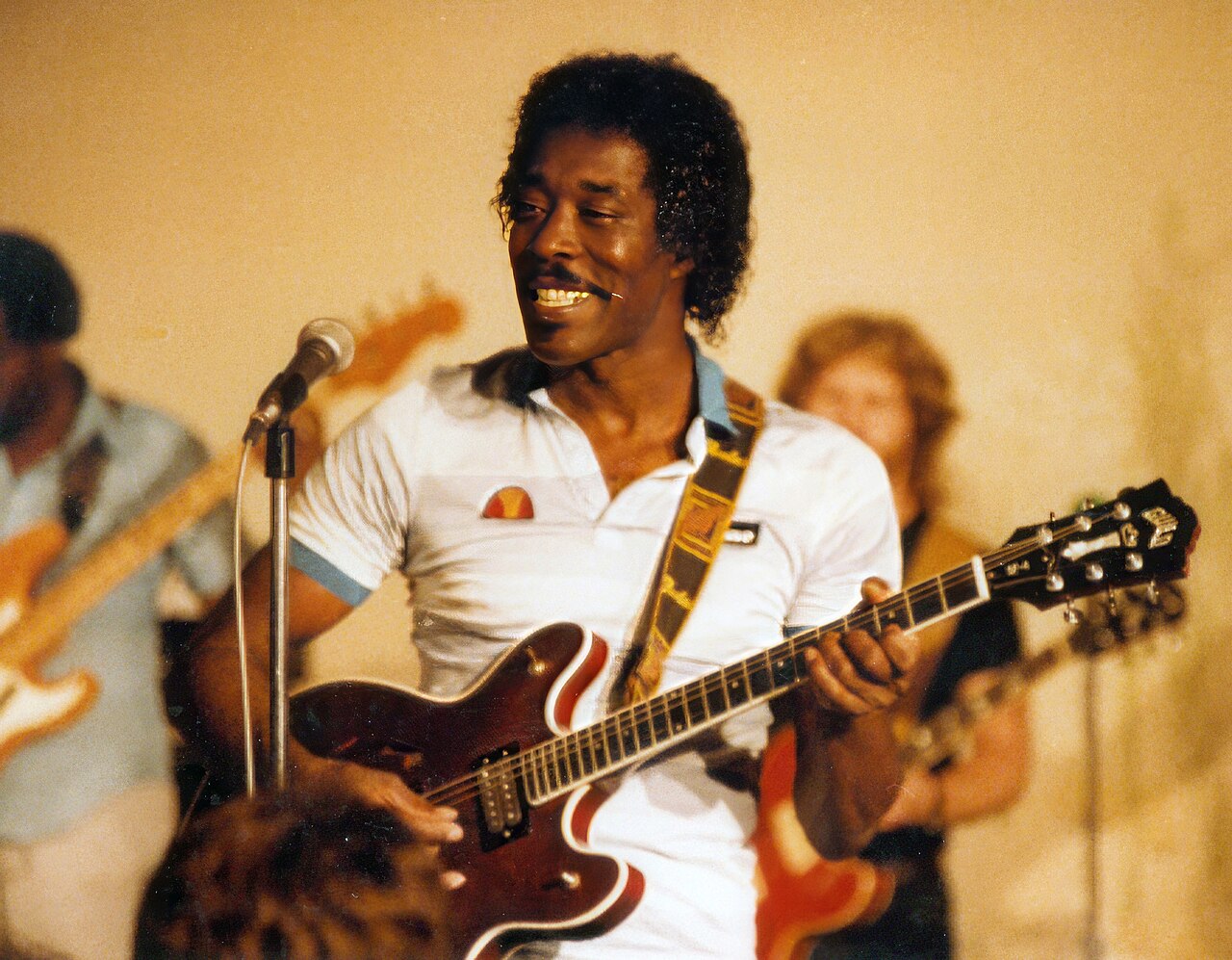
Photo: Bubba73 / Wikimedia Commons / CC BY-SA 3.0 Guild
Starfire
1960
Before they were the Grateful Dead, they were the Warlocks, and Jerry Garcia was playing a Guild Starfire.
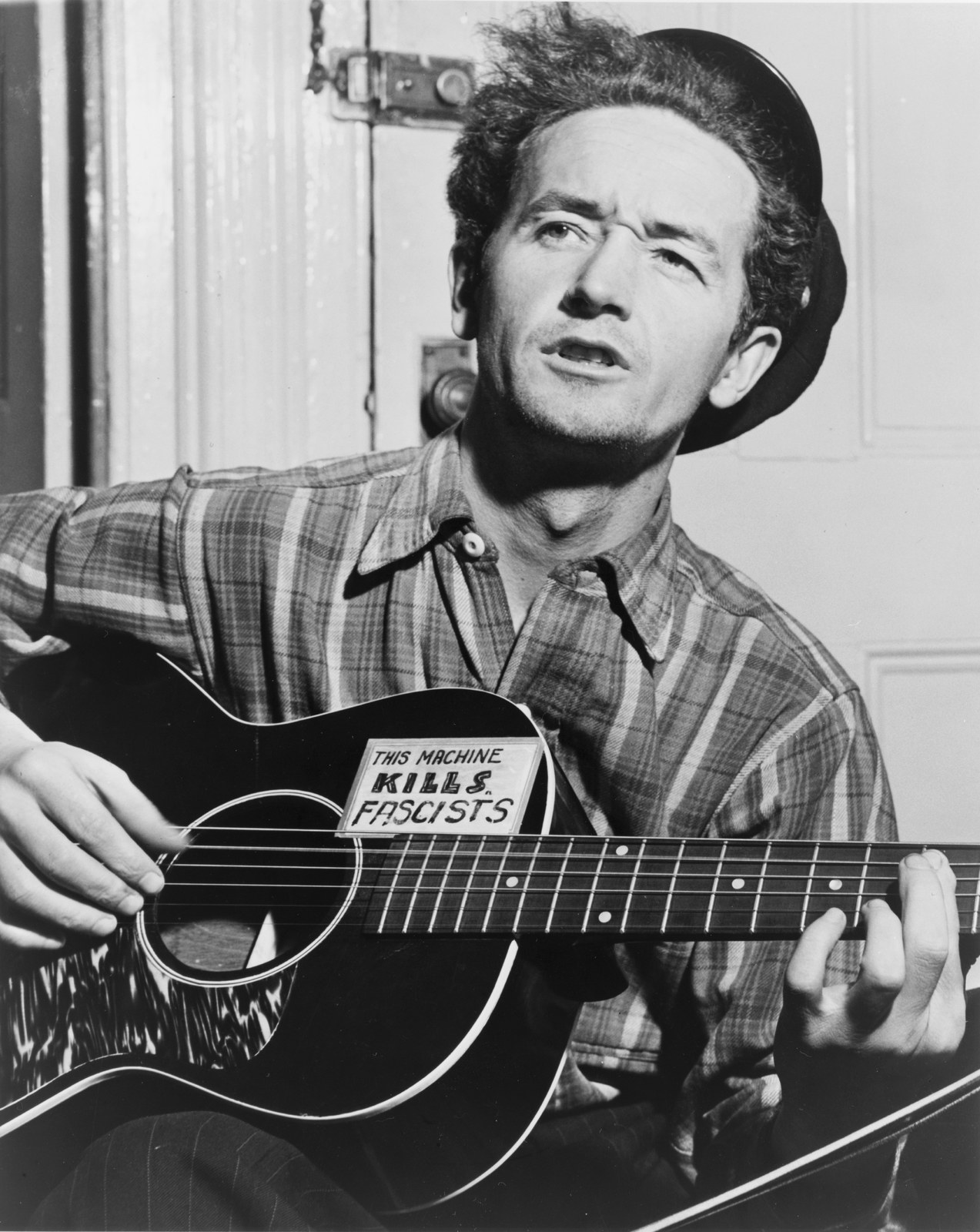
Photo: Al Aumuller / New York World-Telegram & Sun / Library of Congress / Public domain. Via Wikimedia Commons. Gibson
L-00
1931
Gibson’s plainest flat-top of the Depression. Famous names keep getting pinned on it. It never needed them.
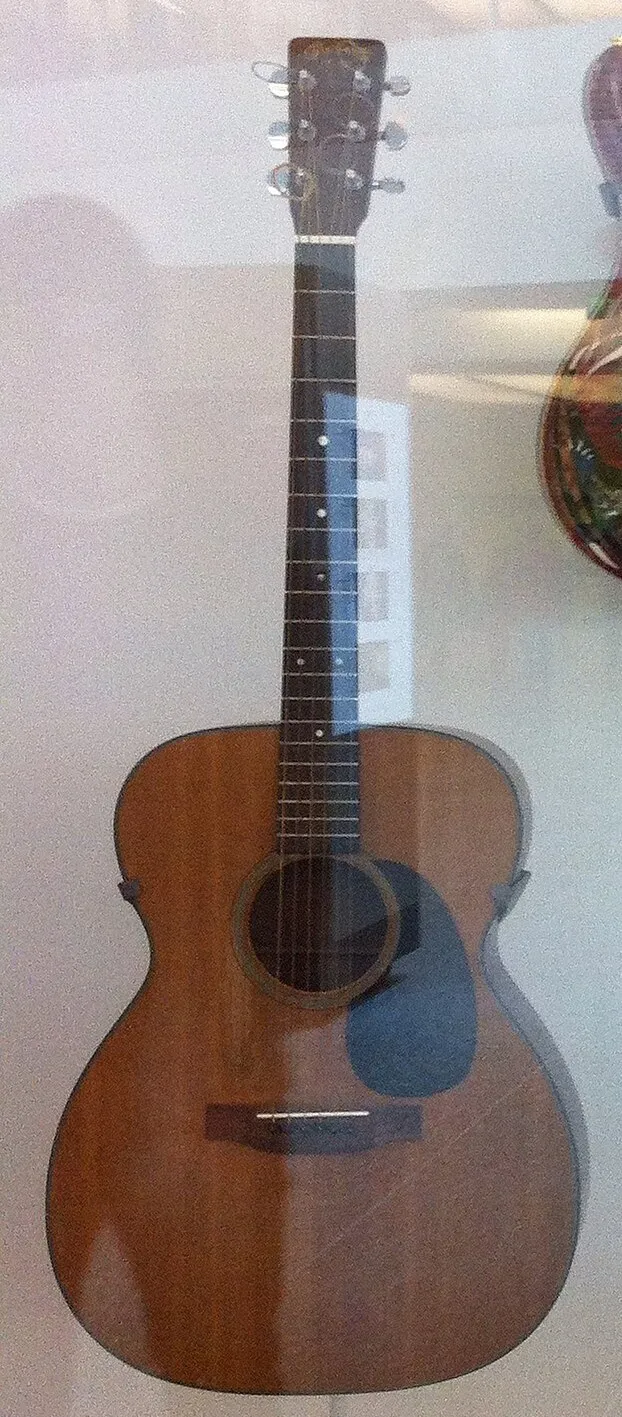
Photo: Tyfferz Y / Wikimedia Commons / CC BY 2.0 Martin
000-18
1934
Julian Lage’s 1939 000-18 had been in pieces. It showed up when his own left hand needed putting back together.