Guild
F-50
Guild built its fanciest jumbo around a shortcut from the archtop shop. Seventy years on, it still hasn’t let go.
New York, 1954. Guild is a young company that makes archtop guitars, and it’s about to make its first flat-tops. It already knows how to press laminated maple into an arched back, a cheaper stand-in for carving one. So the new jumbo gets one of those.
- Introduced
- 1954
- Type
- Acoustic flat-top (jumbo)
- Class
- Production
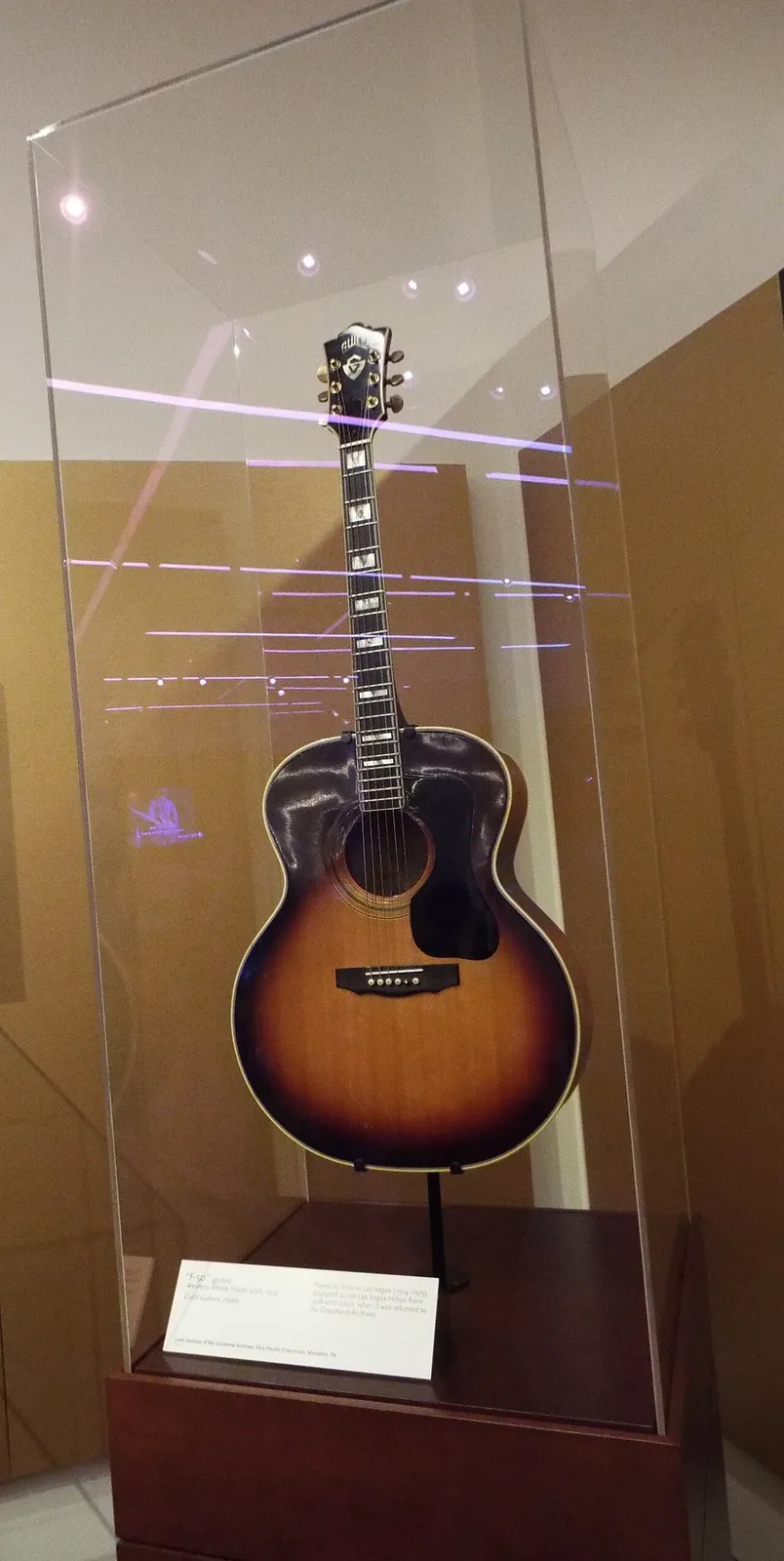
The short version
1954
Three flat-tops
The F-30, F-40, and F-50 arrive, all with the pressed, arched maple back.
1967
Westerly
A year after Avnet buys Guild, a new factory opens in Westerly, Rhode Island.
1968
Clapton on the cover
Guild’s catalog cover shows Eric Clapton with an F-50.
1987
A new name
The F-50 is recatalogued as the JF-65. Same guitar, new sticker.
1993
The loan
Steve Addabbo lends Jeff Buckley his 1967 F-50 for a session at Shelter Island Sound.
2009
New Hartford
Guild’s Connecticut plant starts up, with the D-55 and F-50 first.
2015
Goodbye, F-50
At NAMM, the maple jumbo becomes the F-55 Maple.
2016
You and I
The 1993 Buckley session, on the borrowed F-50, finally comes out.
Side A
A1
A shortcut from the archtop shop
Guild started out in New York in the early 1950s, Alfred Dronge’s company, making archtop jazz guitars. Carving a solid arched back is slow, skilled, expensive work. So from 1953, Guild pressed laminated maple into an arch instead. It looked the part and cost a lot less.
In 1954 Guild made its first flat-tops: the F-30, the F-40, and the F-50. All three got that pressed maple back. The F-50 was the big one, a jumbo, 17 inches across. A few came out of the original shop on Pearl Street in Manhattan before the work moved to Hoboken. (One list says 1953. The catalog people can fight about that.)
Here’s the clever bit. Because the back is arched, it doesn’t need braces. It holds its own shape. Most makers would call a pressed laminate back a compromise. Guild built its fanciest jumbo around it.
Keep an eye on that back. Nearly everything else about the F-50 is going to change.
A2
Not a Gibson with a different logo
The F-50 was doing the same job as Gibson’s Super Jumbo: a big, fancy maple jumbo for players who wanted to be heard. But it’s a different guitar. No moustache bridge, no flowers on the pickguard. Guild’s F-50 wears the Peak and Shield on its headstock and the pressed arch on its back.
A 1967 example from Hoboken shows the recipe at its best: a Sitka spruce top, flamed maple sides, that arched flamed maple back, ebony on the fingerboard and bridge, and mother-of-pearl blocks with little abalone triangles. To my ear, the maple makes it tight and clear, a jumbo that sits up front in a band.
Don’t confuse it with the F-50R. That’s the rosewood version, from 1965, with a solid back, and it lives on today as the F-55. The maple jumbo with the arch is the F-50.
A3
A photograph, not a session
In 1968, Guild put Eric Clapton on the cover of its catalog, holding an F-50. There’s also a rehearsal photo of him with one from a Dutch film about Cream that year, though in the film itself he’s playing his SG. So the F-50 has a Clapton photograph, not a Clapton record.
The company around the guitar was changing too. Avnet bought Guild in 1966, and in 1967 Guild opened a factory in Westerly, Rhode Island. Dronge died in 1972. Most of the vintage F-50s you’ll actually find came out of Hoboken or Westerly.
Flip the record · By the numbers
3
Flat-tops Guild launched in 1954. All three shared the pressed maple back.
17
Inches across the lower bout. A jumbo, not a dreadnought.
0
Braces on the back. The arch holds its own shape.
Side B
B1
Borrowed
My favorite F-50 story isn’t about an owner. It’s about a loan.
In February 1993, Jeff Buckley was recording at Shelter Island Sound, and Steve Addabbo lent him his own 1967 F-50. Those sessions sat on a shelf until 2016, when they came out as You and I, almost twenty years after Buckley’s death. When you hear it, you’re hearing somebody else’s guitar, in the hands of a man who never got to hear the record.
Buckley also played an F-50 on stage in Chicago in 1995, with tape over the soundhole. Nobody has confirmed it was Addabbo’s. And don’t go looking for the F-50 on Grace. Nobody’s put it there.
B2
Turn it over
After Dronge, the F-50 kept moving. In the late 1980s it was renamed the JF-65. Fender bought Guild in 1995. The Westerly plant closed in 2001, and production went to Corona, California, then Tacoma, then New Hartford, Connecticut, where the F-50 and D-55 were the first guitars built in early 2009. That plant closed in 2014, and Guild moved to Oxnard, California.
Every stop changed something. Older F-50s often have rosewood fingerboards and Kluson tuners; the last ones under the name had ebony and Grovers. New Hartford lightened the guitar, with Adirondack spruce braces, a slightly rounder top, and a three-piece mahogany-and-walnut neck. Even the scale length moves around depending on which spec sheet you read.
At the 2015 NAMM show, Guild retired the name. The maple jumbo is now the F-55 Maple. You can’t order an F-50 anymore.
But turn the new one over. There’s the arched, flamed maple back, pressed into shape on a press Guild dates to 1985. Sixty-odd years of new names, new owners, and new factories, and the one thing that never changed is the shortcut Guild took in 1954.
Put this on
You’ve read about it. Now hear it. Here’s what this guitar sounds like, and what to listen for.
You and I
Recorded in February 1993 on Steve Addabbo’s 1967 F-50, lent to Buckley for the session. It came out nearly twenty years after he died.
Find it on YouTube (opens in a new tab)Live in Chicago
Buckley plays an F-50 with tape over the soundhole. Whether it’s the same borrowed guitar isn’t confirmed.
Watch it on YouTube (opens in a new tab)
The cast
The people, and the specific guitars, that made the legend.
1954
Alfred Dronge
Founder
Started Guild in New York. He died in 1972, a few years after the move to Westerly.
1968
Eric Clapton
F-50
On the cover of Guild’s 1968 catalog. A photograph, not a Cream session.
1993
Steve Addabbo
His own 1967 F-50
Lent it to Jeff Buckley for the Shelter Island Sound session.
1993
Jeff Buckley
A borrowed 1967 F-50
Recorded the You and I sessions on it. Don’t hang Grace on this guitar.
John Denver
F-50
Listed among F-50 players, without a named guitar or record.
Liner notes
Specs, construction, rarity, value, and every source we used.
Maple jumbo, pressed arched back — Guild’s F-50, not a Gibson J-200 and not the rosewood D-55.
- Body
- Jumbo. Solid spruce top; arched laminated figured maple back; solid figured maple sides. Lower bout 17"; length 21"; depth 4.8" on the last named F-50 sheet. Blue Book vintage: 17" × 4.5". Mix flagged.
- Neck
- 3-piece mahogany/maple/mahogany on the last named sheet; dovetail. Twelfth Fret on a 1967 Hoboken: two flamed maple with a walnut center. Mix flagged.
- Fingerboard
- Ebony, 12" radius, mother-of-pearl and abalone blocks, 20 frets on the last named sheet. Blue Book vintage: bound rosewood, pearloid blocks. Mix flagged.
- Scale
- 25 5/8" (last named sheet). Blue Book / Carter 1973 / Music Zoo 1979: 25.5". Mix flagged.
- Pickups
- None on this table. New Hartford F-50E used D-TAR. F-55E Maple: LR Baggs Anthem. Not this slug.
- Hardware
- Gold Grover Rotomatics on the last named sheet; tortoiseshell pickguard; G-shield. Blue Book vintage: gold Kluson Deluxe, rosewood bridge. Mix flagged.
- Electronics
- None (F-50).
- Finish
- Gloss nitrocellulose; Natural or Sunburst typical. Black and other colors exist on later USA runs.
- Nut
- 1 11/16". Carter 1973: 1.69".
Open the full research fileConstruction details, the complete player record, production numbers, dated value estimates, and sources
Classic living example = Guild F-50 Navarre (Hoboken / Westerly maple jumbo). Table leans on the last named F-50 sheet (zZounds New Hartford-era copy, fetched 11 September 2026) plus Blue Book / Twelfth Fret splits. No current F-50 SKU. Oxnard F-55 Maple is the renamed maple heir, not this table. F-50R / current F-55 is rosewood. JF-65 is a late-1980s recatalog, not a second guitar. Inches from those sheets; F-55 Maple millimetres only in Construction — mix flagged; no extra millimetres invented.
Construction
Manhattan, 1954. The job was a jumbo that wasn’t Kalamazoo’s Super Jumbo: spruce top, maple, a pressed arched laminate back left over from the archtop shop. Not a dread. Not a concert. Not a Starfire.
Guild’s FAQ: first flattops were F-30, F-40, and F-50, sharing that pressed maple back. Dave Gonzalez, then Guild product manager, on the 2011 company video: introduced 1954 with the F-30 and F-40. Blue Book: mfg. 1954–1987. Hans Moust, via Let’s Talk Guild: originated 1954; a few from the Pearl Street, New York shop, then Hoboken. guitar-list prints 1953–1990, then 2003. Keep 1954. 1953 is a catalog fight, not an invention.
Not a Gibson J-200 (gibson-j-200). Super Jumbo: floral guard, moustache bridge, graduated crowns, 17" class, maple after the war. This is Guild’s F: Peak and Shield, a pressed arched back with no back braces, block or V-block work depending on year. Same job. Different factory. No Gibson SKU. Not the D-55 (guild-d-55). Square-shoulder rosewood dread, 1968, V-blocks. This is a jumbo. Not the M-20 (guild-m-20). All-mahogany concert, 24 3/4". Not a Starfire (guild-starfire). Hollow / semi-hollow electric from 1960. Same badge. Different object.
Not the F-50R. guitar-list: rosewood back and sides from 1965. Solid back, not the arched laminate. Current Guild copy: Oxnard F-55 is formerly F-50R. That rosewood jumbo does not live here. F-30 is the smaller F. F-40 is the 16" sibling. F-412 / F-512 are 12-strings. None of those slugs live here.
The tell is the back. Guild FAQ: archtops from 1953 used pressed laminate maple as a cheaper stand-in for a carved back; the 1954 flattops kept it. No back braces. Twelfth Fret on a 1967 Hoboken (AD-246): 17" across, Sitka, flame maple sides, arched laminated flame maple back, ebony board and bridge, bound Peak, mother-of-pearl blocks with abalone triangles.
Avnet bought Guild in 1966 (Music Museum of New England). Westerly opened 1967. Dronge died 3 May 1972 (Guitar.com). The original F-50 is a Pearl Street / Hoboken / Westerly guitar. Twelfth Fret closes a run 1954–1986, with a 1994–1995 reissue. Let’s Talk Guild: late-1980s George Gruhn recatalog, F-50 becomes JF-65, F-50R becomes JF-55. Guild’s serial chart still prints F50 into 1986 (FD prefix) and JF65M from 1987. Catalog moves. Not a second instrument.
Fender bought Guild in 1995 (Guitar.com; Vintage Guitar, Jay Pilzer, July 2010). Westerly closed 2001. Corona, Tacoma (2005), then New Hartford — Wikipedia: production early 2009, starting with the D-55 and F-50. Reverb’s USA F-50 page prints 2002–2014. Keep both. Pilzer: New Hartford lightened the line — Adirondack braces, laminated birch tail block, open-back tuners, 30-foot top radius (from 40-foot), three-piece mahogany with walnut, dual-action truss, real mother-of-pearl. Plant closed 2014. Cordoba opened Oxnard. NAMM 2015: F-55 & F-55 Maples (previously called F-50 & F-50R). Current Guild copy: F-55 is formerly F-50R. F-55 Maple is the arched-maple jumbo on the arch press Guild dates to 1985. Current footer: Yamaha Guitar Group, 2026.
You cannot order an F-50. The living maple jumbo is that Oxnard F-55 Maple: Sitka, arched flamed maple back, flamed maple sides, scalloped X, mahogany/walnut neck, ebony, gold Gotoh SE700, gloss nitro, 1 11/16" (43 mm) bone nut. Factory sheet: lower bout 17 1/4" (438 mm); length 20 1/2" (521 mm); lower depth 4 3/4" (119 mm); scale 25 5/8" (651 mm). Mix flagged. Same silhouette. Not the same name. Not a 1954 Navarre.
Classic vs current: Hoboken/Westerly — often rosewood board, Klusons, 17" / 4.5", 25.5" on Blue Book — against the last F-50 sheet at ebony, Grovers, 4.8", 25 5/8", and against F-55 Maple at factory millimetres and Gotoh. Same pressed arch. Not the same neck.
Players
Eric Clapton. The photograph is the fact. zZounds and Guild jumbo copy put him on the cover of the 1968 Guild catalog with an F-50. Ground Guitar: Cream Dutch film It was a Saturday Night (1968), Jan Persson rehearsal still; the film’s video shows the SG. Catalog cover, not a Cream session log.
Jeff Buckley. Wikipedia files a 1967 Guild F-50 among his guitars. Ground Guitar, citing Guitar World June 2016: Steve Addabbo lent his own 1967 F-50 in 1993 at Shelter Island Sound, the February sessions later issued as You and I (2016). Ground Guitar: Live in Chicago (1995), tape over the soundhole. Whether the live guitar is Addabbo’s loan is not confirmed on that page. Do not flatten Grace tracking onto this object. The Gibson L-1 is the fingerstyle guitar. Not this slug.
Do not steal Starfire players. Do not hang an M-20, D-55, D-40, or F-512 on this plate because the badge is Guild. Nick Drake is the M-20 cover. Richie Havens is a D-40. Tom Petty is jumbo 12-string / D-25-12 territory. Slash is a D-100 in 1990s ads, not this six-string jumbo. Elvis is a J-200 story (gibson-j-200). Do not flatten a Super Jumbo onto a Guild.
Also known to play stays short. Wikipedia lists John Denver among F-50 users (Equipboard). Equipboard files Jonny Buckland and Chris Martin on a clip of “Lovers in Japan.” YouTube plus a gear wiki. Not a named serial.
Rarity
You cannot buy a new F-50 from Guild. The name left the catalog. Current USA maple jumbo is F-55 Maple. It is not a 1954 Navarre. Westerly Collection F-250E and GAD F-150 are other factories on a jumbo silhouette. They are not this guitar.
Guild does not publish F-50 unit totals. None invented. Serials date a guitar. They don’t count a year. That is why a first-year census is unknown, not the chapter. Guild’s own 1965–69 chart prints AD-prefix ranges for F-50 (AD101–119 in 1965 through AD356–418 in 1969). Dating table. Not a factory ledger. Records before 1960 are, in Guild’s words, “at best sketchy.”
Vintage maple F-50s were the fancy jumbo, not the cheap concert. Hoboken and Westerly are what you actually find. Corona after Westerly closed 2001 (Pilzer; Wikipedia) is the used-market discount era. New Hartford 2009–2014 is last F-50 under that name, not the 1954 object. JF-65 is a recatalog. F-50R is rosewood. Clapton’s catalog guitar and Buckley’s 1967 are unique objects. They are not a vintage F-50.
Value
Informal estimate, 11 September 2026. Not an appraisal.
Ask vs sold labeled. Celebrity lots are not-comps. No invented medians or factory counts.
New street. None under F-50 this pass. zZounds F-50 page: no longer available (fetched 11 September 2026). The living cart is the renamed jumbo line: Guild shop F-55 Series $4,199.99–$4,699.99. Guitar Center F-55 Natural $4,199.99; F-55E Maple Natural $4,599.99; F-55E Maple Antique Burst $4,699.99. Sweetwater F-55E Maple Natural $4,599.99. Those are F-55 / F-55 Maple carts, not an F-50. Historical, not 2026: Vintage Guitar February 2011 F-50 Standard $2,799 retail / $2,099.99 street.
Used modern. Reverb Price Guide widget on Guild USA F-50 (years 2002–2014) did not print a clean USD band this pass. Named solds on that tape: 17 October 2025 Excellent $2,350; 8 June 2025 Excellent $2,375; 15 January 2025 Very Good $3,200; 19 December 2024 Excellent $3,500; 24 November 2024 Very Good $2,100; 29 July 2024 Very Good $2,519.10. Named asks this pass: 2014 New Hartford Very Good $2,245; 2009 Good $3,699. Do not average those.
Vintage / collectible. Reverb Price Guide exists on F-50 1974–1986; the dollar widget did not print a band this pass. Flag: thin sold-comp access. Named asks, not hammers: Music Zoo 1979 Very Good $3,399; guitar-list 1974 Natural Very Good $3,300; 1976 Blonde Very Good $3,850; 1982 Blonde Excellent $3,000; 1963 Cherry Sunburst Good $9,195. Do not average those asks. Do not price these as J-200s. Clapton’s catalog guitar and Buckley’s 1967 are celebrity objects, not a street tape.
See also
- gibson-j-200 — Super Jumbo maple; moustache and crowns, not Guild’s pressed-arch F
- guild-d-55 — rosewood square-shoulder dread; not this jumbo
- guild-starfire — 1960 Hoboken hollow / semi-hollow electric; not this acoustic
Sources
- Guild, FAQ: arched back / 1954 flattops — F-30 / F-40 / F-50 1954; pressed laminate maple back from 1953 archtops; Oxnard USA
- Guild, F-55E Maple Natural — arched flamed maple; 1985 arch press; mixed inch/mm jumbo table; Gotoh SE700; 17 1/4" / 25 5/8" / 1 11/16"
- Guild, F-55 Natural — F-55 formerly F-50R; rosewood jumbo, not this maple slug
- Guild shop, F-55 Series — $4,199.99–$4,699.99; F-55 formerly F-50R; F-55 Maple arched flame
- Guild at NAMM 2015 — 29 January 2015; F-55 & F-55 Maples previously F-50 & F-50R
- Guild, History of My Guild — pre-1960 records sketchy; F50 AD101–418 (1965–69); FD prefix into 1986; JF65M from 1987
- YouTube, Guild F-50, Dave Gonzalez — 23 February 2011; introduced 1954 with F-30 and F-40; jumbo; arched laminated maple back
- zZounds, Guild F-50 Jumbo — 1954 intro; 1968 Clapton catalog cover; 17" / 21" / 4.8" / 25 5/8" / 1 11/16"; arched laminated maple back; solid maple sides; discontinued this pass
- Blue Book, Guild F-50 Navarre / JF-65M — mfg. 1954–1987; 17" / 4.5" / 25.5"; curly maple; Kluson Deluxe
- Vintage Guitar, Jay Pilzer, Guild in the Post-Fender Era — July 2010; Fender 1995; Westerly 2001 / Corona / Tacoma 2005 / New Hartford; nut 1 11/16" vs older 1 5/8"; NH weight and brace changes; F-50 among models surveyed
- Vintage Guitar, Sean OBryan Smith, Guild Standard Series — February 2011; F-50 Standard $2,799 retail / $2,099.99 street
- Wikipedia, Guild Guitar Company — New Hartford early 2009 starting with D-55 and F-50; Fender 1995; factory moves; John Denver listed among F-50 users
- Wikipedia, Jeff Buckley — 1967 Guild F-50 among his guitars
- Ground Guitar, Jeff Buckley’s 1967 Guild F-50 — Guitar World June 2016 Addabbo loan; Shelter Island 1993 / You and I; Live in Chicago 1995 tape on the soundhole; Grace tracking not confirmed
- Ground Guitar, Eric Clapton’s Guild F-50 — Cream Dutch film 1968; Jan Persson rehearsal still; film video shows the SG
- Let’s Talk Guild, Guild jumbos — Moust p. 115: F-50 1954, Pearl Street then Hoboken; F-50 always arched laminated maple back; F-50R solid rosewood; JF-65 / JF-55 Gruhn recatalog
- Twelfth Fret, 1967 Guild Navarre F-50 — AD-246 Hoboken; 1954–1986, reissued 1994–1995; 17"; arched laminated flame maple back
- guitar-list, Guild F-50 Navarre — 1953–1990, 2003; F-50R 1965; named asks
- guitar-list, Guild F-50R — rosewood sibling; 1974 list $790 + case $110 (historical)
- Reverb, Guild USA F-50 — years 2002–2014; named 2024–25 solds; asks $2,245 / $3,699; Price Guide widget no clean USD band this pass
- Reverb, Guild F-50 1974–1986 — Music Zoo 1979 ask $3,399; Price Guide widget no clean USD band this pass
- Carter Vintage, 1973 Guild F-50 — 25.5" / 1.69"; maple/ebony; neck reset, refret, pickup removed
- Guitar Center, F-55E Maple Antique Burst — $4,699.99; first Oxnard maple back-and-sides; 1985 arch press
- Guitar Center, F-55 Jumbo Natural — $4,199.99; formerly F-50R
- Sweetwater, F-55E Maple Natural — $4,599.99
- Guitar.com, A Brief History of Guild — Dronge 3 May 1972; Fender 1995; Oxnard 2015
- Music Museum of New England, Guild — Avnet 1966; Westerly 1967
Keep digging
Guitars this one gets compared to, confused with, or descended from.
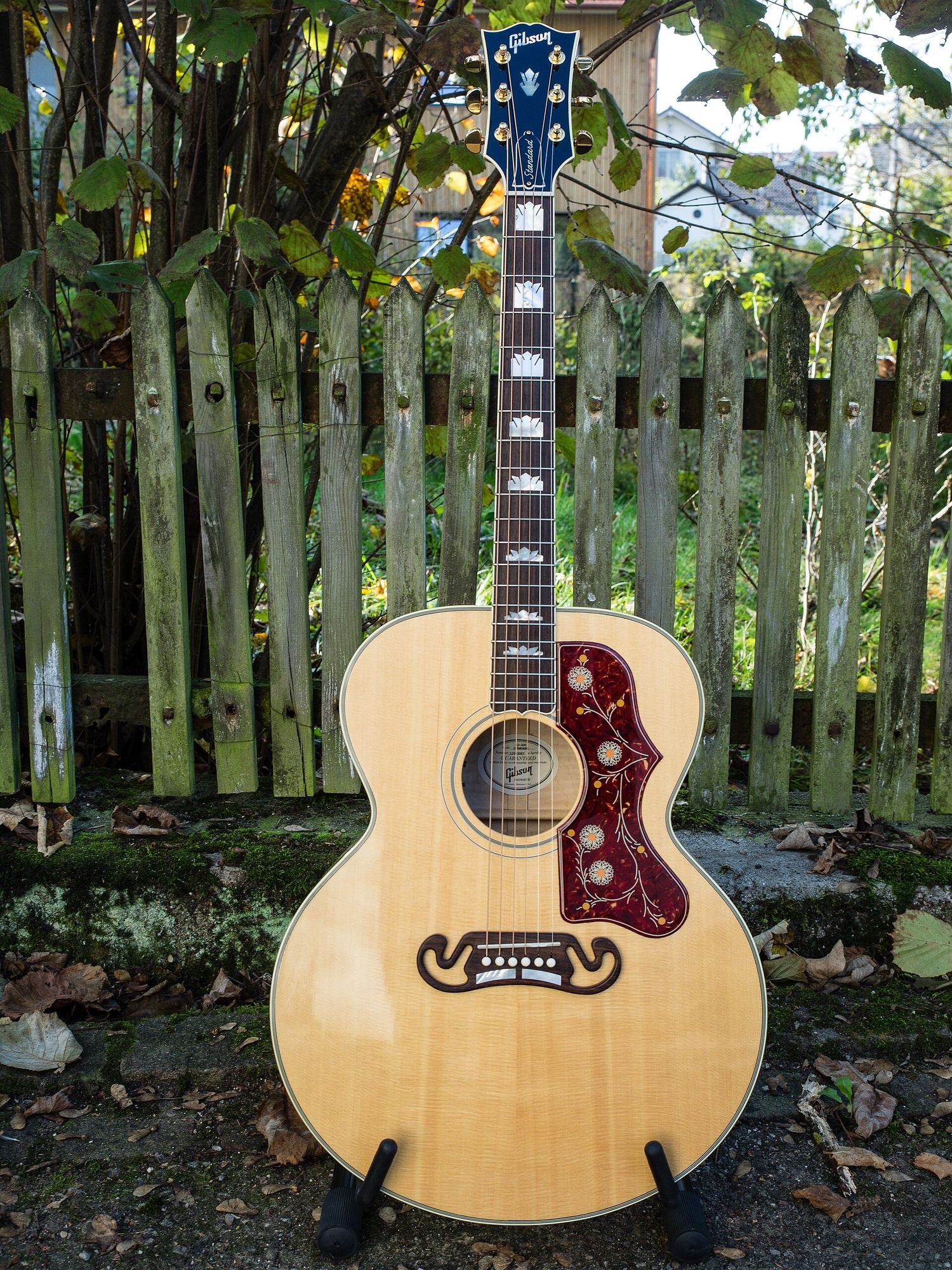
Gibson SJ-200 Standard Acoustic Guitar, Super Jumbo, Antique Natural Finish. Photo by Gibb Stutz. Licensed under CC BY 3.0. Via Wikimedia Commons. Gibson
J-200
1937
Gibson built the first one for a singing cowboy. It has been making people look like stars ever since.
- Send a picture
Guild
D-55
1968
Guild’s D-55 got its name from television. It kept its place as the guitar people play with the cameras off.
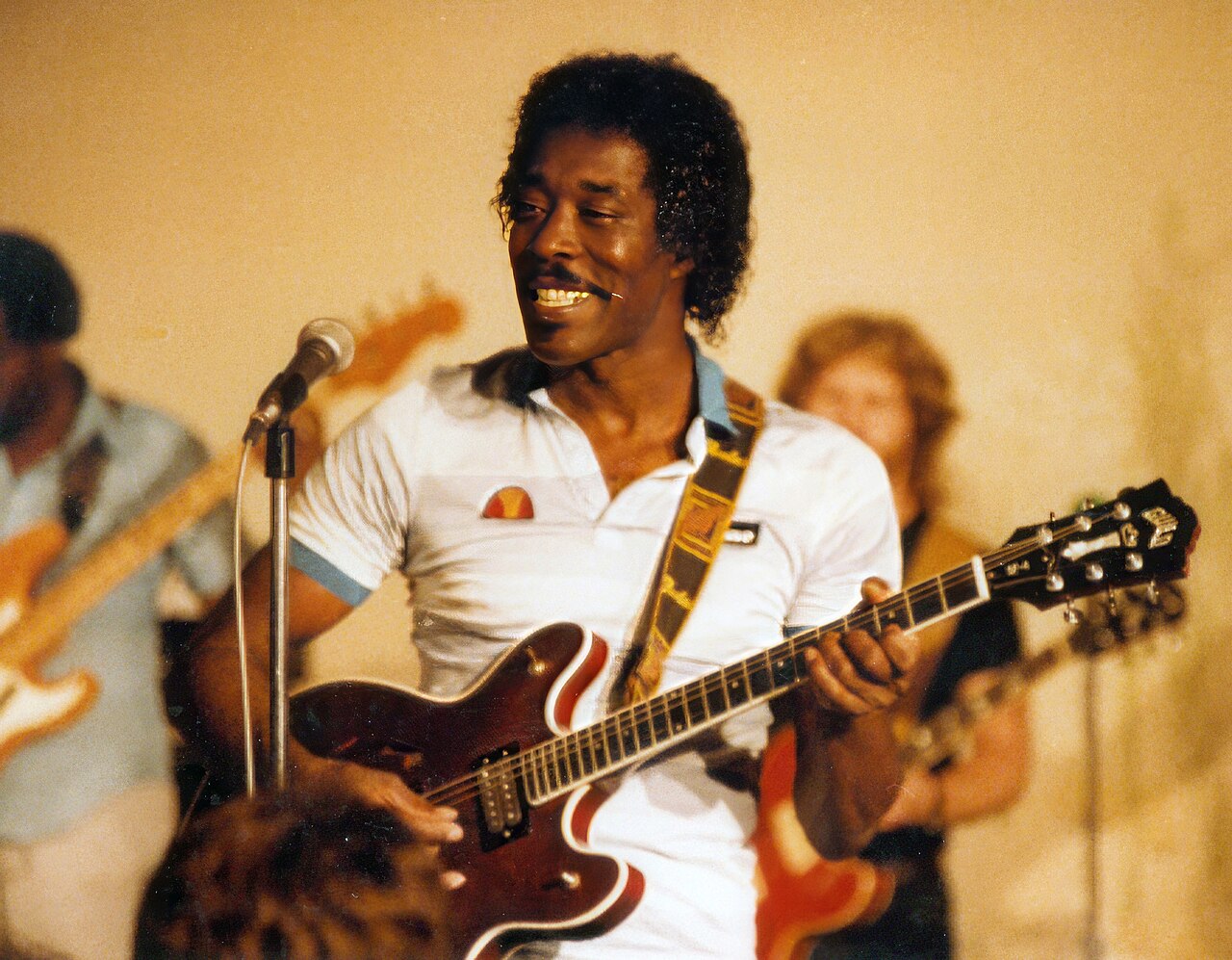
Photo: Bubba73 / Wikimedia Commons / CC BY-SA 3.0 Guild
Starfire
1960
Before they were the Grateful Dead, they were the Warlocks, and Jerry Garcia was playing a Guild Starfire.